black owned whiskey brands are whiskey labels founded, led, or co-owned by Black entrepreneurs, distillers, blenders, and families reshaping a category long dominated by legacy companies.
They span bourbon, rye, Tennessee whiskey, flavored whiskey, and independent bottlings, with founders building distribution, sourcing barrels, and creating house styles.
This guide focuses on verified brand ownership, what each whiskey tastes like, where it is made or sourced, and how to buy it in the United States.
Expect practical context: flagship bottles, proof, mash bills when disclosed, awards, availability, and why each brand matters in American whiskey.
What Black Owned Whiskey Means
Black owned whiskey refers to spirits brands where Black founders, distillers, or entrepreneurs hold majority ownership and direct business operations.
This designation carries historical weight given that enslaved Black Americans built the foundations of American whiskey production yet were systematically excluded from ownership for centuries.
Nathan “Nearest” Green, an enslaved man in Tennessee, taught Jack Daniel the art of charcoal-mellowing whiskey in the 1850s. His contribution went unacknowledged for over 150 years until Brown-Forman formally recognized him in 2016.
Historical Context
After Prohibition ended in 1933, federal licensing requirements and discriminatory lending practices shut Black entrepreneurs out of distillery ownership.
The TTB (Alcohol and Tobacco Tax and Trade Bureau) licensing process demanded capital most Black applicants could not access.
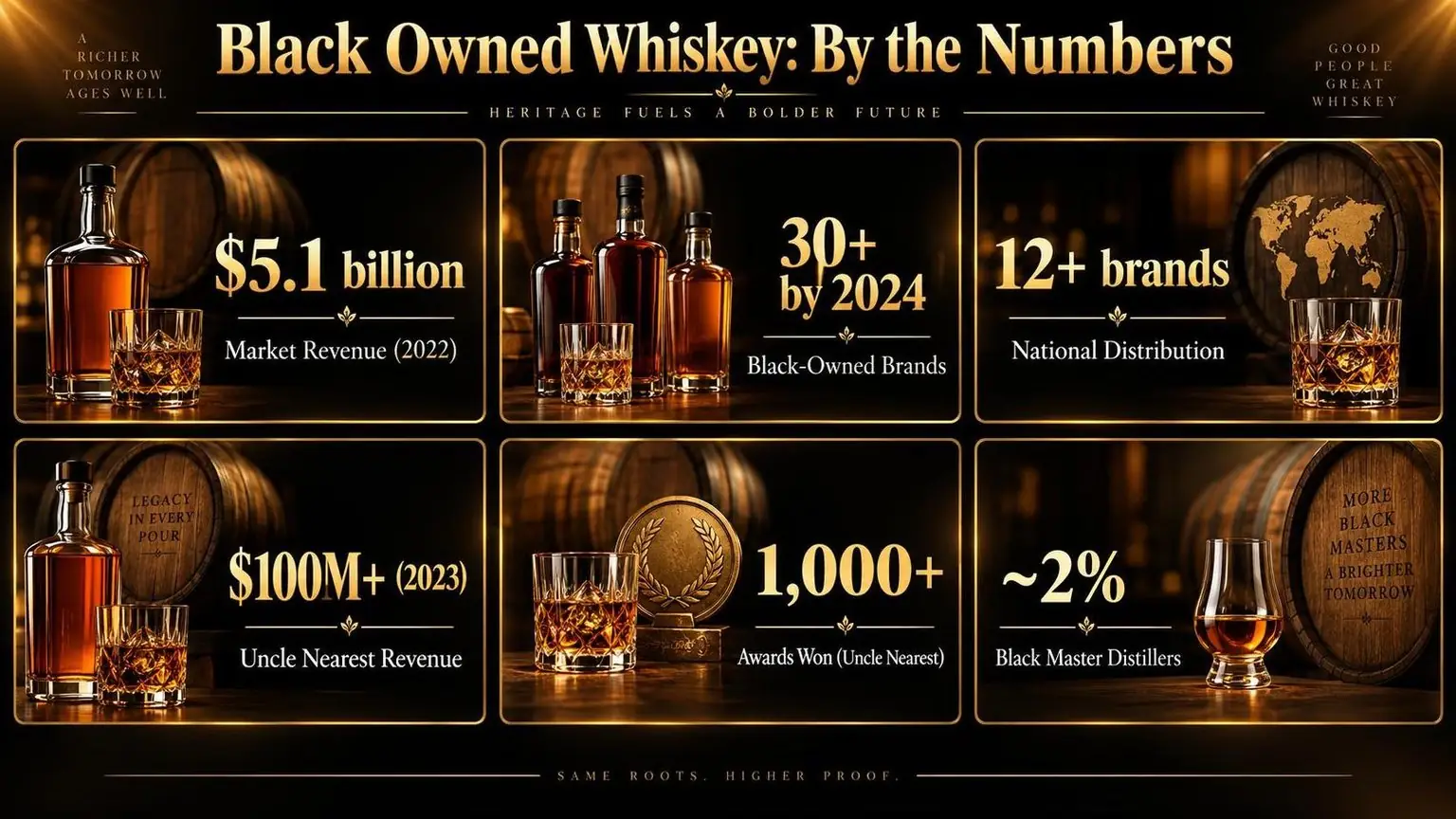
As recently as 2013, there were fewer than five Black-owned whiskey brands operating nationally in the United States. By 2024, that number had grown to more than 30 distinct brands across bourbon, rye, and Tennessee whiskey categories.
What Qualifies as Black Owned
- Majority ownership (51%+) held by one or more Black founders — the standard used by the National Minority Supplier Development Council (NMSDC)
- Operational control over brand direction, sourcing, blending decisions, and distribution strategy
- Independent or contract-distilled — many Black-owned brands use established distilleries (a common industry practice called NDPs, or non-distiller producers) while others operate their own facilities
Economic Significance
The American whiskey market generated $5.1 billion in supplier revenues in 2022, according to the Distilled Spirits Council of the United States (DISCUS). Black-owned brands capture a small but rapidly expanding share of that market.
| Metric | 2017 | 2023 |
| Estimated Black-owned whiskey brands (US) | ~10 | 30+ |
| Black-owned brands with national retail distribution | 2 | 12+ |
| Black representation among master distillers (US) | <1% | ~2% |
Supporting these brands directs revenue into Black communities and corrects a historical imbalance.
Each purchase shifts market data, influences retailer shelf allocation, and signals demand to distributors — the three gatekeepers of spirits industry growth.
The distinction matters beyond symbolism. Ownership determines who profits from a $5.1 billion industry that Black labor helped create.
Notable Black Owned Whiskey Brands
Black entrepreneurs have built whiskey brands that compete at the highest levels of the spirits industry.
Several have earned international awards, secured major retail distribution, and reshaped an industry where Black ownership was historically rare.
Uncle Nearest Premium Whiskey
Founded in 2017 by Fawn Weaver, Uncle Nearest honors Nathan “Nearest” Green, the enslaved man who taught Jack Daniel to distill. The brand became the fastest-growing American whiskey in U.S. history.
Uncle Nearest generated over $100 million in revenue by 2023. The company operates a 323-acre distillery in Shelbyville, Tennessee — the nearest-to-Jack-Daniel’s-original-distillery site.
Its 1856 Premium Aged Whiskey has won over 1,000 awards.
Brough Brothers Distillery
Victor, Bryson, and Christian Yarbrough opened Brough Brothers in Louisville, Kentucky, in 2020. It holds the distinction of being Kentucky’s first African American-owned distillery.
Du Nord Craft Spirits
Chris Montana founded Du Nord in Minneapolis in 2014. It produces Mixed Blood Blended Whiskey and became one of the first Black-owned craft distilleries in the United States.
Other Prominent Brands
| Brand | Founder(s) | Year Founded | Notable Detail |
| Whiskey Culture | Trey Johnson | 2021 | Small-batch bourbon sourced from Kentucky |
| Fresh Bourbon | Sean & Tia Edwards | 2022 | Kentucky Straight Bourbon, Lexington-based |
| Rhetoric Whiskey | Demond Martin | 2023 | Premium sourced bourbon, Atlanta-based founder |
| Ten To One Rum & Whiskey | Marc Farrell | 2019 | Caribbean-rooted, expanded into dark spirits |
Industry Impact
Black Americans represent approximately 12% of whiskey consumers in the U.S. yet have historically owned fewer than 1% of distillery operations. The recent wave of founders is changing that ratio measurably.
- Uncle Nearest employs over 200 people and has a valuation reportedly exceeding $500 million.
- The Nearest Green Foundation has provided business grants to aspiring Black distillers since 2020.
- Black Bourbon Society, founded in 2016 by Samara Rivers, built a 20,000+ member community advocating for representation in brown spirits.
These brands prove that ownership, not just consumption, defines influence in the American whiskey landscape.
Founders Changing American Whiskey
Black entrepreneurs have shaped American whiskey since its earliest days, yet widespread recognition came only in the last decade.
A growing roster of Black-owned brands now commands shelf space in major retailers and earns critical acclaim at international spirits competitions.
Pioneering Brands and Their Founders
Uncle Nearest Premium Whiskey, founded by Fawn Weaver in 2017, honors Nathan “Nearest” Green—the enslaved man who taught Jack Daniel to distill.
The brand sold over 1.5 million bottles by 2023 and became the fastest-growing American whiskey brand in U.S. history.
Uncle Nearest’s Shelbyville, Tennessee distillery spans 323 acres, making it the largest Black-owned distillery in the United States.
The 1856 Premium Aged Whiskey expression earned Double Gold at the San Francisco World Spirits Competition multiple years running.
Brough Brothers Distillery, opened in Louisville, Kentucky in 2020 by brothers Victor, Bryson, and Christian Yarbrough, holds the distinction of being Kentucky’s first African American-owned distillery.
Du Nord Craft Spirits, founded by Chris Montana in Minneapolis in 2013, produces Du Nord Mixed Blood Whiskey. The distillery pivoted during COVID-19 to produce hand sanitizer for underserved communities, earning national media attention.
| Brand | Founder(s) | Year Founded | Location |
| Uncle Nearest | Fawn Weaver | 2017 | Shelbyville, TN |
| Brough Brothers | Yarbrough Brothers | 2020 | Louisville, KY |
| Du Nord Craft Spirits | Chris Montana | 2013 | Minneapolis, MN |
| Fresh Bourbon | Sean & Tia Edwards | 2022 | Lexington, KY |
| Wolcott Kentucky Bourbon | Eboni Major | 2021 | Kentucky |
Industry Impact by the Numbers
Fawn Weaver’s Uncle Nearest raised $78.1 million in funding by mid-2023, reaching a reported valuation exceeding $500 million. That capital infusion ranks among the largest ever for an independent American whiskey company.
- Uncle Nearest distributes in all 50 U.S. states and over 30 international markets
- The Nearest Green Foundation has awarded over $1 million in scholarships to descendants of Nathan Green
- Brough Brothers produces bourbon, vodka, and rum on a 2,500-square-foot production floor
- Fresh Bourbon debuted at the Kentucky Bourbon Festival in 2022, selling out its initial allocation within weeks
These founders are not filling a niche—they are reshaping the $11 billion American whiskey market from production through distribution, proving that diversity drives both innovation and commercial success.
Bourbon Rye and Tennessee Options
Black-owned distillers and brand owners have carved significant space across American whiskey’s core categories.
Their portfolios span straight bourbon, rye, and Tennessee whiskey — each meeting the same federal standards of identity that govern every bottle on the shelf.
Notable Bourbon Brands
Uncle Nearest 1856 Premium Aged Whiskey honors Nathan “Nearest” Green, the enslaved man who taught Jack Daniel to distill.
Founded by Fawn Weaver in 2017, the brand sold over 1.5 million bottles by 2022 and operates a 323-acre distillery in Shelbyville, Tennessee.
Brough Brothers became Kentucky’s first African American-owned distillery when it opened in Louisville in 2020. Their bourbon uses a traditional corn-heavy mash bill and retails around $35.
Fresh Bourbon, created by Tia Edwards in Lexington, Kentucky, launched in 2022. It’s a straight bourbon with a mash bill of 70% corn, 21% rye, and 9% malted barley, bottled at 90 proof.
Rye and Tennessee Whiskey Entries
Pursuit United Rye is a blended rye from pursuit spirits co-founded by Kenny Coleman. The brand sources barrels from multiple distilleries to create a unified flavor profile, typically bottled at 90 proof or higher.
Du Nord Mixed Blood Blended Whiskey comes from Du Nord Craft Spirits in Minneapolis, founded by Chris Montana in 2014. It blends bourbon and rye components at 80 proof.
| Brand | Category | Proof | Approx. Retail |
| Uncle Nearest 1856 | Tennessee Whiskey | 100 | $50–$60 |
| Brough Brothers Bourbon | Kentucky Straight Bourbon | 90 | $30–$40 |
| Fresh Bourbon | Kentucky Straight Bourbon | 90 | $35–$45 |
| Du Nord Mixed Blood | Blended Whiskey | 80 | $25–$35 |
What Distinguishes These Brands
- Distiller-owned vs. brand-owned: Brough Brothers and Uncle Nearest operate their own distilleries; others source and blend, a legitimate and common industry practice.
- Mash bill transparency: Fresh Bourbon and Brough Brothers publish full grain recipes, giving consumers clear information for comparison.
- Price accessibility: Most bottles fall between $25 and $60, positioning them competitively against mainstream labels from major conglomerates.
Federal law requires bourbon to contain at least 51% corn, rye whiskey at least 51% rye, and Tennessee whiskey to use the Lincoln County charcoal filtering process. Every brand listed meets these legal thresholds for its stated category.
How To Verify Brand Ownership
Verifying actual ownership versus celebrity endorsement or minority partnerships requires checking specific public records.
The TTB (Alcohol and Tobacco Tax and Trade Bureau) maintains federal permit databases that reveal the actual permit holder behind every spirits label.
Key Verification Methods
The TTB’s public COLA (Certificate of Label Approval) database at TTBOnline.gov lists the permit holder for every approved label sold in the United States. Search by brand name to identify the actual entity behind the bottle.
State secretary of state business registries reveal corporate officers, registered agents, and ownership structures. Cross-reference TTB permit holders with these filings to confirm Black ownership stakes.
| Resource | What It Reveals | Cost |
| TTB COLA Database | Permit holder, label approval, DSP number | Free |
| State Business Registry | Corporate officers, LLC members, registered agent | Free–$10 |
| USPTO Trademark Search | Trademark owner, filing entity, assignment history | Free |
| SEC EDGAR Filings | Ownership stakes in publicly traded parent companies | Free |
| Kentucky DSP Registry | Distilled Spirits Permit holder and physical distillery location | Free |
Ownership vs. Endorsement vs. Partnership
These three structures differ significantly in who controls the brand and profits from its success. Misidentifying an endorsement deal as ownership misleads consumers seeking to support Black-owned businesses.
- Majority ownership (51%+): The founder or founding group holds controlling interest and makes operational decisions. Examples include Uncle Nearest (founded by Fawn Weaver, who holds majority ownership) and Du Nord Spirits.
- Equity partnership: A celebrity or entrepreneur holds a minority stake—often 10–30%—alongside a larger corporate partner. Profits and decision-making are shared proportionally.
- Endorsement or licensing deal: The individual lends their name and likeness but holds no equity. The brand is owned entirely by the producing company.
Red Flags To Watch For
Vague language like “crafted in partnership with” or “inspired by” often signals endorsement deals rather than ownership. Look for explicit statements naming founders as majority owners or controlling members.
If a brand’s TTB permit holder is a large conglomerate—such as Diageo, Sazerac, or Beam Suntory—the named personality likely holds a licensing arrangement or minority stake rather than full ownership.
Verify the DSP (Distilled Spirits Plant) number to trace production origins.
Organizations like the Black Bourbon Society and Obsidian Wine & Spirits Group maintain curated directories of verified Black-owned spirits brands, offering a practical shortcut alongside public record searches.
Where To Buy These Whiskeys
Distribution networks for Black-owned whiskey brands have expanded significantly since 2020, though availability still varies by state.
Major retailers, online platforms, and direct-from-distillery options each offer distinct advantages for sourcing these bottles.
National Retail Chains
Total Wine & More carries the widest selection among brick-and-mortar retailers, stocking brands like Uncle Nearest, Brough Brothers, and Du Nord in most of its 270+ locations across 28 states.
| Retailer | Approximate Locations | Notable Black-Owned Brands Carried |
| Total Wine & More | 270+ | Uncle Nearest, Brough Brothers, Du Nord |
| BevMo! | 160+ | Uncle Nearest, Equiano |
| ABC Fine Wine & Spirits | 175+ | Uncle Nearest, Pursuit United |
| Kroger (wine & spirits locations) | Varies by state | Uncle Nearest, fresh Vine Wine |
Uncle Nearest 1856 Premium Aged Whiskey has the broadest retail footprint among Black-owned brands, available in all 50 states and over 15 countries as of 2024.
Online Retailers
Online purchasing circumvents local distribution gaps. Shipping legality depends on state alcohol laws — currently around 46 states permit some form of direct-to-consumer spirits shipping.
- Drizly — partners with local retailers for same-day delivery in 1,400+ cities; stocks Uncle Nearest, Brough Brothers, and Meetinghouse
- ReserveBar — ships to 40+ states; carries Uncle Nearest, Pursuit United, and limited-edition releases
- Caskers — curated selection with shipping to most states; periodically features Black-owned brands in spotlight collections
- Seelbachs — bourbon-focused retailer stocking harder-to-find bottles from smaller Black-owned producers
Direct From Distillery
Visiting the source often unlocks exclusive bottles and barrel picks unavailable at retail. Uncle Nearest’s Nearest Green Distillery in Shelbyville, Tennessee spans 323 acres and welcomes over 100,000 visitors annually.
Brough Brothers Distillery in Louisville, Kentucky — the first African American-owned distillery in the state — offers tastings and bottle purchases on-site at 1460 Dixie Highway.
Supporting Black-Owned Through Curated Platforms
Platforms like Black Bourbon Society maintain updated directories of Black-owned spirits brands with purchase links. The organization, founded in 2016, connects consumers directly with producers and hosts tasting events in over 10 cities annually.
Specialty retailers increasingly dedicate shelf space to diverse-owned spirits.
Stores participating in initiatives like “Diversify Your Shelf” often tag Black-owned products with identifying markers, making in-store discovery straightforward.
Common Questions
How many Black-owned whiskey brands currently operate in the United States?
As of 2024, there are over 30 Black-owned whiskey brands operating in the U.S., a number that has more than tripled since 2019.
Notable examples include Uncle Nearest Premium Whiskey, Brough Brothers Bourbon, Fresh Bourbon, and Du Nord Craft Spirits, spanning categories from Tennessee whiskey to rye and bourbon.
What is Uncle Nearest and why is it considered a landmark Black-owned whiskey brand?
Uncle Nearest Premium Whiskey, founded by Fawn Weaver in 2017, honors Nathan “Nearest” Green, the enslaved man who taught Jack Daniel how to distill whiskey in the 1850s.
The brand became the fastest-growing American whiskey in U.S. history and the best-selling African American-founded spirit brand, surpassing $100 million in revenue by 2023.
Its Nearest Green Distillery in Shelbyville, Tennessee, is the largest Black-owned distillery in the United States.
Who were Brough Brothers and what makes their bourbon historically significant?
Brough Brothers Bourbon, founded in 2020 by brothers Victor, Bryson, and Christian Yarbrough, became the first African American-owned bourbon brand in Kentucky — the state responsible for producing 95% of the world’s bourbon supply.
Their bourbon is distilled and bottled in Louisville, reinforcing their roots in the heart of bourbon country.
Do Black-owned whiskey brands distill their own products or source from other distilleries?
Both models exist across the category.
Brands like Uncle Nearest operate their own large-scale distilleries, while others such as Pursuit United and Courage & Stone initially sourced aged whiskey from established distilleries and blended or finished it to their own specifications.
Sourcing is standard practice across the whiskey industry and does not diminish quality — many award-winning labels, regardless of ownership, use sourced stock, especially during startup years when aging inventory is unavailable.
What awards or critical recognition have Black-owned whiskey brands received?
Uncle Nearest 1856 Premium Aged Whiskey has earned over 1,000 awards since its launch, including multiple Double Gold medals at the San Francisco World Spirits Competition.
Fresh Bourbon, founded by Sean and Tia Edwards in Lexington, Kentucky, won gold at the 2022 SIP Awards. These accolades demonstrate that Black-owned whiskey brands compete at the highest levels of craft and commercial quality.
How can consumers specifically support Black-owned whiskey brands when purchasing?
Consumers can use curated directories such as the Black Bourbon Society’s brand listings and the Uncle Nearest “Behind the Bottle” initiative to identify verified Black-owned labels.
Many retailers including Total Wine, Drizly, and ReserveBar now feature diversity-focused collections that highlight Black-owned spirits.
Purchasing directly from brand websites or visiting their distillery tasting rooms — such as the Nearest Green Distillery in Shelbyville, Tennessee, or Du Nord’s cocktail room in Minneapolis — returns the highest margin to the founders.
Related Reading
- What Does Jameson Taste Like? Professional Answer
- What To Mix With Baileys?
- What Does A Whiskey Decanter Do?
- Is Jagermeister A Whiskey Or Not? Answer By Expert
- What To Mix With Disaronno?
- All Alcohol Guides
- Alcohol and Tobacco Tax and Trade Bureau (2024)
- U.S. Small Business Administration – Minority Business Resources (2024)
- U.S. Census Bureau – Annual Business Survey on Minority-Owned Enterprises (2023)
- Cornell University SC Johnson College – Minority Entrepreneurship Research (2023)
- Forbes – Black-Owned Spirits Brands (2023)
- Black Enterprise – Black-Owned Whiskey & Spirits (2023)
- Whisky Advocate – Diversity in American Whiskey (2023)
- The Spirits Business – Black-Owned Brands Reshaping the Industry (2023)
- Wine Enthusiast – Black-Owned Spirits Companies (2023)
- Distiller Magazine / American Distilling Institute (2023)