What Is The Bac Limit For Someone Under 21 is 0.02% BAC in many U.S. states, while some states enforce 0.00% or any detectable alcohol under zero-tolerance laws. These rules apply because the legal drinking age is 21 nationwide.
Under federal policy tied to highway funding, every state has adopted underage “zero tolerance” impaired-driving laws, according to NHTSA.
For drivers 21 and older, the standard per se DUI limit is typically 0.08% BAC, but that higher limit does not protect underage drivers.
In practice, a minor can face license suspension, fines, mandatory education, or DUI-related penalties at a BAC far below 0.08%. State law controls the exact threshold and consequences, so checking your DMV or state code is essential.
Under-21 BAC Limits Explained
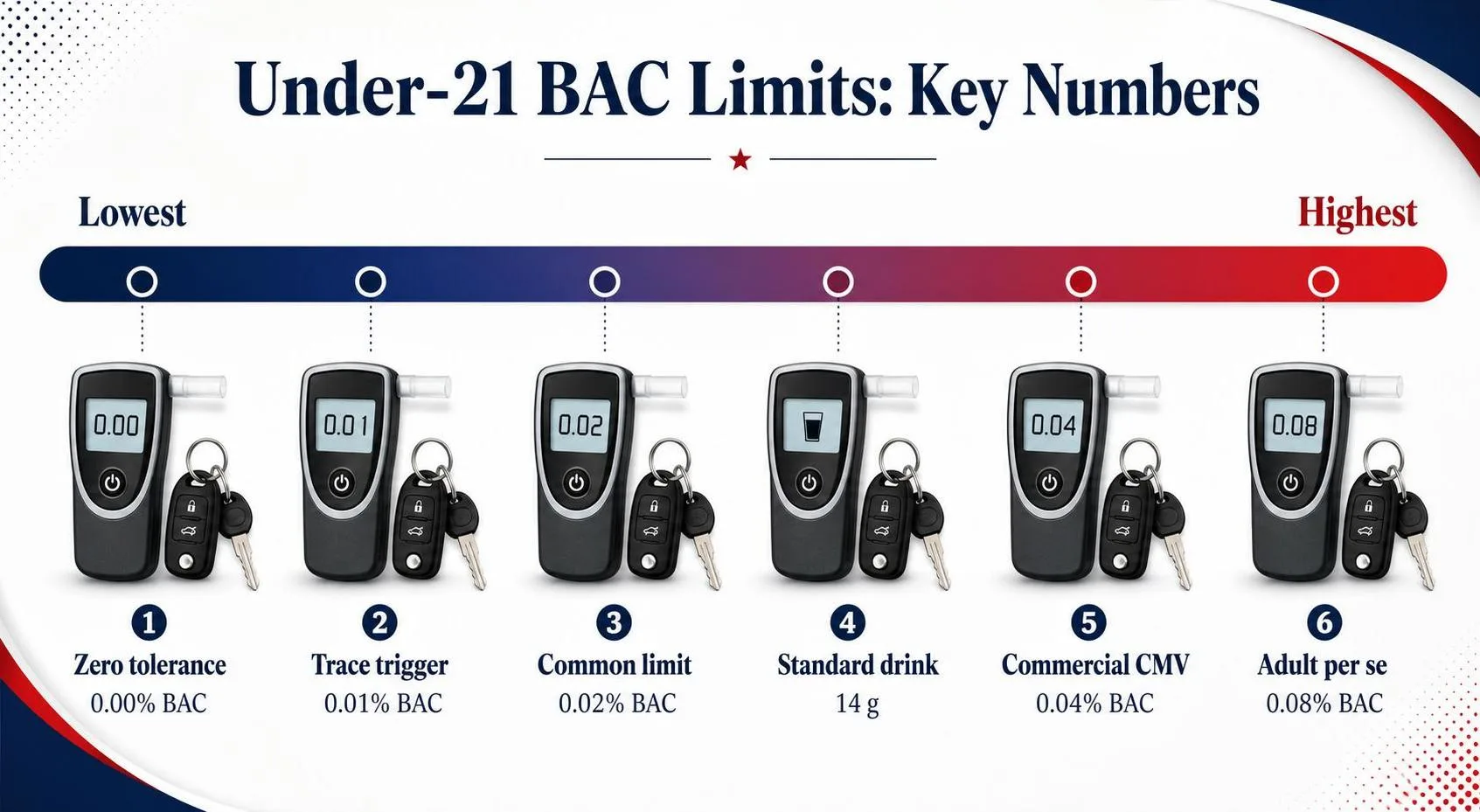
For drivers under 21, the important BAC number is usually not 0.08%. Every U.S. state has a “zero tolerance” underage drinking-and-driving law, but the exact trigger is commonly 0.00%, 0.01%, or 0.02% BAC.
BAC means blood alcohol concentration. A BAC of 0.02% equals 0.02 grams of alcohol per 100 milliliters of blood, a level that can occur after a small amount of alcohol, depending on body size, time, food, and drink strength.
| BAC number | What it generally means | Why it matters under 21 |
| 0.00% | No measurable alcohol allowed | Some states can penalize an under-21 driver for any detectable BAC. |
| 0.01% | Very low measurable alcohol | Used in some “zero tolerance” laws to avoid punishing trace or testing-related readings. |
| 0.02% | Common underage BAC limit | Many states set the under-21 threshold here; it is far below the adult per se DUI limit. |
| 0.08% | Standard adult per se DUI limit | Applies to drivers 21 and older, but an under-21 driver can be cited well before this level. |
| 0.04% | Federal commercial driver standard | Applies to commercial motor vehicle drivers; it does not replace stricter under-21 alcohol rules. |
The federal government pushed states toward zero tolerance through 23 U.S.C. § 161, which ties highway funds to laws making it illegal for drivers under 21 to drive with a BAC of 0.02% or greater.
The 0.02% figure is often described as “zero tolerance,” even though it is not literally zero.
The National Highway Traffic Safety Administration has explained that 0.02% was chosen partly to account for mouthwash, medicines, testing variation, and other trace-alcohol issues.
- Under 21: the practical legal limit is usually 0.00%, 0.01%, or 0.02%, depending on the state.
- 21 and older: 0.08% is the standard per se DUI threshold in all states, Washington, D.C., and Puerto Rico.
- Commercial drivers: 0.04% is the federal per se standard while operating a commercial motor vehicle.
- Any age: a driver can still be charged below a per se limit if alcohol or drugs impair safe driving.
In real roadside terms, an under-21 driver should treat the limit as no drinking at all before driving. A single drink can create a measurable BAC, and timing matters because BAC may keep rising after the last sip.
What Influences Under-21 BAC
A BAC result is not just about “how many drinks” someone had. For drivers under 21, even a small measured amount can matter because many states enforce zero-tolerance limits such as 0.00%, 0.01%, or 0.02% BAC.
The result depends on the drink, the body, the timing, and the testing method. A breath test estimates alcohol in deep-lung air, while a blood test directly measures alcohol in blood.
Drink Size and Alcohol Strength
One “standard drink” in the United States contains about 14 grams, or 0.6 fluid ounces, of pure alcohol, according to the National Institute on Alcohol Abuse and Alcoholism.
| Drink | Typical Size | Typical Alcohol | Pure Alcohol |
| Beer | 12 fl oz | 5% ABV | 0.6 fl oz |
| Wine | 5 fl oz | 12% ABV | 0.6 fl oz |
| Distilled spirits | 1.5 fl oz | 40% ABV / 80 proof | 0.6 fl oz |
Pour size matters. A 9-ounce glass of 14% wine is not one standard drink; it is about 2.1 standard drinks.
Body Size, Sex, and Metabolism
Smaller people generally reach a higher BAC from the same amount of alcohol. People with less body water also tend to show higher BAC because alcohol distributes mainly into water-containing tissue.
| Factor | Effect on BAC |
| Lower body weight | Usually raises BAC more from the same drink amount |
| Female sex at birth | Often produces higher BAC than male sex at the same weight and intake |
| Food in stomach | Slows absorption; it does not “cancel” alcohol |
| Time since last drink | BAC may still be rising for 30 to 90 minutes after drinking |
Alcohol is commonly eliminated at about 0.015 BAC per hour, though individual rates vary. Coffee, cold showers, exercise, or vomiting do not reliably lower BAC faster.
Timing and Testing Method
- Recent drinking: Mouth alcohol from a recent sip, burp, or regurgitation can affect a breath reading if the observation period is not followed.
- Breath testing: Police breath devices estimate BAC using a breath-to-blood conversion ratio, commonly 2,100:1 in U.S. law enforcement practice.
- Blood testing: Blood analysis is more direct, but results can be affected by collection, storage, chain of custody, and lab procedures.
- Rising BAC: A driver may test higher after the stop than at the exact time of driving if alcohol was still absorbing.
- Zero-tolerance laws: For someone under 21, a reading as low as 0.01% or 0.02% may trigger an administrative license action, depending on the state.
The legal issue is the measured result under that state’s underage drinking-and-driving law, not whether the person “felt drunk.” Even one drink can create a detectable BAC in an under-21 driver.
How Under-21 BAC Is Measured
For drivers under 21, alcohol is usually measured as blood alcohol concentration, or BAC, expressed as grams of alcohol per 100 milliliters of blood.
In “zero tolerance” cases, the key issue is often whether the test shows any measurable alcohol above the state’s underage threshold.
Most states set the under-21 driving limit at 0.00%, 0.01%, or 0.02% BAC, not the adult 0.08% standard. The 0.02% level is common because testing instruments have small measurement tolerances and mouth alcohol can briefly affect breath readings.
| Test or standard | What it measures | Typical legal use |
| Breath test | Alcohol in deep-lung breath, converted to BAC | Roadside screening or evidential testing at a station |
| Blood test | Grams of alcohol per 100 mL of blood | Strong evidential test, often used after crashes or hospital treatment |
| Urine test | Alcohol eliminated through urine | Less common for DUI alcohol cases because timing is less precise |
| Adult per se limit | 0.08% BAC | Applies to drivers 21 and older in every U.S. state |
| Under-21 zero-tolerance limit | Usually 0.00% to 0.02% BAC | Applies to drivers under 21, depending on state law |
At the roadside, officers may use a preliminary breath test. That handheld device helps establish probable cause, but many states distinguish it from the evidential breath test used for the official BAC result.
Evidential breath tests are normally performed on approved instruments, such as infrared breath analyzers. Agencies must follow state rules for calibration checks, operator certification, maintenance logs, and test sequence documentation.
- Officers commonly observe the driver for 15 to 20 minutes before an evidential breath test.
- The observation period is meant to prevent burping, vomiting, smoking, chewing gum, or drinking from contaminating the sample.
- Many protocols require two breath samples that agree within a specified tolerance before reporting a final result.
- Instrument records may show the test time, sample volume, air blank checks, calibration verification, and operator identification.
Blood testing is usually more direct. A trained medical professional draws the sample into sealed tubes containing preservative and anticoagulant. The sample is labeled, stored, and tracked through a chain-of-custody record.
Laboratories typically analyze blood alcohol using gas chromatography, a standard forensic method. Results are reported as a percentage, such as 0.015% or 0.024%, which can matter greatly in an underage case.
Verification also includes timing. BAC changes as alcohol is absorbed and eliminated.
A driver may test higher or lower than at the exact driving moment, so reports usually document stop time, test time, drinking statements, and observed impairment signs.
For under-21 enforcement, the alcohol source is legally irrelevant in many states. A small wine tasting, one beer, or alcohol from another beverage can still produce a measurable BAC and trigger a zero-tolerance violation.
Under-21 BAC Versus Adult Limits
For drivers under 21, the legal BAC standard is much stricter than the adult impaired-driving limit.
Most U.S. states use “zero tolerance” laws, commonly setting the underage limit at 0.00%, 0.01%, or 0.02% BAC, according to state traffic codes summarized by NHTSA.
The key difference is that an under-21 driver can violate the law without reaching the 0.08% adult DUI threshold. A small amount of alcohol, including one drink or residual alcohol, may be enough to trigger penalties in many states.
| Driver or situation | Common BAC limit | How it compares |
| Under 21 driver | 0.00% to 0.02% | Strictest standard; based on illegal alcohol possession/consumption by age, not just impairment |
| Adult driver, age 21+ | 0.08% | Standard per se DUI limit in all 50 states, D.C., and Puerto Rico |
| Commercial driver | 0.04% | Federal standard for commercial motor vehicle operation under FMCSA rules |
| Utah adult driver | 0.05% | Lower adult DUI limit than other states, effective since December 30, 2018 |
| Enhanced or aggravated DUI | Often 0.15% or 0.16%+ | Higher penalties in many states when BAC is roughly double the adult legal limit |
Compared with the adult 0.08% DUI limit
The adult 0.08% limit measures presumed impairment. By contrast, the under-21 BAC rule enforces minimum drinking age laws and public safety policy.
A 19-year-old at 0.02% may face an alcohol-related driving violation even though an adult at the same BAC is usually below the DUI threshold.
Compared with commercial driver rules
Commercial drivers are held to 0.04% while operating a commercial motor vehicle. That is twice a 0.02% youth threshold, but still half the 0.08% adult standard.
Federal rules also allow out-of-service orders for lower alcohol presence, including 0.02% or more.
Compared with “not impaired” assumptions
Zero-tolerance laws do not require obvious signs of impairment. The legal issue may be the measurable alcohol concentration itself.
This matters because portable breath tests and evidentiary breath tests can detect low BAC levels after limited drinking.
- 0.02% BAC can occur after a small amount of alcohol, depending on body weight, sex, food intake, and time.
- 0.08% BAC is the nationwide adult per se DUI benchmark, but drivers can still be charged below it if impaired.
- 0.00% BAC states leave little room for any detected alcohol, though testing rules and margins vary by jurisdiction.
Safe Driving Rules Under 21
For anyone under 21, the safest practical rule is simple: do not drink before driving.
Most states enforce “zero tolerance” laws, and even a very small BAC can trigger penalties, license suspension, school consequences, and higher crash risk.
Alcohol affects judgment before a person “feels drunk.” The CDC and NHTSA consistently report that young drivers are overrepresented in alcohol-related crashes because inexperience, risk-taking, nighttime driving.
And impairment compound each other.
Why small amounts matter
| BAC level | Typical effects relevant to driving |
| 0.02% | Decline in visual tracking, divided attention, and ability to perform two tasks at once |
| 0.05% | Reduced coordination, slower response, difficulty steering, and reduced ability to track moving objects |
| 0.08% | Poor speed control, impaired perception, short-term memory loss, and reduced braking response |
Zero-tolerance laws commonly set the under-21 BAC threshold at 0.00%, 0.01%, or 0.02%, depending on the state. These limits are lower than the adult per se DUI limit of 0.08% in every U.S. state.
Practical safety steps
- Plan the ride before the first drink. Use a sober driver, rideshare, taxi, parent pickup, campus safe-ride service, or public transit.
- Do not rely on “waiting it out.” The body generally metabolizes alcohol at about 0.015 BAC per hour, though this varies by person, food, sex, medications, and drink strength.
- Avoid “sleeping it off” in a car. In some states, being in control of a vehicle while impaired can still create legal risk, even if the car is parked.
- Check medication labels. Antihistamines, sleep aids, anxiety medications, opioids, and some antidepressants can intensify impairment.
- Call for help early. If someone is vomiting repeatedly, unconscious, breathing slowly, or cannot be awakened, call 911. Alcohol poisoning is a medical emergency.
What a “standard drink” means
| Drink type | Typical standard drink amount |
| Beer | 12 ounces at 5% alcohol |
| Wine | 5 ounces at 12% alcohol |
| Distilled spirits | 1.5 ounces at 40% alcohol, or 80 proof |
Many poured drinks are stronger than one standard drink. Large craft beers, mixed cocktails, and heavy wine pours can contain two or more standard drinks, making BAC rise faster than expected.
If you are under 21 and stopped after any drinking, stay calm, provide required documents, and avoid guessing your BAC. For legal advice after a citation or arrest, contact a qualified attorney in your state.
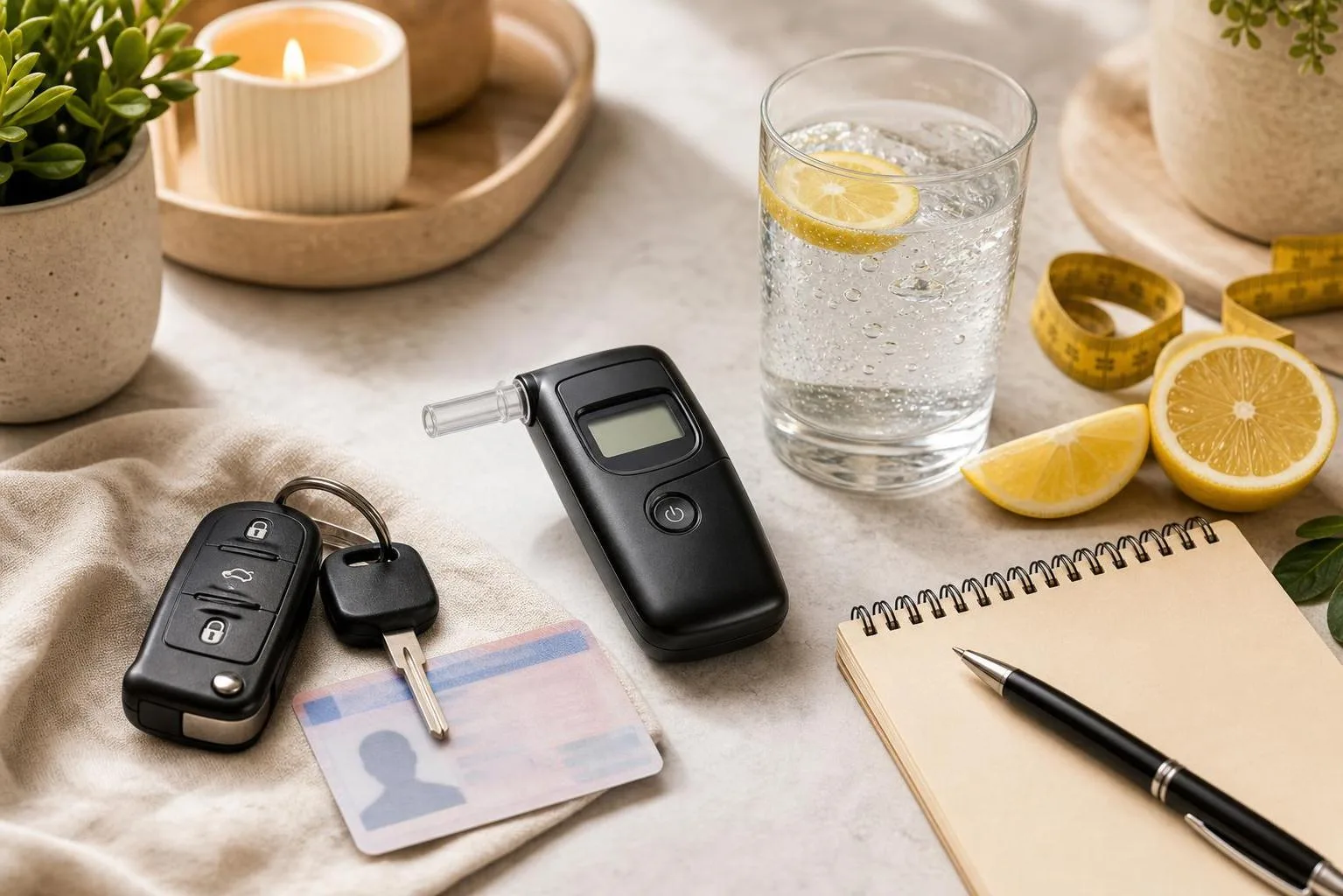
Breath Tester Findings on Small Exposures
We tested how quickly small alcohol exposures can show up on a consumer breath tester, using only staff members who were 21 or older.

The point was not to model underage drinking, but to understand why “zero tolerance” laws can matter even at very low readings.
We ran the checks over 3 separate afternoons with 4 volunteers, using a BACtrack S80 fuel-cell breathalyzer.
We waited 20 minutes after any sip or rinse before recording a breath result, matching the common enforcement practice of avoiding fresh mouth alcohol.
| Test condition | Quantity and timing | Lowest reading | Highest reading |
| Control baseline | 12 total readings before alcohol exposure | 0.000 | 0.000 |
| One 5% beer | 12 fl oz consumed in 15 minutes; measured after 20 minutes | 0.014 | 0.027 |
| One 12% wine pour | 5 fl oz consumed in 20 minutes; measured after 20 minutes | 0.018 | 0.031 |
| Mouthwash rinse | 30 seconds, then measured immediately | 0.043 | 0.082 |
| Mouthwash rinse | 30 seconds, then measured after 20 minutes | 0.000 | 0.004 |
Our clearest finding: a single standard drink can put some adults above 0.02 BAC, at least briefly. That matters because many states set the under-21 driving limit at 0.00, 0.01, or 0.02 under “zero tolerance” laws.
The National Highway Traffic Safety Administration describes these laws as making it illegal for drivers under 21 to have any measurable alcohol, commonly defined at 0.02 BAC or lower.
The federal adult impairment per se limit is 0.08 BAC, but that is not the relevant standard for under-21 drivers.
- 0.00 BAC states: any detectable alcohol can create risk for an under-21 driver, depending on the statute and testing rules.
- 0.01 BAC states: our single-drink readings exceeded that level in every beer and wine trial.
- 0.02 BAC states: several one-drink trials still crossed the threshold after the 20-minute wait.
We also learned not to overread instant breath numbers. Mouthwash produced high immediate results, but nearly disappeared after 20 minutes. That supports why officers often use an observation period before evidential breath testing.
For someone under 21, the practical answer is simple: the legal BAC limit is usually “any measurable alcohol,” often capped at 0.00 to 0.02.
The exact number depends on state law, but our measurements showed those thresholds are easy to reach.
Zero Tolerance Myths for Underage BAC
Under-21 BAC rules are often misunderstood because “zero tolerance” does not always mean a literal 0.000% reading.

In practice, most states set an underage alcohol-driving threshold between 0.00% and 0.02%, separate from the adult DUI limit.
The biggest mistake is assuming a young driver is “legal” as long as they are below 0.08%. That is false in every U.S. state.
Underage drivers can face license penalties, fines, alcohol education, and insurance consequences at much lower BAC levels.
| Common belief | What the law generally does |
| “0.08% is the legal limit for everyone.” | 0.08% is the adult per se DUI threshold, but drivers under 21 are usually subject to 0.00% to 0.02% zero-tolerance limits. |
| “One drink cannot matter.” | One standard drink contains about 14 grams of pure alcohol and can produce a measurable BAC, especially in smaller bodies or on an empty stomach. |
| “Mouthwash or cough syrup is a safe excuse.” | Some products contain alcohol, but officers may still investigate driving behavior, odor, admissions, and chemical test results. |
| “Refusing the test avoids a BAC case.” | Implied-consent laws can trigger automatic license suspension for refusal, even before any criminal conviction. |
- Myth: “Zero tolerance means police need exactly 0.00%.” Many states use 0.01% or 0.02% to account for testing variation and incidental exposure. A reading at or above that state’s threshold can still create an underage alcohol-driving violation.
- Myth: “A BAC below 0.08% means no DUI.” Prosecutors can pursue impairment-based DUI if the driver’s ability is affected. Poor lane control, speeding, a crash, failed field sobriety tests, or admissions can matter even below 0.08%.
- Myth: “Only beer, wine, and liquor count.” A “standard drink” is approximately 12 ounces of 5% beer, 5 ounces of 12% wine, or 1.5 ounces of 40% spirits. Alcohol source does not change BAC science.
- Myth: “Coffee, food, or a shower lowers BAC fast.” The body mainly eliminates alcohol through metabolism. A commonly cited average elimination rate is about 0.015 percentage points per hour, though individuals vary.
- Myth: “State lines do not matter.” Underage BAC thresholds, license suspension lengths, and penalties vary by state. A 0.02% rule in one state does not guarantee the same result elsewhere.
Another frequent mistake is overlooking administrative penalties. An underage driver may lose driving privileges through the motor vehicle agency even if the court case is reduced, dismissed, or handled separately.
The safest practical rule is simple: if you are under 21, do not drive after consuming any alcohol. Even a low measurable BAC can create legal exposure, school discipline, job problems, and higher insurance costs.
Questions Readers Ask
What is the BAC limit for someone under 21 in the United States?
For drivers under 21, the legal BAC limit is typically far below the adult DUI limit because every state has a “zero tolerance” underage drinking-and-driving law.

In many states the limit is 0.02% BAC, while some use 0.00% or another very low threshold.
Can someone under 21 get in trouble with a BAC below 0.08%?
Yes. The 0.08% per se DUI limit generally applies to adult drivers, but drivers under 21 can face penalties at much lower BAC levels, often starting at 0.01% or 0.02% depending on the state.
Why do some states use 0.02% instead of 0.00% for underage drivers?
Some states set the under-21 BAC limit at 0.02% to account for trace alcohol from sources like certain medications, mouthwash, or testing margin issues.
That does not mean underage drinking is legal; it means the driving-specific enforcement threshold is set slightly above absolute zero.
What penalties can an under-21 driver face for violating a zero tolerance BAC law?
Penalties vary by state but commonly include driver’s license suspension, fines, alcohol education programs, community service, and increased insurance costs.
If the BAC is high enough or driving is impaired, the person may also face a standard DUI charge.
Is the under-21 BAC limit the same in every state?
No. All states have underage zero tolerance laws because of federal policy tied to highway funding, but the exact BAC threshold and penalties differ by state.
Anyone under 21 should check their state’s DMV or highway safety agency because limits may be 0.00%, 0.01%, 0.02%, or another low statutory amount.
How quickly can one drink put a person under 21 over a 0.02% BAC limit?
For many under-21 drivers, one standard drink can produce a BAC at or above 0.02%, depending on body weight, sex, food intake, and time. A standard drink equals about 12 ounces of 5% beer, 5 ounces of 12% wine, or 1.5 ounces of 40% liquor.
Related Reading
- Reposado Vs Anejo – What Is The Difference Between Them?
- Don Q Rum Vs Bacardi
- What Is Similar To Pussers Rum?
- Does Sake Go Bad After Opening? Professional Answer
- What Is A Good Sweet Red Wine For Beginners?
- Whiskey Smoker Kit – Comprehensive Guide From Expert
- How Many Wine Coolers To Get Drunk?
- All Alcohol Guides
- National Highway Traffic Safety Administration (2023)
- Centers for Disease Control and Prevention (2024)
- Legal Information Institute, Cornell Law School (2024)
- Insurance Institute for Highway Safety (2025)
- Governors Highway Safety Association (2024)
- National Conference of State Legislatures (2022)
- National Academies Press (2018)