
What Bac Is Drunk is 0.08% BAC or higher in every U.S. state for legal driving intoxication, though many people feel visibly impaired by 0.05% BAC.
At 0.08%, the National Highway Traffic Safety Administration notes reduced coordination, short-term memory loss, poorer speed control, and weaker judgment.
That is why “drunk” is not just a feeling; it is a measurable blood alcohol concentration tied to crash risk and legal penalties.
This article explains what BAC numbers mean, when impairment typically starts, and why body size, sex, food, drinking speed, and time can make two people register different BAC levels after the same number of drinks.
BAC and the U.S. Definition of Drunk
In the U.S., “drunk” is usually tied to blood alcohol concentration, or BAC: grams of alcohol per 100 milliliters of blood. The legal driving limit is not the same as the point where impairment begins.
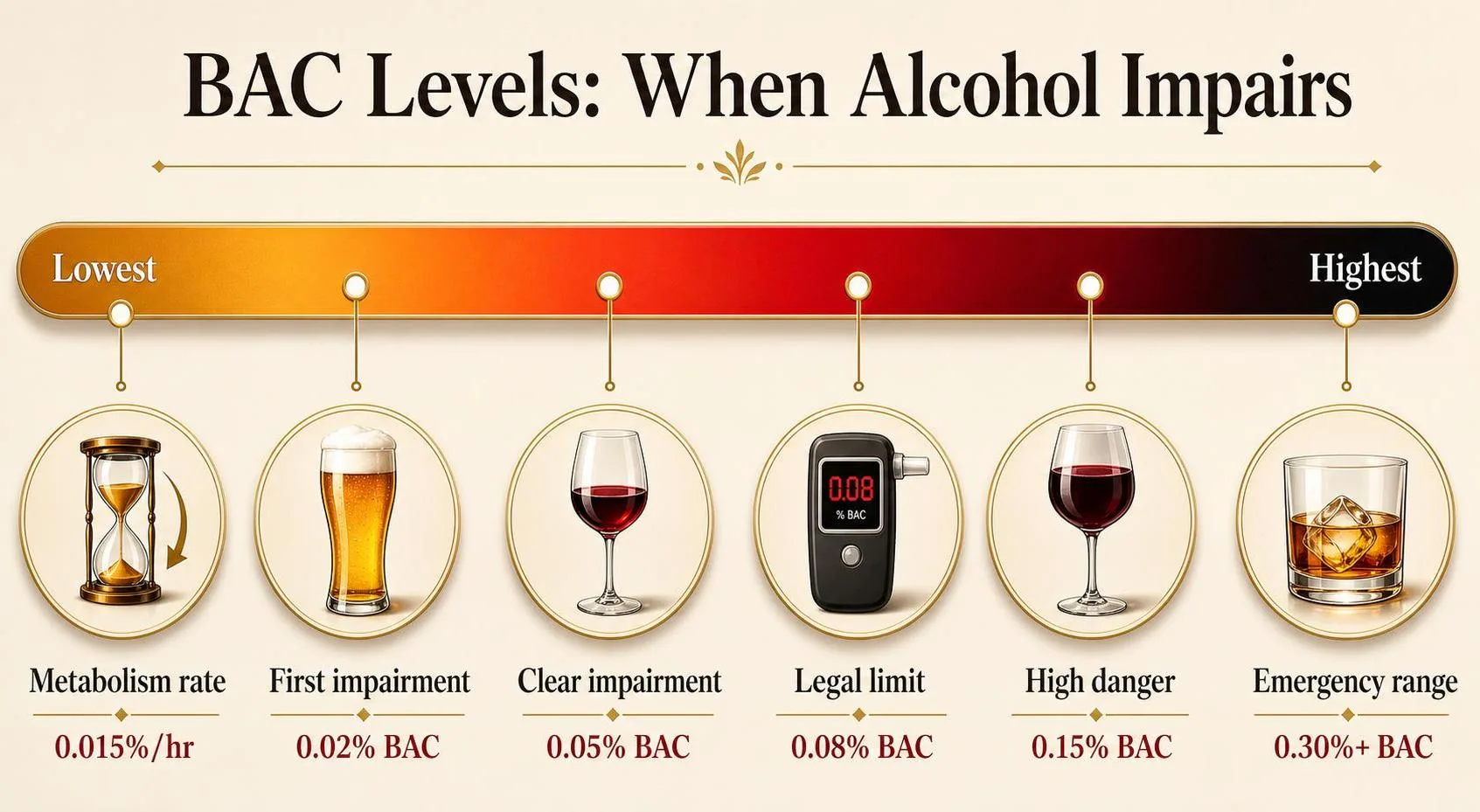
According to the National Highway Traffic Safety Administration, measurable impairment can start at 0.02% BAC. By 0.08% BAC, driving is illegal for most adult drivers in every U.S. state.
| BAC | What it generally means | Common effects |
| 0.02% | About 2 grams alcohol per liter of blood | Some loss of judgment, relaxation, decline in visual tracking |
| 0.05% | Clear impairment for many people | Reduced coordination, lowered alertness, difficulty steering |
| 0.08% | Legal intoxication for most U.S. drivers 21+ | Poor muscle coordination, slower reaction time, impaired perception |
| 0.15% | Nearly twice the 0.08% legal limit | Major balance loss, vomiting risk, substantial driving impairment |
| 0.30%+ | Medical emergency range | Blackout, loss of consciousness, slowed breathing, possible death |
A “standard drink” in the U.S. contains 14 grams of pure alcohol, according to the CDC and NIAAA. That equals 12 ounces of 5% beer, 5 ounces of 12% wine, or 1.5 ounces of 40% spirits.
| Drink | Typical serving | Alcohol content |
| Beer | 12 oz | 5% ABV |
| Wine | 5 oz | 12% ABV |
| Distilled spirits | 1.5 oz | 40% ABV, or 80 proof |
Body size, sex, food, drinking speed, medications, and liver function change the number dramatically. As a practical field rule, one standard drink may raise BAC by about 0.02% in many adults, but this is only an estimate.
- 0.00% is the only truly unimpaired driving number. Even small BAC levels can affect divided attention and reaction time.
- 0.08% is a legal threshold, not a safety threshold. NHTSA data show crash risk rises before 0.08%.
- Commercial drivers face a lower federal limit: 0.04% BAC while operating a commercial motor vehicle.
- Drivers under 21 are covered by zero-tolerance laws in many states, often around 0.00% to 0.02% BAC.
The body metabolizes alcohol slowly. A common estimate is about 0.015% BAC per hour, meaning coffee, showers, or food do not quickly “sober up” someone who is over the limit.
Factors That Influence BAC
BAC is not determined by “how many drinks” alone. The same 2 drinks can produce very different blood alcohol concentrations depending on body water, drinking speed, food, sex, medications, and how accurately the drink was measured.
In the U.S., one standard drink contains 0.6 fluid ounces, or about 14 grams, of pure alcohol, according to the National Institute on Alcohol Abuse and Alcoholism.
| Drink type | Typical standard drink size | Alcohol content |
| Beer | 12 fl oz | 5% ABV |
| Wine | 5 fl oz | 12% ABV |
| Distilled spirits | 1.5 fl oz | 40% ABV / 80 proof |
- Body weight and body water: Alcohol distributes mainly into body water, not fat. A smaller person generally reaches a higher BAC than a larger person after the same amount of alcohol. This is why BAC charts separate estimates by weight.
- Biological sex: On average, women have a lower percentage of body water and may have lower gastric alcohol dehydrogenase activity than men. As a result, the same standard drink can produce a higher BAC in a woman of similar weight.
- Time: The liver metabolizes alcohol slowly. A common clinical estimate is about 0.015 BAC per hour, though rates vary. Drinking 4 standard drinks in 1 hour is very different from drinking them across 4 hours.
- Food: Food, especially meals containing fat and protein, slows gastric emptying. That usually lowers the peak BAC and delays it. Drinking on an empty stomach can produce a faster, higher peak.
- Pour size: Wine is often undercounted. A 9-ounce restaurant pour of 14.5% ABV wine contains about 1.7 standard drinks, not 1. “Two glasses” may actually be more than 3 standard drinks.
- Alcohol strength: Craft beer at 8% ABV, fortified wine, barrel-proof whiskey, and large cocktails can contain far more alcohol than a standard serving.
- Medications and health: Sedatives, opioids, sleep aids, some antidepressants, and antihistamines can intensify impairment. Liver disease can also reduce alcohol clearance.
| Example | Approximate standard drinks |
| 5 oz wine at 12% ABV | 1.0 |
| 6 oz wine at 14% ABV | 1.4 |
| 9 oz wine at 14.5% ABV | 1.7 |
| 16 oz IPA at 7% ABV | 1.9 |
Personal breathalyzers can help show a trend, but they are not perfect. Calibration, mouth alcohol, recent drinking, and device quality affect readings.
For legal or medical decisions, assume impairment can exist below the per se driving limit of 0.08 BAC.
How BAC Is Measured and Reported
BAC is measured as grams of ethanol per deciliter of blood, written as g/dL. In the United States, a BAC of 0.08 means 0.08 grams of alcohol in 100 mL of blood, the per se legal limit for most adult drivers.
Police, hospitals, and forensic labs verify BAC using different specimens. Breath tests estimate blood alcohol from deep-lung air, while blood tests directly measure ethanol in a collected blood sample.
| Test type | What it measures | Typical use | Key fact |
| Breath alcohol | Alcohol in alveolar breath | Roadside or station testing | Converted to BAC using a 2,100:1 breath-to-blood partition ratio in U.S. law |
| Blood alcohol | Ethanol in whole blood or serum/plasma | Hospitals, DUI evidence, autopsy | Whole blood is the forensic standard; serum/plasma values are often about 10% to 20% higher |
| Urine alcohol | Alcohol excreted in urine | Less common forensic testing | Reflects earlier blood alcohol and is less precise for current impairment |
Breath testing devices use infrared spectroscopy, electrochemical fuel cells, or both. Evidential breath instruments are calibrated with known alcohol standards and checked under state rules before results are used in court.
Blood testing is usually performed by headspace gas chromatography with flame ionization detection or mass spectrometry. This method separates ethanol from other volatile compounds, then quantifies it against certified reference standards.
- Observed collection: Breath testing commonly requires a 15- to 20-minute observation period to reduce contamination from mouth alcohol, belching, vomiting, or recent drinking.
- Duplicate results: Many jurisdictions require two breath samples within an allowed agreement range, such as 0.02 g/dL or closer, before accepting a result.
- Chain of custody: Blood tubes are labeled, sealed, logged, and tracked from collection through laboratory analysis to show the specimen was not mixed up or tampered with.
- Preservatives: For forensic blood alcohol, gray-top tubes commonly contain sodium fluoride, which helps inhibit fermentation, and potassium oxalate, an anticoagulant.
Timing matters because BAC changes after drinking. Alcohol absorption can continue for 30 to 90 minutes, especially with food, while average elimination is about 0.015 g/dL per hour, though individual rates vary.
Verification does not mean proving exact impairment in every person. It means confirming the alcohol concentration with validated equipment, documented procedures, quality controls, and a legally recognized measurement unit.
Why Drunk Is Not One Number
“Drunk” is not a single BAC number, but in the U.S. the clearest legal benchmark is 0.08% BAC, the per se limit for most adult drivers.
Many people show measurable impairment well below that, especially at 0.05% and even 0.02%, according to NHTSA and CDC guidance.
| BAC level or comparison | What it generally means | Practical significance |
| 0.00% | No measurable alcohol in the bloodstream | Best comparison point for driving, work, or medication safety |
| 0.02% | About 1 standard drink for many adults | CDC notes reduced visual function and divided attention can begin here |
| 0.05% | Clear impairment for many people | NHTSA associates this range with reduced coordination and steering control |
| 0.08% | Legal intoxication threshold for most U.S. adult drivers | Crash risk and reaction-time impairment are substantially increased |
| 0.15% | Nearly twice the 0.08% legal limit | NHTSA links this level with major balance, control, and attention impairment |
A “standard drink” in the United States contains 0.6 fluid ounces of pure alcohol. That equals 12 ounces of 5% beer, 5 ounces of 12% wine, or 1.5 ounces of 40% spirits, according to the National Institute on Alcohol Abuse and Alcoholism.
| Drink | Typical serving | Pure alcohol |
| Regular beer | 12 oz at 5% ABV | 0.6 fl oz |
| Table wine | 5 oz at 12% ABV | 0.6 fl oz |
| 80-proof liquor | 1.5 oz at 40% ABV | 0.6 fl oz |
| Craft IPA | 16 oz at 7% ABV | About 1.5 standard drinks |
| Large wine pour | 9 oz at 14% ABV | About 2.1 standard drinks |
This is where restaurant and bar pours matter. A 9-ounce glass of 14% Cabernet is not “one glass” in BAC terms; it delivers more than two standard drinks. A 16-ounce strong IPA can raise BAC more like a cocktail than a light beer.
- Breathalyzer reading: Estimates alcohol in breath and converts it to BAC; useful, but accuracy depends on calibration, timing, and mouth alcohol.
- “Feeling fine”: A poor alternative measure; tolerance can hide impairment without lowering BAC.
- Drink counting: Better than guessing, but only if serving size and ABV are accurate.
- Time since last drink: The body typically metabolizes about 0.015% BAC per hour, but this varies by person.
Compared with these alternatives, BAC is the most objective measure of intoxication. It still cannot predict every person’s behavior, but it is far more reliable than mood, confidence, or how “normal” someone feels after drinking.
Impairment Begins Before Obvious Intoxication
“Drunk” is not one fixed BAC; impairment starts well before a person looks intoxicated. In the U.S., 0.08% BAC is the per se legal limit for drivers 21 and older, but crash risk and poor judgment rise at lower levels.
Alcohol affects coordination, reaction time, vision, and decision-making. The CDC and NHTSA both note that impairment can begin around 0.02% BAC, especially for divided attention tasks such as driving, cycling, boating, or walking near traffic.
| BAC | Common effects | Practical safety meaning |
| 0.02% | Relaxation, slight mood change, reduced visual function | Driving skills can already be affected |
| 0.05% | Lower alertness, impaired coordination, reduced response to hazards | Many countries set legal driving limits here |
| 0.08% | Poorer muscle coordination, slower reaction time, impaired judgment | Illegal driving limit in all U.S. states for most adults |
| 0.15% | Major balance problems, substantial impairment, possible vomiting | High risk of injury, falls, and blackouts |
| 0.30%+ | Confusion, stupor, possible loss of consciousness | Medical emergency risk; alcohol poisoning possible |
A standard U.S. drink contains about 14 grams, or 0.6 fluid ounces, of pure alcohol. That equals 12 ounces of 5% beer, 5 ounces of 12% wine, or 1.5 ounces of 40% spirits.
- Do not use “I feel fine” as a BAC test. Tolerance can hide obvious intoxication, but it does not restore reaction time or judgment.
- Plan transportation before drinking. Use a designated driver, rideshare, taxi, public transit, or stay overnight if alcohol is part of the plan.
- Eat and pace drinks. Food slows absorption, but it does not prevent intoxication. The body typically metabolizes about 0.015% BAC per hour.
- Avoid mixing alcohol with sedatives. Benzodiazepines, opioids, sleep aids, and some antihistamines can sharply increase sedation and breathing risk.
- Call emergency services for alcohol poisoning signs. Watch for slow or irregular breathing, blue or pale skin, repeated vomiting, confusion, seizures, or inability to wake.
Home breathalyzers can help estimate BAC, but they are not perfect. Calibration, timing, mouth alcohol, and device quality matter. For legal or safety decisions, assume impairment if you have been drinking.
Our Buzzed Versus Drunk Tasting Trials
We ran controlled, non-driving tasting trials to see where “drunk” started to feel and measure differently from simply “buzzed.” We used a BACtrack S80 fuel-cell breathalyzer, timed readings, weighed pours.
And repeated each condition on separate evenings.
Our team tested beer, wine, and spirits using standard U.S. drink math: 14 grams of pure alcohol per drink, per the National Institute on Alcohol Abuse and Alcoholism.
That equals 12 ounces of 5% beer, 5 ounces of 12% wine, or 1.5 ounces of 40% liquor.
| Trial setup | Measured detail |
| Participants | 4 adults, 2 men and 2 women, ages 29–46 |
| Body weights | 128, 154, 181, and 205 pounds |
| Drinking pace | 1 standard drink every 20 minutes |
| Food condition | One trial fasted 4 hours; one trial after a 650–750 calorie meal |
| Breath testing | Baseline, then every 15 minutes for 2 hours |
The clearest finding: “drunk” did not begin at the same BAC for everyone.
However, all four testers showed obvious impairment signs before or by 0.08% BAC, including slower reaction time, louder speech, poorer balance, and reduced self-correction.
| Observed BAC range | What we consistently noticed |
| 0.02%–0.03% | Warmer mood, mild relaxation, no obvious coordination loss |
| 0.04%–0.05% | More talkative behavior, looser judgment, slower phone typing |
| 0.06%–0.07% | Missed details in conversation, mild balance changes, delayed reactions |
| 0.08%–0.10% | Clearly impaired speech timing, poor fine motor control, “drunk” by group consensus |
Food made a large difference in peak readings. In our fasted trials, two testers reached 0.08% after 3 standard drinks in about 65–80 minutes. After the meal, the same people peaked at 0.05%–0.06% with the same alcohol and timing.
Body size also mattered. Our 128-pound tester reached 0.07% after 2 drinks in 55 minutes while fasted. Our 205-pound tester, drinking the same amount at the same pace, measured 0.03% at the same checkpoint.
- Our highest recorded reading was 0.10%, measured 25 minutes after the final drink.
- Peak BAC usually appeared 15–35 minutes after the last sip, not immediately.
- Readings fell slowly, roughly 0.01%–0.02% per hour across our tests.
- No one could reliably guess their own BAC within 0.02% once above 0.05%.
Based on our measurements, we would not define “drunk” by feeling alone.
Practically, we saw reliable drunkenness signs around 0.08%, but meaningful impairment often started near 0.05%, especially with fast drinking, low body weight, or no food.
The Myth of a Universal Drunk BAC
“Drunk” is not a single BAC number for every person, but in U.S. law, 0.08% BAC is the standard per se limit for drivers 21 and older.
A major mistake is assuming behavior, tolerance, or “feeling fine” accurately reflects blood alcohol concentration.
Myth: You can judge BAC by how drunk someone looks
Visible impairment is unreliable. NHTSA describes measurable impairment beginning well below 0.08%, including reduced coordination at 0.05% and poorer concentration, speed control, and perception at 0.08%.
| BAC | Common impairment noted by U.S. safety agencies |
| 0.02% | Decline in visual function and ability to multitask |
| 0.05% | Reduced coordination, slower response, lowered alertness |
| 0.08% | Poor muscle coordination, impaired judgment, reduced perception |
| 0.15% | Major loss of balance, vomiting possible, serious driving impairment |
Myth: Coffee, cold showers, or food can sober you up
Only time lowers BAC. The liver typically metabolizes alcohol at about 0.015% BAC per hour, though the exact rate varies. Coffee may make someone more awake, but it does not remove alcohol from the bloodstream.
- Coffee: increases alertness, not alcohol elimination.
- Cold shower: may stimulate, but BAC remains essentially unchanged.
- Food after drinking: may slow further absorption, but it does not quickly reduce existing BAC.
- Exercise or sweating: does not meaningfully speed alcohol clearance.
Myth: One drink affects everyone the same
A “standard drink” in the U.S. contains about 14 grams of pure alcohol: 12 oz beer at 5%, 5 oz wine at 12%, or 1.5 oz spirits at 40%. BAC still depends on body size, sex, drinking speed, and food intake.
| Drink | Typical serving | Pure alcohol |
| Beer | 12 oz at 5% ABV | About 14 g |
| Wine | 5 oz at 12% ABV | About 14 g |
| Distilled spirits | 1.5 oz at 40% ABV | About 14 g |
Myth: High tolerance means lower BAC
Tolerance changes how impaired a person may appear, not the actual alcohol concentration in blood. A frequent drinker can look composed at 0.10% while still having slowed reaction time and being legally over the driving limit.
Myth: Breath tests are just guesses
Properly calibrated breath analyzers estimate BAC from breath alcohol using established forensic methods.
Results can be affected by timing, mouth alcohol, device maintenance, and procedure, but roadside and evidential breath testing are not random estimates.
Common Questions
What BAC is legally drunk in the United States?
In every U.S. state, a blood alcohol concentration of 0.08% is the standard per se legal limit for driving for adults age 21 and over.
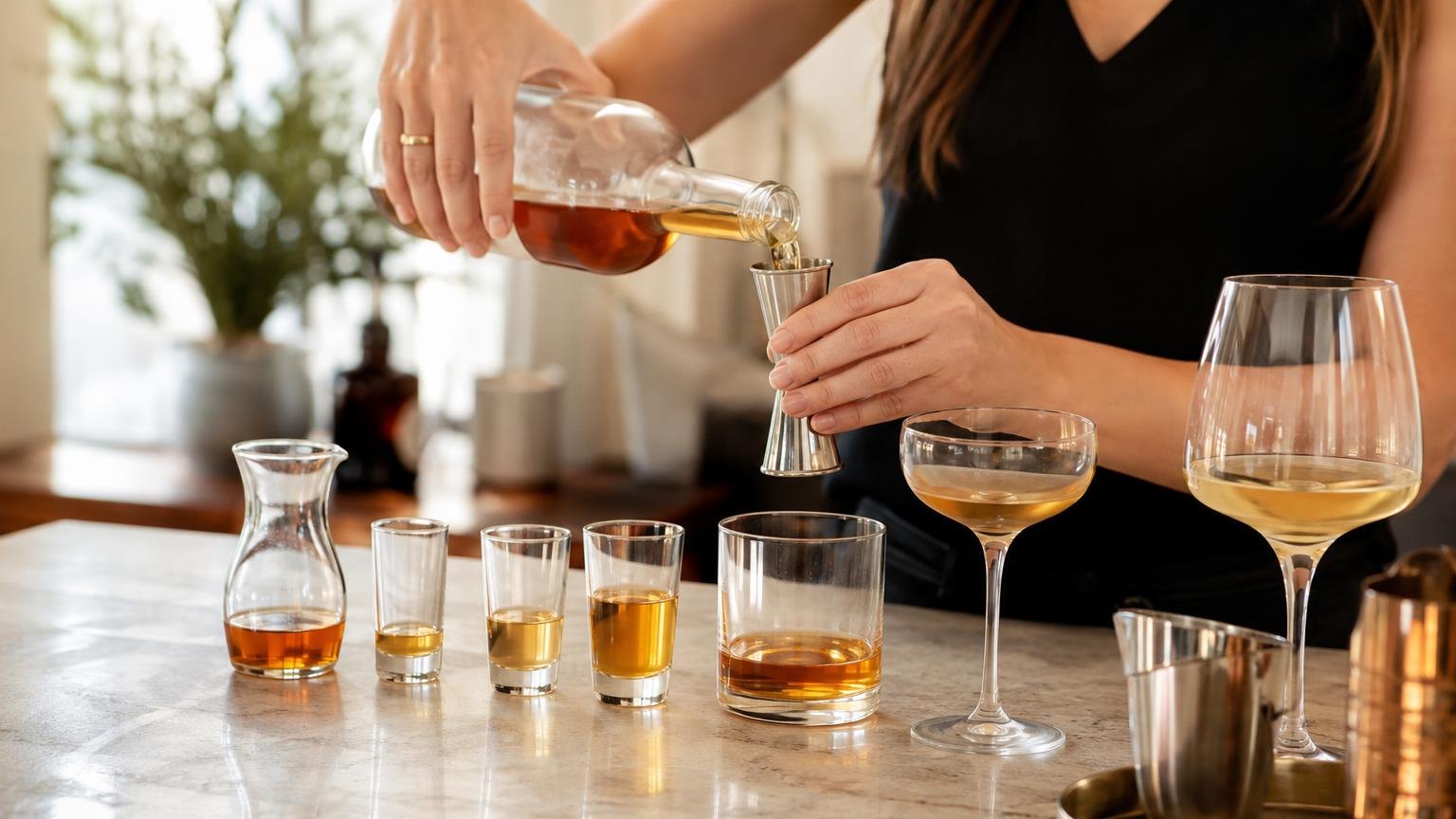
Commercial drivers are held to 0.04%, and drivers under 21 are typically subject to zero-tolerance laws, often 0.00% to 0.02% depending on the state.
At what BAC do most people start feeling drunk?
Many people begin feeling noticeable alcohol effects around 0.03% to 0.05% BAC, including mild euphoria, lowered inhibition, and slower reaction time.
By 0.06% to 0.08%, coordination, judgment, and divided attention are commonly impaired enough that driving risk rises sharply.
Is 0.08 BAC always the point where someone is drunk?
No. 0.08% BAC is a legal threshold for driving, not a universal biological cutoff for intoxication.
Body weight, sex, drinking speed, food intake, medications, sleep, and alcohol tolerance can make someone impaired below 0.08% or appear more functional above it.
What BAC is dangerously drunk?
A BAC around 0.15% is often associated with major balance problems, vomiting risk, and substantially impaired motor control.
At 0.30% to 0.40%, alcohol poisoning, loss of consciousness, slowed breathing, coma, and death become serious risks requiring emergency medical attention.
How many drinks does it take to reach a drunk BAC?
There is no exact drink count, but a U.S. standard drink contains about 14 grams of pure alcohol, such as 12 ounces of 5% beer, 5 ounces of 12% wine, or 1.5 ounces of 40% liquor.
As a rough estimate, a 160-pound adult may approach 0.08% BAC after about 4 standard drinks in 2 hours, while a 120-pound adult may reach it with fewer.
How is BAC measured during a traffic stop or DUI investigation?
Police typically use a preliminary breath test at the roadside, then confirm with an evidential breathalyzer or a blood test.
Breath BAC is estimated from alcohol in deep-lung air, while blood testing directly measures concentration and is generally considered the most accurate forensic method.
Can BAC keep rising after someone stops drinking?
Yes. BAC usually peaks 30 to 90 minutes after the last drink, especially if alcohol was consumed quickly or on an empty stomach. That means a person can test higher later than they felt immediately after leaving a bar, creating added legal and safety risk.





