
How Long Does Champagne Last After Opening? is 1 to 3 days when refrigerated and sealed with a proper Champagne stopper. Pressure drops fast after opening, so bubbles fade before the wine fully spoils.
Vintage Champagne, blanc de blancs, and higher-acid styles often hold texture slightly longer than softer, fruitier bottles.
Store the bottle upright at 35°F to 40°F, reseal it immediately, and avoid spoon tricks or loose corks. Expect the best flavor within 24 hours: crisp acidity, fine mousse, and fresh citrus or brioche notes.
After 72 hours, most opened Champagne tastes flat, oxidized, or muted, even if it remains safe to drink.
How Long Open Champagne Stays Drinkable
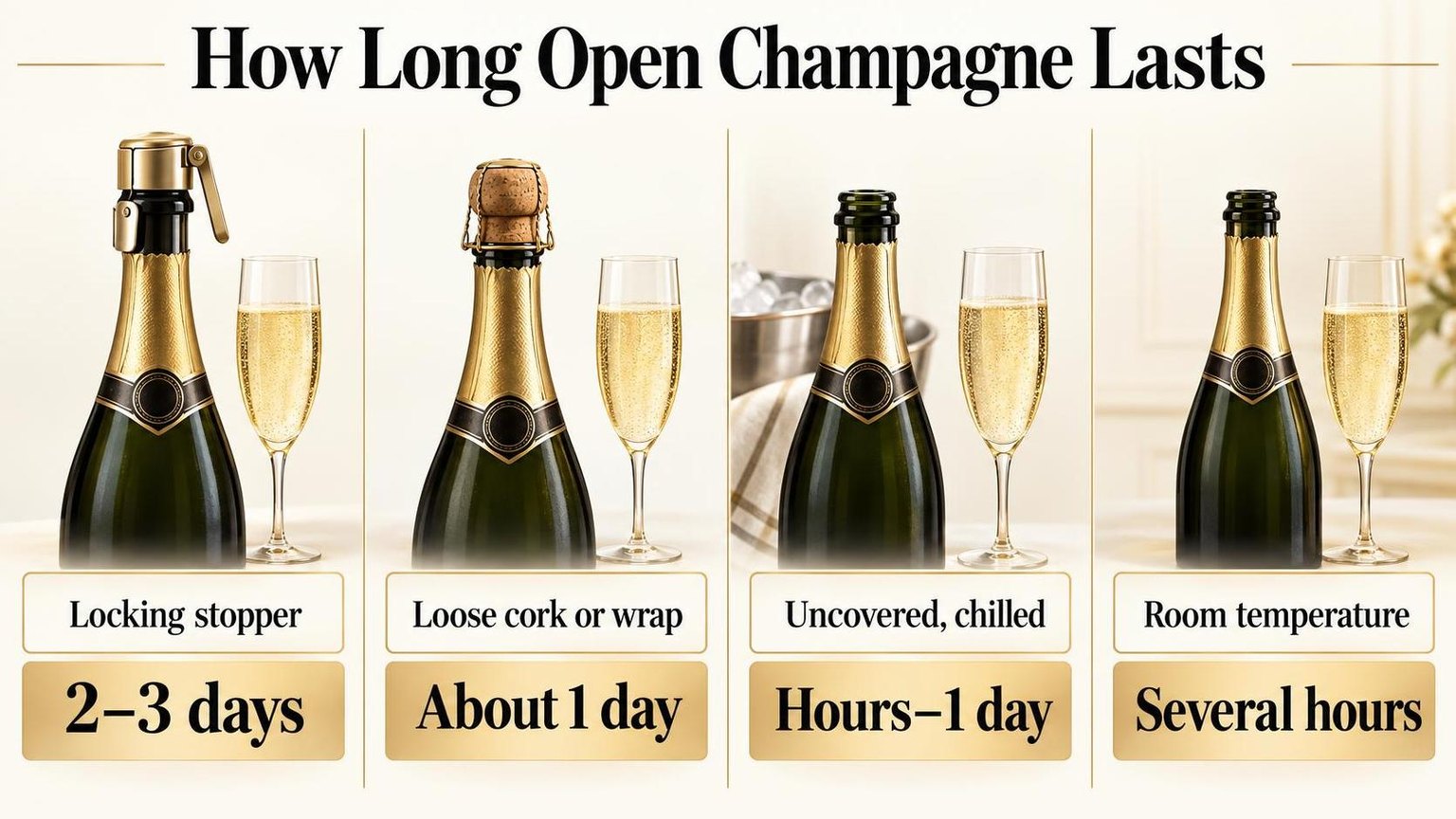
Opened Champagne usually remains enjoyable for several days when sealed with a sparkling-wine stopper and refrigerated. Without an airtight closure, carbonation escapes quickly, leaving the wine noticeably flatter by the next day.
| Storage method | Best-quality window after opening | Expected condition |
| Refrigerated with a locking Champagne stopper | 2–3 days | Some fizz remains; aromas and acidity are generally recognizable. |
| Refrigerated with plastic wrap or a loose cork | About 1 day | Carbonation declines rapidly because the closure does not hold pressure. |
| Refrigerated and uncovered | Several hours to 1 day | Usually flat, with muted aromas and possible refrigerator odors. |
| Left at room temperature after opening | Several hours | Warmer wine loses dissolved carbon dioxide faster and oxidizes more quickly. |
“Drinkable” does not mean “unchanged.” Champagne may remain safe after losing its bubbles, but its intended texture, aroma, and freshness deteriorate as carbon dioxide escapes and oxygen reacts with the wine.
Temperature matters because carbon dioxide stays dissolved more effectively in cold liquid. Return the bottle to a refrigerator promptly, ideally at normal refrigerator temperature, rather than leaving it in an ice bucket that warms overnight.
Use a hinged or clamp-style sparkling-wine stopper. It grips the bottle’s rim and resists internal pressure.
A standard still-wine stopper may loosen, while forcing the original mushroom-shaped cork back into the neck is difficult and can be unsafe.
The Comité Champagne recommends preserving an opened bottle with an airtight stopper and keeping it cold.
The familiar practice of placing a metal spoon in the bottle neck does not create a seal and has not shown reliable preservation benefits in controlled testing.
What shortens the usable window
- Repeatedly opening the bottle releases pressure and introduces fresh oxygen.
- A half-empty bottle contains more oxygen-filled headspace than a nearly full bottle.
- Warm storage accelerates gas loss and oxidation.
- Weak closures allow continuous carbon dioxide leakage.
- Exposure to strong refrigerator odors can affect an uncovered wine.
Before serving leftover Champagne, smell and taste a small amount. Flatness alone is not dangerous; the wine can still work in sauces, vinaigrettes, or cocktails.
Discard it if it smells sharply vinegary, unusually musty, or otherwise unpleasant, or if its appearance suggests contamination.
For best results, stopper the bottle immediately after pouring, refrigerate it upright, and avoid unnecessary reopening. Pressure-preserving systems can extend carbonation, but they cannot reverse oxidation or restore bubbles already lost.
Opened Champagne Shelf Life by Style
Most opened Champagne remains enjoyable for several days when sealed immediately with a locking sparkling-wine stopper and refrigerated.
Style matters, but storage temperature, remaining bottle volume, and time spent uncorked usually affect carbonation more than grape variety or sweetness.
| Champagne style | Best-quality window after opening | Likely change |
| Non-vintage brut | 2–3 days | Bubbles soften gradually; fresh citrus and apple aromas become less distinct. |
| Vintage Champagne | 2–4 days | Greater concentration may preserve flavor after carbonation begins declining. |
| Prestige cuvée | 2–4 days | Complex toasted and autolytic notes can remain expressive, although mousse weakens. |
| Rosé Champagne | 2–3 days | Red-fruit aromas may fade or become subdued before the wine tastes spoiled. |
| Blanc de blancs | 2–3 days | High acidity can keep the palate lively after some effervescence disappears. |
| Blanc de noirs | 2–4 days | Broader Pinot-derived body often remains satisfying with gentler bubbles. |
| Demi-sec or doux | 3–5 days | Residual sugar helps retain perceived richness, but does not prevent oxidation. |
| Unstoppered Champagne | 4–8 hours | Carbon dioxide escapes quickly; refrigeration alone cannot preserve pressure. |
Why the ranges differ
Vintage, prestige, and Pinot-dominant wines often have more body, extract, and mature lees-derived character than a light non-vintage brut.
Those qualities can make partially flattened wine taste balanced longer, but they do not physically stop carbon dioxide from leaving the bottle.
Sweeter Champagne may remain pleasant after its mousse softens because sugar preserves a sense of fullness.
Sweetness does not make an opened bottle microbiologically shelf-stable or immune to oxygen; it primarily changes how the loss of freshness is perceived.
Storage conditions that support these windows
- Refrigerate the bottle at 35–40°F. Cold liquid retains dissolved carbon dioxide better than warm liquid and slows oxidation.
- Use a hinged sparkling-wine stopper that clamps beneath the bottle lip. A standard wine cork or loose decorative stopper does not reliably resist Champagne pressure.
- Keep the bottle upright. The smaller wine surface exposed beneath the stopper limits oxygen contact and reduces leakage risk.
- Reseal immediately after pouring. Leaving Champagne open through a meal can remove a substantial share of its usable carbonation before refrigeration.
Judge the bottle before discarding it
A quiet pour is not automatically spoiled Champagne. Taste it for acidity and clean fruit; lightly sparkling wine can still work in sauces, spritzes, or cocktails.
Discard it if aromas suggest vinegar, bruised apple, wet cardboard, or another clear fault. Normal opened Champagne usually becomes flat and oxidized rather than suddenly unsafe, provided it was kept cold and uncontaminated.
How Bubbles Fade After Opening
Opening Champagne releases the pressure that keeps carbon dioxide dissolved in the wine.
Once the bottle communicates with the atmosphere, dissolved gas escapes continuously, so the mousse becomes softer and the aromas carried by rising bubbles become less pronounced.
An unopened bottle typically contains about 7–9 grams of dissolved carbon dioxide per liter.
Internal pressure commonly reaches 5–6 bar at room temperature, roughly three times the pressure in a car tire, according to Champagne physicist Gérard Liger-Belair’s published research.
| Condition | Typical pressure or effect |
| Sealed bottle at room temperature | Approximately 5–6 bar |
| Immediately after opening | Headspace pressure falls toward 1 bar |
| Cold, stoppered bottle | Noticeable carbonation often remains for 1–3 days |
| Warm or unsealed bottle | Substantial fizz may disappear within several hours |
The pressure drop does not make every bubble vanish immediately. Carbon dioxide remains dissolved throughout the liquid and gradually diffuses into the bottle’s headspace.
Each time the bottle is opened, that accumulated gas escapes and the wine moves closer to equilibrium with ordinary atmospheric pressure.
Temperature controls the rate because carbon dioxide is more soluble in cold wine. Refrigerating the bottle near normal refrigerator temperature slows gas release.
Warm Champagne loses carbonation faster, while shaking or repeatedly moving the bottle creates agitation that helps dissolved gas escape.
Bubbles form at microscopic nucleation sites rather than appearing spontaneously throughout the glass. Tiny cellulose fibers, scratches, and particles trap pockets of gas.
Dissolved carbon dioxide enters those pockets until a bubble grows large enough to detach and rise.
A fading mousse changes more than appearance. Rising bubbles stir the wine and transport volatile aroma compounds to the surface.
As carbonation declines, Champagne may smell quieter, feel less lively, and taste broader or sweeter because acidity is no longer sharpened by vigorous effervescence.
- Use a pressure-rated sparkling-wine stopper: its locking wings resist internal pressure and reduce exchange with room air.
- Refrigerate immediately: lower temperature retains more dissolved carbon dioxide and slows aroma loss and oxidation.
- Keep the bottle upright: the smaller exposed wine surface generally limits gas transfer compared with laying an opened bottle on its side.
- Avoid the spoon trick: placing a metal spoon in the neck does not create a pressure seal and has no reliable gas-preserving mechanism.
Even when visible bubbles remain, the wine is changing through oxidation. Fruit aromas gradually weaken, while bruised-apple, nutty, or flat notes become more apparent.
A stopper preserves pressure; it does not restore carbon dioxide already lost or prevent deterioration indefinitely.
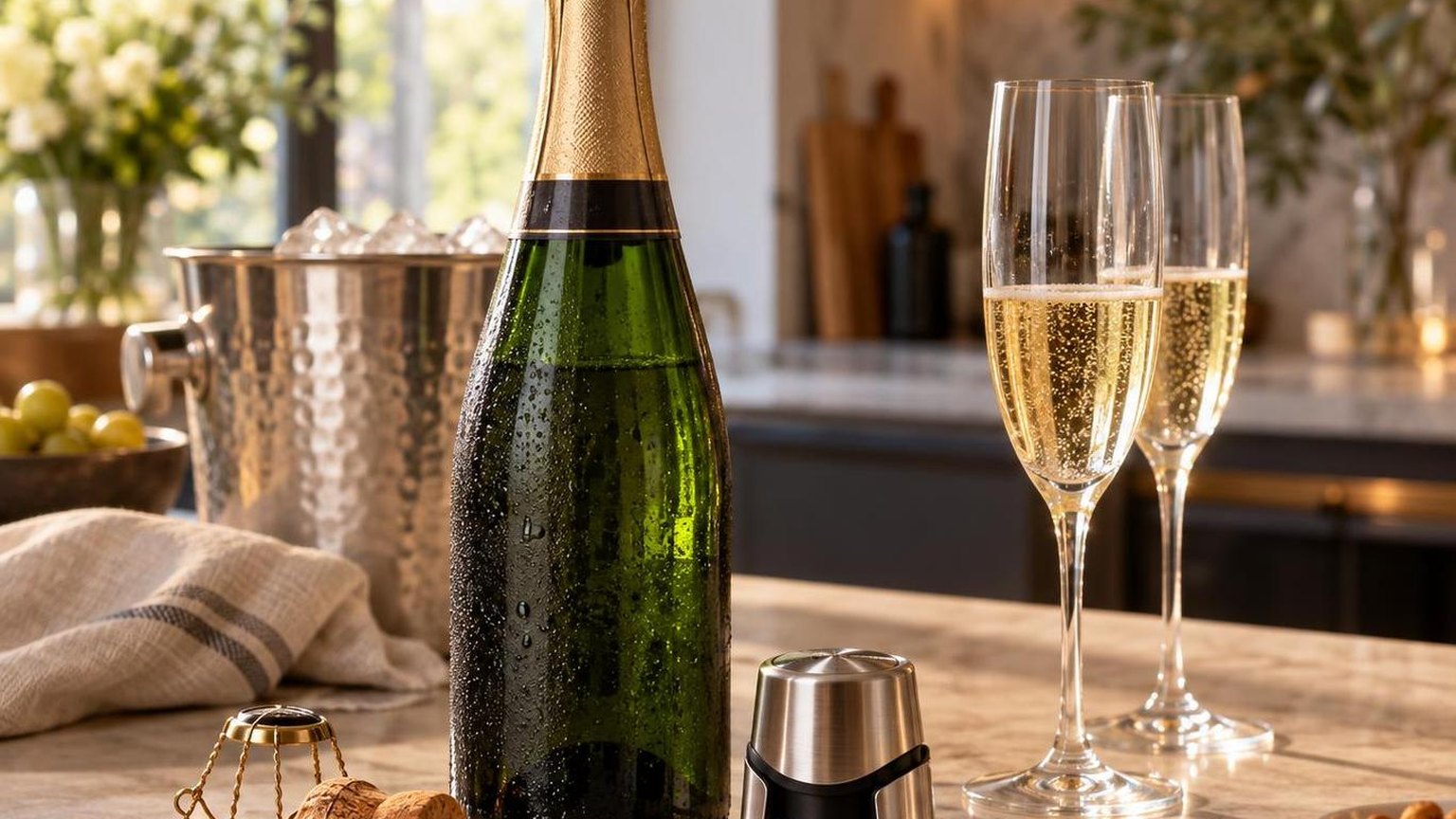
Best Storage for Open Champagne
Store opened Champagne immediately in a refrigerator at approximately 38–40°F (3–4°C). Fit the bottle with a purpose-built sparkling-wine stopper, keep it upright, and minimize temperature changes to preserve carbonation and aroma.
Use a stopper designed for Champagne or sparkling wine.
Its side clamps grip the bottle’s rim while a gasket creates a pressure-resistant seal; ordinary flat wine stoppers can loosen because an opened Champagne bottle still contains substantial dissolved carbon dioxide.
Refrigerate the Bottle Upright
Keep the sealed bottle upright rather than on its side. This reduces the wine’s exposed surface area, limiting carbon-dioxide loss and slowing oxidation. Upright storage also prevents wine from contacting the stopper for extended periods.
| Storage method | Expected quality window | Recommendation |
| Refrigerated, sparkling-wine stopper | 1–3 days | Best option |
| Refrigerated, no stopper | Several hours | Drink promptly |
| Room temperature, stopper fitted | About 1 day | Use only temporarily |
| Freezer storage | Not recommended | Risk of expansion and breakage |
The 1–3-day window describes good drinking quality, not a safety deadline. Champagne usually remains safe longer when refrigerated, but its bubbles, freshness, and aroma decline quickly after opening.
Vintage Champagne and delicate rosé styles often show noticeable quality loss sooner than robust non-vintage cuvées.
Control Temperature and Air Exposure
- Return the bottle to the refrigerator within 15–30 minutes after pouring.
- Keep the stopper fitted between pours instead of relying on the original cork, which cannot be reinserted safely or effectively.
- Store the bottle away from the refrigerator door, where repeated opening causes greater temperature fluctuation.
- Keep Champagne away from strong-smelling foods because wine can absorb odors through imperfect seals and the bottle neck.
Do not depend on the spoon-in-the-neck method. A metal spoon does not form an airtight seal, and controlled testing has not established it as a reliable way to retain carbonation.
Do not freeze an opened bottle. Champagne expands as it freezes, creating pressure that can force out the stopper or crack the glass. If the bottle has already warmed, chill it gradually in the refrigerator before serving.
When to Discard It
Pour a small sample before serving. Discard Champagne that smells strongly of vinegar, wet cardboard, bruised apple, or sulfur, or that has developed a flat, dull taste. Loss of bubbles alone indicates declining quality rather than spoilage.
Signs Open Champagne Has Spoiled
Opened Champagne usually loses quality before it becomes unsafe. Judge it by aroma, flavor, bubbles, and appearance; discard the bottle when contamination, mold, or an unmistakably unpleasant odor appears.
Loss of bubbles
Weak carbonation is the earliest change. Carbon dioxide escapes after opening, especially when the bottle is warm or loosely covered.
A flat pour is stale rather than dangerous, but it no longer delivers Champagne’s expected mousse, texture, or aromatic lift.
| Condition | Typical observation | Meaning |
| Immediately after opening | Persistent streams of fine bubbles and a lively mousse | Normal carbonation |
| After 1–3 refrigerated days with a Champagne stopper | Fewer bubbles, softer mousse, less aromatic intensity | Quality decline; often still drinkable |
| After several days without an airtight stopper | Little or no fizz | Stale, oxidized wine |
| Stored above 40°F | Carbonation and freshness disappear faster | Accelerated deterioration |
Oxidized aromas and flavors
Fresh Champagne may smell of citrus, apple, flowers, brioche, toast, or nuts. Excess oxygen gradually replaces those aromas with bruised apple, stale cider, sherry-like nuttiness, or wet cardboard.
The palate may taste dull, bitter, or unusually heavy.
Slight nuttiness can be intentional in mature or oak-aged Champagne. Spoilage is more likely when that character appears suddenly after opening and accompanies faded fruit, browning, or a flat finish.
Sharp vinegar or solvent odors
A pronounced vinegar smell indicates volatile acidity, commonly associated with acetic acid produced when oxygen and acetic-acid bacteria interact with wine. A nail-polish-remover odor can indicate ethyl acetate.
Do not serve Champagne showing either strong defect.
Unexpected visual changes
- Darkening: White Champagne that shifts noticeably toward deep gold or brown after opening has oxidized.
- Cloudiness: New haze, ropy strands, or floating material can indicate microbial activity, particularly when paired with unpleasant aromas.
- Mold: Fuzzy growth around the closure, bottle lip, or wine surface warrants disposal of the entire bottle.
- Normal sediment: Fine crystals may be harmless tartrates, while older vintages can contain natural sediment. Appearance alone does not prove spoilage.
Taste only after the wine passes the visual and smell checks. A small sip that tastes merely flat can be used for cooking, but sour, musty, chemical, or otherwise repellent Champagne should be discarded rather than masked in cocktails or sauces.
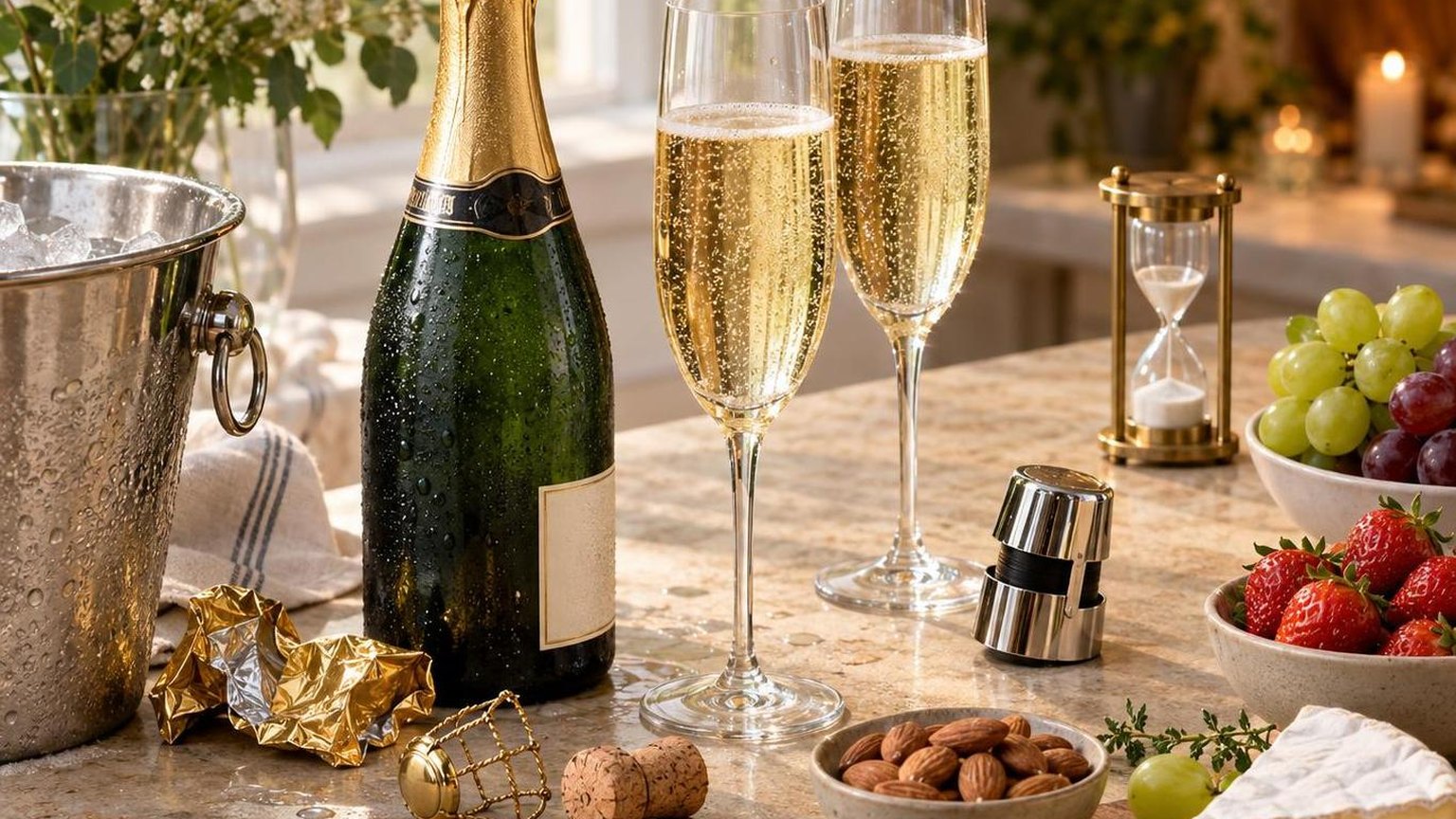
When to Finish an Open Bottle
Finish opened Champagne while its carbonation, aroma, and acidity still feel balanced. Refrigeration and a pressure-rated sparkling-wine stopper preserve quality; neither restores carbon dioxide already lost when the cork was removed.
The practical deadline depends more on storage than on whether the label says Brut, Extra Dry, or Rosé. Use the following windows as quality guidelines, not rigid food-safety limits.
| Storage method | Best drinking window after opening | Expected condition |
| Refrigerated with a Champagne stopper | Within 1–3 days | Usually retains usable bubbles and fresh fruit character; pressure declines each time the bottle is reopened. |
| Refrigerated without a stopper | Same day or by the next day | Carbonation escapes quickly through the open neck, leaving a softer mousse and muted aromas. |
| Left at room temperature | Within several hours | Warmer wine releases dissolved carbon dioxide faster and oxidizes more rapidly. |
| Stored with a spoon in the neck | No dependable extension | A spoon does not create a seal or maintain pressure; use a proper stopper instead. |
Use Sensory Signs, Not the Calendar Alone
A bottle can remain drinkable after losing its sparkle, but it may no longer deliver the texture expected from Champagne. Pour a small sample and assess it before serving guests.
- Finish it now if the stream of bubbles is weaker but the wine still smells fresh and tastes lively.
- Repurpose it if it tastes flat yet remains clean, tart, and free of unpleasant odors. It can work in pan sauces, risotto, vinaigrettes, or poached fruit.
- Discard it if it smells strongly of vinegar, nail-polish remover, mold, or rotten fruit, or if contamination entered the bottle.
Storage That Protects the Remaining Wine
Seal the bottle immediately after pouring and return it to the refrigerator. Keep it upright: the smaller exposed surface area reduces gas exchange compared with storing the bottle on its side.
Use a hinged stopper designed to lock beneath the bottle’s lip. Do not force the original mushroom-shaped cork back into place; it expands after removal and may not hold securely against residual pressure.
For the best experience, plan to finish a properly sealed bottle by the second day. The third day is a reasonable outer target, but delicate aromas and mousse may already be noticeably diminished.
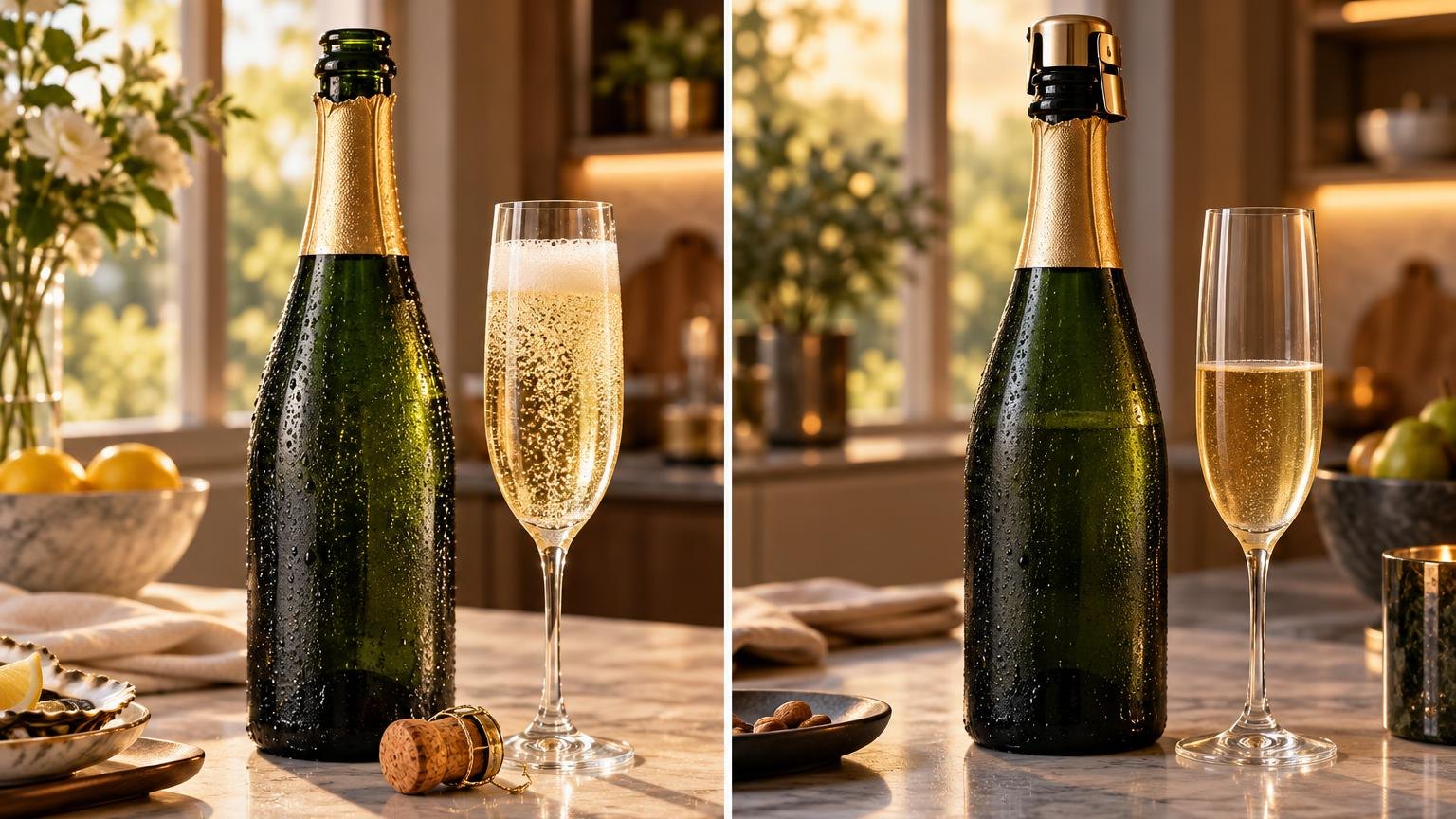
Questions Readers Ask
How long does Champagne last after opening?
Opened Champagne typically retains good carbonation and flavor for 1 to 3 days when sealed with a Champagne stopper and refrigerated at about 40°F. Without a proper stopper, noticeable fizz can disappear within several hours.
Can opened Champagne remain drinkable for a week?
Champagne may remain safe to drink after a week in the refrigerator, but it will usually be flat, oxidized, and less aromatic. Discard it if it develops a vinegar-like odor, an unusual color, or an unpleasant taste.
What is the best way to store opened Champagne?
Fit the bottle with a locking sparkling-wine stopper, keep it upright, and refrigerate it immediately. Cold storage slows carbon dioxide loss and oxidation, while the upright position reduces the wine’s exposed surface area.
Does a regular wine stopper preserve Champagne?
A standard still-wine stopper does not lock onto the bottle and may loosen under pressure. Use a hinged Champagne stopper designed to grip the bottle’s lip and contain carbonation safely.
Does putting a spoon in an open Champagne bottle keep it fizzy?
No reliable evidence shows that placing a metal spoon in the bottle neck preserves carbonation. A pressure-rated Champagne stopper and refrigeration are substantially more effective because they physically limit gas escape.
How can you tell whether opened Champagne has gone bad?
Spoiled or severely oxidized Champagne may smell like vinegar, bruised apples, or damp cardboard and may taste sour or stale. Loss of bubbles alone does not make it unsafe, but it indicates diminished quality.
Can leftover Champagne be frozen to make it last longer?
Freezing Champagne in its original bottle is unsafe because expanding liquid and trapped pressure can crack or eject the closure.
Instead, freeze leftovers in an ice-cube tray for later use in sauces, granitas, or cocktails, where reduced carbonation is unimportant.
Further Reading
- How Long Does Unopened Champagne Last? 9 Surprising Truths You Need to Know
- Difference Between Brut and Extra Dry Champagne
- How Long Does Moet Champagne Last Unopened? – A Real-World, Experience-Based Guide to Shelf Life, Storage, and Quality (2026 Update)
- How Many Calories In A Bottle Of Champagne 750Ml? The Surprising Truth You Need to Know (Complete Guide)
- Cava Vs Champagne: The Easiest Way to Distinguish
- How To Break A Champagne Bottle? – A Complete Safety-First Guide Based on Real Experience
- What Percentage Alcohol Is Champagne?
- Moet Vs Veuve: The Easiest Way to Distinguish Between Them
- All Alcohol Guides





