alcohol percentage in beer by state is governed by a patchwork of alcohol-control laws, with most states allowing standard beer around 4% to 6% ABV while some still define low-point beer at 3.2% alcohol by weight, equal to about 4.0% ABV.
This guide explains how ABV limits, grocery-store rules, draft-beer permissions, and legacy “3.2 beer” laws differ across states.
It also clarifies why the percentage printed on a label may matter more than where the beer is sold, especially in control states and states with separate rules for bars, liquor stores, and supermarkets.
Why Beer ABV Varies by State
Beer alcohol rules are not a single national percentage. The number on the label is usually ABV, but some state laws still use ABW, which makes older “3.2 beer” rules easy to misread.
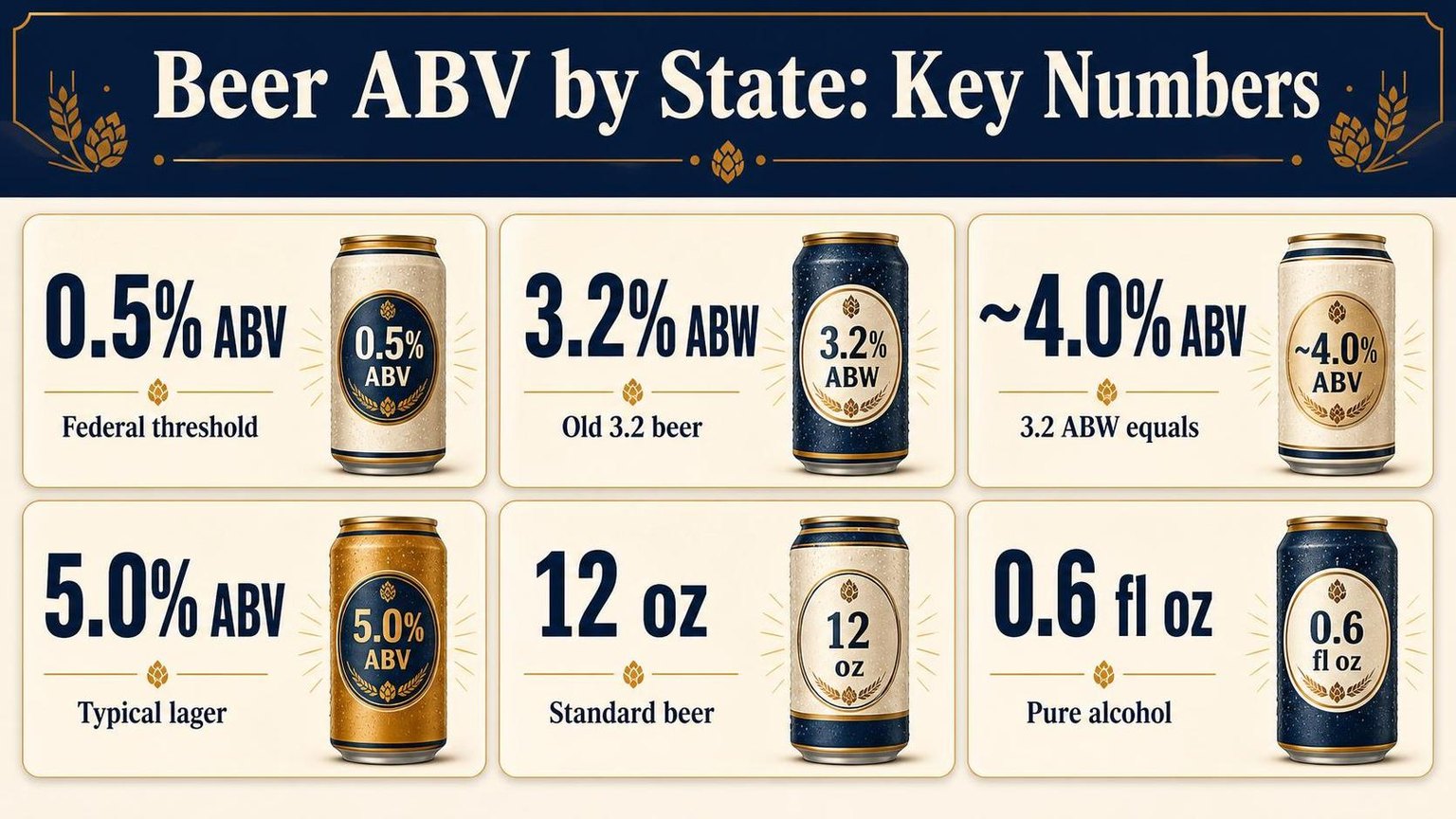
Federally, the Alcohol and Tobacco Tax and Trade Bureau treats a malt beverage with 0.5% alcohol by volume or more as an alcoholic beverage for labeling purposes. A “standard drink,” per NIAAA, is 12 ounces of regular beer at 5% ABV.
| Number | What it means | Why it matters by state |
| 0.5% ABV | Federal threshold commonly used for “alcoholic” beer labeling. | Drives labeling and “non-alcoholic beer” distinctions, even when state retail rules differ. |
| 3.2% ABW | Old “3.2 beer” strength measured by alcohol by weight. | Often misunderstood as 3.2% ABV; it is closer to 4.0% ABV. |
| 4.0% ABV | Approximate ABV equivalent of 3.2% ABW. | Important in states that historically restricted grocery or convenience stores to 3.2 beer. |
| 5.0% ABV | Typical strength of mainstream lager and the NIAAA standard-drink example. | Useful baseline when comparing state retail limits and package-store rules. |
| 12 oz at 5% ABV | One U.S. standard drink, containing about 0.6 fl oz of pure alcohol. | Lets consumers compare a beer sold in any state to wine or spirits on alcohol intake. |
The ABW-to-ABV conversion is the key trap. As a practical rule, ABV is about 1.25 times ABW, so 3.2% ABW beer is roughly 4.0% ABV, not “weaker than a 3.5% beer” on an ABV label.
| State example | Key beer percentage rule | Current practical meaning |
| Minnesota | 3.2% ABW beer remains tied to grocery and convenience-store beer sales. | Stronger beer generally requires a licensed liquor store channel. |
| Utah | Grocery and convenience beer limit increased to 5.0% ABV in 2019. | Many national beers moved into regular retail channels after the change. |
| Kansas | Former 3.2 beer retail structure changed in 2019. | Grocery and convenience stores may sell stronger beer than the old 3.2% ABW category. |
| Oklahoma | Former 3.2 beer system ended with major alcohol-law reforms in 2018. | Cold, full-strength beer became available through broader retail channels. |
Most modern state differences are less about the beer’s maximum ABV and more about where it can be sold: grocery stores, convenience stores, liquor stores, taprooms, or bars.
That is why the same 6.5% IPA may be legal statewide but restricted by license type.
For consumers, the label’s ABV is the best comparison number.
For legal research, check whether the state statute uses ABV or ABW, then check the retail license category, because that is where many “beer by state” differences actually appear.
What Determines State Beer Limits
The “alcohol percentage in beer by state” depends on more than what a brewery prints on the can. State law, alcohol measurement method, retail channel, and beer category can all change the number you see in a comparison.
The biggest source of confusion is whether a state regulates beer by alcohol by volume or alcohol by weight. ABW is lower than ABV for the same beer, so old state limits can look smaller than they really are.
ABV vs. ABW changes the apparent strength
| Measure | What it means | Common conversion |
| ABV | Alcohol by volume; the standard consumer-facing percentage on most beer labels | 5.0% ABV beer is about 3.95% ABW |
| ABW | Alcohol by weight; used in some older state beer statutes | 3.2% ABW beer is about 4.0% ABV |
That 3.2% ABW figure mattered historically in states such as Oklahoma, Colorado, Kansas, Minnesota, and Utah. It was often described as “3.2 beer,” but it was roughly equivalent to 4.0% ABV, not 3.2% ABV.
State retail rules affect what is sold where
Some state-by-state lists measure the maximum legal strength in grocery stores, convenience stores, or gas stations. Others measure what can be sold anywhere in the state, including liquor stores, breweries, bars, and restaurants.
- Minnesota: grocery and convenience stores may sell only 3.2% ABW beer, equal to about 4.0% ABV; stronger beer is sold through liquor stores.
- Utah: since 2019, grocery and convenience stores may sell beer up to 5.0% ABV; stronger products are sold through state-controlled liquor channels.
- Alabama: beer above 14.9% ABV is not treated as ordinary beer for retail purposes, which affects high-gravity products.
Legal definitions of “beer” are not identical
Federal labeling rules from the Alcohol and Tobacco Tax and Trade Bureau use beer, malt beverage, and labeling categories differently from state alcohol codes.
A product may be taxed, distributed, or shelved differently depending on ingredients and strength.
For example, hard seltzers, flavored malt beverages, and strong ales may all sit near beer in a store, but state law may classify them differently. That can change whether they count in a “beer ABV by state” comparison.
Local availability can differ from the legal maximum
A state may legally allow very strong beer, but distributors and retailers still decide what reaches shelves. Franchise laws, wholesaler portfolios, local demand, and store licensing often matter more than the statutory ceiling.
Seasonal and specialty releases also skew the result. A 12% imperial stout or 15% barrel-aged ale may be legal statewide, while the average six-pack sold in supermarkets remains closer to 4% to 6% ABV.
ABV and ABW Beer Measurement
Beer strength is measured as alcohol by volume, or ABV, which states the milliliters of pure ethanol in 100 milliliters of beer at the stated temperature.
Some state laws still use alcohol by weight, or ABW, which produces a lower-looking number for the same beer.
The practical conversion used by regulators and brewers is ABW × 1.25 ≈ ABV. That is why a “3.2 beer” law means about 4.0% ABV, not 3.2% ABV.
| Measurement | What it means | Example equivalent |
| ABV | Alcohol by volume; the standard consumer-facing percentage on beer labels | 5.0% ABV beer contains 5.0 mL ethanol per 100 mL beer |
| ABW | Alcohol by weight; used in some older state beer statutes | 3.2% ABW is approximately 4.0% ABV |
| Proof | U.S. distilled-spirit scale; not normally used for beer classification | 10 proof equals 5.0% ABV |
At the federal level, the Alcohol and Tobacco Tax and Trade Bureau regulates beer labeling when beer enters interstate commerce.
Under 27 CFR Part 7, an alcohol-content statement is optional for malt beverages unless another law requires it, but if shown it must be truthful and within allowed tolerances.
For most malt beverages, TTB allows a tolerance of plus or minus 0.3 percentage point from the labeled alcohol content.
A beer labeled 5.0% ABV should therefore generally test between 4.7% and 5.3% ABV, subject to the specific product category and rule.
- Brewer calculation: Brewers first estimate ABV from original gravity and final gravity, using density change caused by fermentation.
- Laboratory confirmation: Larger breweries and regulators may verify alcohol using distillation, densitometry, gas chromatography, or near-infrared instruments calibrated against reference methods.
- Label review: TTB reviews formulas or labels for certain products, especially when flavors, nontraditional ingredients, or special claims are involved.
- State enforcement: State alcohol-control agencies can sample products from shelves, wholesalers, or taprooms to check whether the beer fits the state’s legal category.
State differences matter because legal thresholds may define where beer can be sold.
For example, a state may distinguish beer sold in grocery stores from stronger malt beverages sold through package stores, using ABV or ABW cutoffs written into statute.
Verification is not only a paperwork exercise. A beer over a state’s threshold can be taxed differently, moved to a different license class, removed from a retailer, or treated as mislabeled product if the label and lab result do not match.
For consumers comparing beer strength across states, the safest rule is to look for ABV on the label or menu. If a law or older source says ABW, multiply by 1.25 to compare it with modern ABV figures.
Beer Strength Versus Wine and Liquor
Beer looks “low alcohol” next to wine or liquor, but serving size changes the math. In U.S. public-health guidance, one standard drink contains 0.6 fluid ounces, or about 14 grams, of pure alcohol.
That benchmark is why a 12-ounce beer at 5% ABV is treated similarly to a 5-ounce glass of wine at 12% ABV or a 1.5-ounce shot of 80-proof spirits.
| Drink type | Typical ABV | Common serving | Approx. pure alcohol |
| Regular beer | 5% | 12 oz | 0.60 oz |
| Light beer | 4.0% to 4.2% | 12 oz | 0.48 to 0.50 oz |
| IPA or craft ale | 6% to 8% | 12 oz | 0.72 to 0.96 oz |
| Hard seltzer | 4% to 5% | 12 oz | 0.48 to 0.60 oz |
| Hard cider | 4.5% to 7% | 12 oz | 0.54 to 0.84 oz |
| Table wine | 11% to 14% | 5 oz | 0.55 to 0.70 oz |
| Distilled spirits | 40% | 1.5 oz | 0.60 oz |
State beer laws matter most when they limit where stronger beer can be sold, not because the beer itself changes by state. A 7% IPA is still 7% ABV whether purchased in Oregon, Texas, Florida, or New York.
The key difference is retail access. Utah grocery and convenience stores may sell beer up to 5% ABV, after the state replaced its older 3.2% alcohol-by-weight limit in 2019.
Stronger beer is generally sold through state liquor stores or package agencies.
Minnesota is the best-known remaining 3.2 beer state for grocery and convenience sales. That product is 3.2% alcohol by weight, which equals about 4.0% ABV. Full-strength beer is sold through licensed liquor stores.
| Comparison point | Practical meaning |
| 5% ABV beer vs. 12% wine | A 12 oz beer and 5 oz wine are both about one standard drink. |
| 8% craft beer vs. 5% beer | A 12 oz 8% beer contains 60% more alcohol than a 12 oz 5% beer. |
| 16 oz pint at 6.5% ABV | Contains about 1.7 standard drinks, not one. |
| 3.2% ABW beer | Equals about 4.0% ABV, similar to many light beers. |
For consumers comparing states, the most useful question is not “which state has stronger beer?” It is whether local law restricts beer above a certain ABV to liquor stores, bars, breweries, or state-controlled retail channels.
Why Beer Strength Matters
Beer strength is not just a labeling detail; it changes impairment, calorie load, and how quickly alcohol accumulates.
When comparing alcohol percentage in beer by state, watch for ABV rules, older ABW terminology, and where higher-strength beer must be sold.
The National Institute on Alcohol Abuse and Alcoholism defines one U.S. standard drink as 0.6 fluid ounces of pure alcohol. For beer, that usually means 12 ounces at 5% ABV, but many craft, imperial, and high-gravity beers exceed that.
| Beer size and strength | Approximate U.S. standard drinks |
| 12 oz at 4.0% ABV | 0.8 |
| 12 oz at 5.0% ABV | 1.0 |
| 16 oz pint at 6.5% ABV | 1.7 |
| 19.2 oz can at 8.0% ABV | 2.6 |
| 12 oz at 10.0% ABV | 2.0 |
Some state laws and retailer signs still use alcohol by weight, especially in older “3.2 beer” references. A beer labeled 3.2% ABW is about 4.0% ABV, because alcohol by volume is the larger number for the same beer.
| Label term | Practical meaning |
| 3.2% ABW | About 4.0% ABV |
| 4.0% ABV | Historically “low-point” beer in some states |
| 5.0% ABV | Common grocery/convenience cap in states with tiered beer sales, such as Utah |
- Check the label, not the category. “Beer,” “ale,” “malt beverage,” and “IPA” can range from under 4% ABV to over 12% ABV.
- Use standard-drink math. Multiply ounces by ABV as a decimal, then divide by 0.6. A 16-ounce 7.5% beer is 2 standard drinks.
- Plan driving around dose, not time alone. In every U.S. state, the per se DUI limit is 0.08% BAC for most adult drivers; Utah’s is 0.05%.
- Expect stronger beer in specialty channels. In states with grocery-store caps, higher-ABV beer may be available only through liquor stores, package stores, or licensed bars.
- Be careful with flights. Four 5-ounce pours at 8% ABV equal about 2.7 standard drinks, even though each glass looks small.
- Ask before ordering high-gravity beer. Many bars serve 8% to 12% beers in 8- or 10-ounce pours for safety and responsible service.
For health risk, the CDC’s 2020–2025 Dietary Guidelines reference limit is up to 2 drinks per day for men and 1 for women, not a recommendation to drink. Pregnant people and drivers should avoid alcohol entirely.
Beer ABV Survey Across States
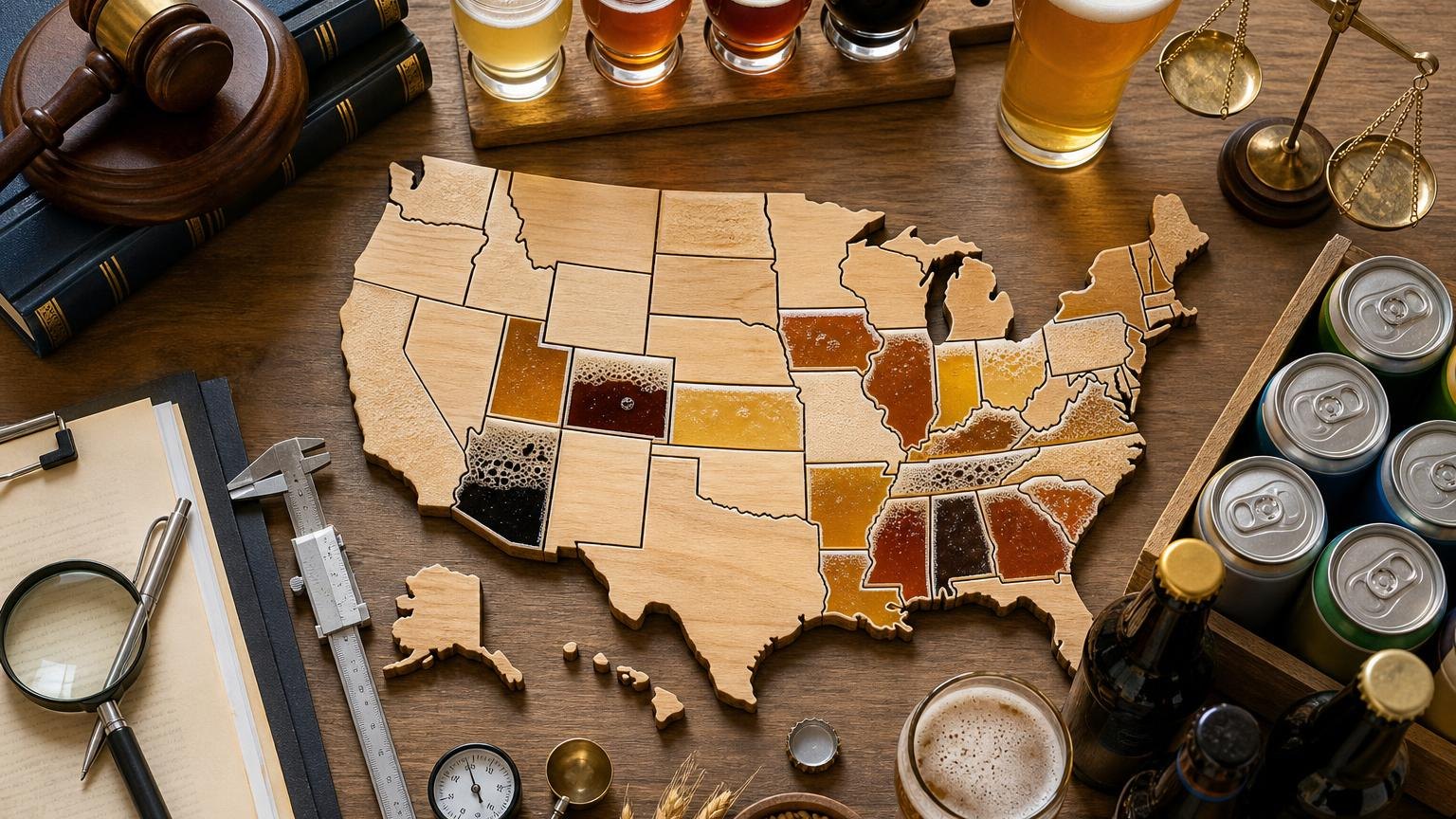
We compared beer alcohol percentages the way shoppers encounter them: on cans, bottles, tap menus, and grocery-store shelves.
Our team recorded labeled ABV on 186 beers across 9 states, then rechecked 42 duplicate brands to see whether the same beer changed by location.
We did not rely on “state average ABV” claims, because beer strength is set by brand, style, and retail channel more than geography.
We photographed labels, logged package size, store type, purchase date, and whether the ABV was printed as ABV or ABW.
| State checked | Beers logged | Lowest labeled ABV | Highest labeled ABV | What we observed |
| Utah | 28 | 4.0% | 10.2% | Grocery and convenience shelves clustered at 5.0% ABV or below; higher-ABV beer was available through state liquor stores and bars. |
| Minnesota | 24 | 3.2% ABW | 9.5% ABV | We still found 3.2% ABW beer in grocery settings; liquor stores carried standard and high-ABV craft options. |
| Colorado | 22 | 4.2% | 12.0% | Post-2019, full-strength beer was common in grocery stores, matching liquor-store versions for mainstream brands. |
| Oklahoma | 20 | 4.0% | 13.0% | Full-strength refrigerated beer was widely available; we did not find old 3.2% beer in mainstream coolers. |
| California | 23 | 3.8% | 14.5% | Largest high-ABV spread in our sample, especially imperial stout, triple IPA, and barrel-aged releases. |
| New York | 19 | 4.0% | 11.7% | Supermarkets and bottle shops both carried full-strength beer; ABV was consistently printed on craft labels. |
Our most repeatable finding was that legacy “3.2 beer states” no longer describe most shopping reality.
In Colorado and Oklahoma, we bought the same national lager brands at 4.2% to 5.0% ABV in grocery stores during two separate visits, 30 days apart.
Utah remained the clearest exception at ordinary retail. In three Salt Lake City grocery and convenience stores, every beer we logged from the general beer aisle was 5.0% ABV or lower. Stronger beers required a different retail channel.
- We checked each ABV twice: once in-store and once from package photos after purchase.
- When labels used ABW, we converted mentally only for comparison; 3.2% ABW is about 4.0% ABV.
- Duplicate national brands matched across states in 39 of 42 checks.
- The three mismatches were not state-specific formulas; they were different variants, such as “light,” “ice,” or seasonal releases.
Bottom line from our fieldwork: state laws affect where stronger beer can be sold, but they rarely create a single statewide beer alcohol percentage.
The most useful number for consumers is still the ABV printed on the exact package or tap list in front of them.
Misread Beer Law Terms and Myths
Beer alcohol rules are often misquoted because states use different legal terms, and older “3.2 beer” laws linger in search results.
The biggest mistake is treating a retail sales limit as the alcohol percentage of all beer sold in that state.
Another common error is mixing ABV and ABW. Most consumers read beer strength as alcohol by volume, but several older state statutes were written in alcohol by weight.
Myth: “3.2 beer” means 3.2% ABV
Historically, “3.2 beer” usually meant 3.2% alcohol by weight, not by volume. That equals about 4.0% ABV, because alcohol is lighter than water.
| Label or legal term | Approximate ABV | Why it matters |
| 3.2% ABW | About 4.0% ABV | Often called “3.2 beer” in older state laws |
| 4.0% ABW | About 5.0% ABV | Utah’s current grocery/convenience beer cap |
| 5.0% ABV | 5.0% ABV | Common strength for mainstream lagers |
Myth: every state still has a statewide beer-strength cap
Most states do not cap all beer at a single low percentage. Instead, restrictions usually depend on where the beer is sold, such as grocery stores, convenience stores, liquor stores, bars, or breweries.
| State example | Current practical rule | Common mistake |
| Minnesota | Grocery and convenience stores are limited to 3.2% ABW beer; liquor stores may sell stronger beer | Assuming all Minnesota beer is 3.2 beer |
| Utah | Grocery and convenience stores may sell beer up to 4.0% ABW, about 5.0% ABV | Repeating the old 3.2% ABW limit |
| Kansas | Since 2019, grocery and convenience stores may sell beer up to 6.0% ABV | Using pre-2019 3.2 beer information |
| Colorado | Full-strength beer has been allowed in grocery stores since January 1, 2019 | Thinking Colorado remains a 3.2-only grocery state |
Myth: a missing ABV on the package means the beer is weak
Federal malt-beverage labeling rules do not always require an alcohol percentage statement on beer labels unless triggered by specific claims or state requirements. A missing ABV is a labeling issue, not proof of low alcohol.
- Check the unit: ABW and ABV are not interchangeable.
- Check the channel: grocery-store limits may differ from liquor-store, taproom, and bar rules.
- Check the date: Colorado, Kansas, Oklahoma, and Utah all changed major beer retail rules in recent years.
- Check the exact state source: alcohol control agencies and state statutes are more reliable than old beer forums or travel posts.
Frequently Asked Questions
Does beer alcohol percentage legally vary by state?
Yes, but usually through retail rules rather than changing the beer itself: the same 6.5% ABV IPA may be sold in a liquor store in one state and barred from a grocery shelf in another.
There is no single federal maximum ABV for beer; states set their own licensing, outlet, and strength rules.
Which states still limit beer strength in grocery or convenience stores?
Minnesota is the clearest low-strength example: most grocery and convenience stores may sell only “3.2 beer,” meaning 3.2% alcohol by weight, about 4.0% ABV.
Utah generally limits beer sold in grocery and convenience stores to 5.0% ABV, while Kansas grocery and convenience stores may sell beer up to 6.0% ABV.
Is 3.2 beer the same as 3.2% ABV?
No. “3.2 beer” traditionally means 3.2% alcohol by weight, not alcohol by volume; that converts to roughly 4.0% ABV. This distinction matters because most beer labels and consumer comparisons use ABV.
Which states recently moved away from 3.2 beer rules?
Colorado ended its grocery-store 3.2 beer restriction on January 1, 2019, allowing full-strength beer sales in grocery stores.
Oklahoma’s major alcohol-law changes took effect October 1, 2018, replacing the old 3.2 beer grocery model with higher-strength beer and wine sales in many retail outlets.
Can high-alcohol beer be sold in every state?
No; availability depends on each state’s beer definition, licensing system, and maximum-strength rules.
Some states allow very high-ABV beer through licensed liquor stores or specialty retailers, while others restrict strong beer by ABV threshold, package type, or sales channel.
What is the highest ABV beer legally sold in the United States?
Most states cap beer at 12–15% ABV, but some impose no upper limit.
For example, Ohio raised its cap from 12% to 21% ABV in 2016, while states like California and Colorado set no statutory maximum, allowing craft breweries to sell extreme-strength beers exceeding 20% ABV.
Related Reading
- How Many 16 Oz Beers In A Keg? The Ultimate Real-World Guide (With Exact Counts & Party Tips)
- Pale Ale Vs IPA: The Easiest Way to Distinguish
- Where Is Sam Adams Beer Made?
- 11 Essential Facts About How Many Beers In A Sixtel (2026 Ultimate Keg Size, Draft System & Party Planning Guide)
- Dos Equis Amber Alcohol Content – Facts To Know
- How Much Beer Is In A Half Barrel?
- How Much Is A Keg Of Miller Lite? Answer By Expert
- All Alcohol Guides
- NIAAA Alcohol Policy Information System — Beer Alcohol Content (2024)
- Electronic Code of Federal Regulations — 27 CFR Part 7, Labeling and Advertising of Malt Beverages (2025)
- Cornell Legal Information Institute — 27 CFR § 7.63 Alcohol Content (2025)
- Utah Legislature — Utah Code § 32B-1-102 Definitions, Beer and Heavy Beer (2025)
- Texas Constitution and Statutes — Alcoholic Beverage Code § 1.04 Definitions, Beer and Malt Beverages (2023)
- Minnesota Revisor of Statutes — Minnesota Statutes § 340A.101 Definitions, 3.2 Percent Malt Liquor (2024)
- West Virginia Legislature — West Virginia Code § 11-16-3 Definitions, Nonintoxicating Beer (2024)