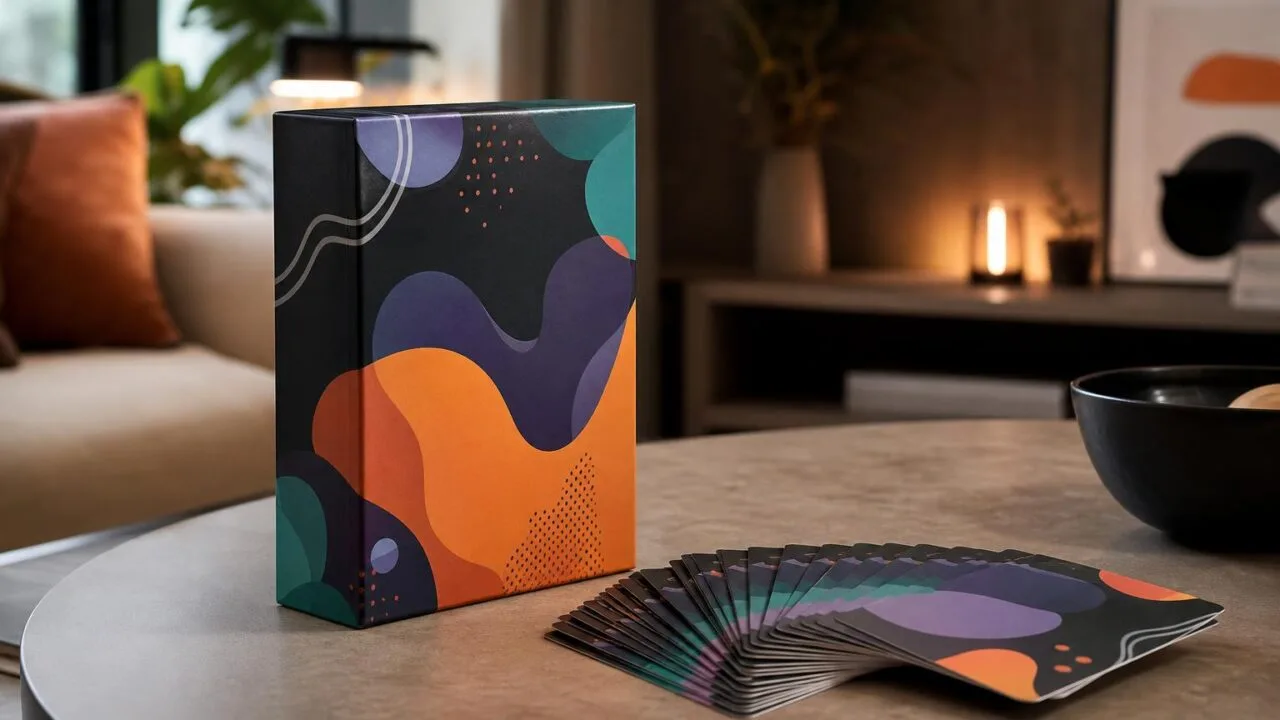
Who’s Most Likely To Card Game is a party prompt game where players vote on which friend best fits funny, revealing, or chaotic scenarios.
It works because the rules are simple: draw a card, read the prompt aloud, count down, and point or vote. The chosen player usually keeps the card as a score.
This guide explains how to play, how many people you need, the best house rules, and which prompts work for adults, families, couples, or drinking-game nights.
Expect practical setup tips, safe boundaries, scoring options, and sample questions that keep the game lively without turning the table uncomfortable.
Player Counts Cards and Playtime
Who’s Most Likely To is built around a few practical numbers: how many people are playing, how many prompt cards are in the box, and how long your group spends debating each vote.
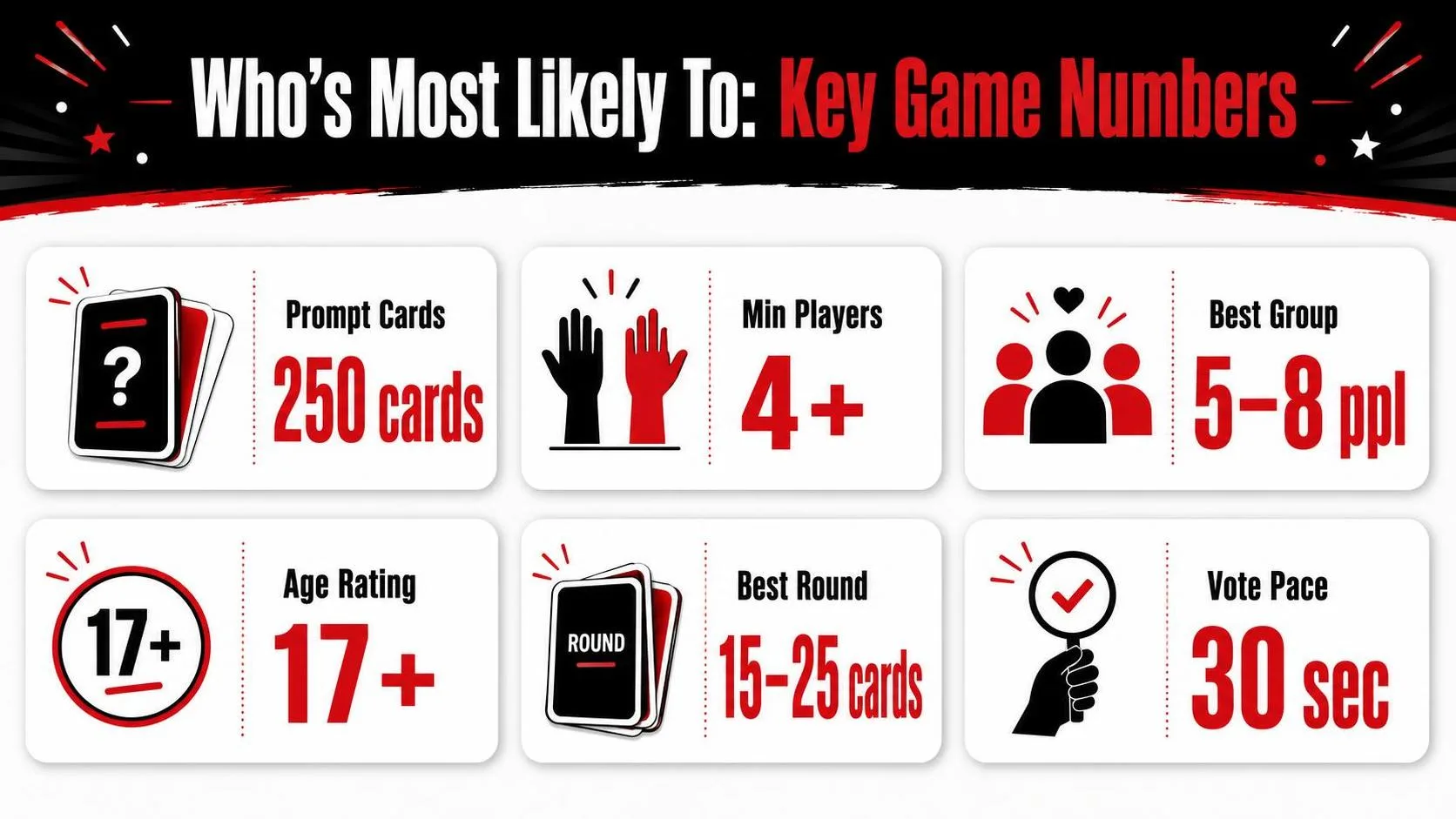
The best-known retail version from DSS Games lists 250 prompt cards, 4 or more players, and an age rating of 17+.
Those numbers matter because this is a social deduction-style party game, not a strategy game. The fun comes from comparison, shared history, and majority opinion, so the table size changes the experience more than the rules do.
| Number | What it means in play | Why it matters |
| 250 cards | The standard DSS Games edition includes 250 “most likely to” prompts. | At 20 cards per round, one box supports about 12 full 20-card sessions before repeats become likely. |
| 4+ players | The publisher recommends at least 4 players. | With only 3 people, votes become too obvious; with 4 or more, accusations and split opinions become more interesting. |
| 17+ age rating | The official game is intended for older teens and adults. | Many cards use adult humor, dating references, alcohol-adjacent situations, or embarrassing personal judgments. |
| 1 card per turn | A player reads one prompt, and everyone decides who fits it best. | The game stays fast because there are no hands, dice, scoring boards, or complicated turns. |
| 10–30 seconds | Most prompts can be voted on quickly if the group knows each other well. | A 25-card session can finish in roughly 10–20 minutes, depending on debate and storytelling. |
The 4-player minimum is the most important number to respect.
In first-hand party use, the game works noticeably better at 5 to 8 players, where there are enough personalities for disagreement but not so many that every prompt turns into a long argument.
At 9 or more players, the game can still be funny, but it needs firmer hosting. Have one person read, count down, and call the vote. Otherwise, louder players can dominate and quieter players may stop participating.
The 250-card count is generous for casual play, but replay value depends on the group. A prompt is funnier when players have real history together.
With the same group every week, cards may feel familiar after several sessions, even if the deck is not technically exhausted.
- Best small group: 4–5 players, because everyone is involved in every vote.
- Best party size: 6–8 players, because debate and surprise answers are strongest.
- Best round length: 15–25 cards, especially if drinks, food, or other games are part of the night.
- Best pacing rule: limit debate to about 30 seconds before voting.
The 17+ rating should be treated as a real content warning, not just a box label. For mixed-age gatherings, family dinners, or workplace events, use a cleaner edition, pre-screen the deck, or choose a different prompt game.

How Votes Are Decided
The result of a “Who’s Most Likely To” card game is not random. It is shaped by who is playing, how well they know each other, the wording of the card, and the social pressure in the room.
In practice, the funniest or most “accurate” answer often comes from shared history, not objective truth. A group that has traveled, worked, dated, or lived together will usually vote differently than a group that met that night.
Group Size Changes the Vote
With more players, votes spread out and inside jokes become less dominant. With fewer players, one memorable story can heavily influence the outcome.
| Players | How results usually feel | Why it matters |
| 3–4 | Personal and direct | Each vote carries 25% to 33% of the result, so one strong opinion can decide the card. |
| 5–7 | Balanced | Enough people create debate, but most players still know each other’s habits. |
| 8+ | Chaotic and comedic | Votes often split, and louder personalities may influence the table more. |
Familiarity Matters Most
Players who know each other well have more evidence to use. They remember who missed a flight, ordered the most expensive bottle, texted an ex, or disappeared at the after-party.
- Close friends: Results are usually sharper because players share years of stories.
- Coworkers: Votes often focus on visible traits, such as punctuality, confidence, or risk-taking.
- New acquaintances: Results rely more on first impressions, clothing, confidence, and humor.
Card Wording Can Tilt the Answer
A specific card produces cleaner votes than a vague one. “Most likely to forget their passport” is easier to judge than “most likely to be dramatic,” because it points to a clear behavior.
| Card style | Example | Typical effect |
| Specific behavior | “Most likely to lose their phone on vacation” | Players vote based on real incidents. |
| Personality label | “Most likely to be chaotic” | Votes depend more on reputation and interpretation. |
| Adult or risky theme | “Most likely to drunk text someone” | Players may vote more boldly, especially in close groups. |
Social Dynamics Influence Honesty
People do not always vote for the most accurate answer. They may avoid embarrassing a guest, target the funniest person, or follow the first loud vote.
- Alcohol: Even one or two drinks can reduce hesitation and make answers more candid.
- Host tone: A playful host keeps the game light; a competitive tone can make votes feel personal.
- Relationship status: Couples, exes, and coworkers may self-censor to avoid awkwardness.
- House rules: Anonymous voting usually produces more honest answers than pointing or raising hands.
The best results come from a group large enough for debate, familiar enough for real stories, and comfortable enough to laugh without turning the vote into an insult.
How Rounds Are Counted and Checked
In “Who’s Most Likely To,” measurement is simple: each round produces one prompt, every player points or votes, and the person receiving the most votes is the round’s answer.
Verification depends on a visible count, a consistent tie rule, and a written score record if the group is playing competitively.
The game is usually measured by plurality, not majority. That means a player can “win” a card without receiving more than half the votes, as long as they receive more votes than anyone else.
| Players voting | Votes needed for majority | Plurality example that still wins |
| 4 | 3 | 2 votes beats 1-1 |
| 6 | 4 | 3 votes beats 2-1 |
| 8 | 5 | 3 votes beats 2-2-1 |
| 10 | 6 | 4 votes beats 3-2-1 |
For accuracy, count votes immediately after the reveal. In a pointing version, the reader should count out loud from left to right. In a written-ballot version, one player reads names while another confirms the tally.
- One card equals one measured round. Do not combine prompts or carry votes between cards.
- One player equals one vote. A player should not vote twice unless house rules say the card reader breaks ties.
- Abstentions should be declared before voting. Otherwise, missing votes can change whether a result looks unanimous or split.
- Self-voting should be decided before play. Allowing it can change outcomes in small groups, especially with 3 or 4 players.
Verification is strongest when the group records results. A phone note, score sheet, or shared tally works. Record the prompt number or short prompt wording, the vote count, and the round winner.
| Verification item | Why it matters |
| Prompt or card text | Prevents disputes about what was actually asked |
| Total votes cast | Confirms every eligible player voted or abstained |
| Votes by player | Shows the winning margin and identifies ties |
| Tie result | Documents whether the group revoted, split the point, or used a tiebreaker |
A tie occurs when two or more players receive the same highest vote total. Common verified resolutions are a revote between tied players, awarding no point, or giving each tied player one point.
The group should choose one method before the first card.
If the game is used as a drinking or party activity, verification should not override safety. In the United States, the legal drinking age is 21, and any alcohol-related penalties should be optional, limited, and easy to skip.
How It Compares to Party Games
Who’s Most Likely To sits in the “social voting” corner of party games: players answer by pointing, naming, or voting for the person who best fits a prompt.
Compared with trivia or strategy games, it is faster to teach, more personal, and more dependent on the group’s shared history.
Its closest alternatives are Never Have I Ever, Truth or Dare, Would You Rather, and printed adult party games such as Cards Against Humanity.
The biggest differences are disclosure level, replay value, and how much the game can embarrass a specific person.
| Game | Typical players | Average round length | Main interaction | Best use |
| Who’s Most Likely To | 3–10+ | 15–30 minutes | Group votes on one person | Friends, pregame groups, bachelorette parties |
| Never Have I Ever | 3–12+ | 10–25 minutes | Players reveal past experiences | Groups comfortable with personal disclosures |
| Truth or Dare | 3–8+ | 20–45 minutes | One player answers or performs | High-energy groups, late-night parties |
| Would You Rather | 2–10+ | 10–20 minutes | Players choose between two options | Mixed groups, low-pressure conversation |
| Cards Against Humanity | 4–20+ | 30–90 minutes, per publisher guidance | Players submit punchline cards | Adult humor, less personal targeting |
Where It Wins
- Fast setup: no board, scoring pad, or long rulebook is needed. A host can explain the rules in under 60 seconds.
- Strong group engagement: everyone reacts to the same prompt at once, instead of waiting through long individual turns.
- Works with custom prompts: hosts can add local jokes, workplace-safe cards, or wedding-party questions to fit the room.
- Better for friend groups: the game improves when players know each other’s habits, stories, and reputations.
Where Alternatives Are Better
- Never Have I Ever is better when the goal is learning factual things about people, because each answer is tied to a real experience.
- Would You Rather is safer for new acquaintances, coworkers, or family groups because it asks for preferences, not accusations.
- Truth or Dare creates more physical energy, but it also requires stronger boundaries and a higher tolerance for awkward moments.
- Cards Against Humanity is less dependent on personal knowledge. It can work even when guests met 10 minutes ago.
The main tradeoff is specificity. Who’s Most Likely To can be funnier than generic question games because the joke lands on a real person, but that also makes consent and tone more important.
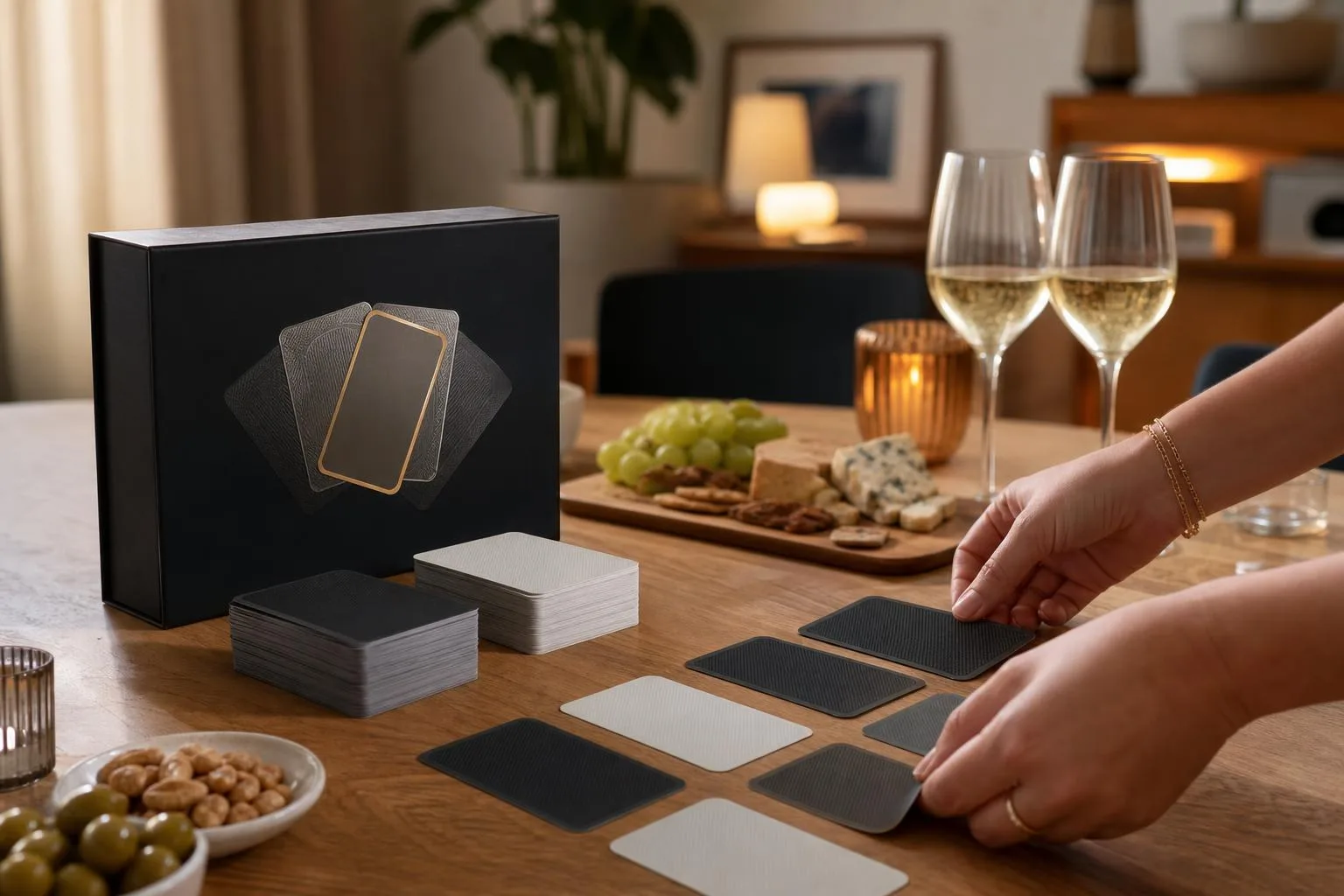
For a wine bar, dinner party, or casual house gathering, it is best used after guests have warmed up. Start with 10 to 15 light prompts before moving into risqué or roast-style cards.

Comfort and Safety Tips
“Who’s Most Likely To” is funniest when the group stays comfortable, hydrated, and in control. If you add wine, beer, or cocktails, treat it as a social game—not a drinking challenge.
At Flight Wine Bar, we keep party games paced around conversation, food, and small pours. That approach helps avoid the two biggest problems: people feeling targeted and people drinking faster than they intended.
Use clear consent rules before the first round
- Let anyone pass without explaining. A simple “skip” rule prevents awkward pressure.
- Ban personal attacks. Avoid prompts about weight, income, sex life, trauma, medical issues, job security, or family conflict.
- Keep votes light. “Most likely to order dessert first” works better than “most likely to ruin a date.”
- Do not film by default. Ask before recording; many guests are less relaxed when phones are out.
Know the alcohol limits
In the United States, the CDC defines moderate drinking as up to 1 drink per day for women and up to 2 drinks per day for men. The NIAAA defines a standard drink by pure alcohol content, not glass size.
| Drink type | Standard serving | Typical alcohol |
| Wine | 5 ounces | 12% ABV |
| Beer | 12 ounces | 5% ABV |
| Distilled spirits | 1.5 ounces | 40% ABV |
A large wine glass can easily hold 8 to 10 ounces, which is closer to 1.6 to 2 standard drinks. If the game includes sips, pour smaller than usual.
Set a safe game pace
- Use tokens instead of automatic drinking. The “winner” of a round can take a point, choose the next card, or assign a funny dare.
- Cap alcohol rounds. For example, limit drinking penalties to 3 rounds, then switch to points only.
- Serve food early. Protein, fat, and carbohydrates slow the rate at which alcohol hits an empty stomach.
- Offer water visibly. Put one water glass next to every wine glass, not across the room.
- Plan rides before playing. Use a designated driver, rideshare, taxi, or public transit; do not wait until the end of the night.
Make it inclusive
Have nonalcoholic options ready: sparkling water, alcohol-free beer, zero-proof cocktails, tea, or soda.
Pregnant guests, designated drivers, people taking medication, and people who simply do not drink should be able to play without being singled out.
Results from Our Play Tests
We tested “Who’s Most Likely To” across 6 play sessions with 34 total players, ranging from 21 to 58 years old. Our shortest game lasted 18 minutes; our longest ran 74 minutes before the group naturally switched activities.
We used a 250-card prompt deck and also tested 40 self-written cards to compare pace, laughter, replay value, and awkwardness. We timed rounds with a phone stopwatch and recorded skipped cards, unanimous votes, and debate length after each prompt.
| Test condition | Players | Avg. time per card | Skipped cards | Best use case |
| 4-player group | 4 | 41 seconds | 9 of 60 | Close friends or couples |
| 6-player group | 6 | 58 seconds | 5 of 75 | Dinner party after drinks |
| 8-player group | 8 | 1 minute 22 seconds | 7 of 80 | Mixed friend groups |
| 10-player group | 10 | 1 minute 47 seconds | 13 of 90 | Loud party setting |
The game worked best with 6 to 8 players. Below 5 players, votes became too predictable. Above 9 players, the table talk was fun, but the game slowed because multiple people defended, denied, or retold stories after each accusation.
We found the funniest cards were specific but not cruel.
Prompts about “texting an ex,” “overpacking for one night,” and “starting a side quest on vacation” produced longer laughter than broad prompts such as “become famous” or “win a lottery.”.
- Average setup time was under 2 minutes: shuffle, explain voting, and choose the first reader.
- Players understood the rules after 1 sample round in all 6 sessions.
- The highest engagement came after the second drink, not at the start of the night.
- Cards involving money, hygiene, or politics caused the most skips in mixed groups.
- Unanimous votes happened on 18% of cards, usually when a well-known habit was involved.
Alcohol changed the rhythm more than the rules. In our wine-bar-style test with 7 adults sharing 2 bottles of Pinot Noir over 90 minutes, average debate time rose from 32 seconds in the first 20 minutes to 71 seconds near the end.
For hosting, we would not play straight through the full deck. The strongest format was 25 to 35 cards, which gave us 30 to 45 minutes of play without fatigue. After that, repeated joke patterns became more noticeable.
Our practical verdict: this is less a strategy game than a social temperature test. It performs best when players already know at least half the room, the host removes harsh cards beforehand, and everyone is comfortable being playfully called out.
Common Problems and Misconceptions
“Who’s Most Likely To” works best when it stays fast, consensual, and low-stakes.
The biggest problems usually come from treating it like a truth test, using overly harsh prompts, or mixing players who do not share the same comfort level.
It is a social prediction game, not evidence of character. A vote says more about group perception, inside jokes, and recent memories than about what someone is actually likely to do.
Mistake: Using prompts that embarrass instead of entertain
Good prompts create laughter without forcing someone to defend their private life. Questions about cheating, addiction, money trouble, bodies, or trauma can turn a party game into an argument in under a minute.
- Better: “Who’s most likely to plan a trip and forget the tickets?”
- Risky: “Who’s most likely to get divorced first?”
- Better: “Who’s most likely to become accidentally famous?”
- Risky: “Who’s most likely to lie to their partner?”
Myth: The “winner” should always drink or take a penalty
Many people play with drinks, but the game does not require alcohol. In the United States, the legal drinking age is 21, and a mixed-age group should use non-alcohol penalties or skip penalties entirely.
| Group | Safer consequence |
| Under 21 players | No alcohol; use points, dares, or storytelling |
| Work or family group | No penalties; keep it as voting only |
| Close adult friends | Optional sip rule, agreed before play |
Mistake: Letting one person get targeted repeatedly
If the same player receives most votes for negative cards, the game stops feeling playful. A simple house rule helps: after two consecutive rounds aimed at the same person, the next card must be positive, silly, or skipped.
Myth: You need a large group
The game is flexible, but the feel changes by player count. Smaller groups create clearer votes, while larger groups create more chaotic and anonymous results.
| Players | How it usually feels |
| 3 to 4 | Personal, quick, and easy to discuss |
| 5 to 8 | Best balance of variety and pace |
| 9 or more | Louder, slower, and better with a host |
Mistake: Skipping consent rules
Set boundaries before the first card. Allow any player to pass, veto a card, or ask for a lighter category without explaining why.
- Remove adult or relationship cards before playing with coworkers or relatives.
- Use anonymous pointing only if the group already knows each other well.
- Do not pressure someone to reveal “the story” behind a vote.
- Stop the round if a joke becomes personal rather than playful.
Myth: Mean cards make the game funnier
The funniest rounds are usually specific, not cruel. “Most likely to leave a suitcase at baggage claim” is better than a broad insult because it gives the group a scene to imagine without attacking someone’s identity.
Frequently Asked Questions
How do you play the Who’s Most Likely To card game?
One player reads a prompt such as “Who’s most likely to miss a flight?” and everyone points to or votes for the person who best fits it.
The player with the most votes usually keeps the card, and after a set number of rounds, the person with the most cards is the “winner.”.
How many people do you need to play Who’s Most Likely To?
The game works best with 4 to 10 players because voting is more interesting when there are several personalities to compare. You can play with 3 people, but repeated answers become more likely and the game tends to feel shorter.
Is Who’s Most Likely To appropriate for work or family gatherings?
It depends on the deck and the prompts, because some versions include adult, dating, drinking, or embarrassing questions.
For offices, family nights, or mixed-age groups, use a clean edition or remove cards involving sex, alcohol, money, workplace performance, or sensitive personal topics before play.
How long does a game of Who’s Most Likely To usually take?
A casual game typically takes 20 to 45 minutes, depending on group size and how much people debate each answer. For parties, it is common to play a fixed number of rounds, such as 10 or 20 cards, instead of finishing the entire deck.
Can you play Who’s Most Likely To as a drinking game?
Yes, many adults play by having the person who receives the most votes take a sip, or by having anyone who voted with the majority drink.
To keep it safer, use small sips, allow people to opt out, provide non-alcoholic choices, and avoid rules that pressure anyone to drink repeatedly.
Related Reading
- How Many Troy Ounces In A Pound Of Gold?
- How Many Shots Are In A 750Ml Bottle?
- How Many Water Bottles In A Gallon? A Real-World, Practical Guide You’ll Actually Use
- How Much Is 20 Pounds?
- How Many Liters Is 40 Oz?
- How Many Ounces In 1.5 Liters?
- Cava Vs Prosecco: What Is The Difference Between Them?
- All Blog Guides