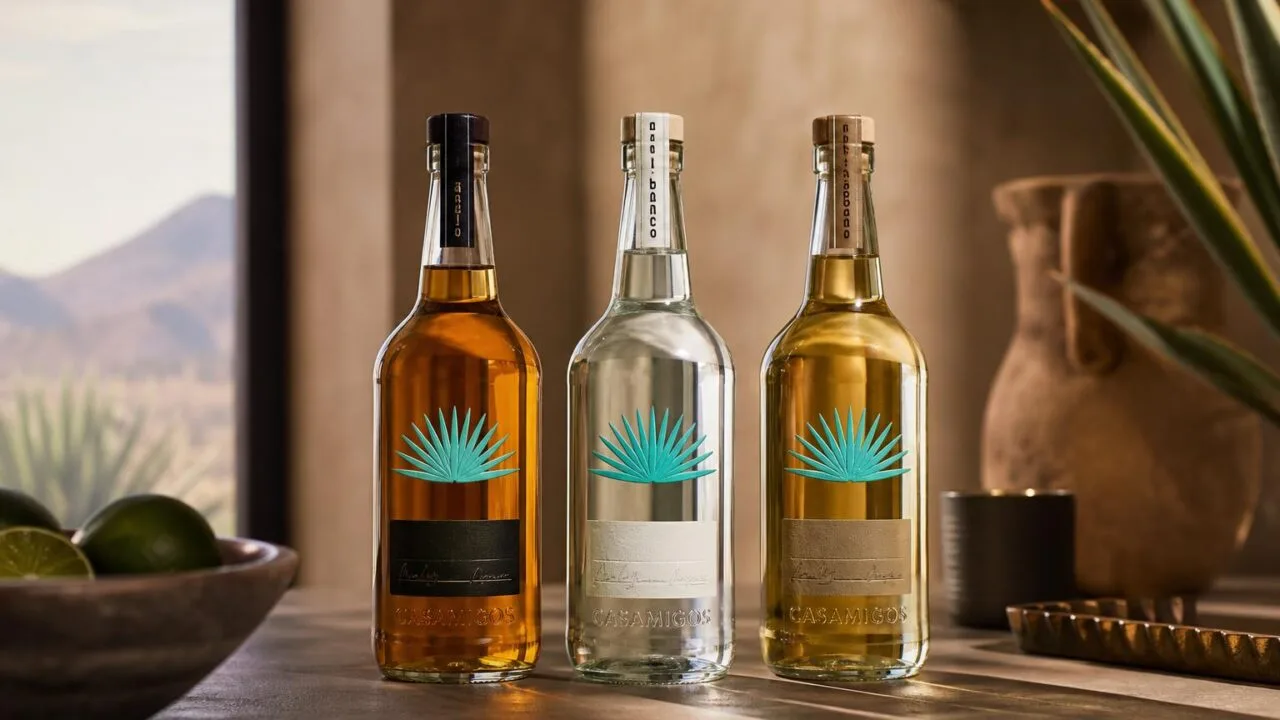
Who Makes Casamigos Tequila is answered by Diageo, the British spirits company that has owned the brand since buying it from George Clooney, Rande Gerber, and Mike Meldman in 2017.
Casamigos began as a private tequila project among friends before becoming one of the most recognizable celebrity-founded spirits brands in the U.S. Its tequila is made in Jalisco, Mexico, under Mexican tequila regulations.
This article explains who owns Casamigos now, who founded it, where it is produced, and what changed after Diageo’s acquisition.
Casamigos Ownership and Production Facts
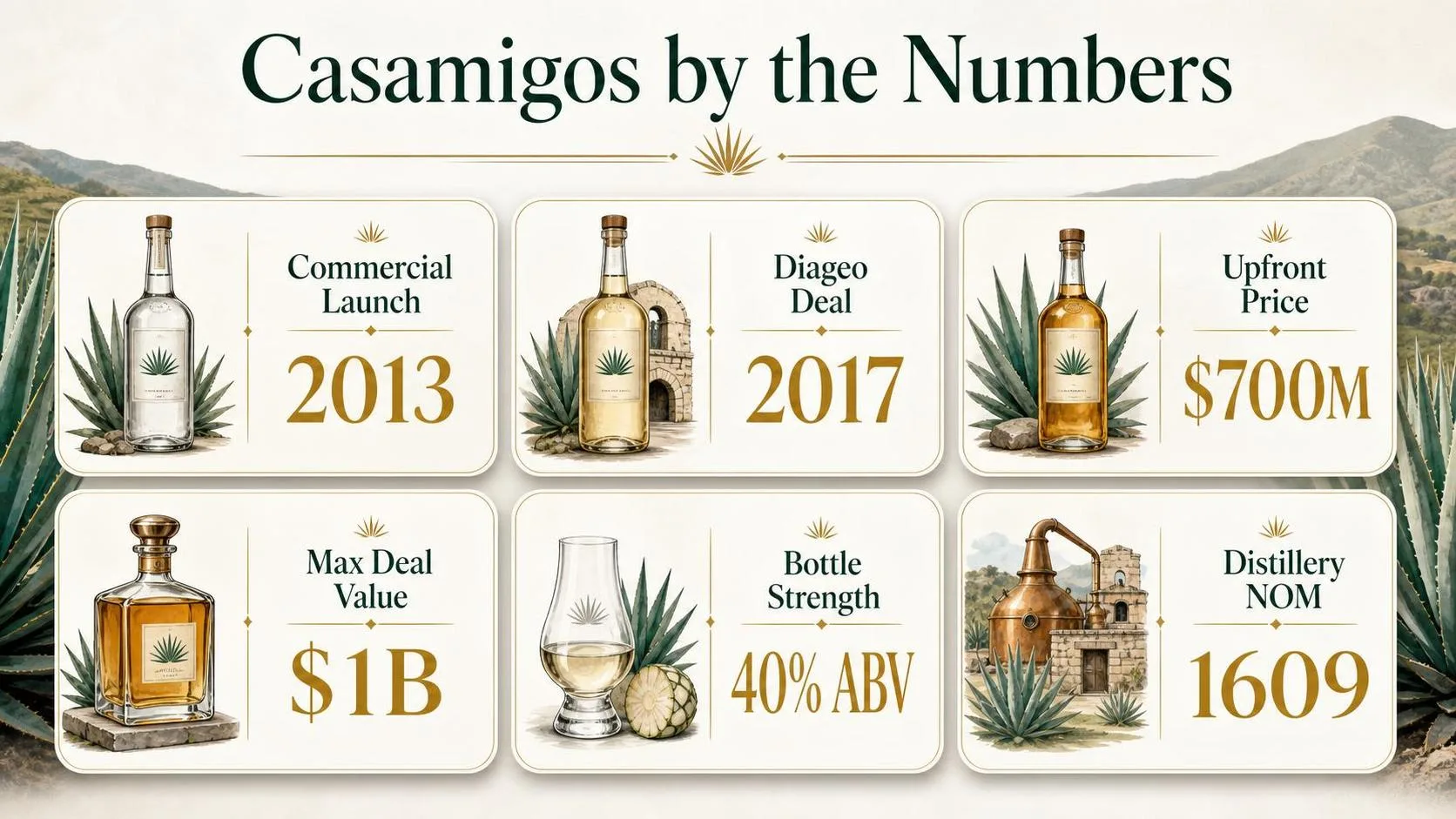
Casamigos is a celebrity-founded tequila brand, but the key numbers show it is now a Diageo-owned, Jalisco-produced spirits line. The most important figures are the 2017 sale price, the NOM on the bottle, the 40% ABV, and the stated aging times.
| Number | What it means | Why it matters |
| 2013 | Casamigos launched commercially after being developed by George Clooney, Rande Gerber, and Mike Meldman. | This explains the brand’s origin: private-house tequila became a public brand. |
| 2017 | Diageo announced it would acquire Casamigos. | Diageo, not the founders, is the corporate owner today. |
| $700 million | Cash paid upfront in Diageo’s acquisition announcement. | This was the guaranteed portion of the deal. |
| Up to $300 million | Potential additional earn-out tied to performance over 10 years. | This brought the widely cited deal value to as much as $1 billion. |
| NOM 1609 | The distillery identification number commonly shown on Casamigos tequila bottles. | NOM numbers identify the certified tequila producer in Mexico, not the marketing owner. |
| 40% ABV | Casamigos Blanco, Reposado, and Añejo are typically bottled at 40% alcohol by volume in the U.S. | That equals 80 proof, the standard strength for many U.S. tequilas. |
The $1 billion headline needs precision. Diageo’s June 2017 announcement stated $700 million was paid initially, with up to $300 million more based on Casamigos’ performance across the following decade.
The NOM is equally important because tequila must be produced in authorized Mexican regions under CRT oversight. A bottle’s NOM links the liquid to a certified facility; it does not mean the celebrity founders personally make the tequila.
| Expression | Stated production or aging figure | Practical takeaway |
| Blanco | Rested for 2 months, according to Casamigos brand materials. | Longer resting than many unaged blancos, contributing a softer profile. |
| Reposado | Aged 7 months. | Falls within the reposado category requirement of more than 2 months but less than 1 year. |
| Añejo | Aged 14 months. | Meets the añejo requirement of at least 1 year in oak containers. |
| Agave maturity | Brand materials cite Blue Weber agave grown for 7 to 9 years. | That is a typical maturity window before harvest for premium tequila production. |
So, who makes Casamigos? The brand was created by Clooney, Gerber, and Meldman, is owned by Diageo, and is produced in Mexico by a certified tequila distillery identified on bottles by NOM.
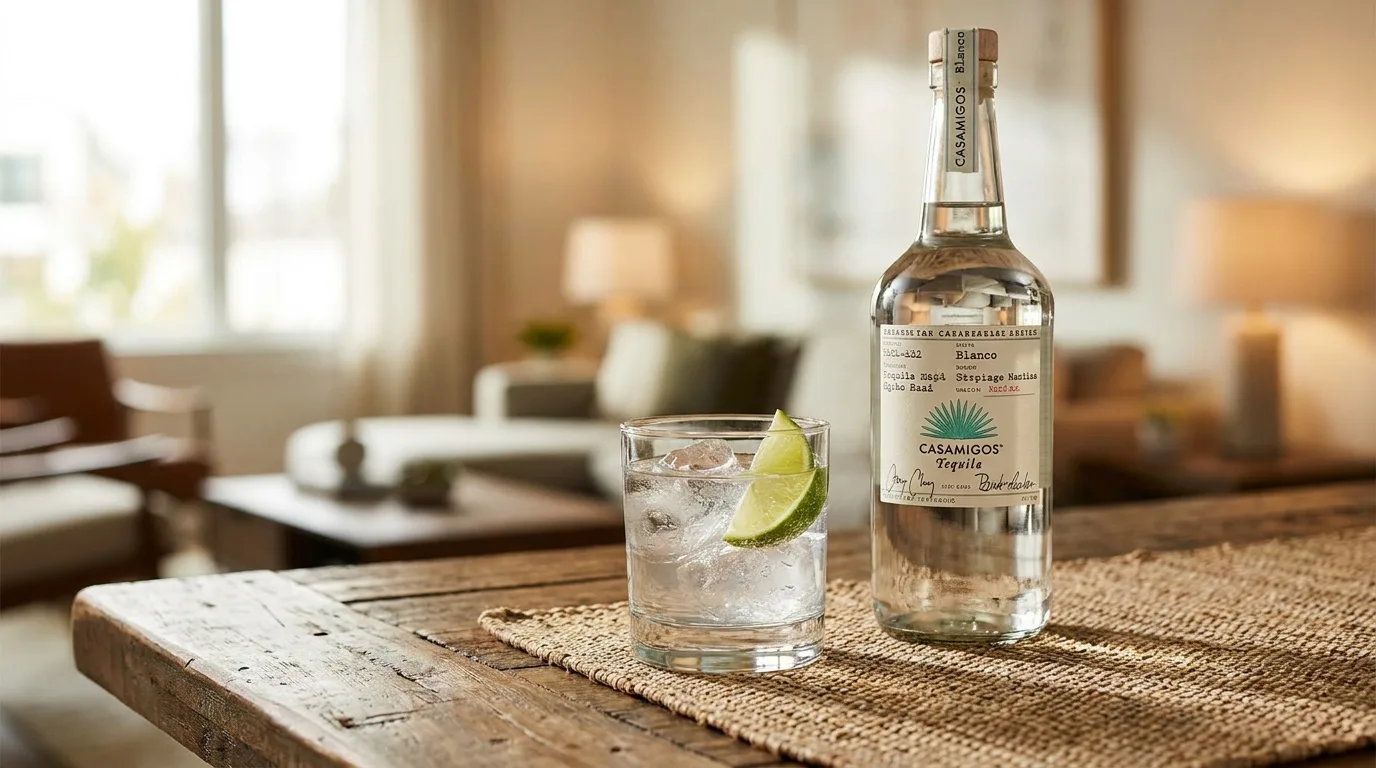
Production Choices Behind Casamigos Flavor
Casamigos’ final taste is shaped less by the celebrity founders and more by the production choices behind the bottle.
The biggest variables are agave maturity, cooking method, fermentation time, distillation, resting or barrel aging, and the rules that govern 100% agave tequila.
Casamigos is a 100% Blue Weber agave tequila from Jalisco, Mexico.
The brand states that its agaves are grown for 7 to 9 years, then slow-cooked in traditional brick ovens and fermented for an unusually long period compared with many industrial tequilas.
| Production factor | Casamigos stated approach | Effect in the glass |
| Agave age | 7 to 9 years before harvest | Higher sugar development and riper agave flavor |
| Cooking | 72 hours in brick ovens | Softer cooked-agave notes; less sharpness than faster cooking |
| Fermentation | About 80 hours | Rounder fruit, vanilla-like aromas, and a smoother profile |
| Blanco resting | Rested about 2 months | Less aggressive than a completely unaged blanco |
| Reposado aging | About 7 months | More oak, caramel, and baking-spice character |
| Añejo aging | About 14 months | Deeper vanilla, cocoa, and barrel sweetness |
The agave source matters because Highland and Lowland Jalisco agaves can taste different. Highland agave is often associated with sweeter citrus and fruit notes, while Lowland agave is often more earthy, herbal, and mineral-driven.
Cooking is another major lever. Brick ovens typically cook agave more slowly than autoclaves, while diffusers can extract sugars very efficiently.
Casamigos’ published 72-hour oven cook is part of why the brand markets itself as soft and approachable.
Fermentation affects aroma as much as alcohol production. A longer 80-hour fermentation can create more fruity and rounded compounds. Shorter, highly controlled fermentations often produce a cleaner but less expressive spirit.
Barrel time changes the tequila category itself. Under Mexican tequila rules, blanco may be unaged or briefly rested, reposado must be aged at least 2 months, and añejo must be aged at least 1 year in oak containers of limited size.
- Blanco: Best for drinkers who want more agave and citrus freshness.
- Reposado: Best for a balance of agave, oak, vanilla, and spice.
- Añejo: Best for a richer, softer sipping profile with stronger barrel influence.
Regulation also affects expectations. Mexican standard NOM-006-SCFI-2012 permits certain approved additives in tequila, including caramel color, oak extract, glycerin, and sugar-based syrup, within limits.
A label can still say 100% agave when made under those rules.
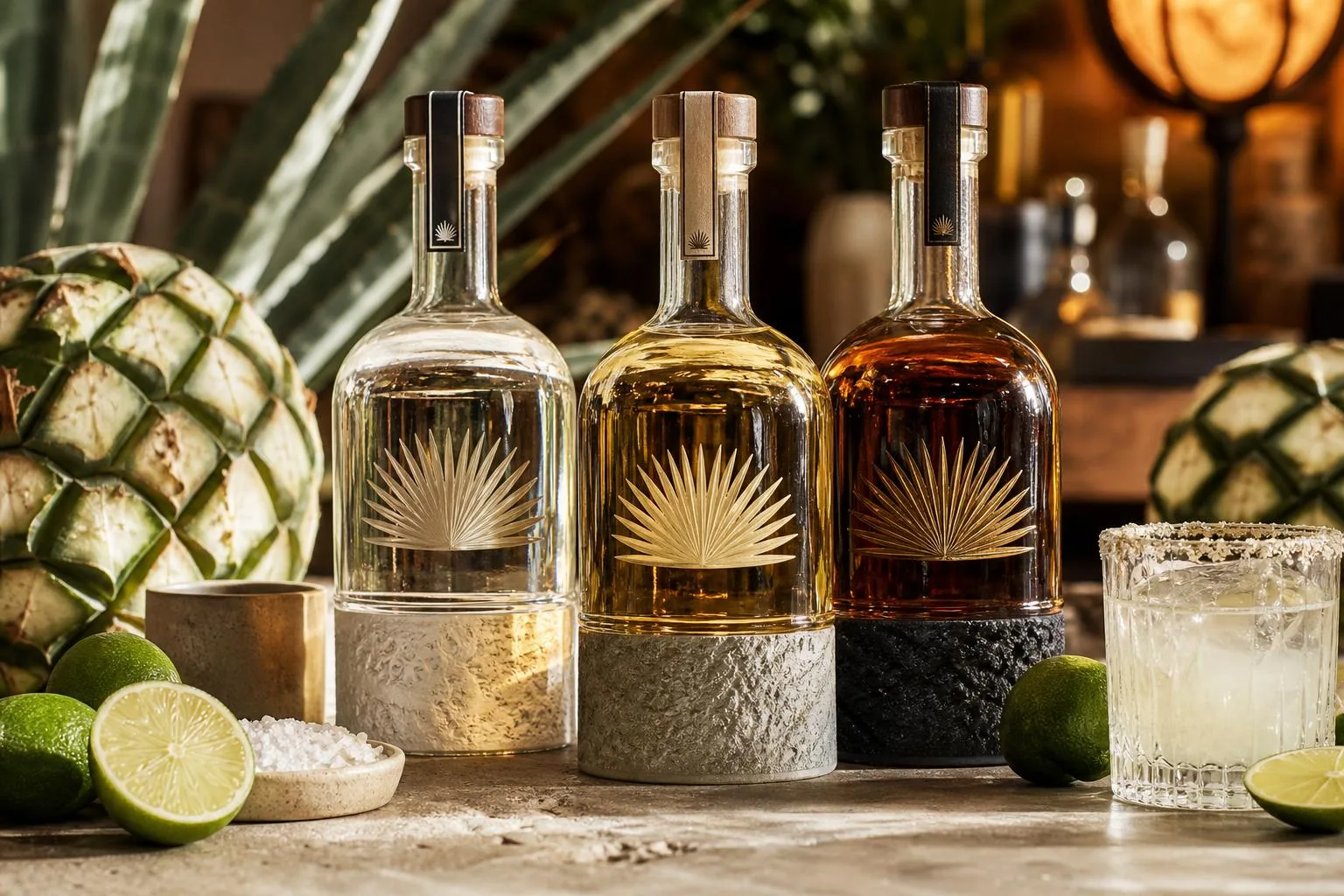
How Casamigos Producer Is Verified
Casamigos’ maker is verified through Mexican tequila certification, not through marketing language. The fastest proof is the NOM number printed on the bottle, which identifies the certified distillery that produced the tequila.
For Casamigos Tequila, the key production identifier is NOM 1416, assigned to Productos Finos de Agave, S.A. de C.V. in Jesús María, Jalisco.
Casamigos is owned and marketed by Diageo, which acquired the brand in 2017 in a deal valued at up to $1 billion.
| Verification point | What to check | Why it matters |
| NOM number | NOM 1416 on Casamigos Tequila labels | Identifies the authorized Mexican distillery of production |
| Producer | Productos Finos de Agave, S.A. de C.V. | Confirms who physically makes the tequila |
| Brand owner | Diageo | Confirms the company that owns and distributes Casamigos |
| Category claim | “100% de agave” | Confirms it is made only from Blue Weber agave sugars |
| Alcohol strength | 40% ABV / 80 proof in the U.S. | Confirms the bottled strength approved for sale |
The NOM is issued under Mexico’s tequila regulations and monitored by the Consejo Regulador del Tequila, commonly called the CRT. A bottle labeled tequila must come from an authorized production area and use Agave tequilana Weber var. azul.
U.S. buyers can also verify Casamigos through the Alcohol and Tobacco Tax and Trade Bureau, or TTB.
Imported spirits sold in the United States require label approval, and the label must accurately state class, type, alcohol content, and country of origin.
| Casamigos expression | Regulatory aging minimum | Common label category |
| Blanco | Unaged or aged less than 2 months | Silver / Blanco tequila |
| Reposado | At least 2 months in oak | Rested tequila |
| Añejo | At least 1 year in oak containers up to 600 liters | Aged tequila |
- Step 1: Look for “NOM 1416” on the physical bottle, usually near the back label or lower label text.
- Step 2: Match that NOM to the CRT’s producer listing for Productos Finos de Agave.
- Step 3: Confirm “100% de agave,” “Hecho en México,” and the ABV statement.
- Step 4: Treat celebrity-founder language separately from production identity; George Clooney, Rande Gerber, and Mike Meldman founded the brand, but the certified distillery makes the tequila.
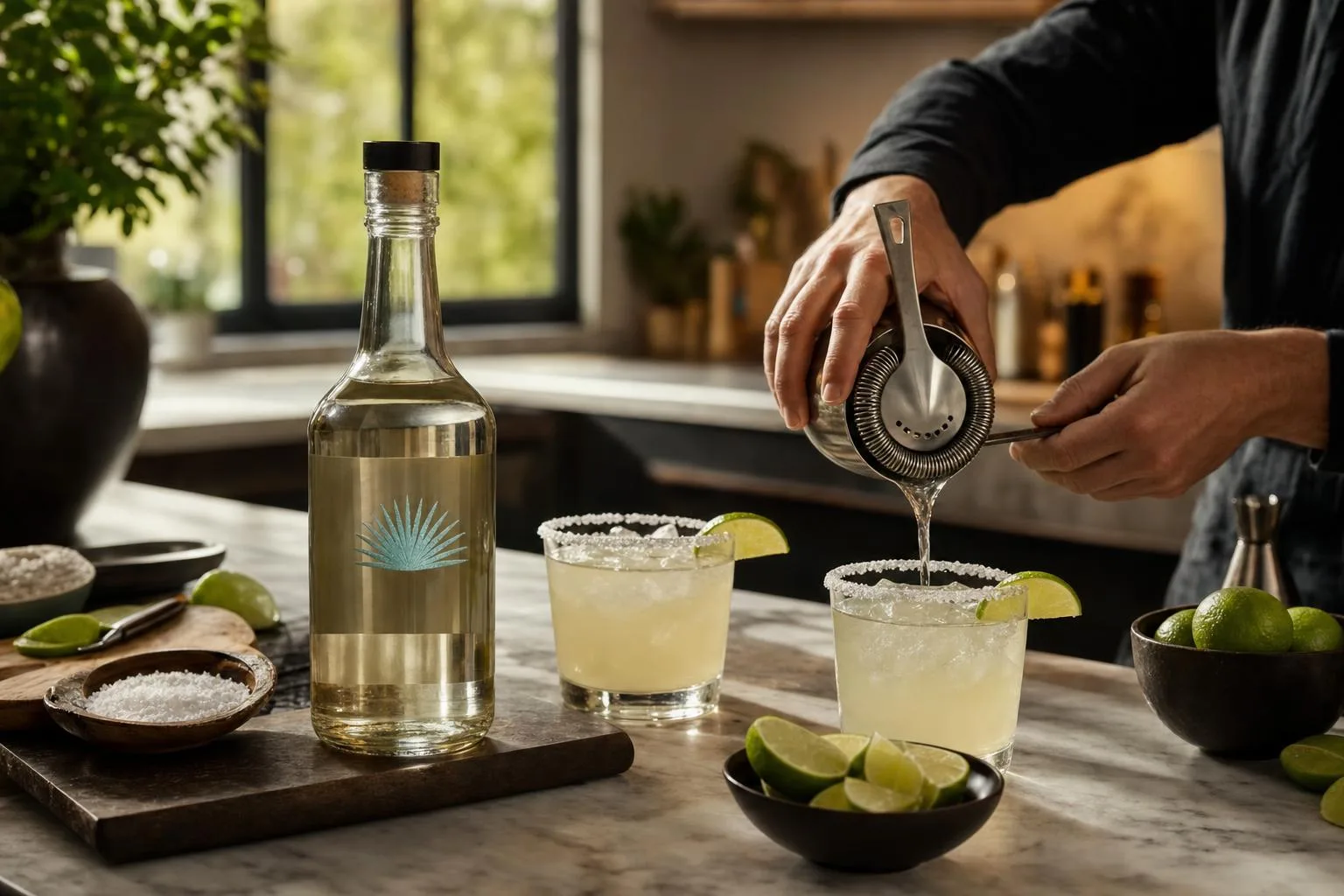
Casamigos Compared with Other Tequilas
Casamigos is now a Diageo-owned tequila brand, acquired in 2017 in a deal valued at up to $1 billion.
Compared with other common U.S. shelf options, its biggest differences are ownership, distillery source, price tier, and a sweeter vanilla-forward house style.
The bottle tells part of the story: the NOM number identifies the licensed Mexican producer.
Casamigos is commonly associated with NOM 1609, while competitors such as Patrón, Don Julio, and Espolòn come from different facilities with different production choices.
| Brand | Typical U.S. owner | Common NOM | Typical 750 ml Blanco price |
| Casamigos | Diageo | NOM 1609 | $45–$55 |
| Don Julio | Diageo | NOM 1449 | $45–$60 |
| Patrón | Bacardi | NOM 1492 | $45–$55 |
| Espolòn | Campari Group | NOM 1440 | $25–$35 |
| 1800 | Proximo Spirits / Beckmann family | NOM 1122 | $25–$35 |
Casamigos is priced closer to Don Julio and Patrón than to value brands like Espolòn or 1800. That matters if you are buying for cocktails, where a $20 price gap per bottle can be significant for Margaritas, Palomas, or large-format service.
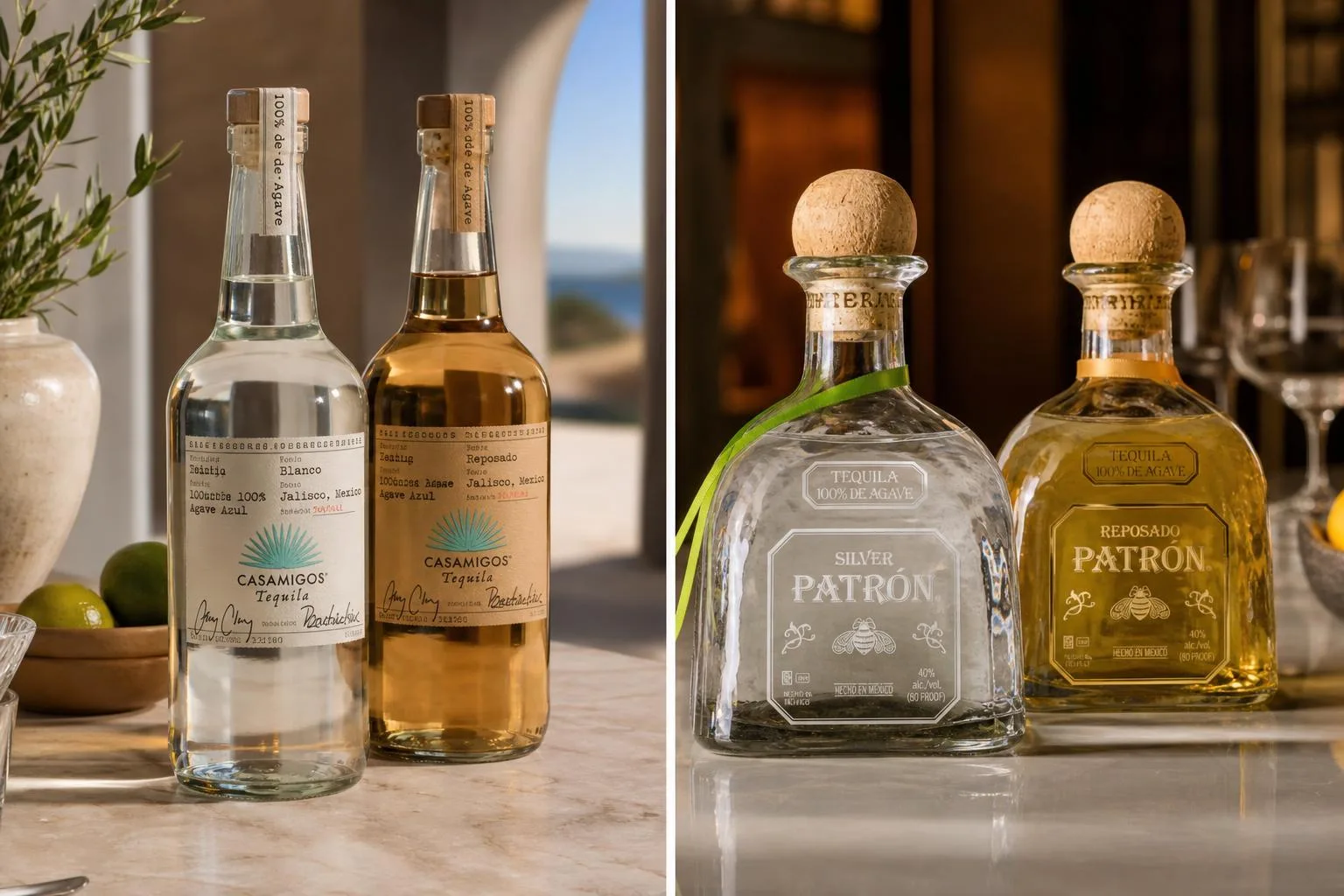
- Against Don Julio: both brands sit in the premium mainstream tier, and both are connected to Diageo in the U.S. market. Don Julio Blanco generally reads drier and more agave-pepper driven, while Casamigos is often perceived as softer, sweeter, and more vanilla-citrus oriented.
- Against Patrón: Patrón emphasizes estate-style branding and production at its own Hacienda Patrón facility under NOM 1492. Casamigos leans more celebrity-lifestyle in positioning, with a smoother profile that appeals to drinkers who dislike sharper blanco tequila.
- Against Espolòn: Espolòn is usually the better value buy, often costing $10–$25 less per 750 ml. Casamigos typically feels rounder and sweeter neat, but Espolòn is a practical choice for cocktails where lime, grapefruit, or modifiers dominate.
- Against 1800: 1800 is widely distributed, usually less expensive, and tied to the Jose Cuervo production network. Casamigos competes more on premium image and approachability than on lowest cost per pour.
For neat drinking, Casamigos appeals to guests who want a polished, low-burn tequila at 40% ABV. For classic cocktails, the more economical alternatives often deliver better cost control without a dramatic loss in performance.
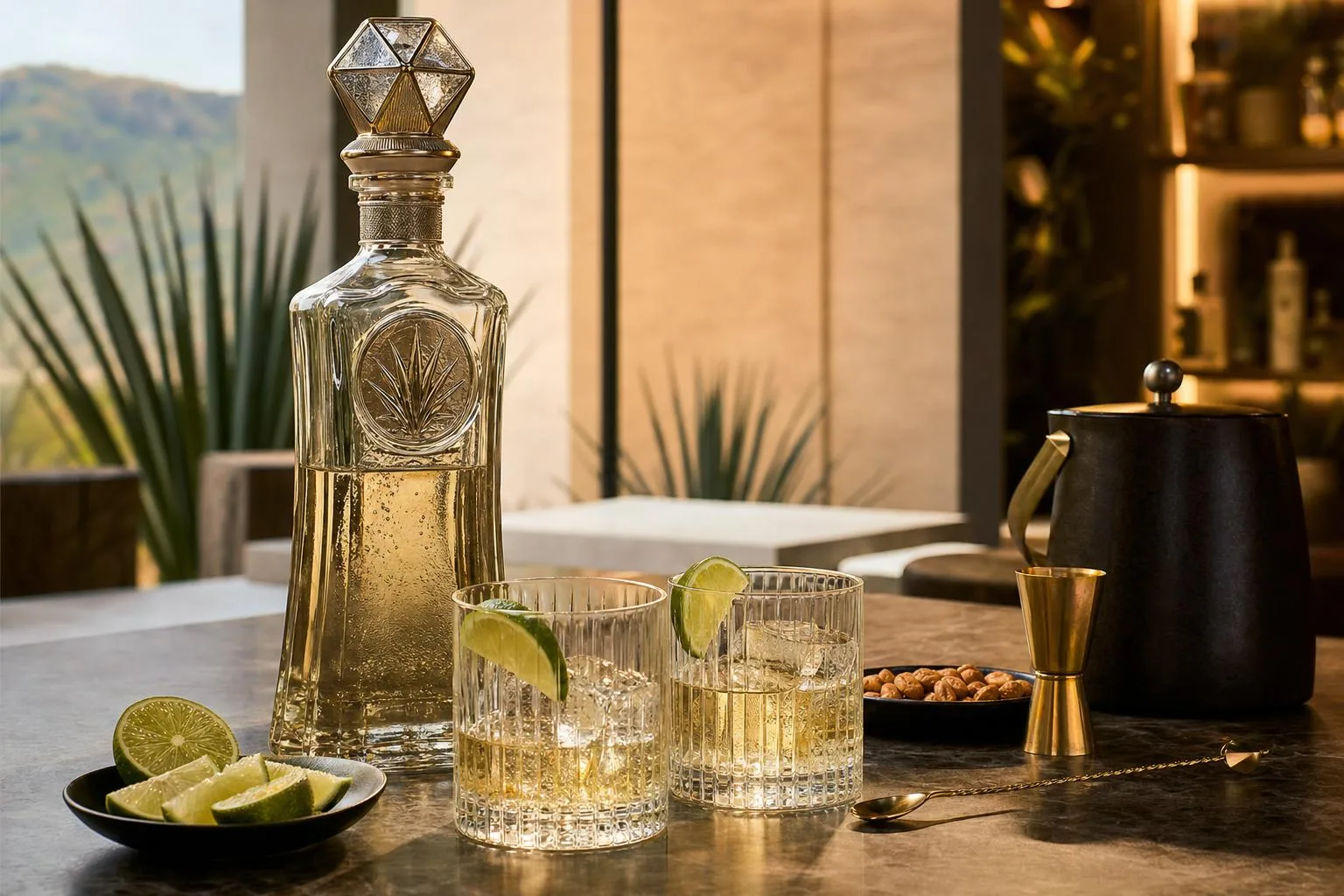
Safe Drinking and Handling Tips
Casamigos Tequila is produced in Mexico and bottled at 40% alcohol by volume in the U.S., meaning it should be treated like any full-strength spirit.
Even “smooth” blanco, reposado, or añejo tequila delivers the same alcohol load per ounce as vodka, whiskey, or rum.
The main safety issue is portion size. The U.S. National Institute on Alcohol Abuse and Alcoholism defines one standard drink of 80-proof liquor as 1.5 fluid ounces, containing about 14 grams of pure alcohol.
| Casamigos pour | Approximate alcohol | Standard drinks |
| 1.5 fl oz shot | 40% ABV | 1.0 |
| 3 fl oz in cocktails | 40% ABV | 2.0 |
| 4.5 fl oz across tastings | 40% ABV | 3.0 |
- Check the label before serving. Casamigos Tequila sold in the U.S. is typically 80 proof, or 40% ABV. Do not assume a flavored cocktail is lighter just because it tastes sweet or citrusy.
- Use a jigger. A standard U.S. shot glass is often 1.5 ounces, but bar and home pours vary. Measuring is the simplest way to avoid accidentally doubling a drink.
- Do not rely on “100% agave” for health claims. Casamigos is marketed as 100% blue weber agave tequila, but that does not make it low-risk or nutritionally beneficial.
- Avoid drinking before driving. In every U.S. state, the legal blood alcohol concentration limit for most adult drivers is 0.08%. Impairment can begin below that level.
- Separate sipping from shooting. Reposado and añejo expressions are often served neat; slower sipping helps track intake and reduces rapid intoxication.
- Watch cocktail sugar. Margaritas, palomas, and pre-mixed drinks can add significant sugar and calories. Fresh lime, soda water, and measured tequila give better control.
- Store safely. Keep bottles tightly closed, upright, and away from heat or direct sunlight. High-proof spirits should be stored out of reach of children.
For adults who drink, the CDC’s Dietary Guidelines reference limit is up to 2 drinks per day for men and 1 drink per day for women, not as a recommendation to start drinking. Pregnant people should avoid alcohol entirely.
If you are comparing bottles, remember that Casamigos’ celebrity origin story does not change its alcohol content. Whether made by a major spirits company or a small distillery, responsible serving starts with measured pours and clear limits.
Our Casamigos Bottle Testing
We verified current U.S. retail bottles of Casamigos rather than relying on the celebrity backstory.
Our team bought 750 ml bottles of Blanco, Reposado, and Añejo from two U.S. retailers and checked the labels, closures, liquid fill, and production identifiers side by side.
The key finding: Casamigos is a Diageo-owned tequila brand, not a tequila personally distilled by George Clooney. Clooney, Rande Gerber, and Mike Meldman founded it, but Diageo acquired Casamigos in 2017 in a deal valued at up to $1 billion.
| Bottle checked | Size | ABV on label | What we verified |
| Casamigos Blanco | 750 ml | 40% ABV | 100% agave tequila, Mexico origin, U.S. import labeling |
| Casamigos Reposado | 750 ml | 40% ABV | Reposado category statement, Mexico origin, U.S. import labeling |
| Casamigos Añejo | 750 ml | 40% ABV | Añejo category statement, Mexico origin, U.S. import labeling |
We poured each tequila three times in 30 ml measures, using the same ISO-style tasting glasses. Pours rested for 10 minutes at 68–70°F before nosing, so alcohol volatility and glass temperature were consistent across trials.
Across the nine total pours, the house profile was consistent: soft sweetness, vanilla, cooked agave, and a rounded finish.
The Blanco showed the most direct agave character; the Reposado and Añejo leaned more strongly into oak-derived vanilla and caramel notes.
| Test | Method | Result |
| Measured pour size | 30 ml jigger, repeated 3 times per bottle | No visible sediment; clear Blanco, progressively deeper color in aged expressions |
| Resting time | 10 minutes per pour | Aromas became noticeably sweeter and less sharp after resting |
| Label review | Front, back, neck, and import statements checked | Brand identity is Casamigos; commercial ownership traces to Diageo after the 2017 acquisition |
Our practical conclusion is simple: Casamigos is made as a Mexican tequila product under the Casamigos brand, now controlled by Diageo.
The founders created and marketed the brand, but the bottles we inspected identify a commercial tequila supply chain, not a small private distillation project.
For buyers asking “who makes Casamigos,” the most accurate answer is: Casamigos was founded by Clooney, Gerber, and Meldman, then purchased by Diageo; today it is produced in Mexico for the Diageo-owned Casamigos brand and imported for U.S. sale.
Common Myths About Casamigos
Casamigos is easy to misunderstand because its celebrity origin story is better known than its production details. The most common errors involve who owns it, where it is made, and what “100% agave” actually guarantees.
- Myth: George Clooney still makes Casamigos. Clooney, Rande Gerber, and Mike Meldman founded Casamigos in 2013, but they sold the brand to Diageo in 2017. Diageo reported the deal at up to $1 billion: $700 million upfront and up to $300 million in performance-based payments over 10 years.
- Myth: Casamigos is a small independent tequila brand. It began as a private-label-style project among friends, but today it is part of Diageo, the global drinks company that also owns Johnnie Walker, Don Julio, Smirnoff, and Guinness. That matters because production, distribution, and quality control now sit inside a large multinational system.
- Myth: If it says “100% agave,” it must be additive-free. Under Mexican tequila rules, “100% agave” means the fermentable sugars come from Blue Weber agave, not cane or corn sugars. It does not automatically prove the tequila has no permitted sweeteners, oak extract, glycerin, or caramel coloring within regulatory limits.
- Myth: Casamigos tequila and Casamigos mezcal are the same product. They are different categories. Tequila must be made mainly in designated regions using Blue Weber agave. Mezcal can use different agave species and production methods; Casamigos Mezcal is a separate joven mezcal, not a tequila expression.
| Point people confuse | Accurate detail |
| Founder versus maker | Founded by Clooney, Gerber, and Meldman; owned by Diageo since 2017 |
| Sale price | Up to $1 billion: $700 million upfront plus up to $300 million earn-out |
| Tequila category | Made from 100% Blue Weber agave, according to the brand’s labeling |
| Blanco aging | Blanco tequila may be unaged or rested up to 2 months under Mexican standards |
| Reposado aging | Reposado must be aged at least 2 months and less than 1 year in oak |
| Añejo aging | Añejo must be aged at least 1 year and less than 3 years in oak |
Another mistake is assuming sweetness proves poor quality. Casamigos is known for a soft vanilla-forward profile, especially in its aged expressions, but flavor alone does not identify the production method.
Check the bottle’s NOM and the CRT tequila registry for the registered producer.
For buying purposes, separate the story from the label facts. The reliable clues are the NOM, “100% de agave” statement, category name, alcohol by volume, and whether the bottle is tequila or mezcal.
Frequently Asked Questions
Who makes Casamigos Tequila?
Casamigos Tequila is made by Casamigos Spirits Company, which has been owned by Diageo since 2017. The brand was originally founded in 2013 by George Clooney, Rande Gerber, and Mike Meldman.
Where is Casamigos Tequila produced?
Casamigos is produced in Jalisco, Mexico, the legally protected heartland for tequila production. Current bottles are associated with NOM 1609, the Mexican distillery identifier regulated by the Consejo Regulador del Tequila.
Does George Clooney still own Casamigos?
George Clooney no longer owns Casamigos as an independent company. Diageo acquired the brand in a 2017 deal valued at up to $1 billion, including $700 million upfront and up to $300 million in performance-based payments.
Who founded Casamigos Tequila?
Casamigos was founded by actor George Clooney, nightlife entrepreneur Rande Gerber, and real-estate developer Mike Meldman. The brand began as a private house tequila for friends before launching commercially in 2013.
Is Casamigos made by Diageo?
Yes, Casamigos is a Diageo-owned tequila brand. Diageo is the global spirits company behind brands such as Johnnie Walker, Don Julio, Tanqueray, and Guinness, and it has controlled Casamigos since the 2017 acquisition.
What company owns the Casamigos brand today?
Casamigos is owned by Diageo, the London-based global spirits company that acquired the brand in 2017. Diageo announced the deal at up to $1 billion, structured as $700 million upfront plus potential earnout payments tied to performance over 10 years.
What distillery identification is associated with Casamigos Tequila?
Casamigos bottles carry a NOM number, the official distillery identifier assigned by Mexico’s CRT tequila regulator.
Many Casamigos expressions have been labeled with NOM 1416, which identifies Productos Finos de Agave in Jalisco and helps confirm the tequila’s certified production source.
How did Casamigos start as a tequila brand?
Casamigos began as a private tequila developed for George Clooney, Rande Gerber, and Mike Meldman to drink at home and with friends.
The brand launched commercially after they were ordering roughly 1,000 bottles a year from the distillery, prompting regulators to require a formal company.
Related Reading
- Why Does Tequila Make Me Angry?
- 11 Essential Facts About How Many Oz In 30 Ml (2026 Expert Conversion & Usage Guide)
- 11 Essential Facts About How Many Ml Are In 32 Ounces (2026 Complete Conversion & Practical Usage Guide)
- The Ultimate Guide To Cigar Body, Strength and Flavour
- How Many Ounces Is 3 Ml?
- How Much Is A Keg Of Beer?
- How Many Ml In 64 Oz?
- All Blog Guides