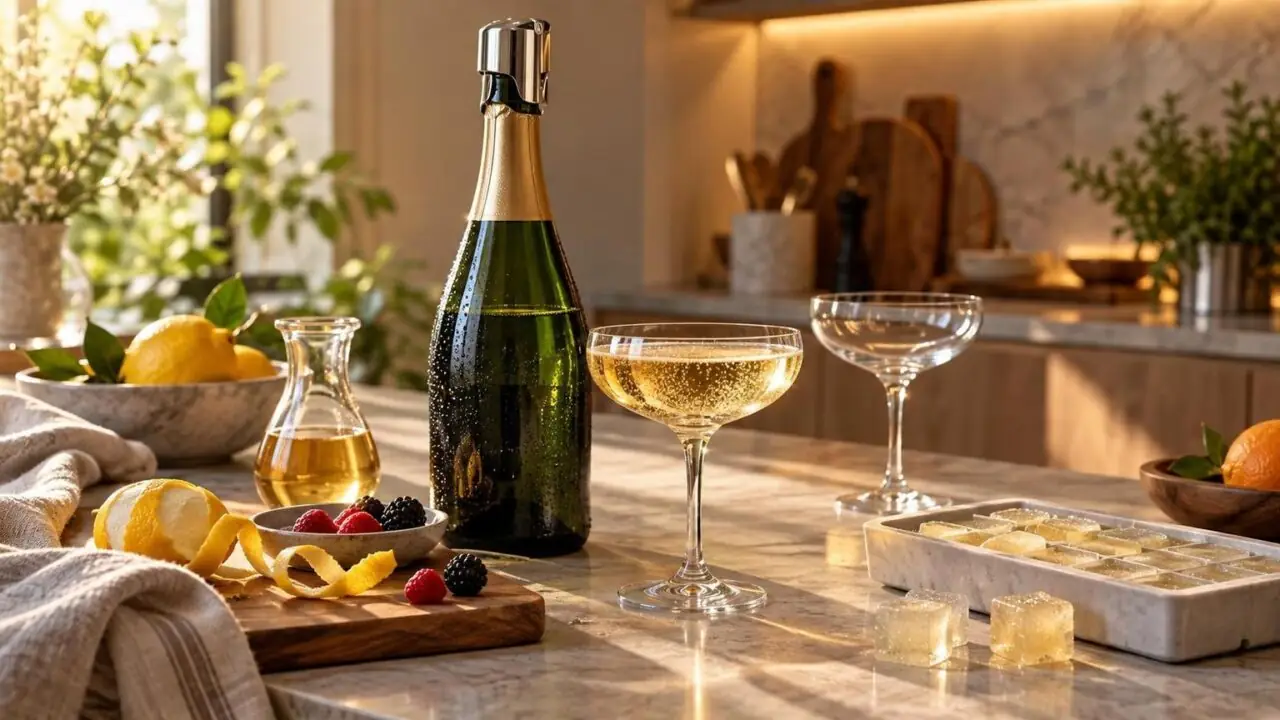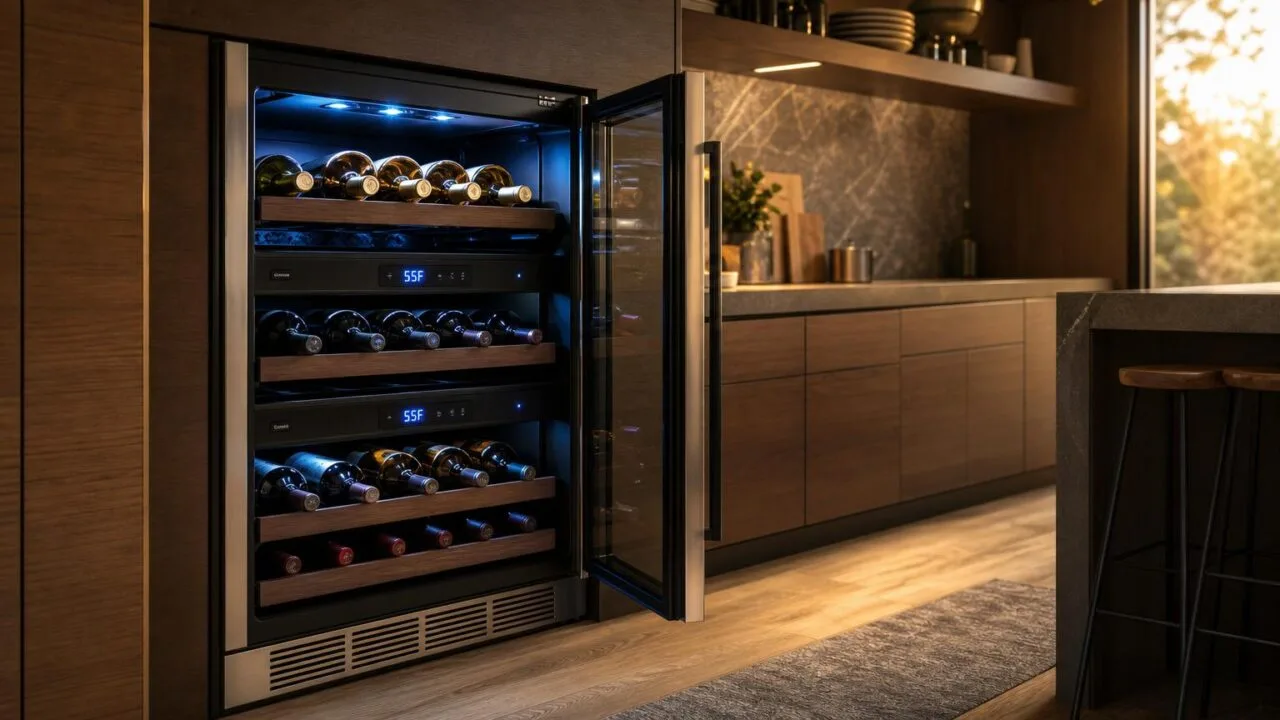
TL;DR — What temperature should a wine cooler be? Set a single-zone wine cooler to 55°F (13°C).
For dual-zone units, run the upper zone at 45–50°F (7–10°C) for whites and sparkling, and the lower zone at 55–65°F (13–18°C) for reds.
Pair the temperature with 50–70% humidity, low vibration, and zero direct sunlight to protect flavor and aging potential.
Storing wine well isn’t reserved for collectors. The temperature inside your wine cooler quietly decides how a bottle ages, how aromatics develop, and whether the cork stays sealed against oxygen.
Even a few degrees of drift can flatten a Pinot Noir or strip the bubbles from a Champagne. The surveys keep confirming it.
The Wine Spectator reference cellars and the long-running aging research at UC Davis Viticulture and Enology both put steady, cool storage at the center of wine longevity.
This guide walks through every wine cooler temperature question that actually matters: best ranges by varietal, single-zone versus dual-zone trade-offs, humidity, calibration, placement, common faults, and how the math changes for long-term aging.
Use it as a checklist, then jump to our best wine cooler brands roundup when you’re ready to shop.
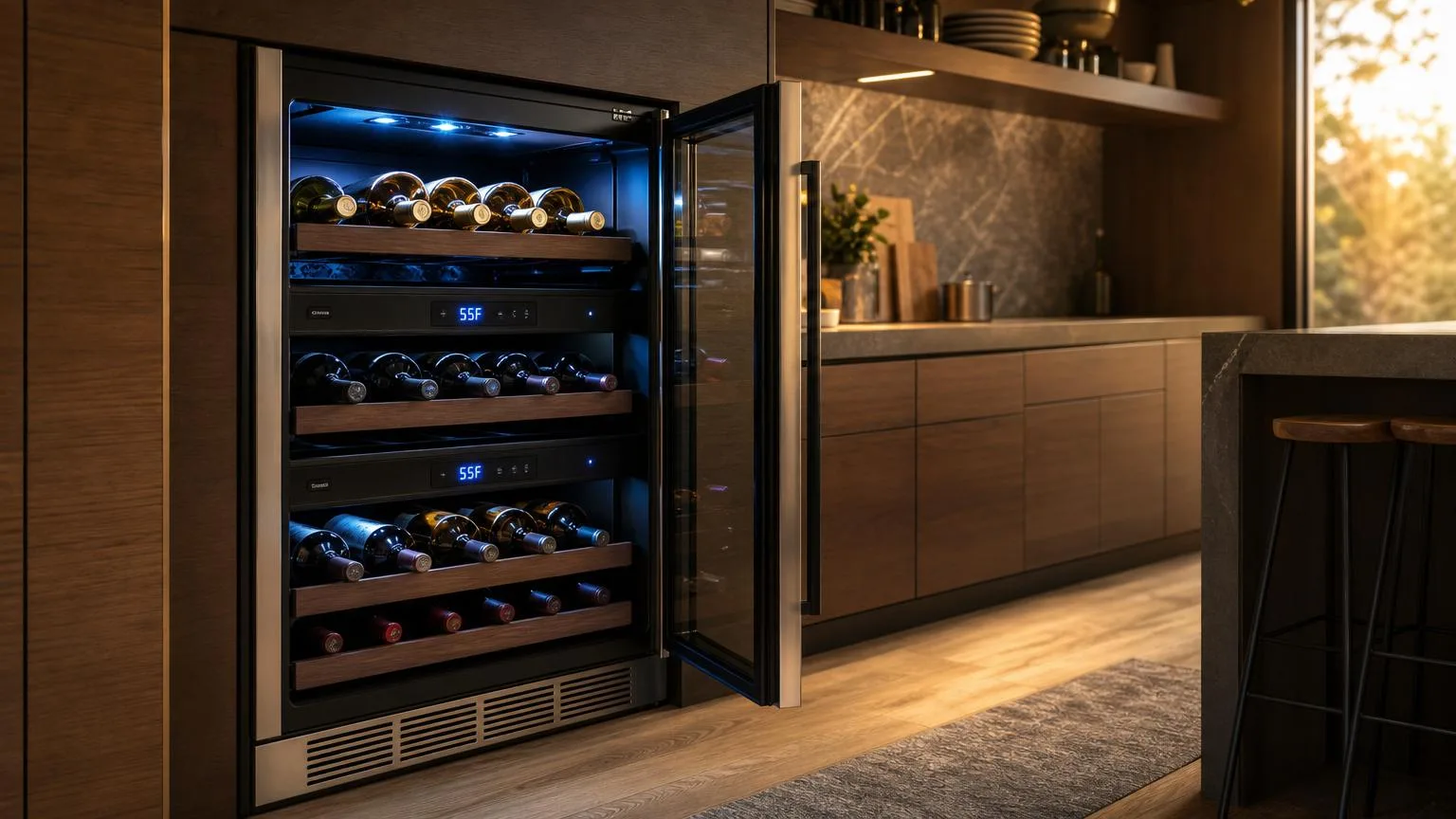
Why Wine Cooler Temperature Matters More Than You Think
Wine is a living chemistry experiment in glass. Heat speeds up every reaction inside the bottle.
A wine kept at 70°F will mature roughly 3–4× faster than the same wine at 55°F, according to data summarized by Decanter’s storage research. That sounds harmless until you taste a young Bordeaux that already feels tired.
Cold has its own penalty. Drop below 40°F and aroma compounds shut down, tannins tighten into something sharp, and you risk pushing the cork as the wine contracts.
The narrow band between those two failure modes is exactly what a wine cooler exists to hold.
People searching for the right wine cooler temperature usually want one of three things: protect a few special bottles, run a small daily-drinker rotation, or build toward serious aging. Each goal pulls the dial slightly differently.
Ideal Wine Cooler Temperature by Wine Type
The single most useful chart in this guide. Storage temperature is not the same as serving temperature, and we’ll cover that distinction next, but these are the values your cooler should hold day after day.
| Wine Type | Storage Range | Sweet Spot |
|---|---|---|
| Full-bodied reds (Cabernet, Bordeaux, Syrah) | 60–65°F (15–18°C) | 62°F |
| Medium-bodied reds (Merlot, Sangiovese, Tempranillo) | 55–60°F (13–15°C) | 57°F |
| Light-bodied reds (Pinot Noir, Beaujolais, Gamay) | 50–55°F (10–13°C) | 53°F |
| Full-bodied whites (Chardonnay, Viognier) | 50–55°F (10–13°C) | 52°F |
| Light/aromatic whites (Sauvignon Blanc, Pinot Grigio, Riesling) | 45–50°F (7–10°C) | 48°F |
| Rosé | 50–55°F (10–13°C) | 52°F |
| Sparkling & Champagne | 40–50°F (4–10°C) | 45°F |
| Dessert/fortified (Port, Sauternes) | 55–60°F (13–15°C) | 57°F |
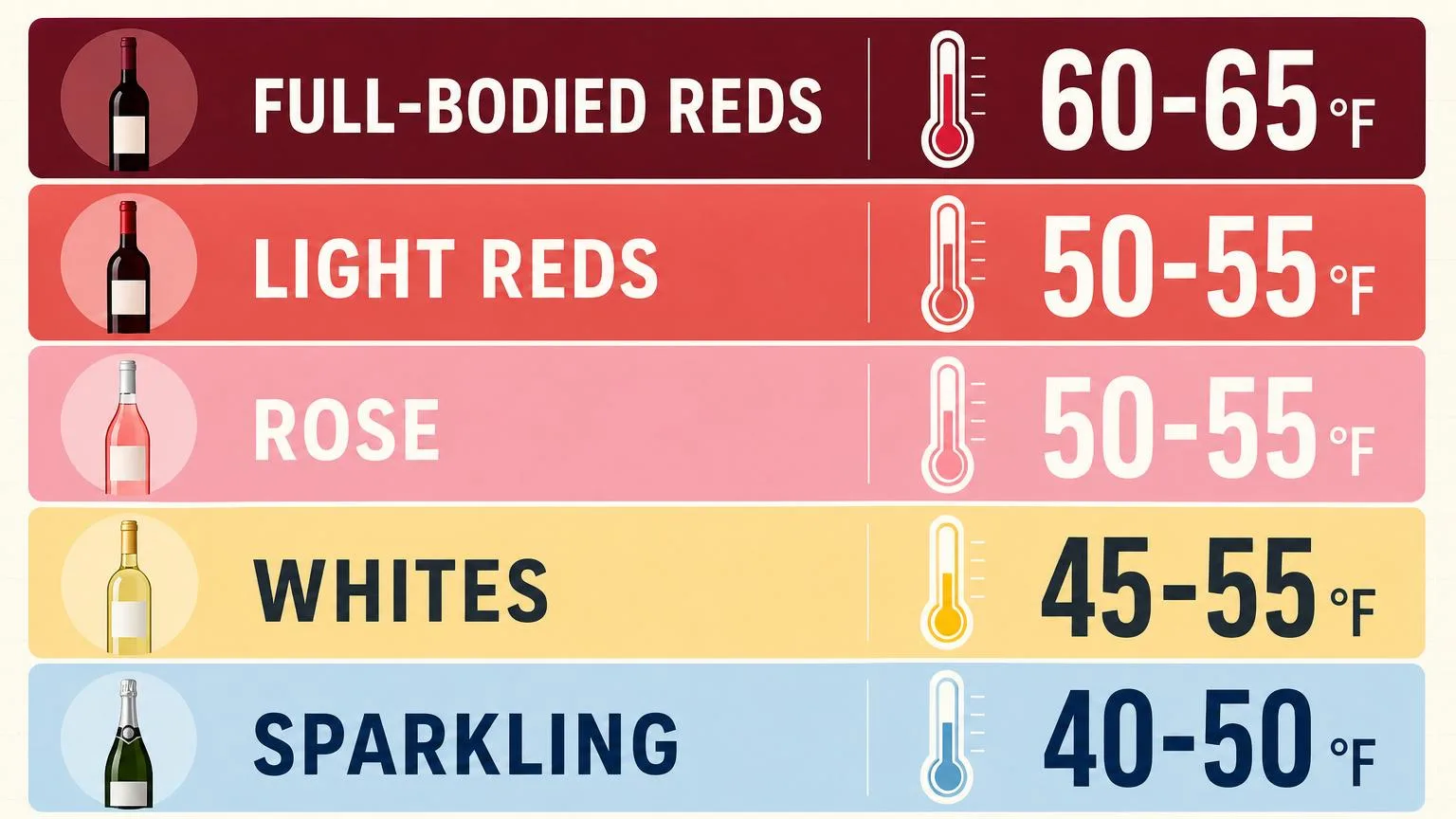
If you only own a handful of bottles or a single-zone unit, the universal answer is 55°F (13°C). That’s the temperature European wine caves have stabilized at for centuries, and it sits inside every storage band above except sparkling.
Storage Temperature vs. Serving Temperature
This is the mistake that costs most beginners a great bottle. Storage temperature keeps wine alive over months and years.
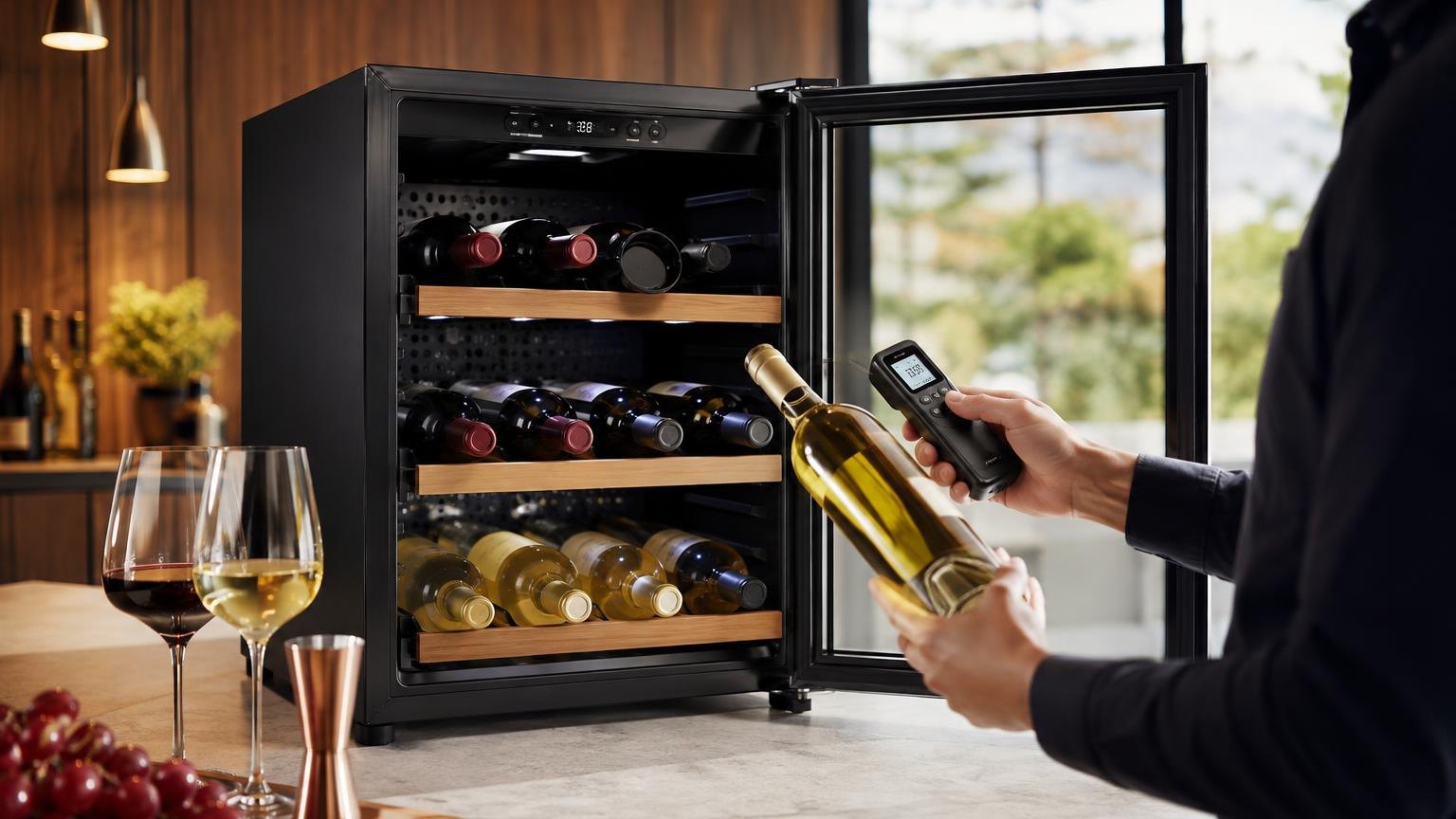
Serving temperature unlocks the flavor for the next 90 minutes. Storage stays steady at 50–58°F for almost everything.
Serving temperatures, by contrast, shift to flatter the wine in the glass. A Cabernet served at 65°F will feel rounder and more aromatic than the same wine pulled straight from a 55°F cooler.
| Wine | Storage | Serve | Quick adjustment |
|---|---|---|---|
| Full reds | 55–65°F | 60–65°F | Pull 30 min before pouring |
| Light reds | 50–55°F | 55–60°F | Pull 15–20 min before |
| Full whites | 50–55°F | 50–55°F | Pour straight from cooler |
| Light whites | 45–50°F | 45–50°F | Pour straight from cooler |
| Rosé | 50–55°F | 50–55°F | Pour straight from cooler |
| Sparkling | 45°F | 40–45°F | 15 min in ice bath if warm |
If a wine is served too warm, alcohol turns hot and aromas blur. Too cold and acidity dominates.
A dual-zone cooler is the cleanest way to side-step the math entirely. If you’re already shopping that direction, our best dual-zone wine cooler picks show what to look for.
Single-Zone vs. Dual-Zone Wine Coolers
The hardware question follows the temperature question. A single-zone unit holds one temperature throughout the cabinet. A dual-zone unit splits the interior into two independently controlled compartments.
TL;DR: your collection is mostly one style (all reds or all whites), you’re aging long-term at a steady 55°F, or you simply want a no-fuss cellar in a small footprint.
Single-zone units cost less, draw less power, and have fewer parts that can drift out of calibration.
Choose dual-zone when: you keep both reds and whites, you entertain often and want bottles ready to serve, or you store sparkling alongside aging reds.
A typical dual-zone setup runs the upper compartment at 45–50°F for whites and sparkling, and the lower compartment at 58–62°F for reds. See our best built-in wine cooler comparisons for cabinet-friendly dual-zone models.
One nuance most buyers miss: the two zones in a dual-zone share a single compressor, so the differential between zones is usually capped near 15°F.
If you need a true 40°F sparkling zone next to a 65°F red zone, you actually need two appliances.
Humidity and Why It Lives Next to Temperature
Temperature gets the headlines, but humidity is the silent partner that keeps corks alive. The accepted target is 50–70% relative humidity, with 60% as the comfortable middle.
Below 50%, corks dry from the outside in. Air sneaks past the seal, oxygen meets the wine, and oxidation accelerates.
Above 75%, mold appears on labels and the cellar starts to smell musty. The wine is usually fine, but bottle aesthetics suffer and that matters at resale.
Most modern compressor wine coolers hold humidity inside the recommended band automatically. Thermoelectric models drift drier and benefit from a small water dish or a humidity puck on a middle shelf.
The Coravin storage guide has a useful primer if you want to dig deeper into the chemistry.
Hygrometers built into cooler doors often read 10–15% lower than actual interior humidity because the sensor sits near the door seal where air exchange is highest.
Place a standalone digital hygrometer mid-shelf for an accurate baseline; calibrate it annually with a 75% salt-test kit (costs under $5).
If humidity climbs above 80% during summer months, silica gel packets — 40 g per 20-bottle zone — pull moisture without affecting temperature. Replace or recharge them every 60–90 days.
For long-term storage beyond 5 years, keep humidity at 65–70% rather than the lower end of the range. Corks in bottles sealed with natural bark lose roughly 1 mg of moisture per year at 55% RH, enough to compromise the seal after a decade.
Synthetic closures and screwcaps eliminate this concern entirely, making humidity less critical for those formats.
Where to Place Your Wine Cooler for Stable Temperatures
A perfectly calibrated cooler in the wrong room will still drift. Wine coolers reject heat into the surrounding air, which means ambient temperature directly shapes interior performance.
The sweet spot for ambient is 60–80°F (15–27°C).
Good locations:
- Climate-controlled dining rooms or living rooms
- Insulated basements (avoid damp basements without a dehumidifier)
- Built-in kitchen cabinetry with proper front ventilation
- Pantries away from the oven and dishwasher
Locations to avoid:
- Beside ovens, ranges, or dishwashers (radiant heat)
- In direct sunlight from a window
- Uninsulated garages where ambient swings 30–40°F daily
- Inside a sealed cabinet if the unit is freestanding (heat builds up against the rear coils)
If a freestanding cooler is the right fit for your room, our freestanding wine cooler placement guide walks through 15 layouts that hold temperature stable in real homes.
How to Calibrate and Verify Your Cooler’s Temperature
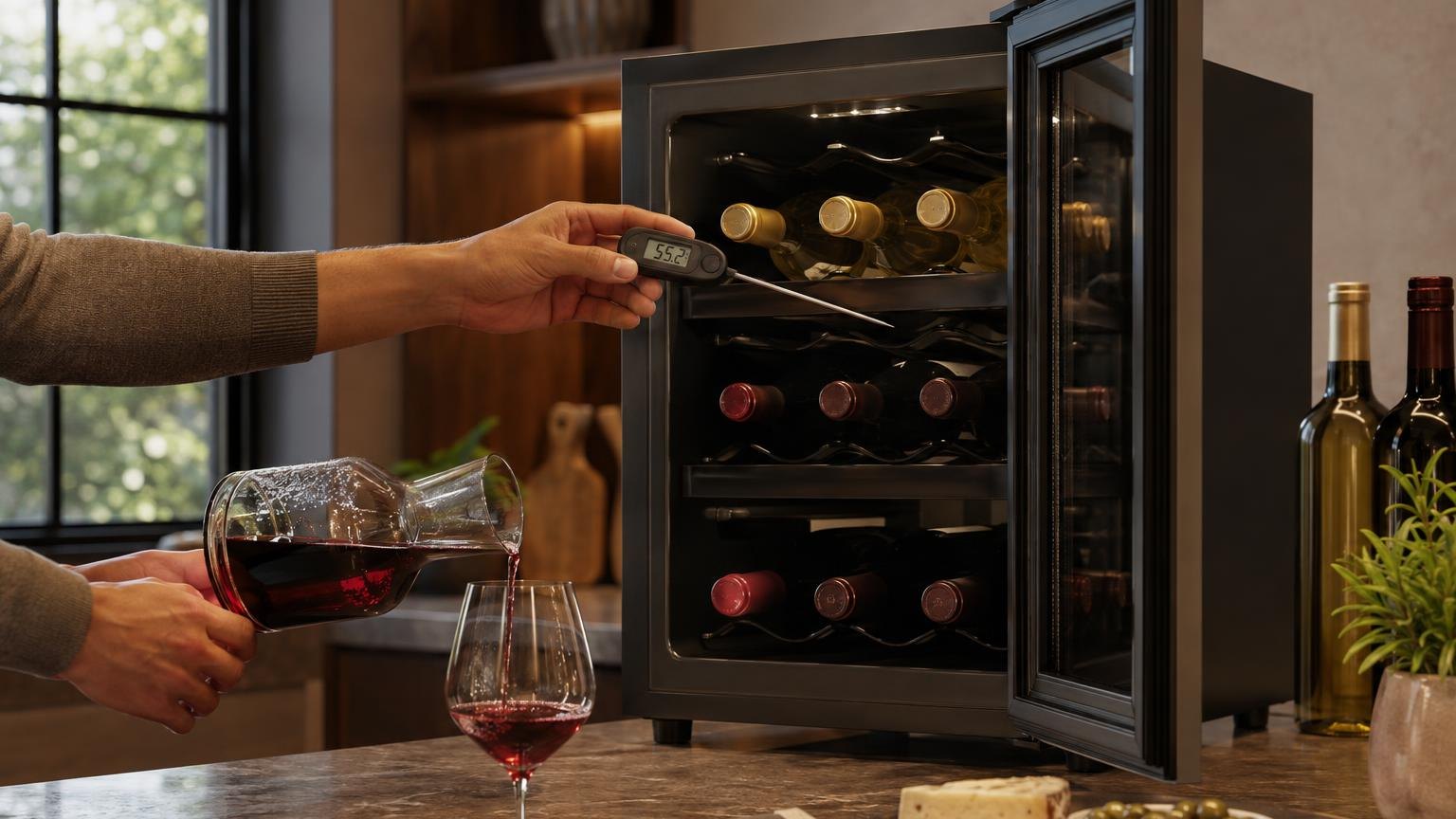
Built-in displays drift. After six months, the readout on the door can be off by 3–5°F from the actual interior, which is enough to push wine out of the safe band.
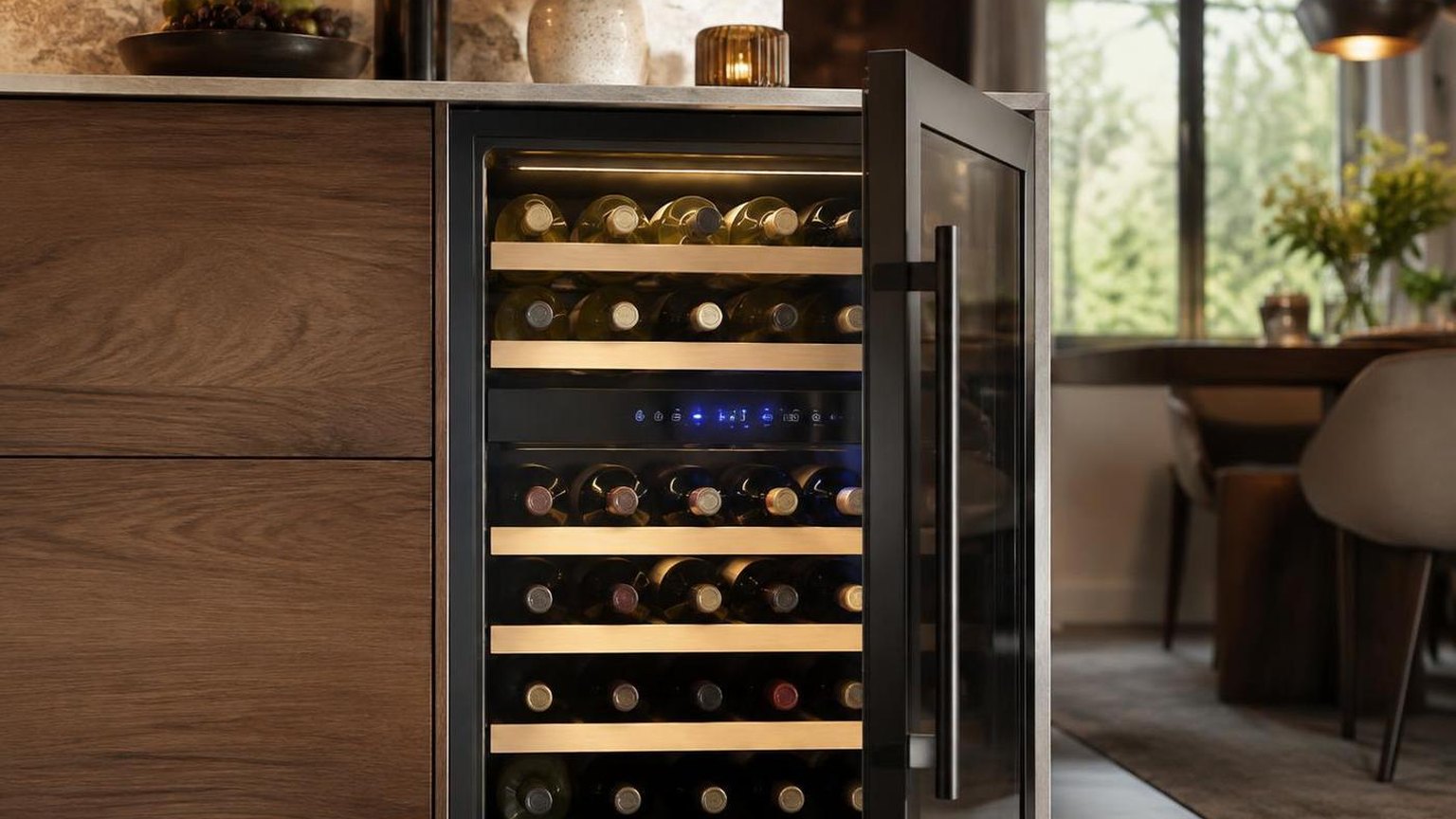
Calibration takes 24 hours and a $10 thermometer.
- Place a digital thermometer probe on the middle shelf, suspended in the air rather than touching glass.
- Wait 24 hours with the door closed and the cooler at its normal load.
- Compare the probe to the front display. A drift of 1–2°F is normal; 3°F or more needs adjustment.
- Adjust the set point in 1°F increments to bring the probe to your target.
- Recheck after another 24 hours to confirm the new value holds.
Repeat the calibration every six months, and any time you move the cooler or experience a long power outage.
Our step-by-step wine cooler temperature setup guide has the deeper walk-through, including model-specific quirks for popular brands.
Place a second thermometer on the bottom shelf simultaneously; a variance exceeding 4°F between shelves signals a failing fan or blocked vent that needs servicing before any set-point adjustment will hold.
Thermometers rated to ±0.5°F accuracy (NSF-certified models) cost under $15 and outperform the ±2°F kitchen units most owners default to.
Log each calibration date and reading in a simple spreadsheet—warranty claims and insurance riders for collections valued above $5,000 often require documented storage history.
Temperature Stability: Why Fluctuations Hurt More Than Set Point
A wine kept steadily at 60°F will outlast a wine that swings between 50°F and 65°F every day, even though the average looks similar on paper.
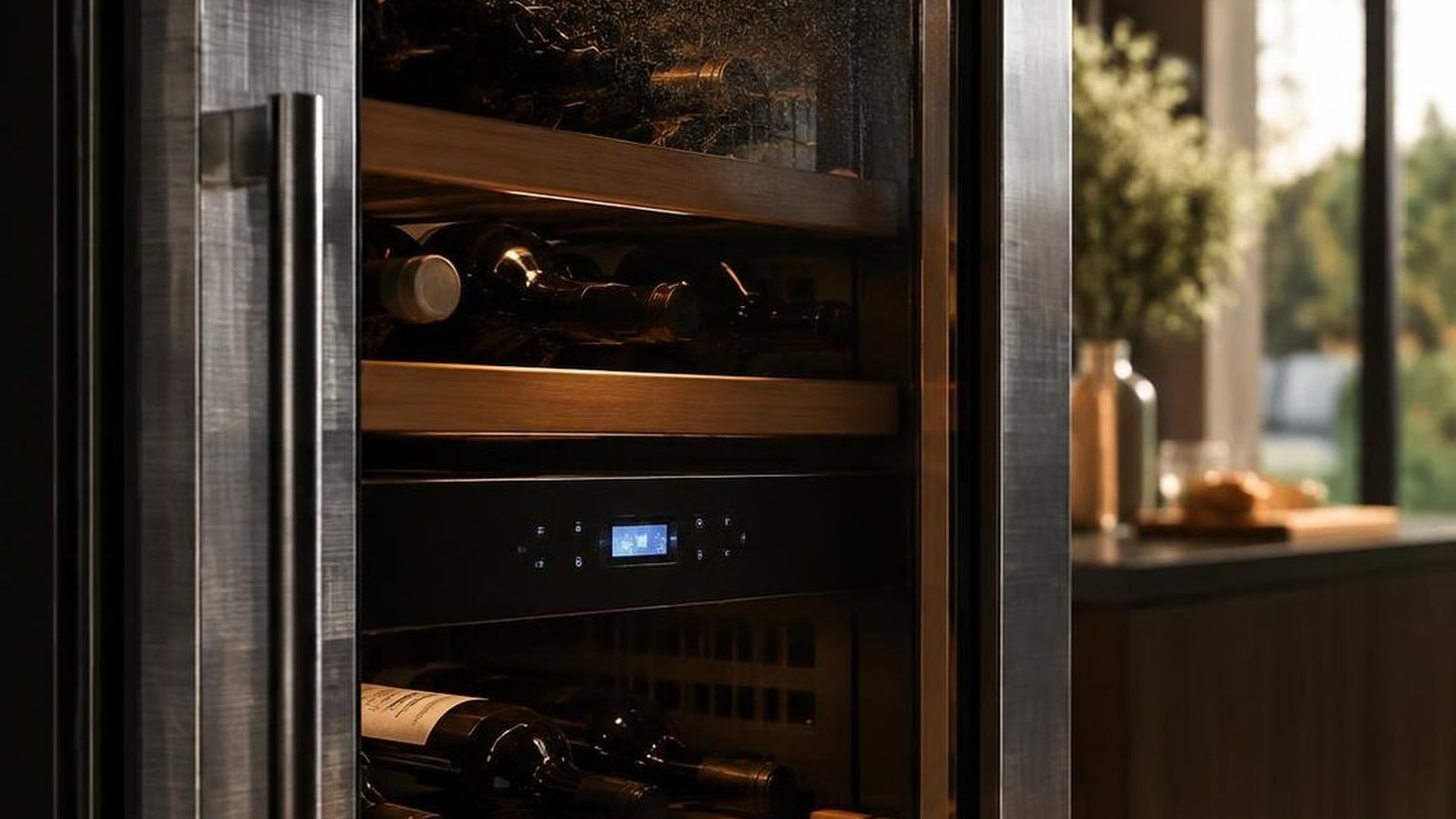
Each thermal cycle expands and contracts the liquid, pumping micro-amounts of air past the cork.
The practical thresholds:
- Daily drift under 3°F: safe for most wines, including premium aging.
- Daily drift 3–6°F: acceptable for everyday drinking, problematic for long-term aging.
- Daily drift over 6°F: moves the cooler from “wine storage” to “fancy refrigerator.” Expect noticeable quality loss within 12 months.
If your interior probe shows wide swings, the usual culprits are a weak door gasket, the cooler placed too close to a heat source, or the unit being undersized for its environment.
Compressor coolers handle high ambient heat better than thermoelectric units. That is the main reason our brand comparison guide leans toward compressor designs for warm climates.
Dual-zone coolers add a second variable: heat bleed between compartments. Expect 2–4°F interference at the zone boundary, so store your most sensitive bottles toward the center of each zone, not at the dividing shelf.
Logging temperature with a wireless sensor every 15 minutes for 72 hours reveals patterns invisible to the cooler’s built-in thermostat, which typically reads ±2°F less accurately than a calibrated external probe.
Units cycling fewer than 6 times per hour generally maintain tighter stability than short-cycle models, which create brief but repeated temperature spikes near the compressor wall.
Special Cases: Aging, Travel, and Power Outages
Long-term aging (5+ years): tighten the band. Hold 53–57°F (11–14°C) with humidity at 60–65% and zero light exposure. Aging wines reward precision more than cellars do.
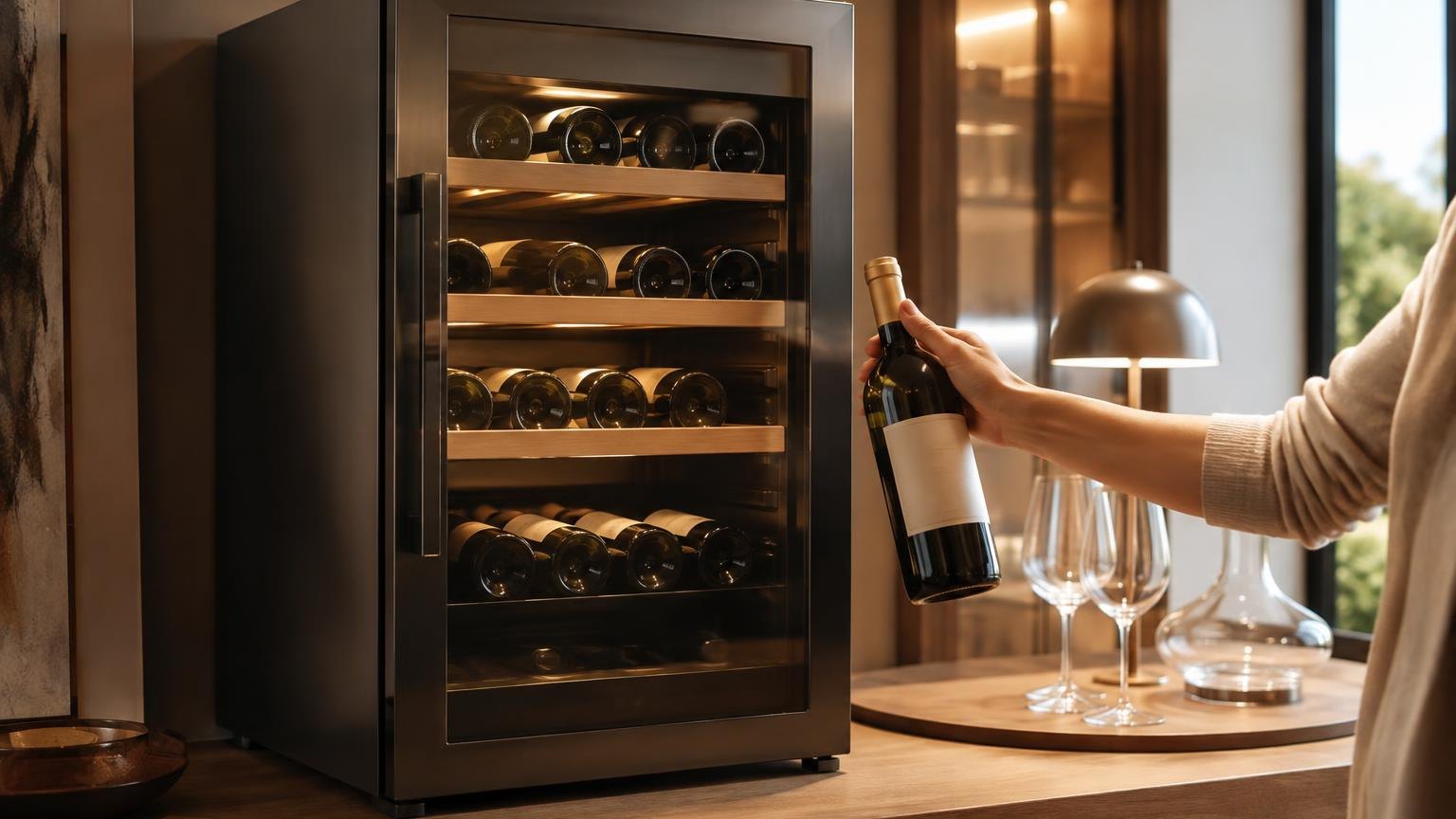
Mixed daily drinker collection: 55°F across the board, then chill whites and sparkling for 20 minutes in a regular fridge before serving. Simpler than dual-zone for most households.
Traveling for weeks: leave the cooler running. Cycling it off and back on stresses both the wine and the compressor. Power consumption is modest, usually 100–150 kWh per year for a 30-bottle unit.
Power outage: keep the door closed. A loaded compressor cooler holds temperature for 12–24 hours without power. After power returns, give the unit 12 hours to settle before checking the calibration probe.
Open bottles: a wine cooler is a fine short-term home for opened wine. Vacuum-pump the bottle, store upright, and finish whites within 3–5 days, reds within 5–7 days, and sparkling within 24 hours unless you have a Champagne stopper.
Open bottles sealed with a vacuum pump or inert-gas spray last 3–5 days at 55°F; fortified wines like port hold 4–6 weeks. Store recorked bottles upright to minimize oxidation surface area.
Earthquake or flood risk areas: secure the cooler to a wall stud with a bracket rated for 1.5× the loaded weight. A tipped 50-bottle unit can shatter every shelf.
Insurance typically excludes wine contents unless scheduled separately on a personal articles policy—document bottles with photos and purchase receipts annually.
Questions Readers Ask
What temperature should I set my wine cooler at?
Set a single-zone wine cooler to 55°F (13°C). That value sits inside the safe band for reds, whites, rosé, and most sparkling wines, and it matches the natural conditions of traditional European wine caves.
For dual-zone units, hold the upper zone at 45–50°F for whites and the lower zone at 55–65°F for reds.
Is 50°F too cold for red wine in a wine cooler?
50°F is on the cold edge but acceptable for light-bodied reds like Pinot Noir or Beaujolais. Full-bodied reds prefer 60–65°F because tannins relax at warmer temperatures.
If your cooler holds 50°F and you mostly drink Cabernet, plan to pull bottles 30 minutes before serving.
Can red and white wine be stored together?
Yes. Storing both at 55°F protects the wine without harming either style. Chill whites for 20 minutes in a kitchen fridge before serving if you prefer them colder. A dual-zone cooler removes the chilling step but is not required for healthy long-term storage.
Why does my wine cooler temperature keep fluctuating?
The most common causes are frequent door openings, a worn door gasket, ambient room temperature outside the cooler’s rated range (usually 60–80°F), placement too close to a heat source, or an overfilled cabinet that blocks airflow.
Vacuum the rear condenser coils twice a year and inspect the gasket for cracks.
How long can wine stay in a wine cooler?
Everyday reds last 1–3 years at 55°F, premium reds 5–20+ years, full-bodied whites 3–8 years, light whites 1–2 years, vintage sparkling 7–15 years, and rosé 1–3 years.
For multi-decade storage of fine bottles, a purpose-built passive cellar with tighter humidity control still outperforms most consumer coolers.
Is a regular refrigerator OK for wine?
Only for very short stretches, like a few days before opening. Standard refrigerators run at 35–40°F, which is too cold for storage, and the dry interior pulls moisture out of the cork within weeks.
The vibration from a kitchen fridge compressor is also noticeably higher than a wine-specific cooler.
Final Take: Set It, Verify It, Then Stop Worrying
The right wine cooler temperature is rarely a single magic number. It’s a steady value inside the safe band for your collection, paired with stable humidity and a quiet, dark, vibration-free spot in your home.
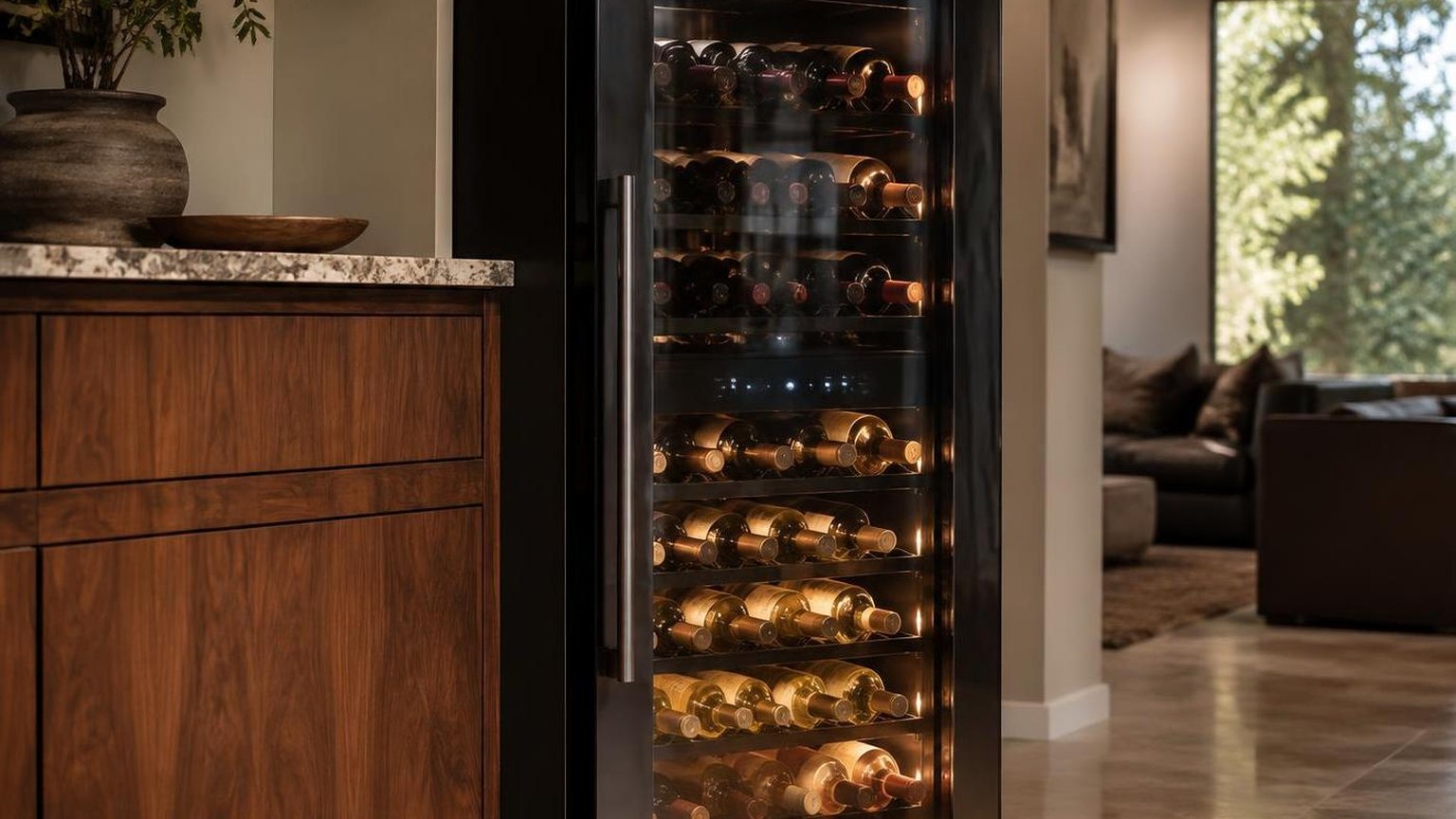
For most readers, that means 55°F single-zone or a 47°F upper / 60°F lower split on a dual-zone unit, calibrated twice a year and otherwise left alone.
Once the temperature is dialed in, the appliance disappears into the background and the wine does the rest.
If you’re still shopping for the cabinet itself, start with our best wine cooler brands roundup, then narrow by capacity using the 12-bottle, 18-bottle, or 24-bottle guides.
For practical operation tips after the cooler is in place, our how to use a wine cooler walkthrough covers loading order, shelf priorities, and daily-use habits that keep temperatures stable.
Sources consulted: Wine Spectator, UC Davis Department of Viticulture & Enology, Decanter, Coravin.
keep every bottle in its ideal window. Readers aging Barolo beyond 10 years should target 53–54 °F rather than the generic 55 °F midpoint, because slower phenolic evolution preserves acidity longer.
If ambient room temperature exceeds 80 °F in summer, expect compressor run-time to increase 25–40 %, raising annual energy cost by roughly $15–$20 on a 24-bottle unit.
Position the cooler where airflow around the rear condenser stays unobstructed by at least 3 inches.