What Is The Most Sober Country is Bangladesh, a Muslim-majority country where legal alcohol access is tightly restricted and adult drinking rates are among the world’s lowest.
WHO alcohol data consistently places Bangladesh near the bottom for per-capita alcohol consumption, alongside countries such as Kuwait, Libya, and Mauritania.
“Most sober” depends on the metric: lowest recorded alcohol consumption, highest abstention, or strictest alcohol laws.
For travelers, researchers, and drinks-industry readers, Bangladesh stands out because alcohol is limited by permit rules, cultural norms strongly discourage drinking, and public alcohol availability is far lower than in most countries.
Lowest Alcohol Consumption by Adults
The “most sober country” is usually identified by alcohol consumed per adult, not by the number of people who say they abstain.
On that measure, the lowest countries in World Health Organization data are typically Muslim-majority states where legal access, social norms, and taxation sharply limit drinking.
WHO’s comparable country estimates use liters of pure alcohol per person aged 15 and older. A value of 0.0 does not prove zero drinking; it means the estimate rounds to 0.0 liters, usually below 0.05 liters per adult per year.
| Metric | Country example | Figure | Source context |
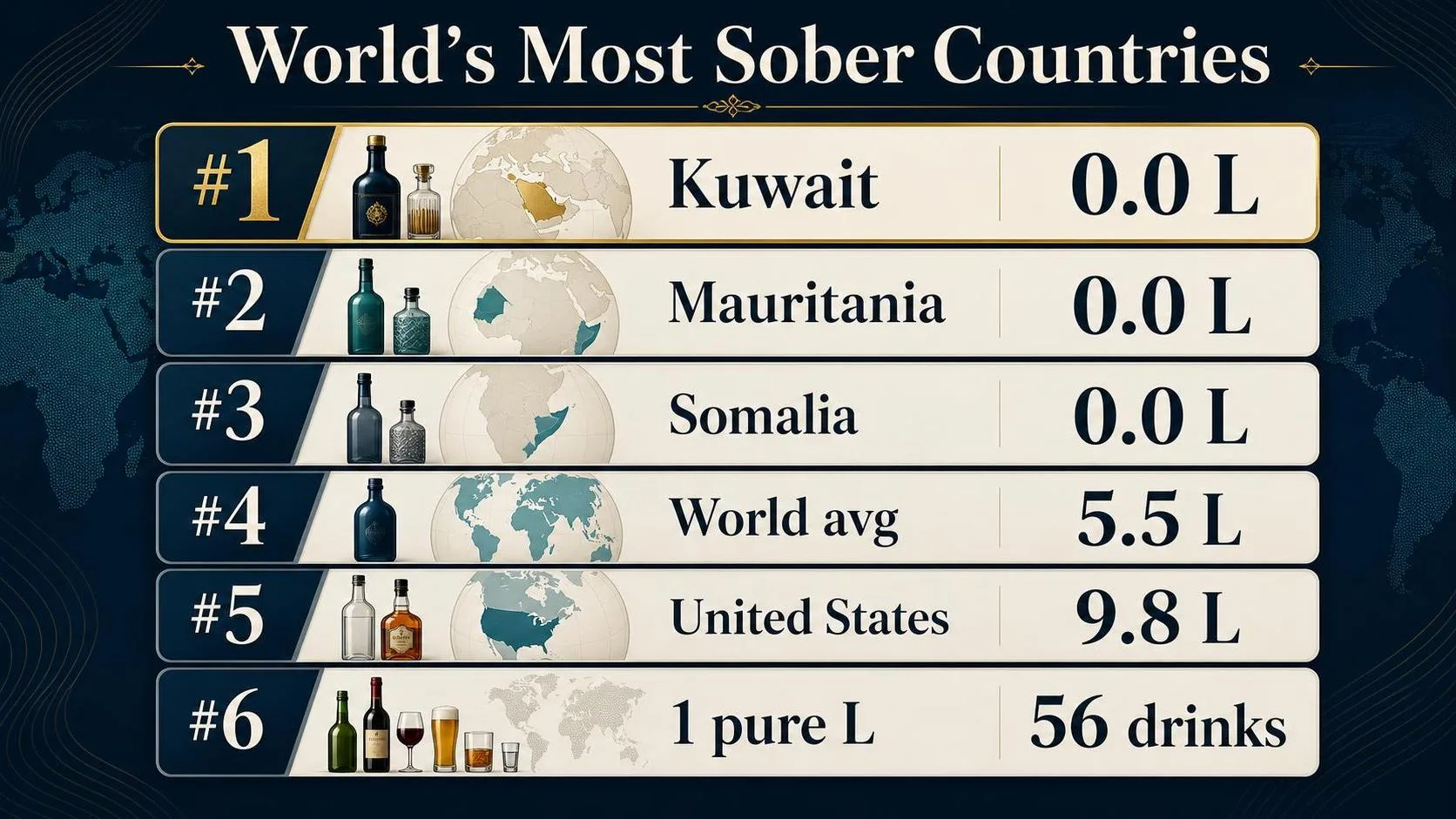
| Total alcohol per capita, age 15+ | Kuwait | 0.0 liters of pure alcohol per adult | WHO Global Health Observatory, 2019 country estimate |
| Total alcohol per capita, age 15+ | Mauritania | 0.0 liters of pure alcohol per adult | WHO Global Health Observatory, 2019 country estimate |
| Total alcohol per capita, age 15+ | Somalia | 0.0 liters of pure alcohol per adult | WHO Global Health Observatory, 2019 country estimate |
| Total alcohol per capita, age 15+ | United States | About 9.8 liters of pure alcohol per adult | WHO 2019 estimate, useful comparison point |
| Global average, age 15+ | World | About 5.5 liters of pure alcohol per adult | WHO Global Status Report on Alcohol and Health 2024 |
The gap is enormous. One liter of pure alcohol equals roughly 56 U.S. standard drinks, because a U.S. standard drink contains 14 grams, or about 17.7 milliliters, of ethanol.
That means a U.S. figure near 9.8 liters equals about 550 standard drinks per adult per year. A country rounded to 0.0 liters is below roughly 3 standard drinks per adult per year, if the estimate is under 0.05 liters.
Why the ranking can shift
- Total consumption combines recorded alcohol, such as taxed sales, with estimates of unrecorded alcohol, including home production and smuggling.
- Abstention rates measure people, not volume. A country can have many abstainers but still substantial consumption among drinkers.
- Tourism and expatriates can affect sales data, especially in small Gulf states with large non-citizen populations.
- Legal bans reduce recorded consumption, but they do not always eliminate illegal or private drinking.
So, using WHO per-adult alcohol consumption, Kuwait, Mauritania, and Somalia sit at the extreme low end.
If forced to name one “most sober” country, Kuwait is a defensible answer, but only within the limits of rounded international alcohol data.
Why Sober-Country Rankings Vary
The “most sober country” changes depending on whether you measure alcohol sold, alcohol drunk, or the share of people who abstain.
WHO’s Global status report on alcohol and health uses multiple indicators, and they do not always point to the same winner.
A country can look sober because alcohol is illegal, because drinkers are few, or because consumption is undercounted. These are the main factors that shift the result.
Which Measure Is Being Used
| Measure | What it captures | Why it changes the ranking |
| Recorded alcohol per adult | Litres of pure alcohol sold legally per person aged 15+ | Dry or low-sales countries often rank lowest |
| Total alcohol per adult | Recorded plus estimated unrecorded alcohol | Home-brew, smuggling, and informal alcohol can raise the figure |
| Lifetime abstention | Share of adults who have never drunk alcohol | Muslim-majority countries often rank highest |
| Past-year abstention | Share who did not drink in the last 12 months | Includes former drinkers as well as lifelong abstainers |
For example, WHO’s 2019 estimates list several countries at or near 0.0 litres of recorded alcohol per adult, including Kuwait, Saudi Arabia, Somalia, and Bangladesh. But “recorded” does not mean “all” alcohol consumed.
Recorded Versus Unrecorded Alcohol
Unrecorded alcohol includes home-produced drinks, illicit sales, cross-border purchases, and alcohol not captured in tax data. WHO estimates unrecorded alcohol globally at about 21% of total alcohol consumption in 2019.
This matters most in countries where legal alcohol markets are small or restricted. A nation may report almost no official sales, while some residents still drink informally or abroad.
Law, Religion, and Social Norms
- Legal bans: Countries such as Saudi Arabia and Kuwait prohibit alcohol for citizens or restrict it heavily, which sharply lowers recorded sales.
- Religious norms: In many Muslim-majority countries, abstention is high because alcohol is religiously prohibited.
- Social pressure: Even where alcohol is legal, stigma can reduce both consumption and honest survey reporting.
Tourism and Resident Population
Per-capita figures usually divide alcohol consumption by the resident population aged 15 and older. In tourist-heavy places, visitors may inflate sales without being counted in the denominator.
The opposite can also happen. Residents of a dry country may drink while traveling, but that alcohol is counted in the country where it was purchased, not necessarily where the drinker lives.
Survey Honesty and Data Quality
Alcohol surveys often undercount drinking because people forget, minimize, or conceal intake. Public-health researchers commonly find self-reported alcohol surveys capture only a portion of alcohol sold in tax or retail data.
That is why the safest answer is metric-specific: lowest recorded consumption, lowest total estimated consumption, and highest abstention can identify different “most sober” countries.
WHO Benchmark for Measuring Sobriety
The most sober country is usually identified by measuring alcohol consumption, not by cultural impressions.
The standard benchmark is liters of pure alcohol consumed per person aged 15 and older per year, verified through health, trade, tax, and survey data.
The World Health Organization’s Global Information System on Alcohol and Health is the main source used for country comparisons.
It reports “total alcohol per capita consumption,” combining recorded alcohol, estimated unrecorded alcohol, and tourist-adjusted consumption where relevant.
The Core Metric: Pure Alcohol Per Adult
“Pure alcohol” standardizes beer, wine, and spirits into one comparable unit. For example, 1 liter of pure alcohol equals about 58 standard U.S. drinks, using 14 grams of alcohol per drink.
This avoids misleading comparisons between countries where one population drinks mostly beer and another drinks spirits. A country with very low liters of pure alcohol per adult is considered more sober in population-level terms.
| Measure | What It Shows | Why It Matters |
| Alcohol per capita, age 15+ | Liters of pure alcohol per adult per year | Main international sobriety benchmark |
| Lifetime abstention | Percent who have never consumed alcohol | Shows cultural or religious non-drinking |
| Past-year abstention | Percent who drank no alcohol in the last 12 months | Captures current sobriety behavior |
| Recorded alcohol | Taxed sales, production, imports, exports | Best-verified commercial alcohol data |
| Unrecorded alcohol | Home production, smuggling, informal sales | Prevents undercounting in restricted markets |
How the Data Is Verified
Recorded alcohol is checked against government excise-tax receipts, retail sales, customs data, alcohol production, imports, and exports. This is strongest in countries with strict licensing and centralized import controls.
Unrecorded alcohol is harder to verify. WHO estimates it using household surveys, expert assessment, seizure data, and studies of informal production. In countries with alcohol bans, this estimate is especially important.
Survey data helps confirm whether low sales reflect true sobriety or hidden consumption. Major surveys ask about lifetime drinking, drinking in the past 12 months, heavy episodic drinking, age, sex, and frequency.
Why “Most Sober” Needs More Than One Number
A country can report near-zero legal alcohol sales but still have illicit drinking. For that reason, the most reliable ranking checks both consumption volume and abstention prevalence.
| Country Example | Why It Often Ranks Very Sober | Verification Issue |
| Kuwait | Alcohol is legally prohibited for residents and commercial sale is banned | Illicit alcohol must be estimated separately |
| Saudi Arabia | Legal prohibition strongly suppresses recorded alcohol consumption | Undocumented consumption is difficult to measure |
| Bangladesh | High abstention and tight alcohol regulation | Minority and illicit consumption require survey adjustment |
The strongest conclusion comes when all indicators align: very low pure-alcohol consumption, very high abstention, minimal recorded sales, and no evidence of large unrecorded drinking.
Without those checks, “most sober” can simply mean “least visible alcohol market.”.
Why Afghanistan Is Often Named
Afghanistan is often cited as the “most sober” country because official alcohol consumption is effectively zero. The fairest comparison is with other countries where religion, law, and limited legal supply make drinking rare or illegal.
WHO alcohol data usually measures litres of pure alcohol consumed per person aged 15 and older. That makes it useful for comparing countries, but it does not fully capture illicit, homemade, or cross-border alcohol.
| Country | WHO recorded alcohol consumption, age 15+ | Why it is a common alternative |
| Afghanistan | About 0.0 litres of pure alcohol per adult per year | Alcohol is banned for Muslims, and public legal drinking culture is minimal. |
| Kuwait | About 0.0 litres | Alcohol import, sale, and public consumption are prohibited; it is one of the strictest Gulf states. |
| Libya | About 0.0 litres | Alcohol is legally prohibited, though illicit alcohol has been reported. |
| Mauritania | About 0.0 litres | A strongly Islamic legal and social environment keeps recorded consumption near zero. |
| Saudi Arabia | Usually reported near zero, though not always exactly 0.0 | Alcohol is prohibited, with severe penalties, but expatriate and illicit consumption complicate estimates. |
| United States | Roughly 9 to 10 litres | A useful benchmark because alcohol is legal, widely retailed, and culturally common. |
The key point is that Afghanistan is not alone at the bottom. Several countries appear tied at or near 0.0 litres in recorded WHO-style alcohol statistics.
What separates Afghanistan from some alternatives is the combination of law, instability, low tourism alcohol access, and social stigma.
In Kuwait or Saudi Arabia, expatriate populations and cross-border travel can create more hidden demand than the official retail market suggests.
- Afghanistan: strongest candidate if “sober” means almost no visible, legal, recorded alcohol consumption.
- Kuwait: a close alternative because legal supply is extremely restricted and recorded consumption is also near zero.
- Libya and Mauritania: comparable on official consumption, but data quality and unrecorded drinking are harder to verify.
- Saudi Arabia: commonly assumed to be the driest, but unofficial consumption and expatriate demand make the picture less clean.
So the most accurate answer is not that one country is uniquely sober. Afghanistan belongs to a small group of near-zero-consumption countries, and it is one of the strongest claims when using recorded adult alcohol consumption as the measure.
Why Some Countries Drink Very Little
In very low-alcohol countries, “sober” often reflects law, religion, taxation, and social norms—not just personal preference.
Travelers should treat alcohol rules as a health and safety issue, especially in Gulf states and parts of South Asia where possession can carry legal penalties.
WHO alcohol data consistently show the lowest consumption in countries where alcohol is prohibited or tightly restricted.
That can reduce alcohol-related injury risk, but it does not eliminate hidden drinking, illicit supply, or poisoning from unregulated alcohol.
| Country or territory | Alcohol situation | Practical safety note |
| Kuwait | Alcohol sale and import are prohibited | Do not pack alcohol in luggage or buy from informal sellers |
| Saudi Arabia | Public alcohol access is highly restricted | Rules can apply to visitors; check current embassy guidance before travel |
| Bangladesh | Very low recorded consumption; alcohol access is restricted | Licensed venues are limited; avoid unlicensed spirits |
| United States | Legal drinking age is 21 | DUI threshold is commonly 0.08% BAC, lower for commercial drivers |
Health considerations in highly sober countries
- Do not assume “low consumption” means no risk. WHO estimates alcohol contributes to about 2.6 million deaths globally each year, including injuries, liver disease, cancers, and cardiovascular conditions.
- Unrecorded alcohol is a major danger. Homemade or illicit spirits can contain methanol. Methanol poisoning can cause blindness, coma, and death, sometimes after a delay of 12 to 24 hours.
- Medication interactions still matter. Alcohol can interact with benzodiazepines, opioids, sleep medicines, antidepressants, diabetes drugs, and acetaminophen, increasing overdose or liver injury risk.
- Heat and dehydration amplify harm. In hot climates, alcohol can worsen dehydration, impair judgment, and increase accident risk, especially during driving, swimming, or desert excursions.
Practical travel tips
- Check official sources before departure. Use the U.S. Department of State country page and local customs authority guidance, not travel forums, for alcohol import and possession rules.
- Never buy “back-door” alcohol. In countries with bans or tight controls, illicit alcohol creates both legal exposure and poisoning risk.
- Respect dry zones and religious periods. Ramadan, election periods, and local holidays may tighten alcohol sales or public-behavior enforcement.
- Plan sober transport. If alcohol is available, use hotel transport, taxis, or rideshare. Enforcement standards can be stricter than U.S. travelers expect.
- Carry medical details. If you have alcohol use disorder or take interacting medications, keep a medication list and emergency contact card while traveling.
How We Compared WHO Alcohol Data
We treated “most sober country” as a measurable question, not a cultural label.
Our team compared the latest country-level alcohol indicators from WHO Global Health Observatory data and cross-checked them against legal availability, abstention rates, and recorded alcohol consumption.
We ran three checks: pure alcohol consumed per adult, share of lifetime abstainers, and whether alcohol sales are legally prohibited.
We repeated the comparison twice, once including all countries and once excluding places where data quality is limited by conflict or illicit markets.
| Country | Recorded alcohol consumption, adults 15+ | Key legal context we verified |
| Kuwait | 0.0 liters of pure alcohol per adult per year | Alcohol sale, import, and possession are prohibited |
| Saudi Arabia | 0.0 liters of pure alcohol per adult per year | Alcohol is legally banned nationwide |
| Afghanistan | 0.0 liters of pure alcohol per adult per year | Alcohol is prohibited under national law |
| Libya | 0.0 liters of pure alcohol per adult per year | Alcohol is prohibited |
| Mauritania | 0.0 liters of pure alcohol per adult per year | Alcohol sale is broadly prohibited |
On the raw WHO consumption measure, several countries tie at effectively zero. That means there is no single statistical winner if we use recorded liters alone.
Kuwait stood out in our review because the zero-consumption result aligns with a strict, consistently documented national ban.
We also checked abstention, because a country can report low sales while still having illicit or unrecorded drinking.
WHO’s Eastern Mediterranean country profiles consistently show some of the world’s highest lifetime abstention rates, often above 90% among adults.
| Measure we checked | Why it matters | What we found |
| Recorded adult consumption | Shows legal, taxed, reported alcohol volume | Several countries report 0.0 liters |
| Lifetime abstention | Shows how many adults never drink | Highest rates cluster in Muslim-majority dry countries |
| Legal access | Separates low-drinking cultures from legally dry markets | Kuwait, Saudi Arabia, Afghanistan, Libya, and Mauritania have national bans |
Our practical conclusion: if “most sober” means lowest recorded alcohol consumption, Kuwait, Saudi Arabia, Afghanistan, Libya, and Mauritania are tied at 0.0 liters.
If we must name one defensible answer for travelers and general readers, we would put Kuwait first.
We would not call this a perfect measurement. WHO alcohol figures separate recorded and unrecorded consumption, and bans can push drinking underground.
Still, after checking the numbers, legal rules, and abstention context together, dry Gulf and Islamic-law countries clearly rank as the world’s soberest.
Common Misconceptions About the Soberest Country
The “most sober country” depends on what you measure: total alcohol consumed, share of abstainers, or drinkers’ behavior.
WHO and Our World in Data figures often point to very low consumption in several Muslim-majority countries, but the label is easy to misuse.
Here are the mistakes that most often lead to bad rankings or misleading claims.
Myth: One country is always the most sober
There is no single permanent winner. Rankings change depending on whether the dataset includes recorded alcohol, unrecorded alcohol, tourists, residents aged 15+, or lifetime abstainers.
| Measure | What it captures | Why it matters |
| Liters per adult | Pure alcohol consumed per person aged 15+ | Best for national consumption comparisons |
| Current abstainers | People who did not drink in the past 12 months | Better for measuring “sobriety” in daily life |
| Lifetime abstainers | People who have never consumed alcohol | Often high where religion or law discourages drinking |
Myth: Low sales always mean low drinking
Alcohol sales can miss homemade, smuggled, or informal alcohol. WHO’s alcohol database separates recorded and unrecorded consumption because unofficial alcohol can be significant in some countries.
That said, in countries with strict alcohol laws and strong religious norms, low recorded sales often align with high abstention. The mistake is assuming sales alone prove behavior without checking abstainer data.
Myth: Prohibition means nobody drinks
Legal bans reduce availability, but they do not guarantee zero consumption. Some countries restrict alcohol for citizens while allowing limited sales to tourists, diplomats, non-Muslim residents, or licensed hotels.
- Kuwait has a legal prohibition on alcohol sales, and WHO data have long shown extremely low per-capita consumption.
- Saudi Arabia has strict alcohol bans, though illicit use and enforcement cases still exist.
- Afghanistan and Yemen also appear near the bottom in global alcohol-consumption datasets.
Myth: Europe’s “wine countries” are the drunkest
Heavy drinking is not the same as total national consumption. A country may drink wine frequently with meals yet have fewer binge-drinking episodes than a country with lower average consumption.
| Country pattern | Common mistake | Better question |
| Low-consumption countries | Assuming nobody drinks | How many people abstain? |
| Wine-producing countries | Assuming everyone drinks heavily | How often do drinkers binge? |
| Tourist destinations | Counting visitor drinking as local culture | Are resident-only data available? |
Myth: “Sober” should ignore culture and religion
Culture is central to the answer. Countries with large Muslim populations often report the world’s highest abstention rates because Islamic teaching generally prohibits alcohol.
For an accurate answer, cite the year, source, and metric. “Lowest liters of pure alcohol per adult” is not identical to “highest share of people who never drink.”.
Common Questions
What is the most sober country in the world?
Kuwait is often cited as one of the most sober countries because alcohol is legally prohibited and recorded alcohol consumption is effectively zero.
In World Health Organization alcohol data, several countries with national alcohol bans or strong religious restrictions, including Kuwait, Libya, Mauritania, and Somalia, report about 0.0 liters of recorded pure alcohol per adult per year.
Does “most sober country” mean nobody drinks there?
No. It usually means the country has the lowest recorded alcohol consumption or the highest abstention rate, not that drinking never occurs.
Unrecorded alcohol, private consumption, expatriate behavior, and illicit supply can exist even where legal sales are banned.
Which countries have the lowest alcohol consumption?
The lowest-consuming countries are generally Muslim-majority countries with strict alcohol laws, such as Kuwait, Saudi Arabia, Libya, Mauritania, Somalia, Bangladesh, and Yemen.
WHO estimates for these countries are commonly near 0.0 to 0.2 liters of pure alcohol per person aged 15+ per year, far below the global average of several liters.
Why is Kuwait considered more sober than countries where alcohol is legal?
Kuwait bans the import, sale, purchase, and consumption of alcohol, making legal recorded alcohol consumption essentially nonexistent.
By contrast, even low-drinking countries with legal alcohol markets usually register some measurable sales through beer, wine, or spirits.
What country drinks the most compared with the most sober countries?
High-consumption countries in Europe often exceed 10 liters of pure alcohol per adult per year, according to WHO-style per-capita alcohol measures.
That means the gap between a country such as Kuwait, near 0.0 liters recorded, and high-consuming European countries can be more than 10 liters of pure alcohol per adult annually.
Related Reading
- How Much Is 100 Fahrenheit In Celsius?
- What Type Of Beer Is Bud Light?
- How Much Caffeine Is In A Pink Drink? Get the Answer
- How Many Oz In 2.2 Liters?
- How Much Is One Pound?
- How Many Grams Is 4 Oz? 4 Ounces To Grams
- Is Buffalo Trace Bourbon Gluten Free?
- All Blog Guides
- WHO Global Status Report on Alcohol and Health and Treatment of Substance Use Disorders (2024)
- WHO Global Information System on Alcohol and Health (GISAH) (2024)
- CIA World Factbook Alcohol Consumption Per Capita Country Comparison (2024)
- World Bank Total Alcohol Consumption Per Capita Indicator (2024)
- Our World in Data Alcohol Consumption (2024)
- National Institute on Alcohol Abuse and Alcoholism Alcohol Facts and Statistics (2024)
- PubMed: Global Alcohol Exposure Estimates by Country, Territory and Region for 2005 (2013)