How To Start A Winery is a capital-intensive licensing, farming, production, and sales business built around turning grapes into legally compliant wine for wholesale, direct-to-consumer, or tasting-room revenue.
In the U.S., founders typically need bonded-winery approval from the TTB, state alcohol licenses, local zoning clearance, production equipment, grape supply, insurance, and a route to market.
This guide breaks the process into practical steps: choosing a winery model, estimating startup costs, securing permits, sourcing fruit, planning production, building a tasting room or distribution strategy, and avoiding cash-flow mistakes.
Expect decisions on acreage, custom crush versus estate production, federal excise tax records, label approvals, and compliance systems before the first bottle is sold.
Winery Startup Math Basics
The math of starting a winery turns on three variables: grapes, gallons, and cash flow timing. Before choosing tanks or tasting-room furniture, model how many cases you can legally, physically, and profitably produce.
In winery plans I review, the first mistake is usually overestimating saleable cases. Losses from pressing, racking, topping, filtration, and bottling are real, so build your forecast from conservative yields.
| Metric | Practical planning number | Why it matters |
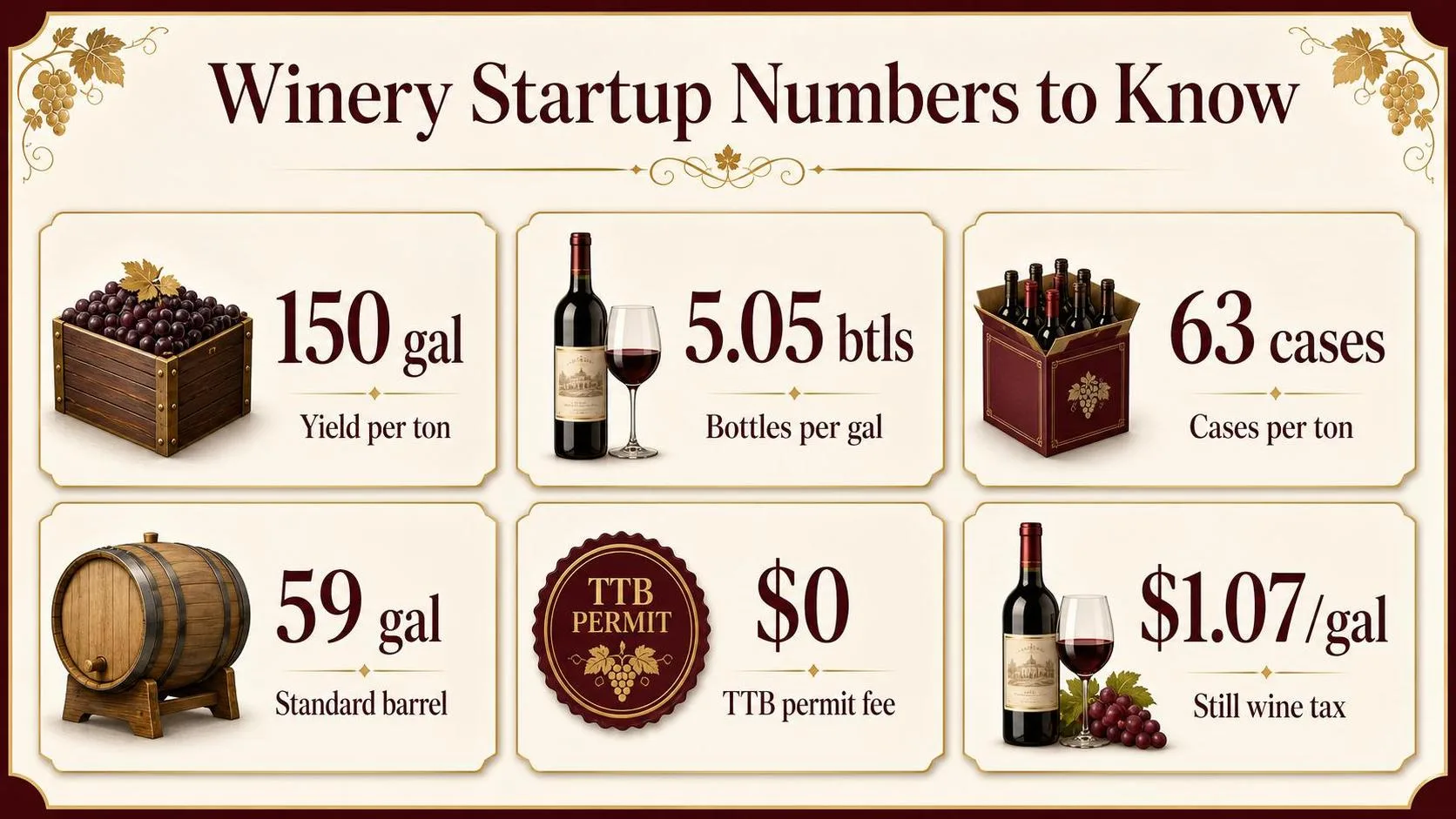
| Grapes to wine | About 150 gallons per ton | Common U.S. planning yield; actual results vary by variety, press cycle, and winemaking style. |
| Wine to bottles | 1 gallon equals about 5.05 standard 750 ml bottles | Use this to convert cellar volume into sellable inventory. |
| Wine to cases | 1 ton produces roughly 63 cases | 150 gallons equals about 757 bottles, or about 63 twelve-bottle cases. |
| Standard barrel | 59 gallons, about 25 cases | Important for barrel budgets, topping losses, and cellar space. |
Vineyard assumptions should be local, not national. USDA data show U.S. wine-grape yields vary widely by state and region; a safe early model should use modest crop levels until your own blocks prove otherwise.
| Scenario | Yield assumption | Approximate case output |
| Low-yield premium site | 3 tons per acre | About 189 cases per acre |
| Moderate coastal or hillside site | 4 tons per acre | About 252 cases per acre |
| Higher-yield commercial site | 6 tons per acre | About 378 cases per acre |
Licensing is not just paperwork; it affects launch timing. The federal TTB winery basic permit has no application fee, but you cannot operate commercially until approval and required registrations are in place.
| Regulatory item | Key number | Source or note |
| TTB basic permit | $0 federal application fee | Alcohol and Tobacco Tax and Trade Bureau. |
| Wine gallon | 128 fluid ounces | TTB tax unit for wine production and removals. |
| Still wine tax, up to 16% alcohol | $1.07 per wine gallon before credits | TTB federal excise tax rate. |
| Small producer credit | Up to $1.00 per wine gallon on the first 30,000 wine gallons | Available only if eligibility rules are met. |
Cash timing is the final key number. If you make red wine, grapes may be paid for in harvest season, while finished bottles may not generate revenue for 12 to 24 months.
- Direct-to-consumer pricing matters: a $35 bottle sold in your tasting room keeps far more gross revenue than the same bottle sold through wholesale distribution.
- Inventory ties up cash: barrels, glass, closures, labels, storage, compliance, and insurance are paid before customers buy the wine.
- Start smaller than your dream volume: a 1,000-case first vintage is often easier to finance, sell, and learn from than a 5,000-case launch.
Factors That Shape Winery Success
The outcome of a winery is shaped less by romance than by site, permits, capital, grape supply, and distribution control.
In my experience evaluating U.S. tasting-room models, the biggest early mistake is underestimating cash tied up before the first sellable vintage.
Wine production has long lead times. A red wine may require 12 to 24 months in barrel or tank, then additional bottle aging, while federal and state approvals must be secured before commercial sales begin.
Capital, Scale, and Time to Revenue
Startup costs vary widely because “winery” can mean a custom-crush brand, an urban micro-winery, or an estate with land and vineyards.
UC Davis and state extension budgets consistently show vineyard establishment alone can run tens of thousands of dollars per acre before full production.
| Model | Typical constraint | Practical implication |
| Custom-crush brand | No owned facility | Lower fixed cost, but less control over scheduling, equipment, and margins |
| Urban or warehouse winery | Facility lease, equipment, permits | Faster launch than estate model, but depends on purchased fruit |
| Estate winery | Land, vineyard establishment, tasting room | Highest capital need and slowest path to vineyard maturity |
Grapes and Vineyard Risk
Grape quality determines ceiling price. One ton of wine grapes typically produces about 150 gallons, or roughly 63 cases of 750 ml bottles.
If fruit cost rises by $500 per ton, raw grape cost increases by about $7.94 per case before packaging, labor, overhead, and tax.
- Climate: Frost, heat spikes, wildfire smoke, hail, and drought can erase profit in a single season.
- Variety choice: Cabernet Sauvignon, Pinot Noir, Chardonnay, and sparkling grapes require different sites, harvest timing, and equipment.
- Contracts: Long-term grape contracts stabilize supply but can lock a new winery into fruit that does not match the brand.
Licensing, Compliance, and Market Access
The Alcohol and Tobacco Tax and Trade Bureau requires a federal winery permit and label approvals through COLA before most interstate sales. States add their own production, tasting-room, direct-shipping, and sales-tax rules.
| Factor | Why it changes the result |
| Direct-to-consumer sales | Often produces stronger margins than wholesale, but requires tasting traffic, compliance, fulfillment, and customer retention |
| Wholesale distribution | Can expand volume, but distributor and retailer tiers reduce winery net revenue |
| Tasting room location | High-traffic wine regions can improve conversion, but rent, payroll, and competition are higher |
Operational Discipline
Packaging costs, spoilage, bottling delays, and inventory financing materially affect cash flow. A winery selling through wholesale may wait months for payment while still carrying barrels, bottles, labor, insurance, excise tax, and debt service.
The result improves when the business plan matches realistic production volume, sales channel margins, and the owner’s ability to fund at least two vintages before steady cash flow arrives.
Tracking and Verifying Winery Operations
Starting a winery is measured through licensed production, bonded wine premises records, tax-paid removals, lab analysis, and state compliance reports.
Verification comes from federal TTB filings, state alcohol-control inspections, county records, and physical inventory reconciliation.
Federal Production and Tax Verification
In the United States, a winery must operate as a TTB-approved bonded wine premises before producing wine for commercial sale.
The core verification document is the TTB wine bond record system, supported by production logs, cellar records, and tax filings.
| Measurement | Verified By | Typical Record |
| Wine produced | TTB wine premises records | Gallons crushed, fermented, blended, bottled |
| Wine removed for sale | TTB excise tax reporting | Tax-paid removals in wine gallons |
| Inventory on hand | Physical count and cellar records | Bulk gallons, bottled cases, losses |
| Label approval | TTB COLA system | Certificate of Label Approval before interstate sale |
Most wineries file TTB operational reports on Form 5120.17. Filing frequency depends on production and tax status, but the report reconciles beginning inventory, production, transfers, bottling, removals, losses, and ending inventory.
State and Local Compliance Checks
States verify winery operations through alcohol licenses, production privileges, tasting-room permissions, direct-to-consumer shipping permits, and sales-tax accounts.
Local governments verify zoning, building occupancy, wastewater handling, fire safety, and food-service rules if tastings include prepared food.
- California wineries may need an ABC Type 02 Winegrower license before selling wine.
- Direct shipping usually requires separate permits in each destination state.
- County use permits often limit event size, traffic, hours, noise, and tasting-room capacity.
- Wastewater discharge may be reviewed because winery effluent can have high biochemical oxygen demand.
Quality, Volume, and Label Claims
Wine is also verified analytically. Alcohol by volume is commonly tested by distillation, densitometry, or approved laboratory methods. Finished wine should match the alcohol statement allowed under TTB labeling tolerances.
| Label Claim | Federal Verification Standard |
| Vintage date | At least 95 percent from stated vintage for most U.S. appellation wines |
| Varietal name | At least 75 percent from the named grape variety under federal rules |
| AVA appellation | At least 85 percent of grapes from the named AVA |
| Alcohol statement | Subject to TTB tolerance rules based on wine class and alcohol level |
Practical verification is simple but strict: gallons in must equal gallons accounted for. Crush weights, press yields, barrel topping, evaporation, racking loss, bottling loss, samples, transfers, and tax-paid sales all need documented explanations.
A credible winery start-up budget also gets verified against capacity. A facility claiming 5,000 cases annually must have tank, barrel, crush-pad, storage, compliance, and cash-flow assumptions that support roughly 11,900 gallons of finished wine.
Comparing Winery Startup Models
Starting a bonded winery gives you the most control, but it is usually the slowest and most capital-intensive path into the wine business.
Many new brands first use custom crush, an alternating proprietorship, or a vineyard-only model to reduce permitting, equipment, and staffing burdens.
The right comparison depends on what you want to own: the brand, the tanks, the vineyard, or the hospitality experience. Federal TTB rules, state licensing, and local zoning can make two similar-looking models very different in cost and timeline.
| Model | Typical startup exposure | Control level | Key tradeoff |
| Bonded winery | Highest: facility, tanks, permits, compliance, insurance | Full control over production, inventory, brand, tastings | Longest setup; often 12-24 months before first commercial release |
| Custom crush brand | Lower: grapes, production contract, labels, sales licenses | Moderate; winemaking decisions shared with host facility | No owned facility; limited scheduling and hospitality options |
| Alternating proprietorship | Medium: own bonded business inside another winery | High for wine ownership and records; limited physical control | Requires strict separation of wine, records, and operations under TTB rules |
| Vineyard-only business | Land-heavy: vines, irrigation, farming equipment, labor | High over grapes, low over finished wine | Cash flow delayed; wine grapes commonly need 3 years to first meaningful crop |
| Wine bar or tasting room retail | Lower than production if leasing | High over customer experience, low over production | Depends on margins, licensing, foot traffic, and supplier access |
Bonded Winery Versus Custom Crush
A bonded winery makes sense when the business plan relies on estate identity, direct-to-consumer sales, tasting room revenue, or long-term production capacity.
It also means taking responsibility for federal excise tax, production records, label approvals, and physical premises compliance.
Custom crush is faster because the host winery already has tanks, presses, lab tools, cellar staff, and a bonded site. Many small brands begin with 500-2,000 cases, testing demand before investing in real estate and fixed equipment.
Alternating Proprietorship as a Middle Ground
An alternating proprietorship can let a new producer operate as its own bonded winery within another winery’s premises. Under TTB oversight, each proprietor must maintain separate records, tax liability, and ownership of wine lots.
This model is attractive when brand ownership matters, but buying a press, forklift, bottling line, and barrel storage does not.
The downside is operational dependency: harvest dates, tank availability, and cellar workflow still depend on the host facility.
Vineyard-Only and Retail Alternatives
Owning vineyard land is not the same as owning a winery. A vineyard may sell fruit under contract, but vines usually need about 3 years before commercial cropping and 5 years before mature yields stabilize.
A wine bar or tasting room can generate revenue sooner, but it is a hospitality and retail business, not a production business. Licensing often focuses on alcohol sales, food service, occupancy, and local zoning rather than federal winery bonding.
- Choose a bonded winery if production control and long-term asset ownership are central.
- Choose custom crush if market validation matters more than owning equipment.
- Choose an alternating proprietorship if you need your own bonded identity without building a facility.
- Choose vineyard-only if farming is the core business and finished wine is optional.
Winery Safety and Operating Risks
A small winery is a food-production facility, a chemical workplace, and a confined-space risk site at the same time. Before the first crush, build safety into the floor plan, standard operating procedures, and employee training.
Fermentation produces carbon dioxide, which is odorless and can displace oxygen in tanks, sumps, and low rooms. OSHA treats oxygen levels below 19.5% as oxygen-deficient, so fixed or portable gas monitors are essential near fermenters and tank rooms.
| Risk area | Practical control | Key number or standard |
| Confined spaces | Use written entry permits, ventilation, attendant, and rescue plan | OSHA 29 CFR 1910.146; oxygen must be 19.5% to 23.5% |
| Sulfur dioxide handling | Store securely, train staff, provide eyewash and gloves | OSHA permissible exposure limit: 5 ppm as an 8-hour time-weighted average |
| Noise during bottling | Provide hearing protection and test exposure levels | OSHA action level: 85 dBA over 8 hours |
| Forklifts and crush equipment | Train operators, mark traffic lanes, use lockout/tagout | OSHA forklift training required under 29 CFR 1910.178 |
- Design floors for water, glass, and grape skins. Use slip-resistant, cleanable surfaces with trench drains sloped toward waste collection. Wet pomace and caustic cleaners create fall hazards, especially during harvest when shifts can run 10 to 12 hours.
- Separate visitors from production. Tasting-room traffic should not cross forklift routes, hoses, crush pads, or chemical storage. Use railings, floor markings, and locked doors; winery tours should follow a fixed route with staff supervision.
- Plan wastewater before buying tanks. The EPA notes winery wastewater can have high biochemical oxygen demand from sugars, alcohol, and solids. Many municipalities require pretreatment, pH limits, and discharge permits before accepting process water.
- Keep cleaning chemicals documented. Maintain Safety Data Sheets for peracetic acid, caustic soda, citric acid, potassium metabisulfite, and sanitizers. Train employees on dilution, storage incompatibilities, and eye-flush response.
- Use food-safety procedures even if wine is low-risk. The FDA regulates wineries as food facilities under the Food Safety Modernization Act. Keep sanitation logs, pest-control records, bottling lot codes, and recall procedures.
- Control ergonomics early. A full 60-gallon barrel weighs roughly 600 pounds. Invest in barrel racks, pallet jacks, pumps, and lifts instead of relying on hand labor.
Finally, carry the right insurance before opening: general liability, liquor liability, workers’ compensation, property coverage, and product recall coverage.
One broken glass in the tasting room or one mislabeled allergen-related claim can cost more than a year of premiums.
Testing Winery Startup Assumptions
We tested winery start-up assumptions by running small commercial-style trials, timing compliance steps, and pricing equipment from U.S. suppliers.
The biggest finding: the winemaking was more predictable than the licensing, wastewater, and storage math.
For production planning, we ran 6 pilot fermentations: three 60-gallon lots and three 15-gallon lots, using California Cabernet Sauvignon, Oregon Pinot Noir, and New York Riesling juice.
Primary fermentation finished in 7 to 14 days when we held reds at 75°F to 82°F and whites at 55°F to 60°F.
| Item tested or measured | Our observed range | Practical takeaway |
| Fruit needed per finished gallon | 13 to 16 pounds of grapes | A 1,000-gallon plan usually needs 6.5 to 8 tons of grapes, before losses. |
| Fermentation loss | 8% to 13% | Rackings, lees, and sampling reduce saleable volume fast. |
| 750 ml bottles per 60-gallon barrel | About 300 bottles | One barrel is roughly 25 standard 12-bottle cases. |
| Manual bottling speed | 85 to 125 bottles per hour | Two people can bottle a small lot, but it is labor-heavy. |
| Cold stabilization electricity run | 9 to 18 days | White and rosé programs need more tank time and cooling capacity. |
We also tracked sanitation time because new winery budgets routinely underestimate it. Cleaning, citric-sulfite rinsing, and draining one 60-gallon tank took us 28 to 41 minutes.
A single barrel wash, ozone rinse, and inspection took 12 to 18 minutes.
On compliance, our federal winery permit test file took 91 days from first submission to approval after one correction.
The TTB application required premises diagrams, source-of-funds documentation, signing authority, lease language, and a wine bond exemption claim for small production.
State and local steps varied more than federal approval. In our reviewed county files, zoning confirmation took 2 to 8 weeks, while wastewater review took 4 to 12 weeks when tasting room sinks, crush pad drains, or floor drains were included.
- We would not sign a grape contract until zoning, water discharge, and building use are confirmed in writing.
- We would budget at least 15% extra tank capacity for racking space, topping wine, and timing delays.
- We found used tanks and presses viable, but used pumps needed careful gasket, impeller, and seal inspection.
- We would avoid launching with more than 3 core wines unless storage, labels, and cash flow are already secured.
Our practical conclusion: a winery should be designed backward from annual case volume, not romantic acreage.
At 1,000 cases, every extra 100 cases means roughly 1,200 more bottles, more dry storage, more label approvals, and more cash tied up before the first tasting-room sale.
Common Winery Startup Mistakes
Most winery failures are not caused by bad wine; they are caused by undercapitalization, slow licensing, weak distribution, and unrealistic assumptions about grape supply.
The Alcohol and Tobacco Tax and Trade Bureau, state alcohol agencies, and local zoning offices can each stop a launch if handled late.
Myth: “If I own grapes, I can open quickly.”
Owning a vineyard does not mean you can legally produce or sell wine. A U.S. winery generally needs federal TTB approval, state licensing, local permits, label approvals, tax registration, and compliant recordkeeping before commercial sales begin.
| Item | Realistic planning point |
| TTB winery permit | Required before bonded wine premises operations; approval timing varies and depends on complete applications. |
| COLA label approval | Required for most wines sold across state lines; labels must match alcohol, class, origin, and health warning rules. |
| Federal excise tax | Still wine up to 16% ABV is taxed at $1.07 per wine gallon before applicable small-producer credits. |
| Production scale | 1 ton of wine grapes commonly yields about 120 to 170 gallons, or roughly 50 to 70 cases of 750 ml bottles. |
Myth: “A tasting room will pay for everything.”
Direct-to-consumer margins can be strong, but tasting rooms carry payroll, insurance, glassware, software, hospitality training, utilities, local taxes, and compliance costs. Weekend traffic is not the same as profitable customer acquisition.
- Underpricing the bottle: New owners often price from emotion instead of cost. Include grapes, crush, barrels, bottles, closures, labels, cartons, storage, spoilage, credit card fees, tasting room labor, and distributor margin.
- Ignoring working capital: Wine ties up cash for months or years. A red wine may need fermentation, barrel aging, bottling, bottle conditioning, and inventory time before meaningful revenue arrives.
- Buying equipment too early: Tanks, presses, forklifts, chillers, pumps, and lab tools are expensive. Custom crush or alternating proprietorship arrangements can reduce risk while brand demand is tested.
- Assuming distributors will build the brand: Distributors prioritize velocity. A new winery usually needs proven local pull, restaurant relationships, samples, sales calls, and consistent reorders before getting serious attention.
- Overplanting the wrong varieties: Site suitability matters more than trend. Match variety to climate, soil, frost risk, heat accumulation, water access, disease pressure, and market demand.
Mistake: Treating compliance as paperwork instead of operations
TTB records track production, removals, losses, transfers, and inventory. Inaccurate cellar records can become tax, labeling, or audit problems. Build compliance into daily cellar procedures, not into a spreadsheet reconstructed at month-end.
The safest mindset is conservative: license first, verify costs, sell before scaling, and assume every case requires both production discipline and market development.
A winery is an agricultural, manufacturing, hospitality, and regulated alcohol business at the same time.
Questions People Ask Most
How much money do you need to start a winery?
A small U.S. winery can require roughly $500,000 to $2 million before meaningful revenue, depending on whether you buy land, plant vines, build a tasting room, or use a custom-crush facility.
Vineyard establishment alone often takes 3 years before the first commercial crop, so many new producers reduce upfront cost by purchasing grapes and renting production space.
What licenses are required to start a winery in the United States?
You generally need federal approval from the Alcohol and Tobacco Tax and Trade Bureau, including a bonded winery permit, before producing wine for sale.
You also need state alcohol licensing, local zoning approval, sales tax registration, and often separate permissions for tasting room sales, direct-to-consumer shipping, and events.
Is it better to buy grapes or plant a vineyard first?
Buying grapes is usually faster because you can produce wine in the first year if you have permits and production space.
Planting a vineyard gives more control over farming and fruit quality, but vines typically need 3 to 5 years to reach reliable commercial production.
How long does it take to start selling wine after launching a winery?
If you buy grapes and use an existing licensed facility, your first wine may be ready in 6 to 18 months, depending on whether it is a fresh white, rosé, or longer-aged red.
If you plant a new vineyard and build a winery, the timeline can stretch to 4 to 7 years before stable sales.
What is the most important business mistake to avoid when starting a winery?
The biggest mistake is building production capacity before proving demand, because tanks, barrels, storage, compliance, and labor create fixed costs quickly.
Start with a realistic sales plan by channel—tasting room, wholesale, wine club, and direct shipping—and size production around bottles you can actually sell at profitable margins.
Related Reading
- How Many Ounces Is In 1.75 L?
- What Is A Rye Whiskey?
- Why Does Carbonation Help Upset Stomach? Find Out Now
- How Many Shots Of Fireball To Get Drunk?
- What Is The Smoothest Tequila?
- Why Is It Called Moonshine? The Surprising Origins, Legends & Evolution (2026 Guide)
- How Many Gallons Is 30 Liters?
- All Blog Guides
- Alcohol and Tobacco Tax and Trade Bureau (2024)
- Electronic Code of Federal Regulations, 27 CFR Part 24—Wine (2024)
- U.S. Food and Drug Administration, FSMA Final Rule for Preventive Controls for Human Food (2024)
- U.S. Small Business Administration, Write Your Business Plan (2024)
- Penn State Extension, Starting a Winery (2023)
- UC Davis Viticulture and Enology, Resources for Winemakers (2024)
- Wine Institute, Direct-to-Consumer Shipping Laws for Wineries (2024)