How Much Is An Oz is 1 ounce: 28.3495 grams by weight or 29.5735 milliliters when referring to a U.S. fluid ounce. The number depends on whether you mean mass, volume, or a labeled serving.
In U.S. kitchens, “oz” can mean a dry ounce on a scale or a fluid ounce in a measuring cup. That distinction matters for recipes, nutrition labels, wine pours, spirits, syrups, and packaged ingredients.
This guide explains the common ounce conversions, why weight and volume ounces are not interchangeable, and how to measure an oz accurately without guessing.
Two Meanings of Oz
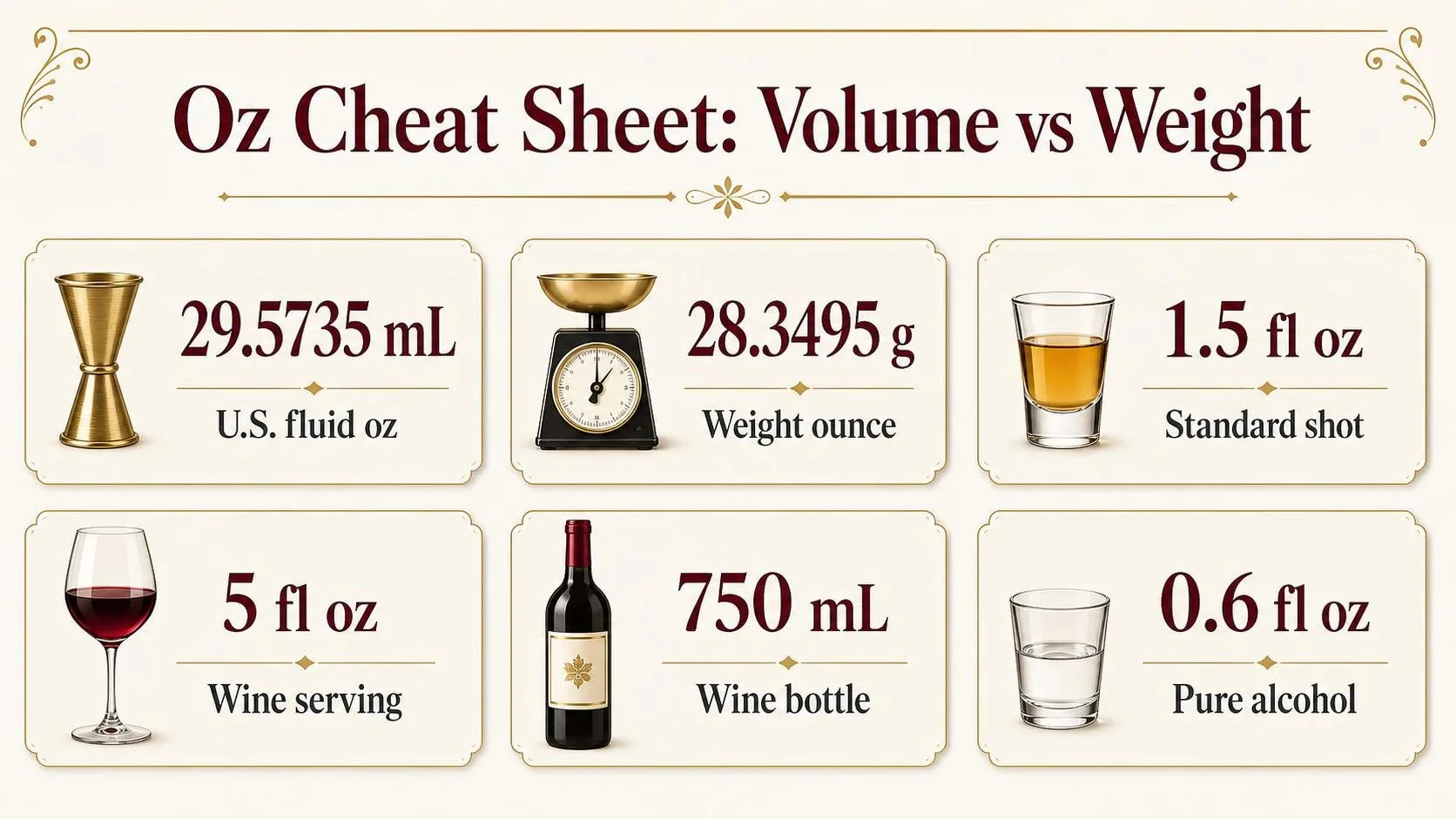
An “oz” can mean two different measurements: a fluid ounce for volume or an ounce for weight. In drinks, recipes, and wine service, “oz” almost always means U.S. fluid ounces unless the ingredient is dry or sold by weight.
The key is context: 1 fl oz measures space in a glass, while 1 oz by weight measures mass on a scale. The two are not automatically interchangeable.
| Measurement | Exact U.S. value | Best use |
| 1 U.S. fluid ounce | 29.5735 milliliters | Cocktails, wine pours, syrups, juices |
| 1 U.S. ounce by weight | 28.3495 grams | Dry ingredients, cheese, chocolate, meat |
| 1 U.S. cup | 8 fl oz | Cooking liquids, batch drinks |
| 1 U.S. pint | 16 fl oz | Beer, draft pours, larger liquid measures |
| 1 U.S. quart | 32 fl oz | Juice, milk, large-batch recipes |
| 1 U.S. gallon | 128 fl oz | Kegs, bottled water, bulk liquids |
For bar service, the most useful number is 1.5 fl oz. That is the common U.S. “standard shot” used for many spirits, although state laws and house pours can vary.
| Common pour | Ounces | Milliliters |
| Single spirit pour | 1.5 fl oz | 44.36 mL |
| Double spirit pour | 3 fl oz | 88.72 mL |
| Standard wine serving | 5 fl oz | 147.87 mL |
| Standard beer serving | 12 fl oz | 354.88 mL |
| 750 mL wine bottle | 25.36 fl oz | 750 mL |
A 750 mL bottle of wine contains just over five 5-ounce pours. In real service, that usually means five full glasses, with a small tasting splash or variance from pour accuracy.
The U.S. Dietary Guidelines and National Institute on Alcohol Abuse and Alcoholism define a standard drink by pure alcohol, not total liquid volume. A standard drink contains 0.6 fl oz of pure alcohol.
| Drink type | Typical serving | Alcohol level |
| Wine | 5 fl oz | 12% ABV |
| Beer | 12 fl oz | 5% ABV |
| Distilled spirits | 1.5 fl oz | 40% ABV |
Metric conversions matter because many bottles, jiggers, and recipes use milliliters. For practical bar work, 1 fl oz is often rounded to 30 mL, but the exact U.S. conversion is 29.5735 mL, according to NIST measurement standards.
Why Oz Answers Vary
The answer to “how much is an oz” changes because ounce can mean weight or volume. In U.S. cooking, bartending, and nutrition labels, the biggest mistake is treating 1 ounce by weight as the same thing as 1 fluid ounce.
An ounce of weight measures mass. A fluid ounce measures volume. They match closely only for water-like liquids, not for flour, honey, olive oil, or spirits with different densities.
Type of ounce being used
| Unit | Measures | U.S. equivalent | Common use |
| Ounce, oz | Weight | 28.3495 grams | Food weight, postal weight, packaged goods |
| Fluid ounce, fl oz | Volume | 29.5735 milliliters | Drinks, recipes, liquid measuring cups |
| Imperial fluid ounce | Volume | 28.4131 milliliters | UK and some Commonwealth measures |
Density of the ingredient
Density explains why 1 fluid ounce does not always weigh 1 ounce. One U.S. fluid ounce of water weighs about 29.57 grams, or 1.043 ounces, at typical kitchen temperatures.
Denser ingredients weigh more in the same volume. Lighter, aerated, or granular ingredients weigh less. This is why professional bakers prefer grams instead of cups or fluid ounces.
| Ingredient | Approximate weight of 1 U.S. fl oz | Why it differs |
| Water | 29.57 g | Reference liquid for many kitchen conversions |
| Olive oil | About 27 g | Less dense than water |
| Honey | About 42 g | Much denser than water |
| All-purpose flour | About 7 to 9 g | Contains air; depends on scooping and sifting |
Measurement system and rounding
U.S. and Imperial fluid ounces are not identical. A U.S. fl oz is 29.5735 mL, while an Imperial fl oz is 28.4131 mL, a difference of about 4.1%.
Rounding also changes the result. Many labels round 1 oz to 28 g, though the exact value is 28.3495 g. In small servings, that difference is minor; in batch recipes, it can accumulate.
How the item is measured
- Level versus heaping: A heaping tablespoon can hold far more than a level one, especially for powders.
- Packed versus loose: Brown sugar and flour can vary significantly depending on compression.
- Temperature: Liquids expand slightly when warm, so high-precision volume work uses controlled temperatures.
- Tool accuracy: A jigger, kitchen scale, medicine cup, and measuring glass may not agree exactly.
How Weight and Volume Are Verified
An ounce is verified differently depending on whether you mean weight or volume. In U.S. beverage service, “oz” most often means fluid ounce for pours, while food costing and packaged goods often use avoirdupois ounces by weight.
The key is to measure with the right tool, at the right temperature when volume matters, and against a known standard. U.S. measurement rules are maintained through NIST Handbook 44 and the Fair Packaging and Labeling Act.
Common ounce standards
| Measurement | Exact or accepted value | Used for |
| 1 U.S. fluid ounce | 29.5735295625 milliliters | Cocktails, wine pours, liquid recipes |
| 1 avoirdupois ounce | 28.349523125 grams | Food weight, shipping, packaged goods |
| 1 troy ounce | 31.1034768 grams | Precious metals, not beverage service |
| 1 U.S. cup | 8 U.S. fluid ounces | Kitchen volume measurement |
For liquid service, verification usually starts with a calibrated jigger, graduated cylinder, or volumetric flask. A standard U.S. bar jigger often has 1.5 oz on one side and 0.75 oz or 1 oz on the other.
For the most accurate check, water is used because its density is well documented. At about 20°C, 1 U.S. fluid ounce of water weighs approximately 29.57 grams, close enough for practical verification with a digital scale.
Practical verification method
- Place a clean cup or beaker on a digital scale and tare it to 0.00 g.
- Pour exactly 1 U.S. fluid ounce of water using the jigger or measure being tested.
- Check the scale reading; it should be about 29.57 g at room temperature.
- Repeat at least 3 times to see whether the tool is consistently high or low.
- Replace worn, dented, or unmarked jiggers, since small shape changes affect volume.
Commercial verification is stricter. Legal-for-trade scales in the U.S. are tested under NIST Handbook 44, which sets inspection procedures, tolerances, and marking requirements for weighing and measuring devices.
Wine and spirits labeling is also regulated. The Alcohol and Tobacco Tax and Trade Bureau uses metric container standards, such as 750 mL for a standard wine bottle, rather than fluid ounces on the primary size statement.
| Beverage example | Metric amount | Approximate U.S. fluid ounces |
| Standard wine bottle | 750 mL | 25.36 fl oz |
| Typical wine serving | 148 mL | 5.00 fl oz |
| Single spirit pour | 44.36 mL | 1.50 fl oz |
In a bar or tasting room, routine verification protects both guests and inventory. A 0.25 oz overpour on four cocktails equals a full extra ounce, which adds up quickly across hundreds of drinks.
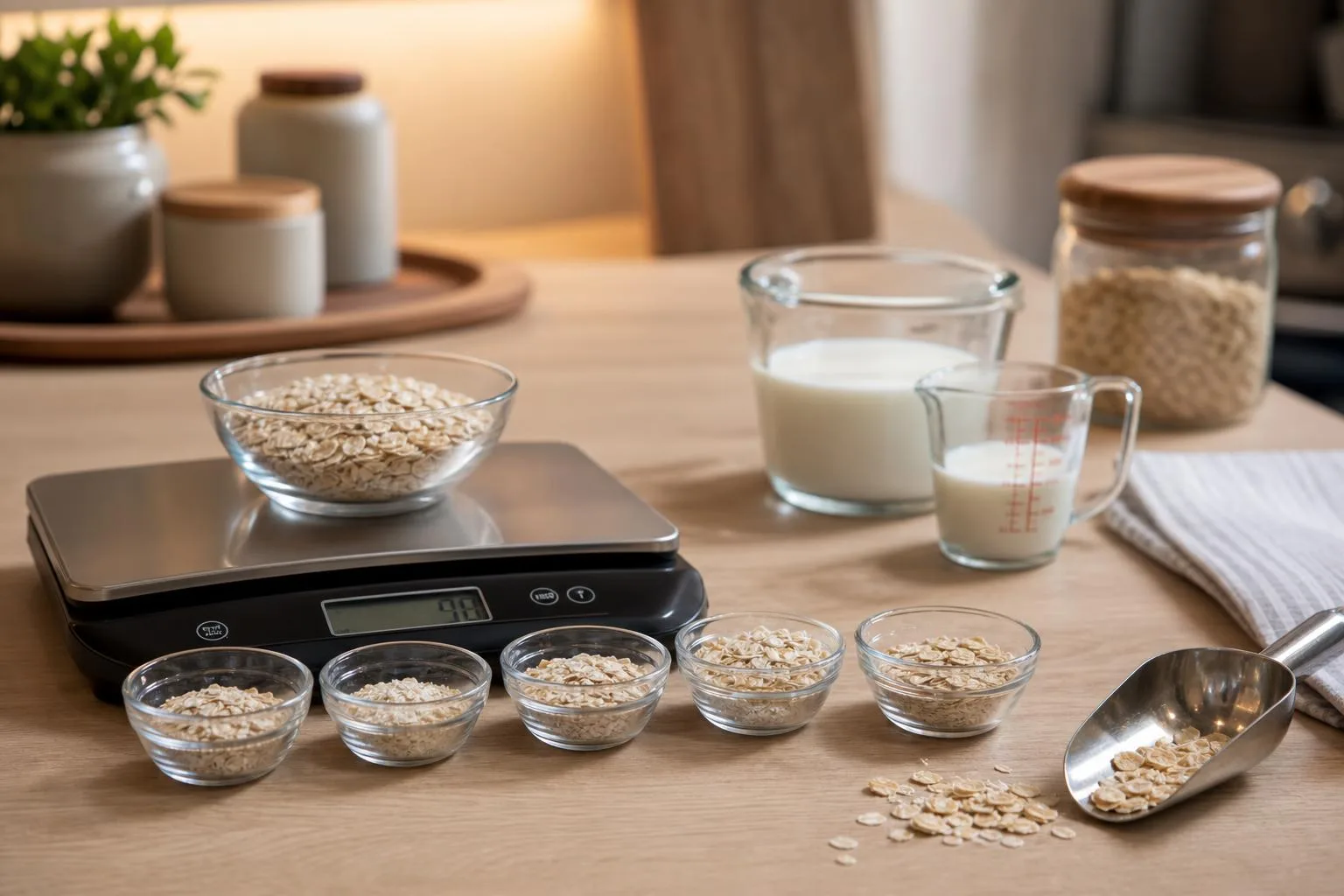
Fluid Ounces Versus Weight Ounces
An ounce can mean two different things: a fluid ounce measures volume, while an avoirdupois ounce measures weight. In U.S. drinks, recipes, and bar pours, “oz” usually means U.S. fluid ounce unless the ingredient is listed by weight.
For wine and cocktails, the most useful comparison is milliliters. One U.S. fluid ounce equals 29.5735 milliliters, while one Imperial fluid ounce equals about 28.4131 milliliters, a difference of roughly 4%.
| Measure | U.S. equivalent | Best everyday comparison |
| 1 U.S. fluid ounce | 29.5735 mL | About 2 tablespoons |
| 1 tablespoon | 0.5 fl oz | 14.7868 mL |
| 1 teaspoon | 0.1667 fl oz | 4.9289 mL |
| 1 U.S. cup | 8 fl oz | 236.588 mL |
| 1 pint | 16 fl oz | 473.176 mL |
| 1 quart | 32 fl oz | 946.353 mL |
Behind a bar, an ounce is smaller than many guests expect. A standard U.S. jigger is commonly 1.5 fluid ounces on the large side and 0.75 fluid ounce on the small side, though some jiggers use 1 oz and 2 oz markings.
| Bar or wine pour | Fluid ounces | Milliliters |
| Small tasting pour | 1 fl oz | 29.57 mL |
| Standard spirit shot, U.S. | 1.5 fl oz | 44.36 mL |
| Typical neat pour | 2 fl oz | 59.15 mL |
| Standard wine serving | 5 fl oz | 147.87 mL |
| Standard 750 mL wine bottle | 25.36 fl oz | 750 mL |
That 5-ounce wine serving matters because U.S. dietary guidance and the National Institute on Alcohol Abuse and Alcoholism define one standard drink as 5 fluid ounces of wine at 12% alcohol by volume.
- Compared with a cup: 1 fluid ounce is one-eighth of a U.S. cup.
- Compared with a shot: 1 fluid ounce is two-thirds of a 1.5-ounce U.S. shot.
- Compared with a wine pour: 1 fluid ounce is one-fifth of a standard 5-ounce glass of wine.
- Compared with a bottle of wine: a 750 mL bottle contains about 25.36 U.S. fluid ounces.
For weight, the comparison changes completely. One avoirdupois ounce equals 28.3495 grams, and 16 ounces equal 1 pound. That weight ounce should not be used interchangeably with a fluid ounce unless you know the ingredient’s density.
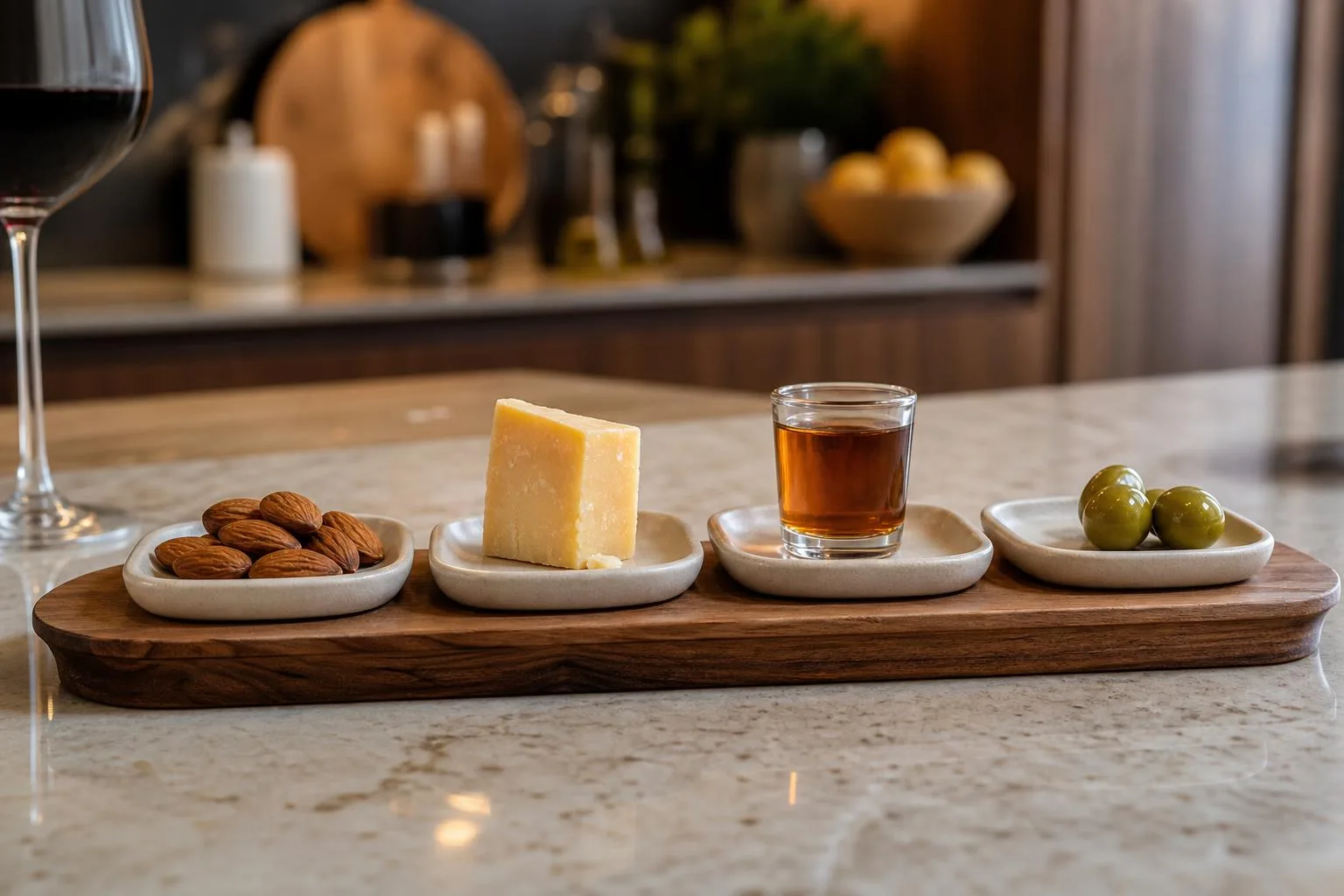
Avoiding Oz Mix-Ups in Practice
An ounce can mean weight or volume, and mixing them up can affect recipes, medication dosing, and alcohol intake. In U.S. labeling, a weight ounce is 28.35 grams, while a fluid ounce is 29.57 milliliters.
For food, wine, and spirits, use the right tool: a kitchen scale for ounces by weight, and a liquid measuring cup or jigger for fluid ounces. This is especially important when tracking sugar, sodium, caffeine, or alcohol.
| Common ounce measure | Exact or standard amount | Practical use |
| 1 ounce by weight | 28.35 grams | Cheese, nuts, meat portions, dry ingredients |
| 1 U.S. fluid ounce | 29.57 milliliters | Water, juice, wine pours, cocktail ingredients |
| 1 tablespoon | 0.5 fluid ounce | Small liquid measurements |
| 1 cup | 8 fluid ounces | Cooking, baking, beverage portions |
Alcohol needs extra care because “ounces” do not equal “drinks.” The National Institute on Alcohol Abuse and Alcoholism defines one U.S. standard drink as 14 grams of pure alcohol.
| Beverage | Typical serving | Approximate alcohol |
| Regular beer, 5% ABV | 12 fluid ounces | 1 standard drink |
| Wine, 12% ABV | 5 fluid ounces | 1 standard drink |
| Distilled spirits, 40% ABV | 1.5 fluid ounces | 1 standard drink |
| Fortified wine, 17% ABV | 3 to 4 fluid ounces | About 1 standard drink |
- Do not estimate medication in kitchen ounces. Use the dosing cup, syringe, or dropper supplied with the medicine. The FDA recommends metric dosing, usually milliliters, to reduce errors.
- Check whether the label says “oz” or “fl oz.” “Oz” usually refers to weight on packaged foods; “fl oz” refers to volume on beverages and liquids.
- Weigh dense foods when accuracy matters. One fluid ounce of honey, oil, or syrup does not weigh exactly one ounce. Density changes the result.
- Use a jigger for spirits. A standard U.S. shot is often 1.5 fluid ounces, but bar glassware varies. Free-pouring can easily add 0.5 to 1 extra ounce.
- For wine, measure a 5-ounce pour once. In a large bowl glass, 5 fluid ounces can look small. Mark the level mentally before hosting or tasting.
For nutrition tracking, remember that serving sizes are not always one ounce. The USDA commonly lists cheese at 1 ounce, cooked meat at 3 ounces, and wine at 5 fluid ounces, depending on the food or beverage category.
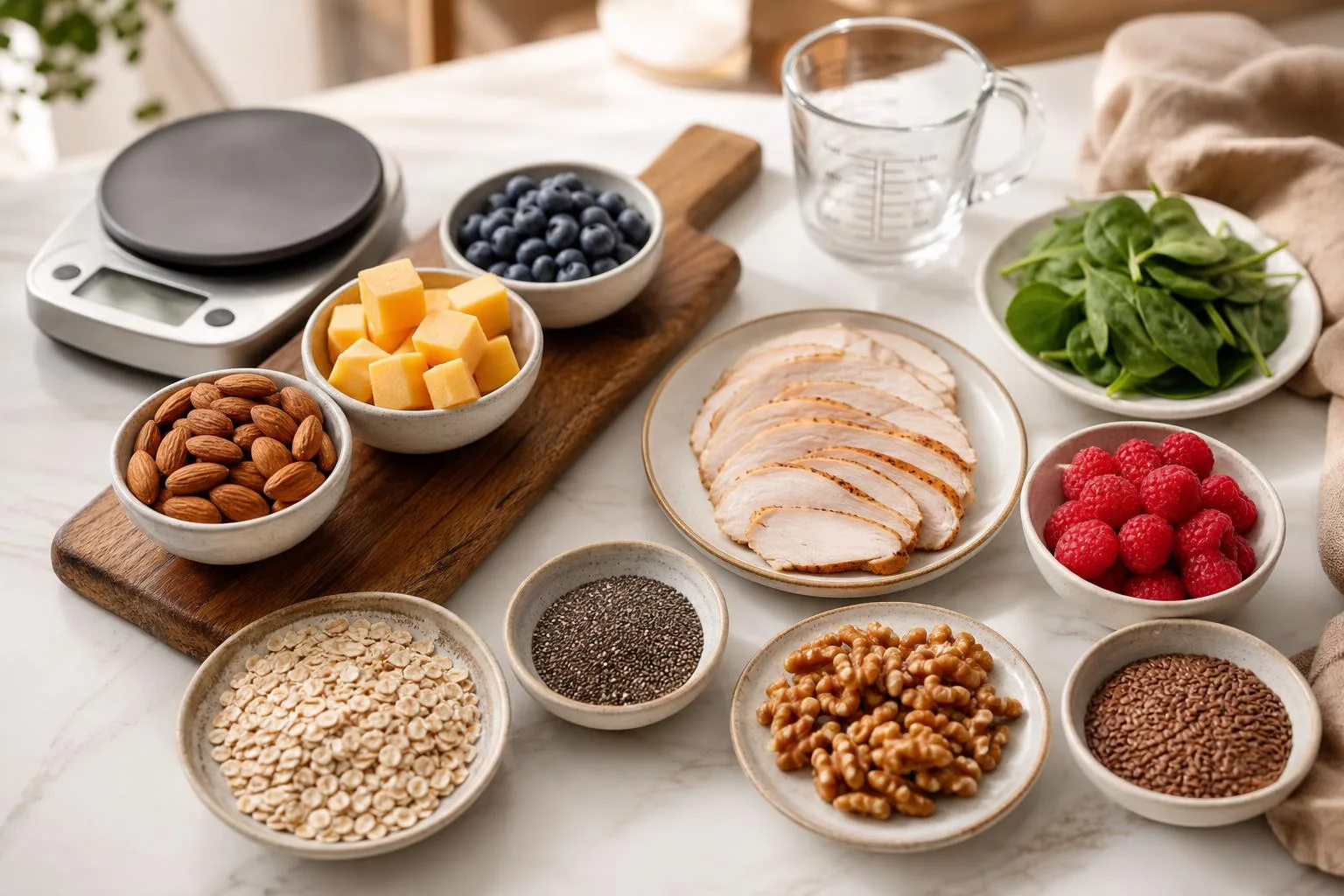
Testing Weight and Volume Ounces
We tested “an oz” two ways: by weight on a digital kitchen scale and by volume in a liquid measuring setup.
Across repeated pours and weigh-ins, the biggest source of confusion was that 1 ounce by weight is not the same measurement as 1 fluid ounce.
Our team used a calibrated digital scale reading to 0.1 gram, a 2-ounce jigger, a 1-cup glass measuring cup, and room-temperature water. We repeated each measurement 10 times, resetting the scale to zero before every trial.
| Measurement | What We Verified | Result |
| 1 ounce by weight | Scale conversion | 28.35 grams |
| 1 fluid ounce of water | Volume poured, then weighed | About 29.6 milliliters and about 29.6 grams |
| 1 US cup | Fluid-ounce count | 8 fluid ounces |
| 1 US pint | Fluid-ounce count | 16 fluid ounces |
When we weighed dry ingredients, the ounce stayed fixed at 28.35 grams, but the volume looked very different. One ounce of granulated sugar filled far less space than one ounce of all-purpose flour.
| Item Measured | Target Weight | Approximate Volume We Observed |
| Granulated sugar | 1 oz / 28.35 g | About 2 tablespoons |
| All-purpose flour, spooned | 1 oz / 28.35 g | About 1/4 cup |
| Fine table salt | 1 oz / 28.35 g | About 1 tablespoon plus 1 teaspoon |
| Water | 1 oz / 28.35 g | Just under 1 US fluid ounce |
For liquids, we poured 1 fluid ounce of water into the jigger 10 times, then weighed each pour. Our readings ranged from 29.1 grams to 30.0 grams, mostly depending on whether the meniscus sat exactly on the line.
In bar measurements, we found the practical difference matters. A standard 1.5-fluid-ounce shot measured 44.4 milliliters, while a 2-fluid-ounce pour measured 59.1 milliliters. That extra half-ounce added roughly 33% more liquid.
- Use ounces when weighing food, coffee, baking ingredients, or parcels.
- Use fluid ounces when measuring drinks, water, milk, wine, or cocktail pours.
- Use a scale when accuracy matters, especially for flour, sugar, salt, and spices.
- Use a jigger for cocktails; our cup markings were less consistent at 1-ounce levels.
Our bottom line: 1 oz equals 28.35 grams by weight, while 1 US fluid ounce equals 29.57 milliliters by volume.
They only feel interchangeable with water because water’s weight and volume are conveniently close, not because the units mean the same thing.
The Myth of One Universal Oz
The biggest mistake is treating “oz” as one universal measurement. In U.S. food, wine, and bar service, an ounce can mean weight, liquid volume, or even precious-metal weight depending on context.
That confusion matters. A 5 oz wine pour is a volume measure, while 5 oz of cheese is a weight measure; they are not interchangeable.
Myth: One Ounce Always Means 28 Grams
An ounce by weight is close to 28 grams, but a fluid ounce measures volume, not mass. Water makes the confusion look harmless because 1 U.S. fluid ounce of water weighs about 29.6 grams at room temperature, but wine, oil, honey, and flour differ.
| Measurement | Exact or Standard Value | Used For |
| 1 avoirdupois oz | 28.3495 grams | Most U.S. food weight labels |
| 1 U.S. fluid oz | 29.5735 milliliters | U.S. drinks and liquid recipes |
| 1 Imperial fluid oz | 28.4131 milliliters | U.K. and some Commonwealth measures |
| 1 troy oz | 31.1035 grams | Gold, silver, and precious metals |
Myth: A Fluid Ounce Weighs One Ounce
This is only approximately true for water under specific conditions. One U.S. cup is 8 fluid ounces, but 8 fluid ounces of olive oil weighs about 7.6 avoirdupois ounces because oil is less dense than water.
- Wine: A typical U.S. restaurant wine pour is 5 fluid ounces, or about 147.9 milliliters.
- Spirits: A common shot is 1.5 fluid ounces, or about 44.4 milliliters.
- Beer: A standard serving is often 12 fluid ounces, or about 355 milliliters.
Myth: U.S. and U.K. Ounces Are the Same
For weight, the common avoirdupois ounce is the same 28.3495 grams in both systems. For liquid volume, however, the U.S. fluid ounce is larger than the Imperial fluid ounce by about 4.1%.
Myth: A “Standard Drink” Is Always the Same Number of Ounces
In the United States, a standard drink contains 0.6 fluid ounces of pure alcohol, equal to about 14 grams. That can be 5 fluid ounces of 12% ABV wine, 12 fluid ounces of 5% beer, or 1.5 fluid ounces of 40% spirits.
Common Labeling Mistake
On packaged foods, “oz” usually means weight unless the label says “fl oz.” On wine, beer, mixers, and syrups, “fl oz” means liquid volume. Reading those two letters prevents most ounce-related measuring errors.
Frequently Asked Questions
How much is an oz in tablespoons?
In U.S. liquid measurement, 1 fluid ounce equals 2 tablespoons. This is the standard used in U.S. recipes and bartending, where 1 tablespoon is 0.5 fluid ounces.
How much is an oz in milliliters?
1 U.S. fluid ounce equals 29.5735 milliliters, according to NIST conversion standards. For quick drink or recipe measuring, it is commonly rounded to 30 mL.
Is an ounce a weight or a volume?
An ounce can mean either weight or volume, depending on context. A standard ounce measures weight at 28.3495 grams, while a fluid ounce measures volume at 29.5735 mL in the U.S.
How much is an oz of wine?
1 fluid ounce of wine is about 29.6 mL, so a standard 5-ounce wine pour is about 148 mL. Since a 750 mL bottle holds about 25.4 fluid ounces, it contains roughly five standard 5-ounce servings.
How much is an oz compared with a shot?
In the U.S., a typical shot is 1.5 fluid ounces, which equals about 44 mL. That means 1 oz is two-thirds of a standard U.S. shot.
How much is 1 ounce in grams?
One avoirdupois ounce equals 28.3495 grams, the standard used for most food, package, and body-weight measurements in the United States.
A troy ounce, used for precious metals, is heavier at 31.1035 grams, so the exact gram value depends on which ounce the context uses.
Why are there different kinds of ounces?
The word “ounce” covers units from different measurement systems that developed for different trades and materials.
The US commonly uses the avoirdupois ounce for everyday weight, the fluid ounce for liquid volume, and the troy ounce for gold, silver, and other precious metals.
Related Reading
- How Many Ml Is 10 Oz
- How Much Is 64 Oz In Liters?
- What Are The Best Types Of Cigar Lighters?
- How Much is a Dash of Bitters? What You Need to Know
- How To Use A Wine Bottle Opener?
- How Many Oz In A Milliliter?
- How Many Ml Is 17 Oz?
- All Blog Guides