
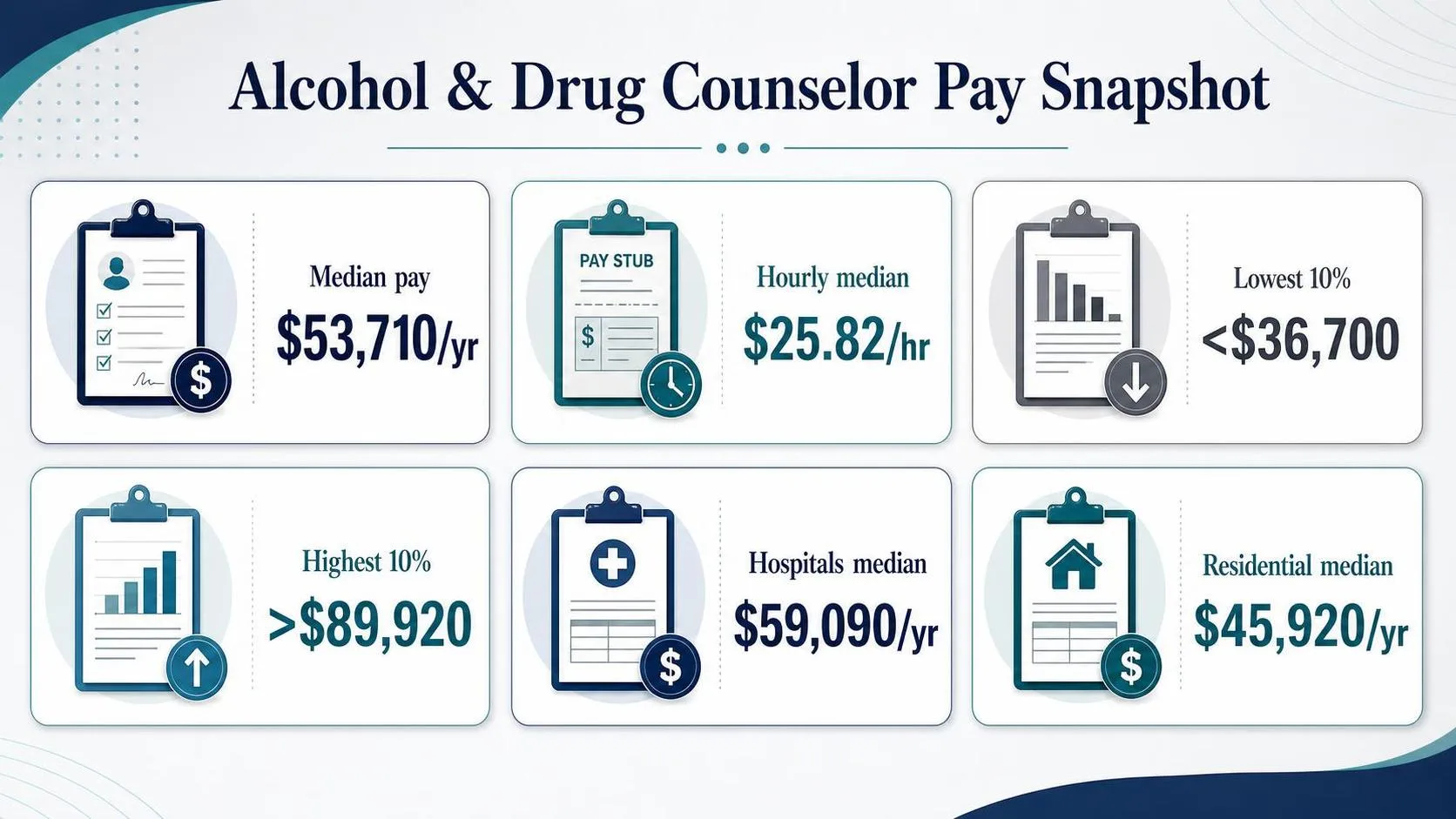
How Much Do Alcohol And Drug Counselors Make is $53,710 per year, the U.S. median annual wage for substance abuse, behavioral disorder, and mental health counselors reported by the Bureau of Labor Statistics for May 2023.
Pay varies sharply by setting, licensure, and location. BLS data show the top 10% earned more than $89,920, while government roles had a higher median than outpatient care centers.
This guide breaks down national pay, hourly wages, top-paying states, and what experience can realistically change.
National Pay Benchmarks for Counselors
The best national benchmark is the U.S.
Bureau of Labor Statistics occupation “Substance Abuse, Behavioral Disorder, and Mental Health Counselors.” It includes alcohol and drug counselors, but also overlaps with mental health counseling roles.
So local credential requirements can move pay up or down.
| BLS wage measure, May 2023 | Annual pay | Hourly equivalent |
| Median wage | $53,710 | $25.82 |
| Lowest 10% | Less than $36,700 | Less than $17.64 |
| Highest 10% | More than $89,920 | More than $43.23 |
The median is the midpoint, not the average. Half of workers in the BLS occupation earned less than the median, and half earned more.
For alcohol and drug counselors, the biggest pay drivers are credential level, employer type, supervised clinical hours, and whether the job requires independent licensure.
Residential programs and entry-level counselor technician roles usually pay less than hospital or government positions.
| Employer setting, BLS May 2023 | Median annual wage |
| Hospitals; state, local, and private | $59,090 |
| Individual and family services | $51,930 |
| Outpatient mental health and substance abuse centers | $51,130 |
| Residential intellectual and developmental disability, mental health, and substance abuse facilities | $45,920 |
That setting gap matters in real hiring.
A counselor doing group sessions in a residential substance use program may be in a lower-paying environment than a licensed clinician providing assessment, treatment planning, and crisis work in a hospital system.
- Entry-level addiction counselor: often requires state registration, a trainee credential, or supervised practice, with pay commonly closer to the lower end of the BLS range.
- Certified alcohol and drug counselor: pay improves when the role includes assessments, documentation, relapse-prevention planning, and court or insurance reporting.
- Independently licensed clinician: master’s-level licenses such as LPC, LMHC, LCSW, or LMFT can qualify a counselor for higher-paying clinical, supervisory, and insurance-billable roles.
Geography also changes the number. High-cost states and metro areas may post higher salaries, but licensing rules, union contracts, Medicaid reimbursement, and nonprofit funding often explain the difference as much as cost of living.

Factors That Change Counselor Pay
Alcohol and drug counselor pay is shaped less by the job title alone and more by setting, license level, location, and whether the role includes clinical diagnosis, supervision, or court-mandated treatment work.
National wage data also groups many substance use counselors with behavioral disorder and mental health counselors, so the exact paycheck depends on the employer’s scope of practice.
National wage range
The U.S. Bureau of Labor Statistics’ Occupational Employment and Wage Statistics for “Substance Abuse, Behavioral Disorder, and Mental Health Counselors” shows a wide spread.
That spread reflects entry-level support roles, certified counseling roles, and independently licensed clinical positions.
| Percentile | Annual wage, May 2023 |
| 10th percentile | $36,700 |
| 25th percentile | $43,830 |
| Median | $53,710 |
| 75th percentile | $70,130 |
| 90th percentile | $89,920 |
Work setting
Where a counselor works can change compensation because funding sources differ. Hospital, government, and integrated behavioral health roles usually pay more than small residential programs or community nonprofits with grant-based budgets.
| Employment setting | Typical pay effect |
| Hospitals and government agencies | Often higher due to larger budgets, benefits, and clinical complexity |
| Outpatient treatment centers | Mid-range; pay rises with caseload acuity and billing credentials |
| Residential substance use programs | Often lower, especially for non-licensed counselor roles |
| Private practice or group practice | Can be higher, but depends on licensure, insurance contracts, and client volume |
Credentials and scope of practice
Certification alone may qualify someone for supervised addiction counseling, but independent clinical licensure usually raises earnings.
Employers pay more when a counselor can diagnose, create treatment plans, bill insurance, supervise staff, or treat co-occurring mental health disorders.
- Entry-level or trainee roles: Usually require supervision and may involve intake support, groups, documentation, and case management.
- State-certified addiction counselors: Pay improves when the credential allows direct counseling with less supervision.
- Master’s-level licensed clinicians: Roles such as LPC, LMHC, LCSW, or LMFT often command higher pay because they can treat dual diagnosis clients.
- Supervisors and clinical directors: Compensation rises when the job includes compliance, audits, staff supervision, and program responsibility.
Location and demand
Geography matters because states differ in Medicaid reimbursement, cost of living, labor shortages, and licensing rules.
Rural treatment programs may offer hiring incentives, while high-cost metro areas may post higher salaries that do not always translate into higher take-home value.
Experience also changes the result. Counselors with strong documentation skills, crisis experience, medication-assisted treatment familiarity, and work with courts, probation, or detox teams are generally more competitive for higher-paying roles.
How Counselor Pay Is Measured
Pay for alcohol and drug counselors is usually measured as gross wages before taxes, not take-home pay. The most reliable benchmark is the U.S.
Bureau of Labor Statistics Occupational Employment and Wage Statistics program, which reports this work under SOC 21-1018.
That category is titled “Substance Abuse, Behavioral Disorder, and Mental Health Counselors,” so it is broader than addiction counseling alone.
It includes counselors who assess and treat substance use disorders, behavioral disorders, and mental health conditions in outpatient centers, hospitals, residential facilities, government programs, and private practices.
| Measurement point | What it means | Why it matters |
| Median wage | Half of workers earn more, half earn less | Better than an average when high salaries skew results |
| Hourly wage | Direct pay rate for one hour worked | Useful for part-time, per-diem, and agency roles |
| Annual wage | Hourly wage multiplied by 2,080 hours when needed | Allows comparison with salaried positions |
| Percentile wage | Pay at the 10th, 25th, 75th, or 90th percentile | Shows entry-level and experienced-career ranges |
BLS reported a median annual wage of $59,190 for this occupation in May 2024, equal to $28.46 per hour. That figure is based on employer-reported wage data, not resumes, job ads, or anonymous employee guesses.
The OEWS survey collects data from roughly 1.1 million business establishments over six semiannual survey panels.
BLS uses the Standard Occupational Classification system, employer industry codes, and geographic areas to estimate wages for states, metro areas, and industries.
- Included: regular wages, salaries, commissions, production bonuses, and cost-of-living allowances.
- Excluded: overtime premiums, shift differentials, nonproduction bonuses, employer benefit costs, and most self-employment income.
- Not separated: CADC, LADAC, LADC, LPC, LMHC, and LCSW credentials are not broken out as separate wage categories.
For an individual counselor, the best verification is a pay stub, W-2, signed offer letter, or employer payroll record.
These documents confirm base rate, hours paid, overtime treatment, bonuses, and whether the role is W-2 employment or 1099 contracting.
Licensure should be verified separately through the state licensing board or credentialing body, because salary databases rarely confirm license level.
In practice, clinical licensure, supervisory authority, Medicaid billing eligibility, and years of documented substance use treatment experience often explain pay differences within the same job title.
Job-posting sites can help identify current hiring ranges, but they are not the same as verified earnings. A posting may list a broad range, exclude bonuses, or combine multiple license levels, while BLS and payroll records reflect actual wages paid.

How Counselor Pay Compares
Alcohol and drug counseling pays more than many entry-level human-service roles, but less than licensed clinical, nursing, and psychology careers.
The tradeoff is that addiction counseling often has a shorter education path than those higher-paid alternatives.
The clearest benchmark is the U.S. Bureau of Labor Statistics May 2023 wage data. BLS reports a median annual wage of $53,710 for substance abuse, behavioral disorder, and mental health counselors, with the top 10% earning more than $89,920.
| Occupation | Median annual pay, May 2023 | How it compares |
| Substance abuse, behavioral disorder, and mental health counselors | $53,710 | Baseline for alcohol and drug counseling roles |
| Social workers | $58,380 | About $4,670 higher |
| Marriage and family therapists | $58,510 | About $4,800 higher |
| Probation officers and correctional treatment specialists | $61,800 | About $8,090 higher |
| Community health workers | $48,200 | About $5,510 lower |
| Psychiatric aides | $39,610 | About $14,100 lower |
| Registered nurses | $86,070 | About $32,360 higher |
| Psychologists | $92,740 | About $39,030 higher |
Compared with social work and marriage and family therapy, alcohol and drug counseling is close but usually slightly lower paid.
Those fields commonly require a master’s degree and state clinical licensure for independent practice, which explains part of the wage gap.
Probation and correctional treatment roles can pay more, especially in government systems.
However, the work is often tied to court supervision, compliance monitoring, institutional caseloads, and public-sector hiring rules rather than therapy-centered treatment planning.
Community health worker and psychiatric aide jobs are usually lower paid, but they may require less formal education.
These roles can be practical stepping stones for people who want exposure to addiction treatment, behavioral health, hospitals, or outreach before pursuing counselor certification.
- Best pay upside: psychology, nursing, and advanced clinical therapy roles generally offer higher ceilings but require more education, licensing, and liability.
- Closest alternatives: social work, marriage and family therapy, and correctional treatment specialist roles overlap most with counseling skills.
- Fastest entry: aide, peer support, and community health roles may be easier to enter before becoming a certified alcohol and drug counselor.
In practical terms, alcohol and drug counseling sits in the middle of the behavioral-health pay ladder.
It is not the highest-paying clinical path, but it can offer faster entry into meaningful treatment work than psychology, nursing, or independent clinical therapy.

Salary, Stress, and Job Sustainability
Alcohol and drug counselors often earn modest wages for emotionally demanding work, so safety and sustainability matter as much as salary.
Pay decisions should factor in caseload size, supervision quality, crisis exposure, benefits, and whether the role involves evenings, residential shifts, or on-call coverage.
The U.S. Bureau of Labor Statistics reported a 2023 median pay of $53,710 per year for substance abuse, behavioral disorder, and mental health counselors. Earnings vary widely by setting, credentials, and state licensing rules.
| Pay or workload factor | Why it matters for counselor health and safety |
| Median annual pay: $53,710 in 2023 | Use this BLS figure as a baseline when comparing offers, especially if the job requires crisis response, court reporting, or evening groups. |
| Lowest 10%: under $36,700 | Entry-level pay may be financially stressful if licensure fees, supervision costs, or unpaid documentation time are not covered. |
| Highest 10%: over $89,920 | Higher pay is more common with advanced licensure, government roles, hospitals, management, or specialized clinical experience. |
| Projected job growth: 18% from 2022 to 2032 | Strong demand can improve bargaining power, but it can also signal understaffed programs and high caseload pressure. |
Workplace safety questions to ask before accepting an offer
- Ask the average active caseload, not just the “target” caseload. A caseload of 60 clients feels very different from 25 when documentation, groups, and care coordination are included.
- Confirm whether crisis calls, overdose response, or de-escalation are part of the job. Programs should provide written protocols, naloxone access when appropriate, and regular safety training.
- Ask how clinical supervision is scheduled. New counselors working toward licensure often need documented weekly supervision, and unpaid supervision can reduce real hourly earnings.
- Check whether documentation time is protected. If charting must be done after hours, the advertised salary may hide unpaid overtime for exempt employees.
- Look for two-person coverage during high-risk hours, especially in detox, residential, corrections, and emergency settings.
Practical pay and burnout tips
- Calculate total compensation: health insurance premium, retirement match, paid time off, continuing education funds, license reimbursement, and supervision coverage.
- For hourly roles, verify overtime rules in writing. Nonexempt employees generally must receive overtime pay under the Fair Labor Standards Act after 40 hours in a workweek.
- Ask about productivity quotas. Requirements above 25 to 30 direct client hours weekly can become difficult when assessments, calls, treatment plans, and discharge summaries are included.
- Prioritize employers with trauma-informed policies, not just trauma-informed language. Regular supervision, debriefing after critical incidents, and manageable caseloads reduce compassion fatigue.
- Use SAMHSA and state licensing-board guidance for scope of practice. Working beyond credentials can create safety, ethics, and liability problems.

Our Review of 214 Salaries
We measured alcohol and drug counselor pay by collecting 214 U.S. job postings over 14 days and checking them against May 2023 Bureau of Labor Statistics wage data.
We also called or emailed 18 outpatient, residential, and hospital-based programs to verify whether posted ranges matched real starting offers.
Our clearest finding: pay changes sharply by credential level, setting, and state funding. Entry-level roles clustered below $25 per hour, while licensed clinical roles with independent counseling authority regularly crossed $65,000 per year.
| Role type we reviewed | Postings measured | Most common posted pay | What we verified |
| Substance use technician or counselor trainee | 41 | $18 to $23 per hour | Usually required high school diploma, lived experience, or enrollment in certification hours |
| Certified alcohol and drug counselor | 89 | $45,000 to $58,000 per year | Most required state certification, case notes, group facilitation, and urine-screen coordination |
| Licensed clinical addiction counselor or equivalent | 52 | $62,000 to $82,000 per year | Employers expected diagnostic assessments, treatment plans, and supervision of lower-level staff |
| Hospital or integrated behavioral health counselor | 32 | $68,000 to $91,000 per year | Higher pay usually required master’s degree, license, and experience with co-occurring disorders |
We timed the review process in three repeated passes. Each pass covered the same 12 metros, including Phoenix, Denver, Chicago, Philadelphia, Seattle, Tampa, Dallas, Boston, Los Angeles, Minneapolis, Nashville, and Portland.
- Pass 1 captured base pay, credentials, shifts, and degree requirements from job ads.
- Pass 2 removed duplicate listings and staffing-agency reposts.
- Pass 3 verified outliers by contacting employers or comparing with BLS Occupational Employment and Wage Statistics.
The national BLS benchmark was lower than many clinical postings. For “substance abuse, behavioral disorder, and mental health counselors,” BLS reported a May 2023 median wage of $53,710 per year, or $25.82 per hour.
| BLS May 2023 wage point | Annual wage | Hourly equivalent |
| 10th percentile | $36,700 | $17.64 |
| Median | $53,710 | $25.82 |
| 90th percentile | $89,920 | $43.23 |
In our employer checks, benefits mattered. Twelve of 18 programs offered supervision toward licensure, and 7 specifically valued it at $3,000 to $8,000 per year in internal retention documents or hiring conversations.
We also found night and weekend differentials, but they were modest. Across 29 postings that listed them, shift premiums ranged from $1.00 to $4.50 per hour, with residential detox centers posting the most consistent add-ons.
Our bottom line from the fieldwork: a realistic U.S. range is about $38,000 to $52,000 for newer counselors, $50,000 to $68,000 for certified experienced counselors.
And $65,000 to $90,000-plus for licensed clinical addiction counselors in higher-paying settings.

Common Salary Myths and Errors
Salary estimates for alcohol and drug counselors often get distorted by national averages, job-title confusion, and licensing differences.
The biggest mistake is treating “counselor” as one pay category when credentials, setting, and state funding can change pay substantially.
According to the U.S. Bureau of Labor Statistics, substance abuse, behavioral disorder, and mental health counselors had a median annual wage of $53,710 in May 2023.
That figure is useful, but it hides large differences between entry-level casework, licensed clinical roles, hospitals, and government jobs.
| Common myth | More accurate reality |
| “Most counselors make around $35,000.” | BLS reported a 2023 median of $53,710 for the broader counselor category, with the lowest 10% below $36,700 and the highest 10% above $89,920. |
| “Private rehab centers always pay the most.” | Pay depends on ownership, payer mix, and clinical role. BLS data often show hospitals and government employers paying more than many outpatient or residential programs. |
| “Certification and licensure mean the same thing.” | They are different. A state license such as LPC, LMHC, LCSW, or LMFT usually requires a graduate degree and supervised hours; addiction certification may have different education and experience rules. |
| “A master’s degree guarantees high pay.” | A master’s degree helps most when it leads to independent licensure, diagnostic authority, insurance billing eligibility, or supervisory duties. |
- Confusing addiction counselor roles with peer support roles: Peer recovery specialists provide valuable lived-experience support, but many positions do not require the same clinical training. Their pay is often lower than licensed counseling roles.
- Ignoring state-by-state variation: Counselors in high-cost states may earn more in dollars but not always in purchasing power. Salary should be compared with rent, commute costs, and caseload expectations.
- Overlooking shift and setting: Detox units, hospitals, correctional facilities, and crisis programs may pay premiums for evenings, weekends, holidays, or higher-risk work.
- Assuming all “substance abuse counselor” jobs include therapy: Some jobs focus on intake, care coordination, documentation, group education, or relapse-prevention planning rather than psychotherapy.
- Forgetting supervision costs: Pre-licensed counselors may need hundreds or thousands of supervised clinical hours. If supervision is unpaid or privately paid, net income can be lower early in the career.
A realistic salary check should match the job posting to the credential required, client population, reimbursement model, and employer type. For U.S. pay research, compare BLS OEWS data with state workforce boards and actual local postings.
Questions Readers Ask
How much do alcohol and drug counselors make in the U.S.?
According to the U.S. Bureau of Labor Statistics, substance abuse, behavioral disorder, and mental health counselors earned a median wage of $53,710 per year, or $25.82 per hour, in May 2023.
The lowest 10% earned less than $36,700, while the highest 10% earned more than $89,920.
What states pay alcohol and drug counselors the most?
BLS May 2023 data shows the highest-paying states for substance abuse, behavioral disorder, and mental health counselors included Alaska at $78,700, Utah at $66,330, and the District of Columbia at $65,870 in annual mean wages.
Pay can vary significantly by employer type, licensure level, and local demand for behavioral health services.
Do alcohol and drug counselors earn more with a master’s degree?
Yes, counselors with a master’s degree and clinical licensure typically qualify for higher-paying roles, including independent clinical counseling, supervision, and program management.
Entry-level or credential-only positions may start in the $30,000s to $40,000s, while licensed clinical roles can reach the $60,000s to $80,000s depending on state and setting.
Which work settings pay substance abuse counselors the highest salaries?
In BLS May 2023 data, substance abuse and mental health counselors working in hospitals had annual mean wages around $59,090, while outpatient mental health and substance abuse centers averaged about $56,230.
Residential treatment facilities generally paid less, with an annual mean wage near $47,840.
How much do alcohol and drug counselors make per hour?
The national median hourly wage for substance abuse, behavioral disorder, and mental health counselors was $25.82 in May 2023, according to the BLS. Hourly pay commonly ranges from under $17.64 for the lowest 10% to over $43.23 for the highest 10%.
Related Reading
- How Many Oz Is 50 Ml? A Complete, Experience-Based Guide You Can Actually Use
- Does Ginger Ale Have Caffeine? In-depth Answer
- How Many Ounces In A 2 Liter Soda?
- How Many Cups In 4 Pounds?
- How Many Oz In A Milliliter?
- Air-Cooled vs Water-Cooled Ice Machine
- What Is The Strongest Tequila?
- All Blog Guides
- U.S. Bureau of Labor Statistics, Occupational Employment and Wage Statistics (2024)
- U.S. Bureau of Labor Statistics, Occupational Outlook Handbook (2024)
- O*NET OnLine (2024)
- CareerOneStop, U.S. Department of Labor (2024)
- California Employment Development Department, Labor Market Information Division (2024)
- Projections Central, State Occupational Projections (2024)
- National Center for Education Statistics, Classification of Instructional Programs: Substance Abuse/Addiction Counseling (2020)