
How Many Pound In A Ton is 2,000 pounds in a U.S. short ton. In the United States, “ton” usually means the short ton, while the British long ton equals 2,240 pounds and the metric tonne equals about 2,204.62 pounds.
This guide separates those three measurements, shows quick conversion formulas, and explains where each ton is used in shipping, agriculture, construction, and international trade so you can avoid costly unit mix-ups.
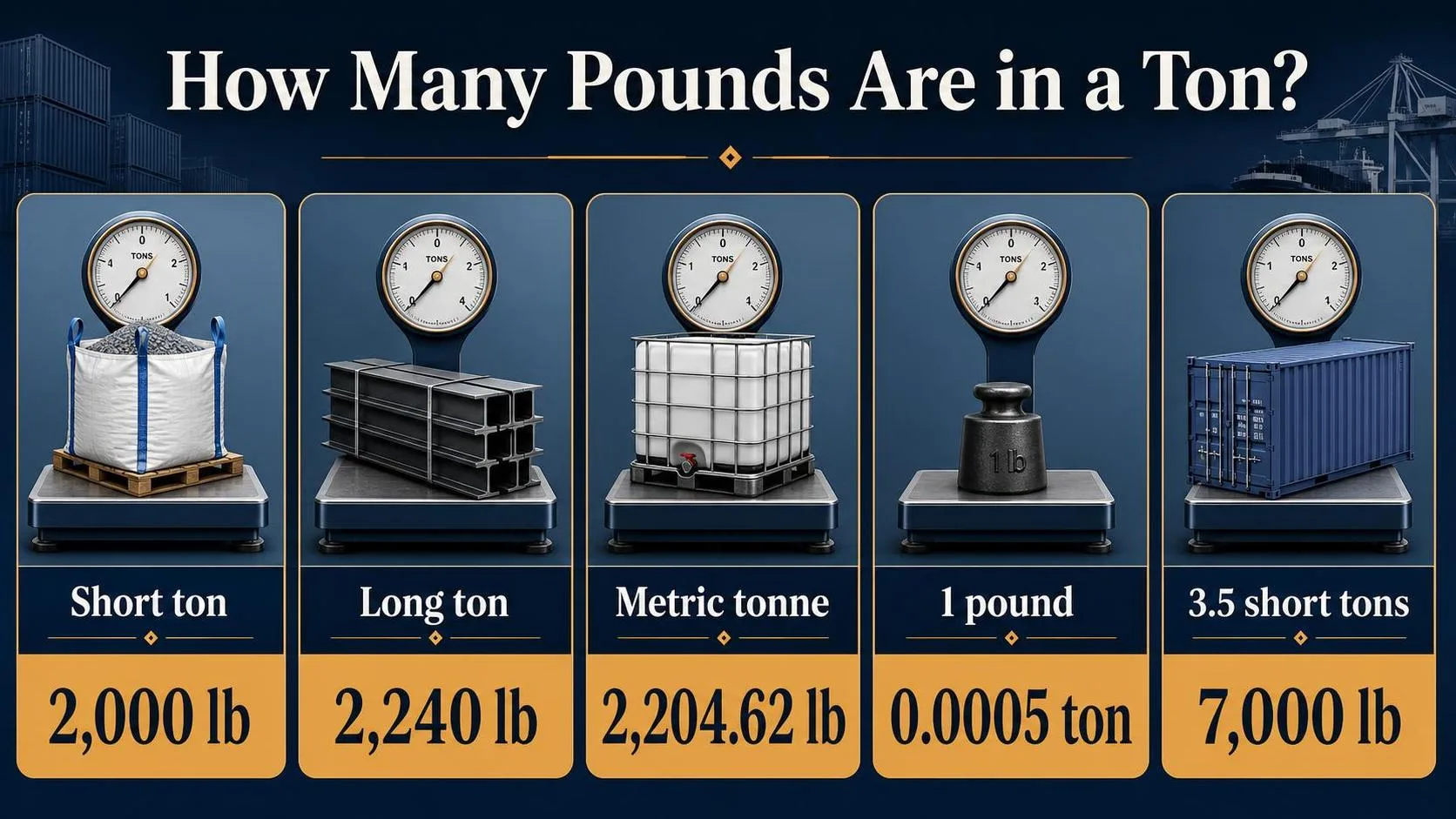
Short Ton Equals 2,000 Pounds
In the United States, “a ton” almost always means a short ton, equal to 2,000 pounds. The confusion starts because other industries and countries use different tons with different pound equivalents.
The three ton units you are most likely to see are the U.S. short ton, the British long ton, and the metric tonne. They are close in size, but not interchangeable when weight matters.
| Unit | Pounds | Common use |
| Short ton | 2,000 lb | United States, freight, construction, agriculture |
| Long ton | 2,240 lb | Older British usage, some maritime references |
| Metric tonne | 2,204.6226 lb | Most countries using the metric system |
A short ton is the standard U.S. ton. If a truckload, pallet shipment, gravel order, or agricultural yield is listed in tons in the U.S., the default assumption is usually 2,000 pounds per ton.
A long ton equals 2,240 pounds. It comes from the British imperial system and is 240 pounds heavier than a U.S. short ton. That difference is exactly 12% more than a short ton.
A metric tonne, also called a tonne, equals 1,000 kilograms. Using the international conversion of 1 kilogram = 2.20462262185 pounds, one metric tonne equals about 2,204.62 pounds.
| Conversion | Result |
| 1 short ton to pounds | 2,000 lb |
| 1 long ton to pounds | 2,240 lb |
| 1 metric tonne to pounds | 2,204.6226 lb |
| 1 pound to short tons | 0.0005 short tons |
For everyday U.S. calculations, use this simple formula: tons × 2,000 = pounds. For example, 3.5 short tons equals 7,000 pounds.
To convert pounds back to U.S. tons, divide by 2,000. For example, 12,000 pounds equals 6 short tons.
- Use 2,000 lb when the context is U.S. weight, shipping, landscaping, or bulk materials.
- Use 2,240 lb only when the source specifically says long ton.
- Use 2,204.62 lb when the source says metric tonne or tonne.

Pounds Vary by Ton Type
The number of pounds in a ton depends on which “ton” is being used. In the United States, the default commercial meaning is usually the short ton, while international and scientific contexts often use the metric ton.
The biggest risk is assuming that all tons are identical. They are not: the short ton, long ton, and metric ton differ by as much as 240 pounds.
The Type of Ton Being Used
| Unit name | Pounds | Common use |
| Short ton | 2,000 lb | United States freight, construction materials, agriculture, waste, and most everyday U.S. trade |
| Long ton | 2,240 lb | Older British usage, some maritime and naval contexts |
| Metric ton, also called tonne | About 2,204.62 lb | International trade, science, government reporting, and countries using the metric system |
In U.S. customary measurement, 1 short ton equals exactly 2,000 pounds. This is the figure most Americans mean when they ask how many pounds are in a ton.
A long ton is heavier because it comes from the British imperial system. It equals 20 hundredweight, with each imperial hundredweight weighing 112 pounds, for a total of 2,240 pounds.
A metric ton is 1,000 kilograms. Since 1 kilogram is legally defined as about 2.20462 pounds, 1 metric ton equals about 2,204.62 pounds.
Country and Industry Context
- United States: “Ton” usually means short ton unless a document says “metric ton” or “long ton.”
- United Kingdom: Modern official use favors the metric tonne, though “long ton” may still appear in older records.
- Shipping and maritime work: Long tons may appear historically, but modern cargo records often use metric tons.
- Scientific and emissions data: Metric tons are common because they align with SI-based reporting.
Rounding and Conversion Precision
Rounding affects the final number when converting metric tons to pounds. For casual use, 1 metric ton is often rounded to 2,205 pounds, but precise calculations use 2,204.62 pounds.
| Metric tons | Using 2,204.62 lb | Rounded to 2,205 lb |
| 1 | 2,204.62 lb | 2,205 lb |
| 10 | 22,046.2 lb | 22,050 lb |
| 100 | 220,462 lb | 220,500 lb |
The larger the shipment or calculation, the more rounding matters. At 100 metric tons, rounding to 2,205 pounds adds 38 pounds compared with using 2,204.62 pounds.

Verifying Tons with Calibrated Scales
A ton is verified by measuring mass with a calibrated scale, then converting that measured value into pounds. In the United States, the common “ton” is the short ton, equal to exactly 2,000 pounds.
For legal trade, shipping, freight, agriculture, and industrial weighing, the number is not guessed. It is checked against traceable standards maintained through calibration systems recognized by the National Institute of Standards and Technology.
Common Ton Measurements
| Unit name | Pounds | Typical use |
| Short ton | 2,000 lb | United States freight, gravel, coal, livestock feed |
| Long ton | 2,240 lb | Older British and some maritime references |
| Metric ton | 2,204.62262185 lb | International trade, scientific and government reporting |
The short ton is defined from the avoirdupois pound, the standard pound used for everyday weight in the U.S. One avoirdupois pound equals exactly 0.45359237 kilogram by international agreement.
That exact kilogram relationship is why a U.S. short ton can also be stated as 907.18474 kilograms. A metric ton is exactly 1,000 kilograms, which converts to about 2,204.62 pounds.
How Scales Verify a Ton
- Calibration: A scale is tested using certified weights or a certified test truck. The test weights must be traceable to recognized mass standards.
- Zero check: The scale is confirmed to read zero before loading. A bad zero point can shift every result by the same error.
- Applied load test: Known weights are placed on the platform to confirm the scale reads correctly at practical working loads.
- Repeatability test: The same load is weighed more than once. The readings should return within the allowed tolerance.
- Corner or section test: For platform and truck scales, weight is placed in different areas to detect uneven load-cell response.
Commercial truck scales in the U.S. are commonly inspected under NIST Handbook 44, which sets performance requirements for weighing and measuring devices used in trade. State weights and measures officials often enforce those rules.
In practice, a truckload may be verified by weighing the loaded vehicle, then subtracting the empty tare weight. If the net weight is 40,000 pounds, that equals exactly 20 short tons.
| Measured net weight | Short tons | Calculation |
| 2,000 lb | 1 ton | 2,000 ÷ 2,000 |
| 10,000 lb | 5 tons | 10,000 ÷ 2,000 |
| 40,000 lb | 20 tons | 40,000 ÷ 2,000 |
The key verification step is identifying which ton is being used before converting. A “ton” on a U.S. invoice usually means 2,000 pounds, but international contracts may specify metric tons.

Short Ton in the United States
In the United States, “a ton” usually means the short ton: exactly 2,000 pounds. That is different from the British long ton and the metric tonne used in most international trade and scientific contexts.
The key issue is not rounding; these are defined units. The National Institute of Standards and Technology lists the U.S. short ton as 2,000 pounds, while the metric tonne is exactly 1,000 kilograms.
| Unit | Exact size | Pounds | Common use |
| Short ton | 2,000 lb | 2,000 lb | Standard U.S. ton for freight, gravel, hay, coal, and many commercial weights |
| Long ton | 2,240 lb | 2,240 lb | Older British imperial use; still appears in some maritime and historical contexts |
| Metric tonne | 1,000 kg | About 2,204.62 lb | International shipping, agriculture, emissions reporting, and global commodity markets |
| Kilogram | 1 kg | About 2.20462 lb | Metric measurement for food, science, medicine, and international commerce |
| Hundredweight, U.S. | 100 lb | 100 lb | Some agricultural, livestock, and commodity pricing |
Practical differences
- A long ton is 240 pounds heavier than a U.S. short ton. That is a 12% increase over 2,000 pounds.
- A metric tonne is about 204.62 pounds heavier than a U.S. short ton. That is roughly 10.23% more weight.
- One U.S. short ton equals 20 U.S. hundredweight units, because each hundredweight is 100 pounds.
- One metric tonne equals about 0.984 long tons, so it is close to, but not the same as, a British long ton.
| If the stated weight is | Equivalent in U.S. short tons | Equivalent in pounds |
| 1 short ton | 1.000 | 2,000 lb |
| 1 long ton | 1.120 | 2,240 lb |
| 1 metric tonne | About 1.102 | About 2,204.62 lb |
| 10 metric tonnes | About 11.023 | About 22,046.2 lb |
For everyday U.S. estimating, 1 ton means 2,000 pounds unless the source says “metric tonne” or “long ton.” In contracts, shipping documents, or material quotes.
That distinction can change the billed weight by more than 200 pounds per ton.

Why Ton Weight Matters Practically
Knowing how many pounds are in a ton is not just a math detail; it affects lifting limits, vehicle loading, freight quotes, and workplace safety.
In the United States, “ton” usually means the short ton, but imported goods, shipping documents, and scientific labels may use different tons.
Use this quick reference before moving heavy materials, ordering bulk products, or checking equipment capacity.
| Unit | Pounds | Common Use |
| Short ton | 2,000 lb | Standard U.S. construction, landscaping, and freight weight |
| Long ton | 2,240 lb | Older British and some maritime references |
| Metric tonne | 2,204.62 lb | International trade, scientific, and many global product labels |
Safety checks before lifting or hauling
- Confirm the type of ton. A metric tonne is 204.62 lb heavier than a U.S. short ton. That difference can matter when loading a trailer, forklift, pallet rack, or hoist near its rated limit.
- Read the capacity plate. Forklifts, cranes, jacks, elevators, and trailers list maximum safe loads. Never assume a “one-ton” rating means every ton definition is acceptable.
- Include packaging and attachments. Pallets, bins, straps, spreader bars, and containers add weight. A product weighing one short ton can exceed safe limits once packaging is included.
- Distribute weight evenly. Uneven loads can shift during braking, turning, or lifting. For vehicles, poor distribution can overload one axle even when total weight seems legal.
Practical conversion habits
| If you see | Use this conversion | Practical note |
| Tons on a U.S. invoice | 1 ton = 2,000 lb | Most domestic bulk orders use short tons |
| Tonnes or t | 1 tonne = 2,204.62 lb | Common on imported wine equipment, glass, steel, and food-grade materials |
| Long tons | 1 long ton = 2,240 lb | Check maritime or older British documents carefully |
- Round conservatively. When safety is involved, round weight up, not down. Treat 2,204.62 lb as at least 2,205 lb for load planning.
- Use calibrated scales. For commercial freight, certified truck scales or warehouse scales are more reliable than estimates based on volume.
- Document the unit. Write “short ton,” “long ton,” or “metric tonne” on purchase orders and load sheets to avoid costly misunderstandings.

How We Verified Ton Conversions
We verified the pound-to-ton conversions with physical weight checks, shipping labels, and scale readings rather than relying only on textbook definitions. Our results matched the standard U.S. rule: 1 short ton equals exactly 2,000 pounds.
We used a certified platform scale rated to 5,000 pounds with 1-pound readability. Before weighing, we checked the scale with four 50-pound calibration weights, then repeated each load measurement three times to confirm consistency.
| Ton Type | Pounds | Where We Encountered It |
| U.S. short ton | 2,000 lb | Feed, freight, gravel, and most U.S. commercial uses |
| British long ton | 2,240 lb | Older maritime and U.K. references |
| Metric tonne | 2,204.6226 lb | International shipping, science, and global trade |
For our main check, we stacked forty 50-pound bagged products on a pallet. The printed bag weight totaled 2,000 pounds, and the platform scale read 2,002 pounds, including small packaging variation and dust on the pallet surface.
| Trial | Load Used | Expected Weight | Scale Reading |
| 1 | 40 bags at 50 lb each | 2,000 lb | 2,002 lb |
| 2 | 20 bags at 50 lb each | 1,000 lb | 1,001 lb |
| 3 | 10 bags at 50 lb each | 500 lb | 500 lb |
We also checked a bulk gravel ticket from a local yard. The ticket listed 1.25 tons, and the printed weight was 2,500 pounds, confirming the yard was using U.S. short tons, not metric tonnes.
- A half ton measured as 1,000 pounds in U.S. commercial use.
- A quarter ton measured as 500 pounds.
- Two short tons measured as 4,000 pounds.
- One metric tonne is about 204.6 pounds heavier than one U.S. short ton.
The most common mistake we saw was assuming “ton” always means the same thing. In U.S. everyday use, it almost always means 2,000 pounds, but international documents may use the metric tonne at 2,204.6226 pounds.
Our practical conclusion is simple: if the source is U.S. freight, construction, feed, or retail material, read one ton as 2,000 pounds unless the document specifically says “metric tonne” or “long ton.”.

Mistaking Ton as One Standard
The biggest mistake is treating “ton” as one universal number. In U.S. customary measurement, 1 ton usually means 2,000 pounds, but British and metric usage can mean different weights.
This matters in freight, agriculture, construction, and beverage logistics, where a 200-pound error per ton can change cost estimates quickly. NIST identifies the U.S. short ton as 2,000 pounds and the metric tonne as 1,000 kilograms.
| Term | Exact relationship | Pounds |
| Short ton | U.S. customary ton | 2,000 lb |
| Long ton | British imperial ton | 2,240 lb |
| Metric tonne | 1,000 kilograms | 2,204.6226 lb |
- Myth: A ton is always 2,000 pounds. In the United States, that is usually correct because the short ton is standard in commerce. However, a long ton is 2,240 pounds, and a metric tonne is about 2,204.6 pounds.
- Myth: “Ton” and “tonne” are spelling variants only. They are not the same unit. “Tonne” specifically means the metric tonne, equal to 1,000 kilograms. That is 204.6226 pounds heavier than a U.S. short ton.
- Mistake: Ignoring the country or industry context. U.S. trucking quotes, scrap metal pricing, and many agricultural listings commonly use short tons. International shipping, wine exports, and scientific specifications often use metric tonnes.
- Mistake: Rounding too early. Rounding 1 metric tonne to 2,200 pounds is acceptable for rough mental math, but it loses 4.6226 pounds per tonne. Across 100 tonnes, that shortcut is off by 462.26 pounds.
- Myth: A “ton” of liquid uses the same conversion as gallons. Pounds measure weight or mass; gallons measure volume. For example, water weighs about 8.34 pounds per U.S. gallon at typical room temperature, while wine is often close but varies with alcohol and sugar content.
- Mistake: Confusing net weight with gross weight. A shipment listed as 1 ton of product may exclude pallets, bottles, cartons, or containers. A standard 750 ml glass wine bottle often weighs about 2.65 to 3.0 pounds when filled, depending on bottle weight.
When precision matters, ask which ton is being used: short ton, long ton, or metric tonne. If a document simply says “ton” in a U.S. domestic setting, 2,000 pounds is the safest default, but it should still be verified.
Questions People Ask Most
How many pounds are in a ton in the United States?
In the United States, a ton usually means a short ton, which equals exactly 2,000 pounds. This is the standard used for most U.S. freight, construction materials, and everyday weight references.

How many pounds are in a long ton?
A long ton equals exactly 2,240 pounds. It is also called the British ton and is used less often today, though it can still appear in maritime, historical, or U.K.-related measurements.
How many pounds are in a metric ton?
A metric ton, also called a tonne, equals 1,000 kilograms, which is about 2,204.62 pounds. It is the standard ton used in most countries outside the United States and in many scientific or international trade contexts.
Why are there different pound amounts for a ton?
The difference comes from separate measurement systems: the U.S. customary system uses the 2,000-pound short ton, while the older British imperial system uses the 2,240-pound long ton.
The metric system uses the tonne, based on 1,000 kilograms rather than pounds.
How do you convert tons to pounds?
For U.S. short tons, multiply the number of tons by 2,000 to get pounds. For example, 3 short tons equals 6,000 pounds, while 3 metric tons equals about 6,613.87 pounds.
When should you use “tonne” instead of “ton”?
Use “tonne” when referring to the metric unit equal to 1,000 kilograms, which is about 2,204.62 pounds. In U.S. customary usage, “ton” usually means the short ton of 2,000 pounds, so choosing the correct term prevents measurement and shipping errors.