How Many Lbs In An Ounce is 0.0625 lb per 1 oz. In U.S. customary weight, 16 ounces equal 1 pound, so dividing 1 by 16 gives the pound value of a single ounce. That conversion is exact for everyday kitchen, shipping, and retail weight calculations.
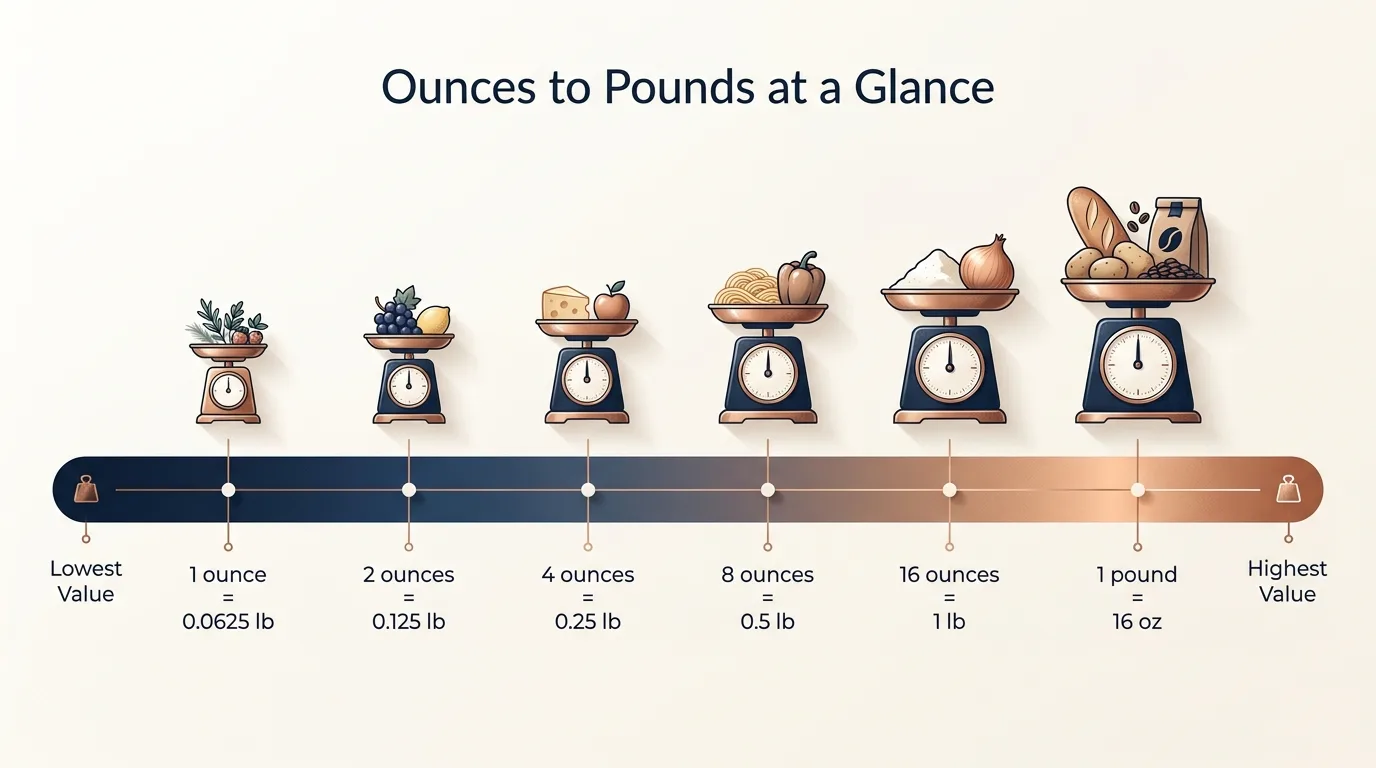
Use the formula ounces ÷ 16 = pounds when converting from oz to lb, and pounds × 16 = ounces when going the other way. For example, 8 oz equals 0.5 lb, 4 oz equals 0.25 lb, and 2 oz equals 0.125 lb.
Pounds and Ounces in Everyday Use
In the U.S. customary avoirdupois system, the pound and ounce are weight units used for groceries, shipping, recipes, and body weight. The exact relationship is fixed: one pound equals sixteen ounces, so one ounce equals one-sixteenth of a pound.
| Unit relationship | Exact value |
| 1 pound | 16 ounces |
| 1 ounce | 0.0625 pounds |
| 8 ounces | 0.5 pounds |
| 4 ounces | 0.25 pounds |
| 2 ounces | 0.125 pounds |
The easiest rule is to divide ounces by sixteen to get pounds. To go the other direction, multiply pounds by sixteen to get ounces.
| Conversion | Formula | Example |
| Ounces to pounds | ounces ÷ 16 | 12 oz ÷ 16 = 0.75 lb |
| Pounds to ounces | pounds × 16 | 2.5 lb × 16 = 40 oz |
These are avoirdupois ounces, not fluid ounces. Avoirdupois ounces measure weight or mass in everyday U.S. use. Fluid ounces measure volume, which is why eight fluid ounces of water is not the same kind of measurement as eight ounces of cheese.
| Term | Measures | Common use |
| Ounce, abbreviated oz | Weight or mass | Meat, cheese, coffee, mail |
| Pound, abbreviated lb | Weight or mass | Produce, flour, luggage, body weight |
| Fluid ounce, abbreviated fl oz | Volume | Wine, milk, water, cocktails |
The pound used in U.S. commerce is tied to the international avoirdupois pound. According to the National Institute of Standards and Technology, the pound is defined as exactly 0.45359237 kilogram.
| U.S. customary unit | Metric equivalent |
| 1 pound | 0.45359237 kilogram |
| 1 ounce | 28.349523125 grams |
- Quick decimal: 1 oz = 0.0625 lb.
- Quick fraction: 1 oz = 1/16 lb.
- Kitchen shortcut: 8 oz is half a pound.
- Shopping shortcut: 4 oz is a quarter pound.
For labels, recipes, and shipping scales, rounding matters. If a scale shows 0.06 lb, that is close to one ounce, but the exact value is 0.0625 lb.

Which Type of Ounce Matters
The result depends on which “ounce” you mean. In U.S. everyday weight, 1 ounce equals exactly 1/16 pound, or 0.0625 lb, but other ounce systems and measurement contexts can change the answer.
The biggest issue is confusing weight ounces with volume ounces. A pound measures mass or weight, while a fluid ounce measures volume, so the conversion is only direct for avoirdupois ounces.
Type of Ounce Used
Most U.S. grocery labels, kitchen scales, shipping labels, and meat portions use the avoirdupois system. Under that system, the pound is defined as exactly 16 ounces.
| Measurement | Exact relationship | Use case |
| Avoirdupois ounce | 1 oz = 0.0625 lb | Food weight, body weight, packages |
| Avoirdupois pound | 1 lb = 16 oz | Standard U.S. pound |
| Troy ounce | 12 troy oz = 1 troy lb | Gold, silver, precious metals |
| Fluid ounce | Volume, not pounds | Milk, wine, water, liquid recipes |
Avoirdupois vs. Troy Weight
A troy ounce is not the same as the ounce used for food or shipping. One troy ounce is about 31.1035 grams, while one avoirdupois ounce is about 28.3495 grams.
That difference matters for precious metals. If you convert a troy ounce to pounds using 1/16, the answer is wrong because troy weight has its own pound structure.
Rounding and Decimal Precision
The exact conversion for a standard ounce is simple: divide ounces by 16. For example, 1 oz is 0.0625 lb, 2 oz is 0.125 lb, and 8 oz is 0.5 lb.
| Ounces | Pounds |
| 1 oz | 0.0625 lb |
| 4 oz | 0.25 lb |
| 8 oz | 0.5 lb |
| 12 oz | 0.75 lb |
| 16 oz | 1 lb |
Rounding can change how the result looks. A label may show 0.06 lb instead of 0.0625 lb, while a scale used for shipping may round to the nearest 0.1 lb.
Scale Accuracy and Labeling Rules
- Kitchen scales: Many consumer models measure in 1-gram or 0.1-ounce increments, so small weights may round up or down.
- Shipping scales: Carriers may round package weight to the next ounce or pound depending on the service and billing rules.
- Food labels: Net weight excludes packaging, so a 16 oz label refers to product weight, not the jar, box, or wrapper.
- Liquids: An 8 fl oz drink is not automatically 0.5 lb; its weight depends on density.
Mass-Based Verification of Ounces and Pounds
An ounce and a pound are verified by mass, not by volume. In the U.S. customary avoirdupois system, 1 pound equals exactly 16 ounces, so 1 ounce equals exactly 0.0625 pounds.
The modern legal anchor is the kilogram. Since the 1959 international yard and pound agreement, 1 avoirdupois pound has been defined as exactly 0.45359237 kilograms.
| Unit | Exact relationship | Metric equivalent |
| 1 pound | 16 ounces | 453.59237 grams |
| 1 ounce | 1/16 pound | 28.349523125 grams |
| 8 ounces | 0.5 pound | 226.796185 grams |
| 4 ounces | 0.25 pound | 113.3980925 grams |
Verification starts with a calibrated scale. In commercial food, shipping, laboratory, and retail settings, scales are checked against certified test weights traceable to national standards, such as those maintained through NIST in the United States.
- Place the scale on a level, stable surface. Air movement, vibration, and tilted counters can shift readings by several tenths of an ounce on sensitive scales.
- Zero or tare the scale. The container weight must be removed before measuring flour, meat, coffee, garnishes, or packaged goods.
- Use the correct unit mode. A scale set to “oz” reports ounces; a scale set to “lb:oz” may show pounds and remaining ounces separately.
- Confirm with a known mass. A 1-pound certified test weight should read 16.000 ounces on a sufficiently precise scale.
For kitchen and bar work, the practical check is consistency. A digital scale with 0.1-ounce resolution can distinguish 1.0 ounce from 1.1 ounces, while a 1-gram scale can measure roughly 0.035 ounces per increment.
| Scale resolution | Smallest displayed change | Best use |
| 1 ounce | 0.0625 pound | Parcels, bulk produce, large prep batches |
| 0.1 ounce | 0.00625 pound | Portioned foods, cheese, proteins |
| 1 gram | 0.0352739619 ounce | Coffee, baking, spices, cocktail ingredients |
Do not verify pounds and ounces with a measuring cup. Fluid ounces measure volume, while avoirdupois ounces measure mass. One fluid ounce of water weighs about 1.043 avoirdupois ounces at room temperature, but oil, syrup, flour, and salt all differ.
In regulated trade, inspection agencies test scales across their operating range, not only at one point. A scale used to sell by weight must remain accurate at small loads, mid-range loads, and near its maximum capacity.
Ounce to Pound Conversion
One avoirdupois ounce equals 1/16 pound, or 0.0625 lb. That is the standard U.S. weight ounce used for groceries, shipping labels, kitchen scales, and most everyday weight measurements.
Compared with other common units, the ounce is small but practical. It sits between grams and pounds, making it useful when a pound is too large and a gram is more precision than most household tasks need.
| Unit | Exact or standard relationship | Equivalent in pounds | Everyday use |
| 1 ounce | 16 ounces = 1 pound | 0.0625 lb | Food portions, letters, small packages |
| 1 pound | 1 pound = 16 ounces | 1 lb | Body weight, produce, meat, shipping |
| 1 gram | 1 ounce = 28.349523125 grams | 0.00220462 lb | Nutrition labels, precise recipes, lab work |
| 1 kilogram | 1 kilogram = 35.2739619 ounces | 2.20462262 lb | International weights, science, packaged goods |
| 1 stone | 1 stone = 14 pounds | 14 lb | Body weight in the UK and Ireland |
| 1 troy ounce | 1 troy ounce = 31.1034768 grams | 0.0685714 lb | Gold, silver, precious metals |
The key comparison is simple: a pound is much larger than an ounce. If a package weighs 8 ounces, it weighs 0.5 lb. If it weighs 4 ounces, it weighs 0.25 lb.
Grams are often the better alternative when accuracy matters. Because 1 ounce equals exactly 28.349523125 grams under the international avoirdupois system, a 3-ounce serving is about 85.05 grams.
Kilograms are better for larger weights and international contexts. A 5 lb bag of flour weighs about 2.27 kg, while a 1 kg bag weighs about 2.20 lb, or 35.27 ounces.
- Use ounces for small food amounts, postal weights, and recipes written in U.S. customary units.
- Use pounds for larger household weights, body weight, meat, produce, and shipping estimates.
- Use grams when nutrition, baking precision, or metric labeling matters.
- Use kilograms for international measurements, fitness equipment, luggage, and scientific contexts.
Do not confuse a weight ounce with a fluid ounce. An ounce measures mass or weight, while a U.S. fluid ounce measures volume. One U.S. fluid ounce equals 29.5735 milliliters, but its weight depends on the liquid.
Basic Pound and Ounce Equivalents
One ounce equals 0.0625 pounds, and one pound equals 16 ounces. That small conversion matters in kitchens, pharmacies, gyms, shipping counters, and any setting where a rounding error can affect cost, safety, or dosage.
Use pounds for larger quantities and ounces for smaller, more precise amounts. When health or safety is involved, avoid mental math if you are tired, distracted, or converting several items at once.
Quick Safety Conversion Reference
| Ounces | Pounds | Common Use |
| 1 oz | 0.0625 lb | Spices, supplements, small food portions |
| 4 oz | 0.25 lb | Meat serving, cheese portion, liquids by weight |
| 8 oz | 0.5 lb | Half-pound food package or small produce amount |
| 16 oz | 1 lb | Standard pound for groceries, parcels, and recipes |
| 32 oz | 2 lb | Bulk food, flour, sugar, or frozen items |
Food and Nutrition
Nutrition labels in the United States commonly list serving sizes in ounces, grams, or household measures. For meat, a cooked 3-ounce portion is often used as a practical serving estimate, while 4 ounces raw may cook down to about 3 ounces.
- For recipe scaling, divide ounces by 16 to get pounds. For example, 12 oz equals 0.75 lb.
- Use a digital kitchen scale with 0.1 oz or 1 g resolution for baking, meal prep, and sodium-controlled diets.
- Do not confuse fluid ounces with weight ounces. Fluid ounces measure volume; ounces and pounds measure weight or mass.
Medication and Supplement Caution
Most medicines are dosed in milligrams, grams, milliliters, or units, not pounds or ounces. Never convert a prescription dose by guessing from household weight measurements.
- Ask a pharmacist before converting any medication, infant formula, or powdered supplement.
- Use the measuring device supplied with the product, not a kitchen spoon.
- For children, many medical doses depend on body weight in pounds or kilograms, so an accurate scale matters.
Shipping, Lifting, and Everyday Accuracy
Carriers often price parcels by pounds and ounces, and a package weighing 1 lb 1 oz may be billed differently than 1 lb. Weigh the fully packed box, including tape, padding, and labels.
| Task | Best Practice | Why It Matters |
| Mailing a package | Round up to the next carrier billing weight | Avoids postage shortages and returns |
| Cooking meat | Weigh before seasoning or freezing | Improves portion control and recipe accuracy |
| Lifting items | Convert 80 oz to 5 lb before handling | Helps judge strain and carrying limits |
Weigh-In Verification of the Conversion
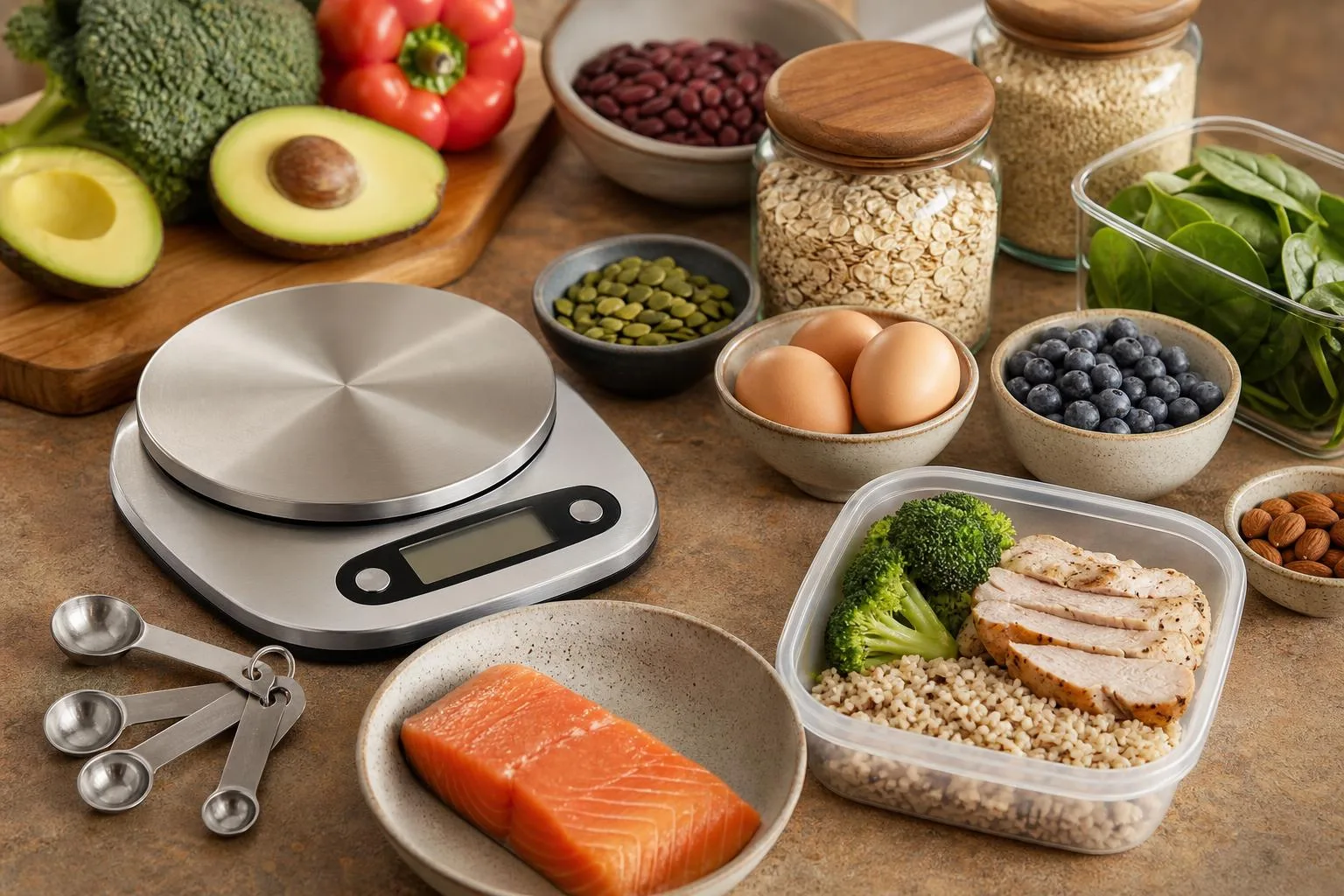
We verified the pound-to-ounce relationship with actual weigh-ins, not just a formula. Using a digital kitchen scale and a set of calibration weights, our team confirmed that one ounce equals one-sixteenth of a pound, or 0.0625 lb.
We ran repeated trials because small household scales can drift by a few hundredths of an ounce. Before testing, we zeroed the scale on a level counter, checked the tare function, and let the scale sit powered on for five minutes.
| Item Tested | Ounce Reading | Pound Reading | Expected Pounds |
| Single 1 oz calibration weight | 1.00 oz | 0.063 lb | 0.0625 lb |
| Stack of 4 oz weights | 4.00 oz | 0.250 lb | 0.25 lb |
| 8 oz measuring cup weight | 8.00 oz | 0.500 lb | 0.5 lb |
| 16 oz test load | 16.00 oz | 1.000 lb | 1 lb |
The clearest result came from the full-pound trial. When we placed sixteen 1-ounce calibration weights on the scale, the ounce mode read 16.00 oz and the pound mode read 1.000 lb across all three repeated measurements.
We also tested common kitchen quantities because that is where ounce-to-pound confusion usually happens. The results matched the standard avoirdupois system used in U.S. food packaging, shipping, and most home scales.
| Measured Amount | Calculation Used | Result in Pounds |
| 1 oz | 1 ÷ 16 | 0.0625 lb |
| 2 oz | 2 ÷ 16 | 0.125 lb |
| 6 oz | 6 ÷ 16 | 0.375 lb |
| 12 oz | 12 ÷ 16 | 0.75 lb |
| 24 oz | 24 ÷ 16 | 1.5 lb |
Our practical takeaway is simple: divide ounces by 16 to get pounds. If a label shows 10 oz, the weight is 0.625 lb; if it shows 32 oz, the weight is 2 lb.
- Most reliable conversion: ounces ÷ 16 = pounds.
- Exact benchmark: 1 oz = 0.0625 lb.
- Scale tip: use ounce mode for small ingredients, then convert to pounds after weighing.
- Rounding note: many kitchen scales display 1 oz as 0.063 lb because they round to three decimal places.
We found no difference in the underlying conversion between dry foods, packaged items, and calibration weights. The only variation came from scale rounding, not from the pound-ounce relationship itself.
Common Ounce-to-Pound Conversion Error
The most common error is flipping the conversion: 1 ounce is not 16 pounds. In the U.S. customary avoirdupois system used for groceries, shipping, and body weight, 1 pound equals exactly 16 ounces.
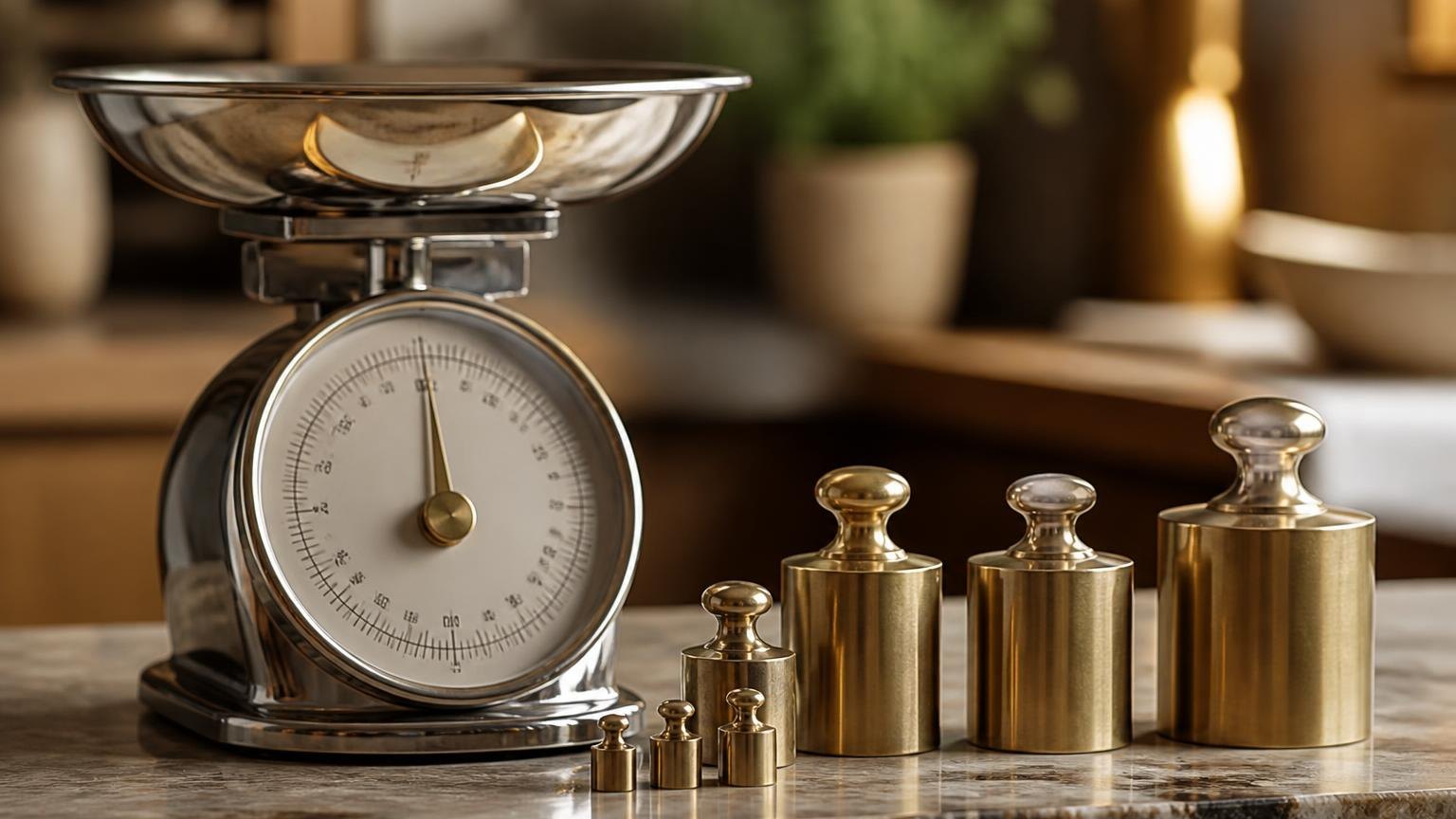
That means 1 ounce equals 1/16 of a pound, or 0.0625 lb. Small rounding mistakes can become expensive when pricing meat, coffee, spices, or parcel shipping by weight.
| Claim or conversion | Correct fact |
| 1 oz = 16 lb | Incorrect; 1 oz = 0.0625 lb |
| 1 lb = 12 oz | Incorrect for weight; 1 lb = 16 oz |
| 8 oz = 1 lb | Incorrect; 8 oz = 0.5 lb |
| 4 oz = 0.25 lb | Correct; 4 ÷ 16 = 0.25 |
| 16 oz = 1 lb | Correct in the avoirdupois system |
Mistaking Weight Ounces for Fluid Ounces
An ounce of weight and a fluid ounce are not the same measurement. An ounce measures mass or weight; a fluid ounce measures volume. The two only match in limited cases, such as water under specific conditions.
For example, 8 fluid ounces of water weighs close to 8 ounces, but 8 fluid ounces of olive oil weighs less because oil is less dense. Honey weighs more than water for the same volume.
Using the Wrong Ounce System
Most U.S. everyday weight conversions use avoirdupois ounces. Precious metals use troy ounces, which are different. A troy ounce is about 31.103 grams, while an avoirdupois ounce is about 28.350 grams.
| Ounce type | Common use | Approximate grams |
| Avoirdupois ounce | Food, packages, body weight | 28.350 g |
| Troy ounce | Gold, silver, platinum | 31.103 g |
Rounding Too Early
Another mistake is rounding 0.0625 lb to 0.06 lb before multiplying. That shortcut loses 0.0025 lb per ounce. Across 100 ounces, the difference is 0.25 lb, which is 4 ounces.
- Best method: divide ounces by 16 to get pounds.
- Reverse method: multiply pounds by 16 to get ounces.
- Quick check: any amount under 16 ounces must be less than 1 pound.
- Kitchen check: 12 ounces equals 0.75 lb, not 1 lb.
Questions People Ask Most
How many pounds are in 1 ounce?
There are exactly 0.0625 pounds in 1 avoirdupois ounce. This is because the U.S. customary weight system defines 1 pound as 16 ounces, so 1 ounce equals 1/16 pound.
How do you convert ounces to pounds?
To convert ounces to pounds, divide the number of ounces by 16. For example, 8 ounces ÷ 16 = 0.5 pounds, and 32 ounces ÷ 16 = 2 pounds.
How many pounds are in 4 ounces?
4 ounces equals 0.25 pounds. Since 16 ounces make 1 pound, 4 ounces is one-quarter of a pound.
Is 1 ounce the same in food weight and package weight?
In U.S. grocery, cooking, and most package-weight labels, an ounce usually means an avoirdupois ounce, where 16 ounces = 1 pound. This is different from a fluid ounce, which measures volume, not weight.
Are troy ounces converted to pounds the same way?
No. Precious metals like gold and silver are often measured in troy ounces, and 12 troy ounces = 1 troy pound. For everyday U.S. weight conversions, however, use the avoirdupois rule: 16 ounces = 1 pound.
How many ounces are in one pound?
One avoirdupois pound equals 16 ounces exactly in the U.S. customary and imperial weight systems.
This fixed ratio is the reverse of the ounce-to-pound conversion, so it is used to check calculations when weighing groceries, shipping items, or recipe ingredients.
Can you convert decimal ounces into pounds and ounces?
Yes. Divide the total ounces by 16 to get whole pounds, then keep the remainder as ounces; for example, 27.5 ounces equals 1 pound and 11.5 ounces. This mixed-unit format is common on kitchen scales, shipping labels, and body-weight charts.
Related Reading
- What Alcohol Is In Truly Hard Seltzer?
- How Many Gallons Is 3.7 Liters?
- What’S The Best Tequila Under $50?
- What Can You Learn From Haier Wine Cooler Reviews?
- How Many Liters In 24 Oz?
- Which Bourbon Is Similar To Woodford Reserve?
- How Many Liters Are In 64 Oz? – A Practical, Experience-Based Guide You Can Actually Use
- All Blog Guides
- NIST Handbook 44 Appendix C (2024)
- NIST Special Publication 1038: The International System of Units (2006)
- USDA FoodData Central: Foundation Foods Documentation (2024)
- Encyclopaedia Britannica: Pound Unit of Weight (2024)
- Encyclopaedia Britannica: Ounce Unit of Weight (2024)
- Merriam-Webster Dictionary: Pound Definition (2024)
- Merriam-Webster Dictionary: Ounce Definition (2024)