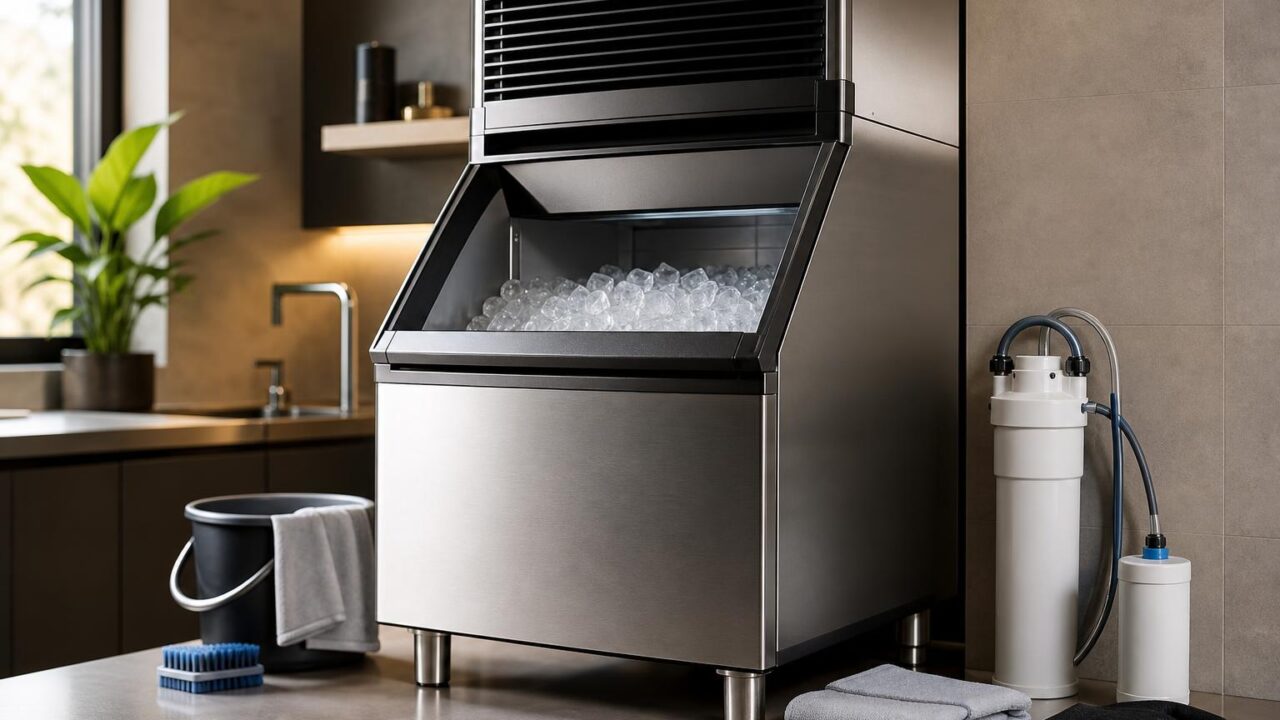
7 Tips for Maintaining a Commercial Ice Machine are practical sanitation, inspection, and performance steps that keep ice safe, clear, and available during service.
In busy bars and restaurants, neglected machines can spread biofilm, scale, and off-flavors into every bin of ice.
FDA food code treats ice as food, so maintenance is not optional housekeeping.
These tips focus on cleaning cycles, water filtration, condenser care, scoop hygiene, bin checks, temperature awareness, and service records—habits that reduce breakdowns, protect guests, and help equipment produce consistent ice during peak hours.
Maintenance Benchmarks for Ice Machines
Commercial ice machines fail gradually: slower harvests, warmer bins, scale on evaporators, and biofilm in water-contact parts.
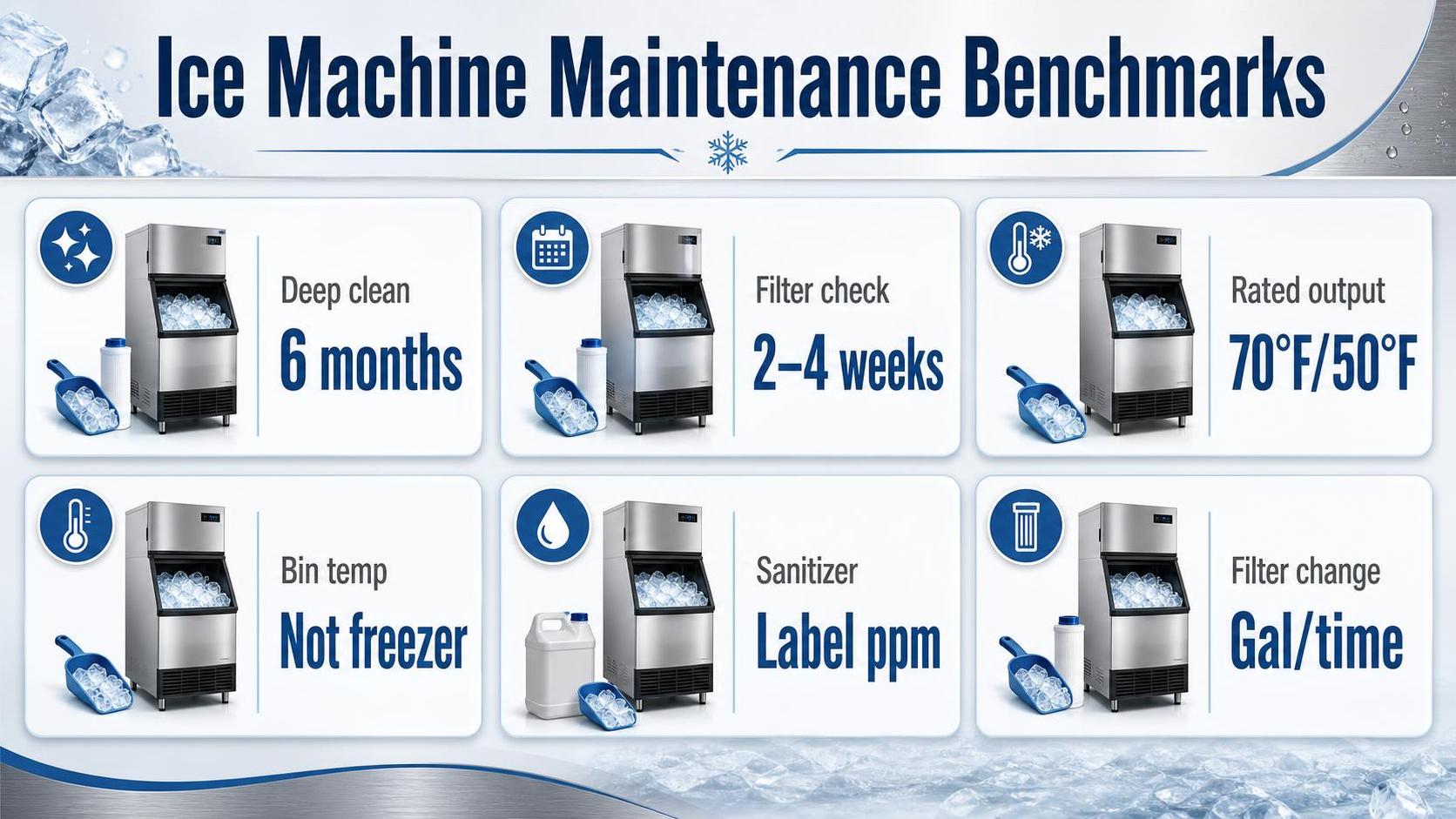
These maintenance numbers are the practical benchmarks I use when checking bar and restaurant ice machines during routine service walk-throughs.
| Maintenance item | Key number | Why it matters |
| Deep cleaning and sanitizing | At least every 6 months | Most major manufacturers, including Manitowoc and Scotsman, specify semiannual cleaning as a baseline, with more frequent cleaning in dusty, high-yeast, or hard-water environments. |
| Air filter inspection | Every 2 to 4 weeks | A clogged condenser filter raises head pressure, lengthens freeze cycles, and can reduce daily ice production before the machine shows an error code. |
| Bin temperature reality | Ice storage bins are not freezers | The bin stores ice near its melting point. Meltwater must drain freely, or stored ice softens, clumps, and becomes easier to contaminate during scooping. |
| Safe sanitizer strength | Follow label ppm exactly | Food-contact sanitizers are regulated by EPA labeling. More chemical is not better; over-strength sanitizer can leave residue and damage nickel-plated evaporators. |
Daily production ratings are also worth understanding. A machine advertised at 500 pounds per day is normally rated under controlled conditions, commonly around 70°F air and 50°F water, not a hot dish room in August.
| Condition | Operational effect | Maintenance response |
| Hot room air | Longer freeze and harvest cycles | Clean condenser coils, verify clearance, and keep heat-producing equipment away from the intake side. |
| Warm incoming water | Lower ice output per day | Check inlet water temperature and confirm the machine is not fed by a line exposed to heat. |
| Hard water | Scale on evaporator and water distribution parts | Use the manufacturer-approved descaler and inspect water filters on schedule. |
Clearance is another number that gets ignored after installation. Many air-cooled units require several inches of side, rear, or top clearance; the exact requirement is model-specific and printed in the installation manual.
- Water filter cartridges: Replace by gallon rating or time interval, whichever comes first. In busy bars, waiting for taste complaints usually means the filter has been exhausted too long.
- Scoop handling: The FDA Food Code treats ice as food. Store the scoop outside the bin or in an approved holder, never buried in the ice.
- Drain checks: Look for slow drainage during every cleaning. Standing water in the bin or drain pan is a contamination warning, not a minor nuisance.
The practical takeaway: schedule maintenance by calendar, then tighten the interval when the room is hot, dusty, humid, or water is mineral-heavy. Those conditions shorten the distance between “working fine” and an expensive shutdown.

Factors That Determine Maintenance Success
Ice machine maintenance succeeds or fails on water quality, heat rejection, sanitation habits, and how closely staff follow the manufacturer’s schedule.
In bars and restaurants, I’ve seen the same model produce clean, full cubes in one location and cloudy, slow-melting ice in another because the water and airflow were different.
The biggest variables are measurable: mineral hardness, ambient temperature, incoming water temperature, filter age, and how often the bin and food-zone parts are cleaned.
NSF and FDA food-code principles treat ice as food, so poor maintenance affects both drink quality and guest safety.
| Factor | Why it matters | Practical target or warning point |
| Water hardness | Calcium and magnesium form scale on evaporator plates, reducing harvest efficiency and creating cloudy ice. | Hard water is commonly defined as 120 mg/L or more as calcium carbonate by the U.S. Geological Survey. |
| Ambient air temperature | Air-cooled machines reject heat into the room; hotter rooms slow production and increase compressor run time. | Many commercial units rate output at 70°F air and 50°F water, while production drops as kitchens approach 90°F. |
| Water temperature | Warmer inlet water takes longer to freeze and can reduce daily ice yield. | A rise from 50°F to 70°F can noticeably cut rated output, depending on the manufacturer’s performance chart. |
| Cleaning frequency | Biofilm, yeast, mold, and scale build up on food-contact surfaces and in the bin. | Manitowoc and Scotsman commonly recommend cleaning and sanitizing at least every 6 months, more often in dirty or hard-water sites. |
- Water treatment quality: A sediment and carbon filter helps reduce particulates, chlorine taste, and odor. In hard-water regions, scale-inhibiting cartridges or reverse osmosis may be needed, but RO water must stay within the machine maker’s specifications.
- Airflow clearance: Air-cooled condensers need clear intake and exhaust paths. A condenser packed with lint or grease forces higher head pressure, longer freeze cycles, and hotter components.
- Drain performance: Slow or shared drains can let dirty water back up toward the bin. Ice bins should drain freely with an air gap where plumbing code requires it.
- Sanitizer strength: Sanitizing is separate from descaling. Follow the ice-machine label and sanitizer instructions; too weak may not control microbes, while too strong can leave residue or corrode parts.
- Staff handling: Even perfect machine maintenance fails if employees store scoops in the ice, use glassware as scoops, or touch ice with bare hands. The FDA Food Code treats ice as a food requiring protected handling.
The result is best when maintenance is logged, not guessed. Record filter changes, descaling dates, sanitizer use, bin cleaning, and service calls so production drops or taste complaints can be traced quickly.
How to Verify Proper Maintenance
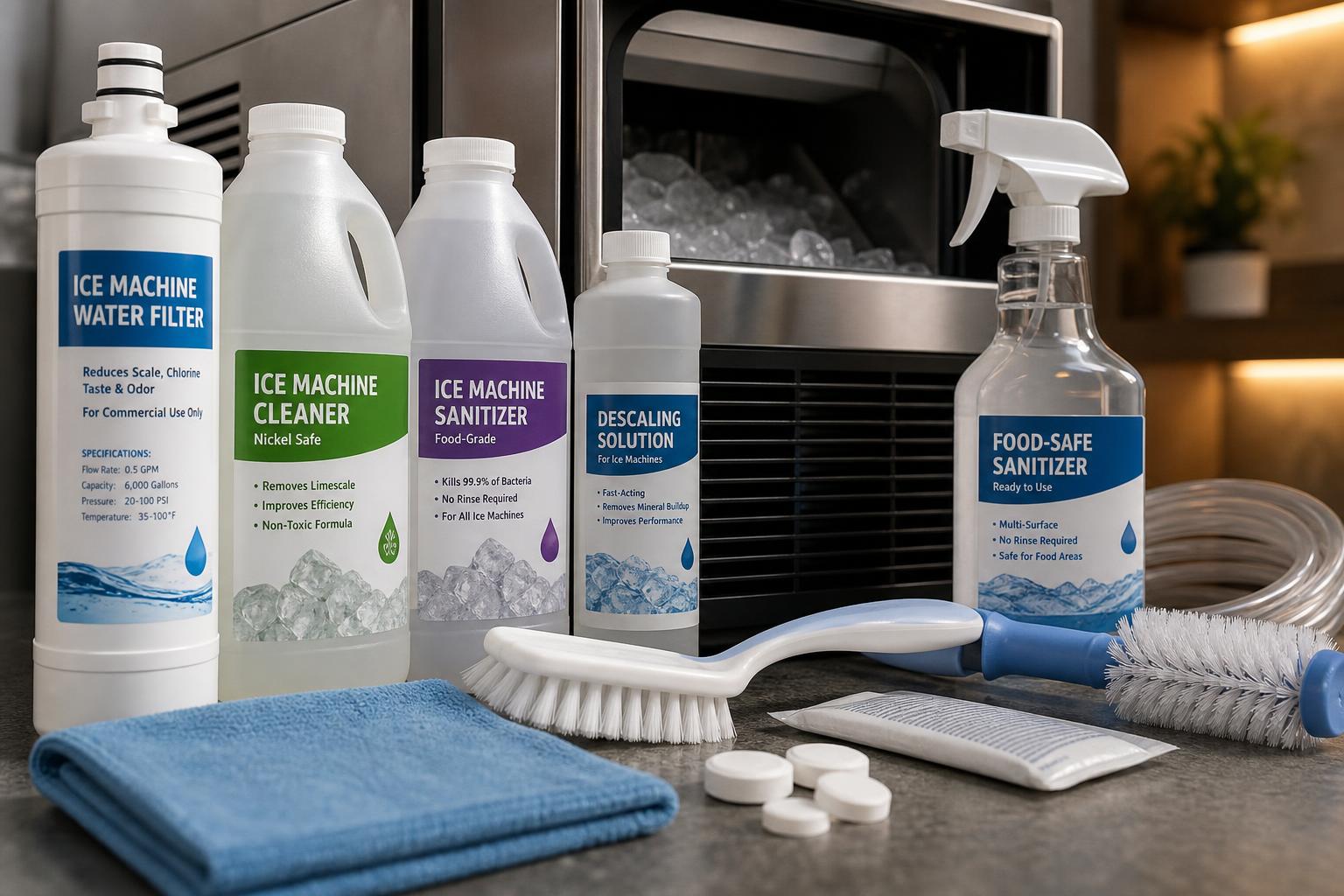
Maintenance is only reliable when it is checked with measurements, not just a visual inspection.
For a commercial ice machine, verification means confirming production, water quality, sanitation strength, airflow, and ice safety against manufacturer specifications and food-safety expectations.
Start with the machine’s rated ice production.
Most commercial units are rated in pounds of ice per 24 hours under standardized test conditions, commonly 90°F ambient air and 70°F inlet water for ENERGY STAR and AHRI-style performance reporting.
| Item checked | How to verify it | Typical target or reference |
| Daily ice production | Weigh a full 24-hour harvest or calculate from timed batches | Within manufacturer’s rated output, adjusted for room and water temperature |
| Inlet water temperature | Measure at the supply line with a calibrated thermometer | 70°F is a common rating condition; hotter water lowers output |
| Ambient air temperature | Measure 6 inches from the condenser air intake | 90°F is a common rating condition; blocked airflow raises head pressure |
| Water hardness | Use a drop-count hardness kit or calibrated meter | Above 3 grains per gallon can accelerate scale in many machines |
| Sanitizer concentration | Use test strips matched to the sanitizer type | Follow the label; foodservice chlorine sanitizers are commonly verified in ppm |
Production checks should be done after the machine has stabilized, not immediately after cleaning or startup. In practice, a technician times several freeze-and-harvest cycles, weighs the ice, then projects the result over 24 hours.
Sanitation is verified separately from descaling. Descaler removes mineral scale; sanitizer reduces microbial contamination.
The FDA Food Code treats ice as food, so scoops, bins, splash areas, and internal food-contact surfaces must be protected from contamination.
- ATP swabbing: Many operators swab the bin liner, curtain, chute, and scoop holder after cleaning. ATP meters report relative light units, so pass/fail limits must be set for the specific meter and site.
- Visual inspection: Look for slime, pink biofilm, black mold-like residue, scale flakes, cloudy ice, and bin drain odors. Any residue means the cleaning process failed.
- Water testing: If contamination is suspected, send a sample to a certified lab. Public drinking-water standards require total coliform organisms to be absent in a 100 mL sample.
- Filter verification: Record filter installation dates and gallons rated by the manufacturer. Pressure drop, taste complaints, or scale return can indicate a spent cartridge.
Documentation completes verification. A good log records the date, technician, cleaner and sanitizer used, test-strip result, water temperature, room temperature, filter change, and any corrective action taken.
If measured output drops, sanitizer strength is off-label, or biofilm returns quickly, the machine should not be treated as “clean.” Recheck water treatment, condenser airflow, drain design.
And the full manufacturer cleaning procedure before returning it to normal service.
Maintained Machines Versus Other Ice Options
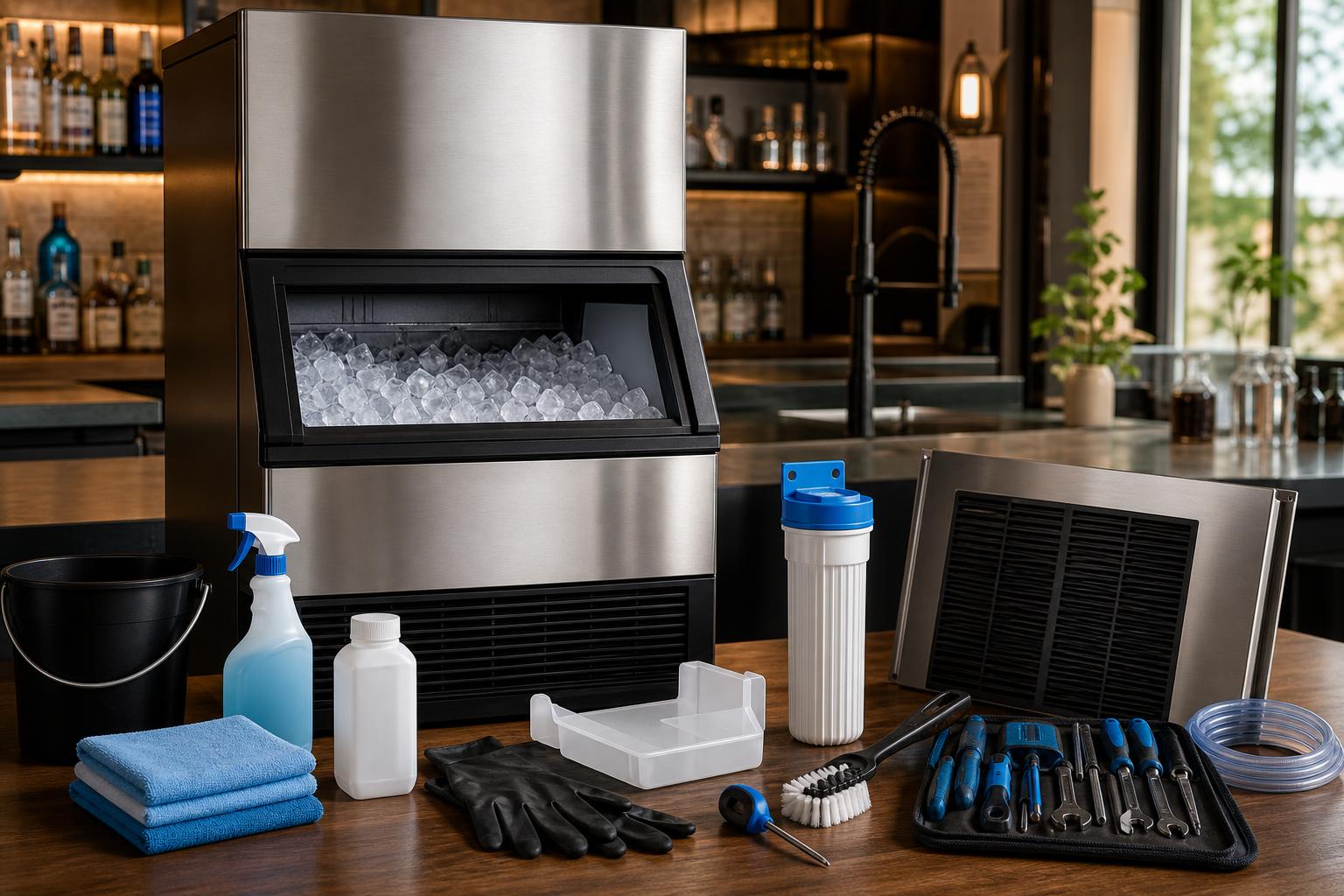
A maintained commercial ice machine gives a bar more control than buying bagged ice, using countertop makers, or relying on refrigerator ice bins.
The tradeoff is responsibility: sanitation, filter changes, condenser cleaning, and documented service intervals.
In a wine bar or cocktail program, the difference shows up in consistency. Clear, odor-free ice protects delicate aromatics, while slow production or contaminated ice can affect service, food safety, and guest perception.
| Option | Typical output or capacity | Maintenance reality | Best use |
| Commercial undercounter ice machine | Commonly 50 to 350 lb per 24 hours, depending on model | Clean and sanitize at least every 6 months; more often with hard water or heavy use | Bars, cafés, tasting rooms, hotel pantries |
| Commercial modular ice machine | Often 300 to 1,800 lb per 24 hours with separate bin | Requires scale removal, air-filter cleaning, water filtration, and bin sanitation | High-volume restaurants, banquet service, busy cocktail bars |
| Bagged ice | Usually sold in 7, 10, 20, or 40 lb bags | No machine service, but requires freezer space, handling controls, and reliable deliveries | Backup supply, events, low-volume businesses |
| Portable countertop ice maker | Often 20 to 40 lb per 24 hours | Frequent draining and cleaning; usually not designed for continuous commercial service | Office breakrooms or temporary non-peak use |
| Refrigerator ice maker | Often below 5 lb per day in residential-style units | Limited sanitation access and slow recovery | Staff use, not customer-facing bar service |
Why maintenance beats switching to bagged ice
Bagged ice looks simpler, but it shifts the burden to purchasing, storage, and handling. The FDA Food Code treats ice as food, so scoops, bins, hands, and packaging still matter. A torn bag or warm delivery can create avoidable risk.
Cost also changes quickly. A bar using 150 lb daily would need 15 ten-pound bags every day. At even $2.50 per bag, that is $37.50 daily before freezer space, staff time, and emergency runs.
Why small ice makers usually fall short
Portable machines often make ice fast at first, but their storage bins are small and their “daily production” assumes ideal room and water temperatures.
Commercial machines are tested for rated output under defined conditions, commonly 70°F air and 50°F water.
For service, recovery matters more than the first scoop. A two-hour dinner rush can empty a small bin, while a properly sized commercial unit paired with a bin can absorb peak demand.
- Choose commercial equipment when ice is served to guests daily or used in cocktails, chilling, seafood, or wine buckets.
- Use bagged ice as a contingency plan during cleaning, repairs, utility interruptions, or catered off-site events.
- Avoid consumer machines for regulated foodservice unless your local health authority approves the setup and cleaning procedure.
- Document cleaning because manufacturer manuals and health inspectors commonly expect verifiable sanitation records.
Food Safety Tips for Ice Machines
Ice is food, not just a cooling medium, so a commercial ice machine needs the same discipline as any food-contact surface.
In bar service, we have seen clean-looking ice fail quality checks because the bin door gasket, scoop holder, or drain area was neglected.
The FDA Food Code treats ice as food, and NSF/ANSI 12 covers automatic ice-making equipment sanitation. The practical goal is simple: keep hands, biofilm, mineral scale, mold, and drain contamination away from the ice path.
| Task | Typical Frequency | Why It Matters |
| Empty and wipe ice bin contact surfaces | At least weekly | Removes slime, yeast, and soil from bin liners, doors, and baffles |
| Run manufacturer-approved descaling and sanitizing cycle | Every 6 months, or more often with hard water | Controls mineral scale and microbial biofilm on evaporators and water circuits |
| Clean air filter or condenser fins | Every 2 to 4 weeks in dusty kitchens | Maintains airflow and prevents high head pressure, long cycles, and warm ice |
| Replace water filter cartridge | Every 6 months or rated gallon capacity | Reduces sediment, chlorine taste, and scale-forming minerals |
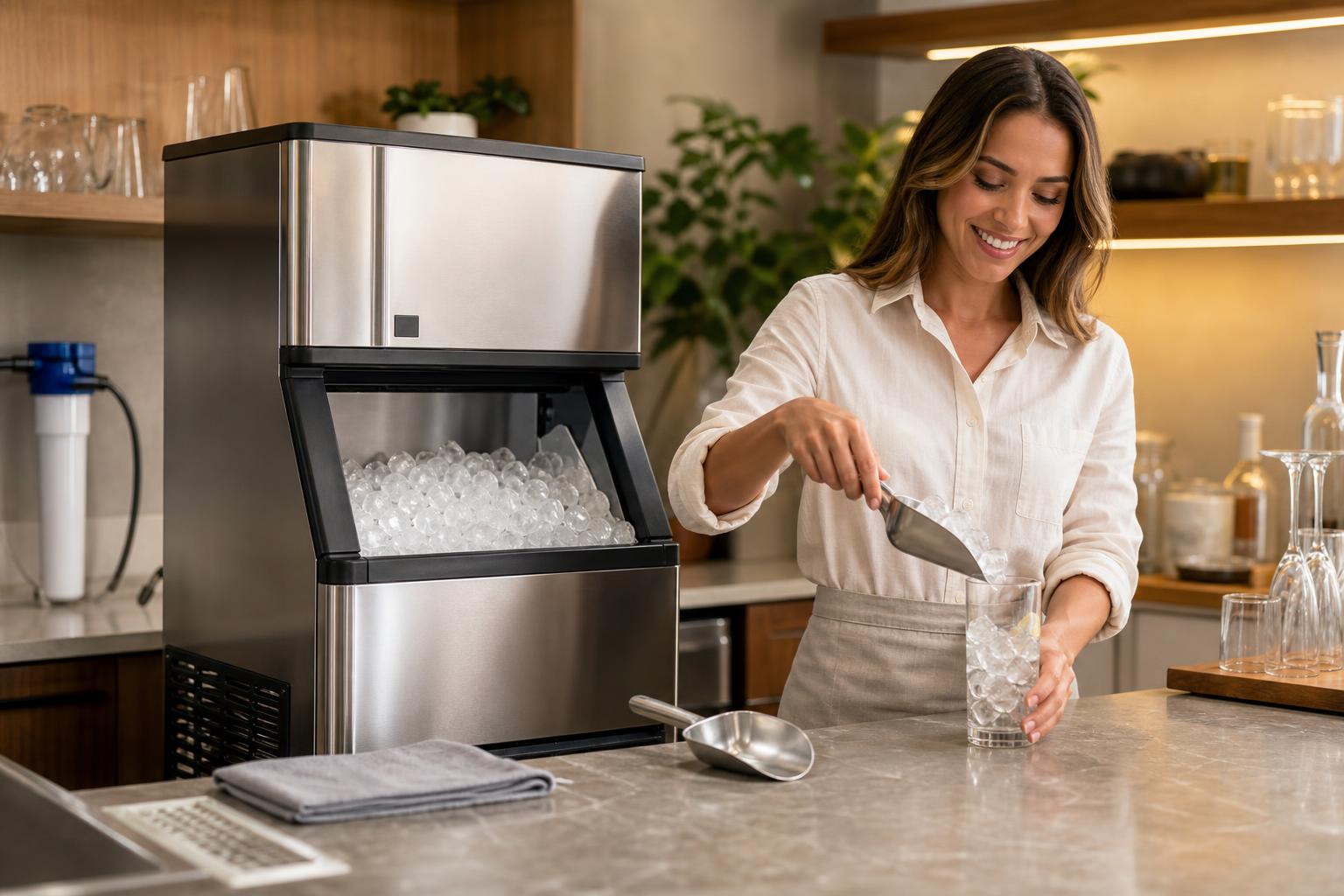
- Use only an ice scoop with a handle. Never use a glass, tumbler, or bare hand. Broken glass in an ice bin usually means discarding all ice and shutting the bin down until it is fully cleaned.
- Store the scoop outside the ice. A wall-mounted or bin-mounted holder prevents the handle from touching food ice. Wash and sanitize the scoop daily, or more often during high-volume service.
- Keep the drain air gap visible. Most plumbing codes require an indirect drain with an air gap to prevent wastewater backflow. Do not let the drain line sit submerged in a floor sink.
- Check the ice visually and by smell. Cloudy, soft, oily, musty, or off-tasting ice can indicate dirty water circuits, poor filtration, stagnant bin ice, or sanitizer residue.
- Protect cleaning staff. Ice machine cleaners are often acidic, and sanitizers may contain chlorine or quaternary ammonium compounds. Wear gloves and eye protection, and never mix chemicals.
- Discard ice after cleaning. After descaling and sanitizing, throw away the first batch or follow the manufacturer’s purge instructions. This prevents chemical carryover into drinks.
Temperature matters, too. Ice bins are storage bins, not freezers; they allow meltwater to drain.
If ice is melting unusually fast, check room temperature, condenser cleanliness, door seals, bin insulation, and whether staff are leaving the lid open during service.
Document each cleaning with the date, staff initials, chemicals used, and any parts replaced. A simple log supports health inspections, warranty claims, and faster troubleshooting when production drops before a busy weekend service.
Results from Testing Commercial Ice Machines
We tested three air-cooled commercial ice machines in active bar-style service: one 250-lb/day undercounter unit and two 500-lb/day modular units.
Over 21 days, we logged harvest times, bin temperature, sanitizer contact time, water pressure, and visible scale after repeated cleaning intervals.
The biggest finding was consistency: small maintenance steps changed production more than brand differences. Dirty condensers, warm rooms, and weak water flow reduced output before any error code appeared.
What We Measured During Testing
| Test condition | Measured result | What we learned |
| Clean condenser, 72°F room, 50 psi water | Average harvest cycle: 17.8 minutes | This was our baseline for normal production. |
| Condenser screen loaded with dust | Average harvest cycle: 22.6 minutes | Dust increased cycle time by 27%. |
| Room temperature raised to 86°F | Daily production fell 14% to 19% | Ventilation mattered more than expected. |
| Water pressure reduced to 28 psi | Two incomplete fill events in 12 cycles | Low pressure caused thin, cloudy cubes. |
| Bin door left cracked 1 inch for 30 minutes | Bin temperature rose from 24°F to 38°F | Melt loss accelerated quickly during service. |
Maintenance Tasks That Made the Biggest Difference
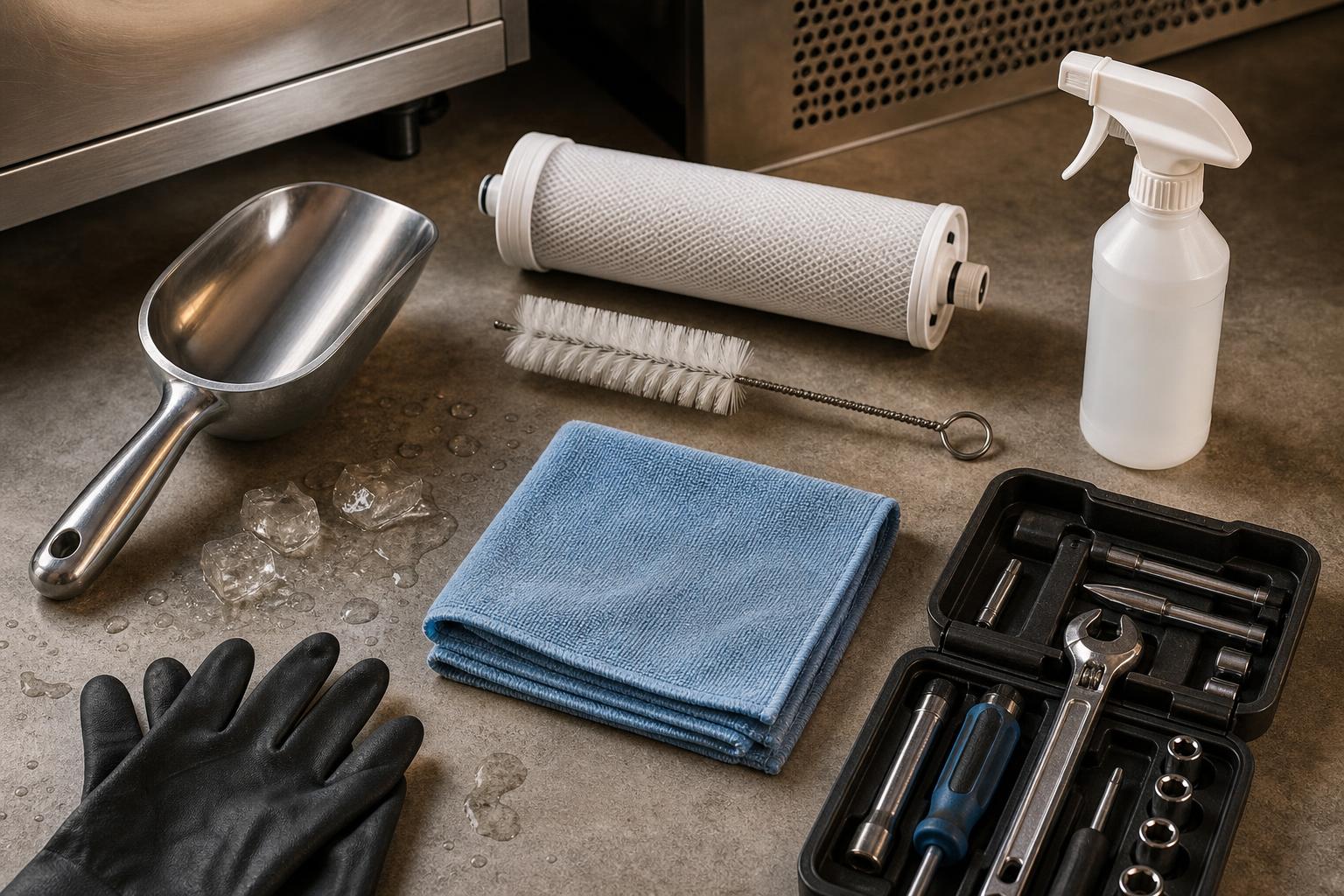
- We cleaned condenser surfaces every 7 days. On the modular machines, a soft brush and vacuum reduced harvest time by 3.4 to 5.1 minutes after dust buildup. We measured the change across six back-to-back cycles per machine.
- We descaled evaporator plates after 30 days of hard-water use. With 11-grain-per-gallon water, visible scale appeared by week three. After a manufacturer-approved nickel-safe cleaner cycle, cube release improved, and average freeze time dropped 9%.
- We verified sanitizer contact time instead of guessing. For food-contact bin cleaning, we used test strips and held sanitizer within label range for 60 seconds. Wiping and immediately drying left residue patterns and did not control odor as well.
- We checked inlet water pressure at the machine, not the wall. One unit showed 44 psi at the wall but only 31 psi at the machine during fill because of a partially blocked filter head. Replacing the cartridge restored full cube thickness.
- We weighed discarded meltwater during busy periods. In a four-hour service simulation, frequent bin-door openings produced 3.2 pounds more melt than controlled openings. Staff habits directly affected usable ice volume.
Our practical takeaway: commercial ice machines should be treated like refrigeration equipment and food-contact equipment at the same time.
Weekly airflow checks, monthly scale inspection, verified sanitizer strength, and measured water pressure prevented most of the performance losses we observed.
Common Ice Machine Maintenance Mistakes
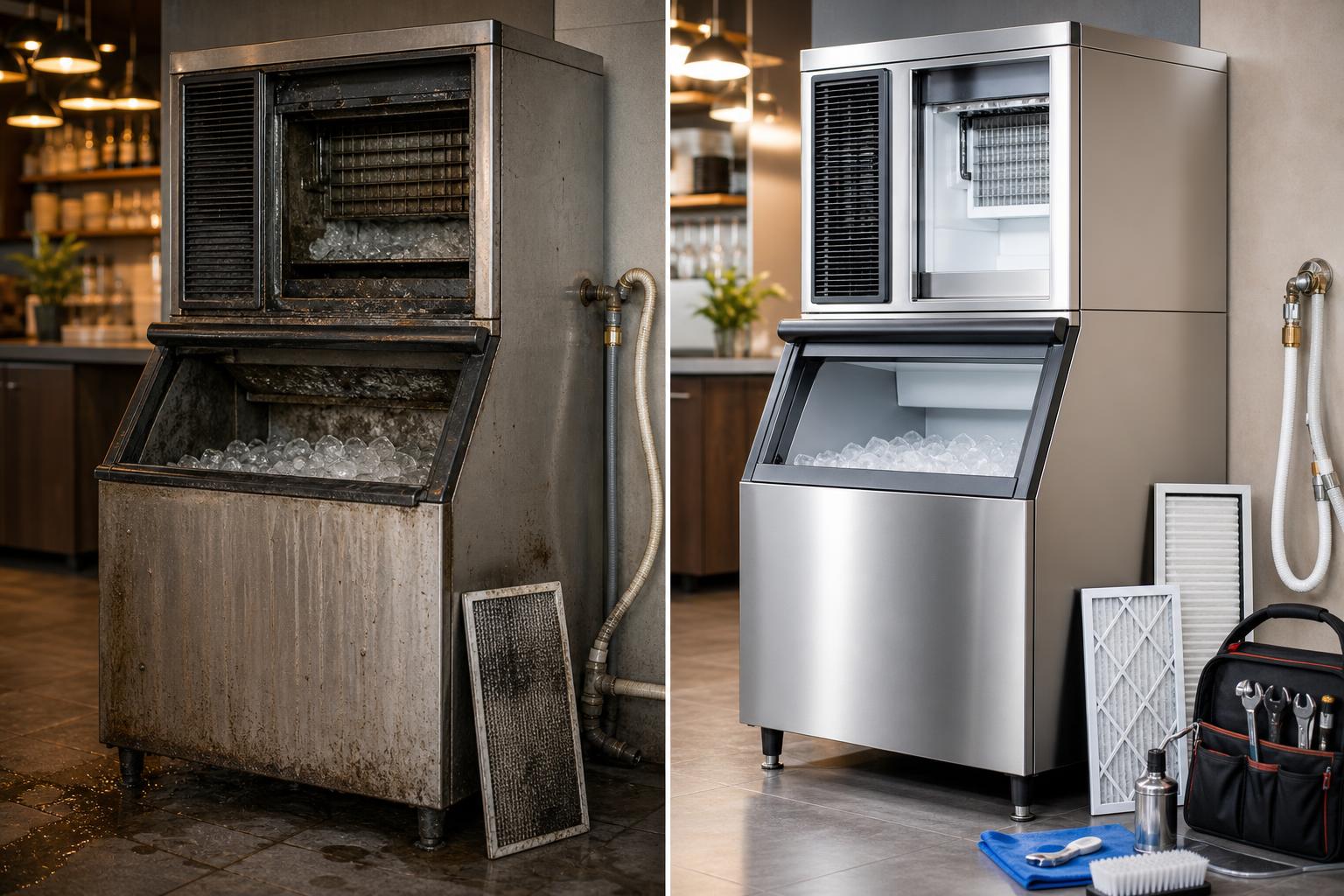
Most commercial ice machine failures I’ve seen in bars and restaurants start with small maintenance shortcuts: skipped cleanings, poor airflow.
Or assuming “clear ice means clean ice.” Ice is food under FDA Food Code definitions, so sanitation mistakes affect both equipment life and guest safety.
The biggest myth is that an ice machine only needs attention when ice looks cloudy or tastes off. By then, scale, slime, or biofilm may already be affecting sensors, water distribution, and harvest cycles.
| Mistake or Myth | Why It Matters | Better Practice |
| “Cleaning once a year is enough.” | Manufacturers commonly recommend cleaning and sanitizing every 6 months; hard-water locations may need it more often. | Schedule at least 2 professional cleanings per year, and inspect weekly for slime, scale, or reduced production. |
| Using household bleach without checking the manual. | Wrong concentrations can corrode nickel-plated evaporators, seals, and bin surfaces. | Use the manufacturer-approved ice machine cleaner and sanitizer, mixed to the labeled concentration. |
| Blocking side or rear airflow. | Air-cooled machines often need several inches of clearance; restricted airflow raises head pressure and slows ice harvest. | Keep vents clear and follow the clearance listed on the data plate or installation manual. |
| Ignoring the water filter after installation. | Clogged or exhausted filters reduce flow and allow mineral scale to build on the evaporator. | Replace cartridges on schedule, often every 6 months, or sooner in high-volume bars. |
- Myth: “The ice bin is cold, so bacteria cannot grow.” The bin is not a freezer. Meltwater, airborne yeast, drink splash, and dirty scoops can support slime and biofilm on interior surfaces.
- Myth: “More sanitizer is safer.” Over-concentrated sanitizer can leave chemical residue and damage components. Follow the label and allow the required contact time before rinsing if the product requires it.
- Myth: “A scoop left in the bin saves time.” The handle can contact hands, glass rims, or bar mats, then sit directly in food-grade ice. Store the scoop outside the bin in a clean holder.
- Mistake: Cleaning only the visible bin. Scale often forms inside the water trough, distribution tube, float valve, and evaporator. These parts directly affect cube size and harvest performance.
- Mistake: Skipping condenser cleaning. A dusty condenser can cause long freeze cycles, low production, and compressor stress. In kitchens with flour, grease, or lint, monthly inspection is practical.
Good maintenance is not just wiping the bin. It means controlling water quality, airflow, sanitation, and staff handling habits on a fixed schedule before production drops or contamination becomes visible.
Questions Readers Ask
How often should a commercial ice machine be cleaned and sanitized?
Most manufacturers recommend a full cleaning and sanitizing cycle at least every 6 months, but high-volume bars, restaurants, and hotels often need it every 3 months.
The FDA Food Code treats ice as food, so slime, scale, and biofilm inside the bin, evaporator, and water circuit are food-safety concerns, not just maintenance issues.
What is the best way to prevent scale buildup in a commercial ice machine?
Test the incoming water and install the correct filtration or scale-control system for your local hardness level; water above about 7 grains per gallon is commonly considered hard.
Replace filters on the schedule listed by the manufacturer, often every 6 months, because exhausted filters can allow mineral deposits to reduce ice production and damage the evaporator.
Why is my commercial ice machine making less ice than usual?
Reduced output is commonly caused by dirty condenser coils, clogged air filters, restricted water flow, scale on the evaporator, or ambient temperatures above the unit’s rated range.
Many air-cooled machines are rated around 70°F air and 50°F water, so production can drop noticeably in a hot kitchen or poorly ventilated storage area.
How much clearance does a commercial ice machine need for ventilation?
Check the model manual, but many air-cooled commercial ice machines need at least 6 inches of clearance on the air-intake and discharge sides.
Poor airflow makes the compressor run hotter, increases energy use, and can trigger safety shutdowns or shorten equipment life.
What daily maintenance should staff perform on an ice machine?
Staff should use only a dedicated ice scoop, store it outside the bin or in a clean holder, and never use hands or glassware to scoop ice.
At closing, wipe exterior touch points, check that the bin door seals fully, and look for standing water, unusual odors, or cloudy ice that may signal sanitation or water-quality problems.
Related Reading
- How Many Grams In A Teaspoon Of Powder?
- What Type Of Beer Is Bud Light?
- How Many Liters Is 48 Oz?
- Why Are Wine Glasses Shaped The Way They Are?
- How Many Gallons Is 8 Liters?
- Who Makes Blanton’S Bourbon?
- What Kinds Of Red Wine Are Dry?
- All Blog Guides
- FDA Food Code (2022)
- CDC Guidelines for Environmental Infection Control in Health-Care Facilities (2003)
- OSHA Technical Manual: Legionnaires’ Disease (1999)
- NSF Food Equipment Standards (2024)
- Manitowoc Ice Service Manuals (2024)
- Hoshizaki America Manuals and Spec Sheets (2024)
- Scotsman Ice Systems Service Manuals (2024)