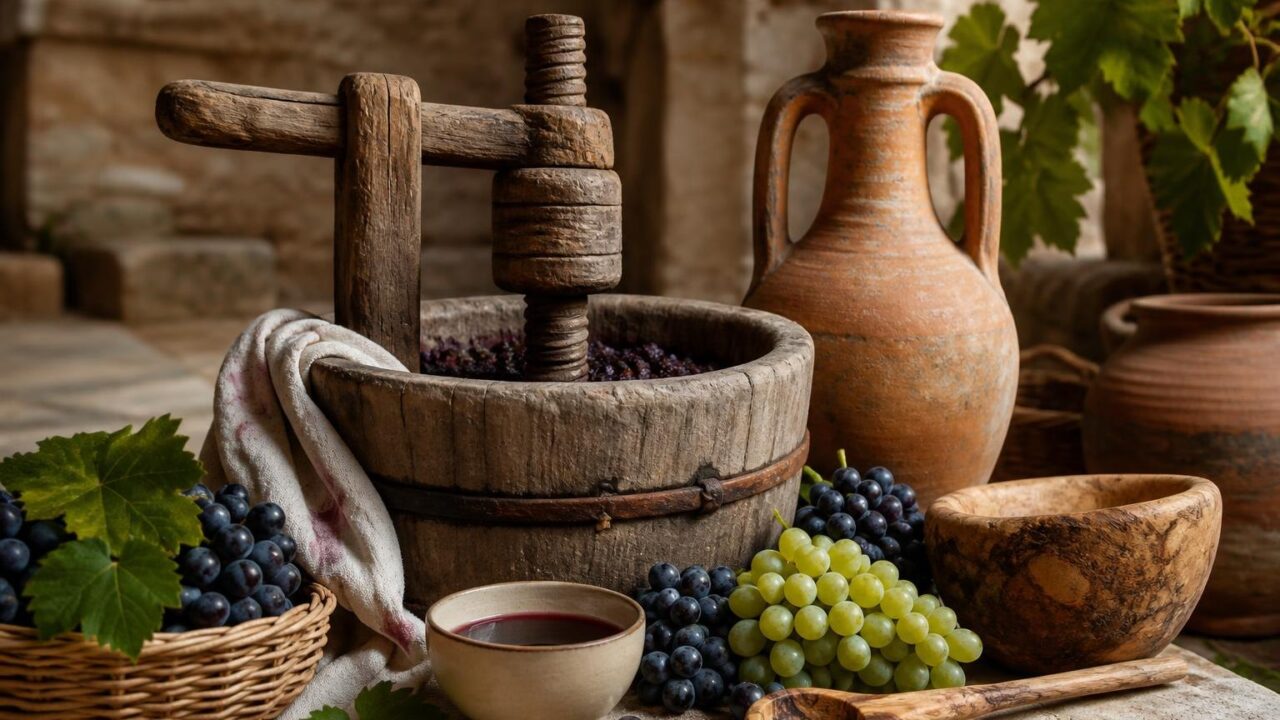
How Did They Make Wine in Bible Times? is answered by crushed grapes, open-air fermentation, clay storage jars, and careful separation of juice from skins and sediment.
Biblical wine began in vineyards, moved to rock-cut presses, then fermented naturally with wild yeasts on grape skins.
Ancient texts, archaeology, and Near Eastern wine installations show a practical process: harvest ripe grapes, tread them in a lower press, collect must in vats, ferment, strain, store, and serve.
This article follows that sequence from vineyard labor to table wine in Israel, Judah, and the wider Mediterranean world.
Grapes Harvested in Ancient Israel
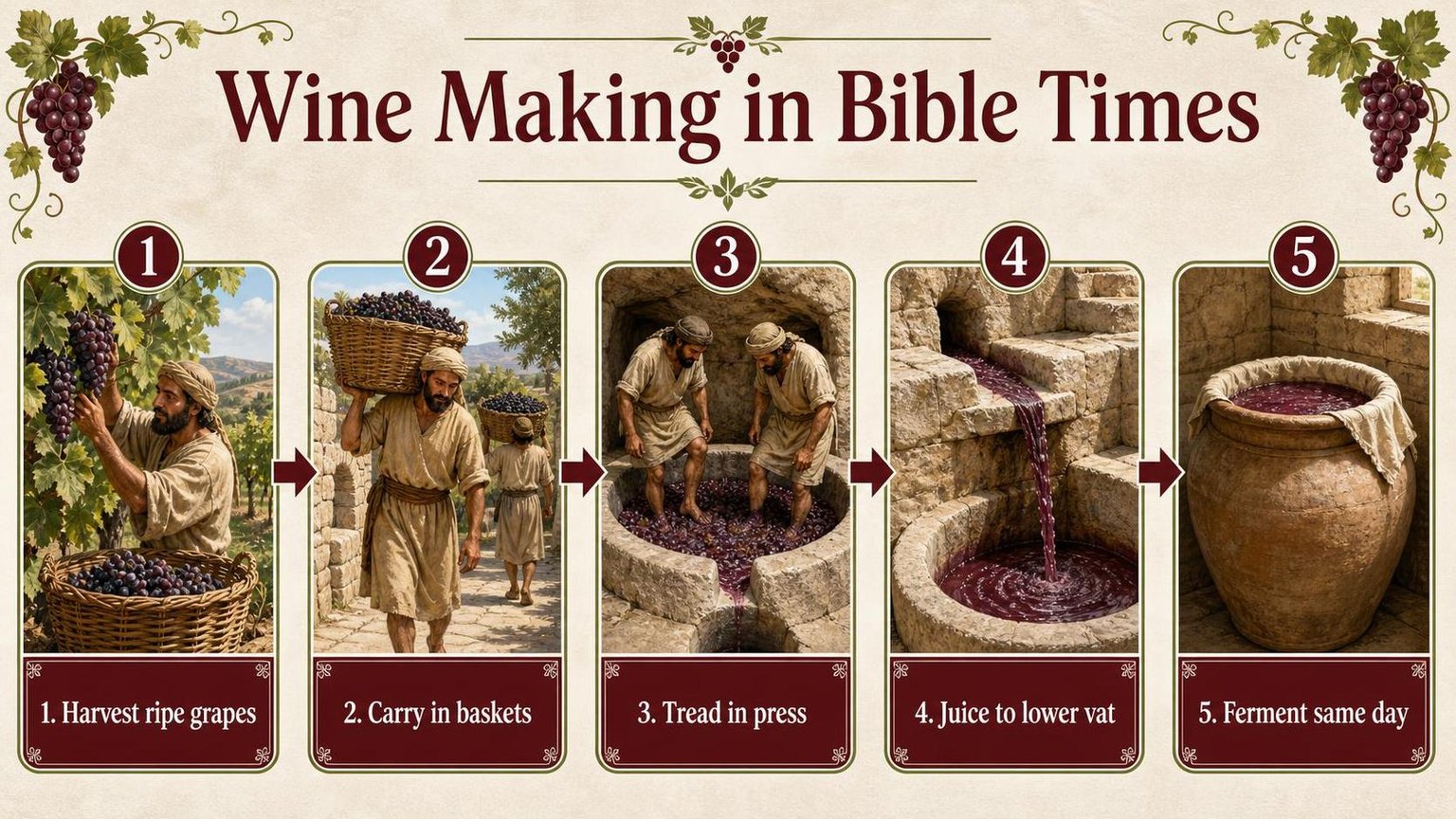
Ancient Israel harvested grapes in late summer, when sugar, color, and seed maturity aligned. In the hill country of Judah and Ephraim, growers cut whole clusters by hand and moved them quickly to nearby presses.
Speed mattered because bruised fruit began fermenting within hours in the heat.
The Hebrew Bible links grape harvest with the end of the dry season. In practice, that usually meant August to September in lower, warmer zones and later in cooler highlands.
Vineyards around terraces and villages reduced the distance between picking, sorting, and pressing.
Workers used small knives and carried clusters in baskets. Harvest was labor-intensive because ancient vines were trained low, often without modern trellising.
Pickers removed damaged or underripe fruit by hand, a necessary step when there were no pumps, crushers, or refrigeration to correct poor fruit later.
Archaeology shows how close vineyards stood to processing sites. Rock-cut winepresses are common across Israel, especially in the Judean hills, Galilee, and the Shephelah.
Many presses had a shallow treading floor leading to a deeper collecting vat, proving that grapes were normally processed immediately after picking.
| Harvest feature | Ancient Israel detail |
| Main harvest window | August-September in warmer areas; sometimes into October in cooler highlands |
| Fruit transport | Hand-carried in baskets or on pack animals over short distances |
| Typical press layout | One treading floor draining into one lower vat |
| Common winepress size | Treading floors often about 2-3 meters across, varying by site |
Terraced vineyards were practical in a rocky landscape. Stone retaining walls slowed erosion, held thin soils, and conserved scarce moisture from winter rains.
Grapevines tolerate dry summers well, which made them a reliable crop in a land where annual rainfall falls almost entirely between roughly November and March.
Harvest also had a legal and social dimension. Leviticus 19:10 and Deuteronomy 24:21 required growers not to strip vineyards bare, leaving some grapes for the poor and for foreigners.
That means gathering was selective, not absolute, and vineyard labor was embedded in local custom and obligation.
The famous cluster from the Valley of Eshcol in Numbers 13 reflects abundance, not normal daily practice. Most clusters were small enough for one hand, but the text preserves the region’s reputation for fertility.
By harvest time, ripe grapes were both fresh food and the raw material for the year’s wine.
Treading Grapes in Rock Winepresses
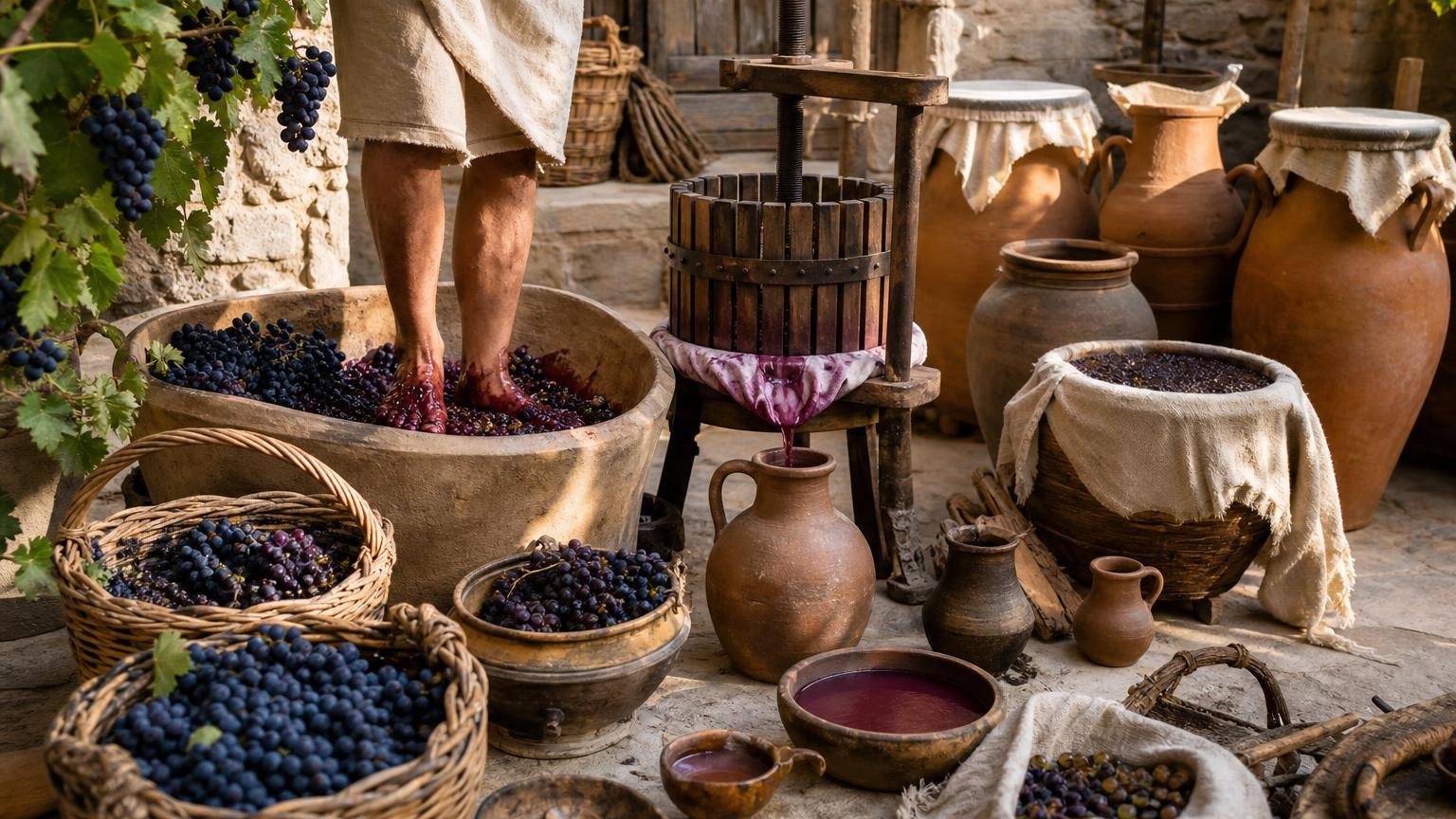
In Bible times, grapes were commonly crushed by foot in rock-cut winepresses carved into limestone.
The method was simple: workers trod grapes on an upper floor, and the juice ran through a channel into a lower vat where solids settled and fermentation began.
Archaeology across ancient Judah, Israel, and the wider Levant shows a consistent two-part design. A shallow treading floor held the grape clusters, and a deeper collecting basin received the must, the fresh juice containing skins, seeds, and pulp.
Many excavated treading floors measure about 2 to 3 meters across. Collecting vats are often around 1 to 2 meters deep, cut below the floor so gravity moved the juice without pumps or lifting.
| Feature | Typical archaeological range | Purpose |
| Treading floor | About 2-3 m wide | Workers crushed grapes by foot |
| Drain channel | Narrow cut groove | Directed juice into vat |
| Collecting vat | About 1-2 m deep | Held must for settling and transfer |
Foot treading mattered because it crushed berries while usually leaving many stems less broken than a heavy stone crusher would. That reduced harsh bitterness from shattered seeds and stems, though some stem contact still occurred during processing.
Texts and images from the ancient Near East fit this process. Isaiah 63:2-3 compares divine judgment to a man treading a winepress, and Nehemiah 13:15 mentions people treading winepresses on the Sabbath, showing the task was familiar field labor.
Treaders likely worked barefoot, sometimes holding ropes or a crossbar for balance on slick fruit skins. Several workers could stand together on one floor, moving rhythmically so the juice flowed steadily through the channel into the vat below.
After the first run of juice drained off, the remaining pomace could be pressed further. In some periods, a beam-and-weight or screw press extracted more liquid, but foot treading produced the first and most prized flow before heavier pressing.
- Rock-cut presses were durable and reused for many harvests.
- Limestone was common in the hill country, making excavation practical.
- The upper-to-lower layout used gravity, reducing labor and contamination.
- Harvest had to move quickly because ripe grapes spoil fast in heat.
This was not symbolic labor only. It was the standard first stage of winemaking in the biblical world, joining vineyard harvest, juice separation, and the start of fermentation in one compact stone installation.
Fermentation in Jars and Skins
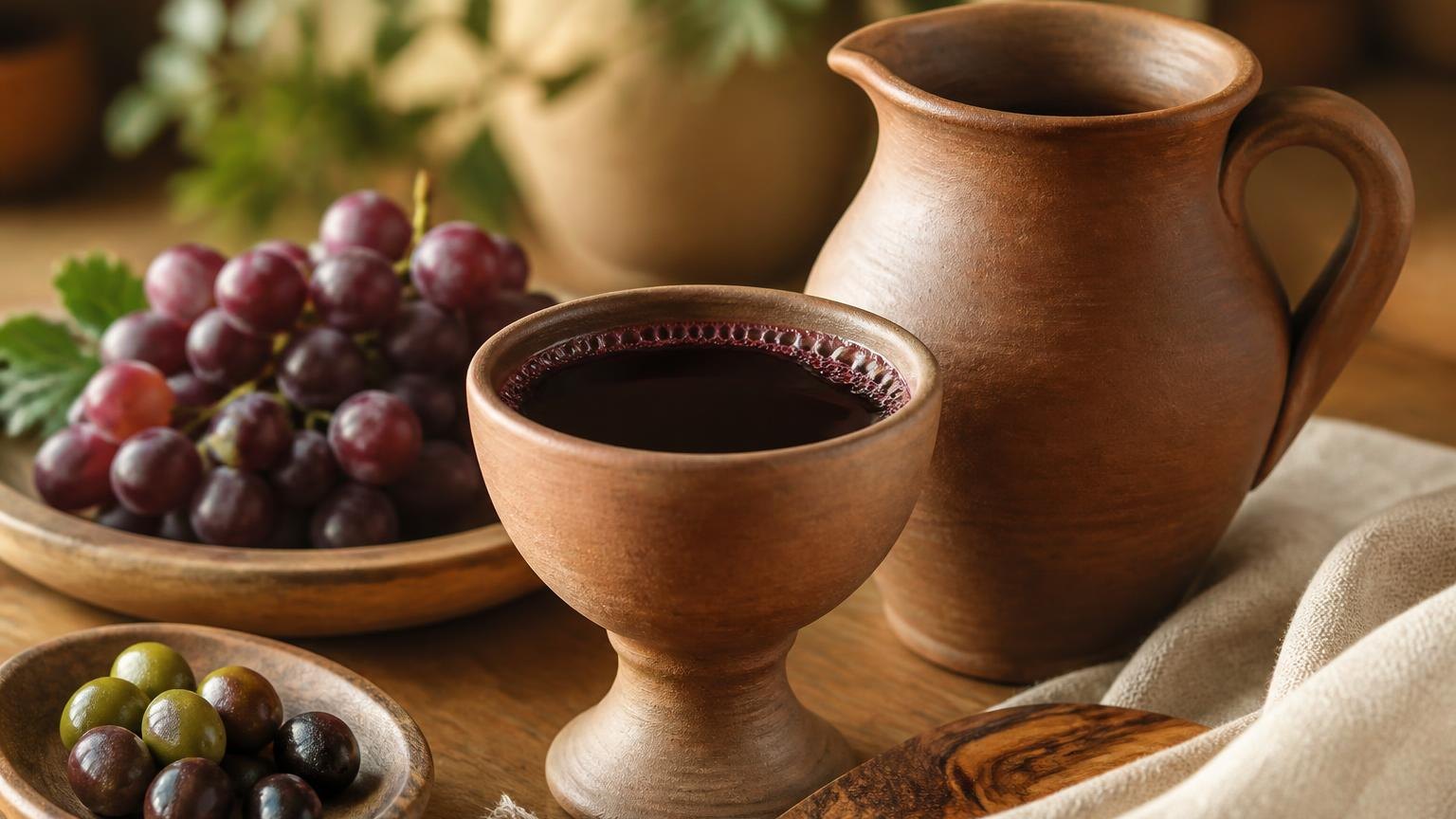
After grapes were trodden, the juice was moved quickly into containers that could survive an active, foaming fermentation.
In the biblical world, that usually meant large clay jars for settling and storage, and animal skins for transport or short-term fermentation.
Both materials matched the chemistry of new wine, which releases heat, foam, and carbon dioxide for several days.
Fresh must began fermenting almost immediately because wild yeasts lived on grape skins and in presses.
In the warm eastern Mediterranean harvest season, often around late summer to early autumn, primary fermentation could start within hours and run hard for roughly 3 to 7 days.
Clay jars were common because they were stable, reusable, and available in large sizes.
Archaeology from Iron Age Judah and the broader Levant shows storage jars ranging from roughly 20 liters to more than 50 liters, with some much larger vessels used in estates or workshops.
Jars worked well once the violent first phase slowed. Their wide mouths let foam rise and made skimming easier. They could also be covered with cloth, a potsherd, or a loose stopper, which reduced contamination without trapping dangerous pressure.
Skins behaved differently. Goat or sheep skins were sewn and sealed, then filled through the neck or a cut opening. Because fresh leather remained elastic, a new wineskin could swell as carbon dioxide built up.
An old, dried skin lost that flexibility and could split, which explains the image behind “new wine into new wineskins” in Matthew 9:17, Mark 2:22, and Luke 5:37-38.
| Container | Typical role | Approximate capacity | Fermentation advantage |
| Clay jar | Settling, aging, storage | About 20-50+ liters | Stable, cool, reusable, easy to cover loosely |
| Goat or sheep skin | Transport, short-term holding, active fermentation | About 10-40 liters | Expands under gas pressure when new |
Ancient winemakers also managed solids. Skins, stems, and pulp could remain with the juice for a period, especially for color and flavor extraction in red wine.
Then the wine was drawn off the heavier lees into cleaner vessels, a basic racking step known across the ancient Near East.
Temperature mattered. Fermentation is faster at higher temperatures, and Judean harvest heat could push yeast activity hard.
That made shaded rooms, rock-cut cellars, and thick-walled jars practical tools, not luxuries, because slower, steadier fermentation reduced spoilage and vinegar formation.
- New wine needed venting because carbon dioxide pressure rises fast.
- Clay jars suited settled wine better than tightly sealed fresh must.
- New skins handled expansion; old skins risked bursting.
- Early racking helped separate wine from sediment and bitter solids.
Straining Lees and Storing Wine
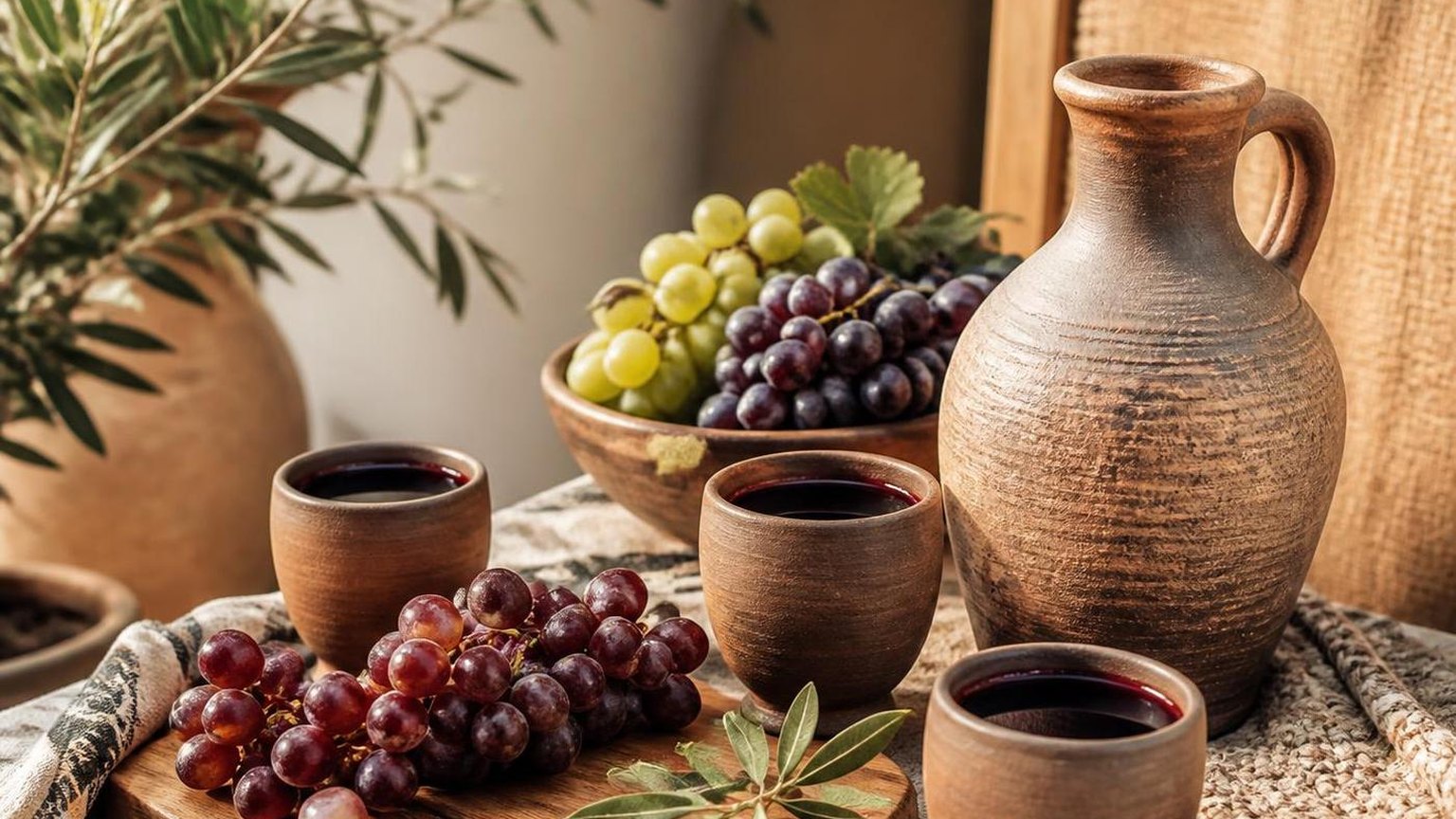
After fermentation, biblical winemakers had to separate drinkable wine from the heavy sediment left by skins, seeds, pulp, and dead yeast. The goal was stability.
Less sediment meant slower spoilage, cleaner flavor, and fewer off-odors during storage and transport.
Ancient sources and archaeology point to a simple sequence: let the new wine settle, draw it off, strain it, then seal it in a skin or ceramic jar.
Jeremiah 48:11 preserves the practice in metaphor, describing wine “settled on its lees” and “not poured from vessel to vessel.”.
“Lees” were the solids that sank after pressing and fermentation. Leaving wine on fine lees for a time could deepen texture.
Leaving it too long on gross lees raised the risk of sourness, reduction, and microbial spoilage, especially in warm Levantine conditions.
The first clarification step was settling by gravity. Fresh wine stood quietly in a vat or jar until heavier particles dropped. Workers then siphoned or poured the clearer layer into another vessel, avoiding the sludge at the bottom.
Straining added a second cleaning step. Cloth filters, woven baskets, or perforated strainers could catch larger fragments missed during settling. This was not modern sterile filtration.
It reduced visible debris and some solids, but ancient wine still often remained cloudy.
Storage depended on the container. Goat- or sheep-skin bags were flexible and useful for short-term holding or transport.
Ceramic jars were better for aging because they were sturdier, less permeable than skins, and easier to seal with stoppers, clay, resin, or pitch.
| Container | Typical capacity | Main use |
| Wineskin | About 20-40 liters | Transport, short storage, everyday handling |
| Amphora | About 20-30 liters | Shipping, trade, household storage |
| Large storage jar (pithos/jar) | Often 50-200+ liters | Bulk cellar storage |
Sealing mattered because oxygen and vinegar bacteria could ruin wine quickly. Resin, pitch, and tight stoppers limited air exposure.
Some jars were partly buried or kept in cool rooms, where steadier temperatures slowed secondary fermentation and spoilage.
Biblical language suggests both risks and preferences. Isaiah 25:6 praises “well-refined” wine, while also mentioning wine “on the lees,” showing that aged wine was valued when managed carefully.
The key was control: settle, rack, strain, seal, then keep the vessel still.
- Racking from vessel to vessel reduced sediment contact.
- Straining removed larger solids but did not sterilize the wine.
- Ceramic storage gave better long-term protection than skins.
- Cooler, sealed storage extended drinkability in hot climates.
Sweet Wine, New Wine, and Vinegar
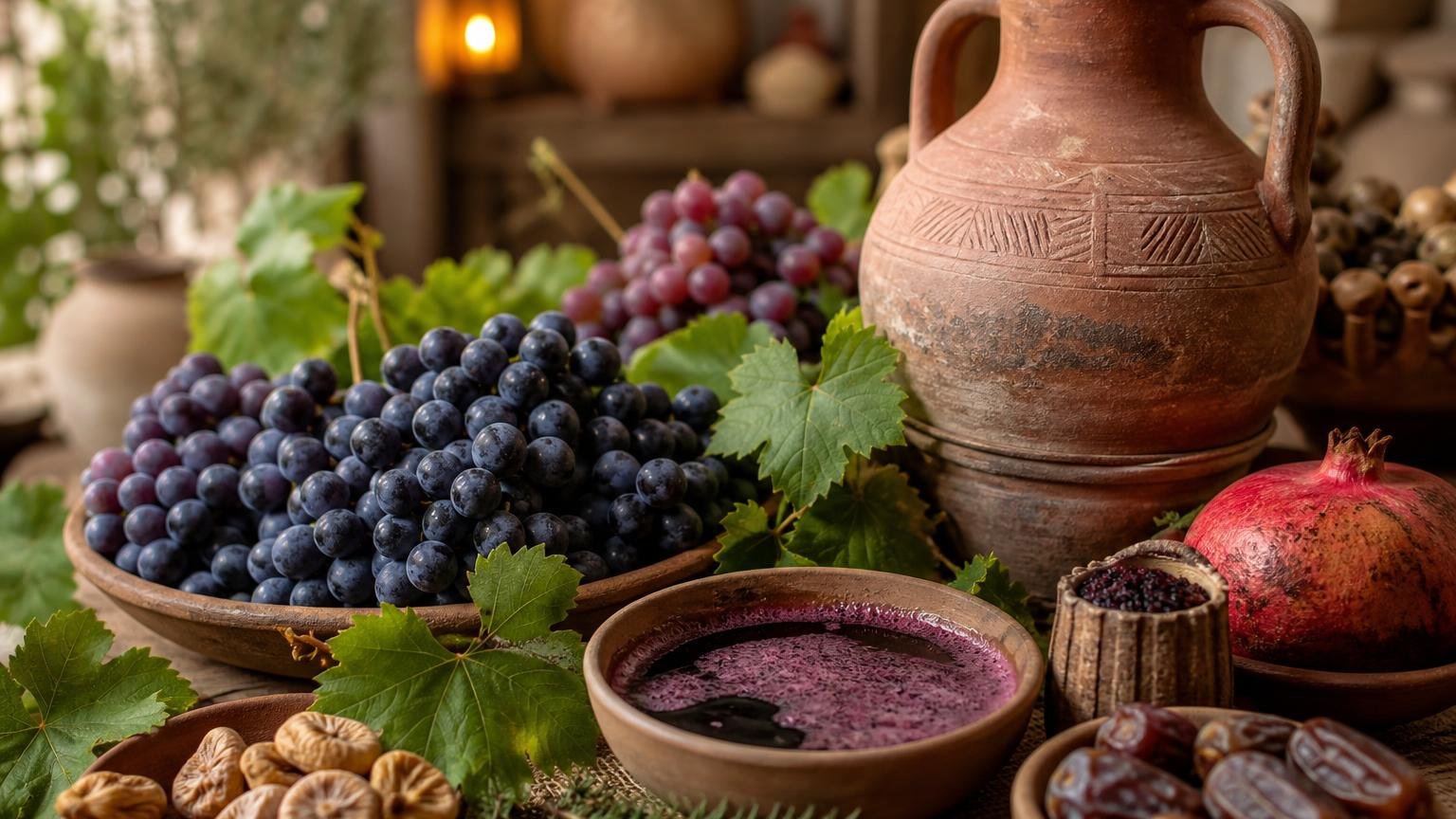
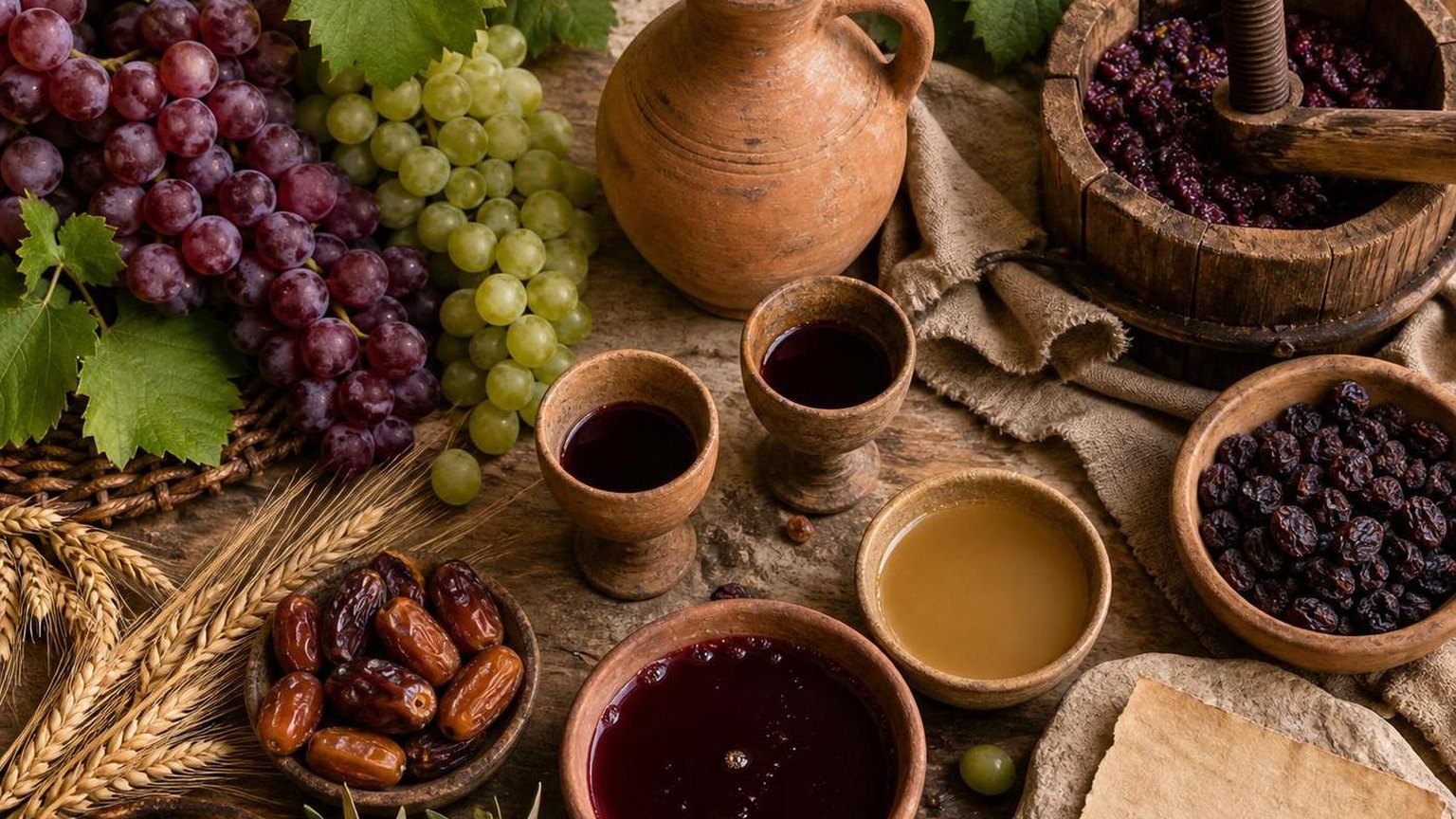
Biblical wine terms did not all mean the same drink. Ancient Hebrew and Greek sources distinguish freshly pressed grape juice, ordinary fermented wine, sweet concentrated products, and sour wine or vinegar used for workers and soldiers.
The key point is stage and treatment. Grapes ripened in late summer, juice fermented fast in the Levantine heat, and producers slowed spoilage by boiling must, drying grapes, sealing jars, or turning wine sour for practical use.
New wine usually refers to freshly made wine from the current harvest.
In Hebrew, tirosh often means fresh produce of the vine, while Greek neos oinos means “new wine.” Fermentation could begin within 6 to 12 hours after crushing because wild yeast lived on grape skins.
That speed explains why ancient people had to process grapes immediately. If they wanted a sweeter drink, they could chill the must, boil it down, or use raisins.
Roman agricultural writers describe concentrated grape must such as defrutum and sapa, reduced to about one-half or one-third of original volume.
Sweet wine in the biblical world was not usually modern dessert wine. It often meant wine made from very ripe grapes, sun-dried grapes, or concentrated must, leaving more residual sugar and a heavier texture.
Such wines were valuable because sugar preservation without refrigeration was difficult.
Vinegar, called chomets in Hebrew and oxos in Greek, was sour wine. It formed when acetic bacteria converted alcohol into acetic acid after exposure to air.
This was common in antiquity because wines were stored in skins, jars, and opened vessels, not sterile bottles.
Sour wine was not automatically spoiled beyond use. Mixed with water, it was a cheap, refreshing field drink. Roman soldiers commonly used posca, a water-and-vinegar drink, which explains why sour wine appears in Passion accounts.
| Term | Ancient sense | Typical production clue |
| New wine | Freshly made wine of the current vintage | Fermentation started within 6-12 hours after crushing |
| Sweet wine | Wine or must with concentrated sugars | Boiled to 1/2 or 1/3 volume, or made from dried grapes |
| Vinegar / sour wine | Wine turned acidic through air exposure | Alcohol converted into acetic acid by bacteria |
- Fresh grape juice existed, but in harvest season it was temporary unless preserved.
- Sweetness usually came from concentration or raisining, not modern fortification.
- Vinegar was a normal household and military drink ingredient, not an oddity.
Wine Dilution at Biblical Meals
Wine at many biblical-era meals was commonly mixed with water before serving.
The point was control: lower intoxication, stretch a costly product, and fit the dining customs shared across the eastern Mediterranean in the Second Temple and Roman periods.
The Bible itself reflects the practice.
Proverbs 9:2 and 9:5 describe wisdom as having “mixed” her wine, and Isaiah 1:22 criticizes merchants whose wine is “mixed with water,” showing that dilution was familiar enough to serve as a moral image.
At ordinary meals, dilution usually meant combining fermented wine with water in a bowl or jar before pouring cups. Greek and Roman writers, whose dining customs shaped Judea in the first century, treated unmixed wine as harsh and often barbaric.
Ancient authors give usable benchmarks. Homer refers to wine mixed at roughly 20 parts water to 1 part wine in epic poetry, while later classical writers more often mention practical table ratios nearer 3:1 or 2:1 water to wine.
Pliny the Elder also describes strong wines needing dilution.
If a fermented wine started near 10 to 12 percent alcohol by volume, those ratios changed the drink substantially. Dilution did not remove alcohol, but it could bring the strength closer to modern light beer or below.
| Mixing ratio | Total parts | Approximate ABV if original wine was 12% |
| 1 part wine : 1 part water | 2 | About 6% |
| 1 part wine : 2 parts water | 3 | About 4% |
| 1 part wine : 3 parts water | 4 | About 3% |
Jewish sources after the New Testament confirm the custom continued. The Mishnah, compiled around A.D. 200 but preserving earlier practice, discusses mixing wine for cups at meals and festivals, including Passover.
This matters for reading biblical scenes. Guests could drink several cups over a long banquet without consuming undiluted wine at full strength.
Drunkenness still happened, as Noah in Genesis 9 and warnings in Proverbs 23 show, but it usually came from quantity, not from modern-strength pours.
- Dilution made expensive wine last longer.
- Dilution softened taste, especially in resinous or concentrated wines.
- Dilution matched elite banquet customs in Greek and Roman society.
- Dilution reduced, but did not eliminate, the risk of intoxication.
Wine at biblical meals, then, was rarely a simple modern glass poured straight from the bottle. It was usually a prepared table drink, mixed for the occasion and served according to household custom, status, and the strength of the wine itself.
Archaeology Behind Biblical Winemaking
Archaeology shows that wine production in the biblical world was industrial, not incidental.
Excavated presses, storage jars, and residue analyses from Israel and surrounding regions confirm that grapes were crushed, fermented, stored, and traded at scale from the Bronze Age through the Roman period.
The material record matches many biblical references to vineyards, presses, vats, and new wine.
Stone installations survive well, and organic traces inside jars now let archaeologists identify wine chemically instead of relying only on shape or context.
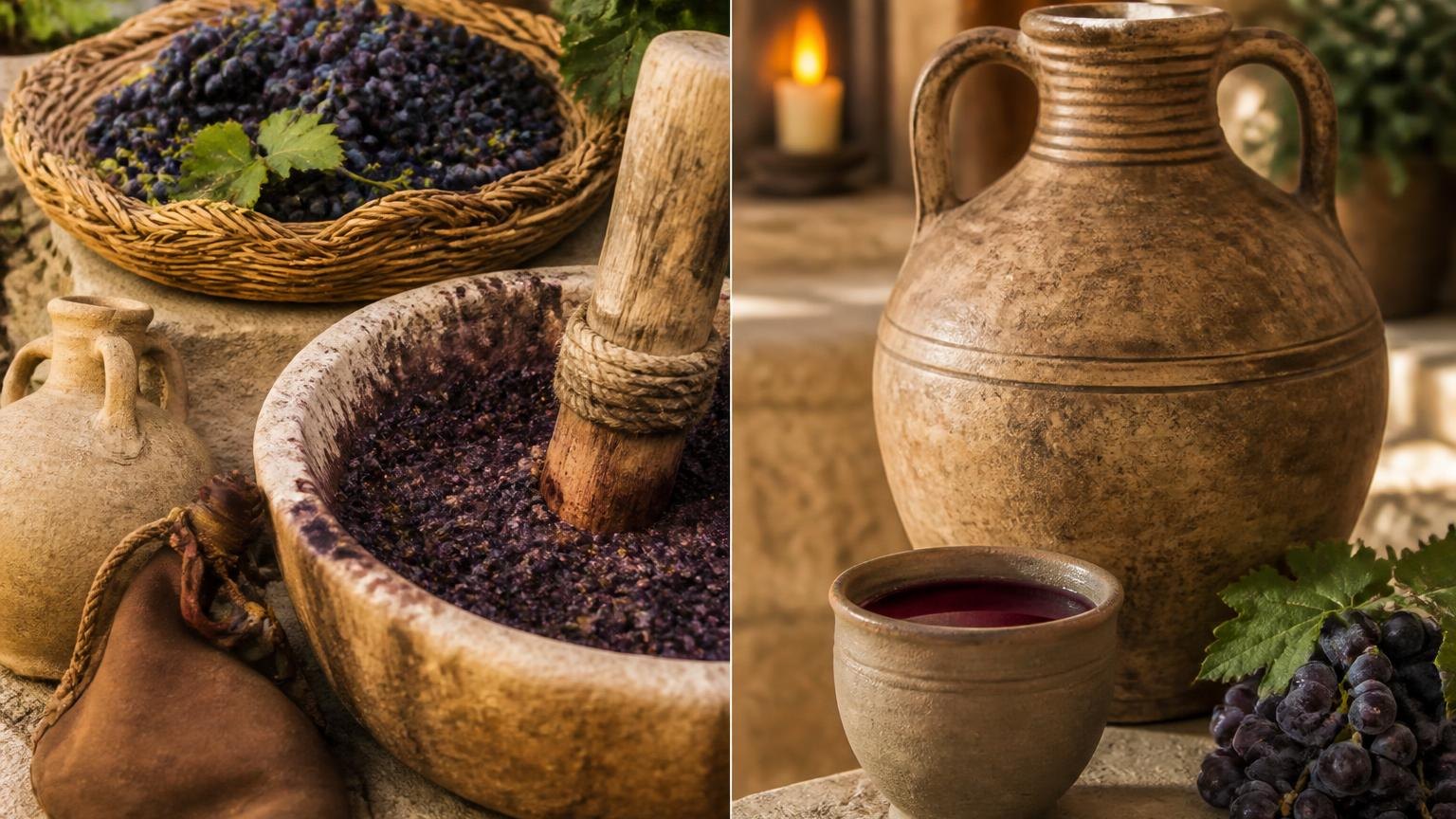
Rock-cut winepresses are the clearest evidence. In ancient Judah and Israel, a typical press had a shallow treading floor where grapes were crushed by foot, plus a lower collecting vat connected by a channel.
Many presses were small household units, but others were commercial. At Gibeon, north of Jerusalem, excavators uncovered at least 63 rock-cut wine cellars from the Iron Age, many associated with jar handles stamped with the place-name Gibeon.
Those underground chambers could hold large ceramic jars below ground temperature, helping stabilize wine after fermentation.
Gibeon is one of the strongest cases for organized biblical-period wine production because installations, storage, and inscriptions were found together.
| Site | Period | Evidence |
| Gibeon | Iron Age, especially 8th–7th century BCE | At least 63 wine cellars, jar handles stamped “Gibeon” |
| Khirbet Qeiyafa | Late 11th–early 10th century BCE | Multiple agricultural installations, including winepresses in Judah’s early monarchy horizon |
| Yavne | Byzantine, 6th–7th century CE | Large wine factory with at least 5 presses, showing later Levantine scale and continuity |
| Kfar Samir | Late Chalcolithic, around 4000 BCE | Earliest local grape-wine indications from residue and processing context |
Ceramic residue analysis has strengthened these identifications.
Archaeologists test absorbed compounds in jar walls for tartaric acid, a key grape marker, often alongside resin traces that suggest preservation methods known across the ancient Near East.
Storage mattered as much as pressing. Large jars, including pithoi and transport amphorae, protected wine during fermentation and shipment.
Some biblical-era handles bear stamped seals, including the well-known lmlk stamps from late 8th century BCE Judah, indicating royal administrative control over storage goods.
- Pressing installations show grape crushing and juice collection.
- Vats and jars show fermentation and storage capacity.
- Stamped handles and inscriptions show ownership, taxation, or distribution systems.
- Chemical residues confirm that some vessels held grape wine rather than oil or water.
Together, these finds show that biblical winemaking used durable stone technology, ceramic storage, and managed distribution.
The archaeology does not reconstruct every recipe, but it proves that wine was a routine agricultural product woven into daily life, worship, and regional trade.
Frequently Asked Questions
How were grapes harvested and prepared for winemaking in Bible times?
Grapes were picked by hand at full ripeness, usually in late summer to early fall, then sorted and carried in baskets to a press.
Ancient Israelite and Judean sites show rock-cut installations where workers removed damaged fruit before crushing, which mattered because sugar level and fruit condition controlled how well the juice would ferment.
What kind of winepress did people use in the biblical world?
The standard press was a hewn limestone installation with a shallow treading floor above and a deeper collecting vat below, connected by a channel.
People crushed grapes by foot, and the free-run juice flowed into the lower vat; archaeologists have found many two-vat presses of this type across Israel, matching imagery such as Isaiah 63:2-3 and Nehemiah 13:15.
How did fermentation happen without modern yeast or equipment?
Fermentation started naturally because wild yeast lived on grape skins, in the air, and on vessels, so fresh must could begin bubbling within hours or days.
The juice was held in jars, vats, or skins while yeast converted grape sugar into alcohol and carbon dioxide, and if the vessel was sealed too early the pressure could split old wineskins, which explains the image in Matthew 9:17.
Did people in Bible times age or store wine for long periods?
Yes. Wine was commonly stored in large ceramic jars or amphorae, sometimes sealed with resin, pitch, clay, or stoppers to slow spoilage and oxidation.
Better wines could be kept months or longer in cool storage, while ordinary wine was often consumed sooner because ancient production lacked modern sulfites, filtration, and temperature control.
Was biblical wine usually diluted, spiced, or otherwise mixed?
Often, yes.
In the eastern Mediterranean, wine was frequently mixed with water for daily drinking, and some wines were flavored with spices, herbs, or resin for preservation and taste; Proverbs 9:2 and Song of Songs 8:2 reflect this practice of prepared or mixed wine.
Dilution reduced harshness and made stored wine more practical at the table, but the drink still remained fermented grape wine rather than unfermented juice.
Related Reading
- How Much Alcohol In Wine Cooler? A Complete 2026 Guide to ABV, Strength & Safety
- How Many Calories In A Bottle Of Moscato?
- How Much Wine In A Glass?
- How Many Calories In A Glass Of Cabernet? Answer By Expert
- What Does Corked Wine Taste Like? Answer From Expert
- What Does Port Wine Taste Like? What You Need to Know
- What Does Port Taste Like? Most Correct Answer
- All Alcohol Guides
- The Beginnings of Winemaking and Viniculture in the Ancient Near East and Egypt (1996)
- Early Neolithic wine of Georgia in the South Caucasus (2017)
- Ancient Wine: The Search for the Origins of Viniculture (2003)
- Wine in the Ancient Mediterranean (2004)
- Wine (2024)
- Ancient Egyptian Wine Production (2010)
- Wine and Viticulture in the Ancient Near East and Egypt (2022)