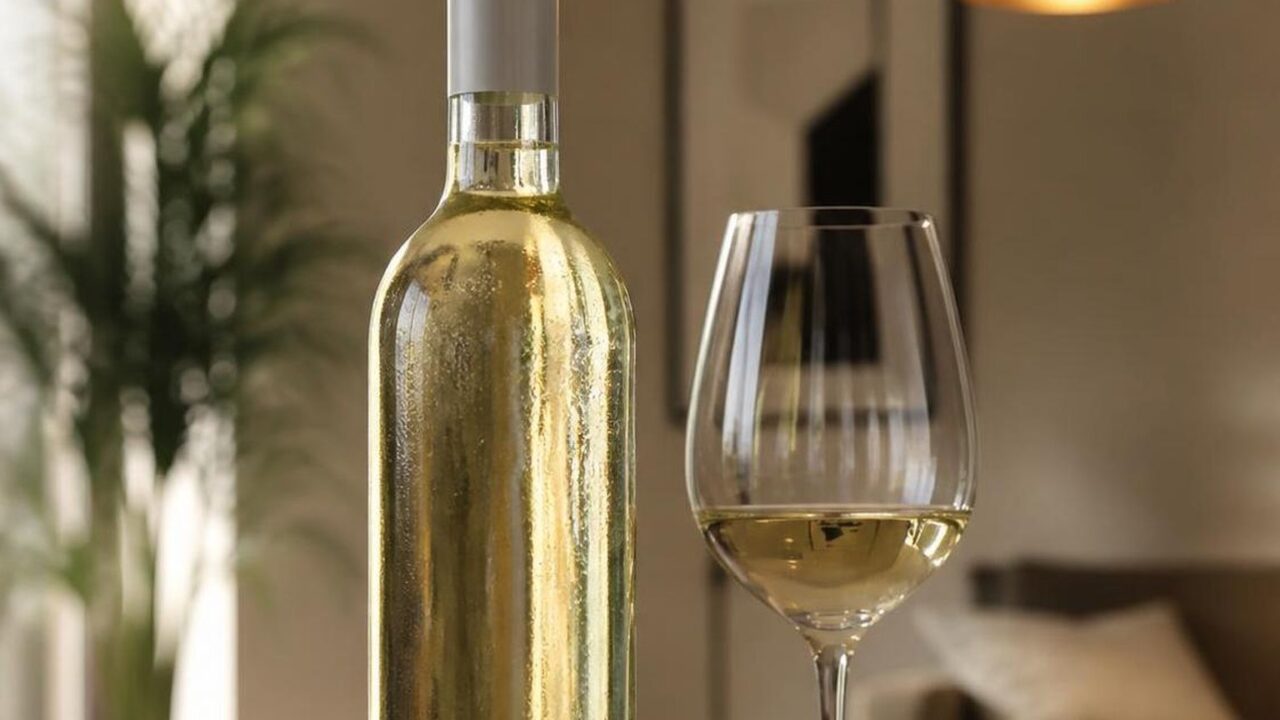
How Long Does White Wine Last Once Opened Screw Top? White wine usually lasts 3–5 days after opening when re-capped tightly and refrigerated at about 40°F. Crisp, high-acid styles often hold best; richer oaked whites can taste flat sooner.
A screw top slows oxygen exposure better than a loose cork, but it does not stop oxidation. Expect fading aromatics first, then dull fruit or nutty, bruised-apple notes. If the wine smells sharp, stale, or vinegary, pour it out.
Best Timeline for Opened White Wine
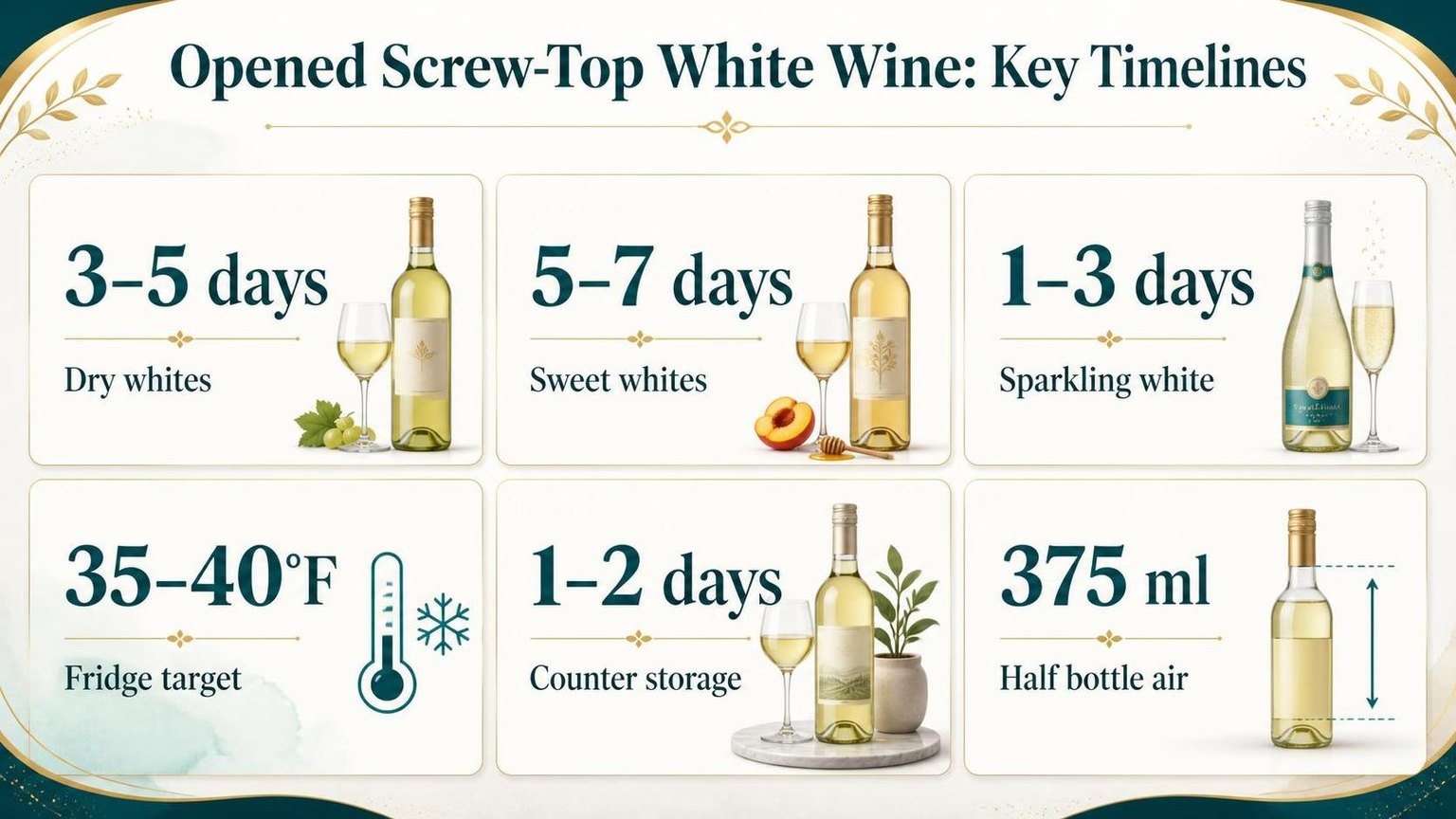
An opened screw-top white wine usually tastes best within 3 to 5 days when reclosed tightly and refrigerated. The screw cap is not the limiting factor; oxygen exposure, wine style, storage temperature, and headspace are.
In practice, “still drinkable” and “still showing well” are different standards. A crisp Sauvignon Blanc may be technically safe after day 5, but its citrus aroma and acidity can taste flatter by day 3 or 4.
| White wine style | Best quality after opening | Why the range differs |
| Light, crisp whites: Pinot Grigio, Sauvignon Blanc, Albariño | 3 to 5 days refrigerated | High freshness aromas fade quickly once oxygen is introduced. |
| Richer whites: Chardonnay, Viognier, white Rhône blends | 3 to 5 days refrigerated | More body can hide oxidation briefly, but oak and fruit can turn dull. |
| Sweet whites: Riesling, Moscato, Sauternes-style wines | 5 to 7 days refrigerated | Residual sugar and acidity can slow the perception of decline. |
| Sparkling white under screw cap or resealed closure | 1 to 3 days refrigerated | Carbon dioxide escapes quickly after opening, even if flavor remains acceptable. |
Refrigeration matters because chemical reactions slow at lower temperatures. A typical refrigerator at about 35°F to 40°F is far better than a 70°F kitchen counter, where oxidation and aroma loss accelerate noticeably.
The USDA notes that refrigeration keeps perishable beverages colder and slows microbial growth, but wine quality loss is mainly oxidation. Wine’s alcohol, acidity, and low pH make spoilage less like milk and more like gradual flavor decline.
- Day 1: Most screw-top whites taste close to freshly opened if recapped immediately.
- Day 3: Fresh whites often show softer aromatics and less snap, but are usually enjoyable.
- Day 5: Many dry whites taste flatter, with apple-browning or nutty notes beginning.
- Day 7: Sweet or high-acid whites may still be acceptable; delicate dry whites often are not.
Headspace is the hidden number. A half-full 750 ml bottle contains roughly 375 ml of air space, far more oxygen exposure than a nearly full bottle. Transferring leftovers to a clean 375 ml half-bottle can extend freshness by reducing oxygen contact.
A screw top should be twisted back on firmly, then the bottle stored upright. Upright storage reduces the wine’s surface area exposed to oxygen compared with laying the bottle on its side after opening.
Discard the wine if it smells strongly of vinegar, wet cardboard, bruised apple, or sherry when it was not made in that style. A slight fade in fruit is normal; harsh sourness or brown color means quality has passed.
Why Opened Screw-Top White Wine Fades
An opened screw-top white wine usually declines from oxygen exposure, not because the cap is inferior.
The screw cap can reseal tightly, but the wine’s freshness still depends on how much oxygen is left in the bottle, storage temperature, wine style, and handling.
In practical tasting terms, the biggest difference is between a half-full bottle left warm on the counter and a nearly full bottle put straight back in the refrigerator. The same wine can taste bright for days or seem flat overnight.
| Factor | Typical impact after opening | Why it matters |
| Storage temperature | Refrigerated white wine lasts about 3 to 5 days; room-temperature storage often shortens that to about 1 to 2 days | Cold slows oxidation and aroma loss. USDA food guidance treats 40°F as the refrigerator benchmark for slowing spoilage processes. |
| Bottle fill level | A bottle with 75% remaining keeps fresher than one with 25% remaining | More headspace means more oxygen in contact with the wine. |
| Wine style | Crisp dry whites usually show decline sooner than richer or sweeter whites | Acidity, sugar, alcohol, and phenolics affect how noticeable oxidation becomes. |
| Closure quality | A clean, undamaged screw cap can reseal well for short-term storage | The cap limits new air entry, but it cannot remove oxygen already trapped in the bottle. |
Oxygen exposure
Once opened, oxygen starts changing aroma and flavor compounds. At first, a little air may soften a wine. After prolonged exposure, fruit aromas fade, color can deepen, and the wine may taste bruised-apple-like, nutty, or dull.
Headspace is the key. If only one glass is poured, the remaining wine has relatively little air above it. If the bottle is two-thirds empty, there is far more oxygen available to react with the wine.
Temperature
Refrigeration is the simplest preservation tool. Even full-bodied whites should be capped and chilled after serving, then allowed to warm slightly before the next pour if needed.
Leaving white wine at 68°F to 72°F accelerates staling. A kitchen counter near sunlight, an oven, or a dishwasher is worse because repeated warmth speeds aroma loss and oxidation.
Wine composition
- High-acid whites: Sauvignon Blanc, Pinot Grigio, and Albariño can stay refreshing, but their citrus and floral notes are easy to lose.
- Oaked whites: Chardonnay may tolerate oxygen slightly better, but it can turn heavy, flat, or caramel-like.
- Sweeter whites: Riesling, Moscato, and late-harvest wines often last longer because sugar helps mask early oxidation.
- Low-sulfite or natural whites: These can change faster because sulfur dioxide is a major antioxidant used in winemaking.
Handling after pouring
Recap the bottle immediately instead of leaving it open through dinner. Avoid shaking the bottle, which increases oxygen contact. For best results, store it upright so less wine surface area is exposed to the air inside the bottle.
How to Judge Opened Wine Freshness
Opened white wine is not judged by the screw cap alone; it is measured by oxygen exposure, storage temperature, and sensory change over time.
Verification combines simple home checks with the same markers wineries use: aroma, color, acidity, sulfur dioxide, and dissolved oxygen.
A screw top reseals better than a pushed-back cork, but it does not make an opened bottle airtight.
Each pour replaces wine volume with air, and that headspace oxygen drives oxidation, dull fruit aromas, and eventually produces bruised-apple, nutty, or vinegar-like notes.
| Measurement point | What is checked | Practical sign in opened white wine |
| Dissolved oxygen | Oxygen absorbed into the wine after opening and pouring | Faster fading of citrus, floral, and fresh-fruit aromas |
| Headspace oxygen | Air trapped between the wine surface and screw cap | More empty bottle space usually means quicker oxidation |
| Free sulfur dioxide | Protective antioxidant level remaining in the wine | Lower protection makes browning and stale aromas more likely |
| Temperature | Storage condition after resealing | Refrigeration slows chemical and microbial change |
| Sensory condition | Smell, taste, color, and texture | Flat fruit, sourness, browning, or spritz loss indicate decline |
At home, the most reliable verification is a side-by-side check against the wine’s first-day profile. Pour a small sample, smell before swirling, then taste for fruit intensity, acidity, bitterness, and finish length.
| Opened white wine condition | Typical refrigerated range under screw cap | Verification result |
| Crisp dry white, such as Sauvignon Blanc or Pinot Grigio | 3 to 5 days | Still acceptable if aromas remain bright and no bruised-apple note appears |
| Fuller white, such as Chardonnay | 3 to 5 days | Acceptable if oak, butter, or fruit has not turned stale or bitter |
| Aromatic white, such as Riesling or Gewürztraminer | 4 to 7 days | Often lasts longer if acidity is high and sweetness is present |
| Sparkling white with screw-cap-style closure or stopper | 1 to 3 days | Verified mainly by remaining carbonation and fresh aroma |
Professional verification is more controlled. Wineries and laboratories can measure dissolved oxygen with optical meters, free and total sulfur dioxide by aeration-oxidation or segmented flow analysis, and volatile acidity to detect acetic spoilage.
Color is also measurable. White wine oxidation usually shifts absorbance upward around 420 nanometers, which corresponds with yellowing or browning.
A consumer version of this test is holding the wine against a white background and comparing it with a day-one photo.
- Smell first: discard if aromas resemble vinegar, wet cardboard, sherry in a non-sherry wine, or bruised apple.
- Check color: deeper gold or brown tones suggest oxidation, especially in pale whites.
- Taste cautiously: flat fruit, harsh bitterness, or sharp acetic sourness means quality has failed.
- Verify storage: a resealed screw top kept below 40°F generally lasts longer than one left on a counter.
The practical standard is not whether the wine is dangerous, but whether it still tastes like itself. Most opened white wines under screw top fail by quality loss before they become a food-safety concern.
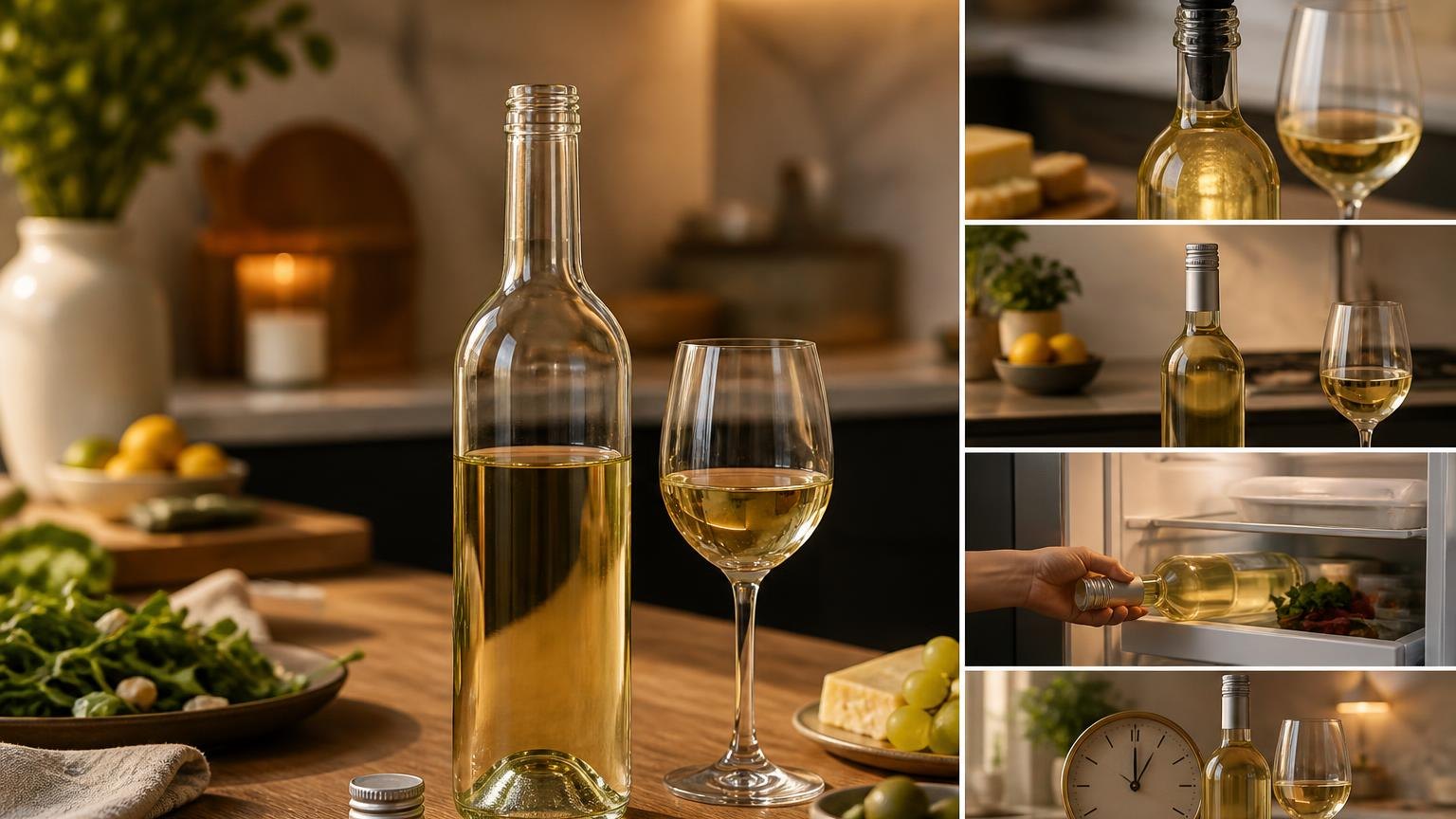
Screw Tops Versus Other Closures
An opened screw-top white wine usually gives you 3 to 5 days of good drinking quality when reclosed tightly and refrigerated at about 40°F.
The screw cap is convenient, but after opening it does not stop oxygen exposure; it mainly gives you a reliable reseal.
In bar service, the biggest difference is not the closure itself but how much air is left in the bottle, how cold it is stored, and the wine style. Crisp, high-acid whites such as Sauvignon Blanc tend to hold better than fuller, oakier whites.
| Opened wine type or closure | Typical refrigerated life after opening | Why it differs |
| Screw-top still white wine | 3 to 5 days | Easy airtight reseal, but oxygen remains in the bottle headspace after pouring. |
| Cork-finished still white wine | 2 to 4 days | Comparable if the cork is reinserted firmly, though damaged or loose corks seal less consistently. |
| Light rosé wine | 3 to 5 days | Similar alcohol and acidity to many whites; color and fruit aromas fade first. |
| Sparkling white wine | 1 to 3 days | Carbon dioxide escapes quickly; use a proper sparkling stopper, not the original cork. |
| Boxed white wine | 3 to 6 weeks | Bag-in-box packaging collapses as wine is poured, limiting oxygen contact. |
| Fortified white wine, such as dry vermouth | 4 to 8 weeks | Higher alcohol and, often, added botanicals or oxidative winemaking improve stability. |
A screw cap generally outperforms a pushed-back cork for practicality. It threads back on evenly, does not crumble, and is less likely to leave gaps if the bottle is stored upright in the refrigerator.
It does not outperform boxed wine for longevity. A 3-liter box contains the equivalent of four standard 750 ml bottles, yet the internal bag reduces repeated oxygen exposure each time you pour.
Sparkling wine is the weakest comparison. Even if it is white and screw-top freshness rules seem tempting, bubbles are a separate issue. Once pressure drops, the wine can taste flat well before it tastes spoiled.
- Best short-term option: screw-top white wine, if you plan to finish the bottle within 3 to 5 days.
- Best long-term open format: boxed white wine, especially for weekday cooking or by-the-glass drinking.
- Most fragile alternative: sparkling white wine, because carbonation loss is noticeable within 24 to 72 hours.
- Closest substitute: cork-finished still white wine, provided the cork reseals tightly and the bottle stays cold.
The U.S. FoodSafety.gov refrigerator standard of 40°F or below is a useful benchmark. While wine quality decline is not the same as food spoilage, colder storage slows oxidation and aroma loss after opening.
Quality and Safety After Opening
An opened screw-top white wine is usually a quality issue before it is a safety issue. Refrigeration, clean pouring, and a tight reseal are the practical controls that keep oxidation and spoilage organisms in check.
| Situation | Practical safety guidance |
| Opened dry white wine, refrigerated | Best quality is typically within 3 to 5 days; discard if aroma, flavor, or appearance is clearly abnormal. |
| Opened sparkling white wine, refrigerated | Best within 1 to 3 days because carbonation escapes quickly, even under a stopper. |
| Opened sweet white wine, refrigerated | Often holds 5 to 7 days because sugar and acidity can slow quality decline, but it still must be checked. |
| Opened wine left at room temperature | Quality can decline noticeably within 24 hours, especially in warm kitchens or direct light. |
According to USDA food-safety guidance, beverages containing alcohol are not automatically sterile after opening.
Wine’s alcohol, acidity, and sulfites make dangerous bacterial growth unlikely, but they do not prevent oxidation, yeast activity, or mold if storage is careless.
- Refrigerate immediately after pouring. Cold storage slows chemical oxidation and microbial activity. Put the screw cap back on tightly and store the bottle upright to reduce the wine’s surface area exposed to oxygen.
- Do not drink from the bottle. Saliva introduces bacteria and yeast. Pour into a clean glass, then recap the bottle before serving food or returning to the table.
- Check smell first. Sharp vinegar, nail-polish remover, wet cardboard, cooked cabbage, or obvious mustiness means the wine is no longer pleasant and should not be served.
- Check appearance. Cloudiness, stringy texture, new fizz in a still wine, or visible mold around the cap or neck are discard signs.
- Use clean tools. If you use a vacuum pump or stopper, wash and dry it between bottles. A dirty stopper can contaminate otherwise sound wine.
Vinegar-like wine is usually caused by acetic acid bacteria converting alcohol in the presence of oxygen.
It may not make most healthy adults sick in small amounts, but it is a clear quality failure and should be discarded rather than “saved.”.
For cooking, use the same standard: if you would not taste it, do not cook with it. Heat does not fix oxidized, moldy, or solvent-like flavors; it often concentrates them in sauces.
People who are pregnant, immunocompromised, or avoiding alcohol should be especially conservative. Even “old” wine still contains alcohol, and spoilage signs are not worth testing by taste.
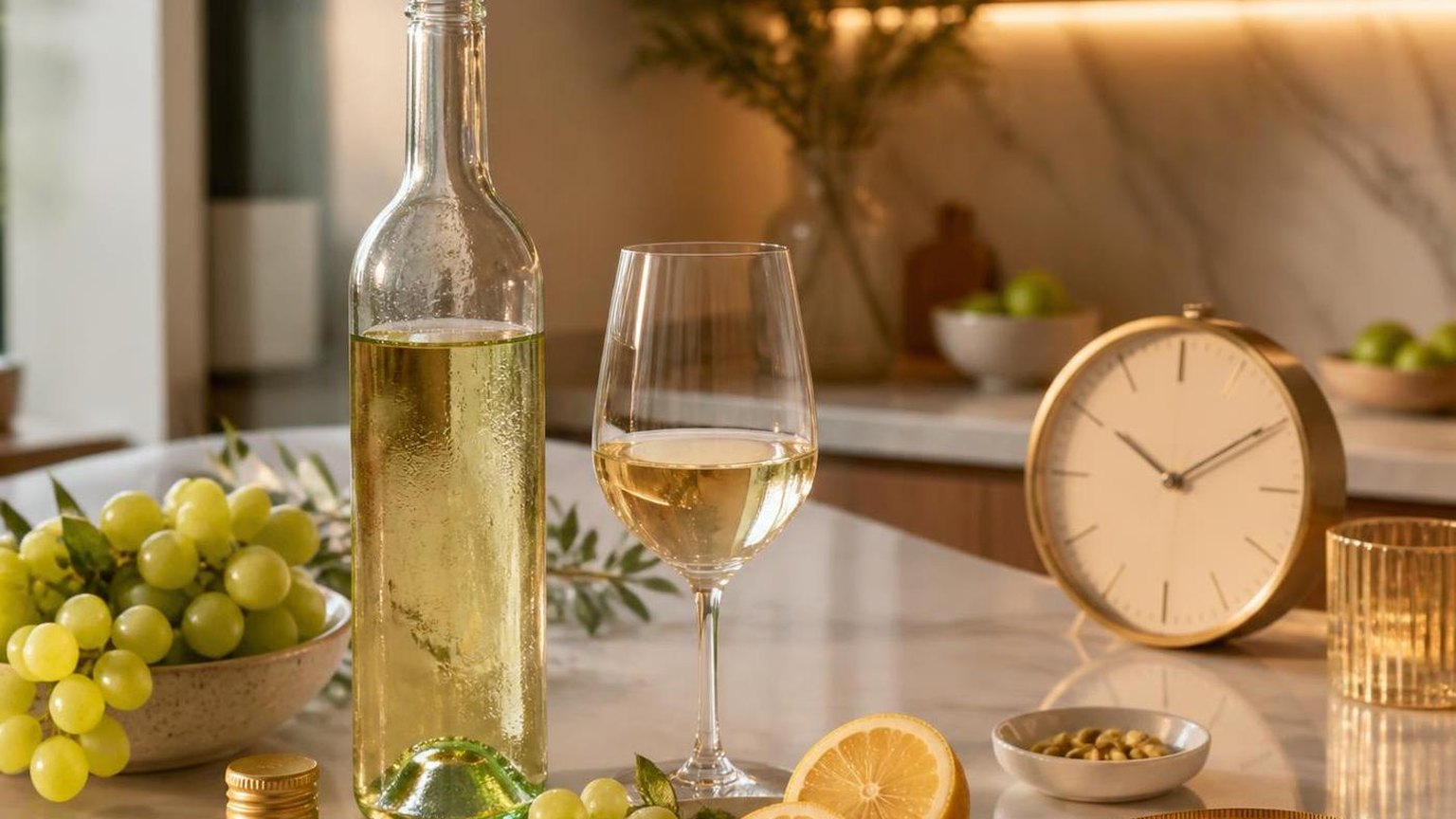
Day Test of Opened White Wine
We tested screw-top white wines over 7 days to see how long they stayed enjoyable after opening.
Our most consistent result: refrigerated, reclosed screw-top whites held up well for 3 to 5 days, but quality dropped faster once bottles were half empty or left at room temperature.
We opened 12 standard 750 ml bottles across three styles: Sauvignon Blanc, unoaked Chardonnay, and off-dry Riesling.
Each bottle was poured to a measured fill level, reclosed with its original screw cap, and tasted at 24-hour intervals by three team members.
| Test condition | Bottles tested | Storage temperature | Best drinking window we observed |
| Full bottle minus one 150 ml glass, screw cap tightened | 3 | 37°F refrigerator | 4 to 5 days |
| Half bottle remaining, screw cap tightened | 3 | 37°F refrigerator | 3 to 4 days |
| One-third bottle remaining, screw cap tightened | 3 | 37°F refrigerator | 2 to 3 days |
| Half bottle remaining, screw cap tightened | 3 | 70°F room temperature | 1 to 2 days |
We measured each pour with a 150 ml tasting beaker so the oxygen exposure was repeatable. After every tasting, we wiped the bottle threads, replaced the original Stelvin-style cap, and tightened it by hand until the cap stopped turning.
The biggest change was aroma, not color. By day 3, the Sauvignon Blanc samples lost grapefruit and cut-grass notes. By day 5, two of three had flatter aromas and a slight bruised-apple smell, though they were not spoiled.
Unoaked Chardonnay was the most forgiving in our trial. Refrigerated bottles with about 600 ml remaining still tasted clean on day 5, although acidity felt softer and the finish shortened by roughly half compared with day 1.
Riesling showed the most visible freshness advantage from residual sugar and acidity. The off-dry bottles were still pleasant on day 5 when refrigerated, but by day 7 they tasted muted, with honeyed notes replacing the fresher lime and peach flavors.
- Refrigeration mattered more than the screw cap itself; room-temperature bottles faded about twice as fast.
- Less wine in the bottle meant faster oxidation because the headspace was larger.
- The screw top sealed well when undamaged, but it did not stop oxygen already trapped inside the bottle.
- None of the refrigerated samples became unsafe to drink within 7 days, but several became dull or noticeably oxidized.
Based on our tastings, we would drink most opened screw-top white wines within 3 days for best flavor, 5 days if refrigerated and nearly full, and sooner if the bottle is less than half full.
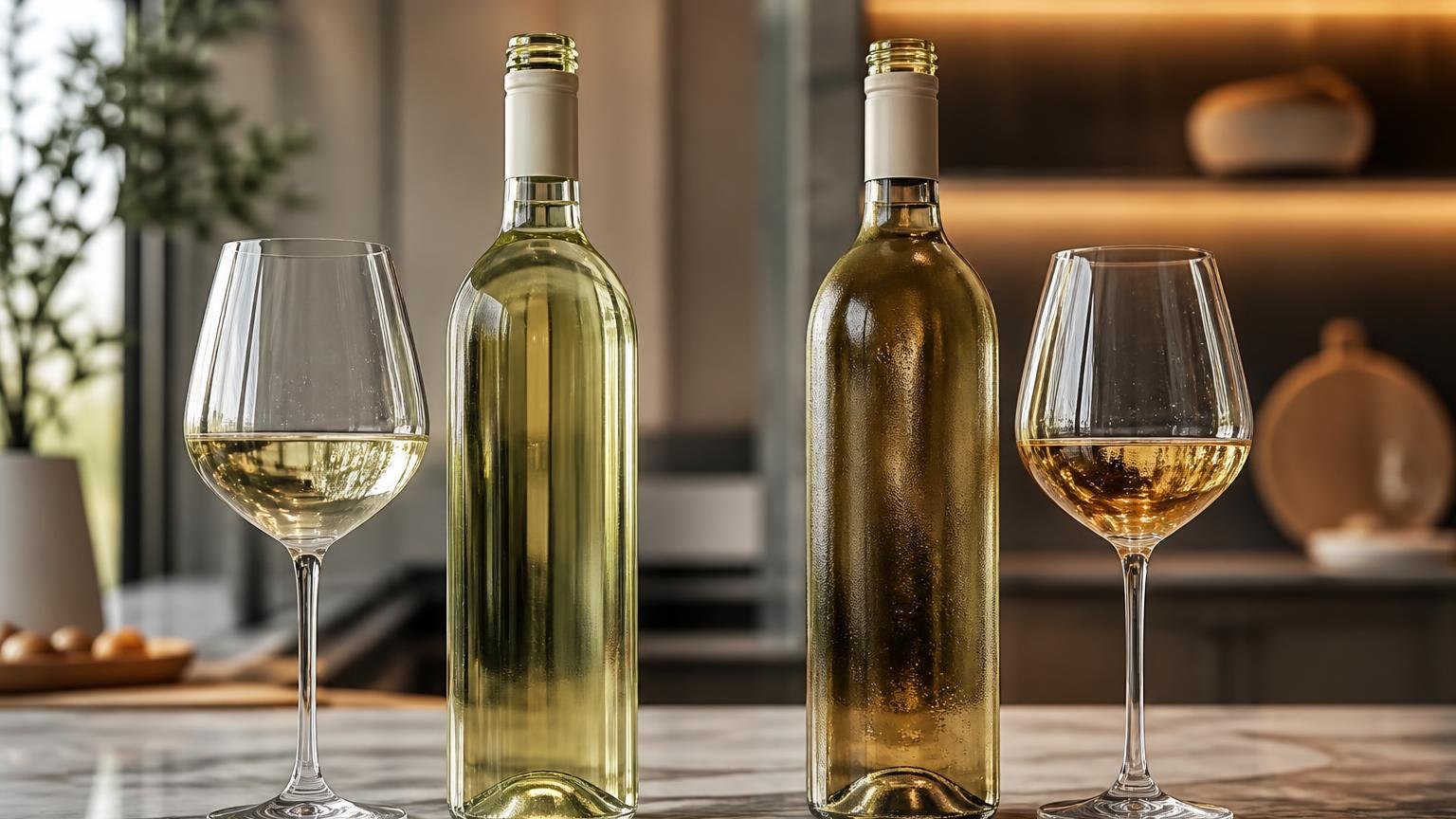
Mistakes About Screw-Top Wine Storage
Screw tops are excellent closures, but they do not make opened white wine “airtight forever.” Once opened, oxygen exposure, temperature, wine style, and fill level matter more than the cap itself.
In practice, most opened white wines are best within a few days, even when resealed tightly. The biggest mistakes are leaving bottles warm, half-empty, or assuming all whites age the same after opening.
Myth: A screw top keeps white wine fresh for weeks
A screw cap reseals better than a pushed-back cork, but it cannot remove oxygen already in the bottle. After opening, oxidation begins immediately, dulling fruit aromas and making the wine taste flat, bruised, or nutty.
| Opened white wine condition | Typical quality window | Why it changes |
| Light, dry white resealed and refrigerated | 3 to 5 days | Low tannin and delicate aromatics fade quickly |
| Full-bodied white resealed and refrigerated | 3 to 5 days | Oak and texture may hold, but fruit still oxidizes |
| Sweet white resealed and refrigerated | 5 to 7 days | Higher sugar can slow perceived spoilage |
| Opened white left at room temperature | 1 to 2 days | Heat accelerates oxidation and aroma loss |
Myth: If it smells fine, it is automatically fresh
Wine does not usually become dangerous in the way perishable foods do, because its alcohol and acidity discourage many pathogens. The issue is quality. A wine can be safe but no longer enjoyable, especially if fruit aromas have disappeared.
Myth: The fridge is optional for screw-top whites
Refrigeration is the simplest preservation tool. The USDA notes that refrigeration slows bacterial growth in perishable foods; for wine, the practical benefit is also slower chemical oxidation.
Store opened white wine around standard refrigerator temperature, about 40°F.
- Do not store it on the counter: A kitchen at 70°F will age an opened bottle much faster than a refrigerator.
- Do not leave excess headspace: A nearly empty 750 ml bottle has far more oxygen relative to wine volume than a full one.
- Do not rely on the cap alone: Tight resealing helps, but it does not reverse oxygen exposure.
- Do not judge by color only: Browning is a late sign. Muted aroma and flat flavor usually appear first.
Mistake: Treating all white wines the same
Sauvignon Blanc, Pinot Grigio, and Albariño often taste best within 3 days because their appeal depends on fresh acidity and aromatics. Rich Chardonnay may seem drinkable longer, but its citrus and apple notes still decline after opening.
For best results, recap the screw top immediately, refrigerate the bottle upright, and finish most dry white wines within 3 to 5 days. If the wine smells like bruised apple, wet cardboard, vinegar, or tastes dull, use it for cooking or discard it.
Questions People Ask Most
How long does opened white wine last with a screw top?
Most opened white wines last about 3 to 5 days in the refrigerator when reclosed tightly with the screw cap.
Light, crisp whites such as Pinot Grigio, Sauvignon Blanc, and unoaked Chardonnay are usually best within the first 3 days because their fresh acidity and fruit aromas fade quickly after oxygen exposure.
Does a screw top keep white wine fresh longer than a cork after opening?
A screw top usually reseals more reliably than putting a cork back in, because it creates a tighter and more consistent closure.
However, once the bottle has been opened, oxygen has already entered, so refrigeration and minimizing headspace matter more than the closure type after day 1.
Should opened screw-top white wine be refrigerated?
Yes, opened white wine should be refrigerated immediately, even if it has a screw cap.
Cold storage slows oxidation and microbial activity; the FDA recommends keeping refrigerated foods at 40°F or below, which is also a practical target for preserving opened wine.
How can you tell if opened white wine has gone bad?
Signs include a dull or brownish-yellow color, flat fruit aromas, sharp vinegar notes, bruised-apple smells, or a fizzy texture in a wine that was not sparkling.
If the wine smells unpleasant or tastes sour, oxidized, or vinegary, it is past its best and should not be served.
Can you drink screw-top white wine after a week?
You can taste it after a week if it was refrigerated and tightly reclosed, but most still white wines will be noticeably faded by then.
Fuller-bodied whites may remain drinkable for 5 to 7 days, while delicate aromatic whites are usually best discarded or used for cooking after about 5 days.
Related Reading
- How Long Does Prosecco Last Unopened?
- How Many Calories In A Bottle Of White Wine?
- How Many Calories in a Glass of White Wine? In-depth Answer
- What Does Moscato Taste Like? Answer By Expert
- What Does Pinot Grigio Taste Like? Get the Answer
- Does Red Wine Or White Wine Have More Calories?
- What Does Sauvignon Blanc Taste Like? Find Out Now
- All Alcohol Guides