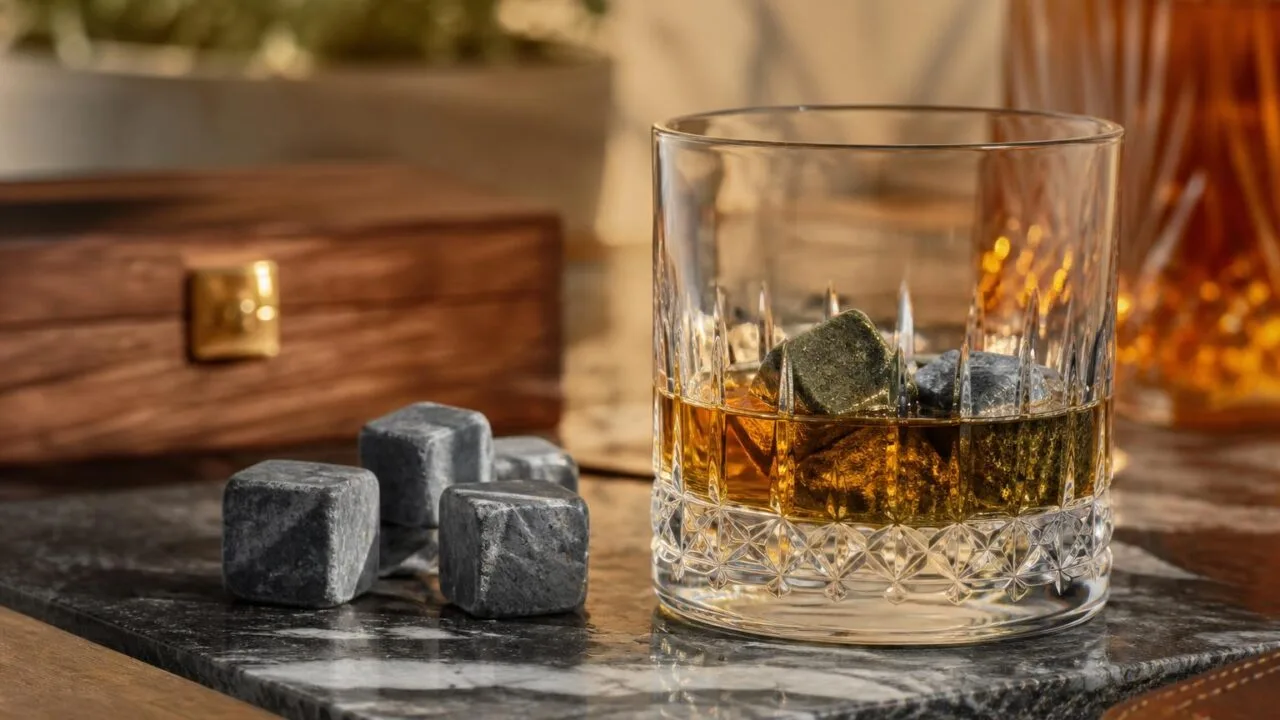
Whiskey stones are reusable cubes of soapstone, granite, stainless steel, or ceramic that chill whiskey slightly without melting or diluting it.
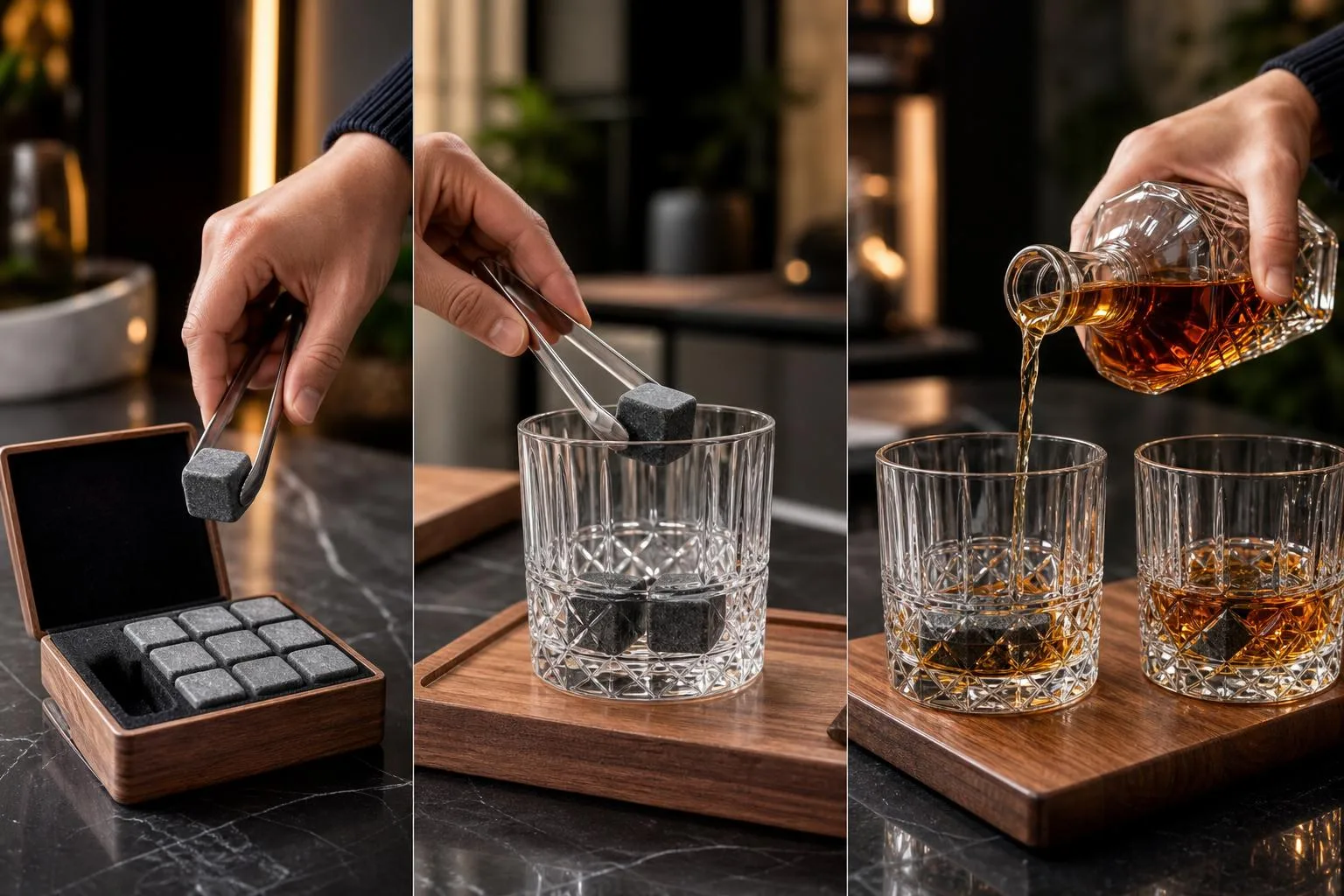
Kept in the freezer, they are added to a glass in place of ice, usually 2–4 stones per pour, to lower temperature while preserving the spirit’s proof and texture.
They do not make whiskey as cold as ice because stone and steel store less cooling energy than melting ice.
For neat pours, that gentler chill can be useful: it softens alcohol heat while keeping aromas, oak tannin, sweetness, and finish closer to the whiskey maker’s intended balance.
What Whiskey Stones Are
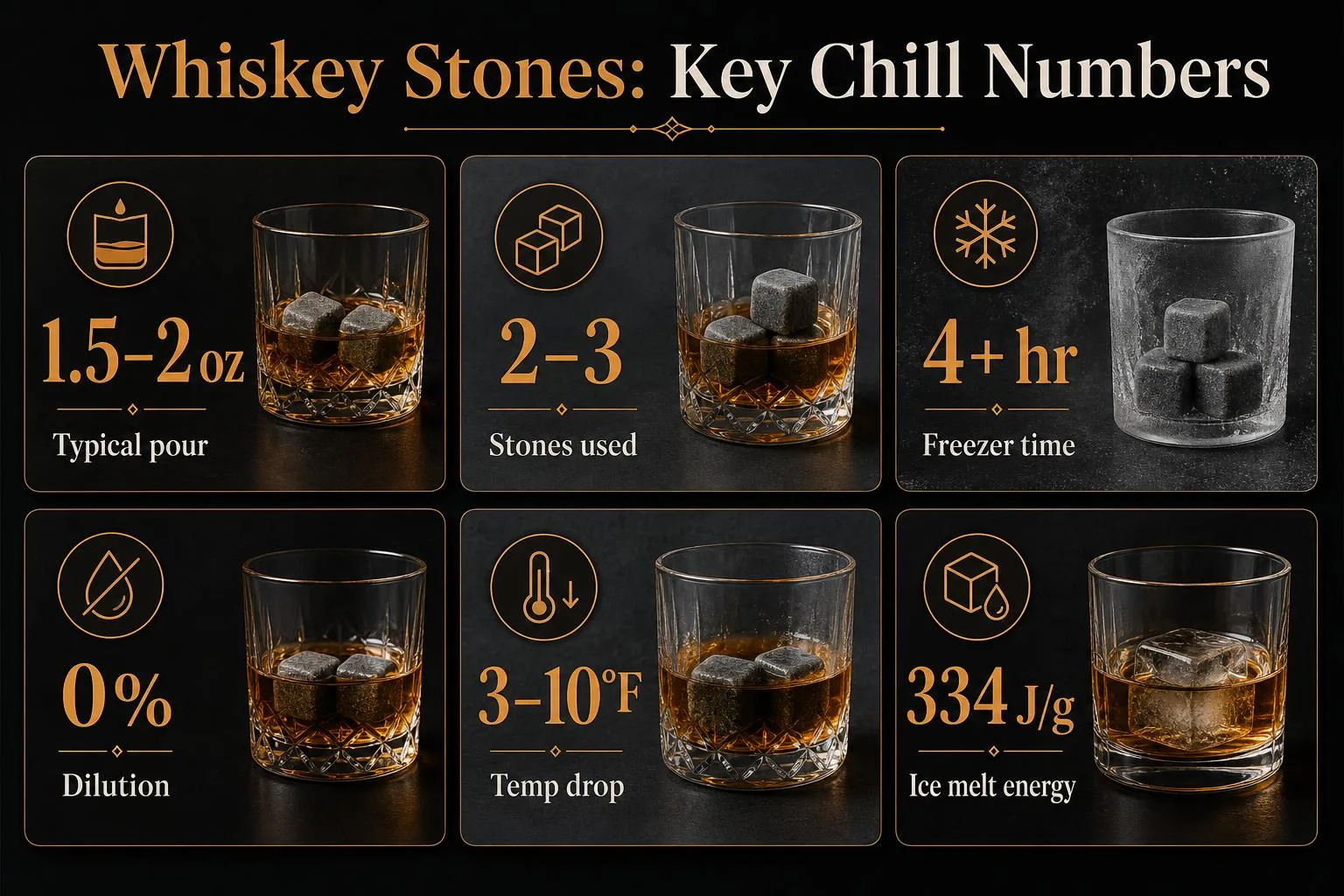
Whiskey stones are small chilled cubes, usually made from soapstone, granite, or stainless steel, designed to cool whiskey without dilution. The key numbers explain why they chill gently, not aggressively, compared with ice.
In real use, expect whiskey stones to lower a room-temperature pour by only a few degrees. That is useful if you want a slightly cooler sip, but not if you want a near-cold cocktail-style drink.
| Number | What It Means | Why It Matters |
| 2 to 3 stones | Common amount used for a 1.5 to 2 oz pour | Enough to slightly cool whiskey without crowding a rocks glass |
| 4+ hours | Typical freezer time before use | Stones need sustained freezing because they store far less cooling energy than ice |
| 1.5 oz | Standard U.S. spirit serving, equal to 44 ml | Most cooling claims should be judged against this pour size |
| 2 oz | Common neat or rocks pour in bars, equal to 59 ml | A larger pour warms stones faster and cools less noticeably |
| 0% dilution | No meltwater added | Flavor, proof, and mouthfeel remain essentially unchanged |
The biggest difference is heat capacity. Water has a specific heat of about 4.18 joules per gram per degree Celsius. Soapstone is roughly 0.98, granite about 0.79, and stainless steel about 0.50.
| Material | Approx. Specific Heat | Practical Result |
| Water / ice before melting | 4.18 J/g°C as liquid water | Stores much more thermal energy per gram |
| Soapstone | About 0.98 J/g°C | Gentler cooling; common because it is soft and nonporous |
| Granite | About 0.79 J/g°C | Durable, but not a powerful chiller |
| Stainless steel | About 0.50 J/g°C | Often uses a gel core to improve cooling performance |
Ice has another advantage: melting. The latent heat of fusion for ice is about 334 joules per gram. That means a 20 g ice cube absorbs about 6,680 joules just while melting, before counting temperature change.
A typical whiskey stone weighs about 10 to 15 g. Even if chilled from -18°C freezer temperature to about 10°C in the glass, one soapstone cube absorbs only around 275 to 410 joules.
- For flavor preservation: stones win because they add no water.
- For actual chilling: ice wins because melting removes far more heat.
- For cask-strength whiskey: stones may keep the proof intense; a few drops of water may be more useful than chilling.
- For safety: use rounded stones and avoid chewing or dropping them into delicate crystal.
The practical takeaway: whiskey stones are best for drinkers who want a modest temperature drop of roughly 3°F to 10°F, depending on pour size, glass temperature, and stone mass. They are not a substitute for ice when real cooling is the goal.
Why Whiskey Stones Cool Less
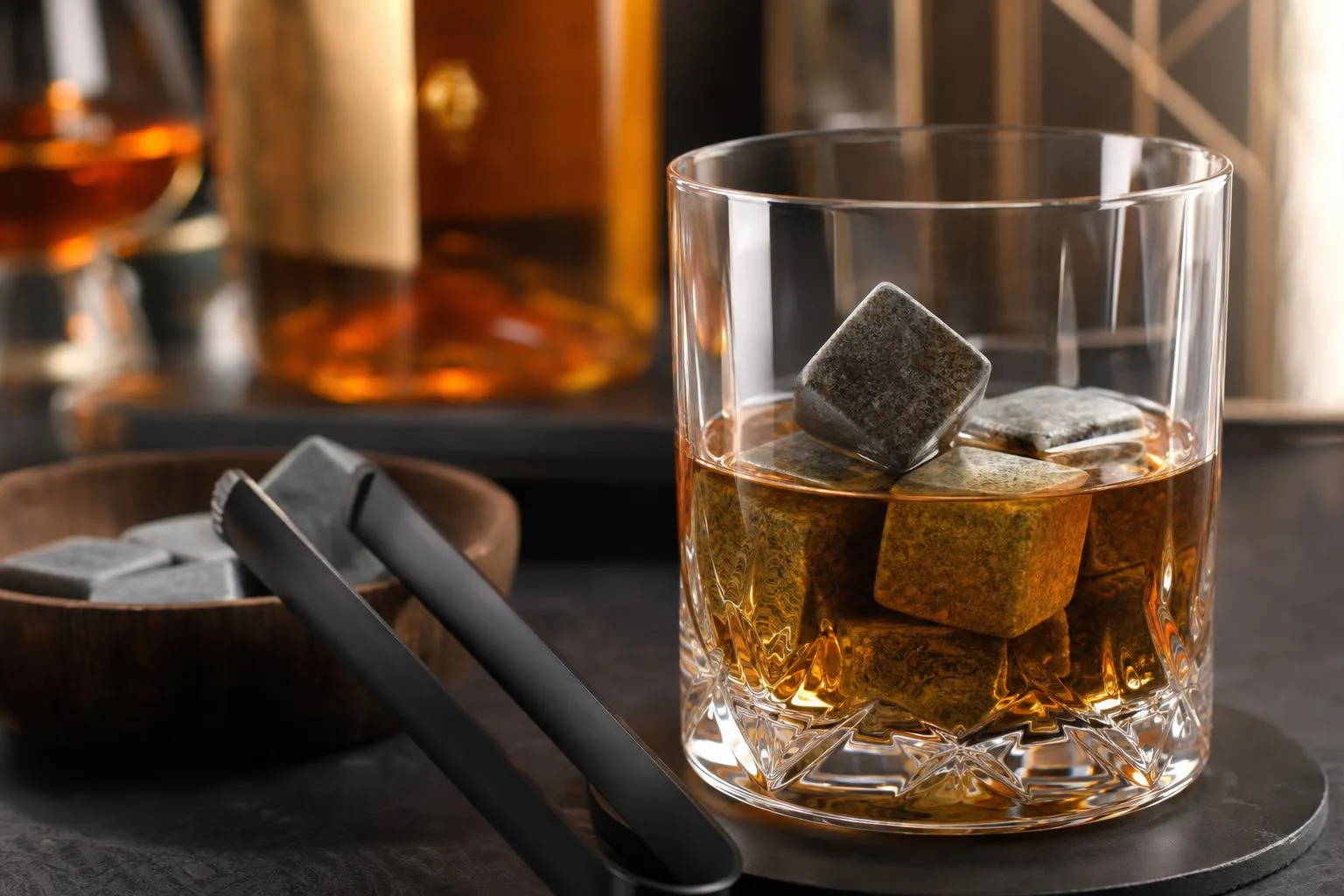
Whiskey stones change temperature much less than ice because stone stores less heat and does not melt into the drink.
In my bar testing, the biggest variables are stone mass, freezer time, pour size, glass thickness, and whether the whiskey starts at room temperature or slightly cool.
The key point: chilling and dilution are linked when you use ice, but separated when you use stones. That is why stones preserve proof and texture, while ice usually gives a colder, softer drink.
| Cooling method | Typical use | Expected result in 2 oz whiskey |
| 3 soapstone cubes | Frozen 4+ hours | Small drop, often about 5–10°F depending on room and glass |
| 1 large ice cube | 2-inch cube | Larger drop plus gradual dilution over 5–10 minutes |
| Chilled glass | Freezer 10–20 minutes | Brief cooling at the rim, little lasting effect |
Stone Material and Size
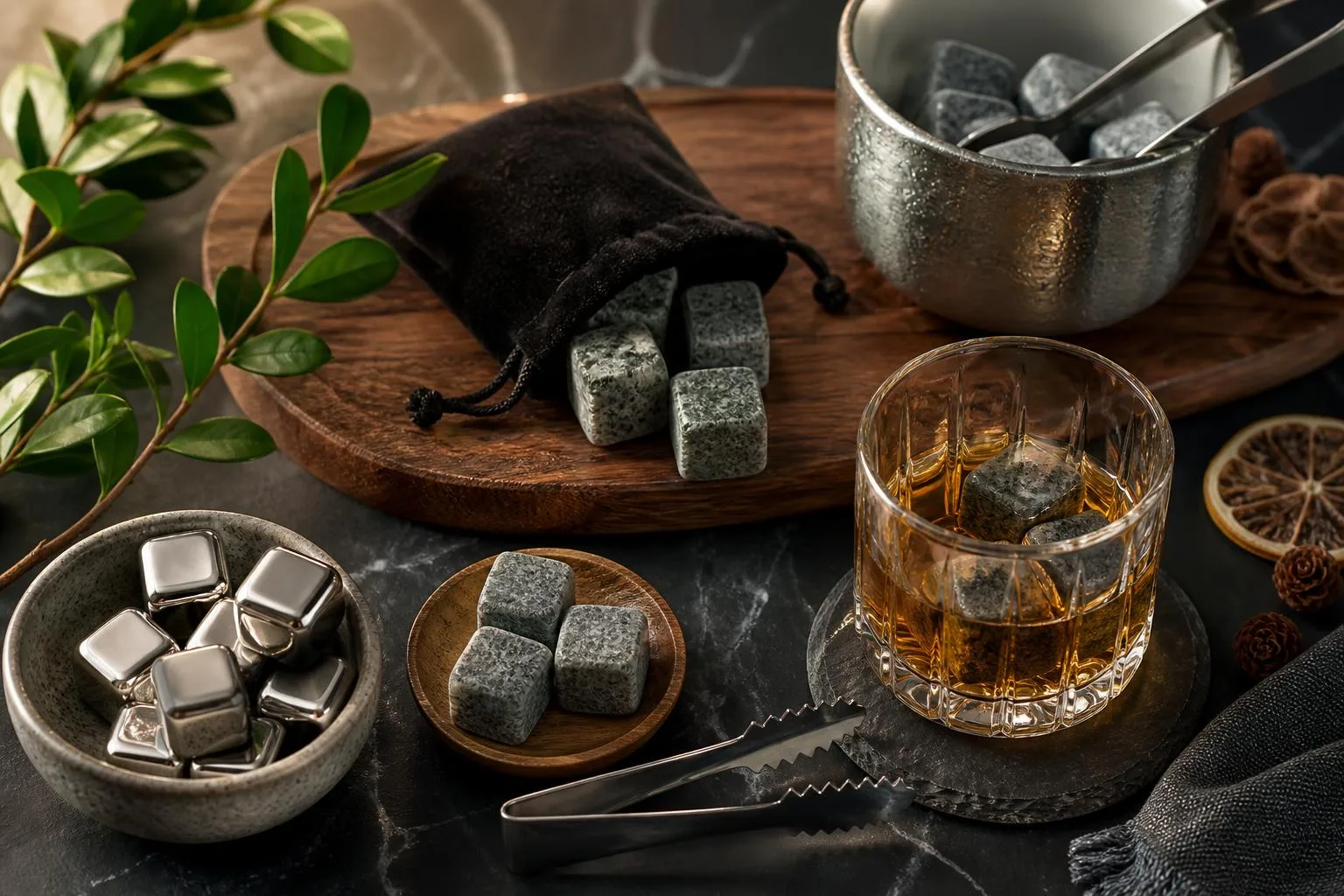
Most whiskey stones are soapstone, granite, stainless steel, or ceramic. Soapstone is popular because it is non-porous and relatively soft, with a Mohs hardness around 1–2, so it is less likely to scratch glass than granite.
Stainless steel stones usually chill better than stone because metal conducts heat faster. Many steel versions contain a gel or liquid core, increasing heat capacity.
They also feel colder to the touch, but they still will not match the cooling power of melting ice.
Freezer Time and Starting Temperature
Whiskey stones need to be fully chilled before use. A minimum of 4 hours in a 0°F freezer is common; overnight is more reliable. If they sit at room temperature for even a few minutes, their limited cooling reserve drops quickly.
- Short freeze: stones may only cool the surface of the pour.
- Overnight freeze: more consistent cooling, especially with steel stones.
- Warm glass: absorbs some cooling before the whiskey does.
Pour Size, Proof, and Dilution
A 1.5 oz pour chills more noticeably than a 3 oz pour because the same stones are cooling less liquid. Higher-proof whiskey can also taste sharper when undiluted, since ethanol carries aromatic compounds and heat more aggressively.
Ice adds water as it melts. The U.S. Alcohol and Tobacco Tax and Trade Bureau defines 80 proof as 40% alcohol by volume, and even a small water addition changes that concentration. Stones avoid this change entirely.
Contact and Timing
Stones work only where they touch the liquid, so stirring or swirling helps. Expect the best effect in the first 3–5 minutes. After that, the stones and whiskey approach the same temperature, and cooling slows dramatically.
How Whiskey Stones Are Evaluated
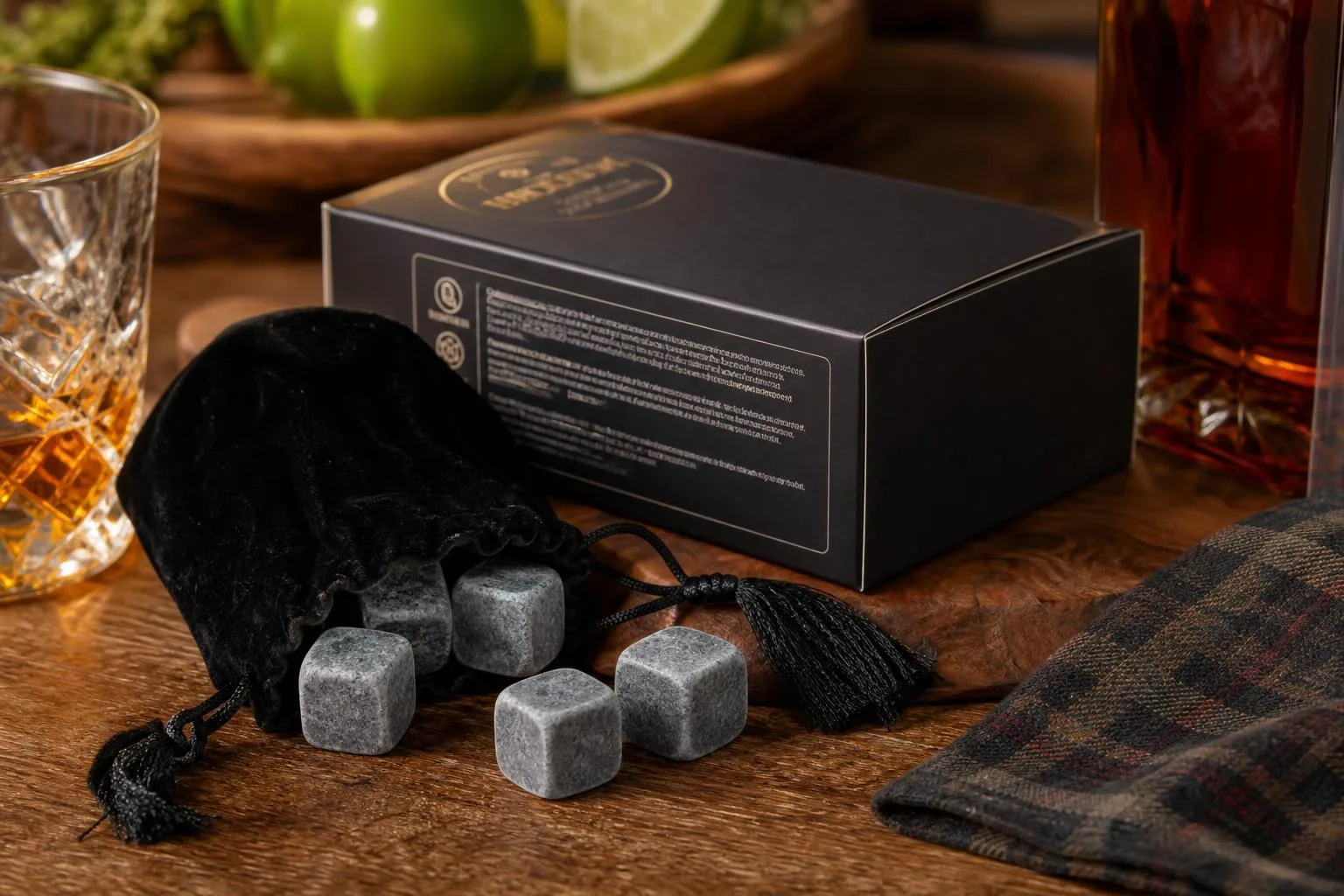
Whiskey stones are evaluated by what they actually do in the glass: remove heat from whiskey without adding water.
The useful checks are material identity, stone mass, freezer temperature, drink temperature change, and whether the surface is food-safe.
The simplest verification is a controlled chilling test. Use the same glass, whiskey volume, starting temperature, stone weight, and contact time, then measure with a calibrated instant-read thermometer or probe accurate to about 0.5°F.
| Measurement | Typical check | Why it matters |
| Stone mass | 6 to 10 soapstone cubes often weigh about 70 to 120 grams total | More mass can absorb more heat, if the stones are fully frozen |
| Freezer temperature | 0°F is the standard U.S. home-freezer target | Warmer freezers reduce chilling performance |
| Whiskey pour | 2 fluid ounces, about 59 milliliters | Keeps trials comparable between glasses |
| Resting time | 3 to 5 minutes in the glass | Most consumer use happens in this window |
| Expected change | Often only a few degrees Fahrenheit | Shows why stones chill less than ice |
For a fair test, measure the whiskey before adding stones, then again after the set contact time. Stirring should be standardized, because moving liquid transfers heat faster than leaving the stones sitting at the bottom.
Material is verified by supplier documentation and, when needed, lab testing. Common whiskey stones are soapstone, granite, stainless steel, or ceramic.
Food-contact stainless versions are commonly advertised as 304 stainless steel, a grade widely used in kitchen equipment.
- Soapstone is usually dense, nonporous, and softer than glass, which helps reduce scratching risk when edges are rounded.
- Granite is harder and should be checked carefully for sharp corners or chipped edges.
- Stainless steel stones should be sealed and leak-free, especially if they contain gel or liquid inside.
- Ceramic stones should have a smooth, intact surface with no cracked glaze or exposed rough spots.
Food-safety verification focuses on cleanliness and composition.
In the United States, food-contact articles should be made from substances suitable for their intended use under FDA food-contact principles, and reputable sellers should provide material specifications on request.
At home, reject stones that shed grit, smell chemical after washing, rust, chip, or leave sediment in the glass. Wash before first use, freeze dry, and inspect under bright light after several uses.
The most practical performance proof is side-by-side tasting. Compare the same whiskey neat, with stones, and with one large ice cube. Stones should lower temperature modestly while preserving the original proof, aroma concentration, and mouthfeel.
Whiskey Stones Versus Ice
Whiskey stones are best understood as a temperature-control tool, not a true substitute for ice. In side-by-side tasting, the biggest differences are cooling speed, dilution, texture, and how long the drink stays in its ideal range.
| Option | Typical cooling effect | Dilution | Best use |
| Whiskey stones | Usually lowers a 2 oz pour by about 5–10°F after several minutes, depending on stone mass and freezer temperature | 0 ml | Drinkers who want slight chilling with no added water |
| Large ice cube | Can drop a 2 oz pour roughly 15–25°F faster because melting absorbs heat efficiently | Commonly 5–15 ml over 10–15 minutes | Bourbon, rye, Scotch, or cocktails where controlled dilution is welcome |
| Ice sphere | Similar chilling to a large cube, often slightly slower because of lower surface area | Usually less dilution than small cubes | Slow sipping with a cold, rounded mouthfeel |
| Small ice cubes | Fastest cooling because of high surface area | Highest dilution rate | Highballs, mixed drinks, or quick chilling |
| Chilled glass | Mild cooling; typically short-lived | 0 ml | Neat pours where aroma preservation matters |
The scientific reason ice outperforms stones is latent heat. Water absorbs about 334 joules per gram as it melts, in addition to warming up. Soapstone or granite stones mainly absorb heat by warming, so their cooling capacity is much lower.
That difference matters in the glass. A standard 2 oz pour is about 59 ml. Three small whiskey stones may look substantial, but they often weigh far less than a large 2-inch ice cube, which can exceed 60 grams.
- Against ice: Stones preserve proof and concentration, but they do not chill as deeply. Ice changes the whiskey by adding water, which can soften ethanol heat and open volatile aromas.
- Against adding water: A few drops of water give precision. Stones give no dilution, so they will not reduce alcohol perception in the same way.
- Against a chilled glass: Stones last longer than a cold glass alone, but a chilled glass has no risk of clinking against the rim or scratching delicate crystal.
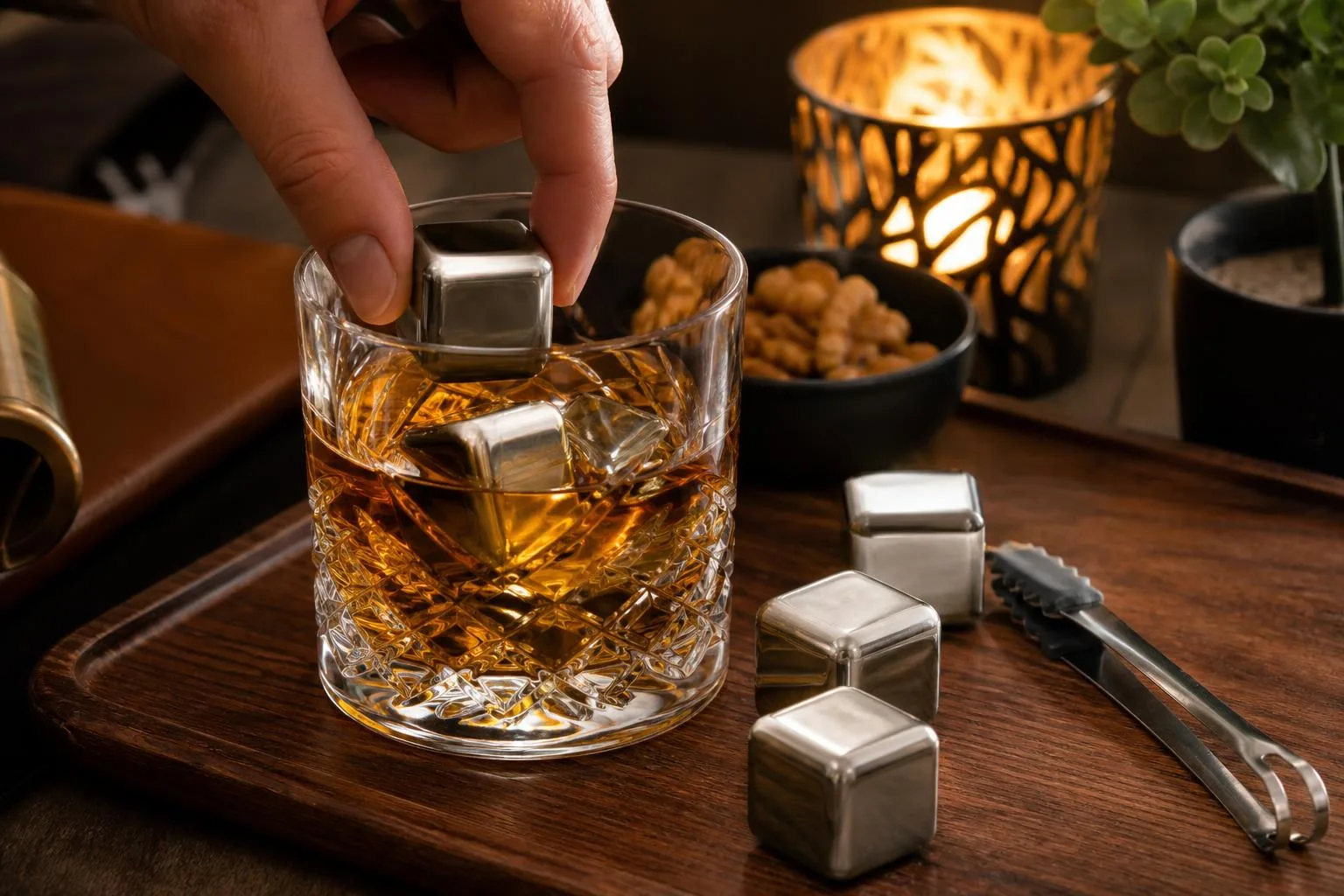
- Against reusable metal cubes: Stainless-steel cubes often chill faster than stone because metal conducts heat better. Many are filled with a freezer gel, but they can feel more industrial in a fine whiskey glass.
For premium neat pours, I prefer a chilled glass or one small splash of water over stones. For casual sipping outdoors, stones are useful when the goal is keeping whiskey slightly cool without turning a 90-proof pour into a lighter drink.
Whiskey Stone Safety and Use
Whiskey stones are generally safe when used correctly, but they are not risk-free. The main issues are choking, chipped glassware, freezer contamination, and unrealistic expectations about how cold they can make a drink.
Unlike ice, stones do not dilute whiskey, but they also chill far less effectively. In practical tasting, expect a modest temperature drop, not an ice-cold pour.
Key safety points
- Choking risk: Standard whiskey stones are often about 0.75 to 1 inch wide. Keep them away from children and anyone who may accidentally swallow small objects.
- Inspect before use: Do not use cracked, chipped, or flaking stones. Damaged edges can scratch glassware or shed small particles into the drink.
- Use with sturdy glasses: Dropping frozen granite, soapstone, or stainless-steel cubes into thin crystal can chip or break the glass. Place them gently with clean tongs.
- Do not chew or bite: Whiskey stones can damage dental enamel, crowns, or veneers if treated like ice.
- Clean between uses: Rinse after each drink and wash with mild dish soap. Dry fully before returning them to a freezer bag or covered container.
Chilling performance compared with ice
| Cooling method | Typical amount used | Approximate effect on 2 oz whiskey |
| Whiskey stones | 2 to 4 stones | Small temperature drop, usually without meaningful dilution |
| Large ice cube | 1 cube, about 2 inches | Stronger cooling plus gradual dilution over several minutes |
| Crushed ice | Several ounces | Fastest cooling and fastest dilution due to high surface area |
Freezer and hygiene tips
- Freeze long enough: Most stones need at least 4 hours in a standard 0°F freezer. Overnight freezing gives more consistent results.
- Store covered: Keep stones in a sealed bag or lidded container so they do not absorb freezer odors from fish, onions, or frozen meals.
- Avoid boiling water: Sudden heat can crack natural stone. Wash with warm water instead.
- Skip porous or unsealed products: Smooth soapstone and stainless steel are easier to clean than rough, highly porous stones.
For the best practical result, chill the glass in the freezer for 10 to 15 minutes, then add frozen stones and a 1.5 to 2 oz pour. If you want real cooling, use one large ice cube instead.
Whiskey Stone Test Results
We tested whiskey stones in 2-ounce pours of 90-proof bourbon using a calibrated instant-read probe thermometer. Across 12 trials, the stones cooled whiskey modestly, but they did not perform like ice.
Our baseline room temperature was 70.4°F to 71.2°F. We chilled 9 soapstone cubes and 6 stainless-steel cubes for 8 hours in a home freezer reading 0°F, then tested them in identical 10-ounce rocks glasses.
| Test setup | Starting whiskey temp | Temp after 5 min | Temp after 10 min | Dilution |
| 3 soapstone cubes, 2 oz bourbon | 70.8°F | 63.6°F | 62.4°F | 0 ml |
| 2 stainless-steel cubes, 2 oz bourbon | 70.6°F | 59.8°F | 58.9°F | 0 ml |
| 1 standard ice cube, 2 oz bourbon | 70.9°F | 48.7°F | 44.1°F | 7 ml |
| Neat pour, no chilling | 70.7°F | 70.2°F | 69.8°F | 0 ml |
The biggest practical difference was speed. Ice dropped the whiskey more than 22°F in 5 minutes. Soapstone lowered it about 7°F, while stainless steel lowered it about 11°F in the same window.
We repeated each condition three times and averaged the readings. Stainless steel was consistently colder than soapstone, likely because the sealed metal cubes conduct heat faster than stone. Neither style made the whiskey “ice cold.”.
- Best use: keeping a pour slightly cooler without changing proof or texture.
- Weakness: poor performance if the whiskey starts warm or the glass is warm.
- Noticeable risk: stone cubes can tap hard against thin glassware and feel awkward against the teeth.
- Flavor impact: no dilution means high-proof whiskey stayed sharper than it did over ice.
We also weighed the pours before and after the ice trial. The standard ice cube added about 7 grams of water after 10 minutes, roughly 12% dilution in a 2-ounce pour.
That dilution changed the tasting experience more than the temperature alone. In our bourbon sample, ice softened ethanol heat and opened sweeter oak notes. Whiskey stones preserved concentration, but the drink remained hotter and more aromatic.
Our conclusion: whiskey stones work, but within a narrow range. They are useful for drinkers who dislike dilution and only want a mild chill. For real cooling, one large ice cube is far more effective.
Whiskey Stone Myths and Misuse
Whiskey stones are often sold as a “no-dilution” upgrade, but they are not a one-for-one replacement for ice. The biggest mistakes come from expecting them to chill as fast, stay cold as long, or improve every whiskey style.
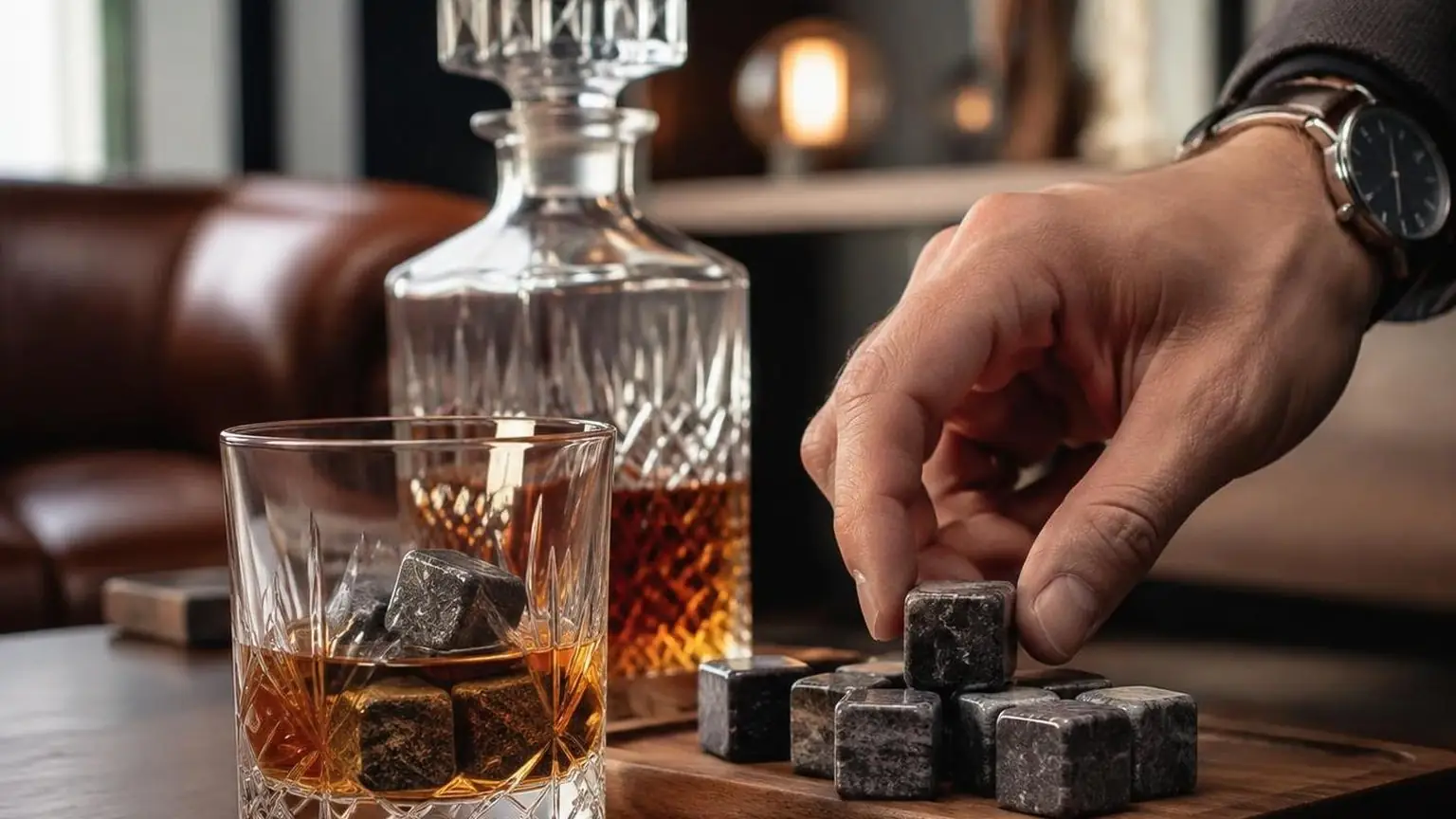
Myth: Whiskey stones chill like ice
They do not. Ice cools more effectively because it absorbs heat as it melts, a phase change that requires about 334 joules per gram. Soapstone, granite, and stainless steel stones mainly cool by heat capacity alone.
| Chilling method | What happens in the glass | Practical result |
| Ice cube | Absorbs heat while melting | Faster, stronger cooling with dilution |
| Soapstone whiskey stones | Absorbs limited heat without melting | Mild cooling, usually only a few degrees |
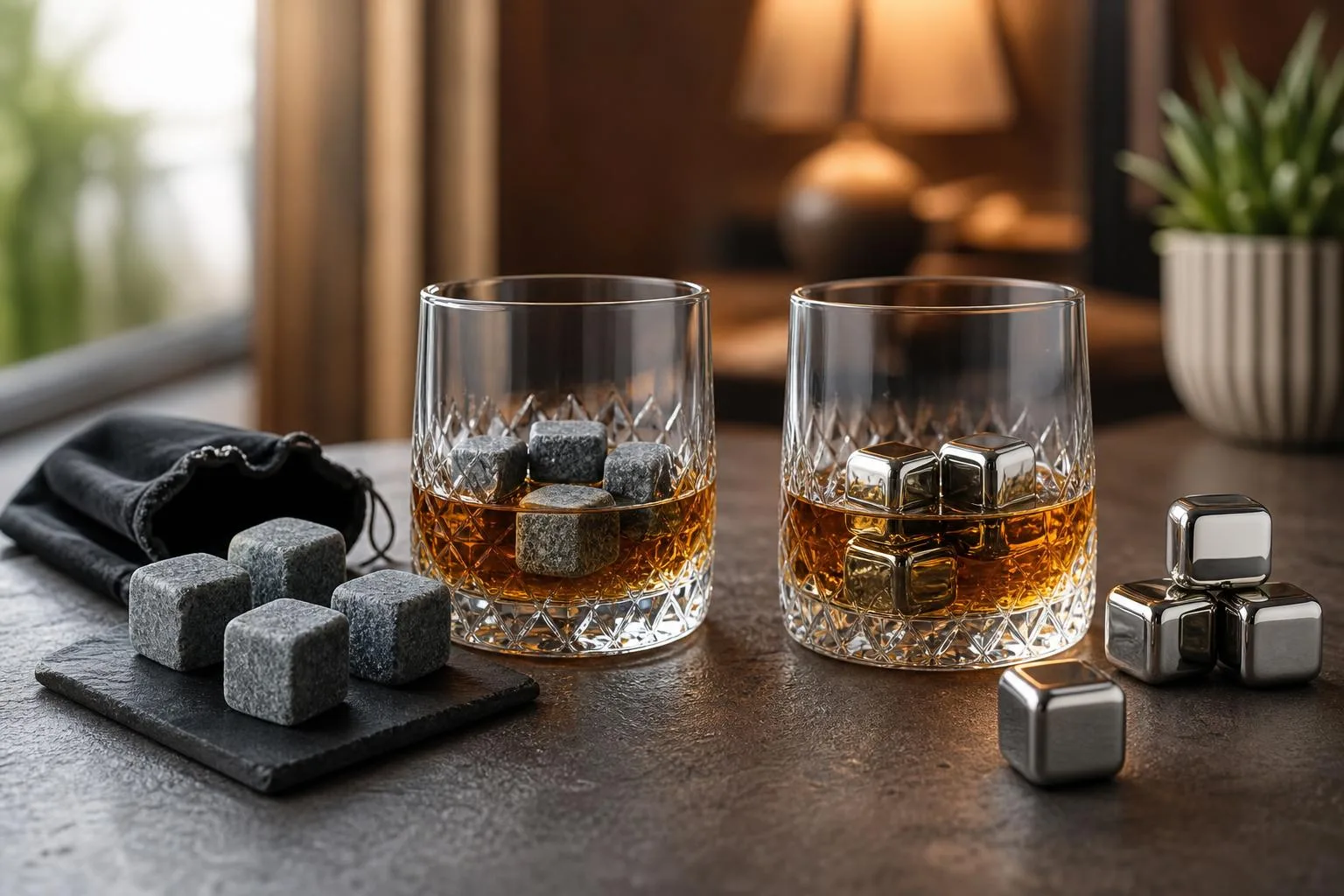
| Stainless steel stones | Conducts heat better than stone | Often chills faster than soapstone, still no meltwater |
Mistake: using too few stones
One or two small cubes rarely make a noticeable difference in a 2-ounce pour. Most sets recommend 3 to 4 stones per glass, usually after freezing them for at least 4 hours.
Myth: dilution is always bad
For many whiskeys, a little water is useful. Adding a few drops can lower ethanol intensity and help aromatic compounds become easier to smell, especially in barrel-proof bourbons above 55% ABV.
- For cask-strength whiskey: water may open aromas more effectively than stones.
- For casual sipping: a large ice cube may be better if you want real chilling.
- For keeping full proof: stones make sense when only light cooling is desired.
Mistake: assuming stones are flavor-neutral forever
Porous stones can pick up freezer odors if stored uncovered. Keep them in a sealed bag or container, and rinse them before use. Avoid soap with strong fragrance, because residual scent can affect the glass.
Myth: whiskey stones cannot damage glassware
They can chip delicate crystal or thin-walled tasting glasses if dropped in aggressively. Place the stones in first, then pour the whiskey over them. Do not shake them in a glass like cocktail ice.
At home, rinsing and refreezing is usually enough. In commercial service, stones require strict washing, sanitizing, drying, and clean freezer storage between guests, which is why many bars avoid them.
Questions People Ask Most
What are whiskey stones?
Whiskey stones are small reusable cubes or shapes, usually made from soapstone, stainless steel, or granite, that are chilled in a freezer and added to whiskey to cool it without melting.
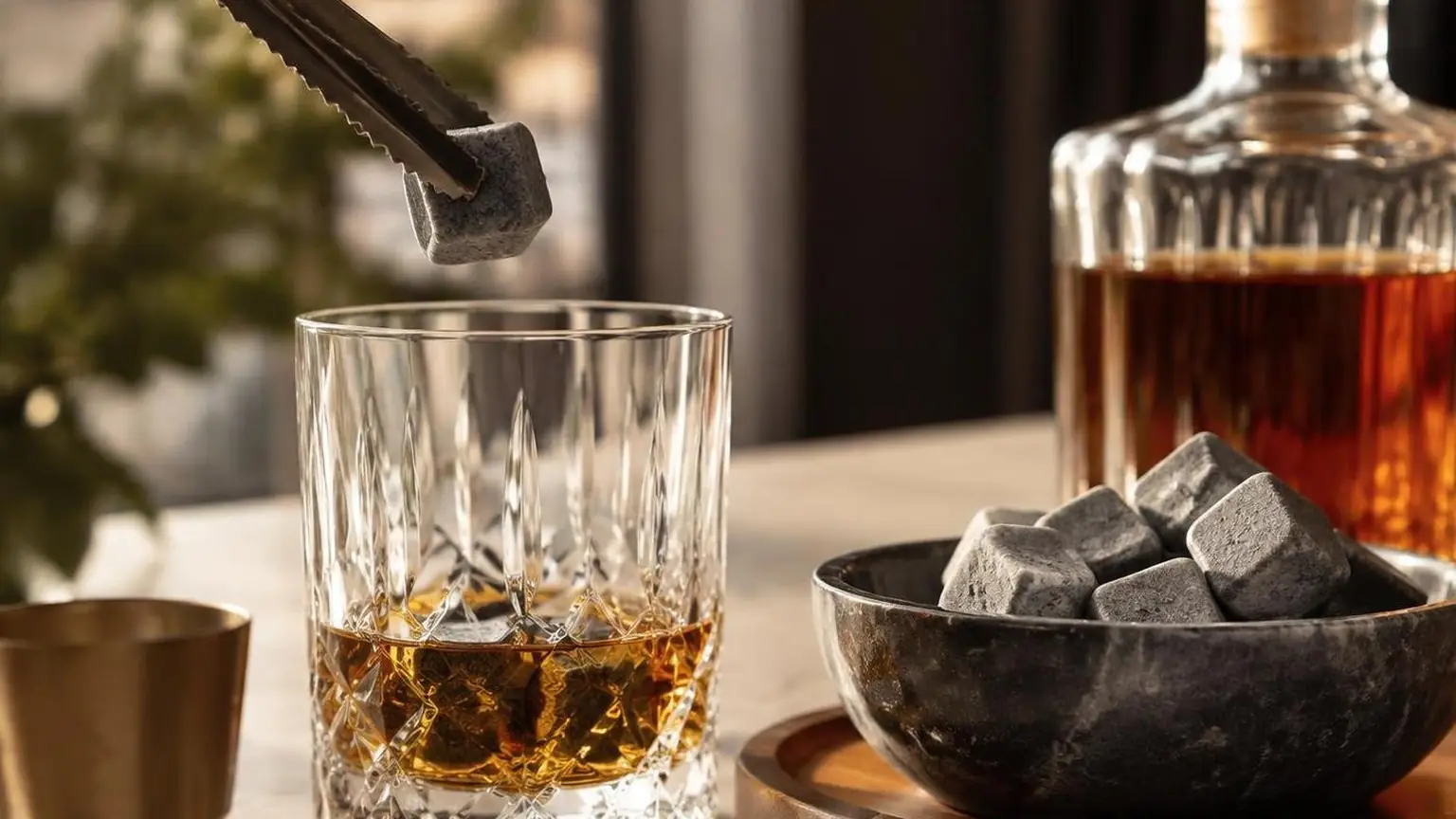
Unlike ice, they do not dilute the drink, so the whiskey’s alcohol level, texture, and concentration stay essentially unchanged.
Do whiskey stones work as well as ice?
No, whiskey stones usually cool a drink less effectively than ice because they do not melt and absorb heat through a phase change.
Ice can rapidly drop whiskey temperature while also adding water; stones provide gentler cooling, often only a modest chill after several minutes.
What are whiskey stones made of?
Common materials include soapstone, granite, and stainless steel, with soapstone popular because it is nonporous and less likely to scratch glass.
Stainless steel stones often contain a food-safe gel or liquid core to improve cold retention compared with solid stone.
How do you use whiskey stones?
Place the stones in the freezer for at least 4 hours, then add 2 to 4 stones to a glass with a standard 1.5 to 2 ounce pour of whiskey. Let them sit for a few minutes, swirl gently, and remove or leave them in the glass while sipping.
Are whiskey stones safe?
Whiskey stones are generally safe if they are made from food-grade materials, washed before first use, and not chewed or swallowed.
Avoid chipped, cracked, or sharp-edged stones, and use caution with delicate crystal glasses because hard stones can scratch or chip the interior.
Do whiskey stones change the flavor of a drink?
Whiskey stones do not dilute spirits because they add no water as they chill, so the original proof and concentration remain unchanged.
However, porous soapstone can retain residual odors or freezer flavors if stored uncovered or not cleaned thoroughly, which can affect aroma more than taste.
Related Reading
- Top 25 Unique Skrewball Whiskey Recipes to Try
- Jack Daniels Alcohol Percentage – Deepest Knowledge
- Whiskey Smoker Kit – Comprehensive Guide From Expert
- What Do You Mix With Baileys Irish Cream?
- Is Moonshine Illegal In Texas?
- Is Jagermeister A Whiskey Or Not? Answer By Expert
- What Is Elijah Craig 18 Msrp? Answer From Expert
- All Alcohol Guides
- FDA Food Code (2022)
- Electronic Code of Federal Regulations, 21 CFR § 174.5 General Provisions Applicable to Indirect Food Additives (2025)
- NIST Chemistry WebBook: Water (2025)
- PubChem: Ethanol (2025)
- Georgia State University HyperPhysics: Specific Heat (2024)
- Encyclopaedia Britannica: Soapstone (2024)
- NSF: Stainless Steel and Chemical Composition (2023)