How Long Does It Take for Tequila to Kick In? is 10–30 minutes for most adults, with faster effects on an empty stomach and slower effects after food.
Absorption starts in the stomach but mainly happens in the small intestine, where alcohol enters the bloodstream and reaches the brain.
A standard 1.5-ounce shot of 40% ABV tequila contains about 14 grams of pure alcohol, the U.S. standard drink amount.
Body weight, sex, drinking speed, hydration, medications, and tolerance change timing and intensity, so “feeling it” can arrive before blood alcohol concentration peaks.
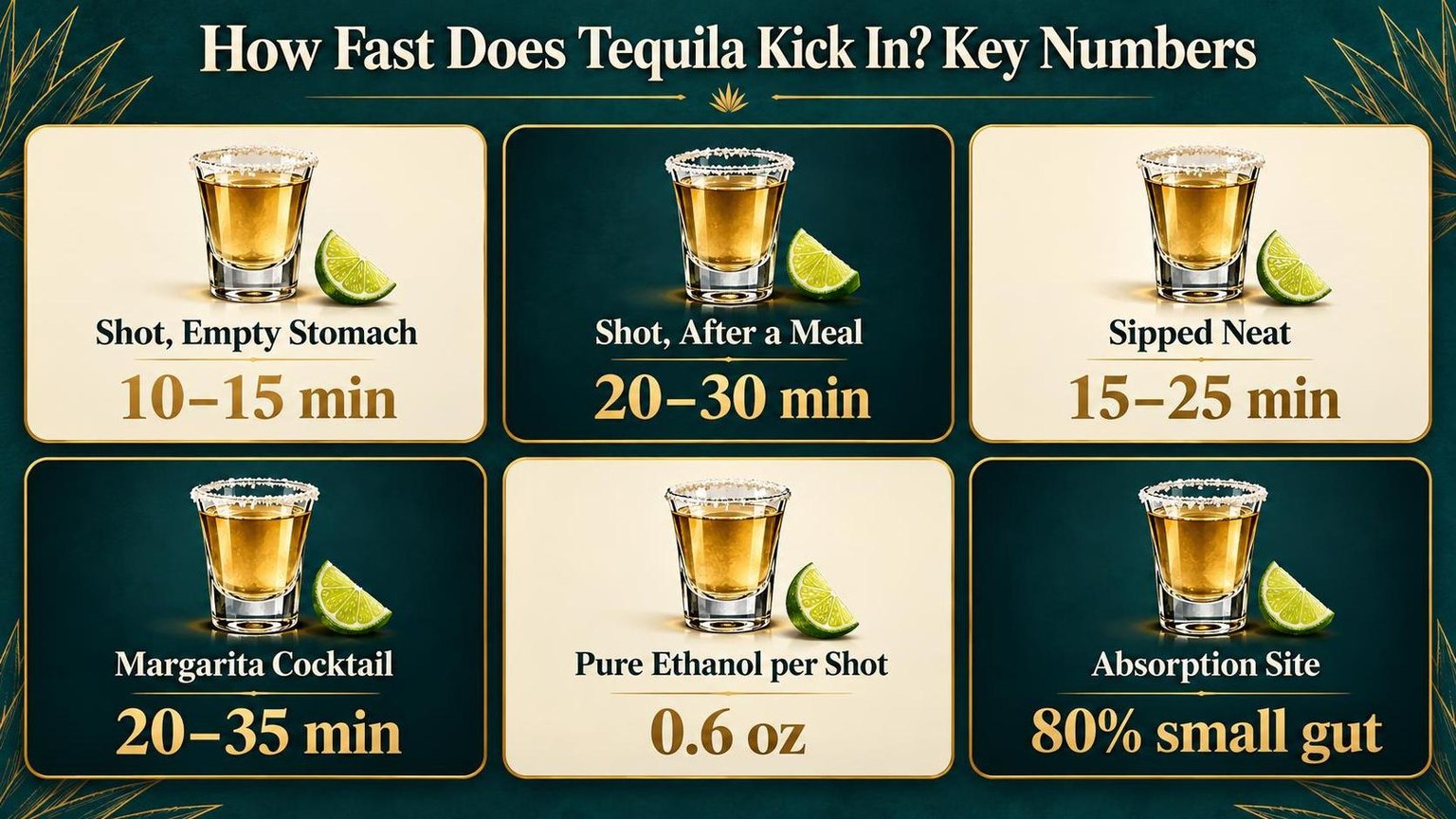
Tequila Onset Time in Minutes
Tequila typically produces noticeable effects within 15 to 45 minutes of consumption. The exact onset depends on whether you drink it as a shot, sip it neat, or mix it in a cocktail—each method changes how fast alcohol reaches your bloodstream.
A standard tequila shot (1.5 oz at 40% ABV) delivers approximately 0.6 oz of pure ethanol. On an empty stomach, blood alcohol concentration (BAC) begins rising within 10 minutes of ingestion.
| Drinking Method | First Effects Felt | Peak BAC Reached |
| Single shot (empty stomach) | 10–15 minutes | 30–45 minutes |
| Single shot (after a meal) | 20–30 minutes | 60–90 minutes |
| Sipped neat or on the rocks | 15–25 minutes | 45–60 minutes |
| Tequila cocktail (e.g., margarita) | 20–35 minutes | 60–90 minutes |
Why the Range Varies
Stomach contents are the single largest variable. A 2006 study in the British Medical Journal confirmed that food in the stomach can delay peak BAC by up to 50% compared to fasting conditions.
Body weight directly influences onset speed. A 130-lb person will reach a higher BAC faster than a 200-lb person consuming the same 1.5-oz shot, because alcohol distributes through less total body water.
- Body composition: Higher muscle mass contains more water, diluting alcohol and slowing perceived onset.
- Biological sex: Women generally have lower levels of alcohol dehydrogenase, leading to faster BAC elevation from the same dose.
- Tolerance: Regular drinkers may not “feel” effects as quickly, though BAC rises at the same rate regardless.
- Carbonated mixers: Sparkling mixers like tonic water accelerate gastric emptying, pushing alcohol into the small intestine faster.
The 20-Minute Rule
Most adults drinking a single tequila shot on a moderately full stomach will notice initial warmth, slight relaxation, and mild cognitive changes around the 20-minute mark. BAC peaks closer to 60 minutes in this scenario.
Waiting at least 20 minutes between shots allows you to gauge your actual impairment before consuming more—a practical guideline endorsed by the National Institute on Alcohol Abuse and Alcoholism (NIAAA).
Why Shots Hit Faster
A standard tequila shot (1.5 oz at 40% ABV) delivers 0.6 oz of pure alcohol in a single swallow.
That concentrated bolus bypasses the gradual absorption curve of sipped drinks, producing measurable blood-alcohol spikes within 10–15 minutes on an empty stomach.
Speed of Consumption Is the Key Variable
Drinking rate directly controls how fast alcohol reaches the small intestine, where roughly 80% of absorption occurs. A shot takes 2–5 seconds to consume; a cocktail or glass of wine typically takes 15–30 minutes.
That difference compresses the entire alcohol payload into a single absorption window. The pyloric sphincter opens, undiluted spirit floods the duodenum, and ethanol enters the bloodstream rapidly.
| Serving Style | Typical Consumption Time | Time to Peak BAC |
| Tequila shot (1.5 oz, 40% ABV) | 2–5 seconds | 15–30 minutes |
| Margarita (2 oz tequila, mixed) | 15–25 minutes | 45–60 minutes |
| Glass of wine (5 oz, 13% ABV) | 20–30 minutes | 45–75 minutes |
| Beer (12 oz, 5% ABV) | 15–30 minutes | 60–90 minutes |
Concentration and Carbonation Effects
Spirits above 20% ABV accelerate gastric emptying compared to lower-concentration beverages.
Research published in the European Journal of Clinical Nutrition found that 40% ABV solutions produced significantly higher peak BAC than equivalent alcohol in diluted form.
When tequila is chased with carbonated soda, CO₂ increases gastric pressure. This pushes alcohol through the pyloric valve faster, amplifying absorption speed by up to 20% versus flat mixers.
Biological Factors That Amplify Shot Effects
- Empty stomach: Without food, alcohol reaches the small intestine in as few as 5 minutes, versus 1–2 hours with a full meal.
- Body composition: A 130-lb person reaches a BAC of approximately 0.04% from one shot; a 180-lb person reaches roughly 0.03%.
- Enzyme activity: Lower levels of alcohol dehydrogenase (common in women and certain ethnic populations) slow first-pass metabolism, letting more ethanol enter circulation intact.
- Fatigue or dehydration: Both reduce blood volume, concentrating alcohol and intensifying perceived effects.
The takeaway is mechanical, not mystical. Shots hit faster because they deliver a concentrated dose in seconds rather than minutes, overwhelming the body’s gradual absorption buffers.
Food Slows Tequila Absorption
Eating before drinking tequila significantly delays alcohol absorption into the bloodstream.
A full meal can reduce peak blood alcohol concentration (BAC) by up to 50% compared to drinking on an empty stomach, according to research published in the Journal of Forensic Sciences.
The pyloric valve controls how quickly stomach contents pass into the small intestine, where approximately 80% of alcohol absorption occurs.
Food—especially protein and fat—keeps this valve partially closed longer, slowing gastric emptying.
| Condition | Time to Peak BAC | Peak BAC (1 shot) |
| Empty stomach | 15–30 minutes | ~0.04–0.05% |
| Light snack (200 cal) | 30–60 minutes | ~0.03–0.04% |
| Full meal (600+ cal) | 60–90 minutes | ~0.02–0.03% |
These estimates assume a 160-pound person consuming a standard 1.5-oz shot of 80-proof tequila. Individual metabolism, body composition, and hydration levels also influence results.
Which Foods Slow Absorption Most
Not all foods delay tequila absorption equally. Macronutrient composition matters more than sheer volume.
- Fat: Slows gastric emptying the most. A study in BMC Gastroenterology found high-fat meals delayed emptying by 45–60 minutes compared to low-fat meals.
- Protein: Triggers pyloric contraction and stimulates glucagon, both of which slow stomach-to-intestine transit. Grilled chicken or steak before tequila measurably blunts BAC spikes.
- Complex carbohydrates: Bread, rice, and pasta absorb liquid in the stomach and moderate alcohol release, though less effectively than fat or protein alone.
- Simple sugars: Least effective at slowing absorption. Sugary snacks move through the stomach quickly and provide minimal buffering.
Practical Timing
Eat 30–60 minutes before your first tequila shot for maximum effect. Meals consumed more than two hours prior offer diminished protection because gastric emptying is largely complete by then.
Drinking tequila on a completely empty stomach—common with early-evening cocktails skipped after lunch—allows alcohol to reach the small intestine within minutes.
The “kick” arrives fast, but so does impairment and next-day regret.
ABV and Pour Size Matter
Tequila’s alcohol by volume (ABV) and the amount you pour directly control how fast intoxication begins. A higher-proof tequila delivers more ethanol per sip, accelerating absorption and shortening the time to noticeable effects.
ABV Ranges Across Tequila Categories
Not all tequilas carry the same punch. Mexican law requires a minimum 35% ABV, while the US market standard sits at 40%. Some expressions go considerably higher.
| Tequila Type | Typical ABV | Ethanol per 1.5 oz Shot |
| Standard blanco (80 proof) | 40% | ~0.6 oz (17.7 ml) |
| Overproof blanco (e.g., Tapatio 110) | 55% | ~0.83 oz (24.4 ml) |
| Cask-strength añejo | 45–53% | ~0.68–0.80 oz |
| Flavored/low-proof tequila | 35% | ~0.53 oz (15.5 ml) |
That overproof shot delivers roughly 38% more ethanol than a standard 40% ABV pour. The difference translates to faster peak blood alcohol and quicker onset of effects.
Pour Size Changes Everything
A “standard drink” in the United States equals 1.5 oz of 40% ABV spirit, containing approximately 14 grams of pure alcohol. Many real-world pours exceed this benchmark significantly.
- Restaurant neat pour: typically 2 oz — delivers ~18.7 g of ethanol, or 1.33 standard drinks.
- Generous home pour: often 2.5–3 oz — up to 2 full standard drinks in a single glass.
- Margarita (classic recipe): uses 2 oz tequila plus 1 oz triple sec (also ~30% ABV), totaling roughly 1.7 standard drinks per cocktail.
A 160-lb person consuming one standard 1.5 oz shot reaches an estimated BAC of about 0.02% within 15–20 minutes. Double the pour to 3 oz and that same person approaches 0.04% — twice the impairment — in the same window.
Practical Takeaway
Always check the label’s ABV and measure your pour. A 55% overproof tequila poured at 2.5 oz delivers nearly 2.5 standard drinks in one glass — enough to push a 140-lb individual past 0.06% BAC within 30 minutes on an empty stomach.
Body Size and Drinking Pace
Body weight directly determines blood alcohol concentration (BAC) from any given amount of tequila.
A 140-pound person reaches a measurably higher BAC than a 200-pound person after the same shot, meaning effects kick in faster and hit harder at lower body weights.
A standard 1.5-oz shot of tequila contains roughly 14 grams of pure ethanol. The body distributes this alcohol through total body water, which correlates closely with weight.
| Body Weight | Estimated BAC After 1 Shot | Estimated BAC After 2 Shots | Onset of Effects |
| 120 lbs (54 kg) | 0.04% | 0.08% | 10–15 minutes |
| 140 lbs (64 kg) | 0.03% | 0.07% | 15–20 minutes |
| 160 lbs (73 kg) | 0.03% | 0.06% | 15–25 minutes |
| 180 lbs (82 kg) | 0.02% | 0.05% | 20–25 minutes |
| 200 lbs (91 kg) | 0.02% | 0.04% | 20–30 minutes |
These estimates assume a male drinker on a moderately full stomach. Women typically carry 10–15% less body water per pound, resulting in BAC values approximately 20% higher at equivalent weights.
Why Drinking Pace Matters
The liver metabolizes alcohol at a fixed rate of roughly 0.015–0.017% BAC per hour, equivalent to about one standard drink every 60–75 minutes. Drinking faster than this rate causes accumulation.
Downing two tequila shots within 10 minutes forces both doses into the bloodstream before any meaningful metabolism occurs. The result is a BAC nearly double what a single shot produces, with peak effects arriving within 30–45 minutes.
- 1 shot per hour: BAC stays near 0.02–0.04% for most adults — mild relaxation, minimal impairment.
- 2 shots in 30 minutes: BAC can reach 0.06–0.08%, producing noticeable cognitive and motor effects.
- 3+ shots in under an hour: BAC may exceed 0.08% (the US legal driving limit), with effects peaking 45–90 minutes after the first drink.
Spacing drinks at least 45–60 minutes apart gives the liver time to process each dose, keeping BAC lower and extending the window before intoxication sets in.
Early Signs Tequila Is Kicking In
Most people notice tequila’s first effects within 15–25 minutes of drinking on an empty stomach.
These early signs reflect rising blood alcohol concentration (BAC) and are measurable, predictable responses — not just subjective feelings.
Timeline of Early Effects
| Time After First Sip | Approximate BAC | Typical Signs |
| 5–10 minutes | 0.01–0.02% | Slight warmth in chest and stomach; mild relaxation |
| 15–20 minutes | 0.02–0.04% | Lowered inhibitions; improved mood; slight lightheadedness |
| 25–35 minutes | 0.04–0.06% | Noticeable buzz; flushed skin; increased talkativeness |
| 40–60 minutes | 0.06–0.08% | Impaired coordination; slowed reaction time; reduced judgment |
These BAC estimates assume a 150-pound person consuming one standard 1.5 oz shot of 80-proof tequila (40% ABV) on an empty stomach.
Physical Signs
- Facial flushing: Alcohol dilates blood vessels, increasing blood flow to the skin within 10–15 minutes.
- Warm sensation: Ethanol triggers peripheral vasodilation, creating a heat-spreading feeling from the core outward.
- Increased heart rate: Studies in Alcoholism: Clinical and Experimental Research show heart rate rises 3–8 bpm after a single standard drink.
- Mild tingling: Lips, fingertips, and cheeks may tingle as BAC climbs past 0.03%.
Mental and Behavioral Signs
- Mood elevation: Alcohol stimulates dopamine release in the nucleus accumbens within 15 minutes of consumption.
- Reduced social anxiety: GABA receptor activation creates a sedative-like calming effect at low doses.
- Impaired fine motor skills: At 0.04% BAC, measurable decreases in finger dexterity appear in controlled testing.
A full stomach delays these signs by 30–60 minutes because food slows gastric emptying, reducing alcohol absorption rate by up to 50%.
Carbonated mixers — like tequila with soda water — can accelerate absorption. Research published in the BMJ found carbonation increases alcohol uptake speed by roughly 20%.
When Tequila Peaks and Fades
Blood alcohol concentration (BAC) from tequila typically peaks 30–90 minutes after your last drink. The decline follows a predictable metabolic curve, but the exact timeline depends on how many shots you consumed and your body composition.
BAC Peak Timeline by Consumption
A single 1.5 oz shot of tequila (40% ABV) delivers roughly 0.6 oz of pure ethanol. The liver metabolizes alcohol at approximately 0.015–0.017 g/dL per hour.
| Drinks Consumed | Estimated Peak BAC (160 lb male) | Time to Peak | Time to Return to 0.00 |
| 1 shot (1.5 oz) | 0.03 g/dL | 30–45 minutes | ~2 hours |
| 2 shots | 0.05–0.06 g/dL | 45–60 minutes | ~3.5 hours |
| 3 shots | 0.08–0.09 g/dL | 60–75 minutes | ~5.5 hours |
| 4 shots | 0.10–0.12 g/dL | 60–90 minutes | ~7 hours |
These estimates assume drinks consumed within a one-hour window. Spreading consumption over a longer period flattens the peak and shortens total clearance time.
The Decline Phase
After peaking, BAC drops at a near-constant rate. The average liver eliminates about one standard drink per hour. No food, water, or coffee accelerates this process.
- 0–30 minutes post-peak: Euphoria and impaired judgment remain strong; most people still feel the full effect.
- 1–2 hours post-peak: Noticeable reduction in intoxication; motor coordination begins recovering.
- 3–4 hours post-peak: BAC approaches baseline for moderate drinkers (1–2 shots), though residual impairment may linger.
- 5+ hours post-peak: Heavy consumption (4+ shots) may still register measurable BAC; driving remains unsafe.
Why Tequila Feels Different on the Way Down
Research published in Psychopharmacology shows that stimulant effects dominate during rising BAC, while sedative effects intensify during the decline. This explains why tequila feels energizing at first, then sluggish later.
Women typically reach higher peak BAC than men at equivalent doses due to lower body water percentage and different levels of gastric alcohol dehydrogenase.
A 130 lb woman consuming two shots may peak near 0.08 g/dL—the U.S. legal driving limit.
Questions Readers Ask
How long does it take for tequila to kick in after the first shot?
A standard 1.5 oz shot of tequila (40% ABV) typically produces noticeable effects within 15–30 minutes on an empty stomach.
Food in the stomach can delay absorption by 30–60 minutes because the pyloric sphincter slows the release of alcohol into the small intestine, where roughly 80% of absorption occurs.
Why does tequila seem to hit faster than beer or wine?
Tequila is consumed as a concentrated 40% ABV spirit, delivering approximately 14 grams of pure ethanol in a single 1.5 oz shot within seconds.
Beer (5% ABV) and wine (12% ABV) are sipped over longer periods, spreading the same ethanol load across 15–30 minutes.
The rapid bolus of alcohol from a shot overwhelms first-pass metabolism in the stomach lining, accelerating peak blood alcohol concentration.
At what blood alcohol concentration do you start feeling tequila’s effects?
Most people perceive initial relaxation and mild euphoria at a BAC of 0.02–0.03%, which a single tequila shot can produce in a 160 lb person within 15–20 minutes.
Impaired judgment and reduced coordination become measurable at 0.05% BAC, roughly equivalent to two shots consumed within an hour for the same body weight. The legal driving limit in all 50 US states is 0.08%.
Does body weight change how quickly tequila takes effect?
Body weight is one of the strongest predictors of absorption speed and peak BAC.
A 120 lb person reaches an estimated BAC of 0.04% after one standard shot, while a 200 lb person reaches roughly 0.02% from the same amount—meaning the lighter individual feels effects nearly twice as intensely and noticeably sooner.
Higher body water volume in larger individuals dilutes ethanol more effectively.
Does the type of tequila—blanco, reposado, or añejo—affect onset time?
All three categories share the same 40% ABV standard, so the onset time is virtually identical from a pharmacokinetic standpoint.
However, añejo and reposado are more commonly sipped neat over 10–20 minutes rather than taken as shots, which slows the rate of ethanol delivery to the bloodstream.
Congeners from barrel aging (acetaldehydes, tannins) do not meaningfully alter absorption speed but may influence hangover severity.
How long does tequila stay active in your system after it kicks in?
The liver metabolizes alcohol at a fixed rate of roughly 0.015–0.017% BAC per hour via the enzyme alcohol dehydrogenase.
A single tequila shot producing a 0.03% BAC clears in about 2 hours, while three shots pushing BAC to 0.08% require approximately 5–5.5 hours to fully metabolize.
Subjective impairment typically outlasts measurable BAC by 30–60 minutes due to residual neurological effects.
Can mixing tequila with soda or juice speed up how fast it kicks in?
Carbonated mixers like club soda or tonic demonstrably accelerate alcohol absorption; a 2007 study in the Journal of Forensic and Legal Medicine found carbonation increased absorption rates by up to 20% compared to flat mixers.
Sugary juices, on the other hand, slightly slow gastric emptying, potentially delaying onset by 5–10 minutes. Drinking a tequila soda on an empty stomach is one of the fastest routes to peak BAC short of taking a straight shot.
Keep Exploring
- What Is Kirkland Tequila Silver Comparable To?
- Tequilla Bottle With Bell – What You Need to Know
- How Many Shots in a Bottle of Tequila?
- How Much Does A Fifth Of Patron Tequila Cost?
- Blue and White Tequila Bottle – What You Need to Know
- What Is Blue Bottle Tequila? Find Out Now
- What Proof Is Tequila?
- Can You Mix Vodka & Tequila? The Answer You Must Know
- All Alcohol Guides
- National Institute on Alcohol Abuse and Alcoholism (2024)
- National Library of Medicine – PubMed: Alcohol Absorption Rate Factors (2020)
- Centers for Disease Control and Prevention – Dietary Guidelines for Alcohol (2024)
- Brown University Health Promotion – Alcohol and Your Body (2023)
- Stanford University Office of Alcohol Policy – Alcohol Metabolism (2023)
- National Institute on Alcohol Abuse and Alcoholism – Alcohol Metabolism (2024)
- Cedars-Sinai – How Alcohol Affects Your Body (2023)
- Cleveland Clinic – How Long Does It Take to Feel Effects of Alcohol (2023)
- Harvard T.H. Chan School of Public Health – Alcohol: Balancing Risks and Benefits (2024)
- Bowling Green State University – Alcohol Metabolism (2023)