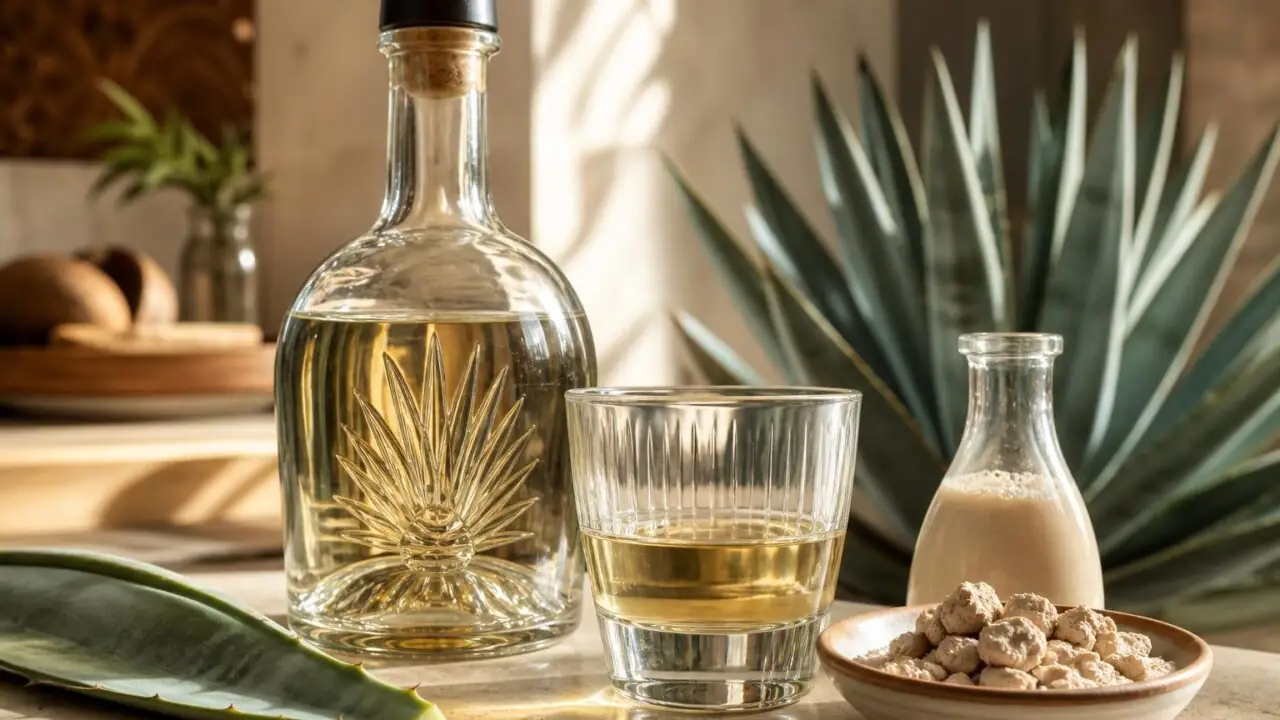
Does Tequila Have Yeast? is answered yes: tequila is made with yeast during fermentation, when cooked blue agave sugars become alcohol, carbon dioxide, and flavor compounds.
Producers may use wild ambient yeast, cultivated strains, or both, depending on the distillery’s house style and consistency goals.
Finished tequila normally does not contain active yeast because it is distilled after fermentation. Distillation separates alcohol and aroma compounds from the fermented agave mash, leaving yeast cells and solids behind.
Yeast still matters because it shapes fruity, earthy, spicy, and floral notes before blanco, reposado, or añejo tequila reaches the bottle.
Does Tequila Contain Live Yeast
Tequila is made with yeast, but finished tequila does not contain live yeast in any meaningful amount. Fermentation depends on yeast converting agave sugars into ethanol, yet distillation and filtration remove or destroy the yeast before bottling.
That distinction matters. “Made with yeast” describes production; “contains live yeast” describes what remains in the glass. For tequila, those are not the same thing.
During tequila production, cooked blue Weber agave juice or extracted sugars enter fermentation tanks.
Producers add cultivated yeast strains or rely partly on ambient microorganisms, and the yeast metabolizes fermentable sugars into alcohol, carbon dioxide, and flavor compounds.
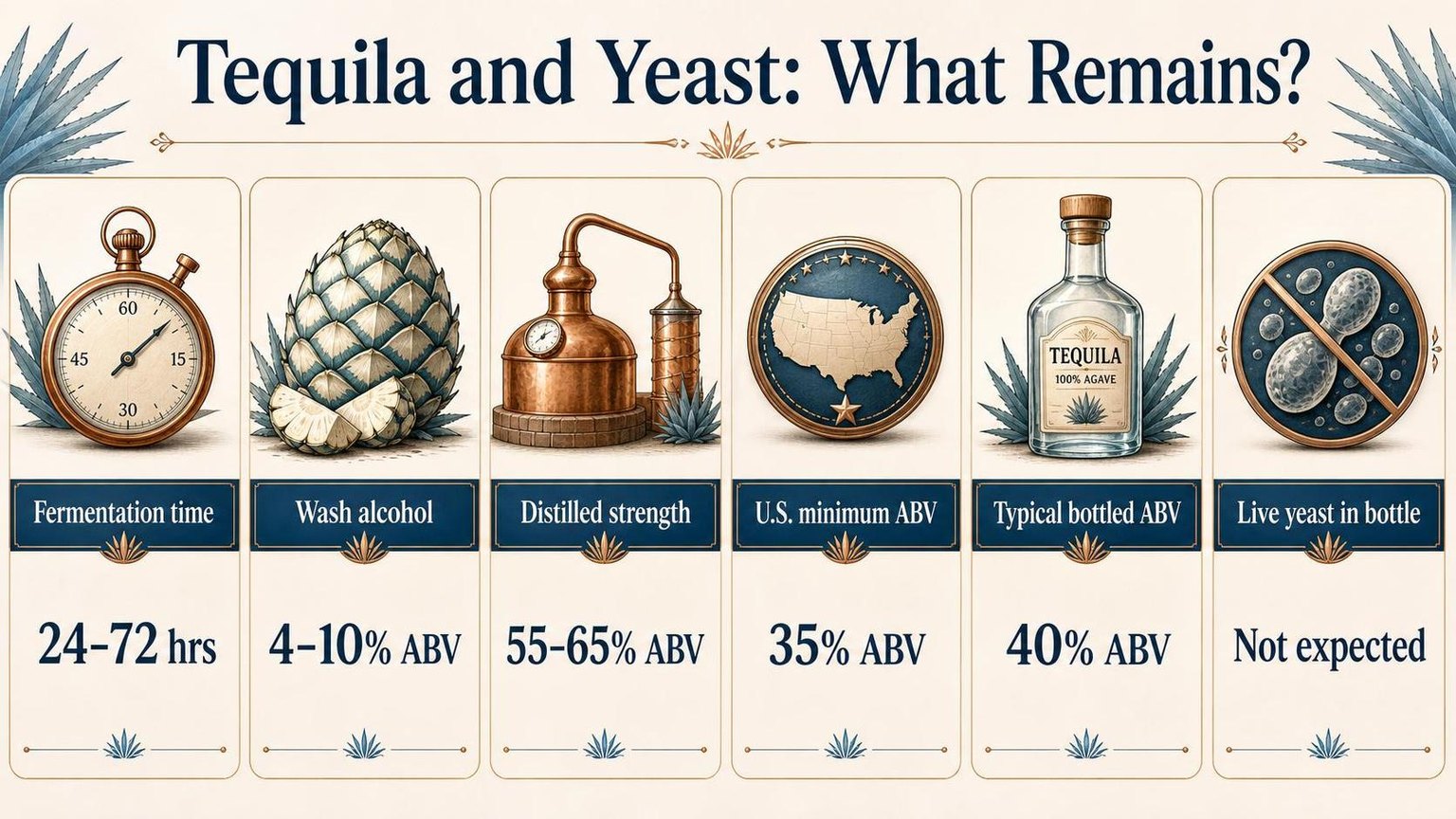
Fermentation usually lasts about 24 to 72 hours in industrial settings, though some traditional operations run longer.
Washes commonly reach roughly 4% to 10% alcohol by volume before distillation, depending on sugar concentration, yeast performance, and house style.
Once fermentation ends, the liquid goes to distillation. Tequila is typically distilled twice in pot stills or column systems.
Distillation heats the fermented liquid enough to vaporize alcohol and aroma compounds, while nonvolatile solids, spent yeast cells, proteins, and most microbial material stay behind in the stillage.
That step is the main reason bottled tequila does not contain live yeast. Yeast cells do not distill over with ethanol vapor.
Even if trace biological material remained somewhere in the process stream, the final spirit’s alcohol level would be hostile to active yeast survival.
| Production stage | Typical alcohol level | Live yeast status |
| Agave fermentation wash | About 4% to 10% ABV | Active yeast present |
| Freshly distilled tequila | Often around 55% to 65% ABV before dilution | Live yeast effectively absent |
| Bottled tequila | Minimum 35% ABV in the U.S.; commonly 40% ABV | Live yeast not expected |
U.S. rules set tequila at not less than 35% alcohol by volume for products sold in the American market. At that strength, live brewing or fermentation yeast is not expected to remain active.
Standard commercial bottling practices also reduce suspended solids that could carry residual cells.
Some consumers confuse tequila with bottle-conditioned beer, kombucha, or unfiltered cider, where live yeast may remain after packaging. Tequila is different because it is a distilled spirit.
Distilled spirits are not packaged to continue fermentation in the bottle.
Exceptions are theoretical, not practical. A poorly handled flavored tequila product could pick up contamination after distillation, but that would be a quality defect, not a normal feature of tequila.
Properly produced tequila should not contain viable yeast cultures.
- Yeast is essential during fermentation.
- Distillation separates alcohol from yeast and other solids.
- Typical bottled tequila is too high in alcohol to support live yeast activity.
- Finished tequila is not considered a source of live yeast, probiotics, or active cultures.
If the question is allergy, sensitivity, or dietary concern, the practical answer is the same: tequila is produced with yeast but should not contain live yeast in the finished bottle.
Trace residues are possible in theory, yet viable yeast is not a normal component of tequila.
Yeast’s Role in Tequila Fermentation
Yes. Yeast is essential in tequila production because it converts sugars from cooked blue Weber agave into ethanol, carbon dioxide, and aroma compounds. Without fermentation, there is no tequila, only sweet agave must.
After harvest, agave piñas are cooked to hydrolyze inulin-type fructans into fermentable sugars, mainly fructose, with some glucose.
The extracted juice, or a juice-fiber mix called mosto, is then sent to fermentation tanks and inoculated with yeast or left to ferment with ambient microflora.
The dominant fermenting organism is usually Saccharomyces cerevisiae. Many distilleries use selected commercial strains for consistency, while others rely partly on native yeasts to build a house profile.
Either way, yeast determines alcohol yield, fermentation speed, and much of tequila’s final aroma.
During fermentation, yeast consumes sugar and produces ethanol plus hundreds of minor compounds. These include higher alcohols, esters, aldehydes, and organic acids.
In balanced amounts, those compounds create fruity, floral, peppery, herbal, and earthy notes associated with different tequila styles.
| Fermentation factor | Typical tequila range | Why it matters |
| Primary yeast | Saccharomyces cerevisiae | Reliable alcohol production and predictable flavor formation |
| Fermentation time | 24 to 72 hours | Shorter runs favor throughput; longer runs can increase complexity |
| Fermentation temperature | About 30 to 35°C | Warmer conditions speed yeast metabolism but can stress cells |
| Wash alcohol before distillation | Usually 4% to 7% ABV | Sets distillation efficiency and affects congeners carried over |
| Tequila source requirement | Minimum 51% blue agave sugars | Defines mixto tequila under Mexican regulations |
| 100% agave tequila source | 100% blue agave sugars | No added non-agave sugar source allowed |
Fermentation vessels vary. Stainless steel tanks dominate modern production because they are easy to clean and control. Some producers still use wood vats or masonry tanks, which can host resident microflora and create more variable fermentations.
Yeast choice matters because agave must is not the same as grape juice or grain mash.
Agave fermentations can contain low nitrogen relative to yeast needs, so distillers may adjust nutrients, aeration, or inoculation rates to avoid sluggish or stuck fermentation.
Native yeasts can contribute complexity, but they also raise risk. Non-Saccharomyces species may produce desirable esters early, yet they often tolerate alcohol poorly.
If bacterial growth takes over, volatile acidity rises and the spirit can become sour, solvent-like, or uneven.
Producers manage yeast through sanitation, temperature, sugar concentration, and time. A healthy fermentation finishes with most sugars depleted, stable alcohol formation, and a clean aromatic profile.
Distillers then move quickly to distillation to preserve desirable congeners and limit spoilage.
- Yeast is present during tequila production, even though little to none remains in the bottled spirit after distillation and filtration.
- Its main job is biochemical: convert agave sugars into alcohol.
- Its secondary job is sensory: create the congeners that make one tequila smell different from another.
So, tequila does have yeast during production. Yeast is not a minor helper; it is the engine of fermentation and a major driver of flavor, texture, and distillery character.
Where Tequila Yeast Comes From
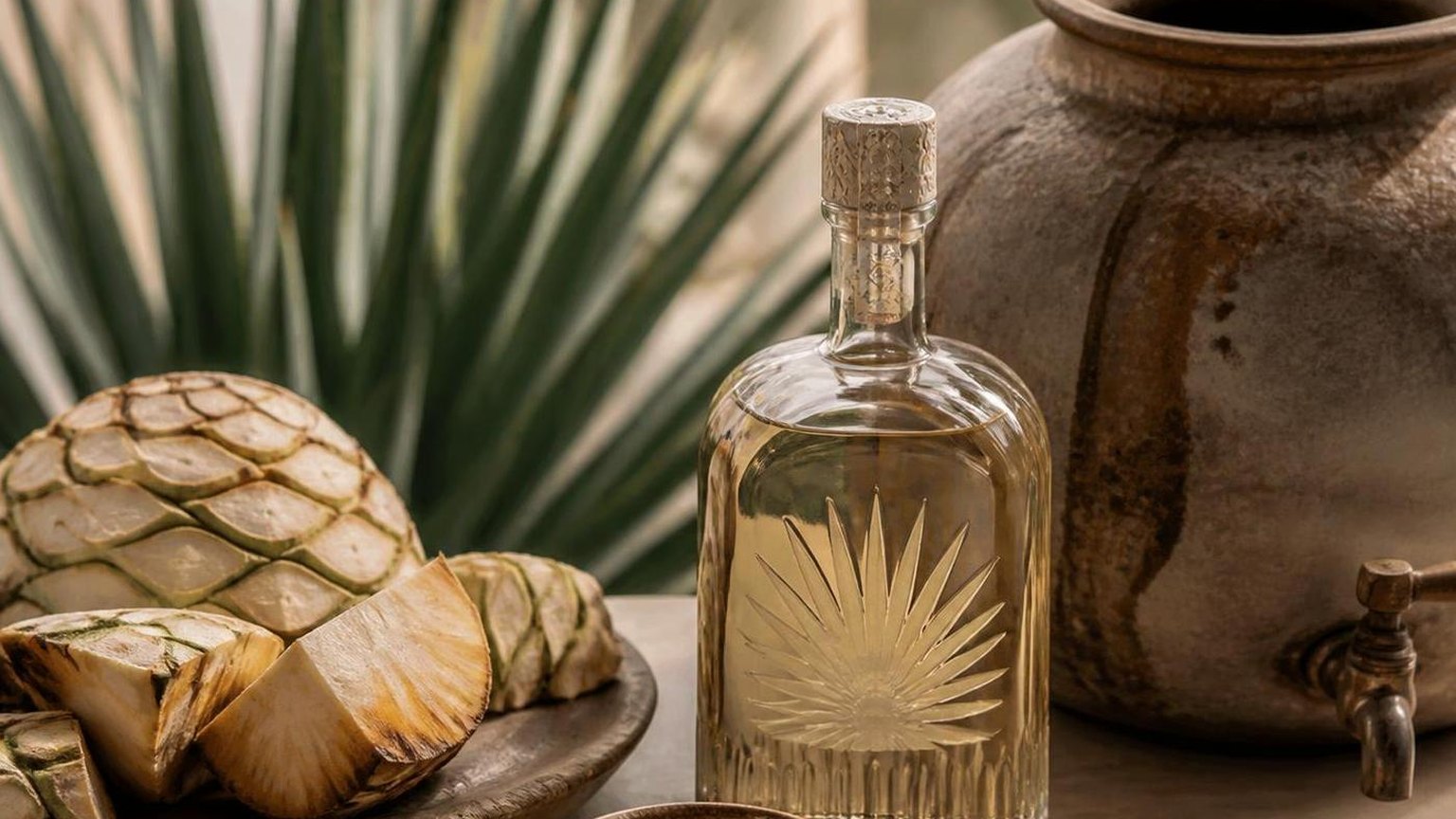
Tequila yeast does not come from the agave plant itself as a permanent, bottled ingredient. It comes from fermentation, when microorganisms reach sweet agave juice or agave mash and convert sugars into ethanol, carbon dioxide, and aroma compounds.
In tequila production, that yeast can arrive from the environment, from the distillery, or from a prepared culture added by the producer. Which source dominates depends on how the distillery cooks, extracts, and ferments the agave.
After blue Weber agave is harvested, the piñas are cooked to convert complex carbohydrates into fermentable sugars. The cooked agave is crushed, and the sugary liquid or mash becomes the substrate where yeast can grow.
If a producer uses spontaneous fermentation, yeast comes from ambient sources. That includes the air, fermentation tanks, wooden surfaces, hoses, tools, workers, and residue from earlier batches that remain in the cellar environment.
Distilleries using open tanks usually expose the must to more airborne and surface microbes than sealed stainless systems.
Ambient populations often include Saccharomyces yeasts, but also non-Saccharomyces species and bacteria that can change flavor and raise fermentation risk.
Many tequila producers do not rely only on chance.
They inoculate with cultured yeast, most commonly strains of Saccharomyces cerevisiae, because it ferments efficiently, tolerates alcohol, and gives more predictable completion times and flavor outcomes.
Commercial yeast may be purchased from specialist suppliers or propagated in-house from a selected house strain.
Some distilleries maintain their own culture over years, effectively creating a microbiological signature tied to their facility and process.
Agave itself can also contribute microbes before cooking, because field-grown plants carry native yeasts and bacteria on their surfaces.
Cooking in ovens or autoclaves reduces many of those populations, so post-cook handling becomes a more important yeast source.
Bagasse, the fibrous agave material left after extraction, can influence that microbial environment when it stays in the fermenter.
Mixed fermentations with juice and fibers may retain more resident microorganisms than highly filtered juice-only systems.
Tequila regulations require fermentation of sugars obtained from Agave tequilana Weber var. azul for 100% agave tequila.
In mixto tequila, up to 49% of fermentable sugars may come from other permitted sources, but the yeast still comes from fermentation management, not from the label category.
| Yeast source | How it enters tequila fermentation | Typical effect |
| Ambient yeast | Air, tanks, walls, tools, previous batches | More variation, sometimes more complex aromas |
| Cultured commercial yeast | Direct inoculation by the distillery | More control, faster and more consistent fermentation |
| House yeast culture | Distillery-maintained strain propagated on site | Consistency with a distinct house profile |
| Plant-surface microbes | Microbes present on harvested agave before cooking | Limited after cooking, more relevant in early handling |
Fermentation temperature and sugar concentration determine which yeasts thrive.
Tequila fermentations often finish in roughly 24 to 96 hours, depending on yeast strain, tank design, temperature control, and whether nutrients, fibers, or dilution water are used.
Water matters too. Once agave sugars are diluted to a fermentable concentration, the mineral content and sanitation of the water can favor or suppress certain microbial populations, especially in spontaneous fermentations.
The practical answer is simple: tequila contains alcohol made by yeast, but the yeast usually comes from the distillery ecosystem or from an added fermentation culture. It is not an inherent, stable component of bottled tequila after distillation.
Can Yeast Remain After Distillation
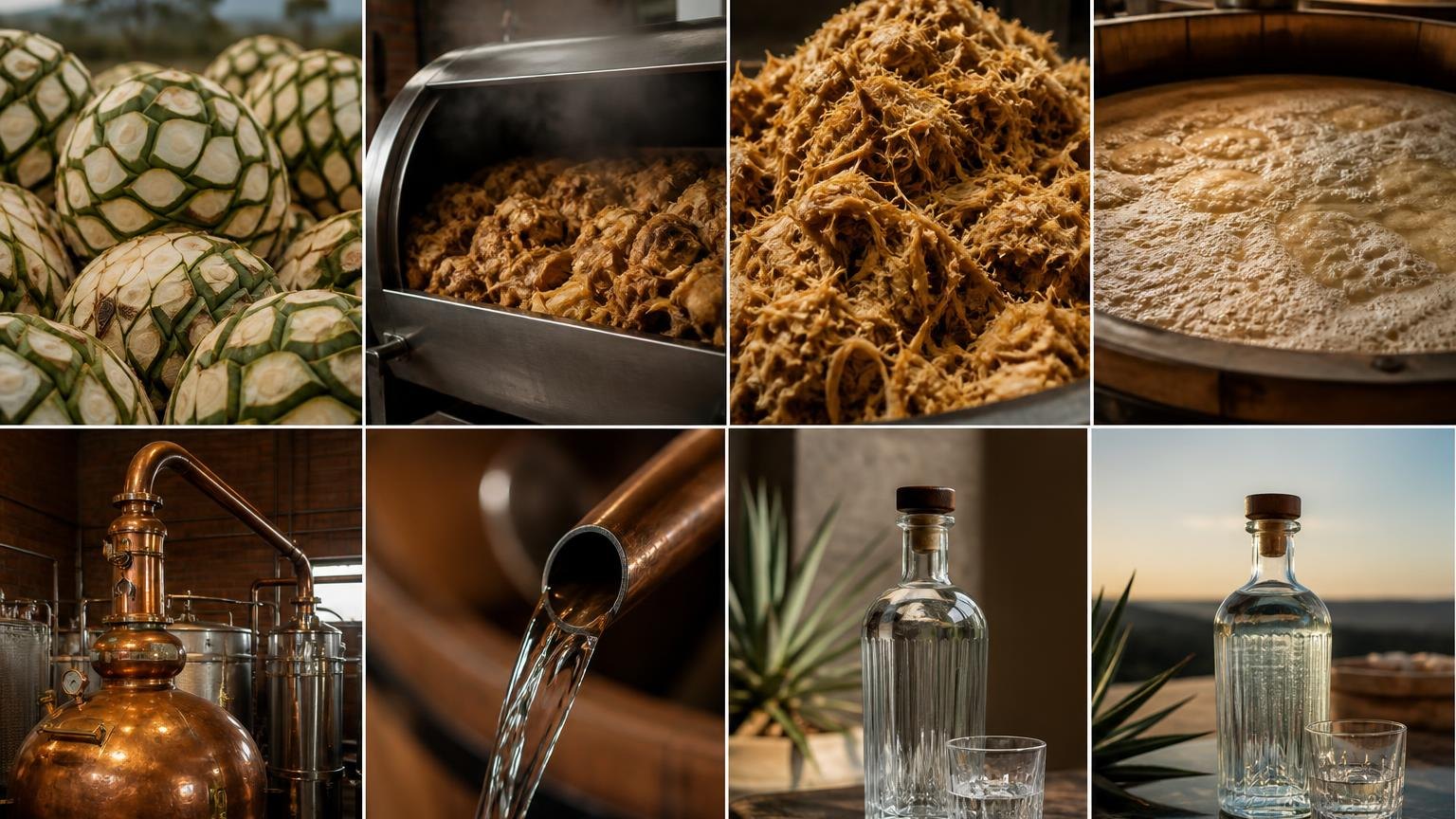
In properly distilled tequila, intact yeast cells do not remain in the final spirit. Distillation separates volatile alcohols and aroma compounds from a fermented agave wash, while heavy, nonvolatile solids such as yeast stay behind in the stillage.
That outcome follows basic physics. Saccharomyces yeast cells are microscopic but still far too large and nonvolatile to evaporate with ethanol and water vapor during distillation.
Tequila starts with cooked blue agave sugars fermented by yeast into alcohol.
That fermented liquid, often called mosto muerto after fermentation, then goes to stills for at least two distillations under Mexican tequila regulations for most commercial products.
During the first distillation, alcohol, water, and volatile congeners rise as vapor. Yeast biomass, proteins, agave fiber, minerals, and other dissolved or suspended solids remain in the pot as spent residue called vinaza or stillage.
Live yeast also cannot survive the temperatures involved. Ethanol boils at 78.37 degrees C, water at 100 degrees C, and distillation runs hot enough to kill fermentation yeast long before any carryover of whole cells would be possible.
| Material | Typical size or boiling behavior | Distillation result |
| Saccharomyces yeast cell | About 5-10 micrometers; nonvolatile solid | Stays in stillage, does not distill |
| Ethanol | Boiling point 78.37 degrees C | Readily enters vapor phase |
| Water | Boiling point 100 degrees C | Partly enters vapor phase |
| Esters and light aroma compounds | Volatile at distillation conditions | Can carry into distillate |
| Proteins and polysaccharides | Nonvolatile, heat-sensitive | Remain behind |
What can remain is yeast influence, not yeast itself. Fermentation creates esters, higher alcohols, aldehydes, and acids, and some of those compounds are volatile enough to pass through the still and shape tequila’s aroma.
For example, ethyl acetate can contribute fruity or solvent-like notes, while isoamyl alcohol can add ripe fruit and fusel character.
These are fermentation byproducts linked to yeast metabolism, and they survive because they are volatile congeners, not living organisms.
Small physical contamination is theoretically possible if a still pukes, foams, or is run poorly.
In that case, entrained liquid droplets could carry tiny amounts of wash into the condenser, but that is a production fault, not normal tequila distillation.
Well-designed distillation reduces that risk through headspace, slower heating, copper pot geometry, plates, and cuts between heads, hearts, and tails.
Many producers also filter or rest spirit before bottling, which further reduces any chance of suspended material.
This matters for consumers asking about yeast sensitivity.
Distilled tequila is generally considered free of viable yeast and essentially free of yeast solids, though flavored tequila products or cream-based tequila liqueurs can introduce non-distilled ingredients after distillation.
- Distillation removes whole yeast cells because they do not vaporize.
- Heat used in distillation kills any remaining live yeast in the wash.
- Yeast-derived flavor compounds can remain because they are volatile.
- Only faulty distillation would allow physical liquid carryover.
The practical answer is direct: standard tequila does not contain residual yeast cells after distillation. It can, however, retain compounds created by yeast during fermentation, and those compounds are part of what gives tequila its final character.
Yeast Allergies and Tequila Safety
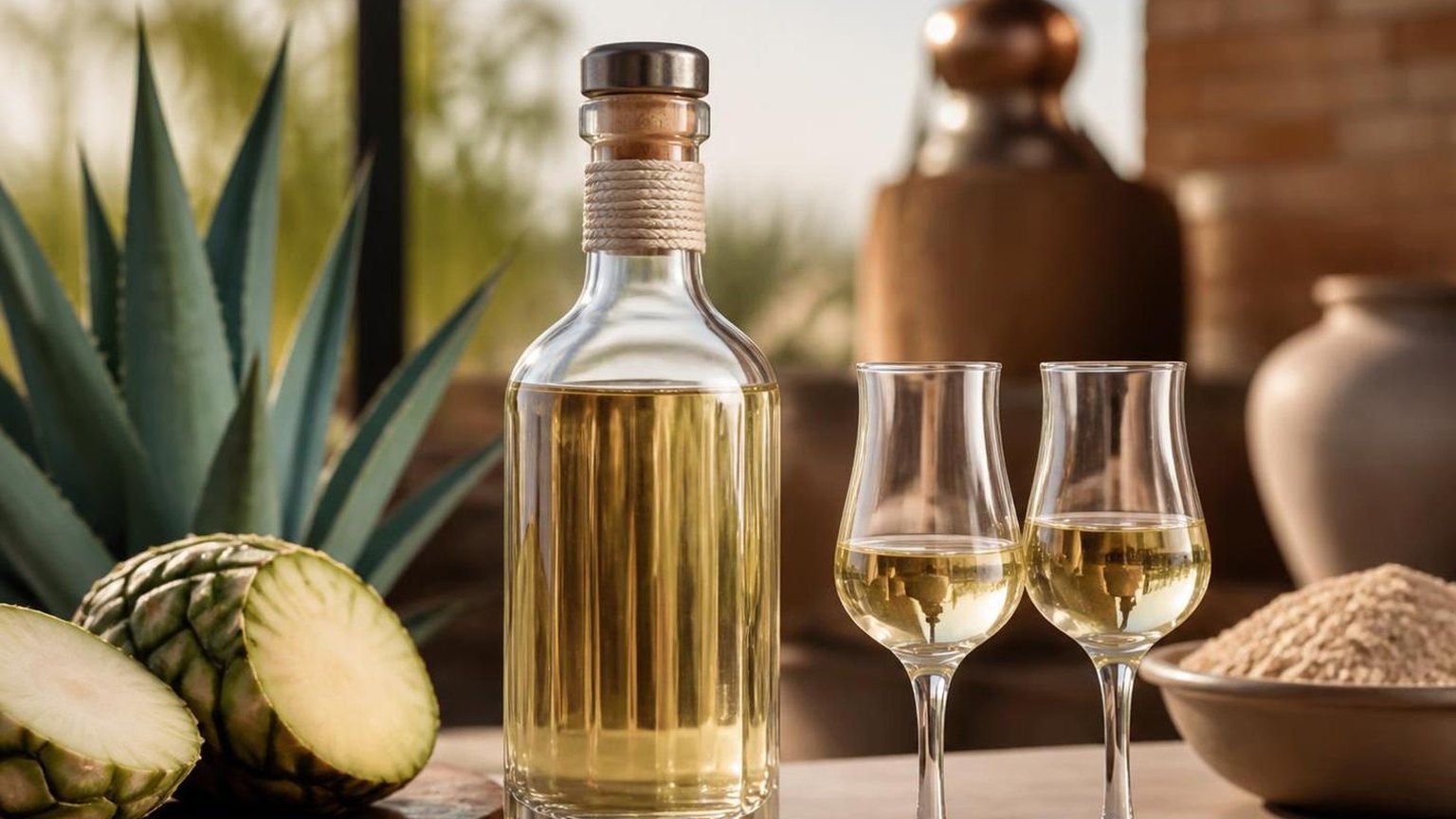
Tequila is fermented with yeast, but standard tequila is also distilled. That distinction matters because distillation separates alcohol and volatile aroma compounds from most nonvolatile solids, including intact yeast cells and larger proteins.
For most people with a yeast allergy, plain 100% agave tequila is less likely to contain meaningful yeast residue than beer, wine, or unfiltered cider.
Safety still depends on the product type, the person’s diagnosis, and the severity of prior reactions.
A true yeast allergy is different from yeast intolerance. Allergy involves an immune response, often to proteins from yeasts such as Saccharomyces cerevisiae, while intolerance is a non-immune reaction with less predictable triggers.
During tequila production, yeast converts agave sugars into ethanol before distillation. In blanco, reposado, and añejo tequila, the distilled spirit is then collected, diluted to bottling proof, and sometimes aged in oak.
Because distillation does not carry over most proteins or whole microorganisms, finished tequila should not contain live fermentation yeast in normal amounts.
That is why distilled spirits are often better tolerated than fermented drinks by people avoiding yeast exposure.
US labeling rules also matter. Tequila must be bottled at a minimum of 35% alcohol by volume in the United States and 38% alcohol by volume in Mexico for domestic sale, with many exported bottles sold at 40% ABV.
| Drink type | Production step | Likelihood of yeast residue |
| Beer | Fermented, not distilled | Higher |
| Wine | Fermented, not distilled | Higher |
| Plain tequila | Fermented, then distilled | Low |
| Tequila liqueur or flavored product | Distilled spirit plus added ingredients | Variable |
The bigger risk is not usually the base tequila.
It is added ingredients after distillation, especially in flavored products, cream liqueurs, cocktail mixers, or low-cost “tequila-based” beverages that can include sweeteners, extracts, and stabilizers.
Mixto tequila also deserves extra label reading. By law, mixto can be made with at least 51% sugars from blue agave and the rest from other sugar sources, while 100% agave tequila uses only blue agave sugars.
That sugar distinction does not prove a yeast risk, but 100% agave bottles are generally the simpler choice. Fewer added processing variables make them easier to evaluate if you are trying to isolate a reaction trigger.
- Choose 100% agave tequila, not a flavored tequila liqueur.
- Avoid cream, spice, dessert, or ready-to-drink tequila products.
- Read for phrases such as “natural flavors,” “caramel color,” or added sweeteners.
- If reactions have been severe, ask an allergist before testing any distilled spirit.
If you have a documented yeast allergy, the safest first trial is a very small amount of plain blanco tequila with no mixer. Do not test with margarita mix, beer back, sangrita, or citrus-heavy canned cocktails because they add other common triggers.
Immediate hives, wheezing, throat tightness, vomiting, or dizziness after drinking need urgent medical attention. If you have ever had anaphylaxis, carry prescribed epinephrine and treat tequila like any other uncertain exposure.
Bottom line: yeast is used to make tequila, but plain distilled tequila is usually low risk for yeast exposure compared with fermented drinks.
The main safety step is choosing unflavored 100% agave tequila and avoiding products with added ingredients.
Questions Readers Ask
Does tequila contain yeast in the bottle?
Finished tequila is distilled, so live yeast from fermentation does not carry over into the final spirit in meaningful amounts.
Standard 80-proof tequila is essentially free of active yeast because distillation separates alcohol and volatile compounds from the fermented agave wash.
Is yeast used to make tequila?
Yes. After cooked blue Weber agave sugars are extracted, yeast ferments those sugars into alcohol and carbon dioxide before distillation.
Producers may use wild ambient yeast or cultured strains of Saccharomyces cerevisiae, depending on the house style and consistency goals.
What kind of yeast is used in tequila fermentation?
Many tequila distilleries rely on Saccharomyces cerevisiae because it ferments efficiently and tolerates rising alcohol levels.
Some traditional producers also allow native yeast and bacteria to participate, which can increase earthy, fruity, or lactic notes in the fermented mosto.
Can people with yeast sensitivities usually drink tequila?
Many people who avoid beer, bread, or wine for yeast-related reasons tolerate tequila better because the final distilled spirit does not contain active fermentation yeast.
The practical issue is usually additives, flavorings, or mixed-drink ingredients, so 100% agave tequila is the cleaner choice.
Does tequila fermentation affect flavor even if yeast is not in the final spirit?
Yes. Yeast creates congeners such as esters, higher alcohols, and organic acids during fermentation, and those compounds influence aroma and taste after distillation.
That is one reason two 100% agave tequilas made from similar agave can still smell different, with one showing more citrus, pepper, or tropical fruit.
Is there yeast in tequila-based liqueurs or ready-to-drink cocktails?
The tequila itself is still distilled, but packaged cocktails or tequila liqueurs can include non-distilled ingredients added after production.
If yeast avoidance is strict, check the label for cream, fruit puree, spice blends, or other additives that may introduce trace solids or potential sensitivities not present in straight tequila.