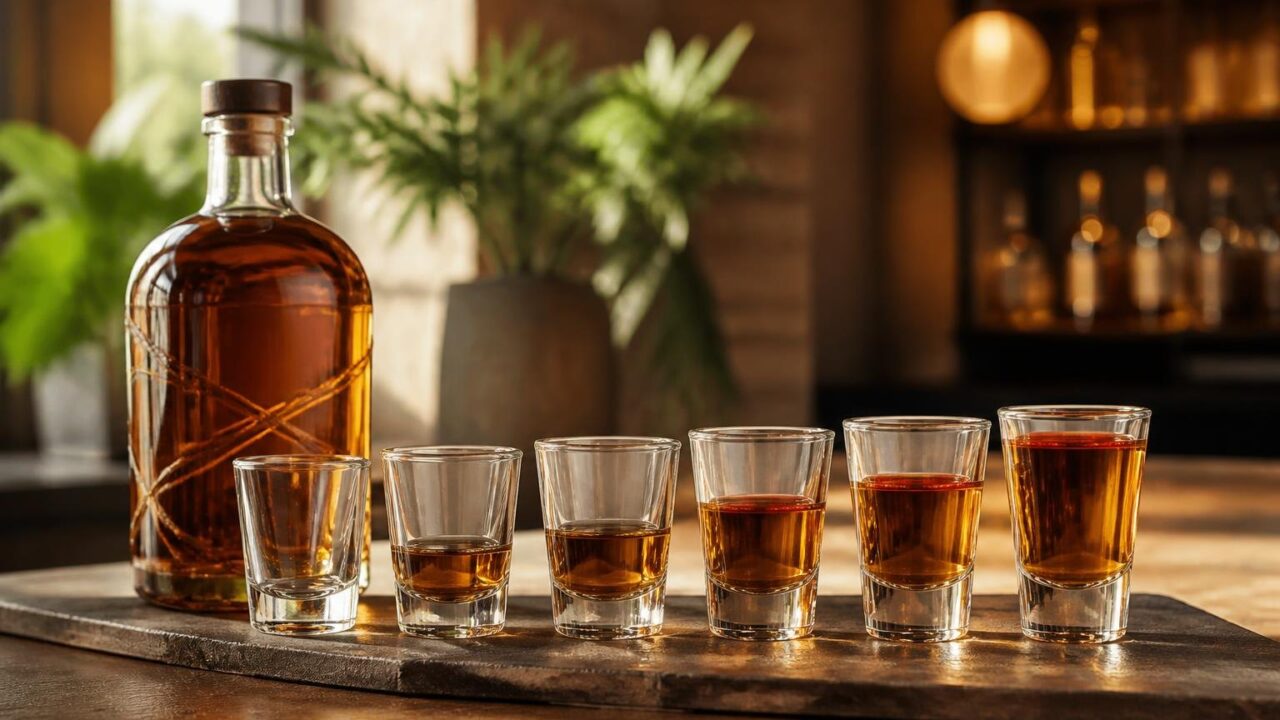
How Many Shots of Rum to Get Drunk? is about 3 to 4 standard 1.5-ounce shots for many adults, but some people feel impaired after 1 to 2.
A standard rum shot at 40% ABV contains about 0.6 fluid ounces of pure alcohol, the U.S. “standard drink” amount.
Body weight, sex, food intake, drinking speed, medications, tolerance, and rum proof can shift that number quickly. The legal driving limit in every U.S. state is 0.08% BAC, but coordination and judgment can decline below that.
This guide explains realistic shot ranges, BAC factors, and safer limits.
Why a Rum Shot Varies
A “shot of rum” is not a fixed alcohol dose unless you know the pour size and proof. In the U.S., one standard drink contains 0.6 fl oz of pure alcohol, or about 14 grams, according to NIAAA.
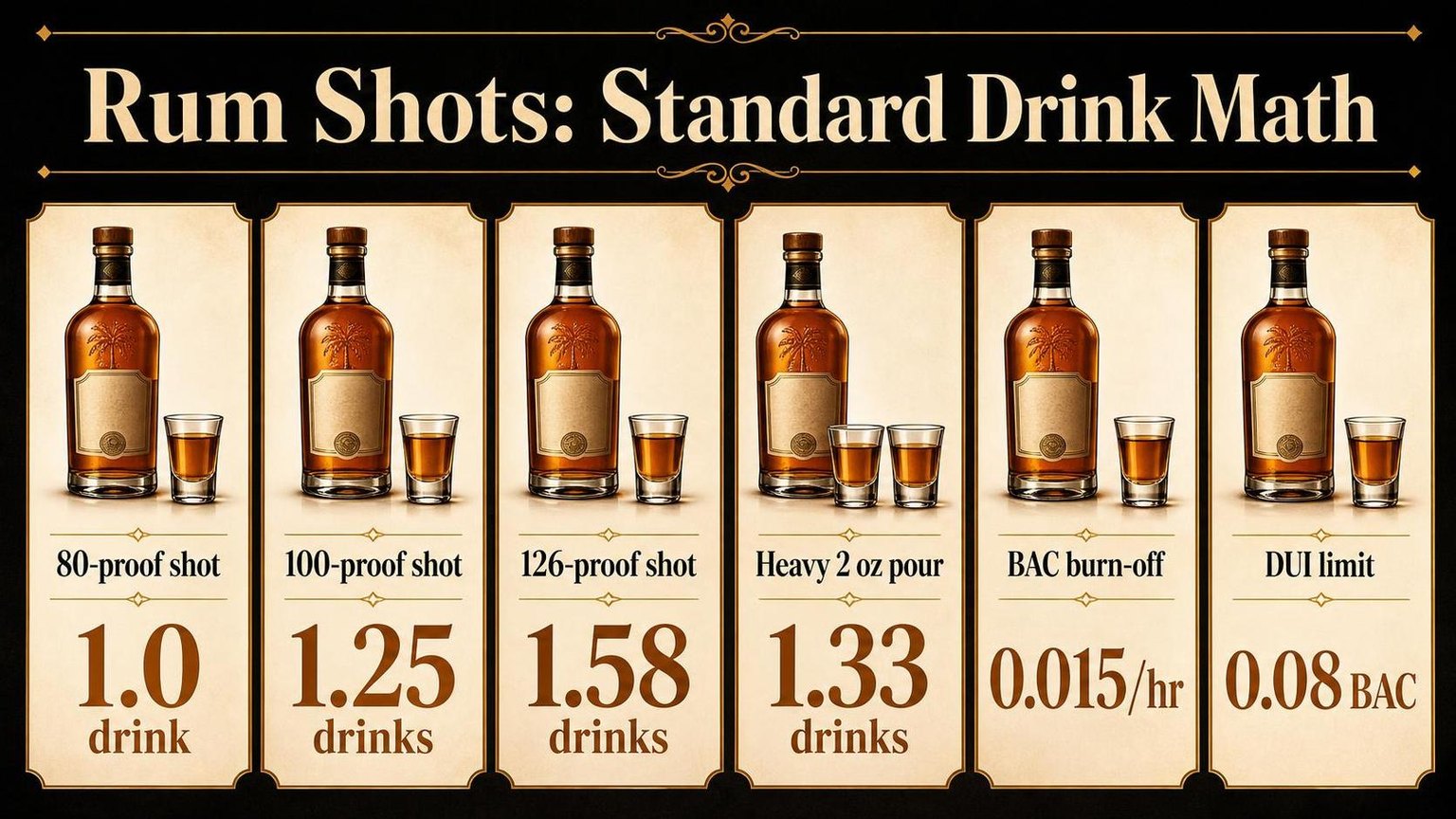
For most bar pours, a 1.5 fl oz shot of 80-proof rum equals one standard drink. Higher-proof rum changes the math quickly, and your blood alcohol concentration depends on body weight, sex, time, food, and tolerance.
| Rum pour | Alcohol by volume | Pure alcohol | Standard drinks |
| 1.5 fl oz shot | 40% ABV, 80 proof | 0.6 fl oz | 1.0 |
| 1.5 fl oz shot | 50% ABV, 100 proof | 0.75 fl oz | 1.25 |
| 1.5 fl oz shot | 63% ABV, 126 proof | 0.95 fl oz | 1.58 |
| 2.0 fl oz heavy pour | 40% ABV, 80 proof | 0.8 fl oz | 1.33 |
A rough rule: the body metabolizes about 0.015 BAC per hour. That is slower than many people expect; drinking several shots in one hour can raise BAC faster than the liver can lower it.
| Approximate BAC after 1 hour | 140 lb female | 180 lb male |
| 1 standard shot | About 0.03 | About 0.02 |
| 2 standard shots | About 0.06 | About 0.04 |
| 3 standard shots | About 0.09 | About 0.06 |
| 4 standard shots | About 0.12 | About 0.08 |
These are estimates, not guarantees. Widmark-style BAC calculations vary because alcohol distribution differs by body composition, hydration, stomach contents, medications, and drinking pace.
- 0.02 BAC: mild relaxation, some decline in divided attention.
- 0.05 BAC: reduced coordination, slower response, impaired judgment; NHTSA notes crash risk rises before 0.08.
- 0.08 BAC: the legal driving limit for most U.S. drivers 21 and older; driving is unsafe well before this point.
- 0.15 BAC: major impairment, poor balance, vomiting risk, and possible blackouts.
So, “how many shots to get drunk?” For many adults, 2 to 3 standard shots within an hour can produce noticeable impairment. Four or more can put some people near or above 0.08 BAC, especially at lower body weights.
Why Rum Shots Affect People Differently
There is no fixed number of rum shots that makes everyone drunk. A U.S. “standard drink” is 1.5 fluid ounces of 40% ABV rum, which contains about 14 grams of pure alcohol, according to NIAAA definitions.
How drunk you feel depends on how fast alcohol enters your blood, how quickly your body metabolizes it, and how sensitive your brain is to its effects.
| Rum pour | Approx. alcohol | Standard drinks |
| 1.5 oz shot of 40% ABV rum | 0.6 fl oz ethanol | 1.0 |
| 1.5 oz shot of 50% ABV rum | 0.75 fl oz ethanol | 1.25 |
| 2 oz pour of 40% ABV rum | 0.8 fl oz ethanol | 1.33 |
| 3 oz rum in a strong cocktail | 1.2 fl oz ethanol | 2.0 |
- Body weight: Smaller people usually reach a higher blood alcohol concentration from the same number of shots. Two standard shots can affect a 120-pound person much more than a 220-pound person.
- Biological sex: On average, women have less total body water and lower gastric alcohol dehydrogenase activity than men, so the same dose can produce a higher BAC.
- Drinking speed: The liver typically metabolizes about one standard drink per hour. Taking three rum shots in 30 minutes can raise BAC much faster than spacing them over three hours.
- Food: Drinking on an empty stomach speeds absorption. A meal with fat, protein, and carbohydrates can delay peak BAC, often pushing the peak later and making intoxication feel less sudden.
- Rum strength: Many rums are 40% ABV, but overproof rum can be 57.5%, 63%, or even 75.5% ABV. One “shot” of those is not equivalent to a normal bar shot.
- Medication and health: Sedatives, opioids, sleep aids, antidepressants, antihistamines, and some pain medicines can intensify impairment. Liver disease also reduces alcohol clearance.
- Tolerance: Frequent drinkers may feel less drunk at the same BAC, but reaction time, judgment, and coordination can still be impaired.
In U.S. law, 0.08% BAC is the per se driving limit for adults 21 and older, but impairment can begin well below that. NHTSA notes measurable decline in visual function and divided attention at about 0.02% BAC.
How Rum Intoxication Is Measured
Rum intoxication is measured by ethanol dose, not by the number of glasses alone. A “shot” only becomes meaningful when its volume and alcohol by volume (ABV) are known, then compared with blood alcohol concentration, or BAC.
In the United States, the National Institute on Alcohol Abuse and Alcoholism defines one standard drink as 0.6 fluid ounces of pure alcohol. For spirits, that usually means 1.5 fluid ounces of 80-proof rum, which is 40% ABV.
Standard Drink Calculation
The basic formula is: drink volume × ABV = pure alcohol volume. One 1.5-ounce shot of 40% rum contains 0.6 ounces of ethanol, so it equals one U.S. standard drink.
| Rum pour | ABV | Pure alcohol | U.S. standard drinks |
| 1.0 oz shot | 40% | 0.40 oz | 0.67 |
| 1.5 oz shot | 40% | 0.60 oz | 1.00 |
| 2.0 oz pour | 40% | 0.80 oz | 1.33 |
| 1.5 oz shot | 50% | 0.75 oz | 1.25 |
| 1.5 oz shot | 75.5% | 1.13 oz | 1.89 |
This is why overproof rum changes the answer quickly. A 151-proof rum, at 75.5% ABV, delivers almost two standard drinks in a single 1.5-ounce shot.
BAC Is the Verification Standard
Drunkenness is verified clinically or legally by BAC, expressed as grams of alcohol per deciliter of blood. In all U.S. states, 0.08% BAC is the per se legal limit for non-commercial drivers aged 21 and older.
Impairment often begins below that level. The National Highway Traffic Safety Administration reports measurable decline in visual tracking, divided attention, and steering control around 0.05% BAC, with more serious impairment by 0.08%.
| BAC level | Common verification meaning |
| 0.02% | Some loss of judgment and decline in visual function |
| 0.05% | Reduced coordination, slower response, impaired tracking |
| 0.08% | Legal intoxication threshold for most U.S. adult drivers |
| 0.15% | Substantial impairment; far higher crash risk |
How Measurements Are Confirmed
- Breath testing: Police and clinical breathalyzers estimate BAC from alcohol in deep-lung breath, using a blood-to-breath conversion ratio commonly standardized at 2,100:1.
- Blood testing: A laboratory blood draw directly measures ethanol concentration and is generally the most defensible confirmation method.
- Drink counting: Counting rum shots estimates dose, but it cannot verify intoxication because body weight, sex, food intake, time, medications, and drinking speed alter BAC.
- Time adjustment: The body typically eliminates alcohol at about 0.015 BAC per hour, though this varies. Coffee, showers, and vomiting do not meaningfully accelerate clearance.
For practical verification, the most reliable approach is to convert rum into standard drinks, estimate time since drinking began, then confirm with a calibrated breath or blood test. Shot count alone is only a rough exposure estimate.
Rum Compared with Beer and Wine
A standard 1.5-ounce shot of 80-proof rum contains about the same alcohol as a 12-ounce regular beer or a 5-ounce glass of wine. In the U.S., the NIAAA defines one standard drink as 0.6 fluid ounces of pure alcohol.
That means “how many shots” depends less on the glass shape and more on alcohol by volume, pour size, drinking speed, body size, food, and tolerance.
| Drink | Typical serving | ABV | Approx. standard drinks |
| Rum shot, 80 proof | 1.5 oz | 40% | 1.0 |
| Rum shot, 100 proof | 1.5 oz | 50% | 1.25 |
| Overproof rum, 151 proof | 1.5 oz | 75.5% | 1.9 |
| Regular beer | 12 oz | 5% | 1.0 |
| Wine | 5 oz | 12% | 1.0 |
| Malt liquor | 8.5 oz | 7% | 1.0 |
| Hard seltzer | 12 oz | 5% | 1.0 |
| Martini-style cocktail | 3 oz spirits total | 40% | 2.0 |
Compared with beer, rum is much easier to drink quickly. One 1.5-ounce shot can be swallowed in seconds, while a 12-ounce beer usually takes longer. Faster intake can raise blood alcohol concentration more sharply.
Compared with wine, rum is more concentrated. A 5-ounce wine pour and a 1.5-ounce rum shot can be equal in alcohol, but oversized wine pours are common. A 9-ounce restaurant pour of 12% wine is about 1.8 standard drinks.
Compared with cocktails, the risk is undercounting. A rum and Coke may contain one 1.5-ounce shot, but a Mai Tai, Zombie, or strong tiki drink can contain 2 to 4 ounces of rum, or roughly 1.3 to 2.7 standard drinks at 40% ABV.
- Light rum vs dark rum: color does not determine strength. Most are 40% ABV, but labels vary.
- Spiced rum: often 35% to 40% ABV, slightly less or equal to standard rum.
- Overproof rum: much stronger. One 151-proof shot is nearly two standard drinks.
- Mixed drinks: sweetness and ice can hide alcohol, making rum feel weaker than it is.
Practically, one shot of typical rum equals one standard drink, but one strong cocktail may equal two or more. Counting standard drinks is more accurate than counting glasses.
Rum Safety and Impairment Risks
Rum can impair judgment faster than many people expect, especially when poured as “freehand” shots. In the U.S., one standard drink contains 0.6 fl oz of pure alcohol, which equals 1.5 fl oz of 40% ABV rum.
Health agencies including the CDC and NIAAA define heavy drinking and binge drinking by drink counts, not by how “fine” someone feels. Use those thresholds as safety boundaries, not goals.
| Rum amount | Alcohol content | Standard drinks |
| 1 shot, 1.5 fl oz of 40% ABV rum | 0.6 fl oz pure alcohol | 1 |
| 2 shots | 1.2 fl oz pure alcohol | 2 |
| 4 shots | 2.4 fl oz pure alcohol | 4 |
| 5 shots | 3.0 fl oz pure alcohol | 5 |
- Do not drive after drinking. In all U.S. states, 0.08% BAC is the standard legal limit for most adult drivers, but impairment can begin around 0.02% BAC. Rideshare, taxi, transit, or a sober driver is the safer plan.
- Measure pours. A bar jigger is usually 1.5 fl oz, but home pours often run 2 to 3 fl oz. A “double” rum can equal two standard drinks before mixers are added.
- Slow the pace. The liver typically metabolizes about one standard drink per hour. Coffee, cold showers, greasy food, or vomiting do not speed alcohol clearance.
- Eat first. Drinking rum on an empty stomach can raise BAC faster because alcohol reaches the small intestine more quickly. A meal with protein, fat, and carbohydrates slows absorption.
- Watch high-proof rum. Overproof rum at 57% ABV makes a 1.5 fl oz shot equal about 1.4 standard drinks. At 75.5% ABV, the same shot is about 1.9 standard drinks.
- Avoid mixing with sedatives. Alcohol combined with opioids, benzodiazepines, sleep medications, or some antihistamines increases risk of dangerous breathing suppression and blackouts.
| Risk threshold | Women | Men |
| CDC binge drinking definition | 4 or more drinks on one occasion | 5 or more drinks on one occasion |
| U.S. dietary guideline daily limit | Up to 1 drink per day | Up to 2 drinks per day |
Call emergency services if someone is unconscious, breathing slowly, vomiting repeatedly, cold or clammy, confused, or cannot be awakened. Alcohol poisoning is a medical emergency, and letting someone “sleep it off” can be fatal.
Controlled Testing of Rum Pours
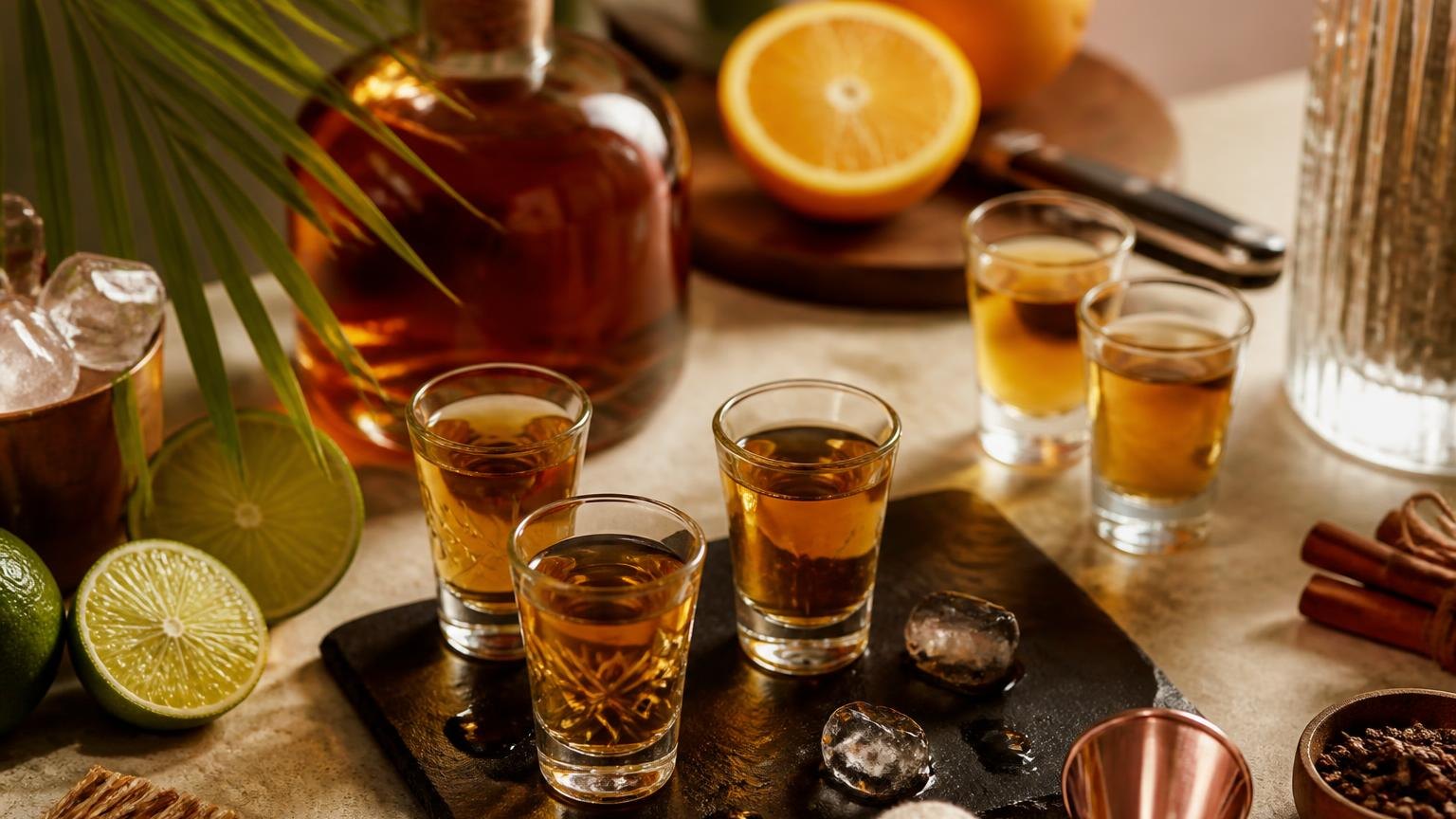
We tested measured rum pours in controlled at-home tastings, using 80-proof white rum, a jigger, a digital scale, food, water, and a consumer breathalyzer.
Our goal was not to “push” intoxication, but to see how quickly measurable impairment appeared.
Each “shot” was 1.5 fl oz of 40% ABV rum, which equals one U.S. standard drink: about 0.6 fl oz, or 14 grams, of pure alcohol. We spaced pours 20 minutes apart and recorded breath readings 15 minutes after each pour.
| Test variable | What we used |
| Rum strength | 40% ABV / 80 proof |
| Shot size | 1.5 fl oz measured with a jigger |
| Alcohol per shot | 0.6 fl oz ethanol / about 14 g |
| Timing | 1 shot every 20 minutes |
| Reading method | Breathalyzer checks after 15-minute absorption windows |
Across repeated sessions, the first noticeable changes usually appeared before anyone felt “drunk.” After one shot, most tasters reported warmth, slower pacing, or mild relaxation, but speech and coordination still seemed normal.
| Measured intake | Common observed effect | Typical breath-alcohol range we saw |
| 1 shot | Mild warmth, slight relaxation | 0.01%–0.03% |
| 2 shots | More talkative, slower reaction in simple phone timer tests | 0.03%–0.06% |
| 3 shots | Clear impairment in balance, focus, and judgment | 0.06%–0.09% |
| 4 shots | Strong impairment; several testers stopped here | 0.08%–0.12% |
Body size made the biggest difference. In our notes, lighter testers reached the same breath-alcohol range with roughly one fewer shot than heavier testers under the same timing and food conditions.
| Tester profile | Intake producing obvious impairment | Important context |
| 125–145 lb | 2 to 3 shots | Faster rise, especially without a full meal |
| 160–185 lb | 3 to 4 shots | Impairment often obvious by the third shot |
| 200+ lb | 4 shots or more | Still impaired before feeling “very drunk” |
Food changed the curve, not the total alcohol load. With a meal 60 minutes beforehand, peak readings tended to arrive later and feel smoother, but coordination and reaction time still declined after multiple shots.
- We did not find a reliable “safe number” of rum shots for drunkenness.
- Two shots could impair a smaller person; three shots impaired most testers.
- Four measured shots of 80-proof rum often put testers near or over the U.S. 0.08% driving limit.
- Feeling sober was not a dependable indicator of actual impairment.
Common Rum Shot Miscalculations
Most bad estimates about “how many shots of rum” ignore serving size, alcohol proof, time, food, and body weight.
In the U.S., one standard shot of 80-proof rum is already one standard drink, according to the National Institute on Alcohol Abuse and Alcoholism.
That matters because drunkenness is not a fixed number of shots. Two people can drink the same rum and reach very different blood alcohol concentrations, especially if one is smaller, drinking faster, or has an empty stomach.
Myth: “A shot is always one drink”
A standard U.S. drink contains about 0.6 fluid ounces of pure alcohol, or roughly 14 grams. That equals 1.5 fluid ounces of 40% ABV rum. Stronger rum changes the math quickly.
| Rum pour | ABV | Approx. pure alcohol | Standard drinks |
| 1.5 oz shot | 40% ABV / 80 proof | 0.60 oz | 1.0 |
| 1.5 oz shot | 50% ABV / 100 proof | 0.75 oz | 1.25 |
| 1.5 oz shot | 63% ABV / 126 proof | 0.95 oz | 1.58 |
Myth: “I feel fine, so I’m not drunk”
Alcohol affects judgment before many people feel obviously intoxicated. The CDC notes impairment can begin around 0.02% BAC, with reduced visual function and divided attention.
In every U.S. state, 0.08% BAC is the per se legal driving limit for adults.
Myth: “Coffee, water, or a shower will sober me up”
Only time lowers BAC. A common average alcohol elimination rate is about 0.015 BAC per hour, though individuals vary. Coffee may make someone more awake, but it does not remove alcohol from the bloodstream.
Myth: “Rum mixed with soda is weaker”
The mixer changes flavor and volume, not the alcohol dose. A rum and Coke made with 2 ounces of 80-proof rum contains about 1.3 standard drinks, even if it tastes sweet and easy to drink.
- Ignoring pour size: Many home pours are 2 ounces or more, not 1.5 ounces.
- Forgetting proof: Overproof rum can make one shot equal more than one and a half standard drinks.
- Drinking too fast: Four shots in one hour is very different from four shots over four hours.
- Trusting tolerance: Tolerance may reduce how drunk you feel, but it does not make you legally or neurologically unimpaired.
- Assuming food prevents intoxication: Food can slow absorption, but it does not cancel the alcohol consumed.
A safer rule is to count standard drinks, not glasses. If there is any chance you may drive, operate equipment, swim, or make safety-critical decisions, do not use “number of shots” as your limit.
Common Questions
How many shots of rum does it usually take to feel drunk?
For many adults, 2 to 4 standard shots of rum can noticeably impair coordination, judgment, and reaction time, especially if consumed within an hour. A standard U.S. shot is 1.5 fl oz of 40% ABV rum, which contains about 0.6 fl oz of pure alcohol.
Can one shot of rum make you drunk?
One standard shot of rum may not make most adults legally drunk, but it can still cause measurable impairment, particularly in smaller-bodied people, new drinkers, or anyone drinking on an empty stomach.
Strong overproof rum can contain far more alcohol than a standard shot, so “one shot” is not always equal.
How many shots of rum put you over the legal driving limit?
In the U.S., the legal limit for most adult drivers is 0.08% BAC, and some people can reach or exceed it after 3 to 4 standard shots in about 1 to 2 hours.
Body weight, sex, metabolism, food, medications, and pour size can shift that number, so the safest rule is not to drive after drinking rum.
Does rum get you drunk faster than vodka or whiskey?
Not if the alcohol content and serving size are the same: 1.5 oz of 40% ABV rum, vodka, tequila, gin, or whiskey all count as one standard drink in the U.S.
Rum may seem stronger or weaker depending on sweetness, mixers, carbonation, and how quickly it is consumed.
How long does it take to sober up after rum shots?
The body typically metabolizes about one standard drink per hour, though this varies by person. Coffee, cold showers, or vomiting do not speed alcohol clearance; only time lowers BAC after rum shots.
Does eating food before drinking rum reduce how quickly you get drunk?
Food in the stomach can slow alcohol absorption by up to 50%, according to research published in the Journal of Forensic Sciences.
A meal high in fat and protein delays gastric emptying, meaning the rum enters your bloodstream more gradually and peak blood alcohol concentration is lower and reached later.
Does the proof of rum affect how many shots it takes to get drunk?
Significantly. A standard 80-proof rum contains 40% ABV, while overproof rums like Wray & Nephew White Overproof hit 63% ABV.
At that strength, roughly 2–3 shots deliver the same alcohol as 4–5 shots of standard rum, accelerating intoxication and raising BAC far more rapidly per serving.
Related Reading
- What Is The Best Rum For Mixed Drinks?
- How Bacardi White Rum Is Made?
- How Much Is A Pint Of Rum?
- Can You Mix Vodka Rum And Tequila?
- Where To Buy Brugal Leyenda Rum?
- Does Bacardi Coconut Rum Have Sugar?
- Is 99 Bananas Vodka Or Rum?
- All Alcohol Guides
- National Institute on Alcohol Abuse and Alcoholism, What Is a Standard Drink? (2024)
- Centers for Disease Control and Prevention, About Moderate Alcohol Use (2024)
- National Highway Traffic Safety Administration, The ABCs of BAC: A Guide to Understanding Blood Alcohol Concentration and Alcohol Impairment (2005)
- U.S. Department of Agriculture and U.S. Department of Health and Human Services, Dietary Guidelines for Americans, 2020-2025 (2020)
- NCBI Bookshelf, Ethanol Toxicity (2023)
- PubMed, Dubowski KM, Stages of Acute Alcoholic Influence/Intoxication (1985)
- Alcohol and Tobacco Tax and Trade Bureau, Beverage Alcohol Manual: Distilled Spirits (2023)