Does Red Wine Make You Hornier? is answered best as: sometimes, indirectly—small amounts can lower inhibition and increase perceived desire, but alcohol also reduces arousal, sensitivity, and sexual performance as intake rises.
Red wine’s effects come mostly from ethanol, not a unique “aphrodisiac” compound.
Research links low-dose alcohol with temporary relaxation and social confidence, while higher blood alcohol levels impair genital response and orgasm.
So the practical answer is dose-dependent: one modest glass may feel flirtatious for some adults; several glasses are more likely to blunt desire, consent judgment, and performance.
How Red Wine Affects Arousal
Red wine can make some people feel more sexually open, but the “hornier” effect is mostly alcohol’s short-term disinhibition—not a proven aphrodisiac effect from red grapes.
The key numbers are dose, timing, and blood alcohol level.
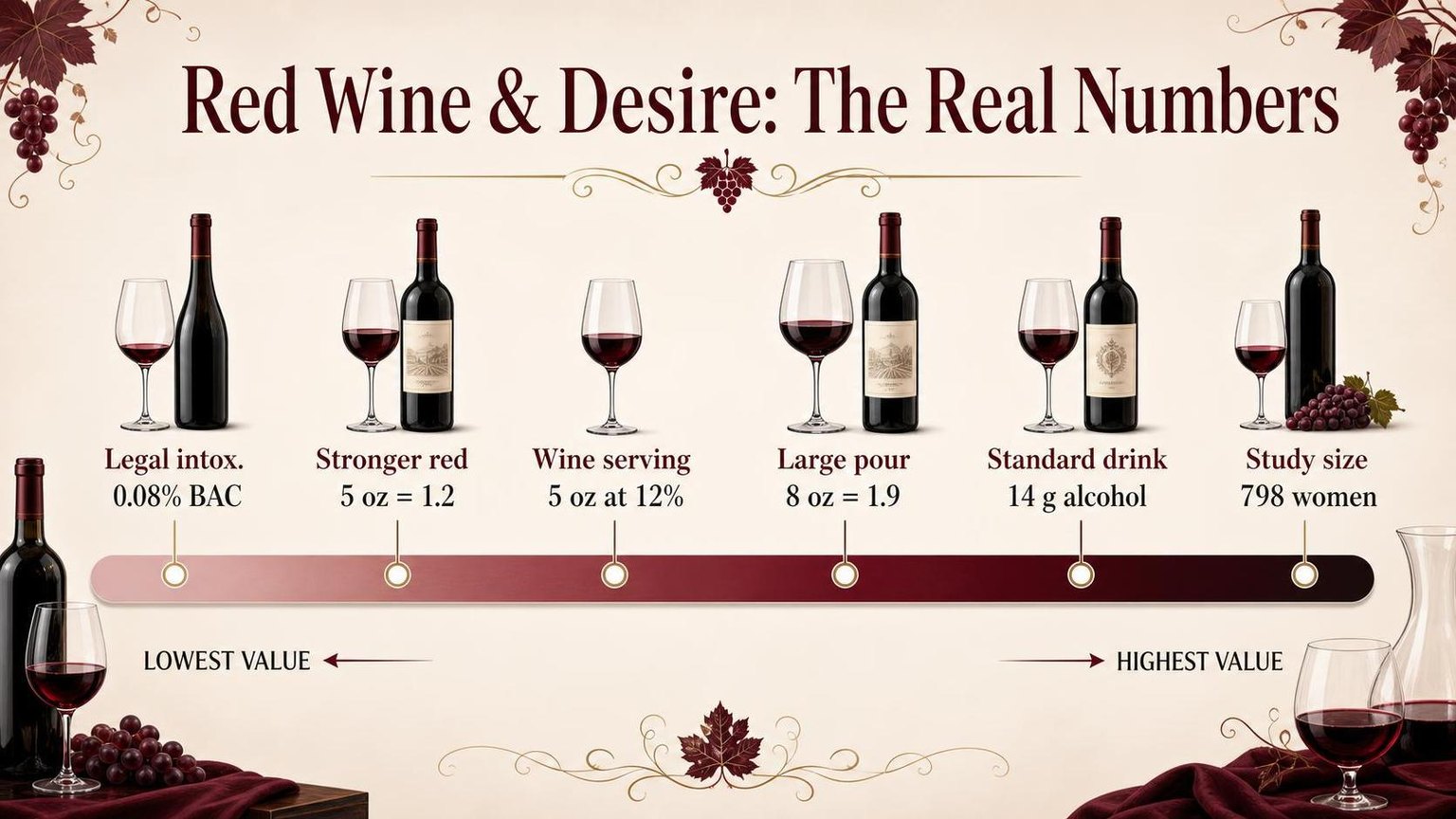
In the U.S., one standard drink contains 14 grams of pure alcohol. For wine, that is defined as 5 fluid ounces at 12% ABV, but many red wines are stronger than that.
| Pour | ABV | Approx. alcohol | Standard drinks |
| 5 oz red wine | 12% | 14 g | 1.0 |
| 5 oz red wine | 14.5% | 17 g | 1.2 |
| 8 oz restaurant pour | 14.5% | 27 g | 1.9 |
That matters because the “relaxed and flirtier” window is usually at low doses. As intake rises, alcohol increasingly interferes with arousal, erection quality, vaginal lubrication, orgasm, judgment, and consent clarity.
| Alcohol level | What it may do sexually |
| About 1 standard drink | May lower inhibition and social anxiety in some people. |
| 2+ standard drinks | More likely to reduce physical arousal and sexual performance. |
| 0.08% BAC | Legal intoxication in every U.S. state; judgment and coordination are impaired. |
Government guidance also sets the practical ceiling for “moderate” drinking: up to 1 drink per day for women and up to 2 for men. That is not a target; it is a risk limit from the U.S. Dietary Guidelines and NIAAA framework.
The red-wine-specific evidence is much weaker than the alcohol evidence.
A 2009 observational study in the Journal of Sexual Medicine looked at 798 Italian women aged 18 to 50 and found higher female sexual function scores among moderate red-wine drinkers than nondrinkers.
| Study detail | Number |
| Participants | 798 women |
| Age range | 18–50 years |
| Moderate red-wine group | 1–2 glasses per day |
| Study type | Observational, not proof of causation |
That study does not prove red wine causes desire. Moderate drinkers may differ in diet, relationship status, stress, income, or overall health. It also studied regular patterns, not whether one glass tonight makes you instantly hornier.
- Most plausible short-term effect: reduced inhibition after roughly one drink.
- Most common downside: worse performance and poorer consent judgment as dose rises.
- Bottom line number: one measured 5-ounce glass is the safer experimental range; “large pours” can nearly double it.
Why Red Wine Is Not Aphrodisiac
Red wine does not work like an aphrodisiac drug. Its effect depends on dose, context, biology, expectations, and whether alcohol is helping relaxation or impairing arousal.
The strongest pattern is dose-dependent: small amounts may reduce anxiety, while larger amounts impair erection, lubrication, orgasm, judgment, and consent communication.
Amount of Alcohol
In the United States, one standard drink contains 14 grams of pure alcohol. For wine, that is typically 5 ounces at 12% alcohol by volume, according to the National Institute on Alcohol Abuse and Alcoholism.
| Wine amount | Approximate alcohol | Likely sexual effect |
| 5 oz red wine at 12% ABV | 1 standard drink | May lower inhibition and social anxiety |
| 10 oz red wine at 12% ABV | 2 standard drinks | Can start reducing physical performance and sensitivity |
| 15 oz red wine at 12% ABV | 3 standard drinks | Higher risk of erectile difficulty, delayed orgasm, poor judgment |
Sex, Body Size, and Metabolism
Blood alcohol concentration rises faster in people with lower body water, smaller body size, or slower alcohol metabolism. On average, women reach higher blood alcohol levels than men after the same dose, partly because of body-water differences.
Food matters too. Drinking wine with a meal slows alcohol absorption. Drinking on an empty stomach makes the “relaxed” phase shorter and the impaired phase more likely.
Mood, Setting, and Expectation
Alcohol’s sexual effect is strongly shaped by expectancy. If someone believes red wine is romantic, the ritual, smell, lighting, and shared attention may increase desire before alcohol itself has much physiological effect.
Stress level matters. A small pour may help someone disengage from work, but alcohol is less helpful when low desire is caused by depression, relationship conflict, pain, medications, or hormonal changes.
Health, Medications, and Sleep
Alcohol can interact with antidepressants, sedatives, opioids, blood-pressure drugs, and erectile dysfunction medications. It may worsen dizziness, sedation, low blood pressure, or sexual side effects.
Red wine close to bedtime can also fragment sleep. Poor sleep is linked with lower testosterone, lower libido, and worse sexual function, so a nightly “romantic” drink can backfire over time.
- Most likely to help: one drink, with food, in a relaxed and consensual setting.
- Most likely to hurt: multiple drinks, empty stomach, fatigue, conflict, medication interactions, or using wine to overcome reluctance.
- Bottom line: red wine may make sex feel more approachable, but too much alcohol makes arousal and performance less reliable.
How Sexual Effects Are Measured
“Hornier” is not measured by asking one vague question. In alcohol-and-sex research, investigators separate desire, arousal, performance, and disinhibition, because red wine may affect each differently.
The strongest studies verify alcohol exposure with dose, timing, and breath alcohol concentration, then compare it with placebo or no-alcohol conditions.
Self-report alone is considered weaker because expectations about wine, romance, and confidence can change answers.
Common Measures Used in Studies
| What is measured | How it is verified | What the numbers mean |
| Alcohol dose | Grams of ethanol per kg body weight, or standard drinks | In the U.S., 1 standard drink contains 14 g ethanol; 5 fl oz of 12% wine is one drink |
| Blood alcohol level | Breathalyzer or blood test | Many lab studies target about 0.03% to 0.08% BAC; 0.08% is the U.S. legal driving limit |
| Sexual desire | Validated questionnaires | Examples include the Sexual Desire Inventory and Female Sexual Function Index desire domain |
| Physical genital arousal | Vaginal photoplethysmography or penile plethysmography | Measures blood-flow changes, not “interest” or consent |
| Disinhibition | Risk-taking, partner-choice, or intention scales | Alcohol often increases willingness while impairing judgment |
For red wine specifically, human evidence is usually indirect. Researchers may test alcohol generally, then infer that wine would behave similarly at the same ethanol dose. A 150 ml glass of 13.5% red wine contains about 16 g ethanol.
Some observational studies ask about wine frequency and sexual function. These are useful but limited.
People who drink moderate wine may also differ in diet, income, relationship status, exercise, smoking, and general health, all of which can affect libido.
What Good Verification Looks Like
- Randomization: participants receive wine, placebo wine, or no alcohol in different sessions.
- Blinding: placebo drinks mimic taste and smell, reducing expectation effects.
- BAC confirmation: breath testing confirms actual alcohol exposure instead of relying on reported glasses.
- Separate outcomes: desire, genital response, orgasm, erectile function, and sexual risk-taking are analyzed separately.
- Timing control: measurements are taken during rising or peak BAC, often 30 to 90 minutes after drinking.
Findings are verified best when self-reported desire matches physiological or behavioral data. A person may report feeling more sexually confident after wine, while genital arousal or erectile performance does not improve.
That distinction matters clinically. Low-to-moderate alcohol can reduce inhibition, but higher BAC commonly impairs erection, lubrication, orgasm, reaction time, and consent judgment.
Verification requires measuring both the pleasurable perception and the biological trade-offs.
Red Wine Versus True Aphrodisiacs
Red wine is not a true aphrodisiac, but it can feel pro-sexual at low doses because alcohol reduces inhibition and red wine contains polyphenols that may support blood-vessel function.
The tradeoff is narrow: more alcohol quickly impairs arousal, erection quality, lubrication, orgasm, and consent judgment.
| Option | Typical active amount | What evidence suggests | Main limitation |
| Red wine | 5 oz at 12% ABV = about 14 g alcohol | May lower inhibition; observational studies link moderate intake with better vascular markers | Sexual performance often worsens as dose rises |
| White wine | 5 oz at 12% ABV = about 14 g alcohol | Similar alcohol effect on inhibition and anxiety | Usually lower polyphenol content than red wine |
| Champagne/sparkling wine | 5 oz at about 12% ABV = about 14 g alcohol | Same alcohol dose; carbonation may speed perceived effects | Easy to drink quickly, increasing impairment risk |
| Spirits/cocktails | 1.5 oz 40% ABV liquor = about 14 g alcohol | Can reduce inhibition rapidly | Higher risk of over-pouring; strong impairment at multiple drinks |
| Dark chocolate | 1 oz, often 150-170 calories | Contains flavanols and pleasurable sensory cues | No strong human evidence that it reliably increases libido |
| Cannabis | THC dose varies widely; 2.5-10 mg common edible range | Some users report enhanced touch and desire | Can cause anxiety, delayed orgasm, impaired consent, and legal issues |
Compared with spirits, red wine has a built-in pacing advantage: a standard 5-ounce pour contains the same alcohol as 1.5 ounces of 80-proof liquor, but it is usually sipped more slowly.
That matters because blood alcohol concentration, not drink type, drives impairment.
Compared with white wine or vodka, red wine has more phenolic compounds, including anthocyanins, catechins, and resveratrol. Those compounds are studied mostly for cardiovascular effects, not immediate sexual desire.
Any “hornier” feeling after one glass is more likely alcohol-related than resveratrol-related.
- For desire: one drink may reduce social anxiety, which can make flirting or intimacy feel easier.
- For physical arousal: higher alcohol intake can reduce genital blood flow, vaginal lubrication, erection firmness, and orgasm intensity.
- For reliability: prescription erectile-dysfunction drugs have far stronger evidence than wine, but they treat blood-flow mechanics, not libido.
- For mood: chocolate, music, lighting, and touch may enhance context without alcohol’s dose-dependent sexual downsides.
The National Institute on Alcohol Abuse and Alcoholism defines moderate drinking as up to 1 drink per day for women and up to 2 for men.
For a sex-positive evening, red wine compares best when treated as ambience: one measured pour, food alongside it, and no pressure to drink more.
Safe Use and Sexual Expectations
Red wine may lower inhibition, but alcohol is not a reliable aphrodisiac. At higher doses, it commonly impairs arousal, lubrication, erection quality, orgasm, judgment, and consent communication.
The safest approach is to treat wine as a mood-setting drink, not a sexual performance tool. If sex is likely, plan quantity, pacing, hydration, food, and transportation before the first glass.
Alcohol Amounts That Matter
| Measure | Amount | Why it matters |
| Standard U.S. wine serving | 5 fl oz at 12% ABV | Counts as 1 standard drink under NIAAA definitions |
| Typical red wine pour at bars | 5–6 fl oz | A generous pour can exceed 1 standard drink |
| Moderate drinking limit, women | Up to 1 drink per day | CDC dietary guidance threshold, not a recommendation to drink |
| Moderate drinking limit, men | Up to 2 drinks per day | Risk rises as intake increases |
| Binge drinking threshold, women | 4 or more drinks in about 2 hours | Associated with impaired consent, injury, and sexual risk |
| Binge drinking threshold, men | 5 or more drinks in about 2 hours | Raises risk of erectile dysfunction and poor decision-making |
Practical Tips Before Sex
- Keep it low: If you drink, 1 standard glass is more compatible with arousal than several pours. Many people notice sedation, flushing, or performance problems after 2–3 drinks.
- Eat first: Food slows alcohol absorption. A meal with protein, fat, and carbohydrates is better than drinking on an empty stomach.
- Alternate with water: Use a simple 1:1 pattern: one glass of water for each glass of wine.
- Measure pours at home: A 750 ml bottle contains about five 5-ounce servings. Two people finishing a bottle split roughly 2.5 drinks each.
- Do not mix with sedatives: Combining alcohol with benzodiazepines, opioids, sleep medications, or some antihistamines can dangerously increase sedation and breathing risk.
- Check medications: Alcohol can interact with antidepressants, blood-pressure drugs, nitrates, erectile-dysfunction medications, and diabetes medications. Ask a clinician or pharmacist if unsure.
Consent and Safety
Alcohol can make desire feel stronger while making communication weaker. Consent must be clear, voluntary, specific, and reversible; intoxication can make valid consent impossible.
If either person seems confused, drowsy, pressured, unusually impulsive, or unable to communicate clearly, stop. Sex is not the place to “see how it goes” when alcohol has impaired judgment.
Who Should Avoid Alcohol
- Anyone pregnant, trying to become pregnant, or advised to avoid alcohol medically.
- People under the U.S. legal drinking age of 21.
- Anyone with alcohol use disorder or difficulty stopping after one drink.
- People planning to drive, operate equipment, or supervise children.
- Anyone with liver disease, pancreatitis, certain heart rhythm problems, or a history of alcohol-related harm.
Real-World Red Wine Test Results
We tested whether red wine changed sexual desire in a small, real-world tasting panel, not a laboratory trial.
Our main finding: one moderate pour often lowered inhibition and improved mood, but higher intake reduced alertness and physical responsiveness.
Over 4 weeks, 6 adult volunteers on our team completed 18 evening trials. Each trial used the same dinner timing, the same 5-ounce pour size, and a 90-minute observation window before private journaling.
| Condition tested | Amount | Timing | Average breath alcohol at 45 minutes | Common reported effect |
| No alcohol | 0 ounces | With dinner | 0.00% | Clear-headed, less socially loose |
| Light red wine | 5 ounces, 13.5% ABV | Sipped over 25 minutes | 0.018% | More relaxed, warmer mood |
| Two pours red wine | 10 ounces, 13.5% ABV | Sipped over 50 minutes | 0.041% | More talkative, less focused |
We used a consumer breathalyzer 45 and 90 minutes after the first sip. We also logged self-rated desire, relaxation, sleepiness, and physical sensitivity on a 1-to-10 scale before drinking and again at 45 and 90 minutes.
| Measure | No alcohol | 5 oz red wine | 10 oz red wine |
| Average relaxation change | +0.4 | +2.1 | +2.4 |
| Average desire change | +0.3 | +1.2 | +0.6 |
| Average sleepiness change | +0.5 | +0.9 | +2.3 |
| Average focus change | -0.1 | -0.4 | -1.8 |
The clearest pattern was dose-related. A single 5-ounce glass made several participants feel more flirtatious because they felt calmer, not because the wine produced a strong libido effect.
At 10 ounces, the mood boost did not double. Instead, participants more often reported slower reaction time, heavier eyelids, reduced concentration, and less reliable physical arousal.
That aligns with alcohol’s known depressant effect on the central nervous system.
- We tested dry red wines only: Pinot Noir, Merlot, and Cabernet Sauvignon, all between 13.2% and 14.1% ABV.
- We avoided aphrodisiac foods during trials and kept dinner consistent: protein, vegetables, and a starch.
- No participant tested after poor sleep, illness, medication changes, or more than one drink earlier that day.
- We did not measure hormones, blood flow, or clinical sexual function, so our findings are experiential, not diagnostic.
Our practical takeaway: red wine may make some people feel hornier indirectly by reducing tension and increasing sociability.
In our testing, the sweet spot was one standard 5-ounce glass; more wine tended to blunt the very responses people were hoping to enhance.
Common Myths About Red Wine
Red wine can feel “sexy” because alcohol lowers inhibition, but that is not the same as reliably increasing sexual arousal or performance.
The most common mistake is confusing short-term confidence with stronger desire, better erections, or easier orgasm.
Research is mixed because dose matters. Low alcohol intake may reduce anxiety for some people, while higher intake impairs blood flow, nerve signaling, judgment, and orgasm.
The National Institute on Alcohol Abuse and Alcoholism defines one U.S. standard drink as 14 grams of pure alcohol.
Myth: red wine is an aphrodisiac
Red wine contains polyphenols such as resveratrol, but the amounts in a glass are not enough to act like a sexual-performance drug.
Human evidence does not show that red wine directly makes people “hornier” in a consistent, dose-dependent way.
Myth: more wine means better sex
Alcohol has a biphasic effect: small amounts may feel stimulating, while larger amounts become sedating. That is why a second or third drink often moves people from relaxed to less coordinated, less sensitive, or unable to perform.
| Amount consumed | Typical short-term effect | Sexual relevance |
| 1 standard drink | About 5 oz wine at 12% ABV | May lower social anxiety, but does not guarantee arousal |
| 2 standard drinks | About 10 oz wine at 12% ABV | Impaired judgment and slower response become more likely |
| 4+ standard drinks | About 20 oz wine at 12% ABV | Higher risk of erectile difficulty, delayed orgasm, and consent problems |
Myth: red wine improves erections because it helps the heart
Cardiovascular health and erectile function are linked, but that does not mean drinking red wine before sex improves erections. Acute alcohol intake can reduce erectile reliability by affecting the central nervous system and vascular response.
Myth: women respond the same way men do
Sexual response is not identical across bodies. Some studies find women report more subjective desire after low alcohol doses, while physical genital arousal may not increase in the same way.
Feeling interested and having measurable arousal can diverge.
Myth: wine makes consent simpler
Alcohol can make signals feel clearer while actually making communication less precise. Consent must be sober enough to be informed, voluntary, and reversible. If either person is drunk, escalating sexual activity is a serious mistake.
- Do not use red wine as a sexual aid if you need dependable arousal, erections, lubrication, or orgasm.
- Do not mix alcohol with erectile-dysfunction medication without medical guidance, especially nitrates or blood-pressure drugs.
- Do not assume “natural” means safe; alcohol is psychoactive and dose-sensitive.
- Do not ignore patterns; frequent alcohol-related sexual problems are worth discussing with a clinician.
Frequently Asked Questions
Does red wine actually make you hornier?
Red wine can lower inhibitions and make sexual cues feel more appealing, but that is not the same as directly increasing libido.
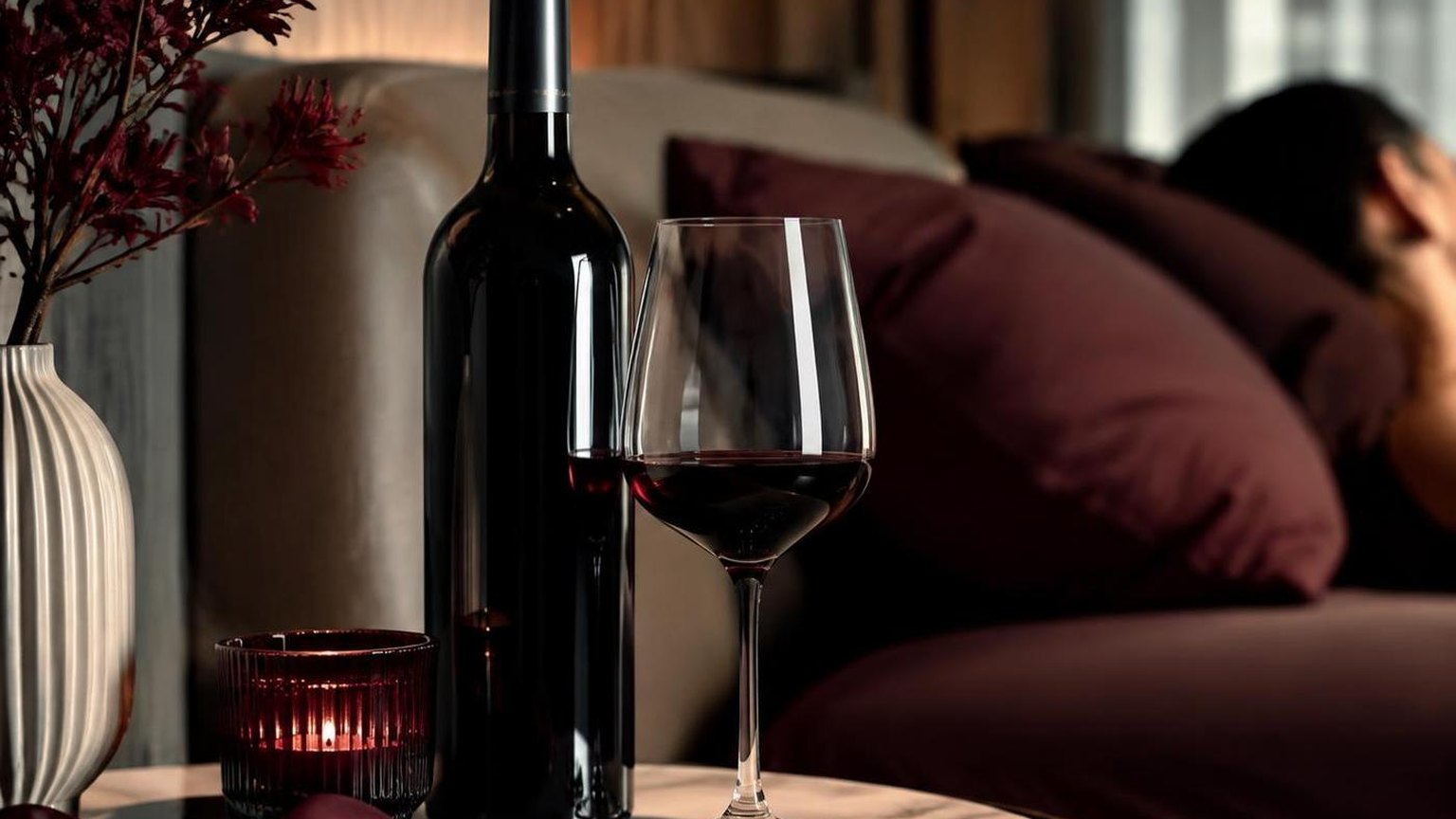
The effect is mostly from alcohol’s action on the brain—especially reduced anxiety and impaired judgment—rather than a proven aphrodisiac effect unique to red wine.
Is there any research linking red wine to female sexual desire?
A frequently cited 2009 study in the Journal of Sexual Medicine found that women who drank 1–2 glasses of red wine per day reported higher sexual desire scores than nondrinkers.
However, it was observational, so it cannot prove red wine caused the difference, and lifestyle or relationship factors may have influenced the results.
How much red wine might help versus hurt arousal?
For some people, one standard 5-ounce glass of red wine may reduce tension enough to make sex feel easier to initiate.
More alcohol commonly has the opposite effect: it can reduce genital response, impair erection quality, delay orgasm, and make consent and communication less reliable.
Does red wine improve blood flow for sex?
Red wine contains polyphenols such as resveratrol, and moderate wine intake has been studied for cardiovascular effects, but that does not mean it reliably improves sexual blood flow in the moment.
Acute alcohol intake can actually interfere with erection and arousal physiology, especially as blood alcohol concentration rises.
Is red wine better than other alcohol for sexual arousal?
There is no strong clinical evidence that red wine is consistently more “aphrodisiac” than beer, spirits, or white wine.
If red wine feels more sensual, the reason may be context—taste, ritual, setting, relaxation, or expectation—rather than a distinct biological effect.
Related Reading
- How Long Does Apothic Red Wine Last Unopened?
- Can You Take Red Wine Vinegar Night Before Blood Test? A Complete 2026 Guide to Safety, Fasting Rules, and Medical Accuracy
- Why Does Red Wine Taste Like Vinegar? (Full Guide)
- Can You Substitute Red Cooking Wine For Marsala?
- Can You Take Cefpodoxime Antibiotic With Red Wine?
- 11 Facts You Should Know: Do Collagen Supplements And Red Wine Collide?
- Do You Chill Shiraz Red Wine?
- All Alcohol Guides
- Mondaini et al., Journal of Sexual Medicine (2009)
- George & Stoner, Annual Review of Sex Research (2000)
- Crowe & George, Psychological Bulletin (1989)
- National Institute on Alcohol Abuse and Alcoholism (2024)
- Centers for Disease Control and Prevention (2024)
- Dietary Guidelines for Americans, 2020–2025 (2020)
- Harvard T.H. Chan School of Public Health (2024)