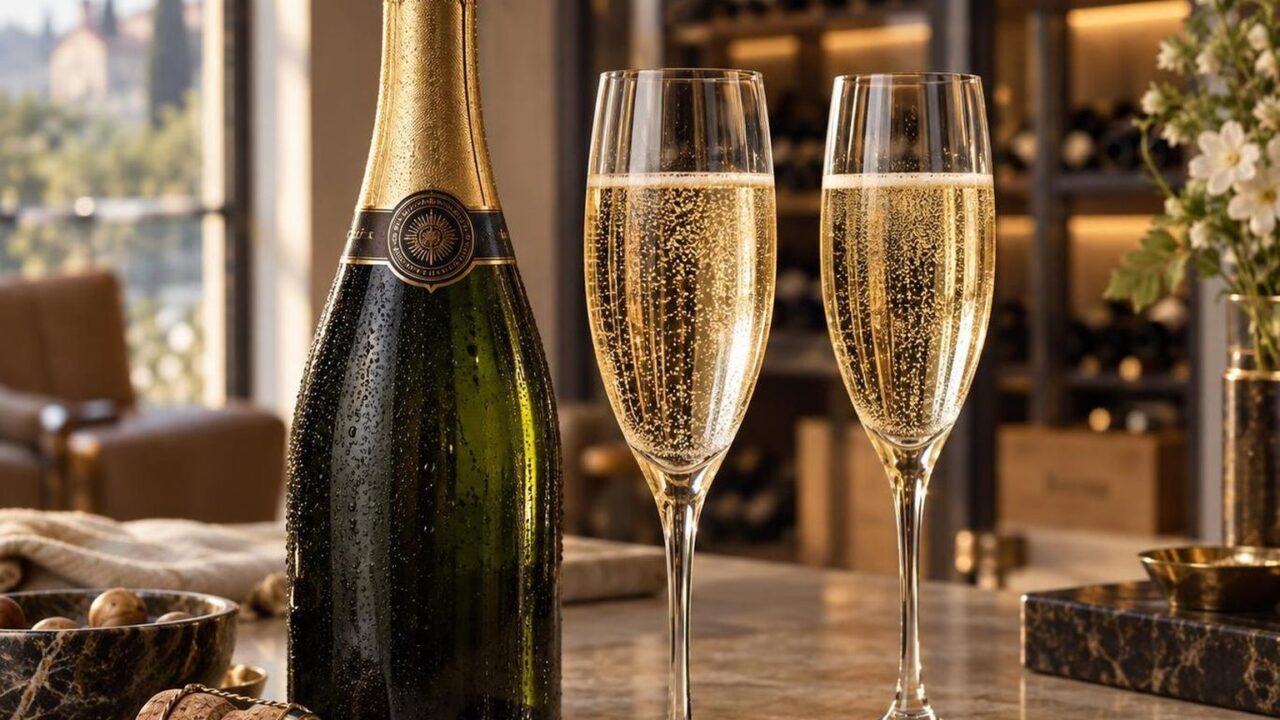
Does Champagne Get Better with Age? is answered by style: vintage Champagne can gain toast, honey, and nutty complexity, while most non-vintage bottles are released ready to drink.
Aging depends on acidity, dosage, lees time, cork condition, and storage near 53-57°F. Prestige cuvées and vintage bottlings usually have the structure for cellaring; simple non-vintage Champagne often tastes freshest within a few years of purchase.
This guide explains which bottles improve, which decline, what flavors develop, and how to store Champagne so aging adds depth instead of flattening the wine.
What Aging Does to Champagne
Aging transforms Champagne through a series of well-documented chemical reactions.
The process fundamentally alters aroma, texture, and flavor, turning a bright, fruit-forward wine into something richer and more complex over months, years, or even decades.
Autolysis: The Foundation of Complexity
After secondary fermentation in bottle, dead yeast cells (lees) break down in a process called autolysis. This releases amino acids, mannoproteins, and polysaccharides into the wine over extended periods of lees contact.
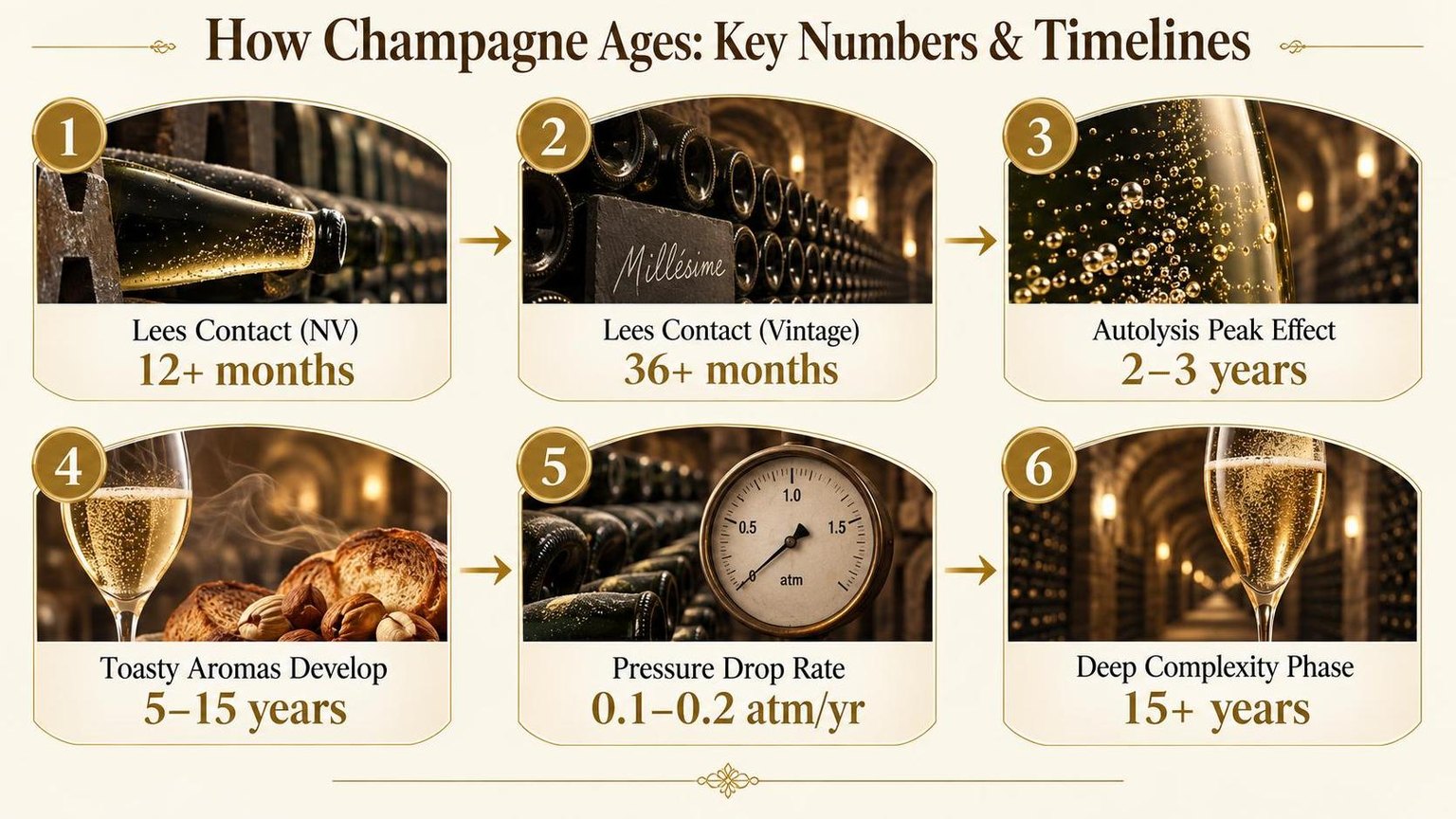
Non-vintage Champagne requires a minimum of 12 months on lees by law. Vintage Champagne requires at least 36 months.
Many top houses far exceed these minimums—Krug Grande Cuvée spends approximately 7 years on lees, and Dom Pérignon typically rests 8 to 10 years before release.
Autolysis produces measurable changes.
Research published in the Journal of Agricultural and Food Chemistry found that mannoproteins increase significantly after 2 to 3 years on lees, directly contributing to the creamy mouthfeel prized in aged Champagne.
Maillard Reaction and Oxidative Development
After disgorgement, a slow Maillard reaction between amino acids and residual sugars generates toasty, biscuity, and brioche-like aromas. These compounds intensify progressively over 5 to 15 years of post-disgorgement aging.
Controlled oxidation also plays a role. The crown cap permits oxygen transfer at roughly 0.5 to 1.0 mg per year, gradually shifting the aromatic profile from primary fruit toward tertiary notes of honey, dried fruit, and truffle.
How Flavor Profiles Shift Over Time
| Age Range | Primary Characteristics | Typical Aromas |
| 0–3 years after disgorgement | High acidity, vibrant mousse | Citrus, green apple, white flowers |
| 3–7 years after disgorgement | Softening acidity, creamier texture | Brioche, toasted almonds, peach |
| 7–15 years after disgorgement | Reduced mousse, fuller body | Honey, dried apricot, ginger |
| 15+ years after disgorgement | Minimal effervescence, deep complexity | Truffle, coffee, caramel, mushroom |
Pressure and Mousse Evolution
A freshly disgorged Champagne holds approximately 5 to 6 atmospheres of pressure. This decreases gradually—around 0.1 to 0.2 atmospheres per year under ideal storage conditions at 10–12°C (50–54°F).
After 20 to 30 years, pressure can drop to 2 to 3 atmospheres, producing a gentler, finer bead rather than aggressive fizz. Many collectors consider this softer mousse a desirable trait in well-aged bottles.
Acidity as the Backbone
Champagne’s high natural acidity—typically 7 to 9 g/L total acidity at disgorgement—acts as a preservative.
Wines with higher acid levels age more gracefully, which is why Chardonnay-dominant Blanc de Blancs from cool sites like Le Mesnil-sur-Oger often show the greatest longevity.
- Tartaric acid remains stable over decades, maintaining structural freshness
- Malic acid, if not fully converted during malolactic fermentation, softens gradually
- Perception of acidity decreases as amino acids and sugars develop balancing richness
Vintage vs Non Vintage Aging
Vintage and non-vintage Champagnes follow fundamentally different aging trajectories. Understanding the distinction determines whether a bottle rewards patience or demands promptness.
Non-Vintage Champagne: The Baseline
Non-vintage (NV) Champagne blends multiple harvest years to maintain a consistent house style. It represents roughly 80–85% of all Champagne production.
EU regulations require a minimum 15 months of aging on lees before disgorgement, with at least 12 of those months on lees. Most reputable houses exceed this significantly.
| Producer | NV Lees Aging | Post-Disgorgement Rest |
| Moët & Chandon Impérial | ~18 months | 3–6 months |
| Veuve Clicquot Yellow Label | ~30 months | 3–6 months |
| Krug Grande Cuvée | ~72 months (6 years) | 6+ months |
| Louis Roederer Collection | ~36 months | 6–8 months |
Most NV Champagnes drink best within 3–5 years of disgorgement. After that, they lose freshness and mousse without gaining meaningful complexity.
Exceptions exist. Krug Grande Cuvée, with its extensive lees aging and multi-vintage reserve wine blend (sometimes spanning 10+ years), can evolve beautifully for a decade or more after disgorgement.
Vintage Champagne: Built to Age
Vintage (also called millésimé) Champagne uses grapes exclusively from a single declared year. Houses typically declare a vintage only in exceptional harvests—roughly 3–4 times per decade.
The legal minimum lees aging for vintage Champagne is 36 months. Top producers far exceed this requirement.
| Producer & Cuvée | Vintage Lees Aging | Cellar Potential After Release |
| Dom Pérignon | ~7–8 years | 15–25 years |
| Pol Roger Cuvée Winston Churchill | ~8–10 years | 20–30 years |
| Bollinger La Grande Année | ~5–6 years | 15–20 years |
| Taittinger Comtes de Champagne | ~8–10 years | 20–30 years |
| Salon Le Mesnil | ~10 years | 30–50 years |
Vintage Champagnes develop autolytic flavors—brioche, toasted nuts, honey—that intensify with bottle age. The best examples gain richness while retaining structural acidity.
Key Differences That Affect Aging
- Dosage: NV Champagnes typically carry 8–12 g/L dosage; vintage cuvées often use 5–8 g/L, giving them a tighter structure that unfolds slowly.
- Acidity: Vintage wines are selected from high-quality years with balanced acidity, providing a stronger aging backbone.
- Extract and concentration: Single-year wines from exceptional harvests contain more phenolic material, which evolves over decades.
- Closure pressure: A fresh Champagne holds about 6 atmospheres of pressure. This slowly diminishes—vintage bottles stored properly retain finer, more integrated bubbles over 20+ years.
Storage conditions matter equally for both categories. A temperature of 10–12°C (50–54°F), consistent humidity around 70%, and darkness are non-negotiable for any long-term cellaring.
The practical takeaway: drink NV within a few years of purchase, and cellar vintage Champagne confidently for a decade or more when properly stored.
How Long Champagne Can Improve
Champagne’s aging potential depends on its category, storage conditions, and base wine quality.
Non-vintage cuvées peak within 3–7 years of disgorgement, while prestige cuvées from exceptional vintages can evolve beautifully for 20–40 years or more.
Champagne ages differently from still wine because dissolved CO₂ acts as a preservative alongside acidity and, in some cases, dosage sugar. These three factors collectively slow oxidation and extend shelf life well beyond what most consumers assume.
Aging Windows by Champagne Category
| Category | Minimum Aging Before Release | Peak Drinking Window | Maximum Potential |
| Non-Vintage Brut | 15 months on lees | 3–7 years from disgorgement | 8–10 years |
| Vintage/Millésimé | 36 months on lees | 7–15 years from vintage | 20–25 years |
| Prestige Cuvée (e.g., Dom Pérignon, Krug) | 5–10 years on lees | 10–25 years from vintage | 30–50+ years |
| Blanc de Blancs (100% Chardonnay) | 36 months on lees | 8–20 years from vintage | 25–40 years |
| Rosé (Vintage) | 36 months on lees | 5–12 years from vintage | 15–20 years |
These windows assume proper cellaring at 10–13°C (50–55°F), 70% humidity, and away from light and vibration. Deviations significantly shorten potential.
What Changes During Extended Aging
- Effervescence: Bubbles become finer and more integrated. A 20-year-old champagne typically retains approximately 4–5 atmospheres of pressure versus 5.5–6 atmospheres at release.
- Color: Pale gold deepens to amber. Blanc de Blancs shifts from green-gold to rich burnished gold over 15+ years.
- Aroma: Primary citrus and floral notes give way to brioche, toasted nuts, honey, dried apricot, and mushroom—compounds generated through Maillard reactions and amino acid breakdown.
- Acidity: Perceived acidity softens as tartaric acid integrates, though total acidity remains relatively stable. This creates a rounder mouthfeel.
Documented Examples of Exceptional Aging
Krug 1928 has been tasted in the 2000s and described as still vibrant. The 1959 Dom Pérignon regularly earns 95+ points at modern tastings, demonstrating 60+ years of development.
In 2010, divers recovered approximately 170 bottles of Veuve Clicquot and Heidsieck from an 1840s shipwreck in the Baltic Sea. Tasters found them drinkable after roughly 170 years, though heavily evolved.
When Aging Becomes Decline
Past peak, champagne loses effervescence entirely and develops sherry-like oxidative notes. Fruit fades to a flat, nutty character without compensating complexity.
Dosage-heavy champagnes (above 8 g/L residual sugar) tend to decline faster than brut nature or extra brut bottlings.
The critical indicator is disgorgement date, not vintage alone. Two identical bottles disgorged years apart will age on different trajectories. Always check back labels for this information when planning long-term cellaring.
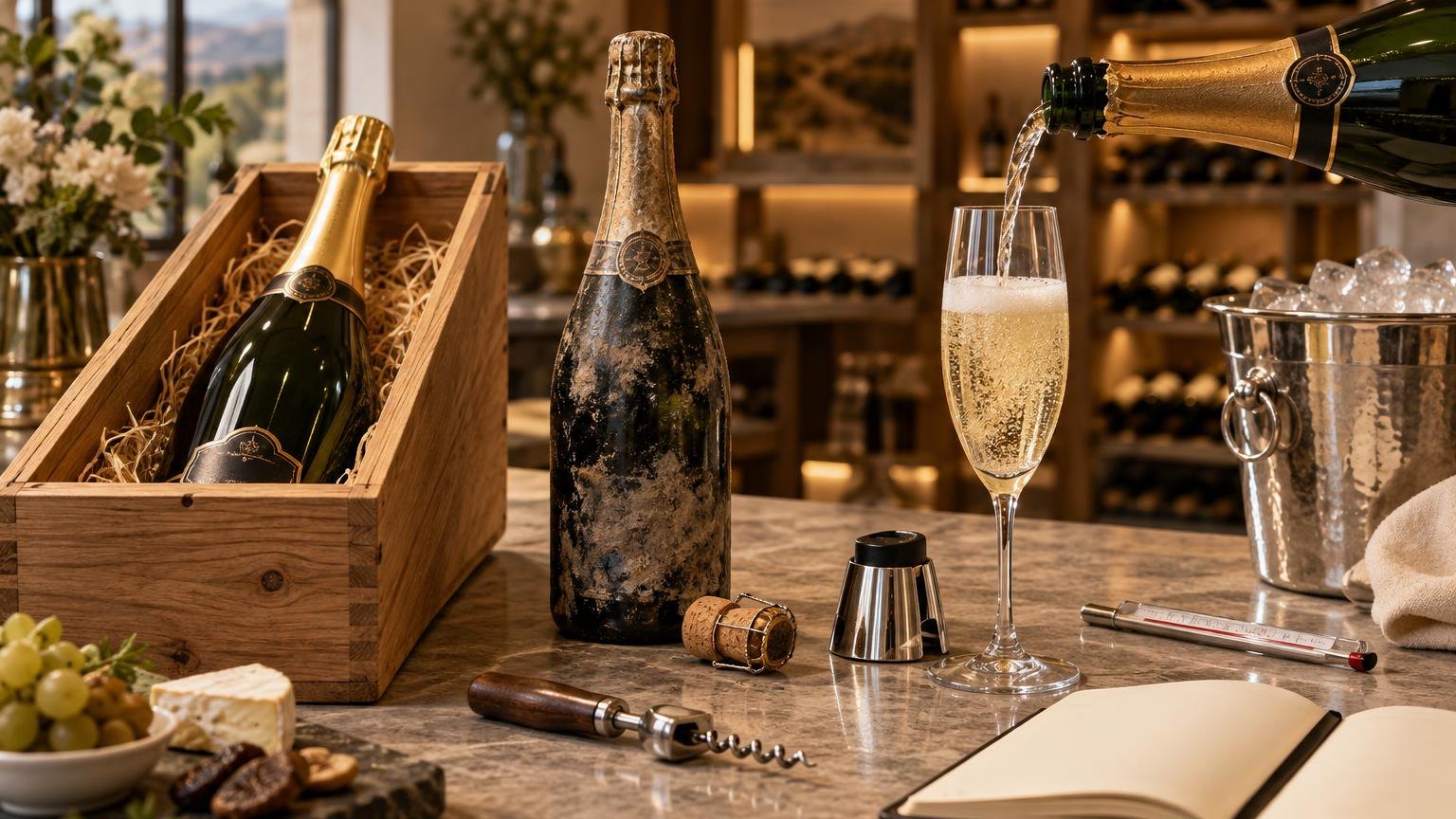
When Aged Champagne Tastes Worse
Not every Champagne improves with time. Most bottles sold today are non-vintage blends designed for immediate consumption, and aging them beyond 3–5 years often strips away freshness without adding complexity.
Understanding when aging backfires saves both money and disappointment.
Non-Vintage Champagne Has a Shelf Life
Non-vintage (NV) Champagne accounts for roughly 80–85% of all Champagne production. These wines undergo a minimum of 15 months of lees aging before disgorgement, per AOC regulations.
Most NV cuvées peak within 1–3 years of disgorgement. After 5 years, oxidative notes frequently overwhelm the fruit, and mousse intensity drops measurably.
What Goes Wrong During Excessive Aging
- Loss of mousse: CO₂ slowly escapes through the cork at a rate of approximately 2–4 mg per year. After 10+ years, a NV Champagne can lose enough pressure to taste flat.
- Oxidation: Crown-capped bottles resist oxygen better than cork-finished ones. A standard cork allows roughly 1 mg of oxygen ingress per year, accelerating browning and stale flavors.
- Volatile acidity rise: Poorly stored bottles develop acetic acid notes—vinegar-like sharpness that no amount of further aging corrects.
- Light strike: UV exposure triggers a sulfur compound reaction (dimethyl disulfide) that produces “wet wool” or “cardboard” off-flavors within hours of exposure.
Storage Failures That Accelerate Decline
Temperature is the single greatest risk factor. Champagne stored above 18°C (64°F) ages at roughly double the rate of wine held at the ideal 10–12°C (50–54°F).
| Storage Condition | Expected NV Shelf Life | Expected Vintage Shelf Life |
| 10–12°C, dark, horizontal | 3–5 years post-disgorgement | 10–25 years |
| 15–18°C, some light | 1–2 years | 5–10 years |
| 20°C+, upright, variable humidity | 6–12 months | 2–4 years |
Styles That Age Poorly
Blanc de Blancs from lighter vintages and rosé Champagnes made via saignée method are especially fragile. Their lower phenolic content provides less natural antioxidant protection.
Demi-sec and doux Champagnes, with 32–50+ g/L dosage, can develop cloying caramelized flavors after 5–7 years that mask any tertiary complexity.
The Disgorgement Date Matters More Than the Vintage
A 2012 vintage disgorged in 2023 is functionally younger than one disgorged in 2018. Since 2003, producers including Krug, Bollinger, and Pol Roger print disgorgement dates or back-label codes.
Without this date, consumers are guessing. A bottle sitting on a retail shelf for 3 years under fluorescent lighting has already suffered measurable degradation regardless of its original quality.
The takeaway: aging Champagne demands the right bottle, the right storage, and realistic expectations. When any element fails, the wine doesn’t plateau—it deteriorates.
Best Storage for Aging Champagne
Champagne demands stricter storage conditions than still wine because dissolved CO₂ makes it more vulnerable to temperature fluctuations and light exposure.
Even premium vintages deteriorate rapidly under poor conditions, losing mousse quality and developing premature oxidation within months.
Temperature Control
Maintain a constant 10–12 °C (50–54 °F). Research from the CIVC (Comité Interprofessionnel du Vin de Champagne) confirms that temperatures above 18 °C accelerate oxidative aging by roughly 2× compared to proper cellar conditions.
Temperature swings matter more than absolute temperature. Fluctuations greater than 2 °C per day stress the cork seal, allowing micro-oxidation and CO₂ loss that flatten the wine’s perlage irreversibly.
| Factor | Ideal Range | Risk Threshold |
| Temperature | 10–12 °C | Above 16 °C or below 7 °C |
| Humidity | 70–75% | Below 50% (cork dries, leaks CO₂) |
| Light exposure | 0 lux (total darkness) | Any UV or fluorescent light |
| Vibration | None | Continuous vibration (e.g., near appliances) |
| Daily temp swing | Less than 1 °C | Greater than 2 °C |
Humidity and Cork Integrity
Keep relative humidity between 70% and 75%. Below 50%, natural cork shrinks and loses its seal. Champagne corks are wider (31 mm vs.
24 mm for still wine corks) and compressed under 5–6 atmospheres of pressure, making seal failure especially damaging.
Unlike still wine, store Champagne bottles horizontally or at a slight downward angle. This keeps the cork moist from the inside while the internal pressure supplements the seal from within.
Light Protection
Champagne is extremely light-sensitive.
A 2001 study published in the Journal of Agricultural and Food Chemistry demonstrated that exposure to fluorescent light for just 2 hours triggered measurable increases in sulfur compounds,.
Producing “light-struck” or “goût de lumière” off-flavors.
Dark green glass filters roughly 90% of UV, but clear or rosé-tinted bottles offer almost no protection. Store all bottles in complete darkness or wrapped in tissue.
Vibration and Position
Vibration disturbs sediment and can accelerate chemical reactions in aging Champagne. Avoid storing bottles near refrigerator compressors, washing machines, or HVAC units.
A passive underground cellar with stone or concrete walls remains the gold standard.
Practical Storage Options
- Dedicated wine cellar: Best option — stable temperature, natural humidity, zero light. Construction costs average $15,000–$50,000 in the US.
- Wine refrigerator (dual-zone): Reliable units from EuroCave or Le Cache hold 10–12 °C with 60–70% humidity. Expect $1,500–$5,000 for 100+ bottle capacity.
- Professional off-site storage: Climate-controlled wine warehouses charge $12–$25 per case per month and guarantee optimal conditions year-round.
Proper storage is non-negotiable for aging Champagne beyond 5 years. A $200 bottle stored carelessly will underperform a $50 bottle cellared correctly — environment determines outcome more than price.
Common Questions
Does non-vintage Champagne improve with additional cellaring?
Most non-vintage (NV) Champagne is blended for immediate enjoyment and reaches consumers after a minimum 15 months of aging on lees at the house.
However, well-made NV bottlings from producers like Krug Grande Cuvée or Bollinger Special Cuvée can develop richer, more toasty and biscuity notes with 2–5 additional years in a cool cellar.
Beyond that window, NV cuvées typically lose freshness without gaining meaningful complexity.
How long can vintage-dated (vintage) Champagne age?
Vintage Champagnes are produced only in exceptional years and must age a minimum of 36 months on lees before disgorgement, though top houses like Dom Pérignon and Salon often age them 7–10 years before release.
Once released, the finest vintage Champagnes—particularly blanc de blancs from Grand Cru villages like Le Mesnil-sur-Oger—can continue evolving for 20–40 years, developing aromas of brioche, dried apricot, honey, and truffle.
What chemical processes drive aging in Champagne?
Autolysis—the breakdown of dead yeast cells during lees aging—releases amino acids and mannoproteins that create the toasty, creamy texture prized in aged Champagne.
After disgorgement, slower oxidative reactions convert fresh citrus and green-apple notes into more complex compounds producing flavors of hazelnut, caramel, and mushroom.
The Maillard reaction between amino acids and residual sugars also contributes brown, biscuity aromas over time.
Does the grape variety affect how well a Champagne ages?
Chardonnay-dominant Champagnes (blanc de blancs) are widely regarded as the longest-aging style due to Chardonnay’s naturally high acidity, which acts as a preservative; benchmark bottles from Salon or Pierre Péters can peak after 25–30 years.
Pinot Noir–dominant cuvées age well but tend to reach maturity faster, typically within 10–20 years.
Pinot Meunier–heavy blends are generally designed for earlier consumption, as the grape produces softer acidity and less aging potential.
What storage conditions does Champagne need to age properly?
Champagne requires a constant temperature between 10–13 °C (50–55 °F), humidity around 70%, darkness, and minimal vibration—the same conditions as fine still wine.
Temperature fluctuations above 20 °C accelerate oxidation and can push corks, allowing CO₂ to escape and air to enter.
Bottles stored upright long-term risk cork drying, which compromises the seal; horizontal storage keeps the cork moist and maintains the internal pressure of roughly 6 atmospheres.
Does dosage level influence Champagne’s aging trajectory?
Brut Champagne (up to 12 g/L residual sugar) and Extra Brut (0–6 g/L) tend to age more gracefully because lower sugar allows the wine’s acidity and autolytic complexity to remain the focal point as it evolves.
Higher-dosage styles like Demi-Sec (32–50 g/L) can become cloying over decades as acidity fades while sugar remains constant.
Zero-dosage (Brut Nature) Champagnes demand flawless fruit and high acidity at base-wine stage, or they risk tasting lean and austere with extended aging.
How can you tell if a Champagne is past its prime?
An over-the-hill Champagne shows a deep amber-gold color, flat or minimal mousse upon pouring, and aromas dominated by wet cardboard, stale nuts, or vinegar rather than pleasant oxidative notes.
On the palate, the acidity will taste hollow and the fruit will have disappeared, leaving only bitter, tired flavors.
A reliable indicator is the disgorgement date printed on the back label—increasingly standard among quality producers like Bollinger and Roederer—which lets you calculate how long the wine has been off its lees and exposed to.
Post-disgorgement aging.
Further Reading
- How Champagne Is Made? The Most Understandable Information
- Best Champagne in Costco: The Ultimate 2026 Guide to Affordable Luxury
- How To Bottle Elderflower Champagne? — A Complete Professional Guide to Safe Bottling, Fermentation Control, and Long-Term Storage
- How Long Does Unopened Champagne Last? 9 Surprising Truths You Need to Know
- 11 Essential Facts About How Much Alcohol Is In Champagne (2026 ABV Guide, Serving Strength, Effects & Real Tasting Experience)
- All Alcohol Guides
- Comité Champagne (CIVC) (2024)
- Journal of Agricultural and Food Chemistry – PubMed (2015)
- USDA FoodData Central – Wine, table, white (2024)
- University of California, Davis – Viticulture & Enology (2023)
- National Center for Biotechnology Information – Maillard Reaction in Wine Aging (2019)
- The Institute of Masters of Wine (2023)
- Cornell University – College of Agriculture and Life Sciences, Enology Extension (2024)
- Decanter – How Long Can You Age Champagne? (2023)
- Wine Spectator – Aging Champagne Guide (2022)
- Jancis Robinson MW (2023)