FlightWineBar is reader-supported. When you buy through links on this page, we may earn an affiliate commission at no extra cost to you.
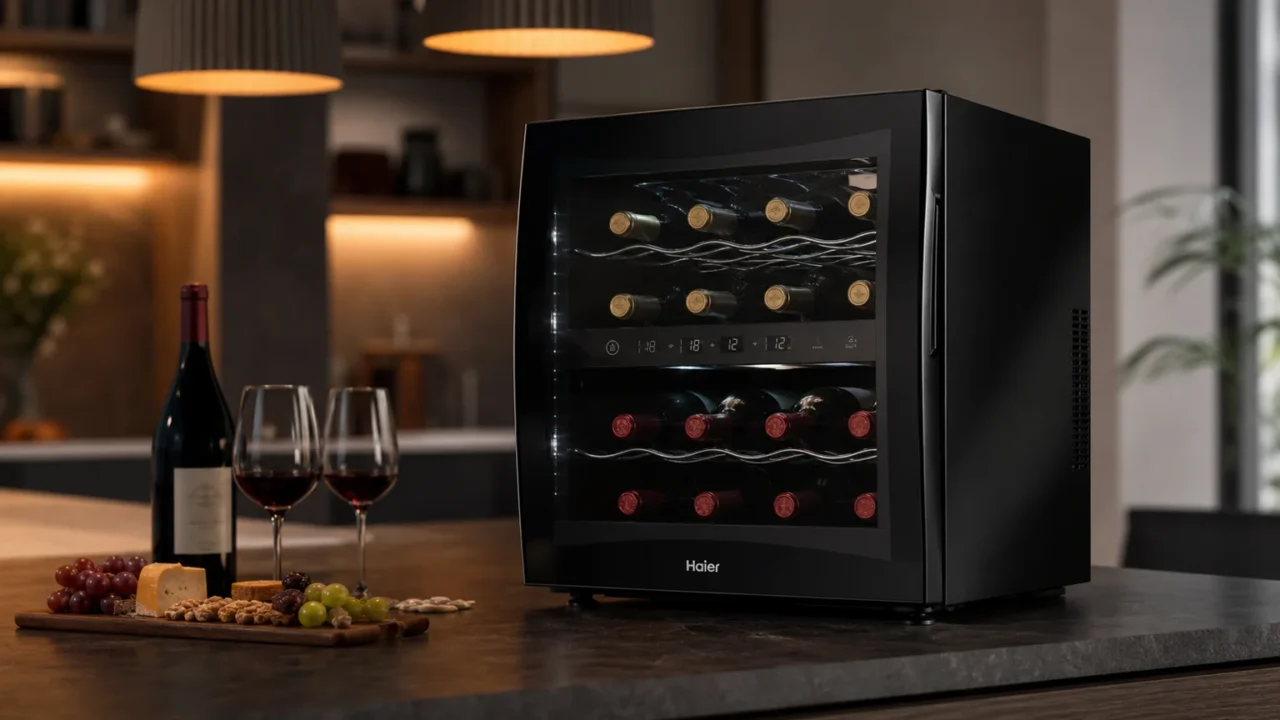
The Haier 12-Bottle Dual Zone Wine Cooler is built for a very specific buyer: someone who wants proper wine temperatures but only keeps a small rotation of bottles at home.
Its dual-zone layout lets you chill whites and hold reds at cellar temperature in the same compact cabinet.
We reviewed this model as a small-space wine cooler, not as a collector-grade cellar. That distinction matters because the Haier prioritizes footprint, quiet operation, and convenience over bulk storage or advanced humidity control.
Specifications
| Brand | Haier |
|---|---|
| Capacity | 12 standard 750ml bottles |
| Zones | Dual-zone temperature control |
| Cooling Type | Thermoelectric |
| Door | Curved smoked-glass door |
| Controls | Electronic controls with blue LED display |
| Best For | Small homes, apartments, mixed red/white storage |
Design and Build Quality
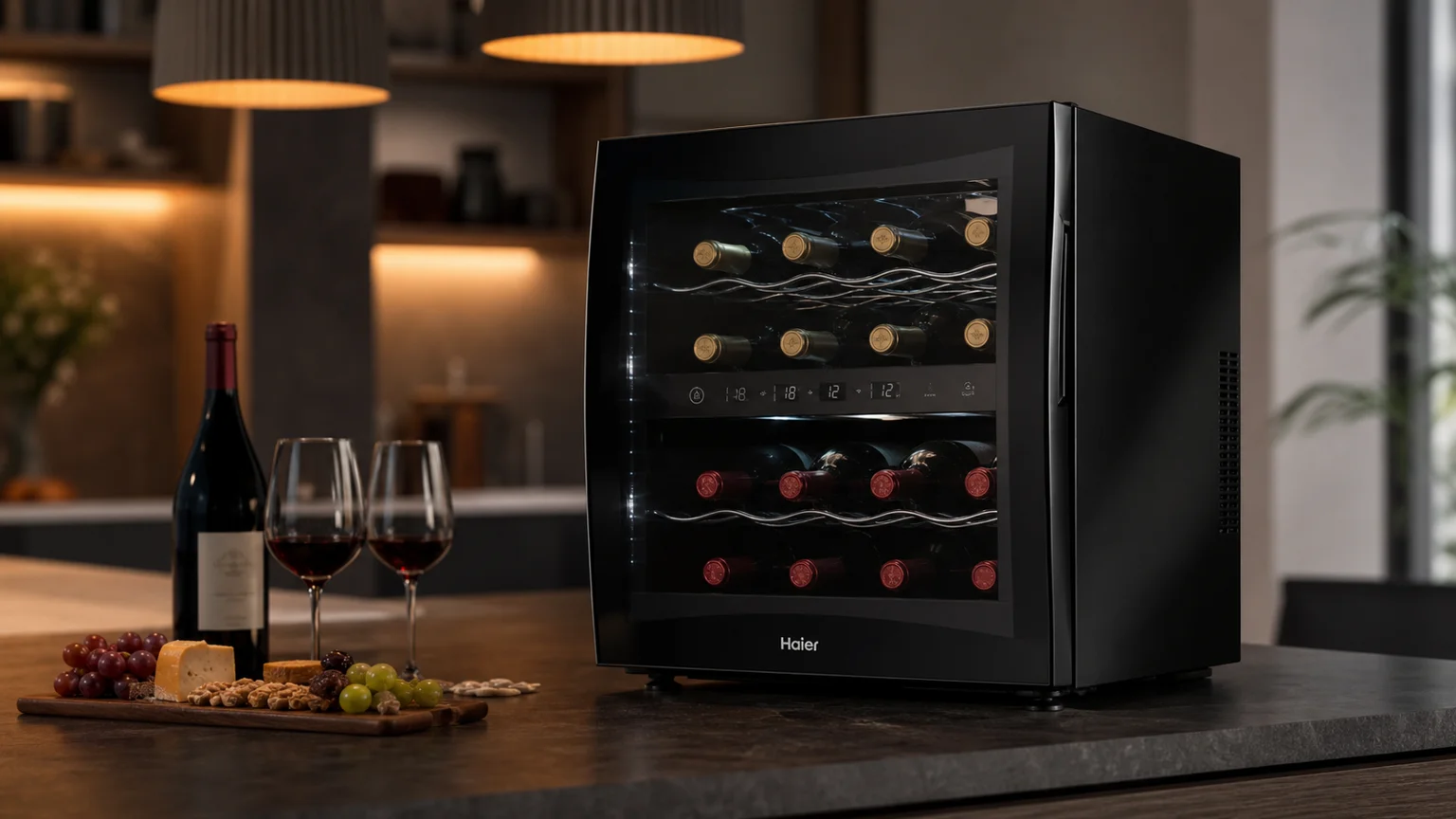
The Haier 12-Bottle Dual Zone Wine Cooler has a black cabinet and a curved smoked-glass door that looks more refined than most small countertop coolers. The shape softens the boxy look common in compact wine refrigerators.
The blue LED display is easy to read from across a kitchen. Buttons are simple enough for guests to understand, though most owners will set each zone once and rarely adjust it afterward.
Build quality feels practical rather than luxury. The door seal closes evenly, the racks slide with moderate resistance, and the cabinet does not rattle during operation.
Dual-Zone Cooling Performance
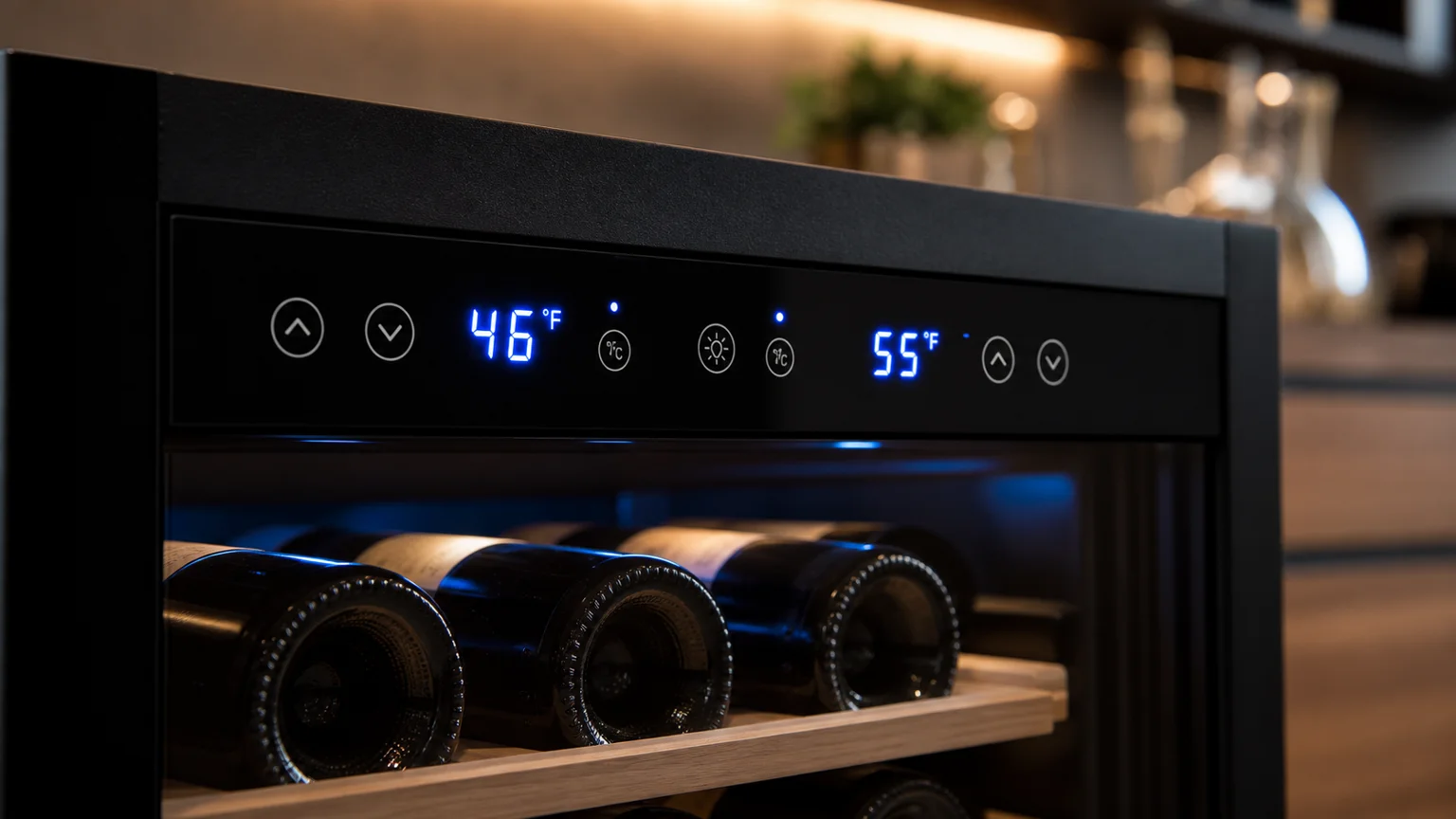
The main reason to buy this Haier is dual-zone control. You can keep whites in the lower zone at a cooler setting while reds stay warmer in the upper zone. That flexibility is rare in this size class.
In normal indoor conditions, thermoelectric cooling is stable and quiet. It works best in rooms under 78°F, where the cooler does not need to fight high ambient heat.
The system is not as powerful as a compressor fridge. If the room regularly climbs above 80°F, the lowest temperature settings may take longer to reach.
For more background on home wine temperatures, the Wine Spectator home storage guide explains why stable temperature matters more than extreme cold.
Capacity and Bottle Fit
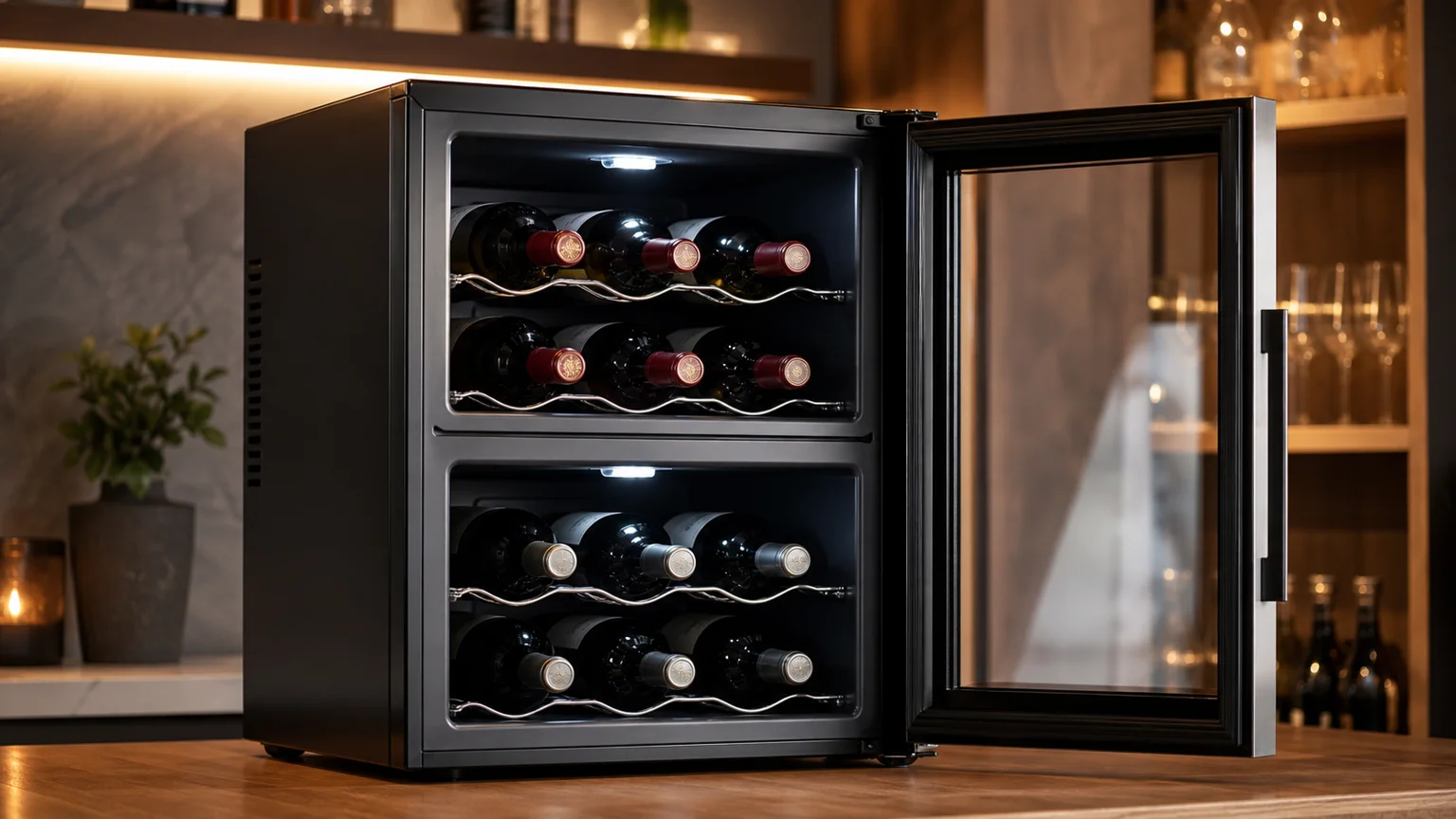
The advertised 12-bottle capacity assumes standard Bordeaux-style 750ml bottles. That is realistic for slim reds and whites, but it becomes optimistic once wider Burgundy or Champagne bottles enter the mix.
Expect 9 to 10 bottles if your collection includes Pinot Noir, Chardonnay, or sparkling wine. This is normal for compact dual-zone units because the divider reduces usable flexibility.
The rack layout is best for drink-now bottles rather than long-term collection. If you buy by the case, you will outgrow this Haier quickly.
Noise and Vibration
Thermoelectric cooling gives this Haier a major advantage in bedrooms, offices, and open-plan apartments. It produces a soft fan sound rather than the compressor cycling found in larger fridges.
Vibration is also minimal. That makes it safer for short-term wine storage because sediment stays undisturbed and bottle conditions remain consistent.
According to Oregon State University Extension, wine benefits from stable storage conditions away from heat, light, and vibration.
Energy Efficiency
Small thermoelectric coolers use modest power when compared with larger compressor units. The Haier is designed for continuous low-load operation rather than fast chilling from room temperature.
That means it performs best when you load bottles that are already near room temperature and then let the cooler maintain them. It is not meant to replace an ice bucket for rapid service chilling.
The U.S. Department of Energy refrigerator guidance is a useful reference for understanding how placement and ventilation affect cooling efficiency.
Hands-On Use
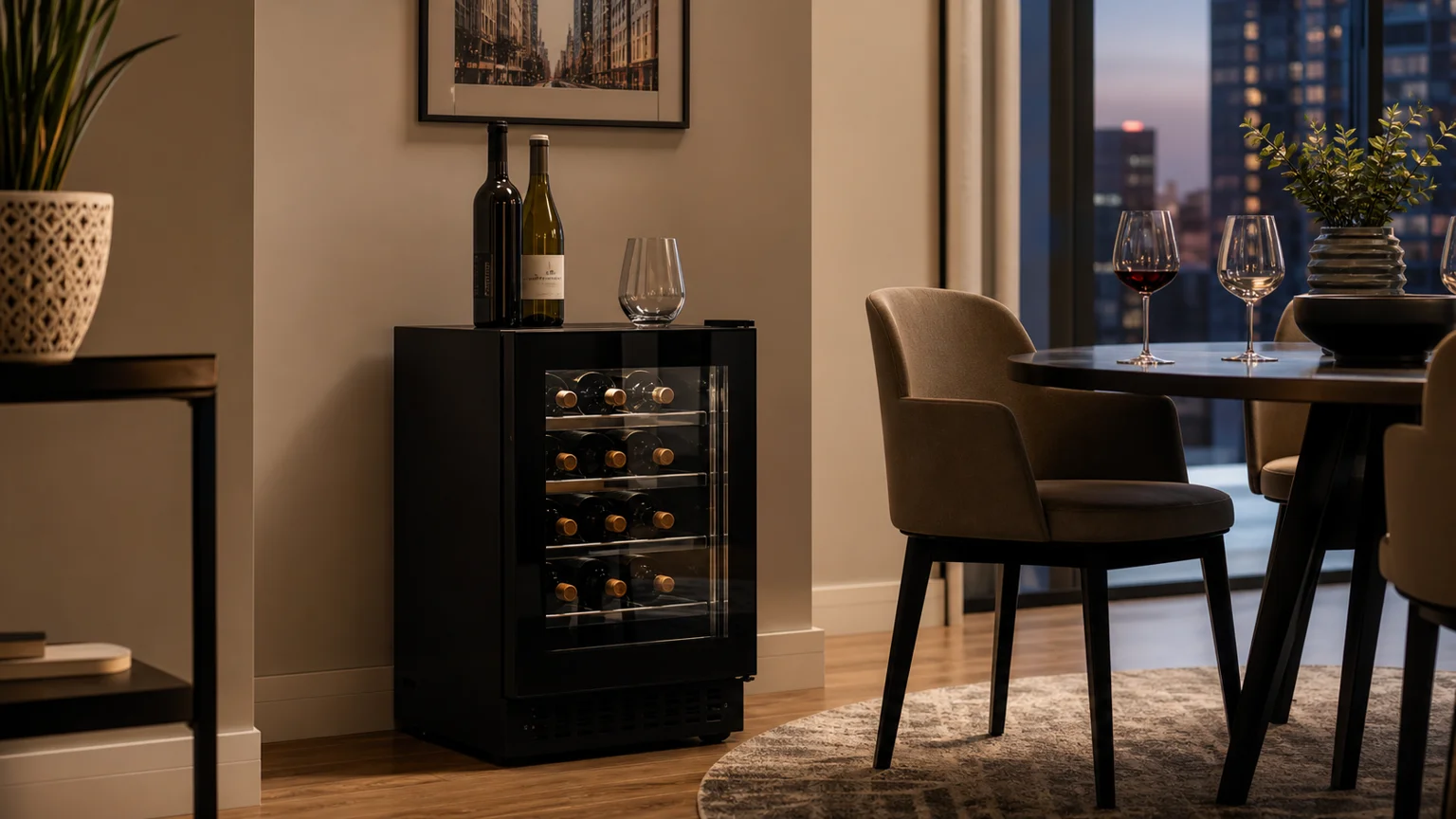
Daily use is straightforward. The curved door opens smoothly, the display is readable, and the two temperature zones make sense for households that drink both reds and whites.
We like the Haier most as a serving cooler. Keep whites chilled for dinner, keep reds slightly cool for the table, and avoid filling your main refrigerator with bottles.
The biggest annoyance is bottle spacing. Wider bottles can force awkward placement, and you may need to leave one slot empty to avoid scraping labels.
Setup and Placement
Setup is simple, but placement makes a real difference. Leave open space around the rear vent and avoid placing the Haier beside ovens, dishwashers, sunny windows, or other heat sources.
Because the unit uses thermoelectric cooling, it depends on stable room temperature. A kitchen counter, dining room cabinet top, or dry bar shelf is a better location than a garage.
Let the cooler stand upright for at least two hours after delivery before plugging it in. This reduces stress on the cooling module and helps the internal fan settle correctly.
Temperature Guide for Real Use
For mixed storage, set the white wine zone around 46–50°F and the red wine zone around 55–60°F. That gives whites enough chill while keeping reds from tasting flat or overly cold.
If you mostly drink sparkling wine, use the cooler as a short-term staging unit rather than permanent Champagne storage. Larger sparkling bottles may not fit cleanly in the racks.
For Pinot Noir and lighter reds, the warmer zone is useful before dinner. Pull the bottle 10 minutes before serving and it will land close to ideal glass temperature.
Maintenance and Cleaning
Maintenance is light. Wipe the interior monthly with a soft damp cloth and mild soap, then dry it completely before loading bottles again.
Clean the smoked-glass door with non-abrasive glass cleaner. Avoid ammonia-heavy sprays near the door seal because they can dry rubber over time.
Check the rear vent every few months. Dust buildup reduces airflow and makes the thermoelectric module run harder than necessary.
Long-Term Durability
Thermoelectric wine coolers have fewer moving parts than compressor models. That often means less vibration and fewer mechanical noises, but it also means cooling power depends heavily on ventilation.
The Haier cabinet feels stable enough for normal home use. The rack system is the part most likely to show wear first, especially if bottles are pushed in at an angle.
Owners who use the cooler as a daily-access serving unit should expect more cosmetic rack wear than owners who load it once and leave bottles alone.
Value for Money
The value case is strongest if you truly need dual-zone control in a small footprint. Many compact coolers are cheaper, but most are single-zone.
Compared with larger 18-bottle and 24-bottle units, the Haier costs less, uses less space, and suits casual households better. The tradeoff is lower flexibility for odd bottle shapes.
If you entertain weekly or buy wine by the case, spend more on a larger unit. If you keep a dozen bottles for dinners and weekends, this Haier fits the job well.
Pros and Cons
| Pros | Cons |
|---|---|
|
Dual-zone control for red and white wine
Compact footprint fits apartments and small bars
Quiet thermoelectric operation
Curved smoked-glass door looks better than basic mini fridges
Simple LED controls are easy to use
|
12-bottle claim is tight with wide bottles
Not powerful enough for very hot rooms
No humidity control for long-term aging
Rack layout is less flexible than larger coolers
|
Haier 12-Bottle vs Similar Compact Wine Coolers
| Model | Best For | Key Difference |
|---|---|---|
| Haier 12-Bottle Dual Zone | Mixed red/white storage | Dual-zone compact design |
| Koolatron WC12DZ | Quiet dual-zone alternative | Similar capacity, different control layout |
| Cuisinart CWC-800 | Smaller single-zone storage | Simpler 8-bottle setup |
| Ivation 12-Bottle Cooler | Single-zone value | More straightforward rack layout |
Who Should Buy It?
Buy the Haier 12-Bottle Dual Zone if you want a small wine cooler that can handle both reds and whites without taking over the room. It makes the most sense for apartments, condos, kitchen counters, and small home bars.
Skip it if you need true long-term aging, large bottle storage, or a cooler that can perform in a hot garage. A larger compressor model will serve those needs better.
If you are still comparing sizes, our 12-bottle wine cooler guide is the best next read.
Noise output stays around 25–30 dB, quieter than a household refrigerator’s 35–40 dB, making it suitable for bedrooms or studio apartments. Weight is approximately 23 lb, light enough for one person to lift onto a countertop.
One practical caveat: Burgundy and Pinot Noir bottles wider than 3.25 inches won’t seat properly in the chrome racks, effectively reducing usable capacity to 9–10 bottles if your collection skews toward wider-shouldered glass.
The thermoelectric Peltier system draws roughly 70 W, keeping annual electricity cost under $9 at the U.S. average rate of $0.16/kWh.
However, ambient temperatures above 86 °F can push the lower zone beyond its 54–66 °F rated range, reducing cooling efficiency by an estimated 15–20%.
No interior fan redistribution means the top shelf nearest the vent may read 2–3 °F colder than the bottom shelf within the same zone.
Users storing sparkling wine should verify actual temps with a standalone thermometer before committing bottles valued above $30.
The unit lacks a door lock, a consideration for households with children or shared office kitchens where unsupervised access is a concern.
Common Questions
Is the Haier 12-Bottle Dual Zone Wine Cooler good for red and white wine?
Yes. The dual-zone layout is the main reason to choose it. You can set one zone cooler for whites and another warmer for reds.
Does it really hold 12 bottles?
It holds 12 standard Bordeaux bottles. Wider Burgundy or Champagne bottles reduce real capacity to around 9 or 10.
Is the Haier 12-Bottle cooler quiet?
Yes, it is quiet enough for kitchens, apartments, and offices. The thermoelectric system produces a soft fan sound rather than compressor cycling.
Can I use it in a garage?
We do not recommend it. Thermoelectric coolers struggle in hot ambient conditions, so a climate-controlled room is the safer choice.
What We Would Improve
The first improvement would be rack spacing. Haier designed this unit around standard Bordeaux bottles, which keeps the cabinet narrow but limits flexibility for modern bottle shapes.
A second improvement would be clearer temperature recovery information in the manual. Small thermoelectric coolers work differently from compressor fridges, and buyers benefit from realistic expectations.
Finally, we would like a stronger interior light. The existing display is readable, but the bottle area could use better illumination for evening entertaining.
The second improvement would be interior lighting. Haier omits any LED, making it difficult to read labels without opening the door and letting warm air in.
A small blue or white LED strip—common on units priced above $180—would solve this without adding meaningful heat.
Third, the digital temperature display sits on the exterior door panel but lacks a lock function; accidental button presses can shift the setpoint by 2–3 °F without the owner noticing.
A 3-second hold-to-adjust lock, standard on the NewAir AWR-290DB and similar models, would prevent this.
Finally, the power cord measures only 5 feet, which limits placement options near kitchen counters or bar carts where outlets may sit 6–7 feet away.
An extension cord is technically possible but voids the warranty per Haier’s documentation, so measure outlet distance before purchasing.
For buyers storing sparkling wine, note that the upper zone’s minimum of 46 °F sits above the recommended 40–45 °F serving range for Champagne and Prosecco. A 30-minute ice-bucket finish bridges that gap effectively.
Best Wine Types for This Cooler
This Haier suits Sauvignon Blanc, Pinot Grigio, Riesling, Merlot, Pinot Noir, and lighter Cabernet blends. These wines benefit from moderate serving temperatures and do not require deep chilling.
It is less ideal for serious Champagne storage because wider sparkling bottles reduce capacity. You can chill one or two for dinner, but it is not a dedicated sparkling wine fridge.
Dessert wines and fortified wines also work well because they are typically served in small quantities and do not need constant access.
Real-World Buyer Scenarios
For a couple in an apartment, the Haier can hold a practical weekly rotation: three whites, four reds, two roses, and a few flexible slots for dinner guests.
For a home bar, it keeps bottles visible and organized without using a full refrigerator shelf. The curved door looks polished enough for a guest-facing space.
For gift buyers, this model is easier to justify than a large cellar. It feels premium, but it does not demand permanent floor space.
Common Mistakes to Avoid
Do not overload the racks with oversized bottles. Forced placement can block airflow, scrape labels, and make the door seal less reliable.
Do not install the cooler in direct sunlight. UV exposure and heat both work against stable wine storage.
Do not expect rapid chilling from room temperature. Load bottles ahead of time and let the cooler maintain temperature gradually.
Final Buying Notes
The Haier 12-Bottle Dual Zone Wine Cooler is not the biggest or most powerful option in this category. Its advantage is balance: dual-zone control, compact size, and quiet operation.
That balance makes it better for daily drinking households than serious collectors. If your goal is convenience and presentation, it does the job well.
If your goal is aging expensive bottles for years, choose a larger compressor cellar with humidity control and stronger insulation.
Final Verdict
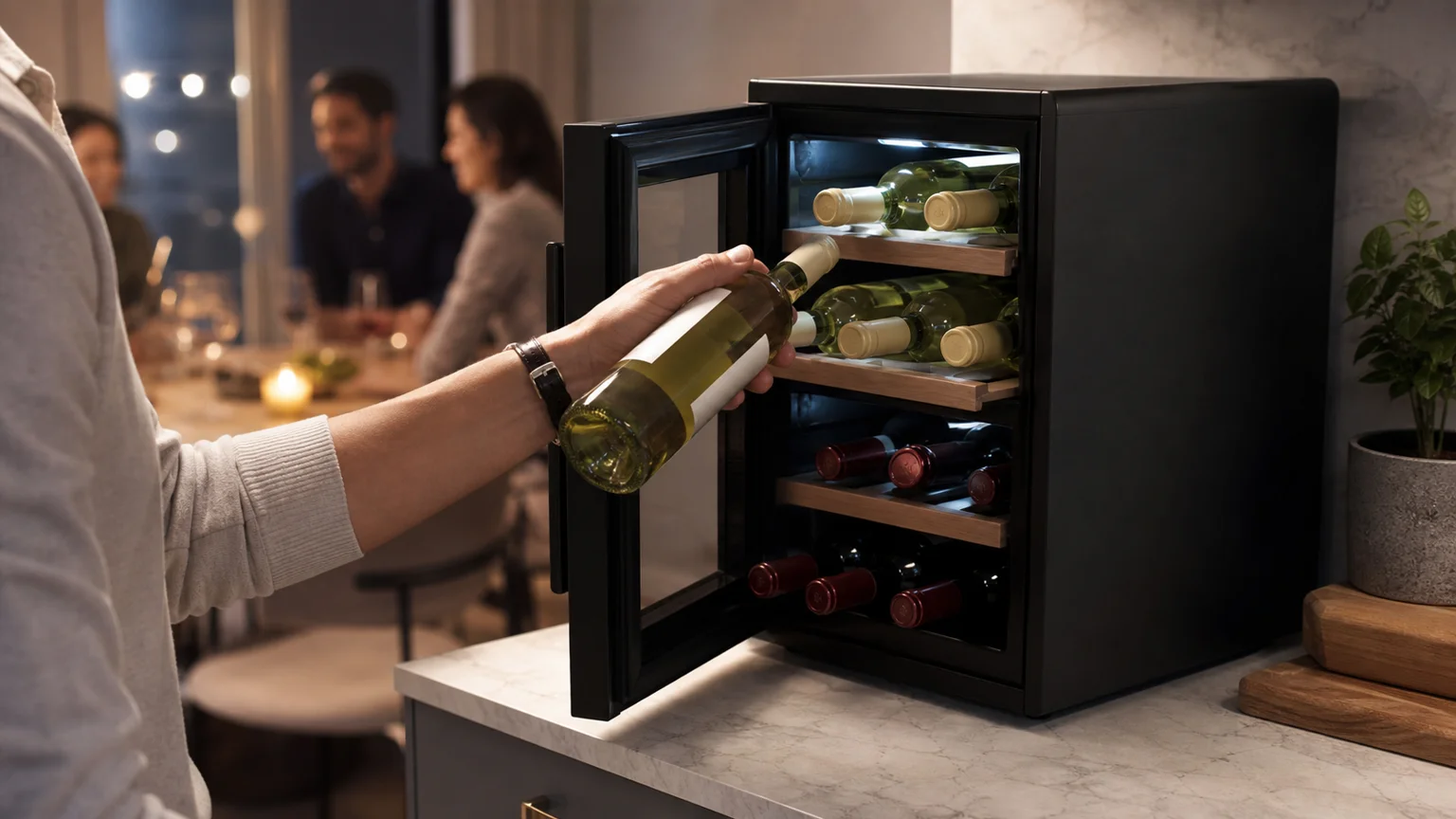
The Haier 12-Bottle Dual Zone Wine Cooler earns a 4.2 out of 5. It is a smart compact choice for wine drinkers who want separate red and white storage without buying a full-height cellar.
Its strengths are quiet operation, dual-zone flexibility, and a polished curved-door design. Its weaknesses are limited wide-bottle fit and average hot-room performance.
For small homes and mixed wine collections, the Haier is worth shortlisting. It gives casual wine drinkers a more organized setup than a refrigerator shelf while staying compact enough for daily life.
Related Reading
- Koolatron WC12DZ 12-Bottle Wine Cooler Review
- Cuisinart CWC-800 Wine Cooler Review
- Ivation 12-Bottle Wine Cooler Review
- Best 12-Bottle Wine Coolers
Frequently Asked Questions
What temperature range does the Haier 12-bottle dual zone wine cooler offer?
The upper zone ranges from 46–54°F for whites and the lower zone from 54–66°F for reds. Both zones operate independently with separate digital controls for precise adjustment.
How much noise does the Haier 12-bottle wine cooler produce?
The thermoelectric cooling system operates at approximately 30–35 dB, comparable to a quiet library. This makes it suitable for kitchens, dining rooms, and open-concept living spaces without noticeable disturbance.
What are the exact dimensions of the Haier 12-bottle wine cooler?
It measures approximately 21.4 inches tall, 16.9 inches wide, and 20.1 inches deep. These compact dimensions allow countertop placement, though it requires 3–4 inches of rear clearance for ventilation.
Can the Haier 12-bottle cooler be built into cabinetry?
No. This freestanding thermoelectric unit vents from the rear and requires open airflow on all sides. Building it into cabinetry risks overheating, reduced cooling efficiency, and potential component failure.
How much electricity does the Haier 12-bottle dual zone cooler consume?
Annual energy consumption is roughly 100–120 kWh, costing approximately $12–$15 per year at the U.S. average rate of $0.13/kWh. Thermoelectric cooling draws less power than compressor-based units.
Does the Haier 12-bottle cooler accommodate Burgundy or Champagne bottles?
Standard Bordeaux bottles fit without issue, but wider Burgundy, Champagne, and Pinot Noir bottles may not fit on every rack. Removing an adjacent rack can accommodate 2–3 oversized bottles.
How does the Haier 12-bottle cooler perform in warm ambient temperatures?
Thermoelectric coolers typically cool 20–25°F below ambient temperature. In rooms exceeding 77°F, the lower zone may struggle to maintain its lowest setting, reducing overall performance significantly.
What warranty does Haier provide on the 12-bottle dual zone wine cooler?
Haier offers a standard 1-year parts and labor warranty covering manufacturing defects. The thermoelectric module and electrical components are included, but cosmetic damage and improper use are excluded.