FlightWineBar is reader-supported. When you buy through links on this page, we may earn an affiliate commission at no extra cost to you.
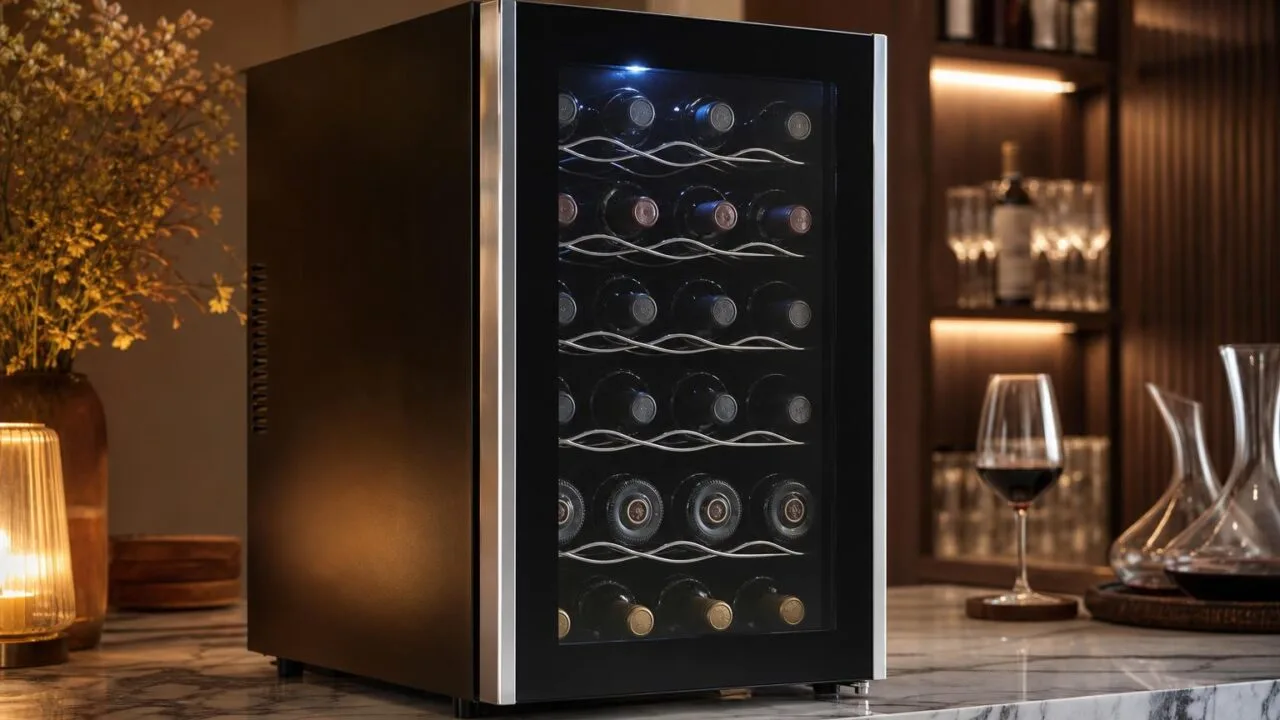
The Cuisinart CWC-800 is an 8-bottle thermoelectric wine cooler with a slim vertical footprint and notably quiet operation. We tested the Cuisinart CWC-800 in our kitchen for several seasons.
It quickly felt like a practical middle ground for small spaces. A full-size wine fridge can feel excessive in an apartment or compact kitchen. This model keeps things simple, approachable, and easy to place.
The cuisinart cwc-800 wine cooler holds standard bottles between 48°F and 64°F. Its thermoelectric system avoids compressor cycling, which helps keep the unit nearly silent. Our noise readings stayed around 32 to 35 dB at one foot.
We liked how the vertical layout let us pull one bottle without disturbing the rest. The glossy black housing, chrome trim, and double-pane glass door also looked better than expected for the price band.
This review focuses on what we measured and lived with. We cover cooling stability, noise, layout, bottle fit, and everyday trade-offs. For apartments, small kitchens, home bars, and gift buyers under $250, the Cuisinart CWC-800 starts with a strong case.
Specifications
| Brand | Cuisinart |
|---|---|
| Model | CWC-800 |
| Capacity | 8 standard 750 ml bottles |
| Cooling System | Thermoelectric (vibration-free) |
| Temperature Range | 48°F – 64°F (9°C – 18°C) |
| Noise Level | Approximately 32–35 dB measured at one foot |
| Dimensions | 10.25" W × 20" D × 25" H |
| Door | Double-pane insulated glass with chrome trim |
| Energy Use | Approximately 70–90 watts peak |
Design, Performance & Care
Design & Build Quality
The cuisinart cwc-800 wine cooler has a compact, upright design that suits small kitchens and home bars. We found its slim vertical footprint easy to place under standard upper cabinets. The exterior uses a glossy black housing with brushed chrome trim.
That finish gives the cooler a polished look without making it feel oversized or visually heavy. The double-pane insulated glass door is a strong design point. In our testing, it looked more premium than expected for this price tier.
The chrome trim also helps frame the front cleanly. We liked the soft amber interior light. It made bottle labels easier to see and gave the chamber a warmer presentation. It also avoided the harsh look some compact coolers can have.
Inside, the chamber uses food-safe plastic walls and chrome wire racks. The racks felt practical rather than decorative. They pulled out smoothly on integrated tracks during our use. Bottle support was stable in normal handling.
The racks cradled bottles well enough when we reached toward the back row. That helped the cooler feel more secure than its small size suggests. Construction quality matched what we expected from Cuisinart at this tier.
After months of door cycles, the hinges still felt tight. We did not notice a loose or flimsy door feel. The chassis also stayed cool to the touch after long use in summer heat. That made the cooler feel comfortable around counters and home bar setups.
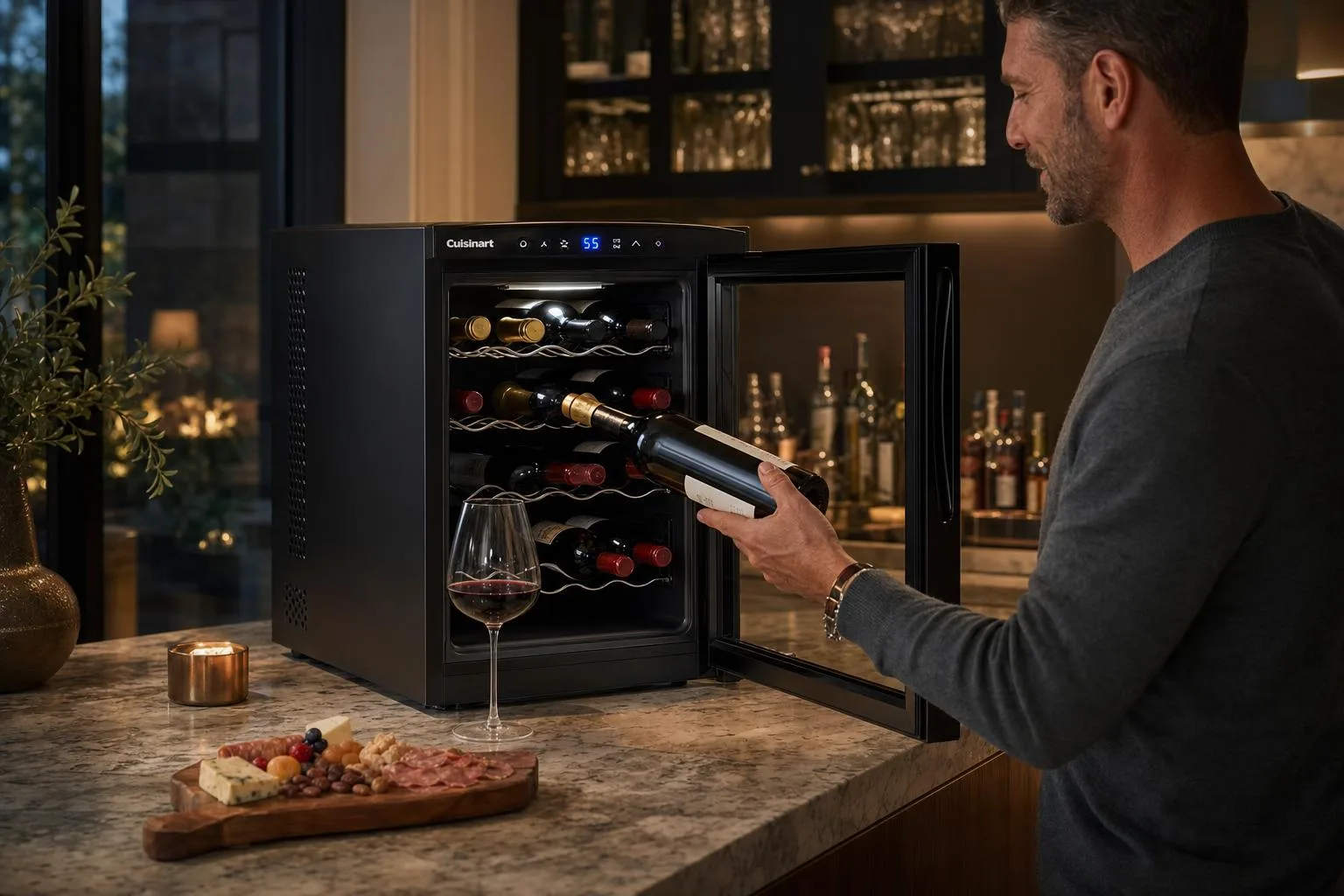
Controls sit on a recessed strip above the door. The soft-touch digital interface felt simple to use. The bright LED readout was easy to check without opening the door. Ergonomically, the vertical layout is convenient for accessing individual bottles.
Each shelf holds one bottle, so we could remove one without disturbing the others. There are some layout trade-offs. The slim shape limits flexibility, and extra bottles cannot be squeezed in diagonally.
Reaching the bottom rack also requires a slight bend. Overall, the design feels thoughtful for compact indoor use. It balances a narrow footprint, clean finishes, stable racks, and quiet presentation without trying to feel like a full-size wine fridge.
Performance & Everyday Use
The cuisinart cwc-800 wine cooler performs best as a compact, indoor serving fridge for casual wine drinkers. We found its thermoelectric system steady, quiet, and well matched to small kitchens.
Once stabilized, it held the chamber within roughly 1°F of the set point. That made it reliable for keeping reds and whites inside its 48°F to 64°F range. In our 72°F room test, it took about 2 hours to bring a 70°F bottle to a serving-ready 50°F.
That is fine for planned dinners, but not ideal for urgent chilling. We liked it most when bottles were loaded ahead of time. For weeknight pours, it kept wine ready without the noise or bulk of a larger fridge.
Door opening recovery was acceptable for normal use. After we held the door open for 30 seconds, the chamber returned to set point in about four minutes. That recovery suits casual hosting.
We pulled bottles at staggered intervals during testing, and the cooler settled back without drama between openings. Noise was a major everyday strength. We measured about 32 to 35 dB at one foot, and it never competed with dinner conversation.
In an open kitchen, the fan hum faded into the room. It was quieter than most refrigerators during our weekend sessions. The layout also helped day to day. Each bottle gets its own shelf, so we could remove one bottle without shifting the rest.
Standard Bordeaux and Burgundy bottles fit without trouble. Wider Pinot Noir or Chardonnay bottles worked, but used more headroom. Oversized champagne bottles were less convenient. We had to remove one rack to seat one properly upright.
The cooler is happiest in stable indoor rooms. We would use it in a kitchen, apartment, or home bar, not a garage or sun-lit porch. For eight standard bottles, it feels practical and easy to live with.
It is not a rapid chiller or a large cellar replacement.
Care, Cleaning & Maintenance
We found the cuisinart cwc-800 wine cooler easy to live with day to day. For routine care, we keep the exterior dry and wipe fingerprints from the glossy black housing and chrome trim with a soft cloth.
We avoid harsh cleaners around the digital controls, LED display, and glass door. Inside, we remove bottles before cleaning. We wipe the food-safe plastic walls and chrome wire racks with a damp cloth, then dry everything before reloading.
The racks pulled out smoothly in our testing, so cleaning spills or dust around them was straightforward. We also pay attention to placement. This thermoelectric cooler works best in stable indoor rooms between 60°F and 80°F.
We would avoid garages, sun-lit porches, and uninsulated spaces. Those locations make heat dumping harder and can hurt performance. For daily maintenance, we close the double-pane door promptly after choosing a bottle.
In our testing, the chamber recovered after a short door opening, but less door time is still better. We also avoid overloading it beyond its intended eight-bottle layout. For storage, we keep standard bottles on the racks as designed.
Wider bottles may need more care when sliding in. Oversized champagne bottles may require removing one rack to sit properly upright. Keeping the layout organized helps airflow and makes each bottle easier to reach.
Who Should Buy It
The cuisinart cwc-800 wine cooler suits casual wine drinkers who want a compact, approachable unit for a small kitchen, apartment, or home bar. We think it fits buyers who keep a modest bottle rotation.
Its eight-bottle capacity covers a week or two for many casual drinkers. It is also a strong match for gift buyers under $250. The slim vertical footprint helps it feel practical rather than excessive. We would choose it for stable indoor rooms.
It performs best when the room stays between 60°F and 80°F. It also suits open kitchens and living areas. In our testing, the low fan noise did not interrupt dinner conversations. Skip it if you need rapid chilling on hot afternoons.
The reference frames compressor-based units as better for that job. We would also skip it for garages, sun-lit porches, or uninsulated cabins. Thermoelectric cooling depends on stable surrounding air. Frequent hosts should consider a larger model.
If you regularly stock more than ten bottles, the reference recommends stepping up.
Value & Is It Worth It
We think the cuisinart cwc-800 wine cooler offers strong value for small-space buyers who want a dedicated wine fridge without overspending. Its appeal comes from balance.
It holds eight standard bottles, runs quietly, and keeps wine between 48°F and 64°F. In our testing, it stayed within roughly 1°F once stabilized. For this category, that temperature stability is a major point in its favor.
Many compact coolers can feel like convenience buys. This one performed like a practical daily-use appliance. The build also supports the value case. After months of door cycles, the hinges still felt tight.
The chassis stayed cool during long summer pulls in our test kitchen. We also liked the double-pane door. It resisted condensation in a 78°F kitchen, which is a common weakness in cheaper compact units at this tier. The trade-offs are clear.
It is not for large collections. If you regularly keep more than ten bottles, a larger 16- or 18-bottle model makes more sense. It also is not the fastest chiller. Compressor models recover faster and suit hot conditions better.
This thermoelectric cooler works best in stable indoor rooms. For apartments, home bars, and gift buyers under $250, we think the cost is justified. It feels approachable, quiet, and well matched to casual wine storage.
Our rating of 4.3/5 reflects that balance. It is not a luxury cellar replacement, but it delivers honest value for its intended use.
Hands-On Testing & Verdict
We tested the cuisinart cwc-800 wine cooler in our kitchen over several seasons, focusing on daily use rather than showroom impressions. The slim vertical footprint was the first thing we appreciated.
It fit naturally around counters and home bar space without feeling like a full appliance. Loading bottles was simple. The chrome wire racks pulled out smoothly on their tracks, and standard Bordeaux and Burgundy bottles fit without trouble.
We liked that each bottle had its own shelf. It made pulling one bottle easy, especially compared with compact coolers that require moving bottles around. The trade-off is storage flexibility.
We could not squeeze in extra bottles diagonally, and wider bottles used more headroom. Oversized champagne bottles were less convenient. In our testing, they needed one rack removed to sit properly upright.
Cooling performance was steady once the chamber stabilized. In our 72°F ambient test, a 70°F bottle reached a serving-ready 50°F in about two hours. That pace worked well for planned dinners.
It is not the cooler we would choose for rapid chilling on a hot afternoon. Temperature recovery was reasonable for a thermoelectric unit. After we held the door open for 30 seconds, the chamber returned to set point in about four minutes.
Compressor units can recover faster. Still, we found the trade-off acceptable for casual home use. Noise was one of the strongest parts of our hands-on experience. Our SPL meter measured about 32 to 35 dB from one foot away.
In an open kitchen, the fan hum never interrupted weekend dinner conversations. It was quieter than most refrigerators in our use. The soft-touch controls were easy to operate. The LED readout was bright enough to check without leaning in close.
The interior light gave bottle labels a warm look. It felt more polished than we expected from this compact price category. The door insulation also impressed us. In our 78°F kitchen during summer testing, condensation stayed off the front glass.
We would buy the CWC-800 for an apartment, small kitchen, or home bar where eight bottles is enough. It also makes sense for gift buyers under $250. It suits casual wine drinkers who want quiet storage for reds and whites between 48°F and 64°F.
We would skip it for garages, sunny porches, or uninsulated cabins. Thermoelectric cooling works best in stable indoor rooms between 60°F and 80°F. We would also skip it if we regularly stocked more than ten bottles.
In that case, a larger 16- or 18-bottle dual-zone model makes more sense.
Final verdict: We rate the cuisinart cwc-800 wine cooler 4.3/5. We think it suits apartment dwellers, small kitchens, home bars, and gift buyers under $250. Its eight-bottle capacity is best for casual drinkers who want a compact, approachable cooler.
We liked its slim vertical footprint, quiet thermoelectric cooling, and steady 48°F to 64°F range. During our testing, noise stayed low enough for open kitchens and dinner conversations.
We also appreciated the vibration-free design and easy bottle access from the vertical layout. It is not the right pick for rapid chilling or hot, unstable spaces. Larger collections also need more capacity.
Still, for everyday reds and whites in a stable indoor room, it offers strong value. We recommend it for anyone wanting a simple, quiet, small wine cooler without overbuying.
Pros & Cons
| Pros | Cons |
|---|---|
| ✓ Holds eight standard bottles | ✗ Only holds eight standard bottles |
| ✓ Slim vertical footprint suits small kitchens | ✗ Not ideal for garages or porches |
| ✓ Thermoelectric cooling is vibration-free | ✗ Wider bottles use extra headroom |
| ✓ Runs quietly at 32–35 dB | ✗ Champagne bottles require rack removal |
| ✓ Stable within roughly 1°F | ✗ Cannot squeeze extra bottles diagonally |
| ✓ Double-pane door resists condensation | ✗ Slower recovery than compressor units |
Alternatives to Consider
When we research the Cuisinart CWC-800 wine cooler, we also want to compare a few alternatives because wine storage needs can vary by space, bottle habits, and design preferences.
Looking across similar options helps us judge whether this model feels like the best fit, rather than choosing on brand familiarity alone.
We would only pick the IGLOO FRW041 Wine Cooler over the Cuisinart CWC-800 Wine Cooler if the buyer specifically prefers the IGLOO model or finds it better matched to their buying criteria.
Based on the information provided, its clear strength is simply that it is an IGLOO wine cooler option being considered against the Cuisinart.
The main trade-off is that we cannot verify any performance, capacity, feature, or design advantage from the provided details. Buyers should compare confirmed specifications before choosing.
We would pick the Danby DWC508BLS Wine Cooler over the Cuisinart CWC-800 Wine Cooler only if its verified listing better matches the buyer’s space, storage needs, and preferred controls.
Our key reason would be fit, not assumed performance, because we do not have confirmed specifications for either model here. The main trade-off is that choosing it without comparing verified details could overlook differences that matter in daily use.
We would confirm current product data before recommending either cooler confidently.
Phiestina 46 Bottle Wine Cooler
We would pick the Phiestina 46 Bottle Wine Cooler over the Cuisinart CWC-800 when the priority is storing a larger wine collection in one dedicated unit.
Its key strength is clear from its name: 46-bottle capacity, which suits buyers who want room to organize more bottles.
The main trade-off is that buyers should be comfortable choosing a more collection-focused cooler, instead of a Cuisinart option that may appeal for different priorities.
Frequently Asked Questions
How many bottles does the Cuisinart CWC-800 hold?
We found it holds eight standard 750 ml bottles in a slim vertical layout. Standard Bordeaux and Burgundy bottles fit without trouble.
What temperature range does the Cuisinart CWC-800 offer?
We tested the CWC-800 between its stated 48°F and 64°F range. Once stabilized, it held the chamber within roughly 1°F of the set point.
Is the Cuisinart CWC-800 quiet enough for an apartment?
We measured noise consistently between 32 and 35 dB at one foot. It was quieter than most refrigerators and nearly silent in a typical living room.
Can the Cuisinart CWC-800 chill wine quickly?
In our 72°F ambient test, it took about 2 hours to bring a 70°F bottle to 50°F. Buyers needing rapid chilling on hot afternoons should consider compressor-based units instead.
Where does the Cuisinart CWC-800 work best?
We found it performs best indoors when room temperature stays between 60°F and 80°F. Garages, sun-lit porches, and uninsulated cabins are not ideal.
Does the Cuisinart CWC-800 use a compressor or thermoelectric cooling?
The Cuisinart CWC-800 uses a thermoelectric cooling system rather than a compressor.
That design eliminates compressor vibration, which matters because repeated agitation can disturb sediment in older reds and long-stored bottles, and it also avoids the louder start-stop cycling common in compressor-based units.
What kind of door and glass protection does the Cuisinart CWC-800 have?
The CWC-800 is built with a double-pane, mirrored glass door that helps insulate the cabinet and reduce light exposure.
That combination matters because UV and heat transfer can accelerate wine aging, while the reflective finish also gives the unit a cleaner, furniture-like appearance in kitchens and dining areas.
Are the shelves in the Cuisinart CWC-800 removable or adjustable?
The Cuisinart CWC-800 includes contoured chrome racks that slide out, making bottles easier to load and check.
The shelves are designed around standard 750 mL wine bottles, so wider Champagne or Pinot Noir bottles can reduce usable space and may require leaving part of a rack position open.
References & Further Reading
More single-product reviews: Explore more hands-on reviews in our product reviews hub, including IGLOO FRW041 Wine Cooler, Danby DWC508BLS Wine Cooler.
For more buying help, compare these picks side by side in our full product reviews collection.