Sour Mash Vs Bourbon is a comparison between a fermentation method and a legally defined American whiskey style, not two separate whiskey categories.
Sour mash means distillers add acidic “backset” from a previous run to a new grain mash for consistency, pH control, and flavor continuity.
Bourbon, by U.S. law, must be made in the United States from at least 51% corn, distilled at no more than 160 proof, entered into new charred oak at no more than 125 proof, and bottled at 80 proof or higher.
Many bourbons use the sour mash process, including major Kentucky producers, but sour mash can also apply to Tennessee whiskey and other American whiskeys.
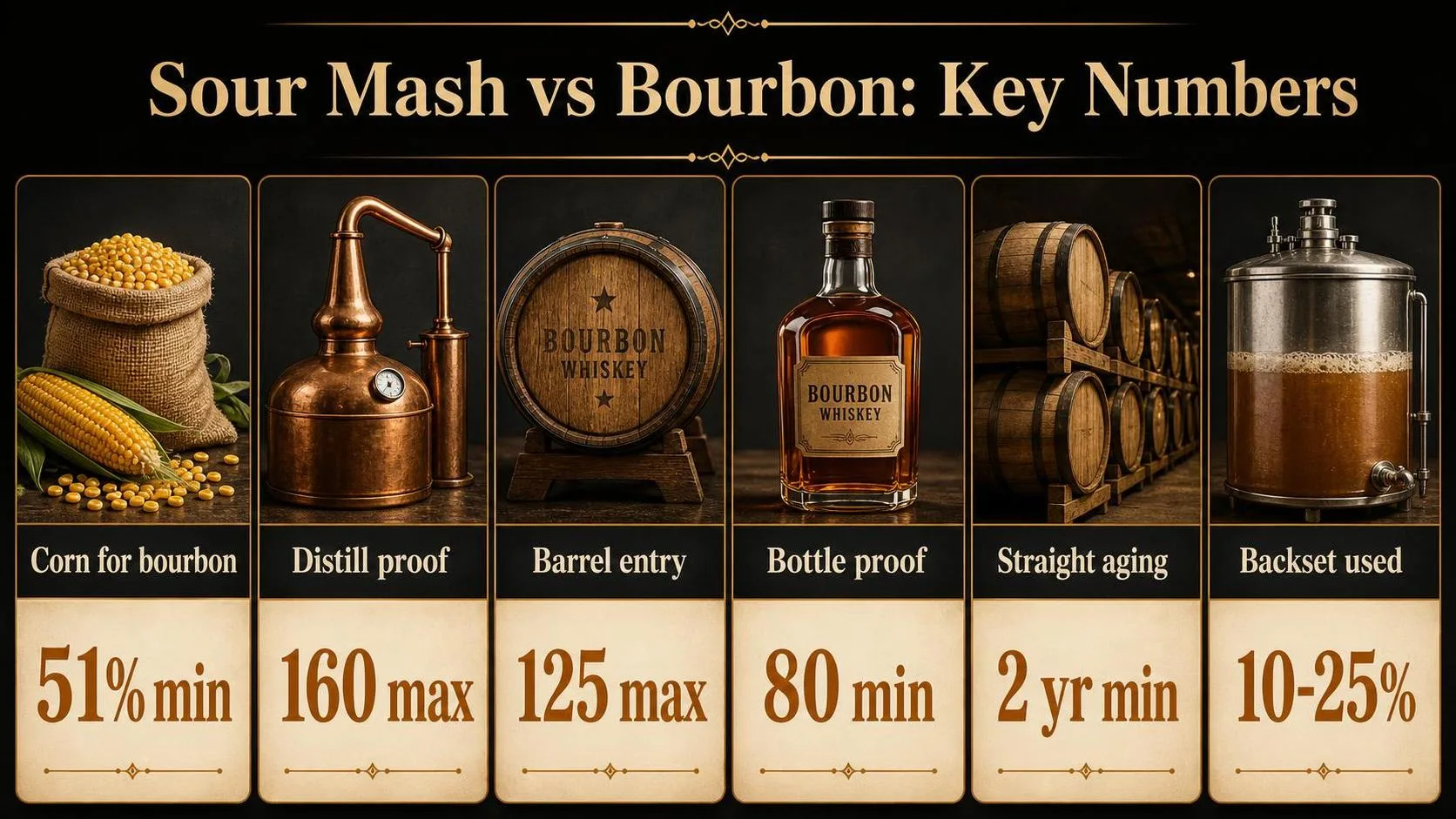
Sour Mash Method vs Bourbon Category
Sour mash is a production method; bourbon is a legally defined whiskey category. The confusing part is that most Kentucky bourbon is also made by the sour mash method, but the numbers that define each term are completely different.
For bourbon, the key figures come from U.S. federal standards of identity, including 27 CFR §5.143. For sour mash, the important numbers are practical distillery targets: acidity, yeast control, and flavor consistency from batch to batch.
| Number | Applies to | What it means |
| 51% minimum corn | Bourbon | The mash bill must contain at least 51% corn. The remaining grain is usually rye, wheat, malted barley, or a combination. |
| 160 proof maximum | Bourbon | Bourbon cannot be distilled above 160 proof, or 80% ABV. This preserves more grain character than a higher-proof neutral spirit. |
| 125 proof maximum | Bourbon | The spirit must enter new charred oak barrels at no more than 125 proof, or 62.5% ABV. |
| 80 proof minimum | Bourbon | Bourbon must be bottled at 80 proof, or 40% ABV, or higher. |
| 0 days minimum aging | Bourbon | Federal law requires new charred oak, but does not set a minimum age for ordinary bourbon. “Straight bourbon” must be aged at least 2 years. |
| 10% to 25% backset, commonly | Sour mash | Many distillers add a portion of acidic spent stillage, called backset, to the next mash. The exact percentage is a house choice, not a legal rule. |
Backset is the liquid left after distillation, once alcohol has been removed. It is not “old whiskey” being poured into a new batch. It is mostly water, grain solids, acids, and dissolved compounds from fermentation and distillation.
The practical purpose is pH control. Fresh grain mash can sit near a pH of about 5.6 to 6.0, while yeast typically performs better in a more acidic range. Adding backset helps push the mash toward roughly pH 5.0 or lower, depending on the distillery.
- 51% corn tells you whether the whiskey can legally be bourbon.
- New charred oak tells you it meets a core bourbon aging requirement.
- Backset percentage tells you how the distiller manages fermentation consistency.
- Proof limits shape bourbon’s retained grain flavor and barrel extraction.
The takeaway: “sour mash” does not mean sour-tasting whiskey, and it does not guarantee bourbon. A Tennessee whiskey, rye whiskey, or bourbon can be sour mash if the distiller uses backset.
Bourbon depends on the legal recipe, proof, barrel, and bottling numbers.
What Actually Shapes Flavor
Sour mash is a fermentation method; bourbon is a legally defined whiskey category.
The final flavor depends less on the phrase “sour mash” on the label and more on grain bill, fermentation control, distillation proof, barrel entry proof, warehouse aging, and blending decisions.
By U.S. law, bourbon must meet specific production rules under 27 CFR §5.143. Sour mash has no separate federal style definition; it describes recycling acidic “backset” from a previous distillation into the next mash.
| Factor | Bourbon requirement or common range | Effect in the glass |
| Corn content | At least 51% of the mash bill | Raises sweetness, body, and flavors often read as corn, caramel, or vanilla after barrel aging |
| Distillation proof | No more than 160 proof, or 80% ABV | Lower proofs retain more grain character; higher proofs taste cleaner and lighter |
| Barrel entry proof | No more than 125 proof, or 62.5% ABV | Influences extraction of oak sugars, tannin, spice, and color |
| New charred oak | Required for bourbon | Creates much of the vanilla, coconut, toast, caramel, and brown-sugar profile |
The sour mash process mainly affects fermentation consistency. Backset is acidic, often around pH 3 to 4, and adding it can help bring a fresh mash into a yeast-friendly range near pH 5.0 to 5.5 before fermentation progresses.
That acidity discourages some unwanted bacteria and helps a distillery reproduce the same conditions batch after batch.
It does not automatically make whiskey taste “sour,” and many famous bourbons use sour mash without tasting sharp or acidic.
- Backset percentage: Many distilleries use roughly 20% to 35% backset in the cooker or fermenter. More backset can increase consistency but may also influence grain expression and fermentation stress.
- Yeast strain: Yeast drives esters and congeners. One strain may emphasize apple, pear, or floral notes; another can create more spice, bread, or nutty character.
- Fermentation time: Bourbon fermentations commonly run about 3 to 5 days. Longer ferments can increase fruity and lactic complexity, but poor control can introduce off-flavors.
- Rye, wheat, or malted barley: Rye-heavy recipes taste spicier and drier. Wheated bourbons tend to feel softer and rounder. Malted barley contributes enzymes and cereal notes.
- Warehouse location: Barrels on hotter upper floors expand and contract more, extracting oak faster. Cooler lower floors usually mature more slowly.
Age also matters, but not in isolation. A 4-year bourbon from a hot Kentucky rickhouse can show more oak than an older barrel stored in cooler conditions. Proofing and blending then decide whether those flavors feel balanced, bold, thin, or tannic.
How Bourbon and Sour Mash Are Verified
Bourbon is verified against federal identity standards; “sour mash” is verified mainly through production records and distillery practice.
In a compliance review, bourbon has hard legal thresholds, while sour mash is a process claim tied to mash pH control and backset use.
For bourbon, the key authority is the U.S. Alcohol and Tobacco Tax and Trade Bureau (TTB), under 27 CFR §5.143.
A whiskey cannot be labeled bourbon unless its mash bill, distillation proof, entry proof, barrel type, and bottling proof meet the required limits.
| Measured item | Bourbon requirement | How it is verified |
| Corn in mash bill | At least 51% | Distillery grain records, formula sheets, production logs |
| Distillation strength | Not over 160 proof, or 80% alcohol by volume | Still run records and proof-gauging records |
| Barrel entry strength | Not over 125 proof, or 62.5% alcohol by volume | Tank-to-barrel transfer records and gauging reports |
| Container | New charred oak container | Barrel purchase records and fill logs |
| Bottling strength | At least 80 proof, or 40% alcohol by volume | Bottling proof checks and label approval files |
Sour mash has no separate federal whiskey class. A bourbon can be sour mash, and many are, but the phrase does not replace the bourbon rules. It describes adding spent stillage, often called backset, from a prior distillation to a new mash.
In practice, distillers verify sour mash by tracking the percentage of backset added and the mash acidity before fermentation.
Backset is acidic because it contains organic acids from the prior cook and fermentation, helping keep batch conditions consistent.
- Backset rate: Many American whiskey producers use roughly 20% to 35% backset in the mash, though exact percentages vary by recipe and equipment.
- pH target: Whiskey mashes commonly ferment in the acidic range, often near pH 5.0 to 5.5 at the start, then lower as fermentation proceeds.
- Microbial control: Lower pH helps discourage unwanted bacteria while supporting yeast performance.
- Batch continuity: Logs show whether the prior stillage source, volume, and timing match the distillery’s sour mash procedure.
Label verification is different. “Bourbon” on a U.S. label requires TTB label approval and records supporting the standard of identity. “Sour mash” is generally treated as a truthful process statement.
So the producer must be able to substantiate it if challenged.
A practical way to read the label is this: bourbon tells you what legal category the whiskey meets; sour mash tells you something about how the fermentation was managed.
One is a regulated identity standard, the other is a documented production method.
How Sour Mash Relates to Other Whiskeys
Sour mash is best understood as a production method, not a whiskey type.
Bourbon, Tennessee whiskey, rye, and even some non-bourbon American whiskeys can be made using sour mash if the distiller recycles part of a previous acidic mash into the next fermentation.
The legal differences matter more than the label wording.
Under U.S. federal standards, bourbon must be made from at least 51% corn, distilled below 160 proof, entered into new charred oak containers at no more than 125 proof, and bottled at 80 proof or higher.
| Whiskey term | What it means | Key numbers or rules | Can be sour mash? |
| Bourbon | A legally defined U.S. whiskey style | Minimum 51% corn; distilled under 160 proof; new charred oak; entered at 125 proof or less | Yes |
| Sour mash | A fermentation method using backset from a previous distillation | Backset is commonly acidic and helps control pH consistency; no federal minimum percentage | It is the method |
| Tennessee whiskey | A Tennessee-made whiskey category closely related to bourbon | Usually meets bourbon rules; commonly charcoal mellowed before aging under Tennessee law | Yes |
| Rye whiskey | A legally defined whiskey made primarily from rye grain | Minimum 51% rye; same 160 proof distillation and 125 proof barrel-entry limits as bourbon | Yes |
| Sweet mash | A fermentation method using fresh mash without backset | No recycled stillage; often more variable and typically more labor-intensive to manage | No |
Sour Mash vs Bourbon
The most common confusion is treating sour mash as an alternative to bourbon. It is not.
A whiskey can be both sour mash and bourbon, and many major Kentucky bourbons are produced that way because backset supports consistent fermentation from batch to batch.
Sour Mash vs Sweet Mash
Sweet mash uses freshly prepared grain, water, and yeast without adding spent mash. Distillers often describe sweet mash as cleaner or more grain-forward, but it requires tighter microbial control because the mash starts with less acidity.
Sour Mash vs Tennessee Whiskey
Tennessee whiskey can also be sour mash.
Jack Daniel’s, for example, has long used sour mash fermentation and is bottled as Tennessee whiskey, not bourbon, largely because of charcoal mellowing and state identity rather than a different grain threshold.
- Choose sour mash bourbon if you want familiar caramel, oak, vanilla, and corn sweetness with consistent batch character.
- Choose rye if you want more spice, dryness, and grain bite; the mash bill must be at least 51% rye.
- Choose sweet mash if you are curious about a less common production style that may emphasize fresh grain and fermentation nuance.
Health Risks Depend on Alcohol
Sour mash and bourbon should be approached the same way from a health standpoint: the risk is driven mainly by ethanol, serving size, and drinking pattern, not the mash technique.
Sour mash is a production method; bourbon is a legally defined whiskey category.
In the United States, bourbon must be bottled at no less than 80 proof, or 40% alcohol by volume, under TTB rules. Many sour mash bourbons are 90 to 100 proof, so a “small” heavy pour can exceed one standard drink quickly.
| Pour | Typical ABV | Approximate alcohol | Standard drinks |
| 1.5 oz bourbon | 40% ABV / 80 proof | 0.6 fl oz ethanol | 1.0 |
| 1.5 oz higher-proof bourbon | 50% ABV / 100 proof | 0.75 fl oz ethanol | 1.25 |
| 2 oz neat pour | 45% ABV / 90 proof | 0.9 fl oz ethanol | 1.5 |
The NIAAA defines one U.S. standard drink as 0.6 fluid ounces, or 14 grams, of pure alcohol. That equals 1.5 ounces of 80-proof distilled spirits, including bourbon and sour mash whiskey.
- Measure pours: Use a jigger. A home “two-finger” pour often lands near 2 ounces, which is about 1.3 standard drinks at 80 proof and 1.7 at 100 proof.
- Check proof before comparing bottles: A 94-proof sour mash bourbon contains 17.5% more alcohol per ounce than an 80-proof bourbon. Flavor intensity does not reliably indicate alcohol strength.
- Do not assume sour mash means sour taste: The term refers to reusing acidic spent mash to control pH and fermentation consistency. It does not reduce alcohol content or make the whiskey safer.
- Plan transportation early: CDC guidance is clear that alcohol impairs coordination, reaction time, and judgment. Rideshare, designated drivers, or public transit should be arranged before tasting begins.
- Avoid alcohol in high-risk situations: Do not drink bourbon or sour mash whiskey when pregnant, before driving, before operating equipment, or when taking sedatives, opioids, sleep aids, or certain antidepressants.
- Hydrate, but do not rely on water as protection: Water may reduce thirst and slow pacing, but it does not speed alcohol metabolism. The liver processes roughly one standard drink per hour for many adults.
- Store bottles safely: Keep whiskey upright, tightly closed, and away from heat or sunlight. Unlike wine, opened bourbon remains stable for months, but oxidation increases when a bottle is less than one-quarter full.
For tasting flights, pour 0.5 ounces per sample. Four half-ounce pours of 90-proof bourbon equal about 1.5 standard drinks, enough to affect judgment for many drinkers.
Testing Sour Mash Versus Bourbon
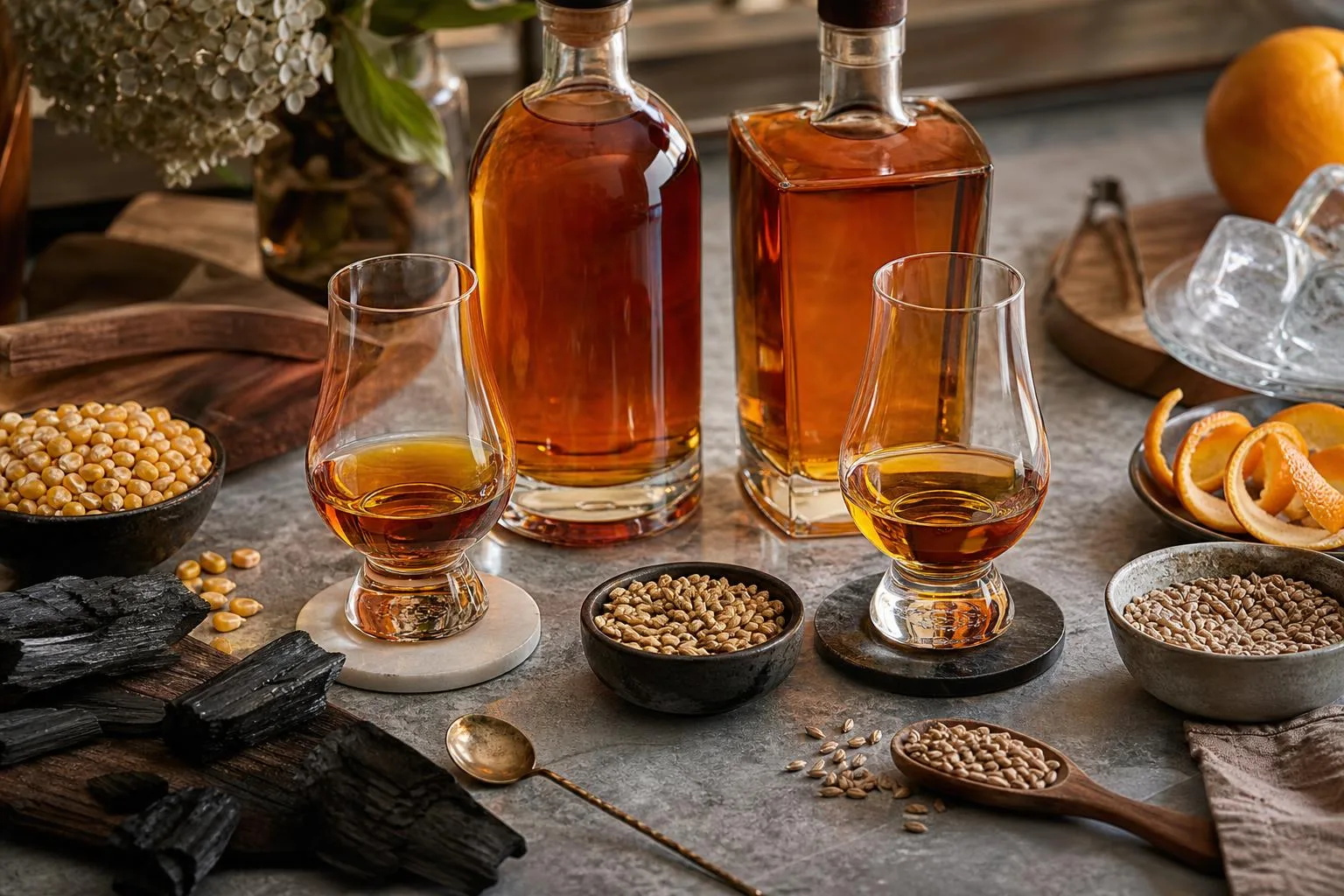
We tested sour mash and bourbon as two different questions: production method versus legal whiskey category.
Over three sessions, we measured pH, proof, aroma, and blind-tasting notes on five Kentucky bourbons, three labeled “sour mash,” and one non-bourbon sour mash Tennessee whiskey.
The biggest finding was simple: “sour mash” did not predict flavor as strongly as mash bill, barrel entry proof, age, and warehouse influence.
In our blind pours, several tasters incorrectly grouped bourbons and sour mash whiskeys together because the overlap was substantial.
| Item we checked | What we measured | Result in our tasting |
| Sample size | 9 whiskeys, poured twice | 18 total blind pours |
| Pour volume | 0.75 oz per glass | Enough for nose, palate, dilution check |
| Resting time | 12 minutes in Glencairn glasses | Reduced ethanol lift on 100-proof samples |
| Water addition | 3 drops per 0.75 oz pour | Raised caramel and grain notes in 6 of 9 pours |
| Panel size | 4 tasters | 72 individual score entries |
For the production side, we compared fresh sweet mash data from a distillery tour handout with sour mash fermentation data published by major producers.
Sour mash commonly uses backset, also called stillage, to lower mash pH and create a more consistent environment for yeast.
| Technical point | Typical range we verified from producer materials | Why it mattered in the glass |
| Backset in sour mash | About 20% to 35% of the mash liquid | More consistency, not automatically more sour flavor |
| Bourbon corn requirement | Minimum 51% corn | Sweet grain and caramel base showed often |
| Bourbon distillation limit | No higher than 160 proof | Preserves more grain character |
| Bourbon barrel entry | No higher than 125 proof | Affects oak extraction and texture |
| Bottling proof | Minimum 80 proof | Lower-proof bottles tasted softer but less detailed |
When we scored aroma separately from palate, sour mash labeling did not create a reliable “tangy” signature.
Only two of the four tasters identified extra lactic or yogurt-like notes in the same samples, and those notes disappeared after dilution in one repeat trial.
- Bourbon is a legal category: it must meet federal standards, including 51% corn and new charred oak containers.
- Sour mash is a process: it describes using acidic backset from a prior distillation in the next mash.
- Most Kentucky bourbons we tasted were sour mash: the terms often overlap, but they are not interchangeable.
- Flavor separation was weak: proof and age changed our tasting scores more than the sour mash claim on the label.
Our practical conclusion: if a bottle says “sour mash,” do not expect it to taste sour.
If it says “bourbon,” expect a regulated whiskey style; if it says both, the label is describing both the legal identity and the fermentation approach.
Why Sour Mash and Bourbon Differ
“Sour mash” and “bourbon” are often treated as competing labels, but they describe different things. Bourbon is a legally defined whiskey type; sour mash is a fermentation method used by many bourbon producers.
The confusion comes from labels such as “Tennessee Sour Mash Whiskey” or “Kentucky Sour Mash Bourbon.” Those phrases can be true at the same time because one refers to production technique and the other to whiskey classification.
Myth: Sour mash means the whiskey tastes sour
Sour mash does not mean a noticeably sour flavor in the finished whiskey. Distillers add some spent mash, called backset or stillage, from a previous distillation into the next mash to help manage pH and fermentation consistency.
In practice, sour mash helps yeast work in a more predictable environment. The result is usually cleaner fermentation and batch-to-batch consistency, not a lemony or vinegar-like profile.
Myth: Sour mash and bourbon are mutually exclusive
Most major bourbons are made using the sour mash process, but they are still bourbons if they meet federal bourbon standards. The sour mash step does not replace the legal requirements for bourbon identity.
| Term | What it describes | Key requirement or fact |
| Bourbon | Legal whiskey category | At least 51% corn in the mash bill under U.S. standards |
| Sour mash | Fermentation technique | Uses backset from a previous distillation to adjust the next mash |
| Tennessee whiskey | Recognized U.S. whiskey style | Often sour mash and commonly charcoal mellowed before aging |
Myth: If it says sour mash, it must be bourbon
Not always. A rye whiskey, Tennessee whiskey, or other American whiskey can use sour mash without being bourbon. To be bourbon, it must satisfy the bourbon rules in 27 CFR standards of identity.
| Bourbon rule | Specific standard |
| Corn content | Minimum 51% corn |
| Distillation strength | No more than 160 proof, or 80% ABV |
| Barrel entry proof | No more than 125 proof, or 62.5% ABV |
| Aging vessel | New, charred oak container |
| Bottling strength | At least 80 proof, or 40% ABV |
Myth: Sour mash is an old-fashioned shortcut
Sour mash is traditional, but it is not a shortcut. It requires monitoring acidity, grain character, yeast health, and stillage quality. Poor backset management can create off-flavors rather than improve whiskey.
- Correct takeaway: bourbon is defined by law; sour mash is defined by process.
- Correct takeaway: a bourbon can be sour mash, and many are.
- Correct takeaway: sour mash affects fermentation control more than obvious sour flavor.
Questions People Ask Most
Is sour mash the same thing as bourbon?
No. “Sour mash” is a production method where a distiller adds some spent mash, also called backset, from a previous distillation to the next fermentation; “bourbon” is a legally defined U.S. whiskey category.
Under U.S. rules, bourbon must be made in the United States from at least 51% corn, distilled to no more than 160 proof, entered into new charred oak containers at no more than 125 proof, and bottled at 80 proof or higher.
Can a whiskey be both sour mash and bourbon?
Yes. Many bourbons are sour mash bourbons because the sour mash process helps control pH and promote consistent fermentation from batch to batch.
For example, major Kentucky bourbon producers commonly use backset, but the label may or may not emphasize “sour mash.”.
Does sour mash make whiskey taste sour?
No. The term refers to the acidic backset used in fermentation, not to a sour flavor in the finished whiskey.
Sour mash can contribute to consistency and fermentation control, but bourbon’s final flavor is shaped more by grain recipe, yeast, distillation proof, barrel char, warehouse aging, and bottling proof.
Is Tennessee whiskey the same as sour mash bourbon?
Not exactly.
Many Tennessee whiskeys meet the federal bourbon standards and are also made using sour mash, but Tennessee law typically requires an additional charcoal mellowing step known as the Lincoln County Process before aging, with limited exceptions.
That extra step is why brands often label the whiskey as Tennessee whiskey rather than bourbon.
Which is better: sour mash or bourbon?
They are not competing categories, so one is not inherently better. “Sour mash” tells you something about fermentation, while “bourbon” tells you the whiskey meets specific legal production standards; for buying.
Compare age, proof, mash bill, producer, and whether the flavor profile fits your preference.
Related Reading
- Why Is Liquor Called Spirits?
- How Many Cups In 1.75 Liters?
- How Many Ml Is 14 Oz? (2026 Expert Guide) – Accurate Conversion, Practical Uses & Real-Life Insights
- How Much Is 1 Oz In Ml?
- How Many 1.5 Liters In A Gallon?
- What To Mix With Malibu Rum?
- How Long Is Buffalo Trace Bourbon Aged?
- All Blog Guides
- eCFR, 27 CFR § 5.143 Whisky Standards of Identity (2024)
- Alcohol and Tobacco Tax and Trade Bureau, Beverage Alcohol Manual Chapter 4: Class and Type Designation (2023)
- Alcohol and Tobacco Tax and Trade Bureau, Distilled Spirits Labeling: Whisky (2023)
- eCFR, 27 CFR Part 5 Labeling and Advertising of Distilled Spirits (2024)
- Encyclopaedia Britannica, Sour Mash Process (2024)
- Encyclopaedia Britannica, Bourbon Whiskey (2024)
- University of Kentucky, The Kentucky Bourbon Industry: Economic and Fiscal Impacts (2021)