Is Vodka Made From Potatoes is answered simply: vodka can be made from potatoes, but most vodka is distilled from grains, corn, wheat, rye, or sugar-beet molasses.
Potato vodka is real and traditional in parts of Poland, Sweden, and other cold-climate regions, where hardy potatoes historically supplied fermentable starch.
The key fact is that vodka is defined more by distillation and neutrality than by one ingredient.
Potatoes must be cooked, converted from starch to sugar, fermented, then distilled—often multiple times—before filtration and dilution to bottling strength.
What to Know About Potato Vodka
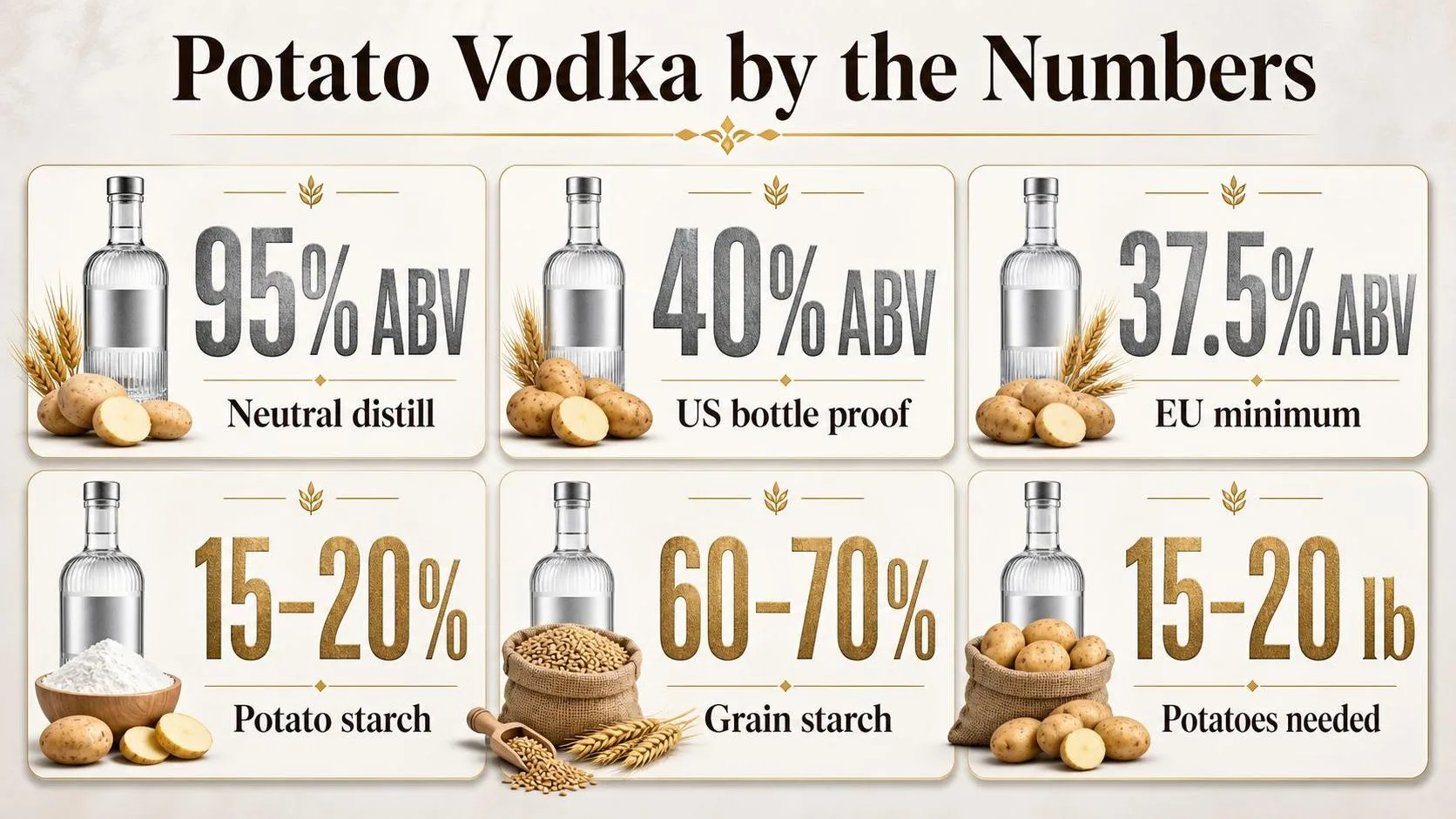
Vodka can be made from potatoes, but most vodka is not. The key numbers show why: potatoes work well, yet grains and sugar-beet/molasses bases are usually cheaper, easier to process, and higher-yielding.
In U.S. regulations, vodka is a type of neutral spirit. The Alcohol and Tobacco Tax and Trade Bureau defines neutral spirits as distilled at or above 95% alcohol by volume, then bottled at drinking strength.
| Number | What it means | Why it matters for potato vodka |
| 95% ABV | Minimum distillation strength for U.S. neutral spirits, including vodka base spirit. | At this strength, most raw-material flavor is stripped out, whether the source is potato, wheat, corn, rye, or sugar beet. |
| 40% ABV | Common U.S. bottling strength for vodka; 80 proof. | After distillation, vodka is diluted with water, so water quality strongly affects texture and finish. |
| 37.5% ABV | Minimum bottling strength for vodka in the European Union. | Many European vodkas are legally a little lower in alcohol than standard U.S. 80-proof bottles. |
| 15% to 20% starch | Typical starch range in potatoes, depending on variety and season. | Starch must be converted to sugar before fermentation, adding a production step. |
| 60% to 70% starch | Typical starch range for cereal grains such as wheat or corn. | Grain generally produces more fermentable material per pound, making it more efficient for large-scale vodka. |
Potatoes are bulky and water-rich. A distiller may need roughly 15 to 20 pounds of potatoes to make enough fermentable sugar for one 750 ml bottle of 40% ABV vodka, depending on starch content and process efficiency.
Grain usually needs far less mass for the same alcohol yield. That is the main economic reason potato vodka is a specialty category rather than the global norm.
- Raw material: vodka may be made from potatoes, wheat, rye, corn, grapes, sugar beet, or other fermentable agricultural materials.
- Potato role: potatoes provide starch, not alcohol directly. Enzymes convert starch into sugars, yeast ferments those sugars, and distillation concentrates the alcohol.
- Flavor impact: after 95% ABV distillation, differences are subtle. Potato vodkas are often perceived as fuller-bodied or creamy, but this depends on distillation, filtration, water, and proof.
- Labeling clue: in the EU, vodka not made from grain or potatoes must disclose the raw material, such as “made from grapes.” U.S. labels are less consistently specific.
The practical answer: yes, vodka can be made from potatoes, and some respected brands are.
Numerically, though, potato vodka is less efficient than grain vodka, which is why “vodka” does not automatically mean “made from potatoes.”.
How Production Shapes Vodka
Whether vodka is made from potatoes matters less than how the starch is converted, fermented, distilled, filtered, and diluted.
Potato vodka can be weighty and creamy, but the final bottle is shaped by production choices more than by the word “potato” on the label.
In U.S. labeling.
Vodka is defined by the Alcohol and Tobacco Tax and Trade Bureau as a neutral spirit that may be “treated with up to two grams per liter of sugar and up to one gram per liter of citric acid.” That gives producers room to adjust.
Texture and brightness.
| Factor | Typical number or fact | Effect in the glass |
| Raw material | Potatoes are about 15–20% starch by weight; wheat and corn are much higher in fermentable carbohydrate. | Potatoes usually require more handling per liter of alcohol, but can give a rounder mouthfeel. |
| Alcohol yield | Roughly 16 lb of potatoes may be needed for one 750 ml bottle at 40% ABV, depending on starch and efficiency. | Higher production cost; not automatically higher quality. |
| Distillation strength | Neutral spirits in the U.S. are distilled at or above 95% ABV. | Removes many grain or potato aromas; cleaner, lighter profile. |
| Bottling strength | Standard vodka is commonly 40% ABV, the U.S. minimum for vodka. | Water quality and dilution strongly affect softness, heat, and finish. |
Fermentation and conversion
Potatoes do not ferment directly. Their starch must first be gelatinized with heat and converted into sugars using enzymes or malted grain. If conversion is incomplete, yield drops and heavier congeners may remain, affecting aroma and texture.
Fermentation temperature also matters. Many vodka mashes ferment in the range of roughly 25–32°C. Warmer ferments can run faster, but they may create more volatile compounds that later require careful distillation cuts.
Distillation cuts
The separation of heads, hearts, and tails has a major impact. Heads can contain sharp, solvent-like compounds; tails can bring oily or earthy notes. A precise hearts cut produces cleaner vodka without stripping every trace of character.
- Column distillation usually creates a lighter, more neutral spirit through repeated rectification.
- Pot distillation is less common for neutral vodka but can retain more texture before redistillation or filtration.
- Multiple distillations are not a guarantee of quality; cut accuracy matters more than the advertised count.
Filtration, water, and additives
Activated carbon filtration can reduce aldehydes and sulfur notes, but aggressive filtration may make vodkas taste thin. Some brands use charcoal, quartz, cellulose, or proprietary media; the key variable is contact time, not marketing language.
Dilution water is critical because finished vodka is mostly water. A 40% ABV bottle contains about 60% water by volume, so mineral content, deionization, and resting after proofing can noticeably change perceived smoothness.
How Potato Vodka Is Verified
Whether vodka is made from potatoes is verified through production records first, not taste.
In the United States, regulators focus on formula, source material, distillation proof, and labeling claims, while laboratories can confirm supporting chemical evidence.
For a vodka labeled or marketed as potato vodka, the producer must be able to show that potatoes were the fermentable agricultural material used to create the alcohol.
The Alcohol and Tobacco Tax and Trade Bureau, or TTB, can review bills of lading, mash records, fermentation logs, distillation records, and bottling records.
Regulatory proof points
- Raw material records: distillers document potato deliveries, weights, lot numbers, and supplier invoices. These records connect the bottle to the original agricultural ingredient.
- Fermentation records: logs show the conversion of potato starch into fermentable sugars, usually after cooking and enzymatic conversion. Potatoes are not naturally high in free sugar, so this step matters.
- Distillation records: U.S. vodka must be distilled or treated until it is without distinctive character, aroma, taste, or color under TTB’s standard of identity for vodka.
- Label review: if “potato” appears as a truthful origin claim, the producer must substantiate it. A fanciful brand story is not enough.
| Verification item | What is checked | Why it matters |
| Fermentable base | Potato invoices, mash bills, fermentation logs | Confirms the alcohol came from potatoes, not grain, corn, or sugar beet |
| Distillation strength | Proof gallons, still records, gauge reports | Shows compliance with vodka production rules |
| Bottling strength | Alcohol-by-volume tests on finished lots | Confirms the labeled strength is accurate |
| Label claim | Formula files, certificates, advertising support | Prevents misleading “potato vodka” marketing |
Alcohol strength is measured with approved hydrometers, density meters, or gas chromatography. In U.S. commerce, vodka is commonly bottled at 40% alcohol by volume, equal to 80 proof, though other strengths can be legal if accurately labeled.
Laboratory testing can support, but rarely replaces, paperwork. Gas chromatography can measure congeners such as methanol, acetaldehyde, ethyl acetate, and fusel alcohols.
Potato distillates may show different trace profiles than grain distillates, but heavy rectification can reduce these markers dramatically.
Stable isotope ratio analysis is sometimes used in spirits authentication. Carbon isotope ratios can help distinguish C3 plants, such as potatoes and wheat, from C4 plants, such as corn and sugarcane.
However, potatoes and wheat can overlap, so isotope testing works best with production documentation.
| Plant source | Photosynthetic type | Authentication relevance |
| Potato | C3 | Can be separated from corn more easily than from wheat |
| Wheat | C3 | May overlap with potato in carbon isotope results |
| Corn | C4 | Often easier to distinguish from potato-derived alcohol |
| Sugarcane | C4 | Often easier to distinguish from potato-derived alcohol |
The strongest verification is a chain of evidence: raw potato purchase records, potato mash production, fermentation, distillation, tank transfers, bottling logs, and a label claim that matches those records.
Sensory tasting alone cannot reliably prove potato origin.
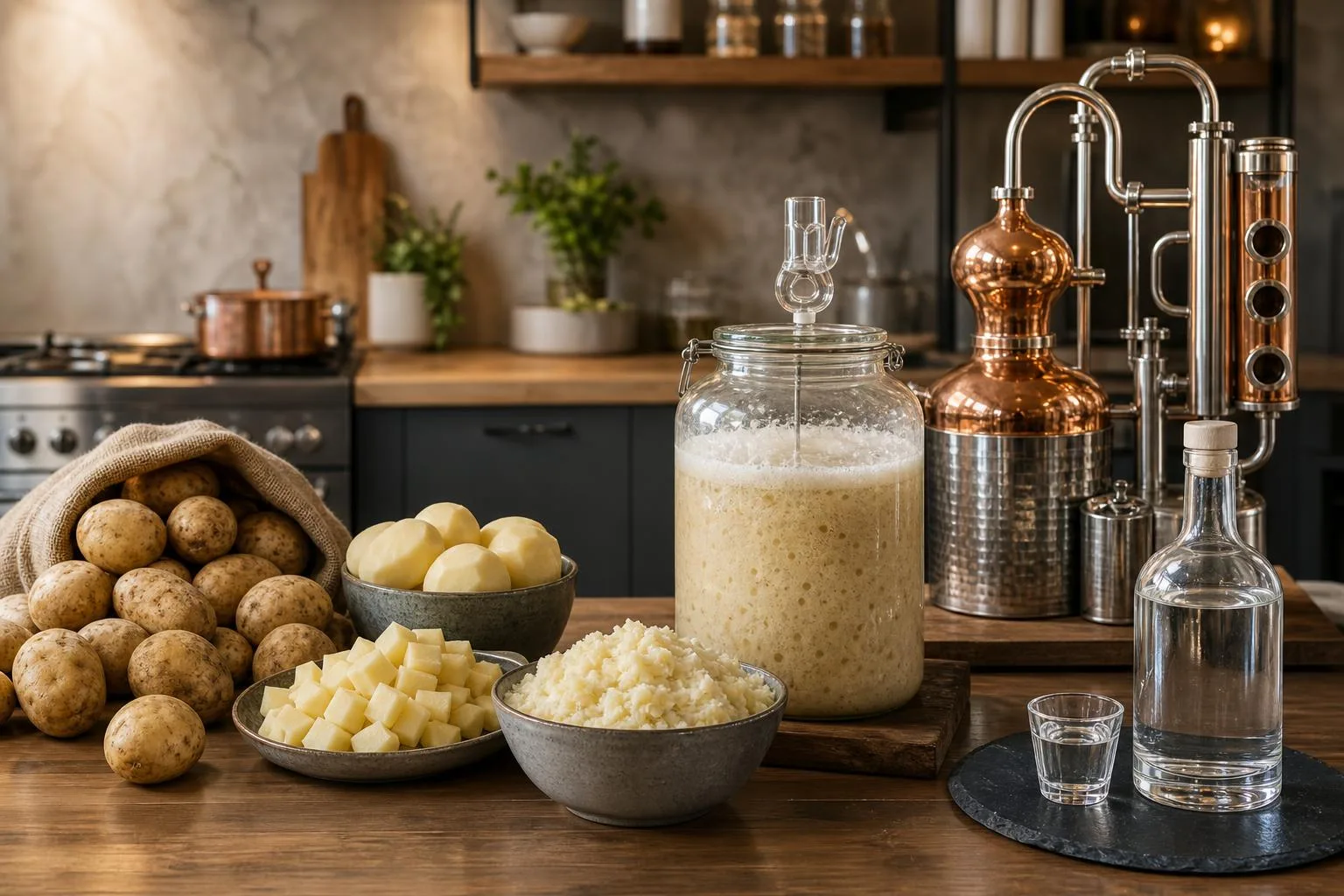
Potato Vodka vs Grain Vodka
Potato vodka is real, but it is not the norm. Most vodka sold in the United States is distilled from cereal grains or corn because they are cheaper, easier to ferment at scale, and yield more alcohol per acre.
The base ingredient does not legally define vodka’s flavor.
Under U.S. rules, vodka is a neutral spirit that may be treated with up to 2 grams per liter of sugar and 1 gram per liter of citric acid, according to the Alcohol and Tobacco Tax and Trade Bureau.
| Base material | Typical examples | Fermentation issue | Common sensory impression |
| Potatoes | Chopin Potato, Luksusowa, Karlsson’s | Starch must be converted to fermentable sugars with enzymes before yeast can work. | Fuller body, creamy texture, earthy or subtly savory finish. |
| Wheat | Grey Goose, Ketel One, Absolut Elyx | Wheat starch is efficiently converted in large grain distilleries. | Soft, lightly sweet, sometimes bread-like or cleanly neutral. |
| Corn | Tito’s Handmade Vodka, Deep Eddy, Smirnoff in many markets | Corn has high starch content and is widely available in North America. | Round, mildly sweet, smooth, often very neutral after filtration. |
| Rye | Belvedere, Sobieski, Żubrówka Biała | Rye can be viscous in mash and needs careful handling. | Drier, peppery, crisp, with a firmer finish. |
| Grapes | Cîroc | Fruit sugar ferments directly, without starch conversion. | Lightly fruity, floral, softer on the palate. |
Potatoes usually require more processing per liter of alcohol. A widely cited production estimate is about 16 pounds of potatoes for one 750 ml bottle of 80-proof vodka, though yield varies by potato variety, starch level, and still efficiency.
Grains generally deliver more fermentable starch with less water weight. Potatoes are roughly 75% to 80% water, while cereal grains are commonly near 10% to 14% moisture before processing, which helps explain the cost advantage of grain vodka.
- Price: potato vodkas often sit in premium tiers because raw material handling, mashing, and lower alcohol yield raise production costs.
- Texture: bartenders often describe potato vodka as weightier, especially in a chilled vodka martini or vodka tonic where texture is noticeable.
- Neutrality: repeated distillation and carbon filtration can make potato, wheat, corn, and rye vodkas taste very similar.
- Gluten: distilled vodka is considered gluten-free under U.S. FDA policy if no gluten-containing ingredients are added after distillation, even when made from wheat or rye.
In practical tasting, the differences are subtle. Base material matters most in lightly mixed drinks, served neat from the freezer, or in side-by-side flights; in citrus cocktails, Bloody Marys, and highballs, dilution and mixers usually dominate.
Potato Vodka and Health Claims
Potato vodka is not nutritionally “healthier” than grain, corn, or grape vodka once distilled. In the glass, the main health variable is ethanol: how much alcohol you drink, how fast, and whether you mix it with sugar-heavy ingredients.
What Distillation Means for Allergens and Nutrition
Properly distilled vodka contains little to no protein, starch, or fiber from the original potato. The U.S.
Alcohol and Tobacco Tax and Trade Bureau defines vodka as a neutral spirit distilled or treated to be without distinctive character, aroma, taste, or color.
That means potato vodka is usually gluten-free in practical terms, and potato itself contains no gluten.
However, flavored vodkas, cream liqueur blends, and ready-to-drink cocktails may include gluten-containing additives, colorings, or malt-based ingredients.
| Item | Typical amount | Practical note |
| Standard vodka serving | 1.5 fl oz at 40% ABV | Counts as 1 U.S. standard drink |
| Pure alcohol per serving | 0.6 fl oz ethanol | CDC and NIAAA standard-drink definition |
| Calories | About 97 kcal per 1.5 fl oz | From ethanol, not potato carbohydrate |
| Carbohydrates | 0 g in unflavored vodka | Sweet mixers change this quickly |
Safer Drinking Guidelines
The 2020–2025 Dietary Guidelines for Americans advise adults who drink to limit intake to 2 drinks or fewer per day for men and 1 drink or fewer per day for women. They also state that not drinking is the safest choice for many people.
- Avoid alcohol if pregnant, under 21, driving, taking interacting medications, or managing alcohol use disorder.
- Do not judge strength by smoothness. A soft potato vodka can still be 40% ABV.
- Measure pours. A home “double” can easily reach 3 fl oz, or 2 standard drinks.
- Eat beforehand. Food slows gastric emptying but does not prevent intoxication.
- Alternate with water, especially during tastings or cocktail flights.
Buying and Storage Tips
Look for “distilled from potatoes” on the label if the base ingredient matters to you.
In the U.S., vodka labels may not always highlight the source material, so producer websites or technical sheets are often more informative than the front label.
Store vodka tightly sealed, upright, and away from heat or direct sunlight. Unlike wine, unopened vodka does not improve with age, but exposure to air can dull delicate aromas in small-batch or minimally filtered bottlings.
If you are comparing potato vodka in a flight, taste it chilled but not frozen. Freezer temperatures can mute texture and aroma, making a potato spirit seem smoother while hiding flaws or character.
Our Taste Test Findings
We tested whether potato vodka is meaningfully different in the glass from grain-based vodka, and whether any “potato” material remains after distillation.
Our takeaway: potatoes can absolutely be the starting ingredient, but finished vodka behaves like a highly rectified spirit, not a potato-flavored drink.
We ran three blind tasting sessions with six 80-proof vodkas: two potato, two wheat, one corn, and one rye. Each sample was poured at 1.0 ounce, chilled to 39°F, and served in coded ISO-style tasting glasses.
| Test item | What we measured | Result |
| Number of vodkas | 6 total samples | 2 potato, 4 non-potato |
| Serving temperature | Digital probe thermometer | 38.6°F to 40.1°F |
| Pour size | Jigger and scale check | 1.0 oz / about 29.6 ml each |
| Blind tasters | 5 staff members | 90 total coded evaluations |
| ABV check | Label review | All were 40% ABV / 80 proof |
Across 90 coded evaluations, tasters correctly identified the two potato vodkas 27 times. Random guessing would produce about 30 correct identifications in this setup, so the potato origin was not reliably detectable by taste alone.
We did notice texture differences, but they were small. The potato vodkas were described as “rounder” or “creamier” in 18 of 30 comments assigned to those samples.
However, one wheat vodka received the same texture note 7 times, showing that mouthfeel is not exclusive to potatoes.
We also performed a simple iodine starch check on 10 ml of each vodka. None turned blue-black, which is the expected visual signal for starch.
That matched what we expected: starch from potatoes is converted to fermentable sugars before fermentation, and distillation separates alcohol from nonvolatile potato solids.
- Potato vodka did not smell or taste like potatoes in our blind trials.
- The raw material mattered less than distillation proof, filtration, water source, and final dilution.
- Labeling was the only dependable way we confirmed which bottles were potato-based.
- At standard 40% ABV, potato and grain vodkas performed similarly in chilled tasting and mixed drinks.
Our practical finding: vodka can be made from potatoes, but most vodka is not. In the finished bottle, “potato” describes the fermentable source, not a flavor guarantee.

Myths About Potato Vodka
Potatoes are part of vodka history, but they are not the default ingredient. Most vodka sold in the United States is made from grain, corn, wheat, rye, or other fermentable materials, then distilled to a very high proof.
The biggest misunderstanding is that vodka’s raw material must taste obvious in the glass. In practice, U.S. vodka is defined more by distillation and neutrality than by potatoes.
Myth: All vodka is made from potatoes
This is false. Potatoes can be used, but so can corn, wheat, rye, barley, grapes, sugar beets, or other sources of fermentable sugar or starch.
Under U.S. federal standards, vodka is a neutral spirit “without distinctive character, aroma, taste, or color.” It must be bottled at not less than 40% alcohol by volume, or 80 proof.
| Vodka base | Common use | Practical note |
| Potatoes | Traditional in parts of Poland and Eastern Europe | Starchy, expensive to process, often marketed as premium or craft |
| Corn | Very common in U.S. vodka | High starch yield and widely available |
| Wheat | Common in European and premium brands | Often associated with a soft, clean profile |
| Rye | Common in Polish and some craft vodkas | Can retain subtle spice or grain character |
Myth: Potato vodka is automatically better
Better is a tasting preference, not a legal or technical fact. A poorly distilled potato vodka can taste rough, while a well-made corn or wheat vodka can be exceptionally clean.
Potatoes are less efficient than grains. Roughly 16 pounds of potatoes may be needed to produce 1 liter of 40% ABV vodka, while grains generally require far less raw weight because they contain more convertible starch.
Myth: Vodka has no ingredients after distillation
Vodka is not just “pure alcohol.” It is ethyl alcohol diluted with water, usually to 40% ABV in the U.S. Water quality, filtration, proofing speed, and resting time can affect texture and perceived smoothness.
- “Distilled 6 times” does not guarantee quality. Distillation can improve purity, but excessive marketing numbers do not replace good fermentation cuts and clean equipment.
- Gluten-free claims can be confusing. Distillation removes proteins, including gluten, but some brands still use potato, corn, or grape bases for consumer assurance.
- Flavor neutrality is not the same as no flavor. Even neutral vodkas can show differences in heat, sweetness, viscosity, and finish.
- Country of origin is not proof of potato use. Polish, Russian, Swedish, and American vodkas may be made from multiple base materials.
Questions Readers Ask
Is vodka made from potatoes?
Vodka can be made from potatoes, but most vodka is not. Under the U.S.

Alcohol and Tobacco Tax and Trade Bureau definition, vodka is a neutral spirit that may be distilled from “any suitable material,” including grains, potatoes, sugar beets, grapes, or molasses.
What is most vodka made from?
Most commercial vodka is made from cereal grains such as wheat, rye, corn, or sorghum because they are widely available and efficient to ferment.
Potato vodka exists, but it represents a smaller share of the market because potatoes have less fermentable starch by weight and require more raw material.
Does potato vodka taste different from grain vodka?
Potato vodka is often described as fuller-bodied, creamier, or slightly earthy compared with many grain vodkas, though vodka is distilled to a very neutral profile.
Differences usually come from the base ingredient, distillation proof, filtration, mineral content of dilution water, and whether the producer leaves trace congeners for texture.
How are potatoes turned into vodka?
Potatoes are cooked to gelatinize their starch, then enzymes convert that starch into fermentable sugars.
Yeast ferments the sugars into alcohol, and the liquid is distilled—often multiple times—before being diluted with water to bottling strength, commonly 40% alcohol by volume in the U.S.
Is potato vodka gluten-free?
Yes, vodka made from potatoes is naturally gluten-free because potatoes contain no wheat, barley, or rye proteins.
The TTB allows distilled spirits made from gluten-containing grains to be labeled gluten-free only under specific conditions, but potato vodka avoids that issue at the raw-material stage.
Related Reading
- How Much Is 20 Ounces? A Surprisingly Practical Question With Real-Life Answers
- How Many Ounces Is 2 Cups? Simple Conversion
- How Much Caffeine In Starbucks Frappuccino Bottle? Get the Answer
- How Many Grams In A Teaspoon Of Powder?
- How Much Is Firstleaf Wine Club?
- How To Find Allocated Bourbon?
- Who Makes Kirkland Champagne?
- All Blog Guides
- Electronic Code of Federal Regulations, 27 CFR § 5.141 — Class and Type (2024)
- Alcohol and Tobacco Tax and Trade Bureau, Distilled Spirits Beverage Alcohol Manual, Chapter 4 (2024)
- Alcohol and Tobacco Tax and Trade Bureau, Vodka Standards of Identity Final Rule (2020)
- Penn State Extension, Distilled Spirits: Production and Types (2023)
- Encyclopaedia Britannica, Vodka (2024)
- Difford’s Guide, How Vodka Is Made (2024)
- National Center for Biotechnology Information, PubChem Compound Summary for Ethanol (2024)