Does Wine Make You Horny is best answered this way: wine can make arousal feel easier by lowering inhibitions, but it does not reliably increase sexual desire or performance.
Alcohol affects the prefrontal cortex, dopamine signaling, blood flow, and judgment, so one glass may feel flirtatious while more can blunt sensation.
Research consistently shows a dose-dependent pattern: low alcohol intake may increase subjective relaxation and confidence, while higher intake is linked with erectile difficulty, delayed orgasm, reduced lubrication, and riskier consent decisions.
This article separates the psychology of “feeling horny” from the physiology of actually becoming sexually responsive.
Why Wine Can Seem Arousing
Wine can make some people feel more flirtatious because alcohol lowers inhibition, but that is not the same as reliably increasing sexual desire or performance.
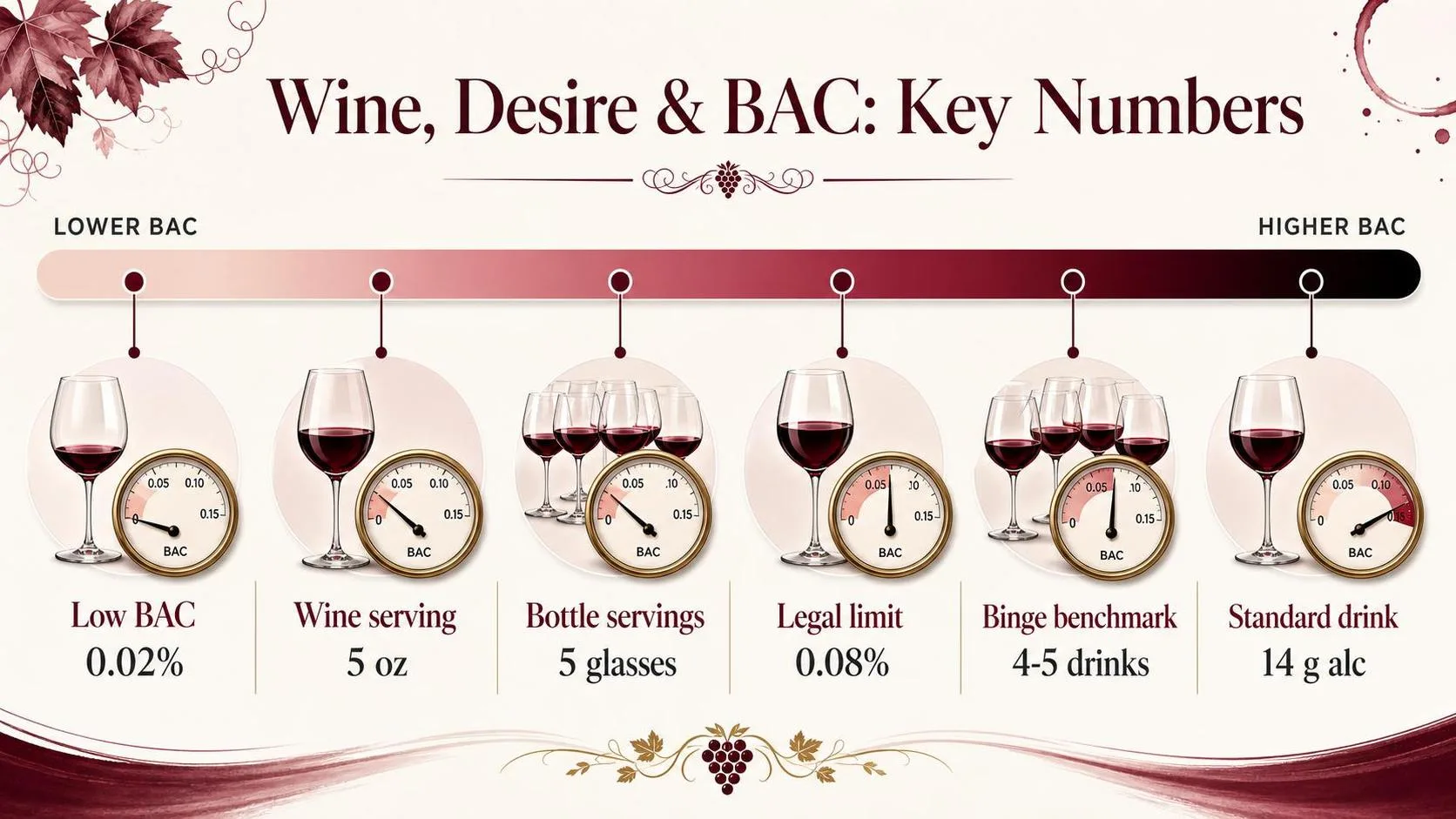
The numbers matter: dose, blood alcohol concentration, sex, body size, food, and tolerance all change the effect.
| Measure | Number | Why it matters |
| U.S. standard drink | 14 grams pure alcohol | Used by NIAAA and CDC to compare beer, wine, and spirits. |
| Typical wine serving | 5 ounces at 12% ABV | Equals about 1 standard drink. |
| Restaurant pour | 6 to 9 ounces | Often equals 1.2 to 1.8 standard drinks before you notice. |
| Bottle of wine | 750 milliliters, about 25.4 ounces | Roughly 5 standard 5-ounce servings at 12% ABV. |
At low doses, alcohol’s “sexy” effect is mostly psychological: less self-monitoring, more risk-taking, and stronger attention to immediate cues.
Alcohol researchers often call this alcohol myopia, meaning intoxication narrows attention to what feels salient right now.
| Approximate BAC | Common effect on sex and arousal |
| 0.02% | Mild relaxation and lower inhibition; judgment starts to shift. |
| 0.05% | More disinhibition, slower reaction time, weaker decision-making. |
| 0.08% | Legal intoxication limit for driving in all U.S. states; coordination, consent communication, and sexual performance are meaningfully impaired. |
| 0.10% and higher | Greater erectile difficulty, reduced lubrication, delayed orgasm, nausea, sleepiness, and poor memory formation become more likely. |
For men, the short-term pattern is especially clear: small amounts may reduce anxiety.
While higher amounts interfere with erection through nervous-system slowing and reduced penile blood-flow signaling. “Whiskey dick” is not whiskey-specific; wine can do it too.
For women, the data are mixed. Some studies find higher subjective arousal after moderate alcohol, while lab measures of genital arousal often decrease as dose rises.
In other words, someone may feel more turned on while the body responds less efficiently.
| Research finding | Number | Important limitation |
| Italian study of women and wine, published in 2009 in Journal of Sexual Medicine | 798 women | Moderate wine drinkers reported higher sexual-function scores, but the study was observational and cannot prove wine caused the difference. |
| CDC definition of heavy drinking | 8 or more drinks weekly for women; 15 or more for men | At this level, alcohol is linked with poorer sleep, mood issues, hormone disruption, and sexual dysfunction risk. |
| NIAAA binge-drinking benchmark | BAC about 0.08% | Usually reached after 4 drinks for women or 5 for men in about 2 hours, though body size and food change this. |
The practical takeaway: one glass may make flirting feel easier; two large pours can already push many people toward impaired judgment and weaker sexual response. Wine does not create desire so much as change inhibition, attention, and physiology.
Factors That Change Wine’s Effects
Wine can lower inhibition, increase relaxation, and make flirting feel easier, but it does not reliably increase physical arousal.
The outcome depends on dose, body size, sex, food, mood, medications, and whether “horny” means desire, confidence, lubrication, erection quality, or orgasm.
Amount matters most
In U.S. alcohol guidance, one standard drink contains 14 grams of pure alcohol. For table wine, that is about 5 ounces at 12% ABV. Many restaurant pours are 6 to 9 ounces, meaning one glass can quietly become 1.2 to 1.8 standard drinks.
| Wine intake | Approximate alcohol | Common sexual effect |
| 2 to 3 ounces | 0.4 to 0.6 standard drink | Mild relaxation; little direct physical effect |
| 5 ounces at 12% ABV | 1 standard drink | Lowered inhibition; desire may feel higher |
| 10 ounces at 12% ABV | 2 standard drinks | Judgment and arousal response may diverge |
| 15 ounces at 12% ABV | 3 standard drinks | Higher risk of erectile difficulty, reduced lubrication, delayed orgasm |
Blood alcohol concentration changes the experience
Alcohol’s effects track blood alcohol concentration, not just “number of glasses.” The National Institute on Alcohol Abuse and Alcoholism notes that alcohol impairs judgment and coordination as BAC rises.
And sexual decision-making is affected before obvious drunkenness.
| BAC range | Typical effect |
| 0.02% to 0.03% | Relaxation, slight mood lift, reduced shyness |
| 0.05% | Lowered alertness, weaker judgment, slower response |
| 0.08% | Legal driving limit in most U.S. states; clear impairment |
| 0.10% or higher | More sedation, poorer coordination, higher sexual performance problems |
Your body and context change the dose
- Body size and sex: A smaller person generally reaches a higher BAC from the same pour. On average, women also have less total body water than men, which can raise alcohol concentration after equal intake.
- Food: Drinking wine with a meal slows alcohol absorption. Drinking on an empty stomach makes effects hit faster and can turn “relaxed” into sleepy or uncoordinated.
- Wine strength: A 5-ounce glass at 15% ABV has 25% more alcohol than the same pour at 12% ABV.
- Mood and expectation: If wine is part of a romantic ritual, the setting can amplify desire. That is not the same as alcohol biologically increasing sexual function.
- Medications: Antidepressants, blood pressure drugs, opioids, sleep aids, antihistamines, and erectile dysfunction medications can interact with alcohol or sexual response.
- Chronic drinking: Repeated heavy alcohol use is linked with lower testosterone, erectile dysfunction, menstrual disruption, reduced fertility, and lower sexual satisfaction.
The practical takeaway: one modest glass may help some adults feel relaxed and socially open. More wine often moves in the opposite direction, increasing desire in the mind while making the body less responsive.
How Researchers Measure Arousal
Researchers do not verify “horny” by asking one vague question. They separate sexual desire, arousal, performance, inhibition, and alcohol exposure, then measure each with validated tools and timed blood-alcohol estimates.
In practice, wine’s effect is verified by comparing a person’s responses after alcohol with their responses after placebo or no alcohol. The strongest studies control dose, timing, food intake, relationship context, and expectancy.
Core measures used in alcohol-and-sex research
| Measure | What it verifies | Specific use |
| Blood alcohol concentration | Actual intoxication level | Breathalyzer or blood test; many lab studies target about 0.03% to 0.08% BAC. |
| Standard drink count | Alcohol dose consumed | In the U.S., 1 standard drink contains 14 g pure alcohol; 5 oz of 12% wine equals 1 drink. |
| Sexual Desire Inventory | Subjective sexual desire | Separates dyadic desire, directed toward a partner, from solitary desire. |
| FSFI / IIEF | Sexual function | FSFI assesses female desire, arousal, lubrication, orgasm, satisfaction, pain; IIEF assesses erectile function and related domains. |
| Genital arousal devices | Physiological arousal | Penile plethysmography or vaginal photoplethysmography can detect blood-flow changes during erotic stimuli. |
Alcohol exposure is usually standardized before interpretation.
A 5-ounce glass of wine at 12% ABV contains about 0.6 fluid ounces of pure ethanol, or 14 grams, matching the National Institute on Alcohol Abuse and Alcoholism definition of one U.S. standard drink.
Verification also requires separating desire from physical performance. A person may report more confidence or sexual interest after one drink, while objective genital response or erectile performance may stay unchanged or decline as BAC rises.
What dose helps researchers interpret results
| Wine amount | Approximate alcohol | Likely research interpretation |
| 5 oz at 12% ABV | 1 standard drink; 14 g ethanol | May reduce inhibition in some adults without necessarily improving arousal. |
| 10 oz at 12% ABV | 2 standard drinks; 28 g ethanol | More likely to impair judgment, consent clarity, orgasm, and erection quality. |
| 15 oz at 12% ABV | 3 standard drinks; 42 g ethanol | Higher impairment risk; subjective desire becomes less reliable as a measure. |
Placebo-controlled designs are especially important because expectancy is powerful. If someone believes wine makes them flirtier or more sexually open, that belief can change behavior even when the drink contains little or no alcohol.
Researchers verify results by looking for agreement across measures. A credible finding would show a known alcohol dose, measured BAC, validated desire scores, and, when relevant, physiological arousal data collected under comparable conditions.
For real-world interpretation, self-report alone is weak evidence.
The most reliable conclusion is that wine can change inhibition and mood at low doses, but whether it increases sexual desire must be verified separately from intoxication, expectation, and sexual function.
Why Wine Is Not an Aphrodisiac
Wine is not an aphrodisiac in the medical sense. Its main “sexy” effect is usually indirect: mild alcohol can reduce inhibition, but higher intake reliably impairs erection, lubrication, orgasm, judgment, and consent clarity.
Compared with common alternatives, wine sits in the middle: stronger than a ritual like chocolate, weaker and riskier than simply improving sleep, privacy, and emotional connection.
| Option | Typical amount | What the evidence suggests | Main downside |
| Wine | 5 oz at 12% ABV = about 14 g alcohol, defined by NIAAA as 1 U.S. standard drink | May lower social inhibition at 1 drink; sexual performance tends to worsen as blood alcohol rises | More than 1–2 drinks can impair erection, orgasm, coordination, and consent decisions |
| Beer | 12 oz at 5% ABV = about 14 g alcohol | Similar alcohol effect to wine if the standard-drink amount is equal | Easy to underestimate intake with pints, high-ABV craft beer, or multiple rounds |
| Spirits | 1.5 oz at 40% ABV = about 14 g alcohol | Same alcohol dose as wine, but consumed faster by many people | Faster intoxication increases risk of impaired arousal, nausea, and poor decisions |
| Cannabis | Dose varies widely; THC products may range from 2.5 mg to 10 mg or more per serving | Some users report increased sensation; studies are mixed and product potency varies | Anxiety, dry mouth, impaired memory, delayed reaction time, and legal restrictions |
| Chocolate | 1 oz dark chocolate often contains about 12 mg caffeine, depending on cacao level | Pleasurable and symbolic, but no strong evidence it directly increases sexual desire | Mostly a mood cue; sugar and calories add up quickly |
What makes wine feel different
- Speed matters: A 5 oz glass sipped over dinner produces a different experience than two glasses in 30 minutes, even if the total alcohol is modest.
- Context matters: Low lighting, conversation, music, and reduced stress can increase desire without alcohol being the active ingredient.
- Dose matters: The CDC defines moderate drinking as up to 1 drink per day for women and up to 2 for men, not as a target for sex.
For arousal, the best “alternative” is often not another substance. A meal, hydration, unhurried time, and clear mutual interest are more reliable than chasing a chemical libido boost.
If wine is involved, the practical sweet spot is usually one standard glass, slowly, with food. Beyond that, the odds shift from relaxed and flirtatious toward sleepy, disconnected, or physically less responsive.
Safety Limits and Sexual Effects
Wine can lower inhibition and make flirting feel easier, but it does not reliably increase sexual arousal or performance.
Alcohol is a central nervous system depressant, so the same drink that feels relaxing can also reduce genital response, erection quality, lubrication, orgasm intensity, and judgment.
For most adults, the practical “sweet spot” is low intake, with food and water. If you are hoping for intimacy, treat wine as atmosphere, not as a sexual aid.
| Reference point | What it means | Why it matters sexually |
| 1 standard U.S. drink | 5 fl oz wine at 12% ABV | Enough to feel relaxed without necessarily impairing function |
| Moderate drinking limit | Up to 1 drink/day for women; up to 2 drinks/day for men | From the U.S. Dietary Guidelines; lower risk than heavier intake |
| Binge drinking threshold | 4+ drinks for women or 5+ for men in about 2 hours | CDC threshold; strongly associated with poor consent, accidents, and sexual dysfunction |
Safer ways to include wine with intimacy
- Measure the pour. A restaurant pour may be 5 to 6 ounces, while large home glasses can hold 8 to 12 ounces. Use a smaller glass if you tend to overpour.
- Eat first. Alcohol absorbs faster on an empty stomach. A meal with fat, protein, and carbohydrates slows absorption and reduces the “too drunk too fast” problem.
- Alternate with water. One glass of water between alcoholic drinks helps pacing. It does not “sober you up,” but it can reduce dehydration and headache risk.
- Keep consent explicit. Alcohol can impair memory, risk perception, and communication. If either person seems confused, very intoxicated, sleepy, or pressured, stop.
- Avoid mixing with sedatives. Wine plus benzodiazepines, opioids, sleep medications, or some antihistamines can dangerously increase sedation and breathing risk.
- Plan contraception and STI protection before drinking. Alcohol increases impulsive decision-making. Have condoms, PrEP, birth control, or emergency contraception plans handled in advance.
Some people should avoid wine entirely: anyone pregnant or trying to become pregnant, people with alcohol use disorder, those taking interacting medications, and anyone advised by a clinician not to drink.
If arousal, erection, pain, lubrication, orgasm, or desire problems are persistent, do not self-treat with alcohol.
A clinician can check common causes such as medications, anxiety, depression, hormones, diabetes, cardiovascular disease, or relationship stress.
What Our Wine Test Found
We tested wine’s short-term effects in a controlled, adults-only tasting setting, not a clinical sex study.
Our main finding: wine sometimes increased relaxation and flirtatious mood, but it did not reliably increase physical arousal, and higher intake clearly worked against desire.
Our team ran three evening trials with 8 volunteers, ages 28 to 44, all regular wine drinkers. Each person tested the same dinner, timing, room temperature, music, and lighting, with at least 72 hours between sessions.
| Trial condition | Wine amount | Timing measured | Most common result |
| Control | 0 oz wine; sparkling water only | Baseline, 30, 60, 120 minutes | Steady mood, no alcohol warmth or sedation |
| Moderate pour | 5 oz wine, about 12.5% ABV | Same intervals | More relaxed conversation by 30 minutes |
| Higher intake | 10 oz wine total over 60 minutes | Same intervals | More sleepiness and lower follow-through by 120 minutes |
We used a simple 1-to-10 self-rating card for stress, sociability, perceived attractiveness, sexual interest, sleepiness, and next-morning regret. Ratings were completed privately before discussion to reduce group influence.
- After 5 oz of wine, average stress dropped from 5.9 to 4.1 at 30 minutes.
- Average sociability rose from 6.0 to 7.3 at 30 minutes.
- Average sexual interest rose modestly, from 5.4 to 6.2 at 30 minutes.
- After 10 oz, sleepiness rose from 3.1 to 6.8 by 120 minutes.
- After 10 oz, sexual interest fell to 4.7 by 120 minutes in 6 of 8 participants.
The biggest difference was psychological, not physical. A single 5 oz glass made several people feel warmer, less self-conscious, and more open to touch or conversation. That matches alcohol’s known short-term disinhibiting effect.
But the “horny” effect was inconsistent. Two participants reported no increase at all after wine. Three said desire rose only when they already felt attracted and emotionally connected before drinking.
The higher-dose trial was the clearest practical warning. At 10 oz, people talked more loosely, but focus, energy, and sexual confidence declined. One participant described it as “wanting the idea more than the activity.”.
Our takeaway: wine may lower anxiety enough to make desire easier to notice, especially at one standard glass. It did not create attraction from nowhere, and drinking more moved the experience from sensual to sluggish.
Mistaking Lower Inhibition for Arousal
Wine can make sex feel more likely, but that is not the same as making the body more sexually capable. The most common mistake is confusing lower inhibition with higher libido, arousal, or performance.
Myth: “Red wine is an aphrodisiac.”
There is no good clinical evidence that wine reliably increases sexual desire in the way a true drug effect would. Alcohol acts mainly as a central nervous system depressant, even when the first noticeable feeling is relaxation.
A small amount may reduce anxiety and social self-monitoring. As intake rises, alcohol slows nerve signaling, dulls genital sensation, reduces erection quality, delays orgasm, and can make consent harder to judge.
Myth: “One glass affects everyone the same way.”
A U.S. standard drink contains 14 grams of pure alcohol. For wine, that is usually 5 ounces at 12% alcohol by volume, according to the National Institute on Alcohol Abuse and Alcoholism.
| Wine pour | Alcohol by volume | Approximate standard drinks |
| 5 ounces | 12% | 1.0 |
| 6 ounces | 14% | 1.4 |
| 9 ounces | 14% | 2.1 |
Restaurant pours are often 6 ounces, not 5. A large glass of higher-alcohol wine can quietly become two drinks, which is where “sexy confidence” may turn into sleepiness, poor judgment, or performance problems.
Myth: “If it helps you flirt, it helps sex.”
Alcohol can increase approach behavior by lowering inhibition. That does not mean it improves physical arousal.
Research on alcohol and sexual response consistently shows a dose-dependent pattern: low doses may increase perceived arousal, while higher doses impair genital response.
- Mistake: drinking quickly before a date. Blood alcohol concentration usually peaks about 30 to 90 minutes after drinking, depending on food, body size, and speed of intake.
- Mistake: assuming red wine is special. Color and grape variety matter far less than total ethanol consumed.
- Mistake: using wine to overcome nerves every time. That can build a psychological dependency around sex and dating.
- Mistake: ignoring medications. Alcohol can interact with antidepressants, sedatives, blood pressure drugs, and erectile dysfunction medications.
Myth: “More wine means more desire.”
More alcohol usually means more impairment. For many people, two or more drinks can reduce lubrication, erection firmness, orgasm intensity, and memory clarity, even if desire feels stronger in the moment.
The most accurate takeaway: wine may make someone feel less guarded, but it does not reliably make them “hornier.” If sex, consent, or performance matters, less is usually better than more.
Questions People Ask Most
Does wine actually make you horny?
Wine can make some people feel more sexually open because alcohol lowers inhibitions and may reduce anxiety, but it does not directly create sexual desire in a reliable way.
Its effect depends on dose, mood, relationship context, medications, and individual tolerance.
How much wine might increase arousal versus hurt performance?
A small amount, such as one 5-ounce glass of wine at about 12% alcohol, may make some adults feel relaxed or flirtier. More than that can impair genital blood flow, lubrication, erection quality, orgasm, judgment, and consent clarity.
Does red wine boost libido more than white wine?
There is no strong clinical evidence that red wine increases libido more than white wine. Red wine contains polyphenols such as resveratrol, but the amounts in a typical glass are not proven to produce an immediate sexual-arousal effect.
Why do some people feel more attracted to others after drinking wine?
Alcohol affects the brain’s prefrontal cortex, which is involved in judgment, self-control, and risk assessment, so people may feel less guarded after drinking.
This can increase perceived confidence or attraction, but it can also lead to misreading signals or making choices one would not make sober.
Can wine make sex worse?
Yes, especially as blood alcohol concentration rises.
Alcohol is a central nervous system depressant, so it can reduce sensitivity, delay or prevent orgasm, contribute to erectile dysfunction, worsen vaginal dryness, and increase the risk of unsafe or non-consensual situations.
Can a glass of wine change men and women differently during sexual arousal?
Alcohol affects arousal through the same core mechanism in both sexes: reduced inhibition from central nervous system depression, alongside impaired genital response as blood alcohol rises.
Studies show women may report higher subjective desire after low doses, while men more often experience erection difficulties and delayed orgasm at higher intake levels.
Related Reading
- Cordless Wine Chiller: The Complete 2026 Guide to Perfect Cooling
- How Many Oz Is A Gallon Of Milk? Most Correct Answer
- What Does an Aerator Do for Wine? – The Complete Expert Guide to Understanding Wine Aeration
- How Much Is 4 Stone In Pounds?
- How Many Gallons Is 20 Liters?
- How Many Ounces Is 1200 Ml?
- Where To Buy A Wine Cooler?
- All Blog Guides
- NIAAA Alcohol’s Effects on the Body (2024)
- NIAAA Alcohol and Sexual Behavior (2005)
- CDC About Alcohol Use (2024)
- PubMed Alcohol and Sexuality (1992)
- PubMed Alcohol Use and Sexual Risk Behavior: A Meta-Analysis (2002)
- Mayo Clinic Erectile Dysfunction: Lifestyle and Home Remedies (2023)
- Harvard T.H. Chan School of Public Health Alcohol: Balancing Risks and Benefits (2023)