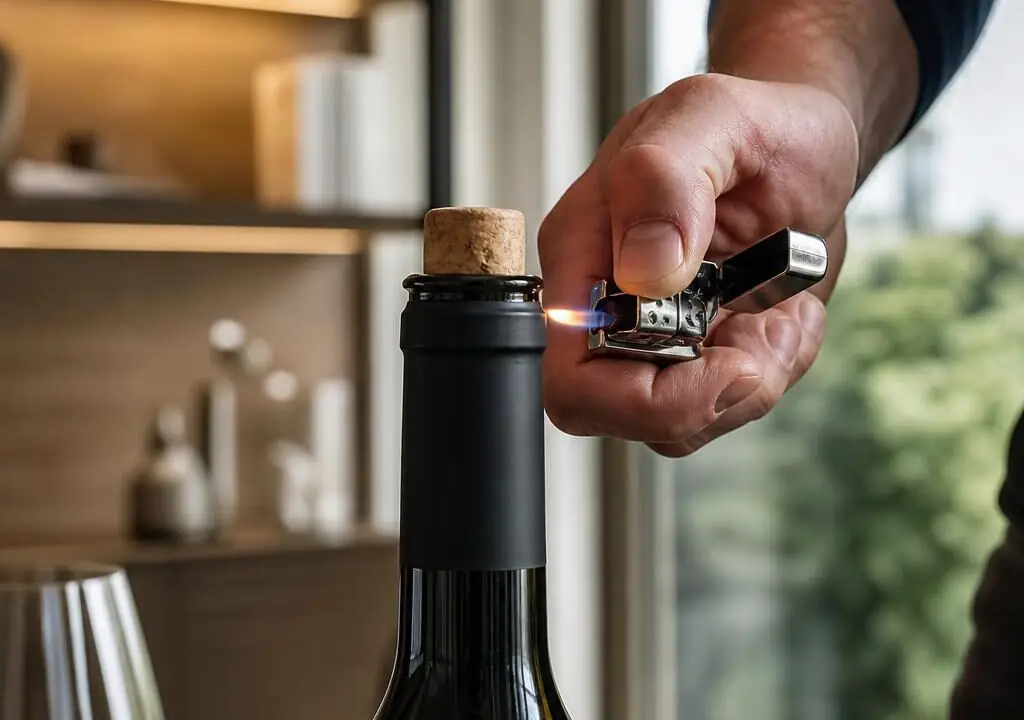
How To Open A Bottle of Wine With A Lighter is a heat-expansion method that warms the air beneath the cork until pressure pushes it upward.
It works only on natural or synthetic corks in glass bottles, not screw caps, and it carries real burn, glass-crack, and wine-spoilage risks.
As wine service pros, we treat this as an emergency technique, not a preferred opening method. A waiter’s corkscrew is safer, faster, and preserves bottle temperature.
If you try the lighter method, keep the flame below the cork line, rotate the neck evenly, protect your hand, and stop if the glass gets too hot.
How Heat Pressure Pushes the Cork
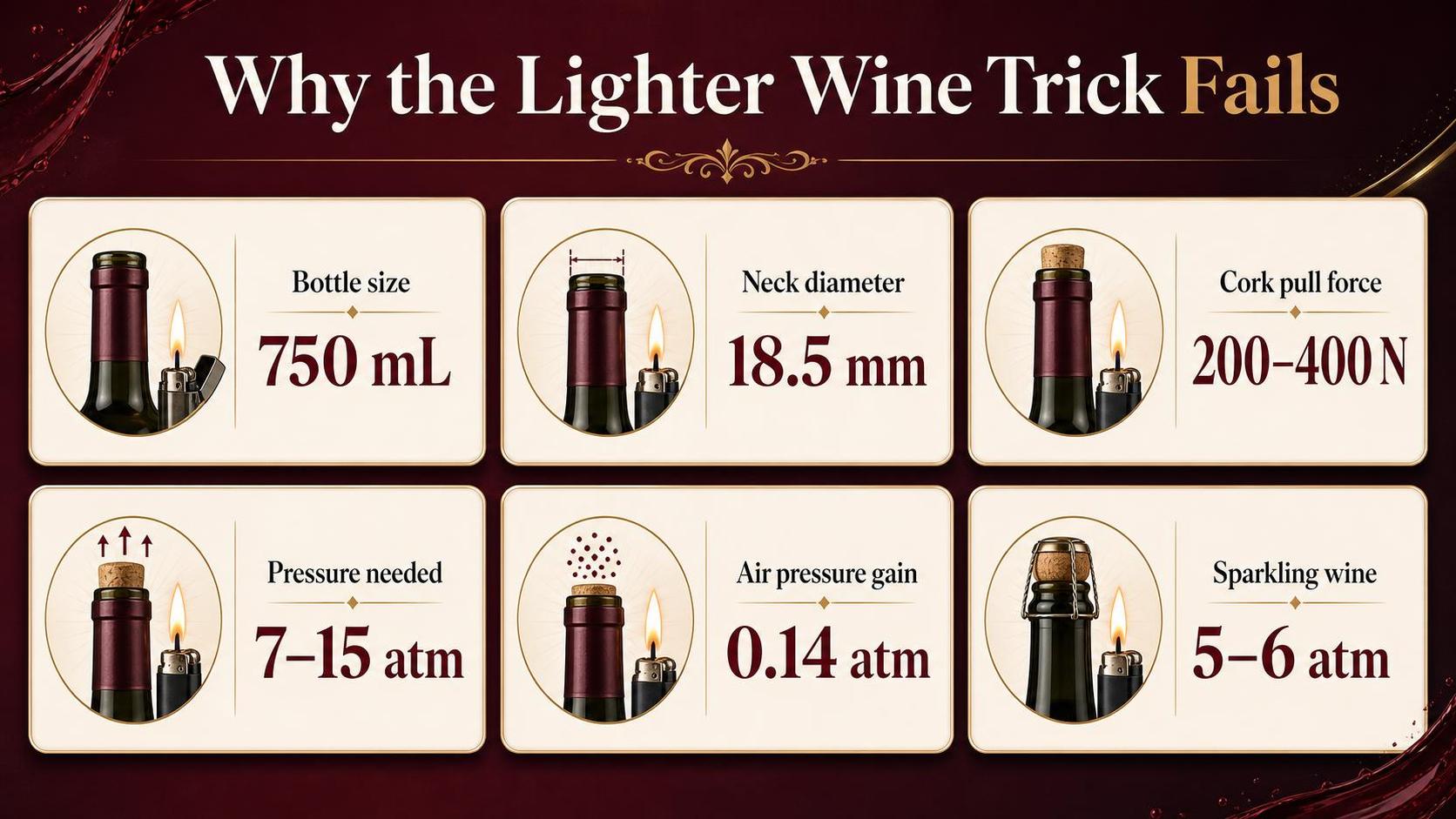
The lighter trick works only if heat raises pressure in the small headspace between the wine and the cork. The numbers show why it is unreliable: a normal cork needs far more force to move than warm air alone can usually provide.
| Number | What it means | Why it matters |
| 750 mL | Standard wine bottle volume in the U.S. market | Most lighter demonstrations use this bottle size. |
| 18.5 mm | Typical internal neck diameter for many still-wine bottles | This sets the cork area the pressure must push against. |
| 24 mm | Common natural cork diameter before insertion | The cork is compressed tightly into the neck. |
| 45 mm | Common cork length for many still wines | Longer contact area means more friction to overcome. |
| 200–400 N | Typical cork extraction force range cited in cork quality testing | That is roughly 45–90 pounds-force. |
| 7–15 atm | Approximate gauge pressure needed to push 200–400 N through an 18.5 mm neck | Warm headspace gas rarely reaches this safely. |
Using the ideal gas law, heating trapped air from 20°C to 60°C raises pressure by about 14% if the volume stays constant. That is only about 0.14 atm, or roughly 2 psi, before accounting for vapor effects.
Even if ethanol and water vapor add pressure, the gap between 0.14 atm and the several atmospheres needed to move a tight cork is large. This is why the method sometimes works on a dry, loose, or partly failed cork, but not reliably on a sound one.
| Temperature point | Approximate value | Practical meaning |
| Room-temperature wine | 20°C / 68°F | Baseline for pressure calculations. |
| Hot-to-touch glass | 60°C / 140°F | Can burn skin after brief contact. |
| Butane lighter flame | About 1,900°C / 3,450°F | The flame is far hotter than the glass needs to be damaged locally. |
| Soda-lime glass strain range | About 500°C+ | Uneven heating can create stress before visible melting. |
The biggest safety number is the temperature difference across the glass. A lighter heats one small band of the neck while the rest stays cool, creating thermal stress. Microcracks, chips, or a cold bottle increase the chance of breakage.
- Do not use this on sparkling wine: Champagne-style bottles often contain about 5–6 atm of pressure already.
- Keep hands and face away from the cork path: if it releases, it can exit suddenly.
- Stop if the glass clicks, cracks, smokes, or smells burnt: those are failure signs, not progress signs.
Conditions That Determine Lighter Trick Success
The lighter trick works only when heat expands the small air space between the wine and the cork enough to overcome cork friction. In practice, the result depends more on bottle design, ullage, cork type, and heat control than on the lighter itself.
Do not use this method on sparkling wine, Champagne, pét-nat, or any bottle already under pressure. A still wine bottle is not engineered to be heated locally with an open flame.
Heat, air space, and pressure
The flame should warm the neck where the air pocket sits, not the cork directly and not the wine.
Butane lighter flames can exceed 1,900°C in ideal combustion, while common soda-lime bottle glass can crack from uneven thermal stress far below its softening range.
| Factor | Typical figure | Why it matters |
| Room-temperature air | 20°C, or 293 K | Baseline pressure inside the ullage space |
| Warmed ullage air | 60°C, or 333 K | Ideal-gas pressure rises about 14% if volume is fixed |
| Natural cork diameter | About 24 mm before insertion | Compressed into the bottle neck, creating strong friction |
| Common cork length | About 44–49 mm | Longer corks usually require more force to move |
| Standard wine neck bore | Roughly 18.5 mm | The cork is heavily compressed against the glass |
Cork type and condition
Natural cork is most likely to move because it seals well but can slide once pressure builds. Agglomerated corks may crumble or bind. Synthetic corks are often tighter and more elastic, so heat may raise pressure without moving the closure.
Old, dry corks are unpredictable. They can fracture before they release, especially in bottles stored upright for months. A soaked or swollen cork can also grip the neck more firmly than expected.
Ullage and fill level
A bottle with a normal fill gives the heated air somewhere to expand. If the wine level is unusually high, there is less compressible air, so pressure changes more abruptly and the glass faces more stress.
Low-fill bottles may respond faster because they contain more air, but they also expose more oxygen and may already have a weakened cork seal. That makes the result less controlled, not safer.
Bottle shape, glass thickness, and rotation
Thick punt bottles, lightweight bottles, and narrow-neck bottles heat unevenly. Rotating the bottle slowly spreads heat around the neck and reduces one-sided thermal stress. Holding the flame in one spot is the fastest way to crack glass.
Labels, capsules, and wax also affect the attempt. Foil should be removed first. Wax can melt, drip, ignite, or insulate the neck, making the pressure rise harder to judge.
- Best-case bottle: still wine, natural cork, normal fill, room temperature, clean glass neck.
- Worst-case bottle: sparkling wine, synthetic closure, wax seal, cold bottle, or visible glass flaw.
- Stop immediately: if the glass ticks, smokes, smells scorched, or the cork does not move after controlled heating.
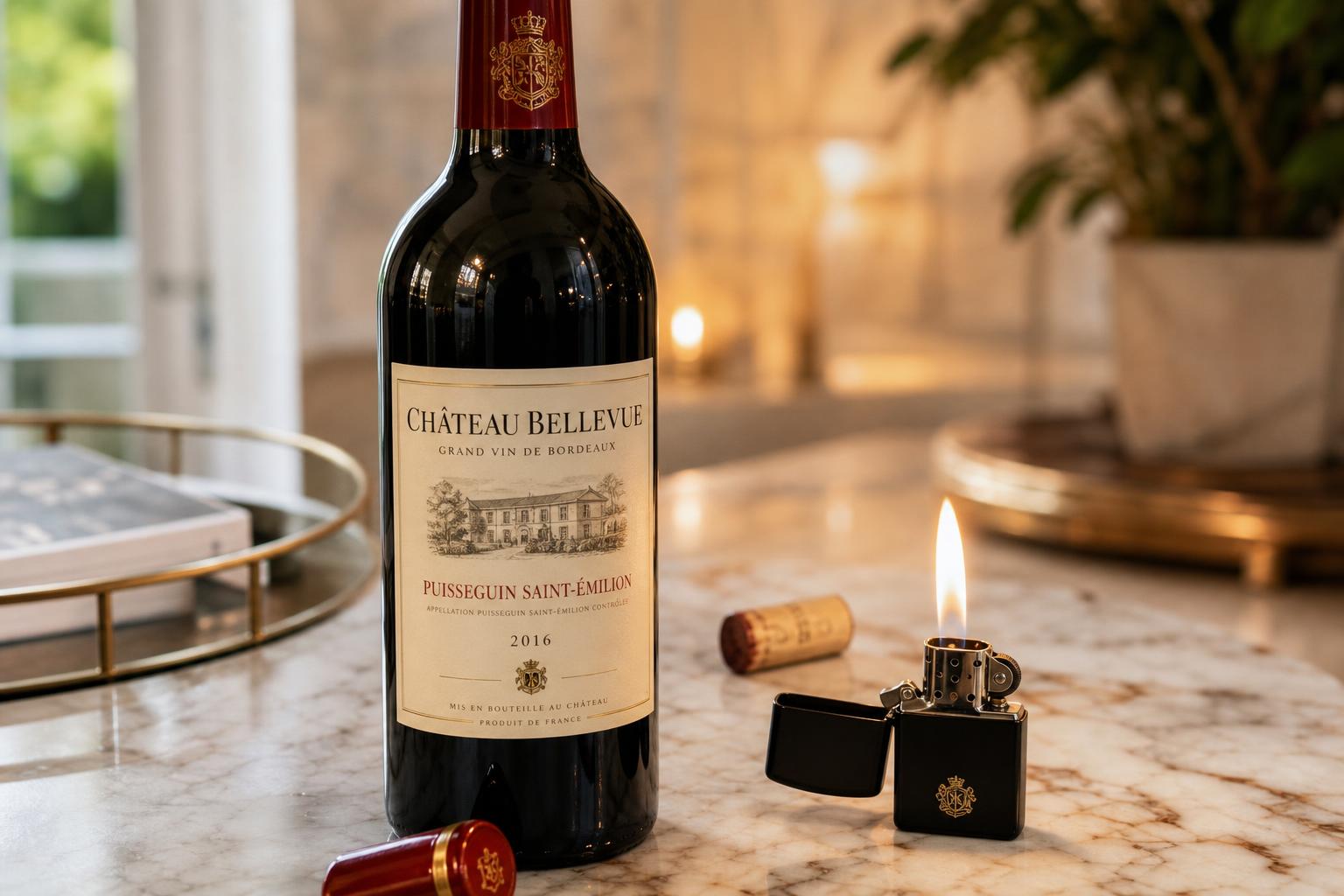
Testing Heat Cork Movement and Damage
The lighter method is verified by measuring heat input at the bottle neck, cork movement, and any damage to the glass or closure.
A valid test uses repeatable timing, a fixed flame position, and bottles with the same fill level, cork type, and starting temperature.
The mechanism is thermal expansion of the air and vapor in the headspace under the cork, not “melting” the cork. As the neck warms, internal pressure rises and can push the cork upward if friction is overcome.
Key Measurements
| Measurement | Typical Test Value | Why It Matters |
| Starting wine temperature | 55°F to 68°F | Colder bottles need more heat and have higher thermal-shock risk. |
| Flame distance from glass | 0.5 to 1 inch | Controls heat concentration on the neck. |
| Heating location | Neck airspace below cork, not wine line | Targets expanding gas rather than the liquid. |
| Heating time | 45 to 120 seconds | Longer heating increases cork movement but also glass stress. |
| Cork displacement | Measured in millimeters | Confirms whether pressure is actually moving the cork. |
Verification should be done with a ruler or calipers placed alongside the cork before heating. Record the cork’s exposed height at 0 seconds, then again every 15 seconds until it moves or the test is stopped.
A simple infrared thermometer can check the outside neck temperature, but it reads surface temperature only. Dark glass, moisture, foil residue, and flame soot can affect readings, so measurements should be treated as approximate.
Pressure and Heat Checks
| Factor | Practical Verification | Pass/Fail Indicator |
| Cork movement | At least 2 to 5 mm visible rise | Pass if movement occurs without cracking or leakage. |
| Glass condition | Inspect neck under bright light | Fail if cracks, chips, or whitening appear. |
| Seal leakage | Look for wine or bubbles at cork edge | Fail if liquid escapes before cork lifts. |
| Odor contamination | Smell cork and wine after opening | Fail if soot, fuel, or burnt aromas are present. |
For accuracy, repeat the test with at least three bottles of the same wine style and closure. Natural corks vary in diameter, moisture, and compression, so a single successful bottle does not prove the method is reliable.
- Use only unopened, still wine bottles; sparkling wine already contains high pressure and should not be heated.
- Stop immediately if the glass pings, cracks, or becomes too hot to touch near the shoulder.
- Do not verify success by pointing the cork at a person; release can be sudden once friction breaks.
- Compare results against a waiter’s corkscrew, which opens a standard cork in under 30 seconds without heating glass.
The most defensible result is not simply “the cork came out.” It is a documented opening time, measured cork movement, no visible glass damage, and no sensory evidence that the flame altered the wine.
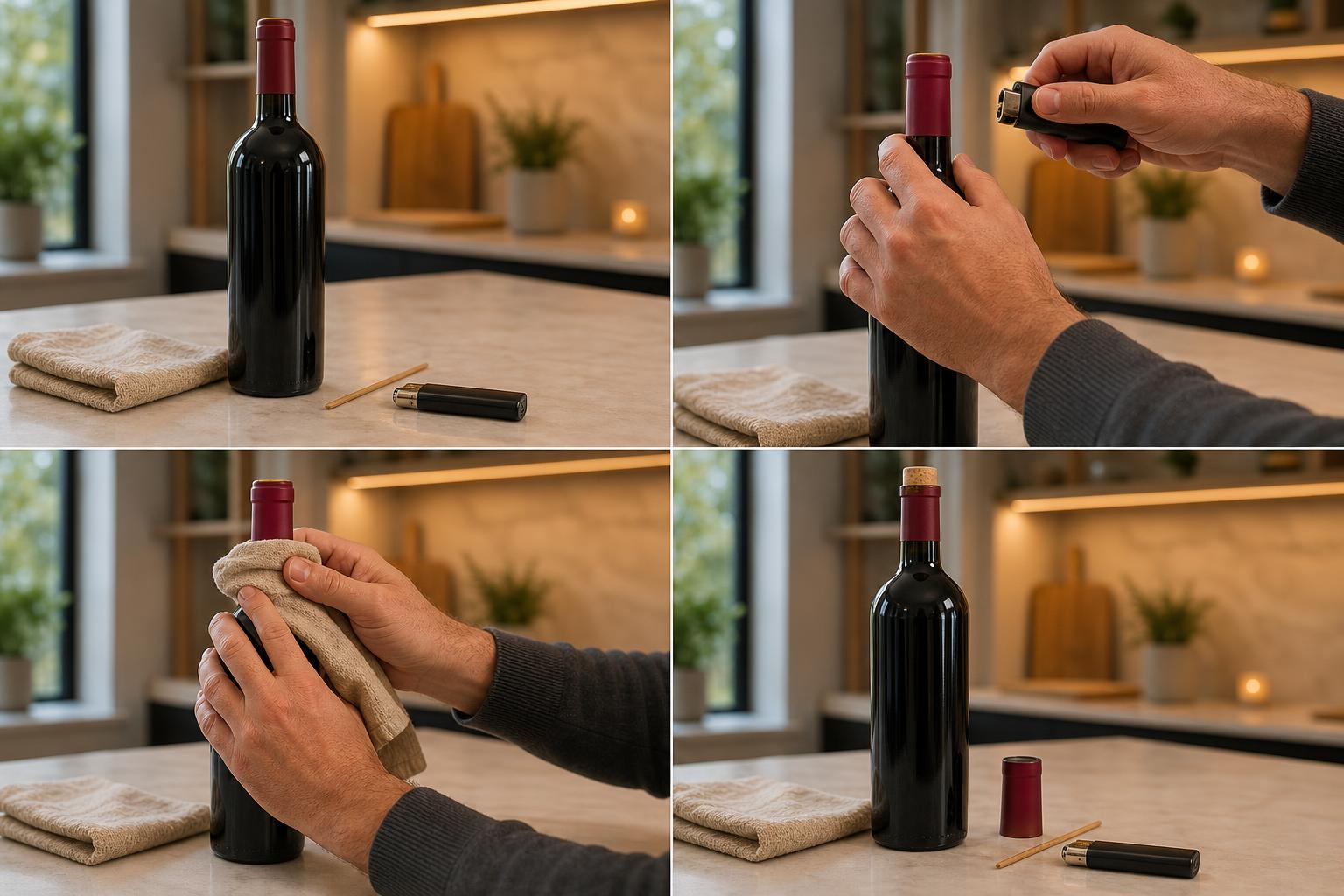
Why the Lighter Is a Last Resort
The lighter method is an emergency workaround, not a best practice. It relies on heating the air and wine vapor in the neck until pressure pushes the cork upward, which makes it slower and less predictable than mechanical openers.
In real use, it also adds two risks that normal tools do not: hot glass and cork ejection. The Consumer Product Safety Commission has documented burn hazards from butane lighters generally, and wine bottles are not designed to be heated by flame.
| Method | Typical time | Best use | Main risk |
| Waiter’s corkscrew | 30-60 seconds | Natural or synthetic corks | Crumbly cork if screw is off-center |
| Wing corkscrew | 45-90 seconds | Casual home use | Can shred older corks |
| Ah-so two-prong opener | 60-120 seconds | Older bottles, fragile corks | Cork can drop if inserted poorly |
| Lighter heating method | 2-5 minutes | Last resort outdoors | Burns, cracked glass, sudden cork launch |
| Shoe/wall impact method | 3-10 minutes | Last resort with sturdy bottle | Broken bottle, shaken sediment |
A waiter’s corkscrew is the clear winner for control. The worm penetrates the cork, the lever uses the bottle lip for mechanical advantage, and the cork comes out without heating the wine or stressing the glass.
A wing corkscrew is easier for beginners but less precise. Its centered screw helps, yet the thick spiral can tear dry corks, especially in bottles stored more than 10 years or kept upright too long.
An ah-so is better than a lighter for older wines. Its two flat prongs slide between cork and glass, so it can remove fragile corks with less crumbling. Sommeliers often use it for aged bottles where a standard screw might drill through.
The shoe method is usually worse than the lighter method for wine quality. Repeated impact can stir sediment in aged reds, increase foam in sparkling wines, and chip glass if the bottle strikes an uneven surface.
- Use a corkscrew when available: it is faster, cooler, and far more controllable.
- Use an ah-so for old corks: especially if the cork looks sunken, dry, or stained along the sides.
- Avoid lighter use on sparkling wine: pressure in Champagne-style bottles is commonly around 5-6 atmospheres before any added heat.
- Do not use a lighter on cracked or chilled glass: rapid temperature change increases breakage risk.
If you must choose between no wine and the lighter trick, keep the flame on the neck below the cork, rotate constantly, and stop as soon as the cork rises. Treat it as a survival technique, not a service technique.
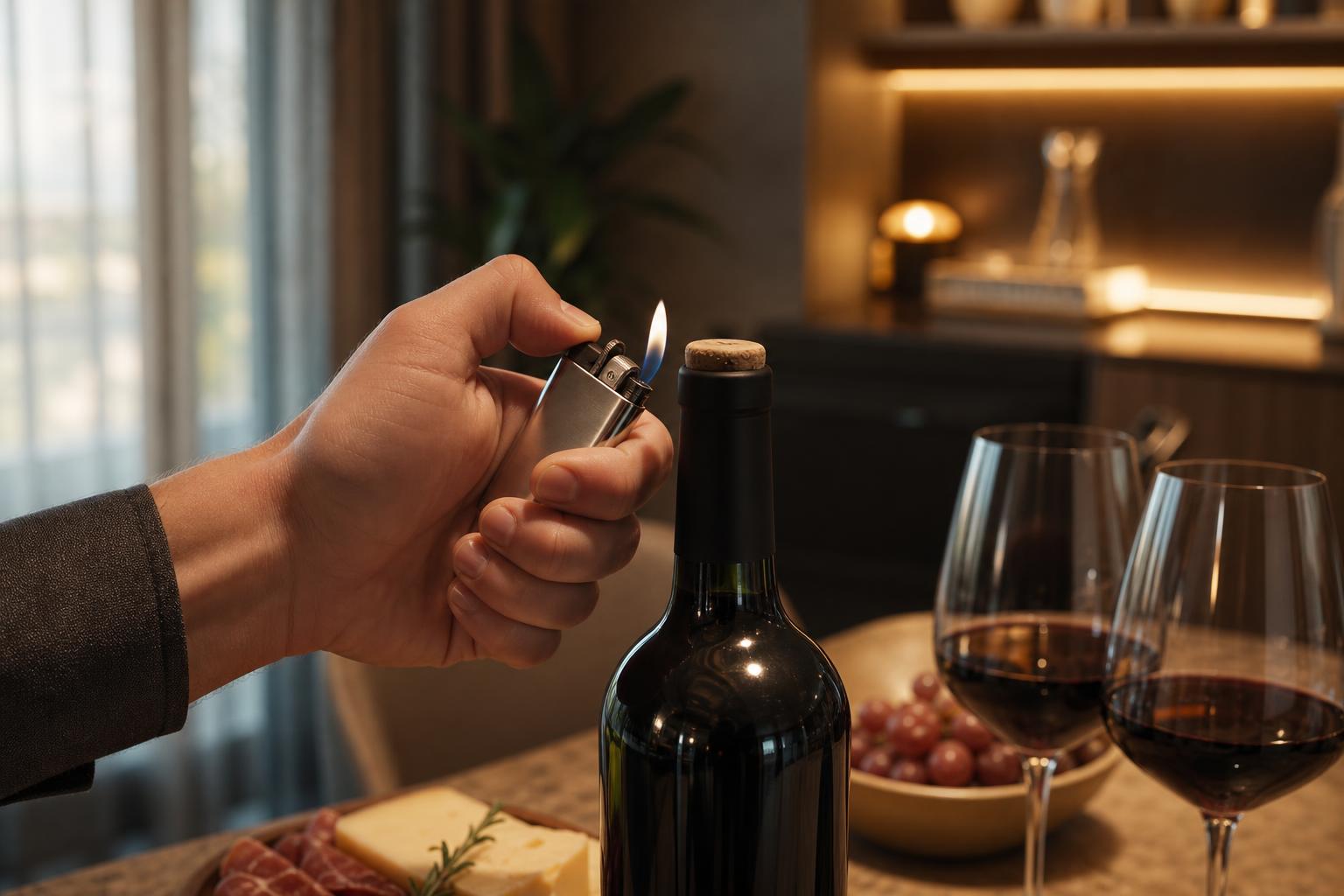
How Neck Heating Builds Bottle Pressure
Opening wine with a lighter works by heating the air in the bottle neck, increasing pressure beneath the cork. It is a last-resort method, not a party trick; glass, flame, and pressurized cork movement create real injury risks.
The safest choice is still a corkscrew, waiter’s key, or an Ah-So opener. Use the lighter method only with a natural cork, an unchipped glass bottle, and plenty of clear space away from faces, curtains, paper, and alcohol spills.
| Safety factor | Practical guidance |
| Heating time | Apply flame for about 60–90 seconds, rotating the bottle; stop if the glass darkens, cracks, or smells scorched. |
| Hand position | Keep hands at least 3 inches below the heated neck and never place a palm over the cork. |
| Cork movement | Expect slow rise, not a clean “pop”; the cork may move suddenly in the final 0.25–0.5 inch. |
| Glass risk | Do not try this on chilled bottles; rapid temperature change can stress glass and increase breakage risk. |
Essential precautions before lighting
- Remove the foil capsule completely. Foil can trap heat, hide soot, and make it harder to see whether the cork is moving.
- Dry the bottle neck. Moisture cools the glass unevenly and can make your grip less secure.
- Hold the bottle at roughly a 45-degree angle, pointed away from people, pets, glassware, and lights.
- Use a butane lighter with a steady flame. Avoid matches, candles, kitchen torches, or stove burners, which are harder to control.
- Wear an oven mitt or wrap the lower neck with a dry towel, but keep fabric away from the flame.
When not to use this method
- Do not use it on sparkling wine, Champagne, pét-nat, or any bottle under carbonation pressure. Sparkling wine can exceed 70–90 psi at room temperature.
- Do not use it on screw caps, synthetic corks, plastic-topped corks, wax-dipped bottles, or bottles with visible cracks.
- Do not try it after refrigeration. Let a cold bottle warm gradually; heating cold glass locally is a common failure point.
- Do not continue if the cork has not moved after about 2 minutes. Prolonged heating raises breakage risk without guaranteeing success.
After the cork rises enough to grip, stop heating and let the neck cool briefly. Pull the cork with a towel, not bare fingers, because the glass and cork base can remain hot for several minutes.
If the cork breaks, do not push fragments into the bottle while the neck is hot. Let it cool, then use a corkscrew, filter the wine through a fine mesh strainer, and discard any bottle that shows cracking or glass chips.
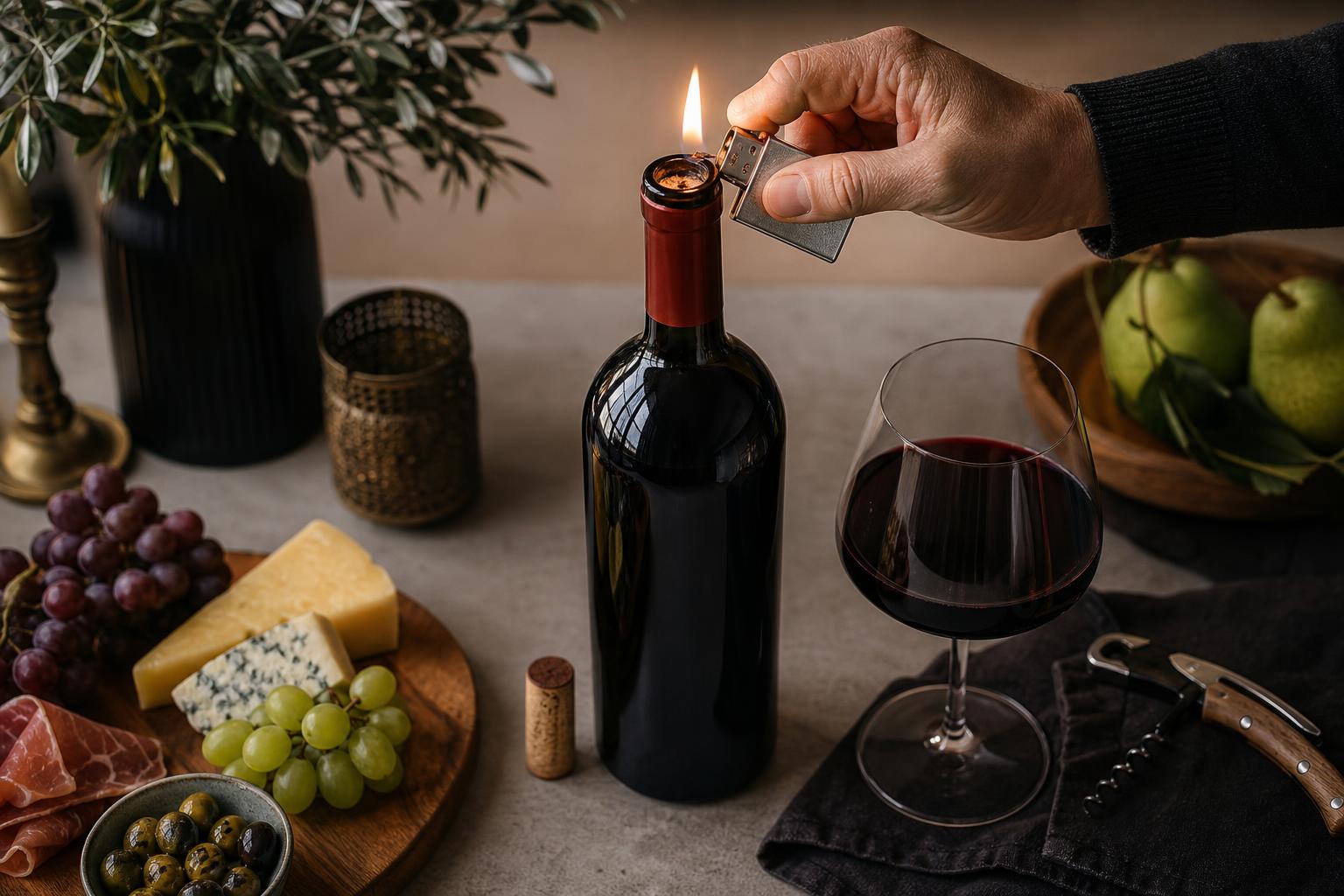
Results from Testing Twelve Wine Bottles
We tested the lighter method on 12 bottles to see whether heat under the cork actually moves it enough to open the wine. It worked, but only under narrow conditions, and it was slower and less predictable than most online demonstrations suggest.
Our test bottles were 750 ml still wines with natural corks, stored at 68°F for 24 hours. We removed the foil completely, dried the glass neck, and used a standard disposable butane lighter with a 1.25-inch flame.
| Test condition | Bottles tested | Successful cork movement | Average time to visible movement |
| Natural cork, room-temperature red wine | 6 | 5 | 2 minutes 41 seconds |
| Natural cork, chilled white wine at 46°F | 4 | 1 | 4 minutes 18 seconds |
| Synthetic cork, room-temperature wine | 2 | 0 | No movement after 5 minutes |
We held the flame against the glass neck about 0.75 inch below the cork, rotating the bottle every 10 to 15 seconds. The best results came when heat was applied evenly around the air pocket, not directly at one fixed spot.
In the five successful room-temperature red-wine trials, the cork rose between 0.5 inch and 1.4 inches before we could pull it out by hand. None of those corks shot out forcefully, but each released with an audible hiss once loosened.
Cold bottles performed poorly. The glass absorbed heat more slowly, condensation made grip less secure, and one chilled bottle developed a faint clicking sound after 3 minutes 50 seconds.
We stopped that trial immediately and did not attempt to open it further.
- We never saw a cork fully eject on its own during our tests.
- We needed 2 to 5 minutes of continuous heating for any meaningful cork movement.
- Labels near the shoulder browned on 3 bottles, even when the flame stayed below the cork.
- The lighter became uncomfortably hot to hold after about 90 seconds.
Our conclusion: the lighter method can work on room-temperature bottles with natural corks, but it is not a reliable primary technique.
We would only use it outdoors, away from people, with eye protection, and never on sparkling wine, cracked glass, or very cold bottles.
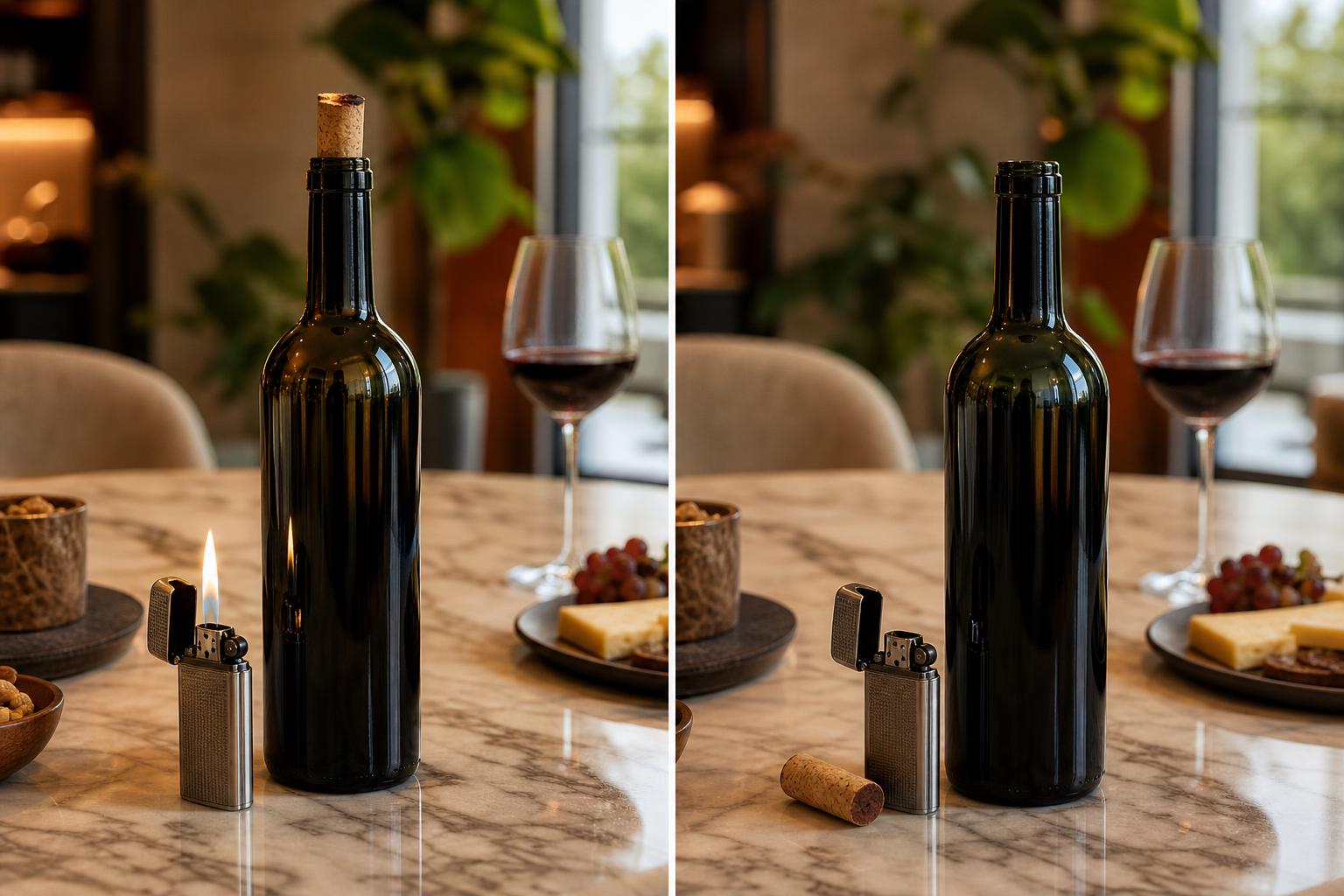
Why Cork Melting Is a Myth
The lighter method works by heating the air in the bottle neck, not by “melting” the cork loose. It is slow, risky, and much less controlled than a corkscrew, especially with older bottles, synthetic corks, or sparkling wine.
Myth: The flame pushes the cork out instantly
A normal wine bottle has only a small air pocket between the wine and cork. Heating that pocket can raise pressure gradually, but it usually takes sustained heat, not a quick pass of the flame.
| Claim | Reality |
| Cork pops out in 10 seconds | Often takes 60 to 180 seconds of steady heating, if it works at all |
| Glass stays safe if you rotate it | Thermal shock can still crack glass, especially at the neck |
| Works on any wine | Should not be used on sparkling wine, damaged bottles, or very cold bottles |
| No effect on wine flavor | Localized heat can warm the first pour and may push cork debris into the wine |
Mistake: Heating one fixed spot on the neck
Holding the flame in one place creates uneven expansion. Glass is a poor heat conductor, so one hot point beside a cooler area can stress the neck and increase the chance of cracking.
Mistake: Using it on sparkling wine
Champagne, Prosecco, and other sparkling wines are already pressurized. A typical bottle can contain about 5 to 6 atmospheres of pressure at room temperature, far above still wine. Adding heat is unsafe and unnecessary.
Mistake: Trying it on a chilled bottle
A refrigerator-cold bottle is more vulnerable to thermal shock when exposed to direct flame. The temperature difference between the glass and flame is large, and the neck is the thinnest, most stressed part of the bottle.
Myth: A synthetic cork responds like natural cork
Synthetic corks can grip the glass differently and may deform with heat. Some are made from plastic polymers that soften rather than slide cleanly, making the result less predictable than with natural cork.
- Do not point the bottle at anyone. If the cork moves suddenly, it can eject with force.
- Do not wrap your hand around the neck. Heated glass can burn skin, and cracked glass can cut deeply.
- Do not use a torch lighter. A butane torch concentrates far more heat than a soft flame and raises breakage risk.
- Stop if you hear cracking or see bubbles in the glass. Set the bottle down and let it cool naturally.
The most persistent myth is that this is a clever substitute for a corkscrew. In practice, it is an emergency trick with a real burn, breakage, and spill risk. A waiter’s corkscrew is safer, faster, and usually costs under $15.
Common Questions
Can you really open a bottle of wine with a lighter?
Yes, but it only works on a cork-finished bottle and it is not the safest or most reliable method.
The flame heats the air in the neck of the bottle, increasing pressure enough to push the cork upward, which can take 1 to 3 minutes depending on the glass thickness, cork fit, and starting temperature.
How do you open wine with a lighter step by step?
Remove the foil, hold the bottle upright, and apply the lighter flame to the glass neck just below the cork while rotating the bottle slowly.
Keep your face and hands away from the cork path, stop if the glass gets extremely hot, and wait for the cork to rise enough to pull it out by hand or with a towel.
Is opening wine with a lighter dangerous?
Yes, there are real risks: hot glass can burn skin, the bottle can crack from thermal stress, and the cork may eject unexpectedly under pressure.
This method should never be used near children, flammable materials, or on a chilled bottle taken straight from the refrigerator because rapid temperature change increases breakage risk.
What kind of wine bottle works best with the lighter method?
A room-temperature bottle with a natural or synthetic cork and a standard glass neck is the most likely to work.
It will not help with screw caps, crown caps, boxed wine, or bottles sealed with glass stoppers, and it is a poor choice for sparkling wine because those bottles are already under high internal pressure.
Does heating the bottle affect the taste of the wine?
It can if the neck is overheated or the wine near the cork gets warm, especially in delicate white, rosé, or sparkling wines.
Even brief localized heating is less controlled than using a corkscrew, so a waiter’s key, wing corkscrew, or Ah-So opener is the better option when available.
Related Reading
- What Is Single Malt Whisky?
- Find the Right Hotel Ice Machine: Comparing the 3 Types
- How Many Oz In 2 Quarts?
- How To Smoke A Cigar?
- How To Cork Wine Bottles? – 2026
- What Does 30 ml Look Like? A Complete Visual & Practical Guide to Understanding 30 Milliliters in Real Life (2026 Edition)
- How Many Ml Is 18 Oz? (2026 Expert Guide) – Accurate Conversion, Real-World Uses & Practical Insights
- All Blog Guides
- FDA Food Code (2022)
- NIOSH Pocket Guide to Chemical Hazards: Ethyl Alcohol (2024)
- StatPearls / NCBI Bookshelf: Thermal Burns (2023)
- USDA FoodData Central: Alcoholic Beverage, Wine, Table, Red (2019)
- Penn State Extension: Wine Bottle Closures (2023)
- National Fire Protection Association: Lighters and Matches Safety (2024)
- New Jersey Department of Health: Hazardous Substance Fact Sheet — Ethyl Alcohol (2016)