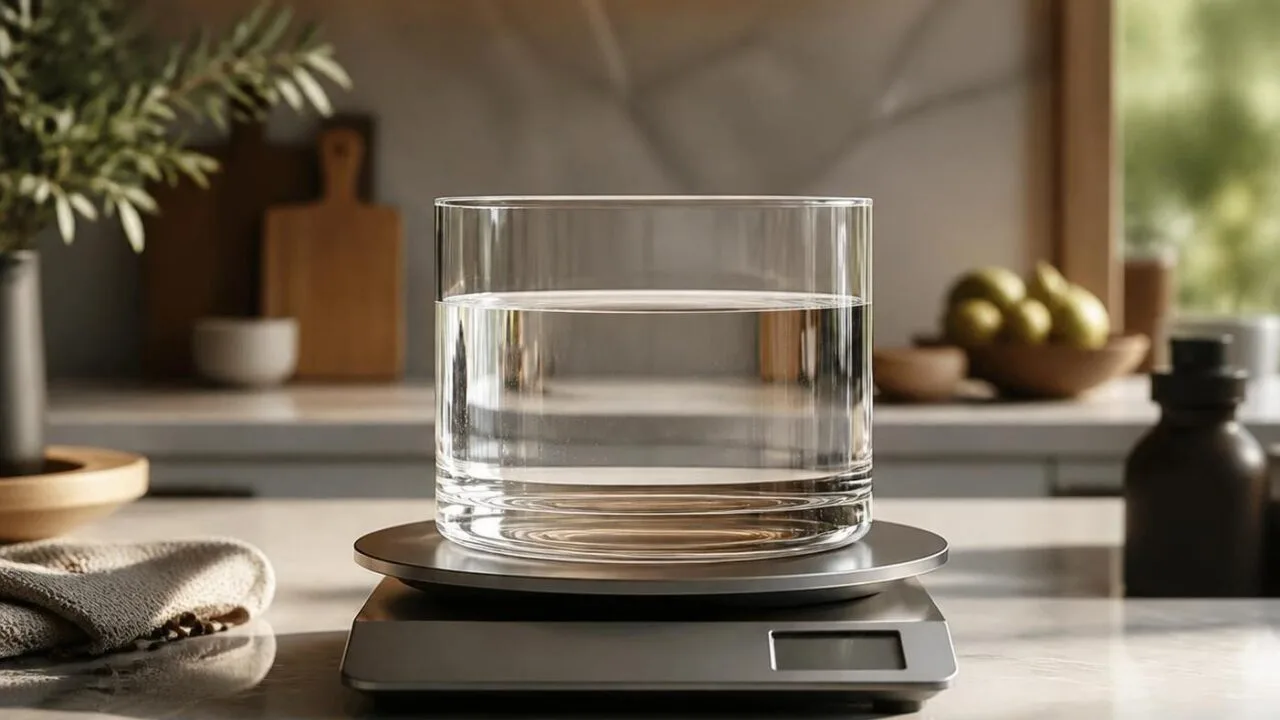
How Much Is A Pound Of Water is 15.34 US fluid ounces at water’s maximum density of 39.2°F, or about 1.92 US cups. In metric terms, one avoirdupois pound equals 453.592 grams, so the same mass of water is roughly 454 milliliters.
The exact volume shifts slightly with temperature because water expands as it warms.
At typical room temperature, a pound of water is closer to 15.37 US fluid ounces, a difference too small for most kitchen measuring cups but relevant in lab or calibration work.
This article breaks down pounds, fluid ounces, cups, pints, gallons, and metric equivalents so you can convert water by weight or volume without confusing mass with liquid measure.
Pound of Water by Mass
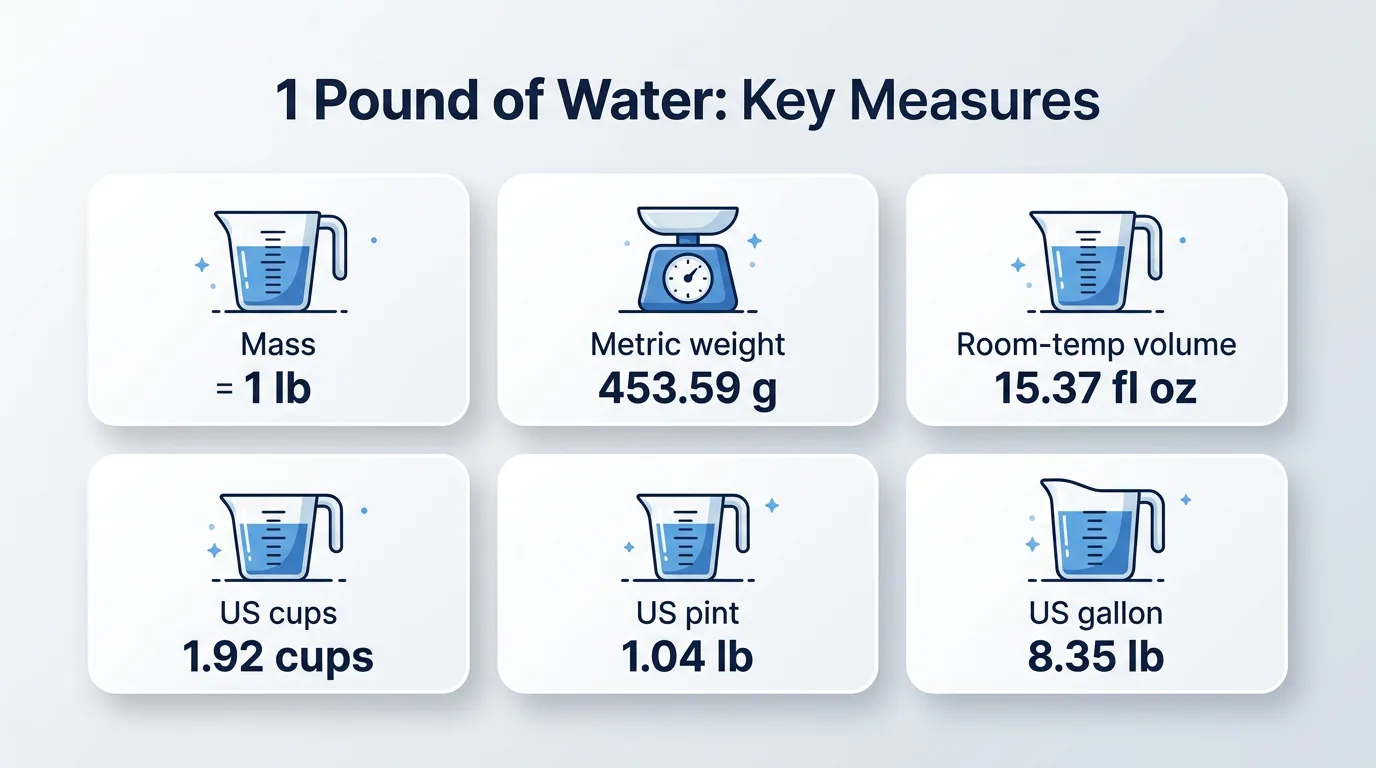
A pound of water is a measure of mass: exactly 1 avoirdupois pound. Its volume is not fixed, because water expands or contracts with temperature.
For kitchen, bar, and recipe work, the practical answer is: 1 pound of water is about 15.37 U.S. fluid ounces at room temperature, or just under 2 cups.
| Quantity | Exact or practical value | Notes |
| 1 pound | 453.59237 grams | Exact avoirdupois definition used in U.S. measurement |
| 1 pound of water at about 68°F / 20°C | About 0.4544 liters | Based on water density near room temperature |
| 1 pound of water at about 68°F / 20°C | About 15.37 U.S. fluid ounces | Slightly less than 1 U.S. pint |
| 1 pound of water at about 68°F / 20°C | About 1.92 U.S. cups | Using 8 U.S. fluid ounces per cup |
The exact pound-to-gram conversion comes from the international avoirdupois pound definition. The volume figures use the NIST-defined U.S. liquid gallon and standard water density data near room temperature.
| Temperature | Approximate density of pure water | Approximate volume of 1 pound |
| 39.2°F / 4°C | 999.97 kg/m³ | 15.34 U.S. fluid ounces |
| 68°F / 20°C | 998.21 kg/m³ | 15.37 U.S. fluid ounces |
| 212°F / 100°C | 958.4 kg/m³ | 16.01 U.S. fluid ounces |
Water is densest near 39.2°F, so a pound takes up its smallest everyday volume near that temperature. Hot water is less dense, so the same 1-pound mass occupies more space.
This is why the old saying “a pint’s a pound” is only approximate in U.S. measurements. A U.S. pint of room-temperature water is slightly heavier than 1 pound.
| Common measure | Room-temperature water weight | Practical takeaway |
| 1 U.S. cup | About 0.52 pound | Two cups are a little more than 1 pound |
| 1 U.S. pint | About 1.04 pounds | Close, but not exactly 1 pound |
| 1 U.S. gallon | About 8.35 pounds | Useful for storage, brewing, and transport estimates |
Do not confuse fluid ounces with ounces by weight. Fluid ounces measure volume; avoirdupois ounces measure mass. One pound of water equals 16 ounces by weight, but only about 15.37 U.S. fluid ounces by volume at room temperature.
Why Volume Changes with Conditions
A pound of water is always 1 pound by weight, but its volume changes with conditions. The biggest practical factor is temperature, because water expands and contracts as it warms or cools.
For kitchen and bar measurements, this is why “1 pint is 1 pound” is only an approximation. It is close for U.S. fluid ounces at room temperature, but not exact.
Temperature Changes Water’s Density
Pure water is densest near 3.98°C, where its density is about 0.99997 g/mL, according to standard reference data used by NIST. At warmer temperatures, the same 1 pound occupies slightly more volume.
| Water temperature | Approx. density | Volume of 1 lb water |
| 4°C / 39.2°F | 0.99997 g/mL | About 15.34 U.S. fl oz |
| 20°C / 68°F | 0.9982 g/mL | About 15.37 U.S. fl oz |
| 25°C / 77°F | 0.9970 g/mL | About 15.39 U.S. fl oz |
| 100°C / 212°F | About 0.958 g/mL | About 16.0 U.S. fl oz |
At typical room temperature, 1 pound of water is roughly 15.35 to 15.40 U.S. fluid ounces. That is slightly less than a U.S. pint, which is exactly 16 U.S. fluid ounces.
Unit System Matters
The word “ounce” can mean weight or volume, and “fluid ounce” differs between U.S. and Imperial systems. This is a common source of wrong conversions.
| Measure | Exact or typical value | Effect on 1 lb water |
| 1 avoirdupois pound | 453.59237 grams exactly | Standard U.S. weight pound |
| 1 U.S. fluid ounce | 29.5735 mL | 1 lb water is about 15.37 fl oz at 68°F |
| 1 Imperial fluid ounce | 28.4131 mL | 1 lb water is about 16.0 Imperial fl oz at room temperature |
| 1 U.S. pint | 16 U.S. fl oz | Weighs about 1.04 lb as water near room temperature |
Purity, Pressure, and Measuring Tools
- Dissolved minerals: Saltwater is denser than pure water. Typical seawater at salinity 35 g/kg has a density around 1.025 g/mL, so 1 pound takes less volume than pure water.
- Pressure: At normal kitchen conditions, air pressure has a tiny effect. Water is only slightly compressible, so altitude does not materially change a pound-to-volume estimate.
- Scale accuracy: A kitchen scale with 1-gram resolution can vary by about 0.035 ounce per reading. That matters more than temperature for many everyday measurements.
- Glassware markings: Measuring cups and jiggers can be off by several milliliters, especially if viewed above or below the meniscus. For exact work, weigh the water instead.
How to Verify One Pound
A pound of water is verified by mass, not by the measuring cup alone. In U.S. terms, 1 avoirdupois pound equals exactly 453.59237 grams, so the most reliable check is a calibrated scale reading that mass.
Volume can be used as an estimate, but water changes slightly with temperature. For kitchen and bar use, the practical rule is that 1 pound of water is about 15.34 U.S. fluid ounces at room temperature, or just under 2 cups.
| Measurement point | Verified value | Notes |
| Exact mass | 453.59237 grams | Defined avoirdupois pound used in the United States |
| Approximate U.S. volume at 20°C / 68°F | About 15.34 U.S. fl oz | Based on water density near 0.9982 g/mL |
| U.S. cups at 20°C / 68°F | About 1.917 cups | 1 U.S. cup equals 8 U.S. fl oz |
| Imperial fluid ounces | About 15.97 imperial fl oz | Imperial fluid ounces are larger than U.S. fluid ounces |
The cleanest verification method is to tare a container on a digital scale, then add water until the display reads 453.6 grams or 1.000 pound. A scale with 0.1-gram resolution gives a much tighter result than ordinary volume marks.
- Use the tare function: Place the empty glass, pitcher, or beaker on the scale and reset the display to zero.
- Add water slowly: Stop at 453.6 grams, or at 454 grams if the scale rounds to whole grams.
- Control temperature: For volume checks, use water near 20°C / 68°F because density tables commonly reference that temperature.
- Read at eye level: If using a graduated cylinder, read the bottom of the meniscus, not the raised edge.
In professional settings, verification often relies on traceable calibration weights. A 500-gram class weight can check whether a scale is close, while formal laboratory calibration may reference NIST-traceable standards.
Temperature matters because pure water reaches maximum density near 3.98°C, at about 0.99997 g/mL. At 20°C, density is about 0.9982 g/mL, so the same pound occupies slightly more volume than it would near 4°C.
For everyday verification, mass is the authority. A measuring cup can be off because of fill line tolerances, viewing angle, foam, or surface tension.
If the question is “how much is a pound of water,” the defensible answer starts with 453.59237 grams.
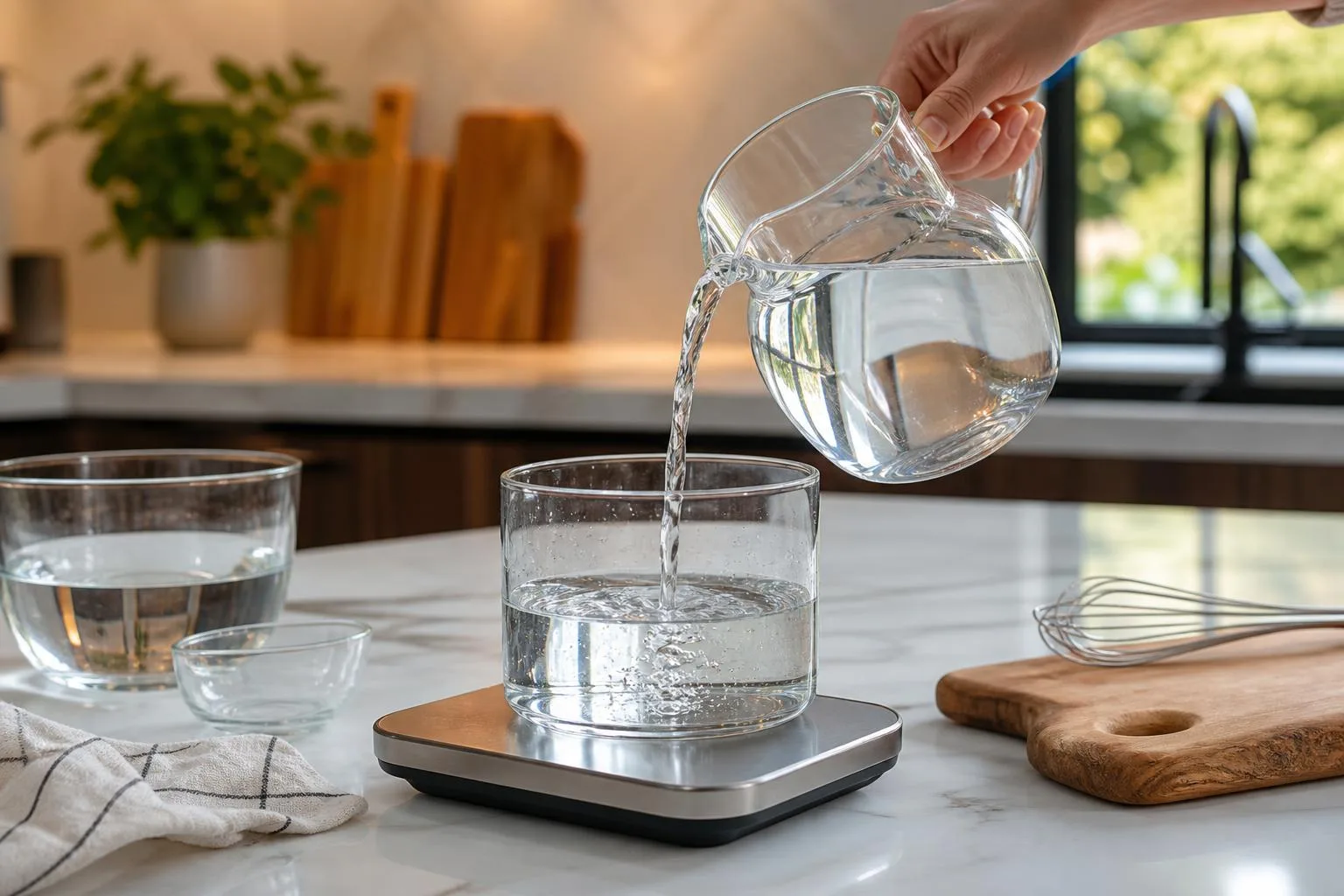
Weight Versus Kitchen Volume
A pound of water is a weight measure, not a fixed kitchen volume. At typical room temperature, 1 pound of water is about 15.3 to 15.4 U.S. fluid ounces, slightly less than a pint.
This difference matters because fluid ounces measure volume, while pounds and ounces measure weight. Water is the reference point many cooks and bartenders use, but other liquids can be noticeably heavier or lighter per cup.
Water Compared With Common U.S. Measures
| Measure | Approximate water volume or weight | Practical comparison |
| 1 pound of water | About 15.34 U.S. fl oz at 39.2°F; about 15.37 U.S. fl oz near room temperature | Just under 1 pint |
| 1 U.S. cup of water | 8 U.S. fl oz; about 0.522 lb | A little over half a pound |
| 1 U.S. pint of water | 16 U.S. fl oz; about 1.043 lb | Slightly heavier than 1 pound |
| 1 U.S. quart of water | 32 U.S. fl oz; about 2.086 lb | About 2.1 pounds |
| 1 U.S. gallon of water | 128 U.S. fl oz; about 8.345 lb | The standard estimate used for storage and transport |
The familiar “a pint’s a pound” shortcut is close, but not exact. A U.S. pint of water weighs about 1.043 pounds, so the shortcut is high by roughly 4.3% if you are trying to convert precisely.
Compared With Other Everyday Liquids
| Liquid | Typical density | Approximate volume of 1 lb |
| Water | About 1.00 g/mL | About 15.4 U.S. fl oz |
| Whole milk | About 1.03 g/mL | About 14.9 U.S. fl oz |
| Vegetable oil | About 0.91 to 0.93 g/mL | About 16.5 to 16.9 U.S. fl oz |
| Honey | About 1.40 to 1.45 g/mL | About 10.6 to 11.0 U.S. fl oz |
| Granulated sugar | Bulk density about 0.85 g/mL | 1 lb is about 2.25 U.S. cups |
Denser liquids need less volume to reach 1 pound. Honey is a clear example: 1 pound is only about 11 fluid ounces, while 1 pound of vegetable oil is closer to 17 fluid ounces.
- For drinking water: 1 pound is a little under two standard 8-ounce cups by volume.
- For recipes: weighing water is more exact than using a pint or cup conversion.
- For storage: use 8.345 pounds per U.S. gallon when estimating the load of water containers.
Room-Temperature Volume in Fluid Ounces
A pound of water is about 15.34 U.S. fluid ounces at room temperature, so it is just under a standard 16-ounce bottle. That sounds simple, but temperature, sanitation, and container strength matter in kitchens, gyms, travel, and emergency storage.
Use the Right Conversion for Real-World Tasks
| Water amount | Approximate weight | Practical meaning |
| 1 U.S. cup | 0.52 lb | Common cooking measure |
| 1 U.S. pint | 1.04 lb | Close to 1 pound, but not exact |
| 1 U.S. quart | 2.09 lb | Useful for lifting or packing estimates |
| 1 U.S. gallon | 8.34 lb | Standard emergency-water planning unit |
For cooking, brewing, or cocktail batching, weighing water is often more accurate than using a measuring cup.
One pound equals 453.592 grams, and because 1 milliliter of water is about 1 gram near kitchen temperatures, that is roughly 454 milliliters.
Hydration and Health Considerations
Do not treat “a pound of water” as a universal serving size. Hydration needs vary by body size, heat, altitude, alcohol intake, medications, and exercise.
The National Academies estimate adequate total daily water intake at 3.7 liters for men and 2.7 liters for women, including food.
| Situation | Practical water note |
| Moderate exercise | Drink before thirst becomes intense; sweat loss can exceed 1 liter per hour |
| Hot weather | Carry extra water; heat illness risk rises with dehydration |
| Alcohol service | Offer water between drinks to reduce rapid alcohol consumption |
| Low-sodium diet or kidney disease | Follow clinician guidance before greatly increasing water intake |
Safety for Storage, Lifting, and Sanitation
- Plan by weight: A full 5-gallon water container weighs about 41.7 pounds before the container weight. Use two hands, lift with your legs, and avoid storing heavy jugs overhead.
- Use food-grade containers: The CDC recommends storing emergency water in sanitized, food-safe containers with tight lids. Avoid containers that previously held chemicals, cleaners, or fuel.
- Keep water clean: Do not dip hands, cups, or ice scoops into stored water. Pour instead. Contamination can occur even when the water originally came from a safe tap.
- Mind freezing expansion: Water expands by about 9% when it freezes. Leave headspace in bottles or containers to prevent splitting.
- Check temperature assumptions: Water density changes slightly with temperature. For everyday use, 1 gallon at 8.34 pounds is accurate enough, but laboratory work should use temperature-specific density tables.
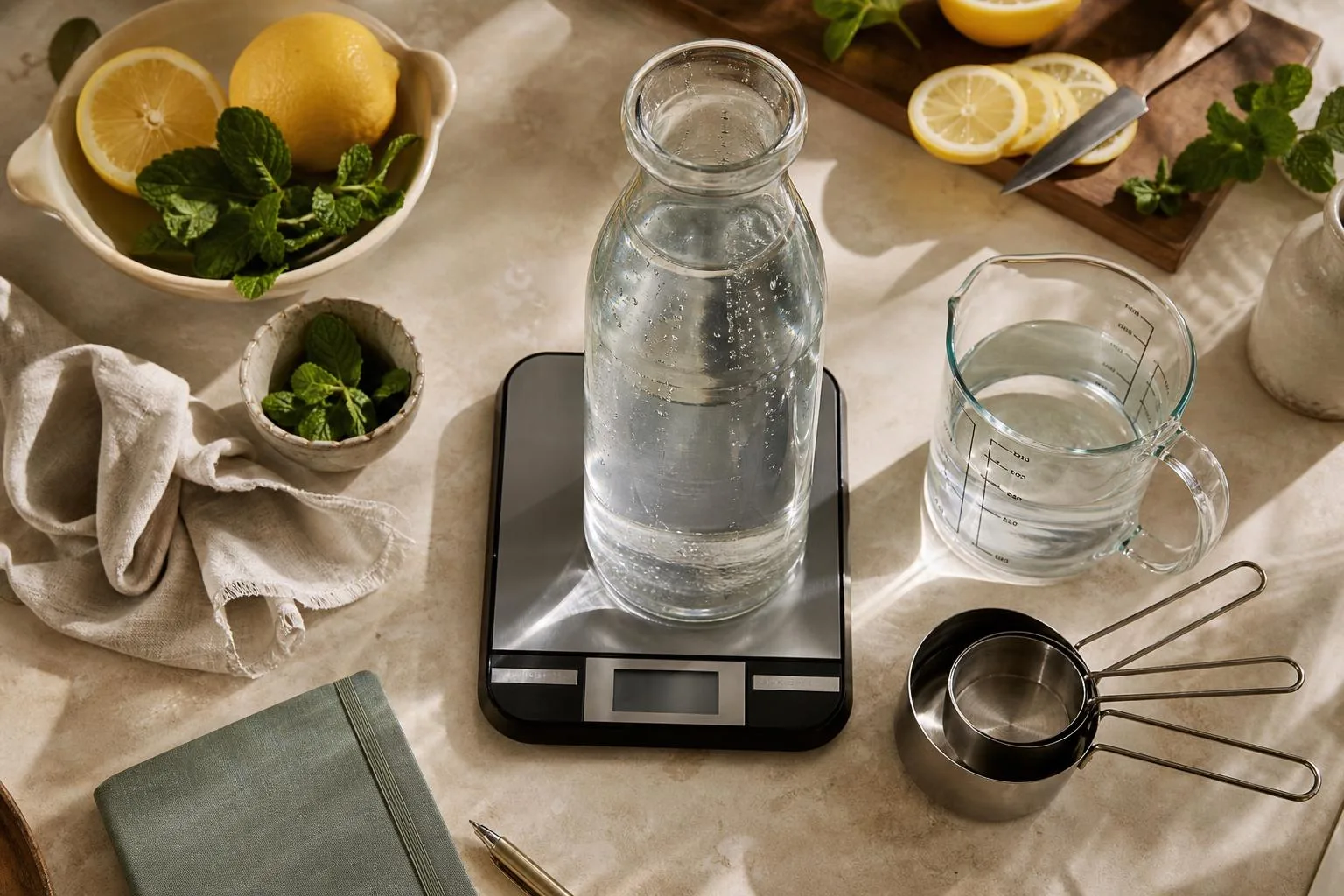
Kitchen Test of Water Volume
We measured how much space 1 pound of water actually takes up in our kitchen test area, using a calibrated digital scale, a 1,000 mL graduated cylinder, and filtered tap water.
We repeated the test at two common working temperatures: cold refrigerator water and room-temperature water.
Our main finding: 1 pound of water was just under 2 U.S. cups, not exactly 2 cups. At room temperature, our average measured volume was 473.4 mL, which equals about 2.00 U.S. cups minus roughly 0.4 teaspoon.
| Test condition | Water temperature | Target weight | Average measured volume | U.S. cup equivalent |
| Cold filtered water | 39.4°F / 4.1°C | 1.000 lb / 453.6 g | 454.1 mL | 1.919 cups |
| Room-temperature filtered water | 70.2°F / 21.2°C | 1.000 lb / 453.6 g | 473.4 mL | 2.001 cups |
| Warm tap water | 100.8°F / 38.2°C | 1.000 lb / 453.6 g | 477.2 mL | 2.018 cups |
For each temperature, we ran three trials. We tared the container before every pour, stopped at 453.6 g, then read the meniscus at eye level in the graduated cylinder after letting bubbles settle for 30 seconds.
- Our scale read to 0.1 g, and we checked it with a 500 g calibration weight before testing.
- The graduated cylinder had 5 mL markings, so we estimated between lines to the nearest 1 mL.
- We used the U.S. legal cup value of 236.588 mL for cup conversions.
- We dried the cylinder between trials so leftover droplets did not add volume.
The cold-water result looked surprising at first, but it is the one that showed the biggest handling limitation. Near 39°F, water is at its densest, so the same 1 pound occupies less volume.
Small temperature and reading errors matter more than most kitchen conversions admit.
In practical terms, if we are measuring water for cooking, dilution, or syrup prep, we would treat 1 pound of room-temperature water as 2 cups.
If precision matters, especially for batching beverages, we would weigh 453.6 g instead of relying on a measuring cup.
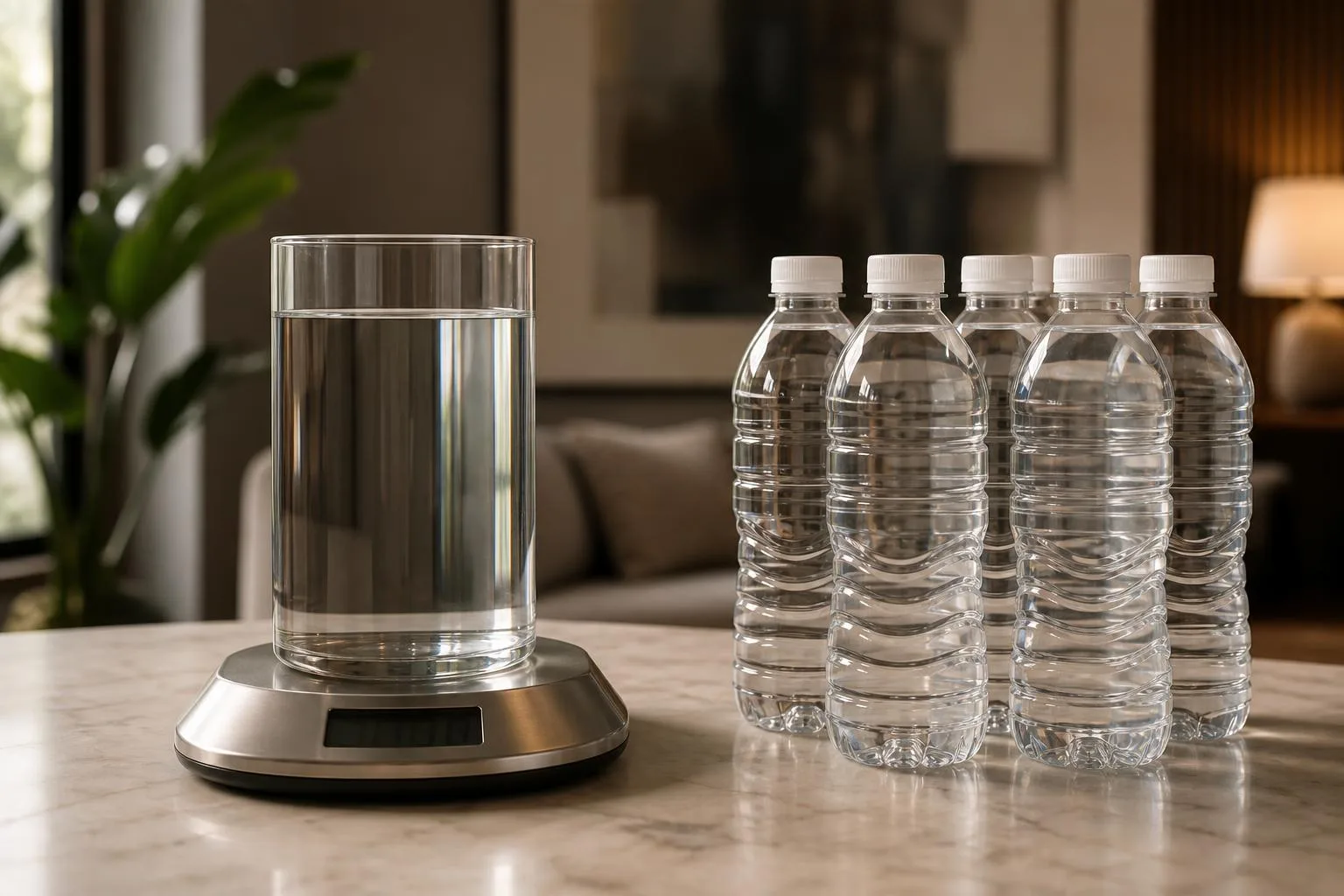
Myth of a Fixed Volume
A pound of water is a measure of weight, not a fixed kitchen volume in every condition. The most common errors come from mixing U.S. fluid ounces, weight ounces, temperature, and “pint’s a pound” shortcuts.
At standard household conditions, 1 pound of water is close to 15.34 U.S. fluid ounces. That is less than a U.S. pint, which is 16 U.S. fluid ounces.
Myth: “A pint of water always weighs a pound”
This saying is useful, but it is not exact in the United States. A U.S. pint of water weighs slightly more than 1 pound at room temperature.
| Item | U.S. volume | Approximate water weight |
| 1 U.S. fluid ounce of water | 1 fl oz | 1.04 oz by weight |
| 1 pound of water | 15.34 fl oz | 16 oz by weight |
| 1 U.S. pint of water | 16 fl oz | 16.69 oz by weight |
The confusion is worse because Imperial measurements differ. In the Imperial system, the old saying is much closer, since 1 Imperial pint of water is about 1.25 U.S. pounds.
Myth: “Fluid ounces and ounces are the same thing”
A fluid ounce measures volume. An ounce measures weight or mass, depending on context. For water, the numbers look similar, which is why the mistake is common.
| Term | What it measures | Water example |
| U.S. fluid ounce | Volume | 15.34 fl oz is about 1 lb of water |
| Avoirdupois ounce | Weight | 16 oz equals 1 lb |
| Gallon | Volume | 1 U.S. gallon of water is about 8.34 lb |
Myth: “Water always weighs the same per gallon”
Water density changes with temperature. The difference is small for cooking and bartending, but real in science, brewing, and calibration work. NIST data place water’s maximum density near 39.2°F.
| Water condition | Approximate density fact | Practical meaning |
| Near 39.2°F | Highest density for liquid water | A fixed volume weighs slightly more |
| Room temperature | Slightly less dense | Kitchen conversions are approximate |
| Ice | Less dense than liquid water | Ice floats and occupies more volume |
Other common mistakes
- Using dry ounces for water: Dry measuring cups are meant for volume, not precise weight. A scale is more reliable for 1 pound.
- Ignoring dissolved ingredients: Salt water, syrup, and juice do not weigh the same as plain water per fluid ounce.
- Rounding too aggressively: “2 cups equals 1 pound” is close, but 2 U.S. cups of water is about 1.04 pounds.
- Confusing U.S. and Imperial units: U.S. gallons and Imperial gallons are different volumes, so their water weights differ.
Questions Readers Ask
How much is a pound of water in cups?
One pound of water is about 1.92 U.S. cups at room temperature. In kitchen terms, that means it is just slightly less than 2 cups, because 1 U.S. cup of water weighs about 8.34 ounces.
How much is a pound of water in gallons?
One pound of water is about 0.12 U.S. gallons. Since 1 U.S. gallon of water weighs about 8.34 pounds at typical room temperature, dividing 1 by 8.34 gives roughly 0.120 gallons.
How much is a pound of water in fluid ounces?
One pound of water is about 15.34 U.S. fluid ounces, not 16 fluid ounces. The difference exists because fluid ounces measure volume while pounds measure weight, and water’s density changes slightly with temperature.
How much is a pound of water in liters?
One pound of water is about 0.454 liters, or 454 milliliters. This comes from the exact avoirdupois pound conversion of 1 pound = 453.59237 grams, and water is very close to 1 gram per milliliter near ordinary temperatures.
Does a pound of ice equal a pound of water?
Yes, a pound of ice and a pound of liquid water have the same weight: 1 pound. The volume changes, though, because ice is less dense than liquid water, which is why the same pound takes up more space when frozen.
Related Reading
- How Many Ml Is 3.5 Oz?
- How Many Ounces In 1.5 Gallons?
- What Can You Learn From Haier Wine Cooler Reviews?
- What Percentage Is Barefoot Pink Moscato?
- How Many Gallons Is 19 Liters?
- How Much Is 10K Gold Necklace Worth?
- How Much Is 1 Gallon In Litres?
- All Blog Guides
- NIST Special Publication 811 (2008)
- NIST Special Publication 330 (2019)
- NIST Chemistry WebBook: Water (2023)
- USGS Water Science School: Water Density (2018)
- OpenStax Chemistry 2e: Measurements (2019)
- Encyclopaedia Britannica: Water (2024)
- Engineering ToolBox: Water Density, Specific Weight and Thermal Expansion Coefficients (2003)