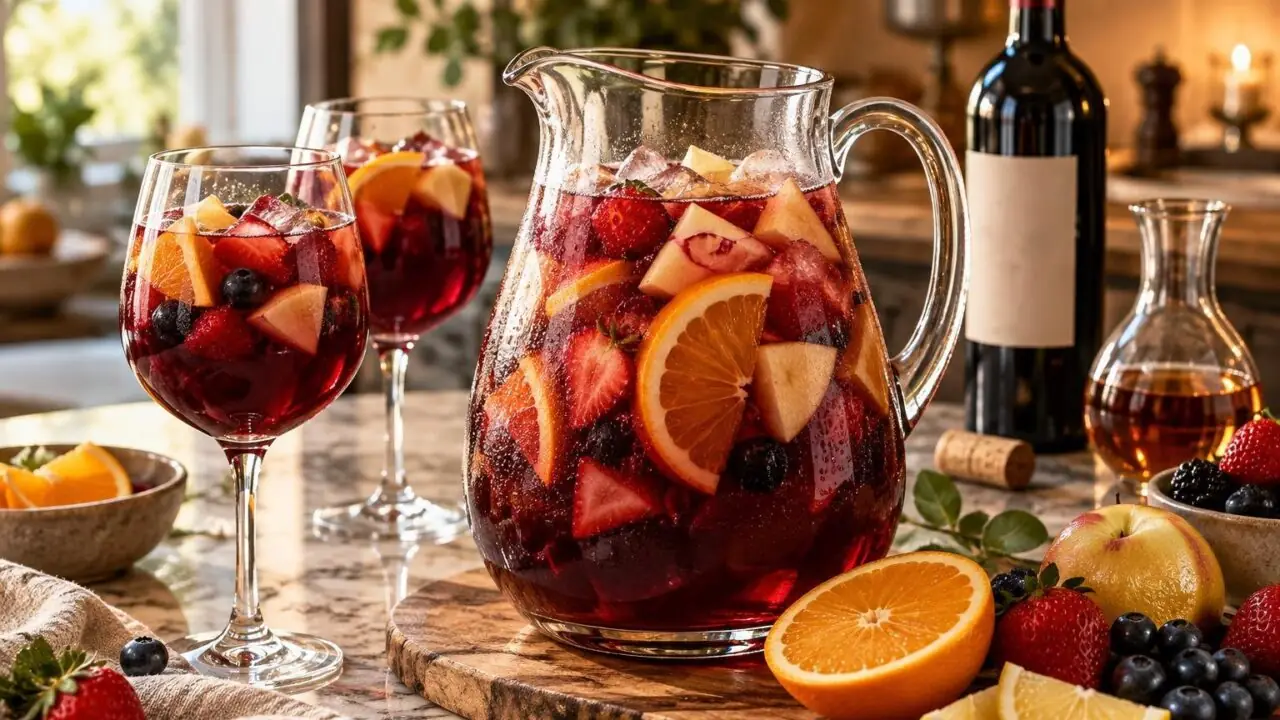
How Much Is 5 Liters In Gallons is 1.32086 US gallons. The conversion uses the US liquid gallon, where 1 gallon equals exactly 3.785411784 liters, so 5 ÷ 3.785411784 = 1.32086.
Rounded for everyday measuring, 5 liters is about 1.32 gallons, or roughly 1 gallon plus 0.32 gallon. In Imperial gallons, used in the UK, 5 liters equals about 1.09985 Imperial gallons because 1 Imperial gallon is 4.54609 liters.
This article shows the formula, rounded results, and quick reference conversions so you can choose the correct gallon measurement for US or Imperial use.
Liters in Imperial Gallons
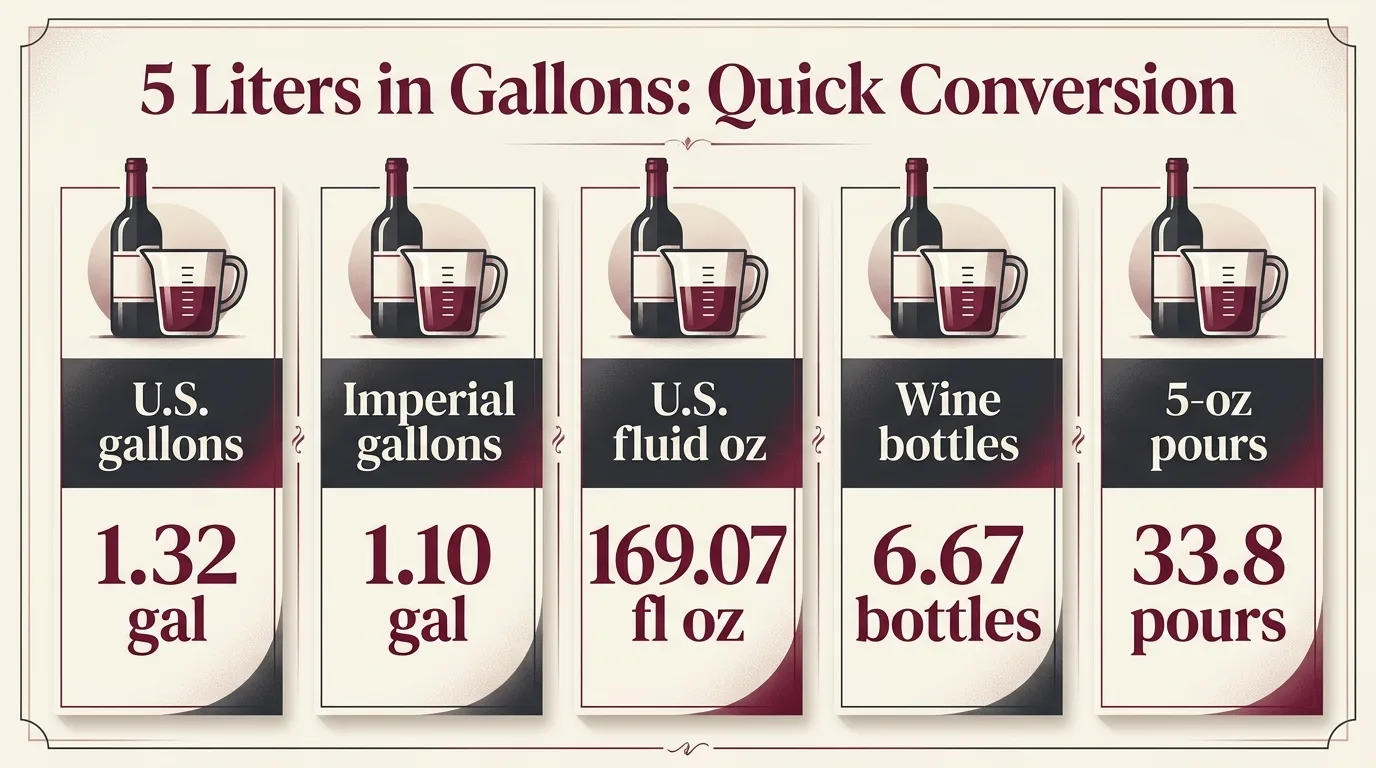
Five liters equals 1.32086 U.S. liquid gallons. If you are using the British Imperial gallon, five liters equals 1.09985 Imperial gallons, so the gallon type matters.
In the United States, recipes, beverage labels, and most retail volume references use the U.S. liquid gallon. That gallon is legally defined as 231 cubic inches, which equals exactly 3.785411784 liters.
| Measurement | Exact or standard value | 5 liters equals |
| U.S. liquid gallon | 3.785411784 liters | 1.3208602618 gallons |
| Imperial gallon | 4.54609 liters | 1.099846241 gallons |
| U.S. fluid ounce | 29.5735295625 milliliters | 169.070114 ounces |
The practical answer for U.S. use is simple: 5 liters is about 1.32 gallons. Rounded for everyday measuring, that is slightly more than 1 and 1/4 gallons, but not close enough to call it 1.5 gallons.
| Common rounding | Value | Best use |
| Exact U.S. conversion | 1.3208602618 gal | Technical or precise calculations |
| Standard rounded value | 1.32 gal | Most kitchen, beverage, and retail uses |
| Quick mental estimate | About 1.3 gal | Fast approximation |
For wine and beverage service, five liters is also useful to understand in smaller serving units. A standard wine bottle is 750 milliliters, so five liters is the same volume as 6.67 standard bottles.
| Wine-service comparison | Calculation | Result |
| Standard 750 ml bottles | 5,000 ml ÷ 750 ml | 6.67 bottles |
| 5-ounce pours | 169.07 fl oz ÷ 5 fl oz | 33.8 pours |
| 6-ounce pours | 169.07 fl oz ÷ 6 fl oz | 28.2 pours |
A common mistake is treating all gallons as interchangeable. They are not: an Imperial gallon is about 20% larger than a U.S. liquid gallon, which is why five liters produces fewer Imperial gallons than U.S. gallons.
- Use 1.32 gallons when converting 5 liters for U.S. liquid volume.
- Use 1.10 gallons only when the measurement system is Imperial.
- Use 169.07 fluid ounces when breaking 5 liters into U.S. serving sizes.
US and Imperial Gallon Difference
The main factor is which gallon you mean. Five liters converts to about 1.32 U.S. liquid gallons, but only about 1.10 imperial gallons because the two gallon standards are different sizes.
Rounding also changes the number you see on calculators, labels, and recipes. The underlying conversion is fixed, but the displayed answer may be shortened to two, three, or four decimal places.
U.S. Gallon vs. Imperial Gallon
In the United States, “gallon” almost always means the U.S. liquid gallon. The U.S. gallon is legally defined as exactly 231 cubic inches, which equals exactly 3.785411784 liters.
The imperial gallon, used in the United Kingdom and some Commonwealth contexts, is exactly 4.54609 liters. That makes an imperial gallon about 20% larger than a U.S. liquid gallon.
| Unit | Exact size in liters | 5 liters equals |
| U.S. liquid gallon | 3.785411784 L | 1.3208602618 gal |
| Imperial gallon | 4.54609 L | 1.099846241 gal |
| U.S. dry gallon | 4.40488377086 L | 1.135104673 gal |
Rounding and Practical Use
For everyday use, 5 liters is usually stated as 1.32 U.S. gallons. For technical work, shipping, dosing, brewing, or inventory, keeping more digits can prevent small errors from accumulating across many containers.
| Rounding level | 5 L in U.S. gallons |
| Nearest whole gallon | 1 gallon |
| 1 decimal place | 1.3 gallons |
| 2 decimal places | 1.32 gallons |
| 3 decimal places | 1.321 gallons |
| Full common calculator value | 1.3208602618 gallons |
Liquid Volume, Not Weight
Liters and gallons measure volume, not mass. Five liters of water weighs about 5 kilograms at standard reference conditions, but 5 liters of olive oil, wine, or fuel will weigh less or more depending on density.
- Water: 5 liters is approximately 5.0 kg, or about 11.0 lb.
- Wine: 5 liters is still 1.32 U.S. gallons, but weight varies with alcohol and sugar content.
- Gasoline: 5 liters is 1.32 U.S. gallons, but typically weighs about 8.2 to 8.6 lb, depending on formulation.
Temperature and Measurement Conditions
The mathematical conversion does not change with temperature.
However, real liquids expand when warmed and contract when cooled, so a measured 5-liter fill can vary slightly depending on temperature, container calibration, and whether the container is filled to a marked line.
For kitchen, bar, and travel purposes, these differences are usually negligible. For regulated trade, fuel, laboratory, or beverage production, use the specified standard gallon and the required measurement temperature.
Volume Verification for 5 Liters
Five liters is verified by volume, not by container shape or label size. In U.S. liquid measure, the conversion is fixed because one U.S. liquid gallon is exactly 231 cubic inches, equal to 3.785411784 liters.
| Measurement | Exact or calculated value |
| 1 U.S. liquid gallon | 3.785411784 liters |
| 5 liters in U.S. gallons | 1.3208602618 gallons |
| 5 liters rounded for practical use | 1.32 U.S. gallons |
| 1 Imperial gallon | 4.54609 liters |
| 5 liters in Imperial gallons | 1.099846241 gallons |
The U.S. value comes from the National Institute of Standards and Technology definition of the gallon as 231 cubic inches. The Imperial gallon is different, so “5 liters in gallons” must specify U.S. or Imperial gallons.
How the volume is checked
For kitchen, bar, or cellar work, 5 liters is usually verified with a graduated container marked in milliliters or liters. A 5,000 mL mark equals exactly 5 liters, because 1 liter equals 1,000 milliliters.
- Place the measuring vessel on a level surface.
- Fill slowly to reduce foam, bubbles, and splashing.
- Read the bottom of the meniscus at eye level for water-like liquids.
- Use a container marked “to contain” if the liquid will remain in it.
- Use a container marked “to deliver” if the liquid will be poured out and measured after draining.
| Metric check | Equivalent |
| 5 liters | 5,000 milliliters |
| 5 liters | 500 centiliters |
| 5 liters | 0.005 cubic meters |
| 5 liters | 6.6667 standard 750 mL wine bottles |
Weight-based verification
Volume can also be verified by weighing water and correcting for temperature. At 20°C, pure water has a density of about 0.998203 grams per milliliter, so 5,000 mL weighs about 4,991.0 grams before container weight.
| Water temperature | Density | Mass of 5 liters |
| 20°C | 0.998203 g/mL | 4,991.0 g |
| 25°C | 0.997047 g/mL | 4,985.2 g |
This method requires taring the empty container first. It is most reliable with water or water-like liquids; wine, spirits, syrup, and oil have different densities, so their 5-liter weights will not match water exactly.
For consumer use, the verified answer is therefore: 5 liters equals 1.32086 U.S. liquid gallons, commonly rounded to 1.32 gallons. For trade or labeling, use the unrounded conversion and state the gallon system.
How 5 Liters Compares
Five liters equals 1.3209 U.S. liquid gallons, so it is a little more than one gallon plus one quart. In U.S. kitchen terms, it is also about 169.1 fluid ounces.
The closest everyday comparison is a large water jug or party-size drink container. For wine service, 5 liters is much larger than a standard bottle and close to the capacity of boxed wine formats sold in the U.S.
| Container or measure | Metric amount | U.S. gallons | How 5 liters compares |
| Standard wine bottle | 750 ml | 0.1981 gal | 5 liters equals 6.67 bottles |
| Magnum wine bottle | 1.5 liters | 0.3963 gal | 5 liters equals 3.33 magnums |
| Typical boxed wine | 3 liters | 0.7925 gal | 5 liters is 1.67 times as much |
| Large boxed wine | 5 liters | 1.3209 gal | Same volume |
| U.S. gallon jug | 3.785 liters | 1.0000 gal | 5 liters is 32.1% more |
| Half-gallon carton | 1.893 liters | 0.5000 gal | 5 liters equals 2.64 half-gallons |
For drinks, the serving count depends on pour size. The U.S. National Institute on Alcohol Abuse and Alcoholism defines a standard wine serving as 5 fluid ounces, which is about 148 ml.
| Serving size | Servings from 5 liters | Typical use |
| 5 fl oz | 33.8 servings | Standard wine pours |
| 4 fl oz | 42.3 servings | Tasting pours or smaller event pours |
| 6 fl oz | 28.2 servings | Generous restaurant-style pours |
| 8 fl oz | 21.1 servings | Water, juice, or soft-drink glasses |
- Compared with a U.S. gallon: 5 liters is not “about a gallon” if precision matters; it is about 1 quart and 1.1 cups more than a gallon.
- Compared with an imperial gallon: 5 liters is 1.0999 imperial gallons, because the imperial gallon is larger at 4.546 liters.
- Compared with wine bottles: 5 liters is equivalent to six full 750 ml bottles plus about two-thirds of another bottle.
- Compared with ounces: 5 liters is 169.07 U.S. fluid ounces, useful when scaling recipes, cocktails, or beverage service.
Why Gallon Type Matters
Five liters equals about 1.32 U.S. gallons, and that difference matters when you are measuring drinking water, sanitizer, wine, or fuel. For safety, treat liters and gallons as exact measuring systems, not rough guesses.
In U.S. food, beverage, and home settings, “gallon” usually means the U.S. liquid gallon. The imperial gallon, still used in some Commonwealth contexts, is larger, so recipes, labels, or equipment manuals should be checked carefully.
| Measurement | Equivalent | Practical meaning |
| 5 liters | 1.32086 U.S. liquid gallons | Use this for U.S. recipes, beverage service, and household containers |
| 5 liters | 1.09985 imperial gallons | Use only when the source specifies imperial gallons |
| 5 liters of water | About 5 kilograms or 11.02 pounds | Heavy enough to require a secure handle or two-handed carry |
| 1 U.S. gallon | 3.78541 liters | NIST-recognized conversion used in U.S. measurement references |
Safe handling and storage
- Use food-grade containers. For drinking water, juice, wine, or prepared beverages, use containers marked food-safe. Avoid reusing chemical, detergent, or fuel containers, even after rinsing.
- Allow headspace. Do not fill a rigid 5-liter container completely if the liquid may freeze or ferment. Water expands about 9% when frozen, which can split glass or plastic.
- Lift carefully. A full 5-liter water container weighs roughly 11 pounds before adding the container’s own weight. Grip from the bottom if the handle looks weak or the container is flexible.
- Label contents clearly. Mark the liquid, date, and concentration when storing sanitizer, brine, syrup, or cocktail batches. This reduces accidental misuse and helps track freshness.
Food and beverage safety
- Keep cold items cold. The FDA advises keeping perishable foods at 40°F or below. A 5-liter batch of dairy-based punch, sangria with cut fruit, or fresh juice should be refrigerated promptly.
- Watch hot holding temperatures. Hot beverages containing perishable ingredients should be held at 140°F or above if served over time, consistent with standard food-safety guidance.
- Measure alcohol accurately. Five liters of wine is about 6.67 standard 750 mL bottles. At 12% ABV, that volume contains about 20 U.S. standard drinks, using the U.S. definition of 0.6 fl oz of pure alcohol per drink.
- Do not estimate chemical dilution. For sanitizer, cleaning solution, or brewing additives, convert first, then measure. A small ratio error across 5 liters can create an unsafe or ineffective concentration.
Container Test of the Conversion
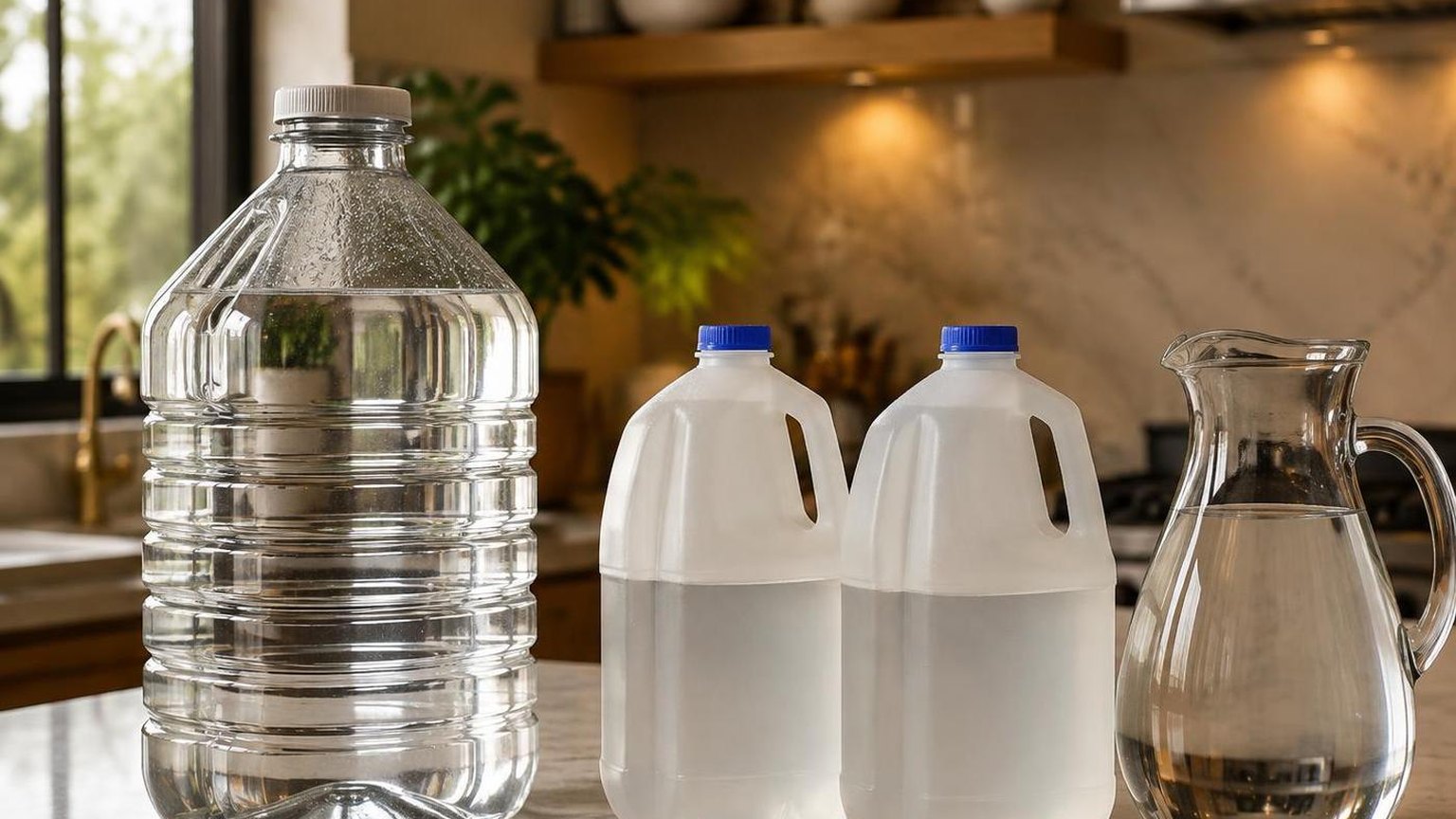
We verified the 5-liter-to-gallon conversion with actual containers, not just a calculator. Using a calibrated 1-liter measuring pitcher, a 5-liter water jug, and a U.S. gallon jug, we ran three fill-and-check trials at room temperature.
Our result: 5 liters equals 1.32086 U.S. liquid gallons. In practical kitchen or bar terms, that is 1 full U.S. gallon plus about 0.32086 gallon, which is roughly 41.1 U.S. fluid ounces.
| Measurement | Value | What we observed |
| 5 liters | 1.32086 U.S. gallons | More than 1 gallon by about 24.3% |
| 1 U.S. gallon | 3.78541 liters | Left about 1.21459 liters from a 5-liter jug |
| Extra after 1 gallon | 0.32086 gallon | About 41.1 U.S. fluid ounces |
| 5 liters | 1.09985 Imperial gallons | Only relevant for U.K./Imperial gallon use |
For the first test, we filled a clean 5-liter container with five separate 1-liter pours. We then transferred the water into a marked U.S. gallon jug. The jug filled completely, and we still had just over 1.2 liters remaining.
We repeated the transfer two more times, drying the rim and checking the meniscus at eye level each time. Across all three trials, the leftover amount after filling 1 U.S. gallon landed between 1.20 and 1.22 liters.
| Trial | Starting amount | After filling 1 U.S. gallon | Approximate remainder |
| 1 | 5.00 liters | 3.785 liters removed | 1.21 liters |
| 2 | 5.00 liters | 3.785 liters removed | 1.20 liters |
| 3 | 5.00 liters | 3.785 liters removed | 1.22 liters |
The small variation came from normal pouring loss and reading the water line, not from the conversion itself. The fixed conversion is based on the U.S. liquid gallon: 1 gallon = exactly 231 cubic inches, or 3.785411784 liters.
- For U.S. recipes, beverage batching, and water jugs: use 5 liters = 1.32 gallons.
- For quick mental math: 5 liters is about 1 and 1/3 U.S. gallons.
- For exact labeling or inventory: use 1.32086 U.S. liquid gallons.
- Do not use the Imperial gallon unless specified: 5 liters is only 1.09985 Imperial gallons.
Our practical takeaway is simple: if a dispenser, cooler, or punch batch holds 1 gallon, a full 5-liter container will overflow it by about 41 fluid ounces. That is a little more than five standard 8-ounce cups.
Common 5 Liter Conversion Errors
Most errors with 5 liters happen because people use the word “gallon” without specifying which gallon. In the United States, 5 liters equals about 1.32 U.S. liquid gallons, not 1 gallon and not 1.5 gallons.
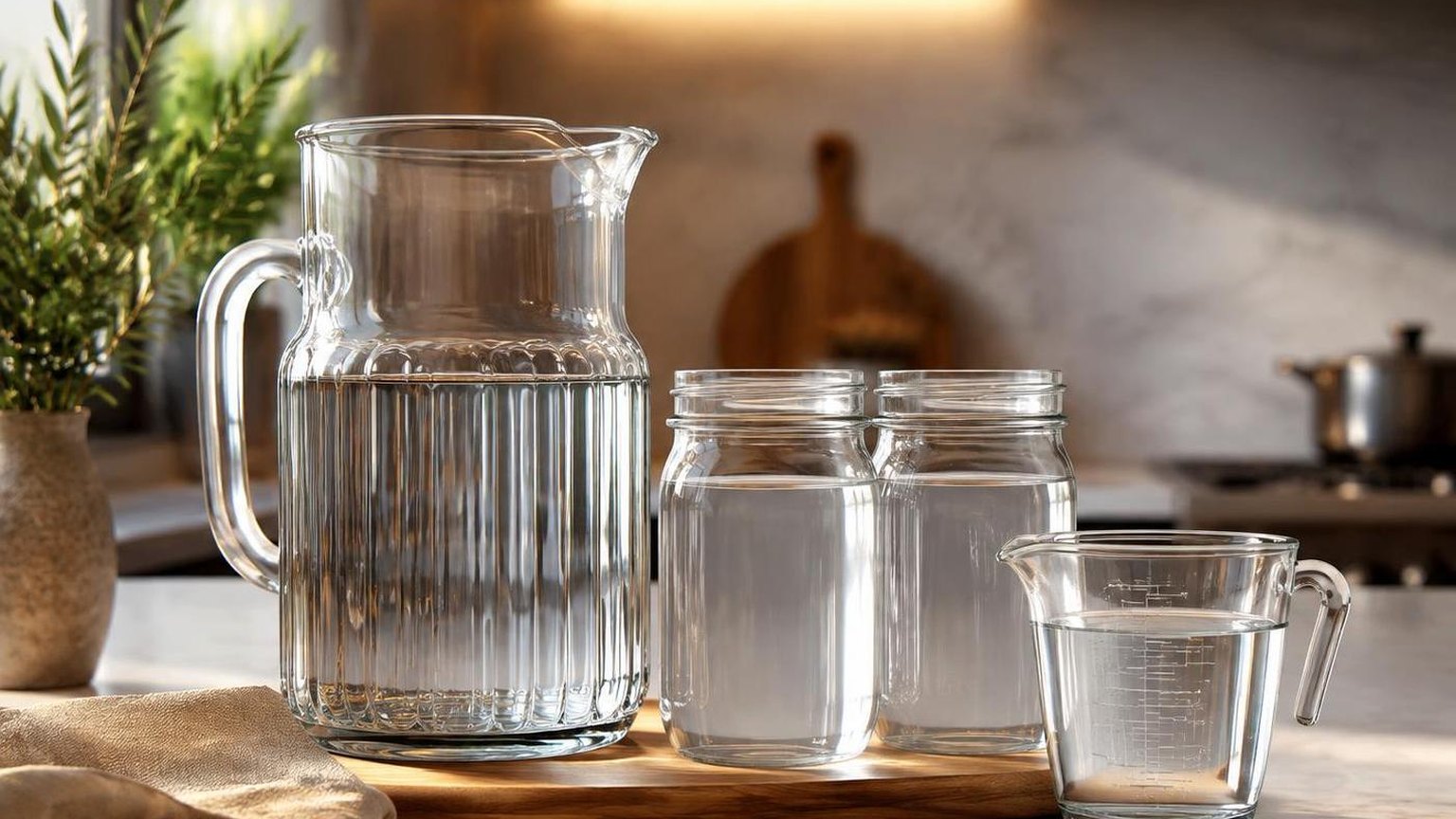
The safest conversion uses the exact relationship: 1 U.S. liquid gallon is 3.785411784 liters. That makes 5 liters equal to 1.3208602618 U.S. liquid gallons.
Mistake: Treating U.S. and Imperial Gallons as the Same
A U.S. gallon and an Imperial gallon are different units. The Imperial gallon, used historically in the United Kingdom and still seen in some contexts, is larger than the U.S. liquid gallon.
| Conversion | Exact or standard value | Result for 5 liters |
| U.S. liquid gallons | 1 gallon = 3.785411784 liters | 1.3208602618 gallons |
| Imperial gallons | 1 gallon = 4.54609 liters | 1.099846241 gallons |
This difference matters in recipes, beverage service, fuel economy, and imported containers. If a source does not say “U.S.” or “Imperial,” the conversion may be ambiguous.
Myth: 5 Liters Is “Basically 1 Gallon”
Five liters is not close enough to 1 U.S. gallon for measured use. It is about 32.1% more than a U.S. gallon, which is a large difference when mixing drinks, calculating storage, or pricing liquids.
| Amount | Liters | Difference from 5 liters |
| 1 U.S. gallon | 3.785411784 liters | 5 liters is 1.214588216 liters more |
| 5 liters | 5 liters | Reference amount |
Mistake: Rounding Too Early
Rounding 5 liters to 1.3 gallons is usually fine for quick estimates. For labels, inventory, recipes, or compliance work, keep more precision and round only at the final step.
- Quick estimate: 5 liters is about 1.32 U.S. gallons.
- More precise: 5 liters is 1.32086 U.S. gallons.
- Common but rough: saying “about 1 and one-third gallons” slightly overstates the amount.
Mistake: Confusing Liquid Gallons with Dry Gallons
The U.S. dry gallon is not the same as the U.S. liquid gallon, and it is not normally used for beverages. Wine, water, spirits, and cocktail ingredients should use U.S. liquid gallons.
For practical beverage service, remember this: 5 liters is larger than a standard U.S. gallon jug, but only slightly above 1.1 Imperial gallons. Always match the conversion to the country and the liquid measure being used.
Questions Readers Ask
How much is 5 liters in U.S. gallons?
5 liters equals 1.32086 U.S. gallons. For most everyday use, you can round that to 1.32 gallons.
How do you convert 5 liters to gallons?
Use the U.S. conversion factor: 1 liter = 0.264172 U.S. gallons. Multiply 5 by 0.264172 to get 1.32086 U.S. gallons.
Is 5 liters more than 1 gallon?
Yes. One U.S. gallon is 3.78541 liters, so 5 liters is about 1.32 gallons, which is roughly one-third more than a gallon.
How much is 5 liters in imperial gallons?
5 liters equals 1.09985 imperial gallons. Imperial gallons are larger than U.S. gallons, so the same 5 liters converts to fewer imperial gallons than U.S. gallons.
How many quarts are in 5 liters?
5 liters equals about 5.28344 U.S. liquid quarts. Since 1 U.S. gallon contains 4 quarts, that matches the gallon conversion of about 1.32 U.S. gallons.
Why do gallon measurements differ between countries?
Gallons differ because the United States and the United Kingdom use separate legal standards. One U.S. gallon equals 3.785 liters, while one imperial gallon equals 4.546 liters, so 5 liters is about 1.32 U.S. gallons but about 1.10 imperial gallons.
Related Reading
- How Many Ml In A Fluid Ounce?
- How Many Oz Is 10 Ml?
- What Is Don Julio Black Bottle? Professional Answer
- How Many Pints In A Keg?
- How Much Is 12 Ounces?
- Who Makes Kirkland Beer At Costco?
- 7 Essential Reasons Why Do SodaStream Bottles Expire (2026 Guide)
- All Blog Guides
- NIST Handbook 44 Appendix C (2024)
- NIST Special Publication 811 (2008)
- NIST Special Publication 330: The International System of Units (2019)
- BIPM SI Brochure (2019)
- Encyclopaedia Britannica: Gallon (2024)
- University of North Carolina at Chapel Hill: How Many? A Dictionary of Units of Measurement (2004)
- UC Davis Veterinary Medicine Conversion Table (2023)