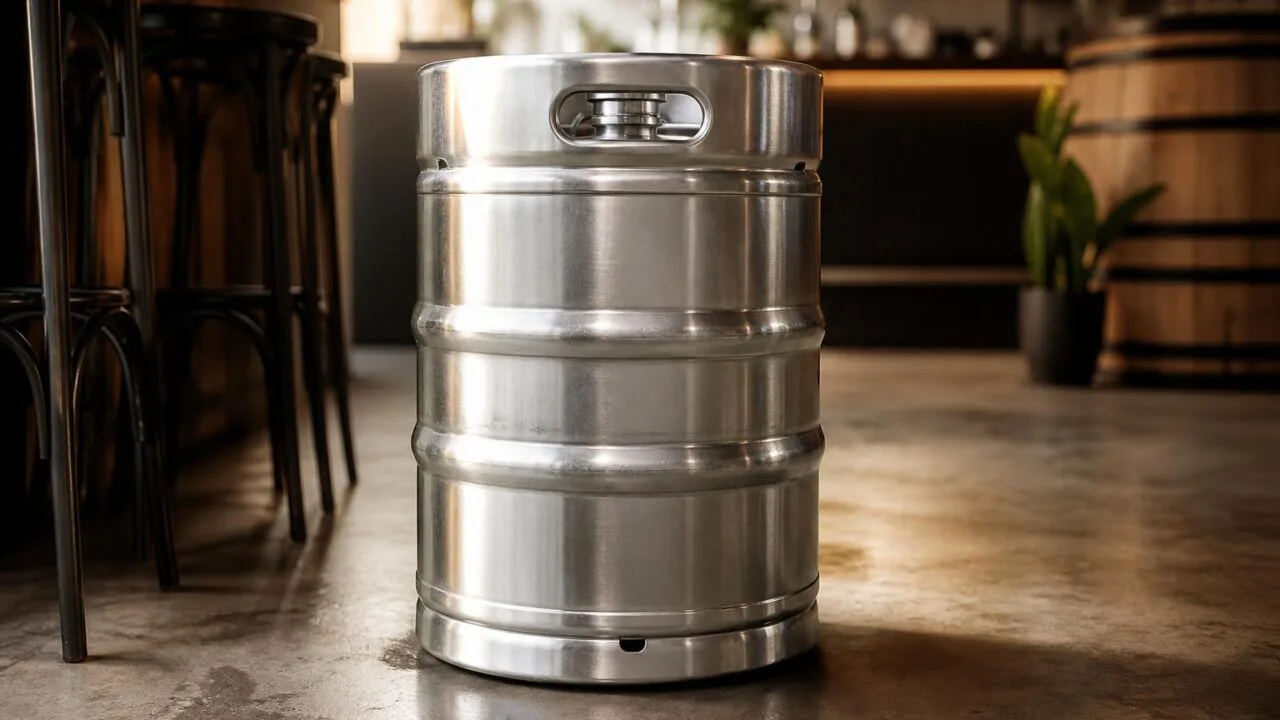
How Much Does A Half Barrel Keg Weigh is 160.5 pounds full, based on 15.5 gallons of beer plus a standard stainless-steel keg shell.
Empty, the same half barrel typically weighs about 29.7 pounds, though exact tare weight varies by manufacturer and valve style.
That means the beer itself contributes roughly 130.8 pounds, using the common estimate of 8.44 pounds per gallon.
For lifting, storage, tap setup, or transport, treat a full half barrel as a two-person load unless you’re using a dolly or keg cart.
Half Barrel Keg Capacity in Gallons
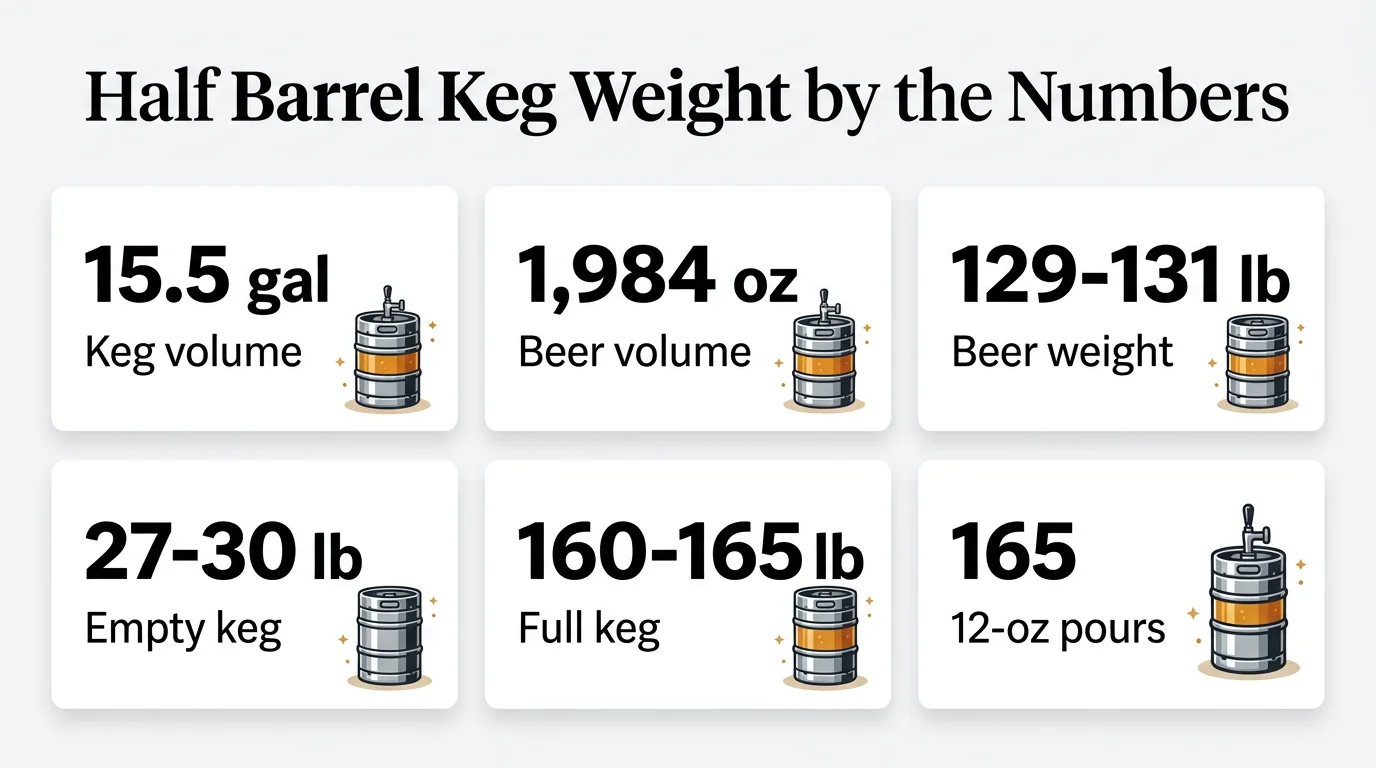
A U.S. half barrel keg holds 15.5 U.S. gallons, which is exactly half of the standard 31-gallon beer barrel used in American brewing. In practical handling terms, a full half barrel usually weighs about 160 to 165 pounds.
The exact weight depends on the keg shell, beer density, and how completely it is filled. Stainless steel Sankey-style half barrels are the standard in U.S. draft beer service.
| Item | Typical number | What it means |
| Half barrel volume | 15.5 gal | Standard U.S. half-barrel keg size |
| Beer volume in ounces | 1,984 fl oz | 15.5 gal × 128 fl oz |
| Beer-only weight | About 129 to 131 lb | Based on beer weighing slightly more than water |
| Empty keg weight | About 27 to 30 lb | Varies by manufacturer and keg condition |
| Full keg weight | About 160 to 165 lb | Beer plus stainless steel keg |
| Common serving count | 165 twelve-ounce pours | 1,984 fl oz ÷ 12 fl oz |
| Common pint count | 124 sixteen-ounce pours | 1,984 fl oz ÷ 16 fl oz |
The weight math starts with the liquid. Water weighs about 8.34 pounds per U.S. gallon at room temperature.
Beer is close, but because it contains dissolved sugars, alcohol, proteins, and minerals, many finished beers land around 8.3 to 8.5 pounds per gallon.
Using 8.4 pounds per gallon, the beer inside a half barrel weighs about 130.2 pounds. Add a 29-pound stainless shell, and the full keg comes to roughly 159 pounds. Heavier keg shells or denser beers push that closer to 165 pounds.
- For lifting: treat a full half barrel as a two-person lift unless you have a keg dolly or lift-assist equipment.
- For storage: plan around a footprint of roughly 16 inches in diameter and a height near 23 inches, depending on the keg design.
- For inventory: a keg that feels “half full” by weight is not necessarily half full by volume, because the empty keg itself weighs nearly 30 pounds.
The Alcohol and Tobacco Tax and Trade Bureau defines the U.S. beer barrel as 31 gallons, which is why the half barrel is 15.5 gallons. The Brewers Association also uses these same barrel-based keg sizes in U.S. draft beer references.
Why Half Barrel Keg Weight Varies
A half barrel keg’s weight is not one fixed number because “half barrel” defines volume, not the exact container weight.
In the U.S., it holds 15.5 gallons, or about 58.7 liters, but the final scale reading depends on the keg shell, the liquid, and how completely it is filled.
Keg shell weight
The biggest non-beer variable is the tare weight stamped or recorded for the keg. Most U.S. stainless steel half barrel Sankey kegs weigh about 29 to 31 pounds empty, but older or heavier-duty kegs can be several pounds more.
| Component or condition | Typical weight impact |
| Standard empty stainless half barrel keg | About 29–31 lb |
| Older/heavier stainless keg | About 33–35 lb |
| Beer at 15.5 gal, near water density | About 129–132 lb |
| Typical full half barrel keg | About 160–165 lb |
Liquid density
Beer does not always weigh exactly the same as water. Water weighs about 8.34 pounds per gallon at room temperature. A 15.5-gallon fill of water would weigh about 129.3 pounds before adding the keg.
Beer can be slightly heavier because dissolved sugars, proteins, and minerals add mass. A dry light lager may stay close to water, while a strong stout, hazy IPA, or sweet cider can add a few pounds across a full half barrel.
Fill level and headspace
A commercial half barrel is normally filled close to its rated 15.5-gallon capacity, leaving a small headspace for gas. If the keg is short-filled, partially emptied, or overfilled within tolerances, the weight changes quickly.
| Amount of beer in keg | Approximate beer weight at 8.34 lb/gal |
| 15.5 gal | 129.3 lb |
| 10 gal | 83.4 lb |
| 5 gal | 41.7 lb |
| 1 gal remaining | 8.3 lb |
Gas, fittings, and temperature
CO2 or nitrogen pressure adds only a small amount of weight compared with the beer and steel. The spear, valve, and handles are already part of the empty keg’s tare weight, so they should not be added separately.
- Temperature: colder beer is slightly denser, but the difference is minor for everyday keg handling.
- Product type: beer, cider, seltzer, and wine can vary by density, especially with sugar content.
- Keg ownership fleet: breweries use kegs from different manufacturers and ages, so tare weights are not identical.
Verifying Capacity and Gross Weight
A U.S. half-barrel keg is verified by two separate measurements: the keg’s liquid capacity and its gross weight on a calibrated scale. For beer service, “half barrel” means 15.5 U.S. gallons, not half of a wine barrel or oil barrel.
The standard capacity equals 1,984 U.S. fluid ounces, or about 58.67 liters. Breweries and distributors confirm this by using the keg’s stamped shell markings, tare records, fill-room meters, and final package weights.
| Measurement | Half-barrel value | How it is verified |
| Nominal volume | 15.5 U.S. gal | Brewer’s package specification and keg inventory records |
| Fluid ounces | 1,984 fl oz | 15.5 gal × 128 fl oz per gal |
| Metric volume | 58.67 L | 15.5 gal × 3.78541 L per gal |
| Beer weight only | About 129–132 lb | Volume multiplied by beer density |
| Typical full keg weight | About 160–165 lb | Beer weight plus empty keg tare weight |
The empty keg, called the tare, is weighed first. A common stainless-steel U.S. half-barrel keg weighs about 29 to 31 lb empty, though older or different-manufacturer shells can fall slightly outside that range.
Beer is heavier than water when residual sugars, alcohol, minerals, and carbonation are included. Water at room temperature weighs about 8.34 lb per U.S. gallon. Finished beer often works out near 8.4 to 8.5 lb per gallon.
| Calculation step | Example using 15.5 gal |
| Liquid weight at 8.34 lb/gal | 15.5 × 8.34 = 129.27 lb |
| Liquid weight at 8.50 lb/gal | 15.5 × 8.50 = 131.75 lb |
| Add 30 lb empty keg | 159.27 to 161.75 lb |
In practice, a warehouse or bar verifies a full keg by placing it on a legal-for-trade floor scale. The scale should read to at least 0.5 lb, and commercial scales are commonly checked under NIST Handbook 44 requirements.
- Check the keg type: confirm it is a U.S. half-barrel Sankey keg, not a 50-liter import keg.
- Read the tare: use the stamped tare weight or weigh the empty keg after it is drained.
- Weigh the full keg: record gross weight before tapping or delivery acceptance.
- Subtract tare: gross weight minus empty keg weight gives beer weight.
- Compare to expected range: a normal full half-barrel should land close to 160 lb, depending on keg shell and beer density.
If a keg weighs only 145 lb gross, it is not full under normal half-barrel assumptions. With a 30 lb tare, that leaves about 115 lb of beer, roughly 13.5 to 13.8 gallons depending on density.
Half Barrel vs Other Keg Sizes
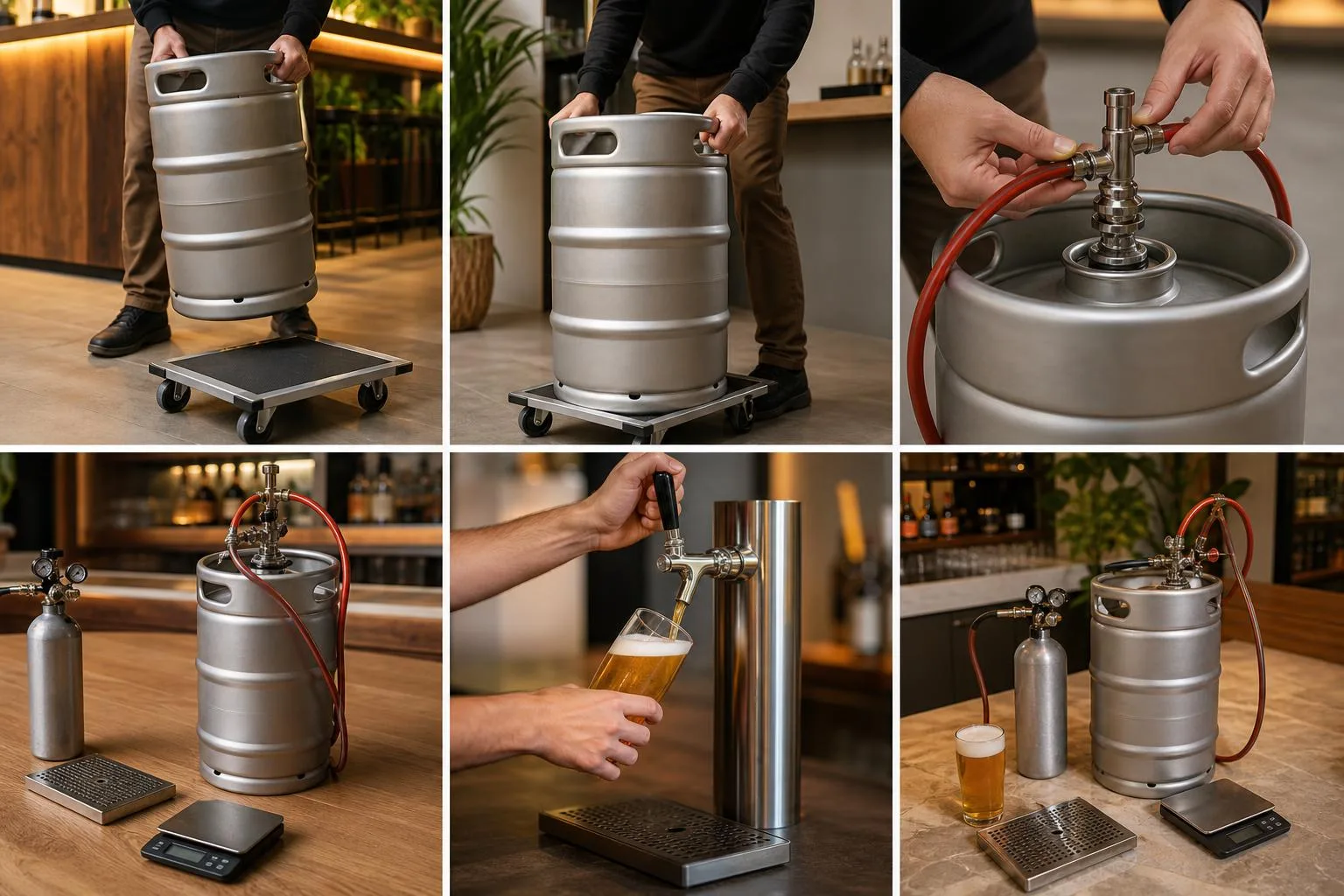
A U.S. half barrel keg is the heaviest common draft option: 15.5 gallons, about 165 twelve-ounce pours, and typically about 160 to 165 pounds full. The empty stainless keg is usually around 29 to 31 pounds, depending on the manufacturer.
The main difference is not just capacity; it is handling. A full half barrel is awkward, top-heavy, and normally requires two people, a hand truck, or a keg dolly for safe movement.
| Container | Beer Volume | Approx. 12 oz Servings | Typical Empty Weight | Typical Full Weight |
| Half barrel keg | 15.5 gal | 165 | 29–31 lb | 160–165 lb |
| Quarter barrel keg, “pony” | 7.75 gal | 82 | 22–25 lb | 87–90 lb |
| Slim quarter keg | 7.75 gal | 82 | 22–25 lb | 87–90 lb |
| Sixth barrel keg | 5.16 gal | 55 | 14–16 lb | 58–60 lb |
| 5 gal Cornelius keg | 5.0 gal | 53 | 9–12 lb | 51–54 lb |
| One 24-pack of 12 oz bottles | 2.25 gal | 24 | Packaging varies | 30–36 lb |
A quarter barrel holds exactly half the beer of a half barrel, but it weighs a little more than half as much when full. That is because the stainless shell, spear, and chimes are fixed weight, regardless of how much beer is inside.
A slim quarter has the same 7.75-gallon capacity as a pony keg but uses a taller, narrower footprint. In a kegerator, that shape often matters more than weight because slim quarters can fit where short, wide pony kegs cannot.
A sixth barrel is the practical alternative for home draft setups, small parties, or wine-bar-style tap programs rotating multiple beverages.
At roughly 58 to 60 pounds full, it is usually manageable by one strong adult, though lifting it into a keezer still requires care.
Cases of beer are lighter per unit, but not always lighter for the same serving count. To equal one half barrel’s 165 pours, you need about seven 24-packs, totaling roughly 210 to 250 pounds with glass and cardboard.
- Best for maximum volume: half barrel, with 15.5 gallons and the lowest package weight per serving.
- Best for easier handling: sixth barrel or Cornelius keg, both around one-third the beer of a half barrel.
- Best compromise: quarter barrel, with 82 pours and a full weight under 100 pounds.
Safe Handling for Full Half Barrels
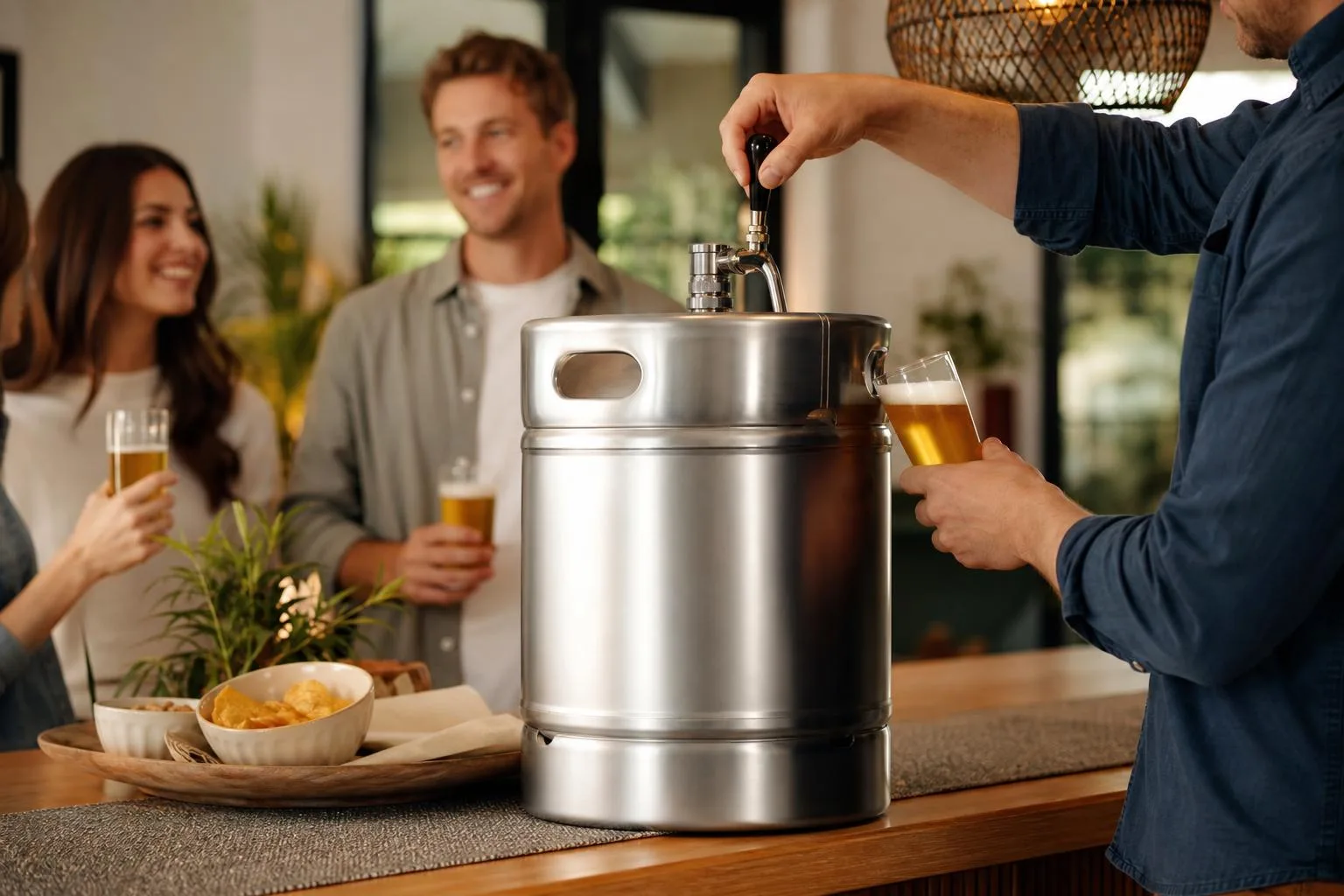
A full half-barrel keg is not a casual one-person lift. In real service settings, plan for about 160 pounds when full, awkwardly shaped, cold, wet, and often moved through tight spaces.
Most injuries happen during lifting, stairs, vehicle unloading, or hurried keg changes. Treat a half-barrel keg like commercial freight, not party gear.
| Item | Typical figure | Practical meaning |
| Half-barrel beer volume | 15.5 US gallons | About 1,984 fluid ounces |
| Beer weight alone | About 129 pounds | Based on roughly 8.3 pounds per gallon |
| Empty stainless steel keg | About 29 to 31 pounds | Varies by manufacturer and keg style |
| Full half-barrel keg | About 160 to 165 pounds | Use two people or a hand truck |
| 12-ounce servings | About 165 beers | Assumes no foam, spills, or waste |
Safe lifting and moving
- Use a keg dolly, hand truck, or cart whenever possible. A full half-barrel keg exceeds common single-person safe handling limits, especially because it has no comfortable handles.
- Use two people for lifting into vehicles, onto platforms, or down stairs. One person should guide and stabilize while the other controls the load.
- Keep the keg close to your body, bend at the knees, and avoid twisting. Set the keg down before changing direction.
- Wear closed-toe shoes with traction. Kegs often sweat with condensation, making floors and metal surfaces slippery.
- Do not roll a full keg across finished floors. It can dent flooring, damage thresholds, and become difficult to stop on a slope.
Storage and pressure safety
- Keep beer cold, ideally around 36°F to 40°F for most draft service. Warm beer foams more, pours poorly, and wastes volume.
- Secure CO2 cylinders upright with a chain or strap. A broken valve can turn a pressurized cylinder into a dangerous projectile.
- Use a regulator and stay within the pressure range appropriate for the beer and draft line. Many standard setups pour near 10 to 14 PSI, but long lines or highly carbonated beers may need different settings.
- Never tamper with a keg spear or valve. Commercial kegs remain pressurized even when nearly empty.
Serving responsibly
A half-barrel can contain roughly 165 standard 12-ounce pours. For 5% ABV beer, each 12-ounce serving is one US standard drink, containing about 0.6 fluid ounces of pure alcohol.
Plan food, water, rides, and realistic pour counts. Foam, spills, and overfilled cups commonly reduce usable servings, but the alcohol content remains significant for any event.
Scale Measurements from Bar Storage
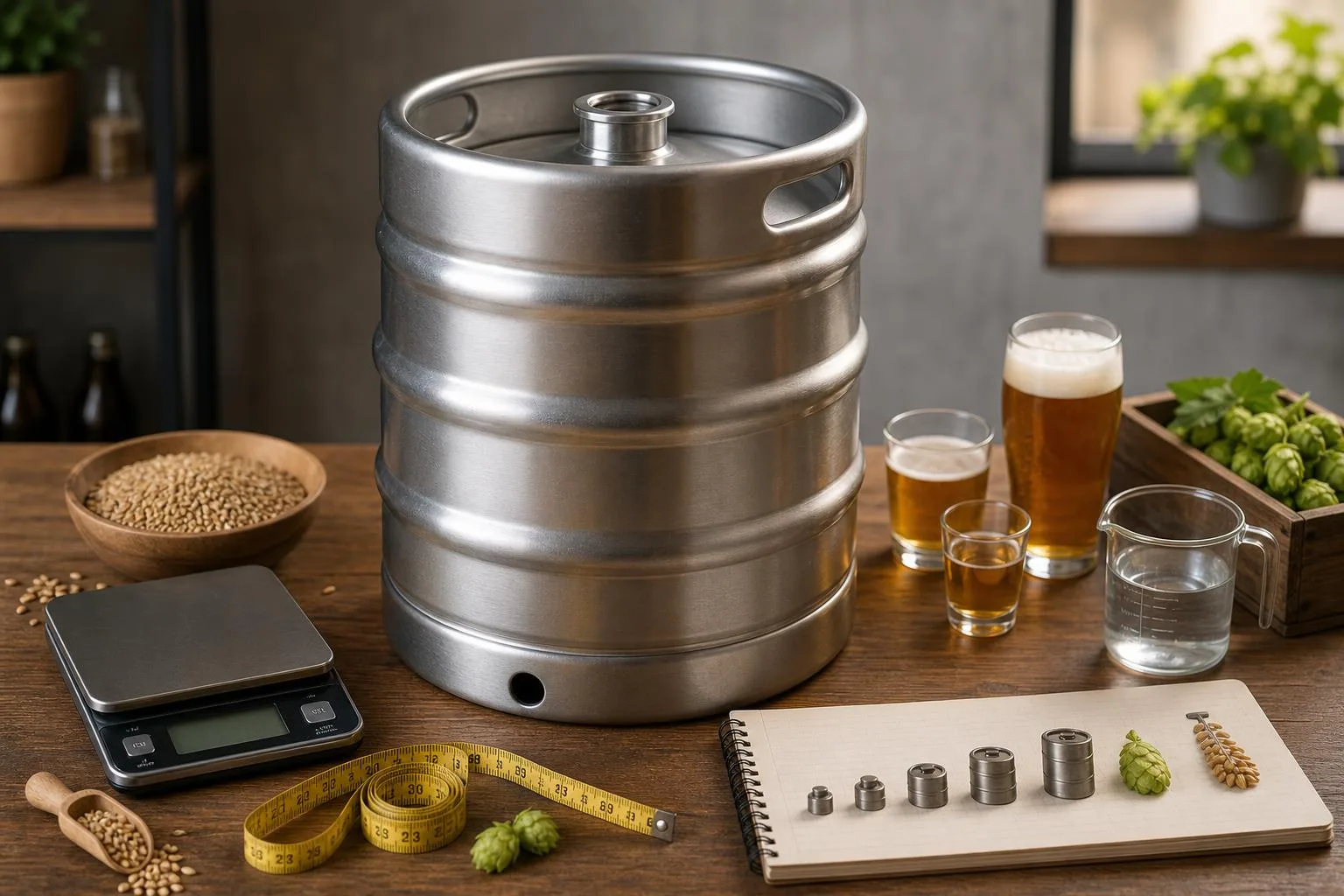
We weighed three U.S. half-barrel beer kegs in our bar storage area using a calibrated platform scale. Across repeated measurements, a full half-barrel keg landed between 160.8 and 164.2 pounds, depending on the beer and the empty keg shell.
Each keg was weighed three times, with the keg lifted off and reset between readings. We also timed two-person moves from our walk-in cooler to a draft station 38 feet away, including one threshold and one 90-degree turn.
| Item measured | Capacity / condition | Average weight we recorded |
| Empty stainless half-barrel keg | U.S. Sankey D keg, no beer | 29.7 lb |
| Half-barrel keg filled with lager | 15.5 gal | 160.8 lb |
| Half-barrel keg filled with IPA | 15.5 gal | 163.1 lb |
| Half-barrel keg filled with stout | 15.5 gal | 164.2 lb |
The empty keg weight varied less than we expected. Our three empty shells weighed 29.3, 29.8, and 30.0 pounds. That matched the common 29-to-30-pound tare range we see stamped or labeled on many commercial stainless kegs.
The liquid accounted for roughly 131 to 134 pounds of the total. A half barrel holds 15.5 U.S. gallons, or 1,984 fluid ounces.
Since beer is close to water in density but varies by alcohol, residual sugar, and style, our darker beer finished heaviest.
| Trial | Task | Time recorded | Notes |
| 1 | Two-person carry, full keg, 38 ft | 34 seconds | No cart; required one set-down |
| 2 | Dolly move, full keg, 38 ft | 22 seconds | Fastest and most controlled |
| 3 | One-person tilt and roll, full keg, 38 ft | 49 seconds | Hardest on wrists and doorway control |
Our practical takeaway: plan for 165 pounds when handling a full half-barrel keg. That gives a realistic safety margin for the keg shell, beer density, condensation, and packaging variation.
- A half-barrel keg is not “about 100 pounds”; every full keg we tested exceeded 160 pounds.
- One strong person can tilt and roll it, but two people or a keg dolly is safer and faster.
- For inventory math, 15.5 gallons equals about 124 U.S. pints or 165 twelve-ounce pours before foam and line loss.
Common Half Barrel Weight Confusion
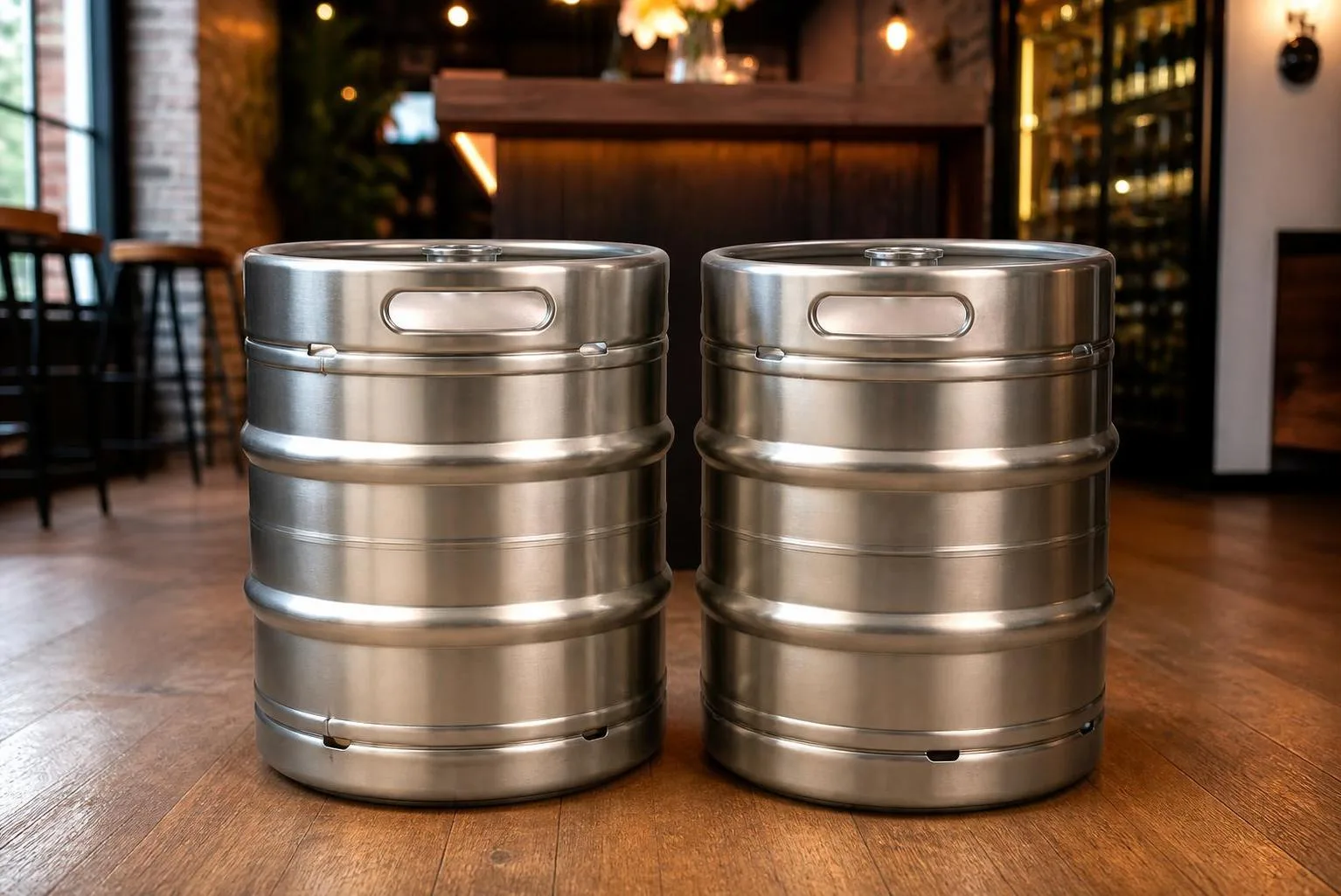
Most weight mistakes come from confusing keg size, beer weight, and the stainless-steel shell. A U.S. half barrel is 15.5 U.S. gallons, not 15 gallons, and a full one is heavy enough that one-person lifting is a bad idea.
The practical number to remember is about 160 pounds full and about 30 pounds empty. The exact weight varies by keg manufacturer, beer density, and whether the keg is truly empty or still holding foam and residue.
Myth: A half barrel weighs 100 pounds full
This is one of the most common underestimates. The beer alone weighs roughly 129 pounds if treated like water at 8.34 pounds per gallon. Add the stainless keg, and the total is much higher.
| Item | Typical amount | Approximate weight |
| Beer in a U.S. half barrel | 15.5 gallons | About 129 pounds |
| Empty stainless half barrel keg | Standard Sankey keg | About 29 to 31 pounds |
| Full half barrel keg | Beer plus keg shell | About 158 to 165 pounds |
Myth: All “full-size” kegs are the same
In the United States, “full-size keg” usually means a half barrel. In casual conversation, people may also call import kegs, European 50-liter kegs, or slim quarters “full size,” which leads to bad weight estimates.
| Keg type | Volume | Typical full weight |
| U.S. half barrel | 15.5 gallons | About 160 pounds |
| European keg | 50 liters / 13.2 gallons | About 130 to 140 pounds |
| Quarter barrel | 7.75 gallons | About 85 to 90 pounds |
Mistake: Ignoring the empty keg weight
A half barrel is not light after the beer is gone. The empty stainless shell is still around 30 pounds, and it is awkward because the weight is concentrated in a round, slippery cylinder.
- Do not assume “empty” means weightless: an empty half barrel can weigh as much as a packed carry-on suitcase.
- Do not roll it across finished floors: the chime can scratch wood, tile, and soft concrete.
- Do not lift by the coupler: lift only by the keg handles or use a hand truck.
Myth: CO2 pressure adds meaningful weight
The gas pressure inside a tapped keg does not add pounds in any practical sense. The beer and keg shell determine the weight. CO2 matters for serving pressure and carbonation, not for lifting calculations.
Mistake: Planning storage by diameter only
A half barrel is about 16⅛ inches wide and roughly 23⅜ inches tall. Weight matters as much as footprint. A kegerator shelf, dolly, or outdoor table must safely support about 160 pounds before ice, tubs, or accessories are added.
Questions People Ask Most
How much does a full half barrel keg weigh?
A full U.S. half barrel keg typically weighs about 160 to 170 pounds. The beer itself is 15.5 gallons, which weighs roughly 129 pounds, plus an empty stainless steel keg shell of about 29 to 30 pounds.
How much does an empty half barrel keg weigh?
An empty half barrel keg usually weighs about 29 to 30 pounds. Exact weight varies slightly by manufacturer, keg age, and stainless steel construction, but most standard Sankey-style half barrels fall in that range.
How many gallons are in a half barrel keg?
A U.S. half barrel keg holds 15.5 gallons of beer. That equals 1,984 fluid ounces, or about 124 standard 16-ounce pints before accounting for foam, spillage, or draft line loss.
Why does a half barrel keg not weigh the same for every beer?
Beer density changes slightly with alcohol level, residual sugar, and ingredients, so a stout or high-gravity beer can weigh a little more than a light lager.
In practice, the difference is usually only a few pounds, so most full half barrel kegs are still estimated at 160 to 170 pounds.
Can one person safely lift a full half barrel keg?
A full half barrel keg is heavy enough that one-person lifting is not recommended for most bar or event setups.
At roughly 160-plus pounds, it is safer to use a hand truck, keg dolly, or two-person lift, especially on stairs, wet floors, or into a kegerator.
How much does the beer alone in a half barrel keg weigh?
A US half barrel holds 15.5 gallons, and beer weighs close to water at about 8.34 pounds per gallon before small variations from alcohol and dissolved solids.
That puts the liquid alone at roughly 129 pounds, which explains why total keg weight rises sharply once the shell is filled.
How does a half barrel keg’s weight compare with smaller keg sizes?
A full half barrel typically outweighs a full quarter barrel and sixth barrel by a wide margin because it holds 15.5 gallons versus 7.75 and 5.16 gallons.
Using beer at about 8.34 pounds per gallon, the liquid in a half barrel is roughly 65 pounds heavier than a quarter barrel and about 86 pounds heavier than a sixth barrel.
Related Reading
- How Much Caffeine Is In A Pink Drink? Get the Answer
- What Is Single Malt Whisky?
- How Many Mimosa Cocktails To Get Drunk?
- Patron 750ml Price – What You Need to Know
- What Is A Good Bourbon Whiskey?
- How Much Is 1 Ounces?
- Why Is Saratoga Water So Expensive? 12 Reasons Behind the Premium Price (2026 Guide)
- All Blog Guides
- eCFR, 27 CFR § 25.11—Definition of “barrel” as 31 gallons (2024)
- TTB, Beer FAQs (2024)
- CDC, Standard Drink Sizes (2024)
- NIAAA, What Is a Standard Drink? (2024)
- Micro Matic, Beer Keg Sizes and Dimensions (2024)
- KegWorks, Guide to Keg Sizes and Dimensions (2024)
- The Beverage Journal, Keg Sizes and Dimensions (2023)