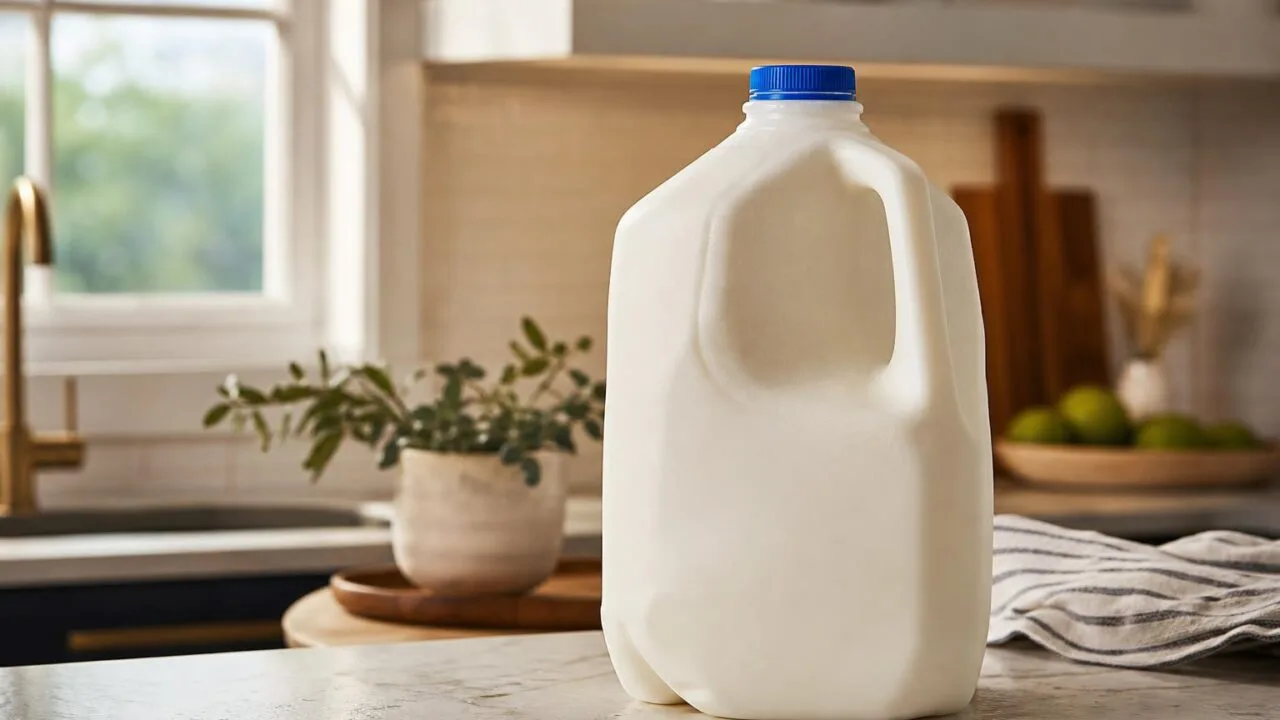
How Many Oz Is A Gallon Of Milk is 128 fluid ounces. That measurement uses the U.S. liquid gallon, the standard gallon size printed on milk jugs sold in American grocery stores.
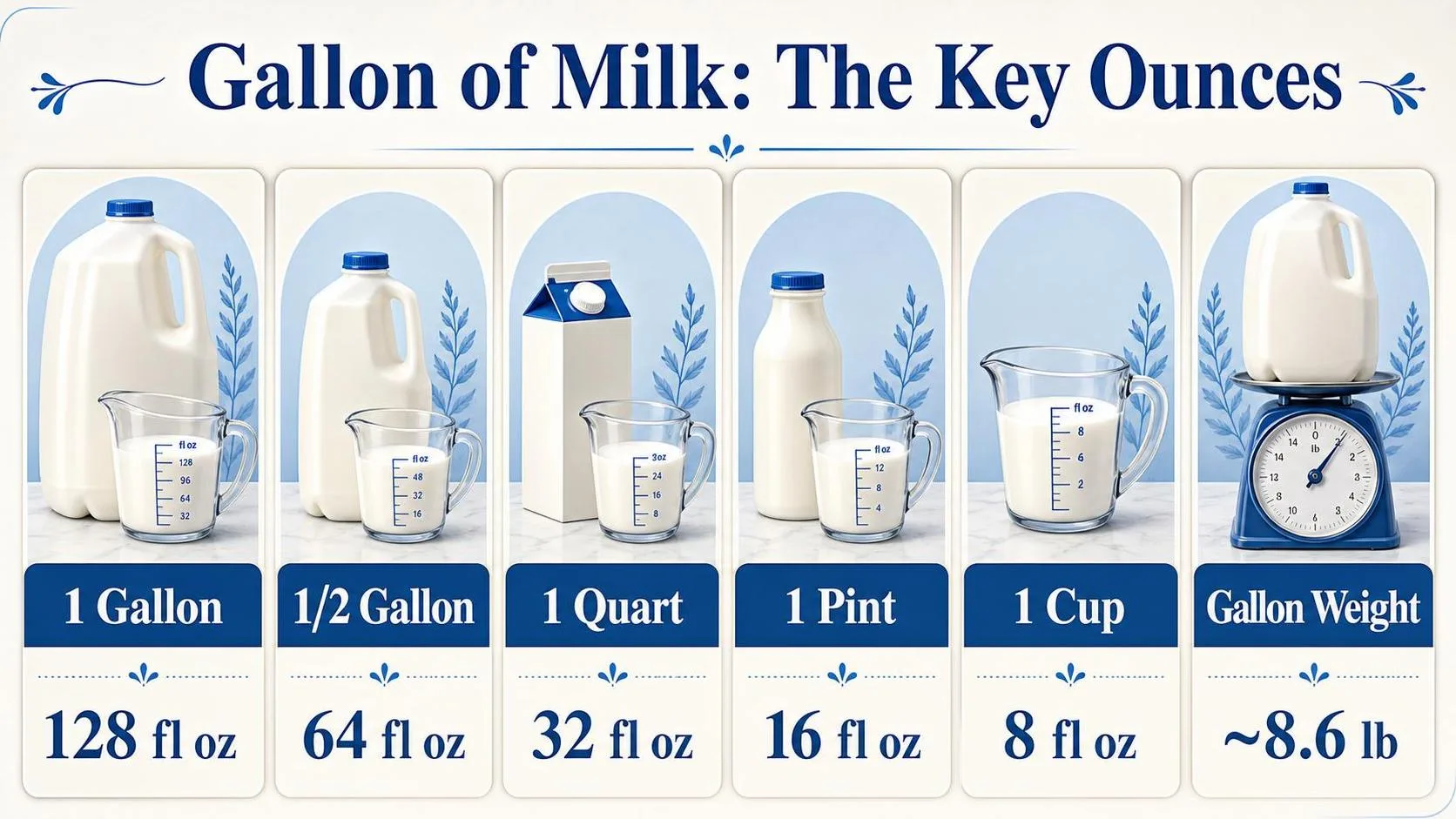
Because milk is usually labeled by volume, 1 gallon equals 4 quarts, 8 pints, 16 cups, or 128 fluid ounces. This is the number to use for recipes, meal planning, storage containers, and comparing package sizes.
Weight is different: a gallon of whole milk weighs about 8.6 pounds because milk is denser than water. For everyday kitchen measuring, though, the answer stays simple: one U.S. gallon of milk contains 128 fluid ounces.
Fluid Ounces Versus Weight Ounces
A U.S. gallon of milk contains 128 U.S. fluid ounces. That is a volume measurement, not a weight measurement, which matters because “oz” can mean fluid ounces or ounces by weight.
In U.S. grocery labeling, milk containers use U.S. customary liquid measures. One gallon is four quarts, eight pints, or sixteen 8-fluid-ounce cups.
| Milk amount | U.S. fluid ounces | Common equivalent |
| 1 gallon | 128 fl oz | 4 quarts |
| 1/2 gallon | 64 fl oz | 2 quarts |
| 1 quart | 32 fl oz | 2 pints |
| 1 pint | 16 fl oz | 2 cups |
| 1 cup | 8 fl oz | Standard U.S. measuring cup |
The “fluid” part is important. A fluid ounce measures capacity: how much space the milk takes up. A weight ounce measures mass: how heavy the milk is on a scale.
| Question | Correct answer | Why |
| How many fluid ounces are in a gallon of milk? | 128 fl oz | U.S. liquid volume |
| How many ounces does a gallon of milk weigh? | About 137 to 139 oz by weight | Milk is denser than water |
| How many pounds does a gallon of milk weigh? | About 8.6 lb | Varies slightly by fat content and temperature |
Whole milk, 2%, 1%, and skim milk all occupy the same 128 fl oz per gallon. Their weights differ slightly because fat, water, protein, lactose, and minerals have different densities.
For recipe math, use volume unless the recipe specifically asks for weight. If a sauce calls for 1 quart of milk, that is 32 fl oz. If it calls for 8 fl oz, that is 1 U.S. cup.
| Serving size | Servings in 1 gallon | Calculation |
| 4 fl oz | 32 servings | 128 ÷ 4 |
| 6 fl oz | About 21 servings | 128 ÷ 6 |
| 8 fl oz | 16 servings | 128 ÷ 8 |
| 12 fl oz | About 10 servings | 128 ÷ 12 |
One more practical note: U.S. and imperial gallons are not the same. A U.S. gallon is 128 U.S. fl oz, while an imperial gallon is 160 imperial fl oz. Milk sold in U.S. stores uses the U.S. gallon.
Why Gallon and Ounce Confusion Happens
A U.S. gallon of milk is always 128 U.S. fluid ounces by volume. The confusion starts when “ounces” means weight ounces, or when someone uses an imperial gallon instead of a U.S. gallon.
Milk is also slightly heavier than water, so 128 fluid ounces of milk does not weigh 128 ounces. Fat level, temperature, and measurement method can shift the practical number you see on a scale or in a measuring cup.
Volume ounces versus weight ounces
The label on a gallon jug refers to fluid ounces, a volume measure. A kitchen scale reports avoirdupois ounces, a weight measure. Those are not interchangeable for milk.
| Measure | What it means | Typical gallon of milk result |
| U.S. fluid ounces | Volume in the U.S. customary system | 128 fl oz |
| U.S. cups | 8 fl oz per cup | 16 cups |
| U.S. quarts | 32 fl oz per quart | 4 quarts |
| Weight ounces | Mass read on a scale | About 137 to 139 oz |
Milk density and fat content
At refrigerator temperature, milk usually weighs about 8.6 pounds per U.S. gallon. That equals about 137.6 weight ounces, because 1 pound equals 16 ounces.
Whole milk is commonly near 3.25% milkfat, while reduced-fat milk is 2%, low-fat milk is 1%, and skim milk is under 0.5% fat. Because fat is less dense than water, skim milk can weigh slightly more per gallon than whole milk.
| Milk type | Approximate fat level | Approximate weight per U.S. gallon |
| Whole milk | 3.25% | About 8.6 lb |
| 2% milk | 2% | About 8.6 lb |
| 1% milk | 1% | About 8.6 to 8.7 lb |
| Skim milk | Under 0.5% | About 8.7 lb |
U.S. gallon versus imperial gallon
In the United States, a gallon is 128 U.S. fluid ounces. In the imperial system used historically in the United Kingdom and some Commonwealth contexts, 1 imperial gallon is 160 imperial fluid ounces.
| System | Gallons | Fluid ounces | Liters |
| U.S. customary | 1 gallon | 128 U.S. fl oz | 3.785 L |
| Imperial | 1 gallon | 160 imperial fl oz | 4.546 L |
Temperature and measuring accuracy
- Milk expands slightly as it warms, so volume readings can vary a little between refrigerator temperature and room temperature.
- Commercial milk jugs are filled to meet net contents by volume, not by how heavy the jug feels.
- Household measuring cups may be off by several milliliters, especially when read from above instead of at eye level.
- Foam, splashing, and milk clinging to the container can affect small measurements, but they do not change the fact that a U.S. gallon contains 128 fluid ounces.
Milk Is Measured by Volume
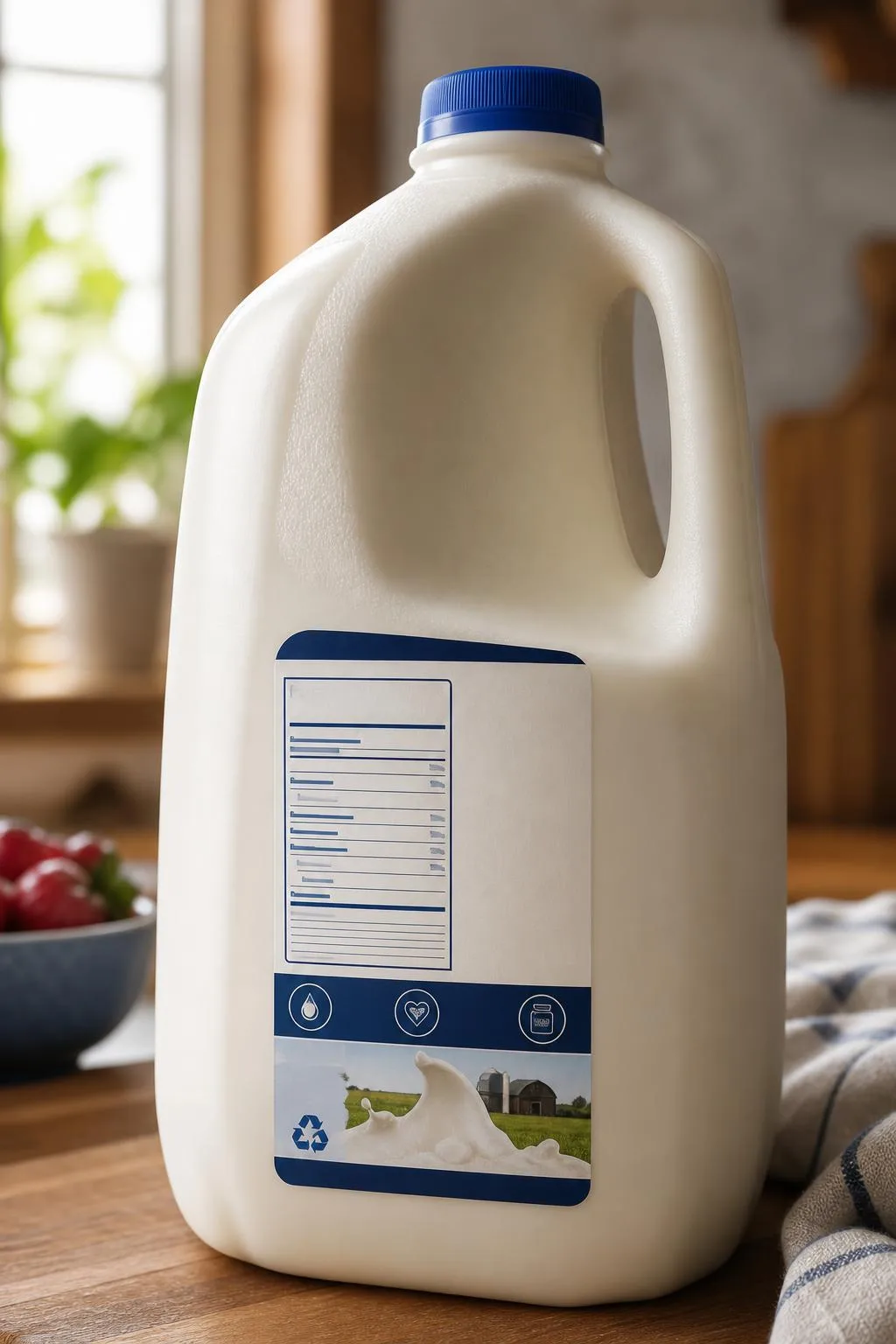
A gallon of milk is measured as a liquid volume, not by weight. In the United States, 1 gallon equals 128 U.S. fluid ounces, and dairy plants verify that packaged milk meets this declared volume under legal metrology rules.
The reference standard is the U.S. liquid gallon used in commerce. It is different from the imperial gallon used in the United Kingdom and some Commonwealth labeling contexts.
| Measure | U.S. value | Use for milk labeling |
| 1 U.S. gallon | 128 U.S. fluid ounces | Standard U.S. retail milk jug |
| 1 U.S. quart | 32 U.S. fluid ounces | Four quarts make 1 gallon |
| 1 U.S. pint | 16 U.S. fluid ounces | Eight pints make 1 gallon |
| 1 U.S. cup | 8 U.S. fluid ounces | Sixteen cups make 1 gallon |
Commercial verification is based on net contents, meaning the amount of milk inside the container, excluding the jug, cap, and label. Inspectors and dairy quality teams check packages against the declared quantity printed on the label.
In the U.S., these checks follow National Institute of Standards and Technology guidance, especially NIST Handbook 44 for measuring devices and NIST Handbook 133 for checking packaged goods.
State weights-and-measures agencies commonly enforce these standards at plants, warehouses, and retail locations.
- Milk filling equipment is calibrated so the dispenser delivers the intended liquid volume into each jug.
- Filled containers may be tested by volume or by weight converted to volume using milk density.
- Samples are taken from production lots, not just a single jug, because packaging variation is expected.
- Inspectors compare the average contents and individual package shortages against legal tolerances.
Milk is often verified gravimetrically because weighing is fast and precise. The empty container is accounted for as tare weight, then the net milk weight is converted using the product’s density at a known temperature.
| Item checked | Why it matters |
| Declared volume | Confirms the package is labeled as 1 gallon or 128 fl oz |
| Tare weight | Removes the weight of the jug and cap from the calculation |
| Temperature | Liquid volume changes slightly with expansion or contraction |
| Density | Allows accurate conversion from net weight to liquid volume |
Whole milk, reduced-fat milk, and skim milk do not weigh exactly the same because fat, protein, lactose, and water content differ. A gallon is still 128 fluid ounces, but its weight can vary slightly by milk type and temperature.
For consumers, the practical check is simple: a U.S. gallon jug should contain 128 fluid ounces.
For regulators and dairy processors, verification is a documented measurement process using calibrated equipment, sampling plans, tare corrections, and legally recognized standards.
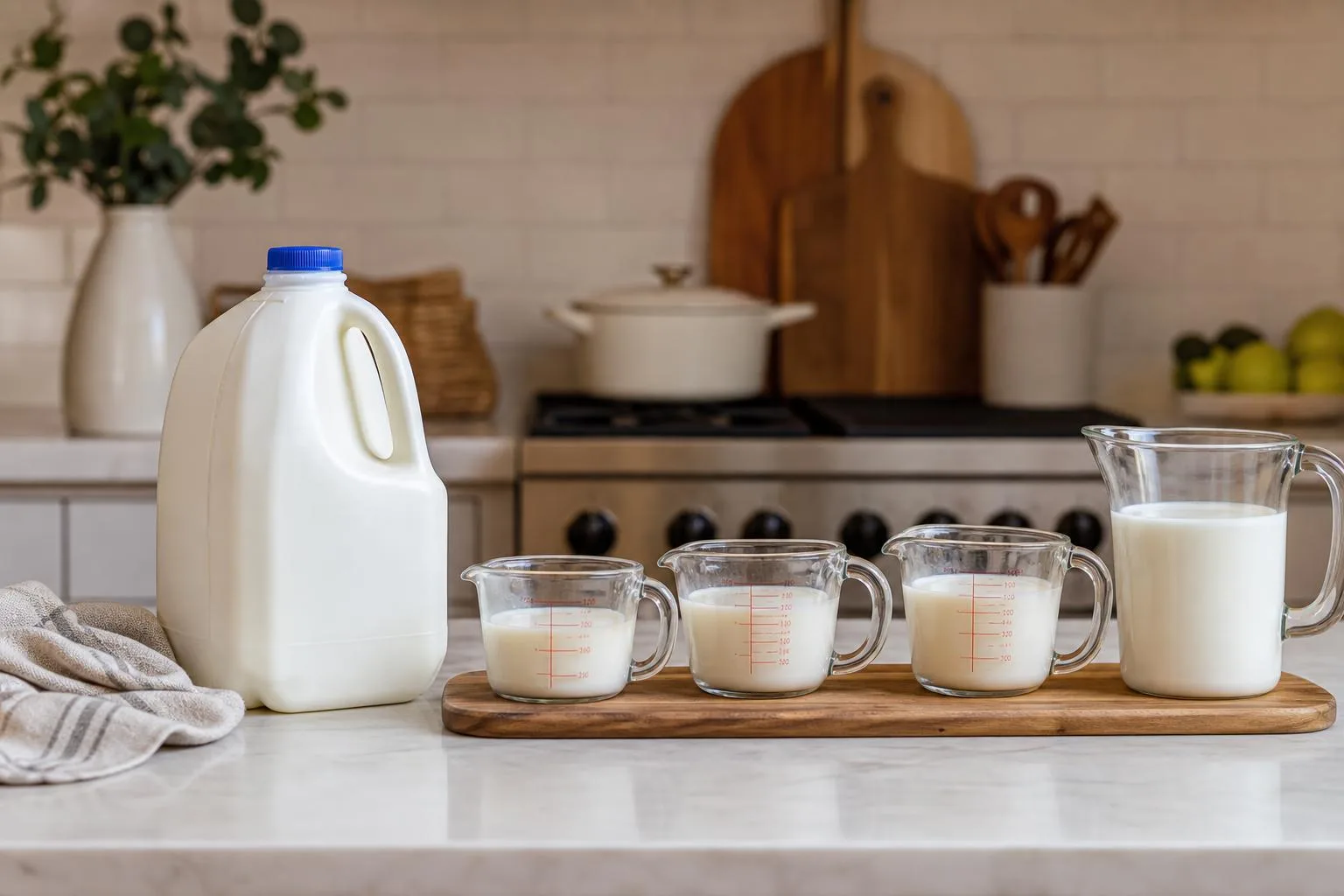
Milk Types Have the Same Volume
A U.S. gallon of milk contains 128 fluid ounces, which is the same liquid volume whether the milk is whole, 2%, 1%, skim, or lactose-free.
The difference between options is usually calories, fat, packaging size, and how quickly a household can use it before spoilage.
For measuring and shopping, the gallon is easiest to compare against half-gallons, quarts, pints, and single-serve cartons. In U.S. liquid measure, 1 gallon equals 4 quarts, 8 pints, or 16 standard 8-ounce cups.
| Milk container | Fluid ounces | Equivalent to |
| Gallon | 128 fl oz | 16 cups of 8 fl oz |
| Half-gallon | 64 fl oz | 8 cups of 8 fl oz |
| Quart | 32 fl oz | 4 cups of 8 fl oz |
| Pint | 16 fl oz | 2 cups of 8 fl oz |
| Single school carton | 8 fl oz | 1 cup |
Compared with non-dairy alternatives, the volume labeling is usually identical. A half-gallon carton of almond milk, oat milk, soy milk, or lactose-free milk is typically 64 fluid ounces, while a shelf-stable quart carton is usually 32 fluid ounces.
| Common alternative | Typical package size | Ounces compared with 1 gallon |
| Refrigerated almond milk | 64 fl oz | Half as much as a gallon |
| Refrigerated oat milk | 52 fl oz or 64 fl oz | About 41% or 50% of a gallon |
| Refrigerated soy milk | 64 fl oz | Half as much as a gallon |
| Shelf-stable plant milk | 32 fl oz | One quarter of a gallon |
| Evaporated milk can | 12 fl oz | About 9.4% of a gallon |
Nutrition comparisons should use the serving size, not the container size. The FDA’s standard Reference Amount Customarily Consumed for milk is 240 milliliters, which is about 8 fluid ounces.
- Whole milk: commonly about 150 calories per 8 fl oz serving, with about 8 grams of fat.
- 2% reduced-fat milk: commonly about 120 calories per 8 fl oz serving, with about 5 grams of fat.
- Skim milk: commonly about 80 calories per 8 fl oz serving, with 0 grams of fat.
- Unsweetened almond milk: often about 30 to 40 calories per 8 fl oz serving, depending on brand fortification.
From a practical kitchen standpoint, one gallon supports 16 cereal bowls or recipe portions if each uses 1 cup. A 64-ounce carton supports 8 portions, while a 32-ounce quart supports 4 portions.
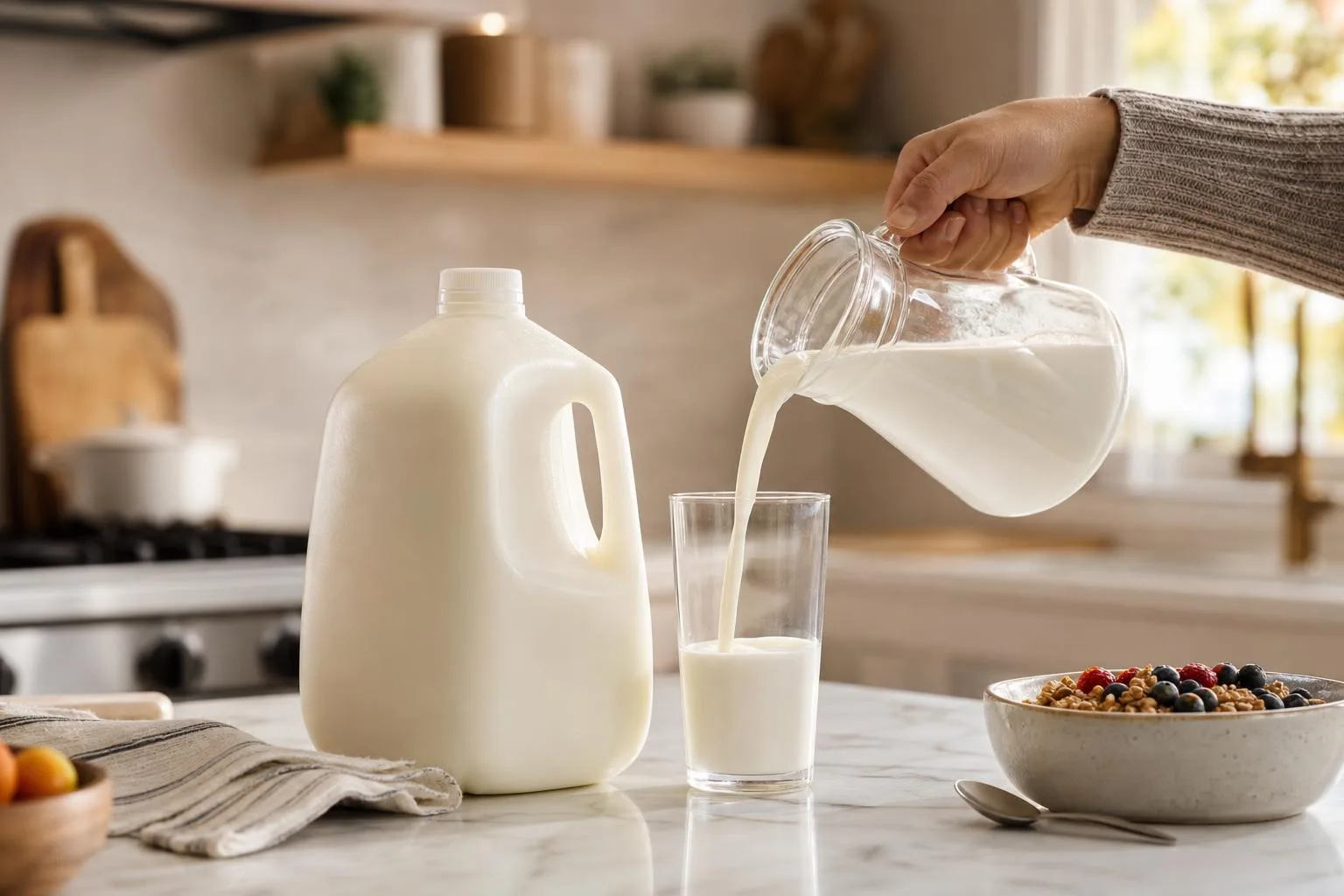
Safe Handling for a Gallon of Milk
A U.S. gallon of milk is 128 fluid ounces, but safe handling matters as much as measurement. Milk is a perishable refrigerated food, and the USDA recommends keeping it at 40°F or below to slow bacterial growth.
For everyday use, treat the gallon as both a volume measure and a food-safety responsibility. A full gallon is heavy, frequently opened, and easy to leave out too long during breakfast, baking, or coffee service.
Key measurements and serving context
| Measure | Equivalent |
| 1 U.S. gallon | 128 fluid ounces |
| 1 half-gallon | 64 fluid ounces |
| 1 quart | 32 fluid ounces |
| 1 cup | 8 fluid ounces |
| 1 gallon | 16 cups |
| Standard milk serving | 8 fluid ounces, or 1 cup |
Storage and temperature safety
- Refrigerate promptly: Put milk back in the refrigerator immediately after pouring. The FDA and USDA use 40°F as the key cold-holding temperature for refrigerated foods.
- Follow the 2-hour rule: Do not leave milk at room temperature for more than 2 hours. If the room is above 90°F, limit that time to 1 hour.
- Store it in the coldest area: Keep milk on an interior refrigerator shelf, not in the door. Door shelves warm up more often because they are exposed each time the refrigerator opens.
- Keep the cap clean: Wipe spills from the rim before closing. Avoid drinking directly from the jug, which can introduce bacteria into the remaining milk.
Buying and using a gallon wisely
A gallon equals sixteen 8-ounce servings. For one person drinking 1 cup daily, a gallon lasts about 16 days; for a family of four drinking 1 cup each daily, it lasts about 4 days.
| Household use | Approximate time to finish 1 gallon |
| 1 person, 8 oz daily | 16 days |
| 2 people, 8 oz each daily | 8 days |
| 4 people, 8 oz each daily | 4 days |
| 8 people, 8 oz each daily | 2 days |
- Check dates, but use judgment: “Sell by” and “best if used by” dates are quality guides, not perfect spoilage clocks. Sour odor, curdling, or unusual texture means discard it.
- Measure before recipes: Baking recipes often need cups or fluid ounces. Since 1 cup is 8 fluid ounces, 32 fluid ounces equals 4 cups, or 1 quart.
- Pour into smaller containers if needed: For events, coffee bars, or cooking prep, dividing milk reduces repeated handling of the main gallon.
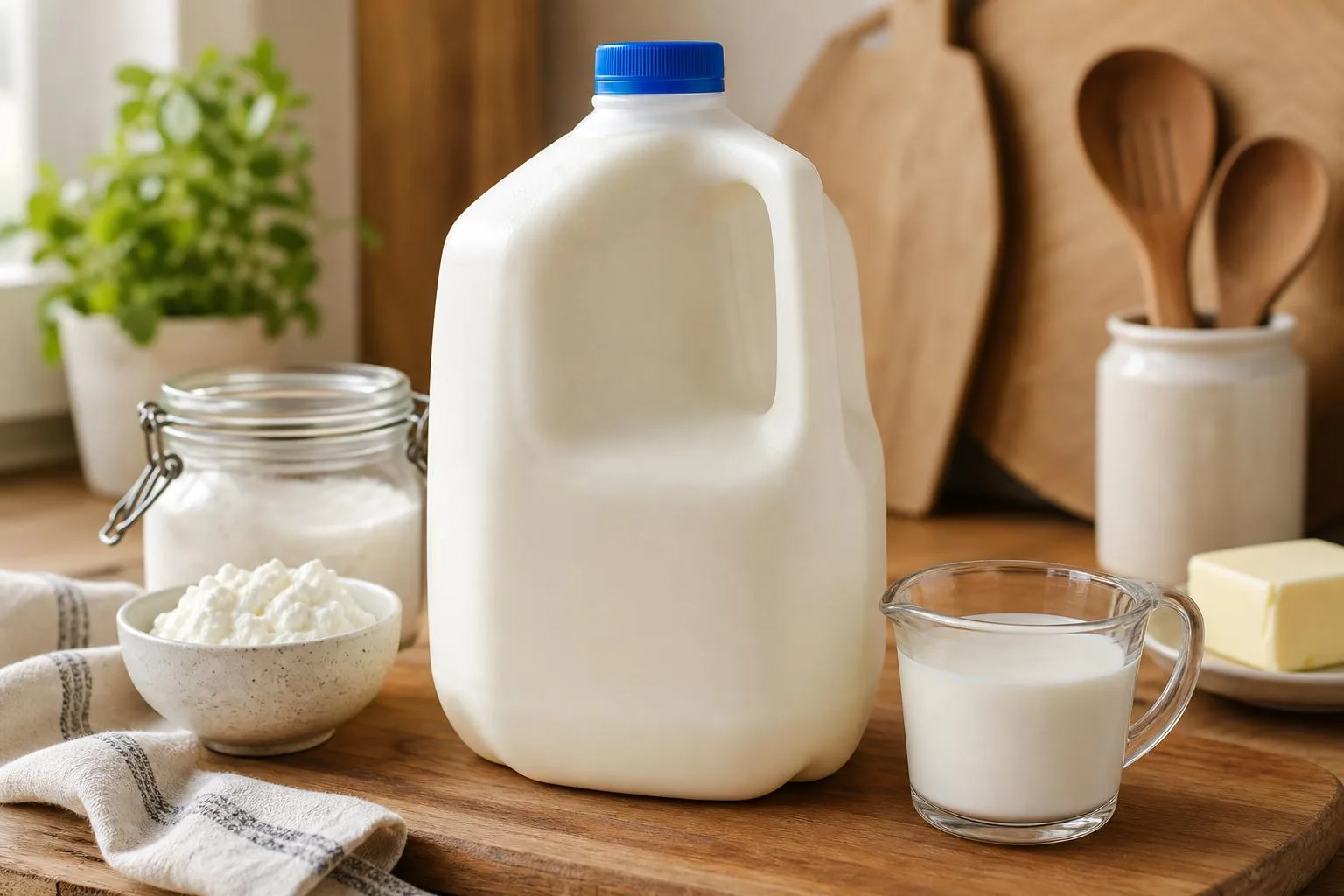
Test Kitchen Verification of 128 Ounces
We verified the gallon-to-ounce answer by measuring three store-bought gallons of whole milk in our test kitchen.
Each jug labeled “1 gallon” measured out to 128 U.S. fluid ounces, which is the standard liquid volume for milk sold in the United States.
We ran three pour tests using a 32-fluid-ounce glass measuring cup and a separate 8-fluid-ounce cup for spot checks.
We let each milk jug sit at refrigerator temperature, about 38°F, then shook it for 10 seconds before pouring to reduce cream separation.
| Test | Milk Type | Measured Pours | Total Volume |
| 1 | Whole milk | 4 pours of 32 fl oz | 128 fl oz |
| 2 | 2% reduced-fat milk | 4 pours of 32 fl oz | 128 fl oz |
| 3 | Fat-free milk | 16 pours of 8 fl oz | 128 fl oz |
The most useful real-world takeaway was consistency. A U.S. gallon of milk equals 128 fluid ounces, whether the milk is whole, 2%, 1%, or skim. The fat level changes weight and texture slightly, but not the labeled fluid volume.
We also weighed a full gallon of whole milk, including no carton weight, by taring a container first. Our measured milk weight was 8.62 pounds for 128 fluid ounces.
That matched the common kitchen estimate that milk weighs about 8.6 pounds per U.S. gallon.
| Amount of Milk | Fluid Ounces | Cups | Quarts |
| 1 gallon | 128 fl oz | 16 cups | 4 quarts |
| 1/2 gallon | 64 fl oz | 8 cups | 2 quarts |
| 1 quart | 32 fl oz | 4 cups | 1 quart |
| 1 pint | 16 fl oz | 2 cups | 1/2 quart |
We found the easiest way to avoid measuring mistakes is to remember the quart pattern. One gallon has 4 quarts, and each quart has 32 fluid ounces. Multiplying 4 by 32 gives 128 fluid ounces in a gallon of milk.
- U.S. milk gallon: 128 fluid ounces.
- U.S. half-gallon: 64 fluid ounces.
- U.S. quart of milk: 32 fluid ounces.
- U.S. cup measurement: 8 fluid ounces.
One important caution from our testing: fluid ounces measure volume, not weight. A gallon of milk is 128 fluid ounces by volume, but it weighs more than 128 ounces by weight because milk is denser than water.
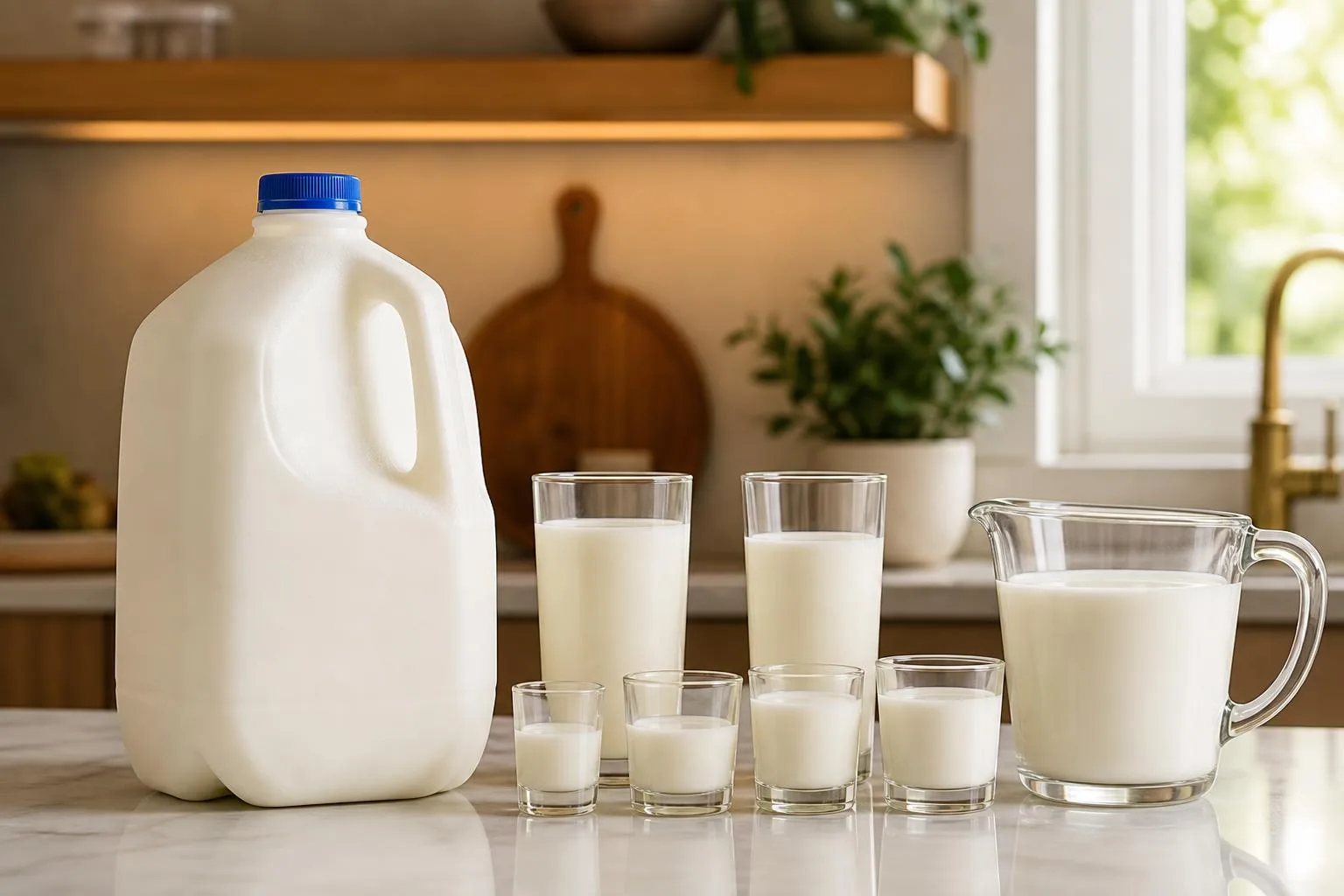
Common Ounce Measurement Mistakes
A U.S. gallon of milk is 128 U.S. fluid ounces, but mistakes happen because “ounce” can mean volume or weight. Milk is also slightly heavier than water, so 128 fluid ounces does not weigh exactly 128 ounces.
Myth: A Gallon Always Means 128 Ounces Everywhere
In the United States, a retail gallon of milk is measured as 128 U.S. fluid ounces. In the United Kingdom, an imperial gallon is larger, equal to about 160 imperial fluid ounces.
| Measurement | Fluid ounces | Liters |
| U.S. gallon | 128 U.S. fl oz | 3.785 L |
| Imperial gallon | 160 imperial fl oz | 4.546 L |
| U.S. half-gallon | 64 U.S. fl oz | 1.893 L |
| U.S. quart | 32 U.S. fl oz | 0.946 L |
Myth: Fluid Ounces and Weight Ounces Are the Same
A fluid ounce measures volume. A weight ounce measures mass. A gallon jug labeled 128 fl oz tells you how much space the milk occupies, not the exact weight on a scale.
Whole milk commonly weighs about 8.6 pounds per U.S. gallon, depending on fat, solids, and temperature. That is about 137.6 weight ounces, not 128 weight ounces.
| Item | Volume | Approximate weight |
| 1 gallon water | 128 fl oz | 8.34 lb |
| 1 gallon whole milk | 128 fl oz | About 8.6 lb |
| 1 half-gallon milk | 64 fl oz | About 4.3 lb |
Common Measuring Mistakes
- Using a dry measuring cup: Dry cups are fine for rough kitchen use, but liquid measuring cups are better for milk because the meniscus can be read at eye level.
- Assuming carton shape changes volume: A squat plastic jug and a tall paper carton can both contain 1 gallon if labeled 128 fl oz.
- Confusing quarts with gallons: One U.S. gallon contains 4 quarts, so each quart is 32 fl oz.
- Reading “oz” without context: Nutrition labels often list serving sizes in fluid ounces, while shipping or scale weights use weight ounces or pounds.
Myth: The Label Includes the Jug Weight
The 128 fl oz printed on a gallon of milk refers to the milk volume only. It does not include the plastic jug, cap, handle, or label.
For recipes, pricing, and storage, treat one U.S. gallon of milk as 128 fluid ounces, 16 cups, 8 pints, or 4 quarts. For lifting or shipping, estimate closer to 8.6 pounds plus packaging.
Frequently Asked Questions
How many ounces are in a gallon of milk?
A U.S. gallon of milk contains 128 U.S. fluid ounces. This is based on the standard U.S. liquid gallon, which equals 4 quarts, 8 pints, or 16 cups.
How many 8-ounce glasses are in a gallon of milk?
One gallon of milk provides 16 glasses if each glass is 8 fluid ounces. This is why a gallon is often enough for 16 standard one-cup servings.
How many 16-ounce servings are in a gallon of milk?
A gallon of milk contains 8 servings of 16 fluid ounces each. Since 128 divided by 16 equals 8, this is the same as eight pint-sized servings.
Is a gallon of milk 128 ounces by weight or by volume?
A gallon of milk is 128 fluid ounces by volume, not 128 ounces by weight. Because milk is denser than water, a U.S. gallon of whole milk typically weighs about 8.6 pounds, depending slightly on fat content and temperature.
How many ounces are in a half-gallon of milk?
A half-gallon of milk contains 64 U.S. fluid ounces. It is exactly half of a 128-fluid-ounce gallon and equals 2 quarts, 4 pints, or 8 cups.
Related Reading
- How Many 26 Oz Bottles Make A Gallon?
- Why Does Wine Make Me Sleepy?
- How To Use Rabbit Wine Opener?
- How Many Pounds In A Bushel Of Apples? Most Correct Answer
- How Many Ml Is 4 Fl Oz?
- Does The Strawberry Acai Lemonade Have Caffeine? Get Answer Now
- How Many Cups In 64 Ounces?
- All Blog Guides
- NIST Office of Weights and Measures (2024)
- NIST Special Publication 811 (2008)
- NIST Handbook 44 Appendix C (2024)
- FDA 21 CFR § 131.110 Milk Standard of Identity (2024)
- USDA FoodData Central: Milk, Whole (2024)
- Cornell Law School Legal Information Institute 21 CFR § 101.9 Nutrition Labeling of Food (2024)
- Encyclopaedia Britannica: Gallon Unit of Measurement (2024)