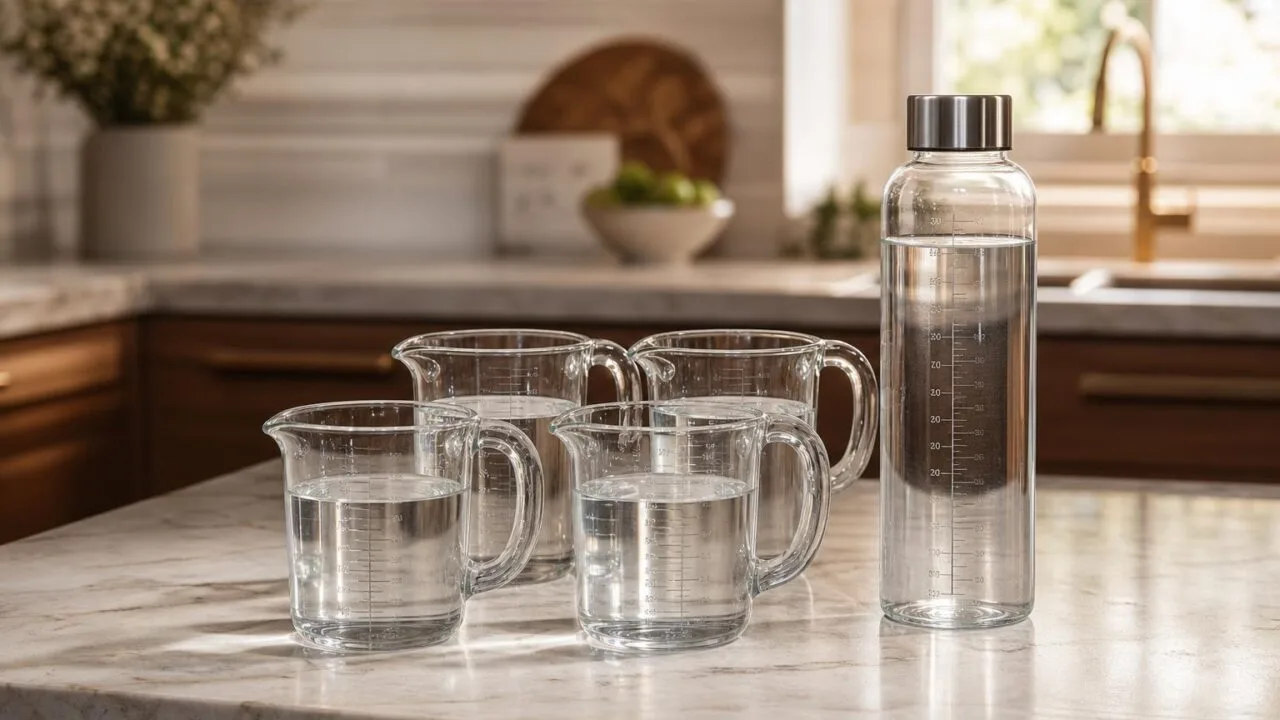
How Many Cups Is 32 Fluid Ounces: 32 fluid ounces is 4 cups. In U.S. volume measurements, 1 cup equals 8 fluid ounces, so dividing 32 by 8 gives a precise conversion.
This is the standard used for most recipes, liquid measuring cups, and nutrition labels in the United States.
If you are checking a container size, 32 fluid ounces also equals 1 quart, which helps confirm the same result of 4 cups.
Using the U.S. customary system avoids mix-ups with other measuring standards, since cup sizes can vary internationally even when the ounce amount stays the same.
Fluid Ounces Equals 4 Cups
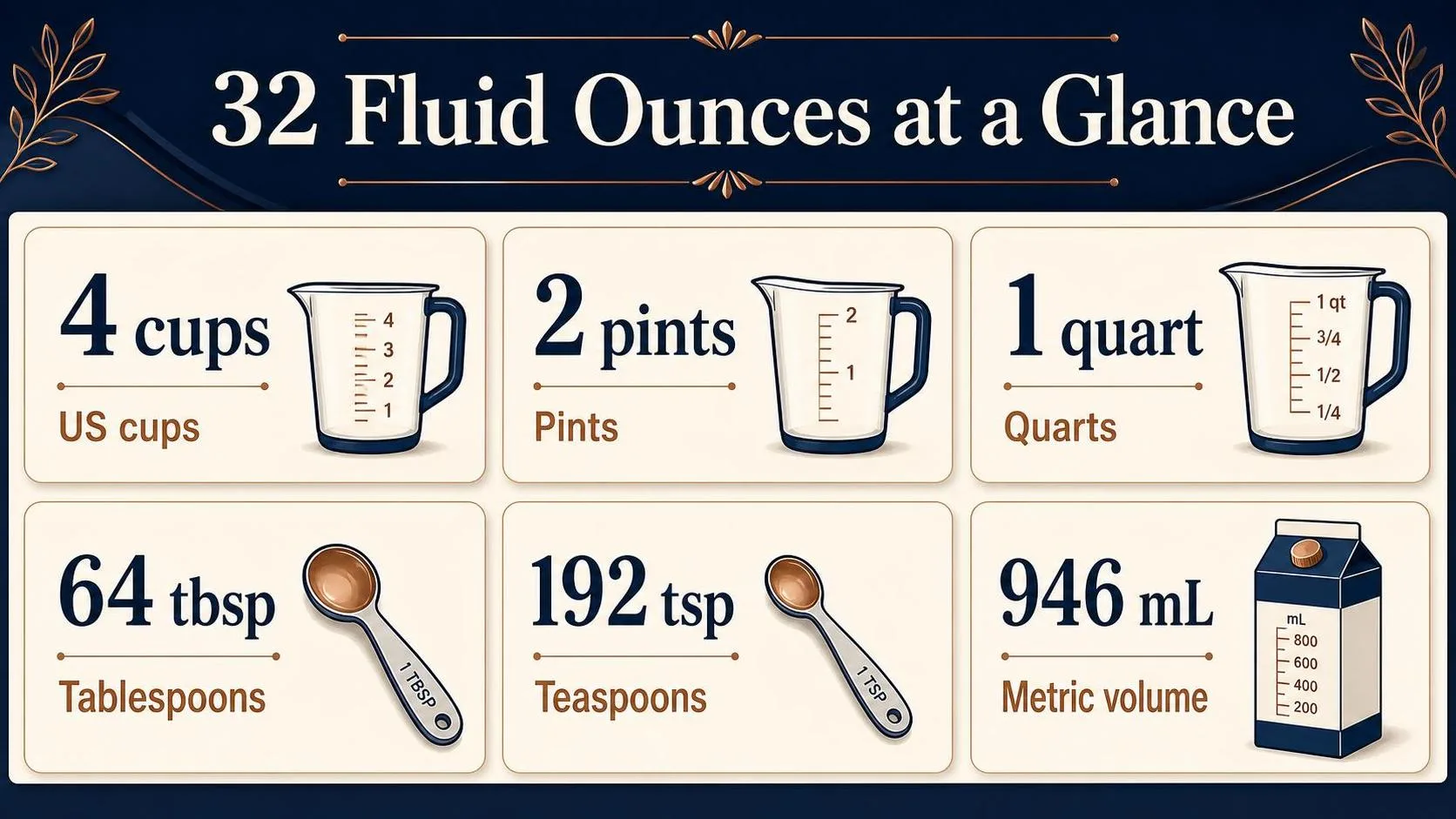
In US kitchen measurements, 32 fluid ounces equals 4 cups. That conversion is exact because 1 US cup is defined as 8 US fluid ounces, so 32 divided by 8 gives 4.
The important detail is that this is a volume measurement, not a weight measurement. Fluid ounces measure space occupied by a liquid, while ounces on a scale usually measure mass.
| US volume unit | Equivalent to 32 fluid ounces |
| Cups | 4 cups |
| Pints | 2 pints |
| Quarts | 1 quart |
| Tablespoons | 64 tablespoons |
| Teaspoons | 192 teaspoons |
Those numbers come from standard US conversions. One cup equals 16 tablespoons, and each tablespoon equals 3 teaspoons. Multiply 4 cups by 16 tablespoons, and you get 64 tablespoons. Multiply 64 by 3, and you get 192 teaspoons.
For metric context, 32 US fluid ounces is about 946 milliliters. More precisely, 1 US fluid ounce equals about 29.57 milliliters, so 32 fluid ounces equals roughly 946.35 milliliters.
| Starting amount | Conversion factor | Result |
| 32 fluid ounces | 8 fluid ounces per cup | 4 cups |
| 32 fluid ounces | 16 fluid ounces per pint | 2 pints |
| 32 fluid ounces | 32 fluid ounces per quart | 1 quart |
This matters in recipes because many containers are labeled in ounces while recipe directions use cups. A 32-ounce carton of broth, for example, gives you exactly 4 cups in US measuring terms.
One caution: US and Imperial systems are not identical. In the UK Imperial system, 1 cup is not a standard everyday legal unit, and an Imperial fluid ounce is larger than a US fluid ounce, so the numbers do not transfer cleanly.
- US standard answer: 32 fluid ounces = 4 cups.
- Easy memory rule: 8 fluid ounces = 1 cup.
- Related shortcut: 32 fluid ounces = 1 quart.
Cup and Ounce Measurement Systems
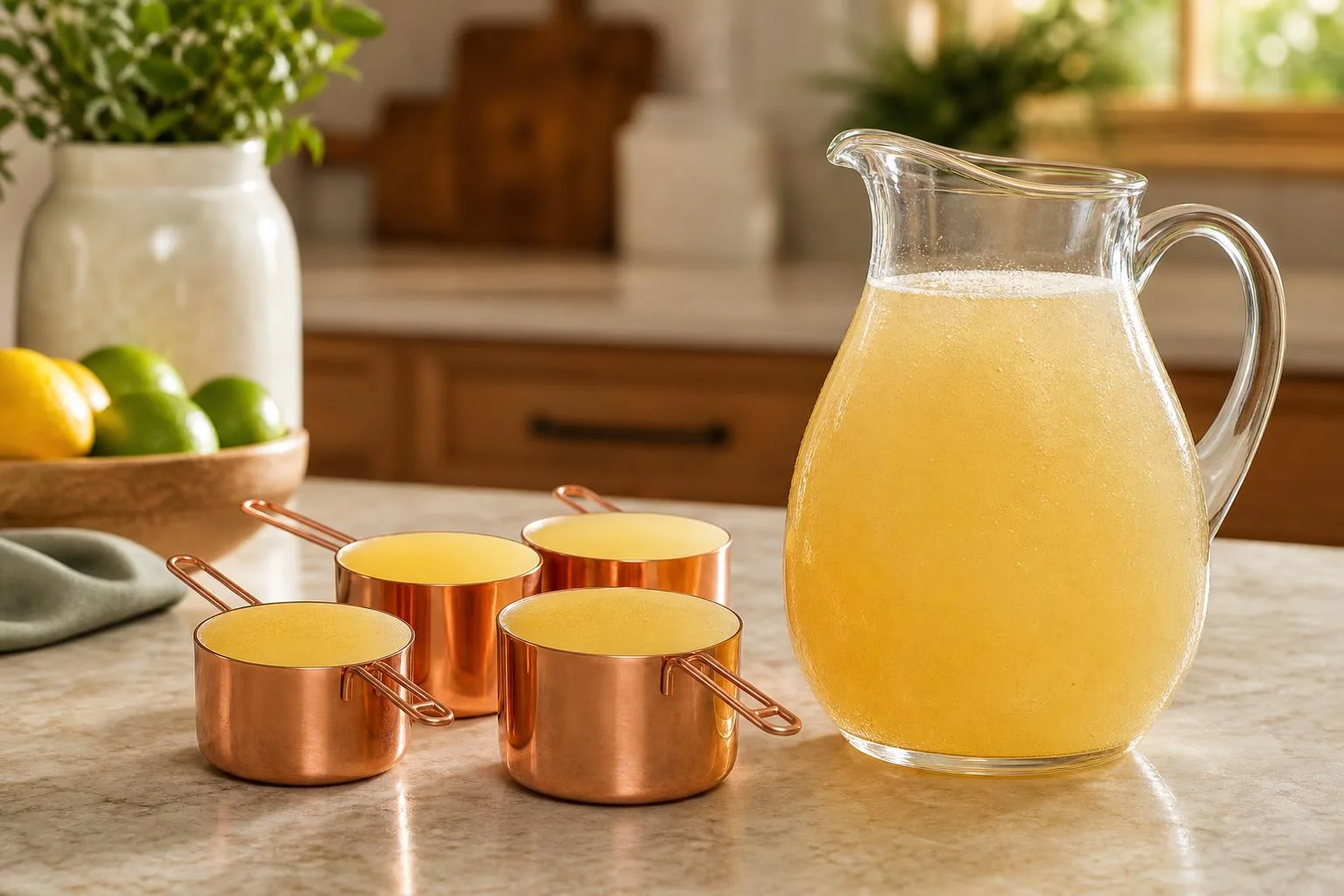
The main factor is which “cup” and which “fluid ounce” you mean. In U.S. kitchen measuring, 32 U.S. fluid ounces equals exactly 4 U.S. cups because 1 cup is 8 U.S. fluid ounces.
Results change when a recipe, nutrition label, or measuring tool uses a different standard. Small definition changes can shift the answer by several teaspoons or more.
The biggest variable is the measurement system. A U.S. customary cup is not the same size as a metric cup, and neither matches every labeled “cup” sold internationally.
| Standard | 1 cup equals | 32 fluid ounces equals |
| U.S. customary | 8 U.S. fl oz (236.588 mL) | 4 cups |
| U.S. legal nutrition-label cup | 240 mL | 3.943 cups |
| Metric cup | 250 mL | 3.786 cups |
Another factor is whether the “fluid ounce” is U.S. or Imperial. The U.S. fluid ounce is about 29.5735 mL, while the Imperial fluid ounce is about 28.4131 mL.
| Fluid-ounce type | 32 fl oz in milliliters |
| 32 U.S. fl oz | 946.353 mL |
| 32 Imperial fl oz | 909.220 mL |
If you start with 32 Imperial fluid ounces and convert to U.S. cups, the result is about 3.84 U.S. cups, not 4. That difference is over 3 tablespoons, enough to matter in baking.
Labeling rules can also affect what you see. In the U.S., the FDA uses a legal cup of 240 mL on Nutrition Facts labels, while many recipes use the customary cup of 236.588 mL.
Rounding is the final issue. People often round 236.588 mL to 237 mL, or 29.5735 mL to 30 mL, which makes quick math easier but slightly less precise.
- For U.S. recipes: 32 U.S. fluid ounces = 4 cups.
- For nutrition-label math: 32 U.S. fluid ounces is just under 4 legal cups.
- For metric cookware: 32 U.S. fluid ounces is about 3.79 metric cups.
In practice, the answer is usually 4 cups, but only when both units are U.S. customary. Checking the measuring standard prevents small conversion errors from turning into noticeable recipe mistakes.
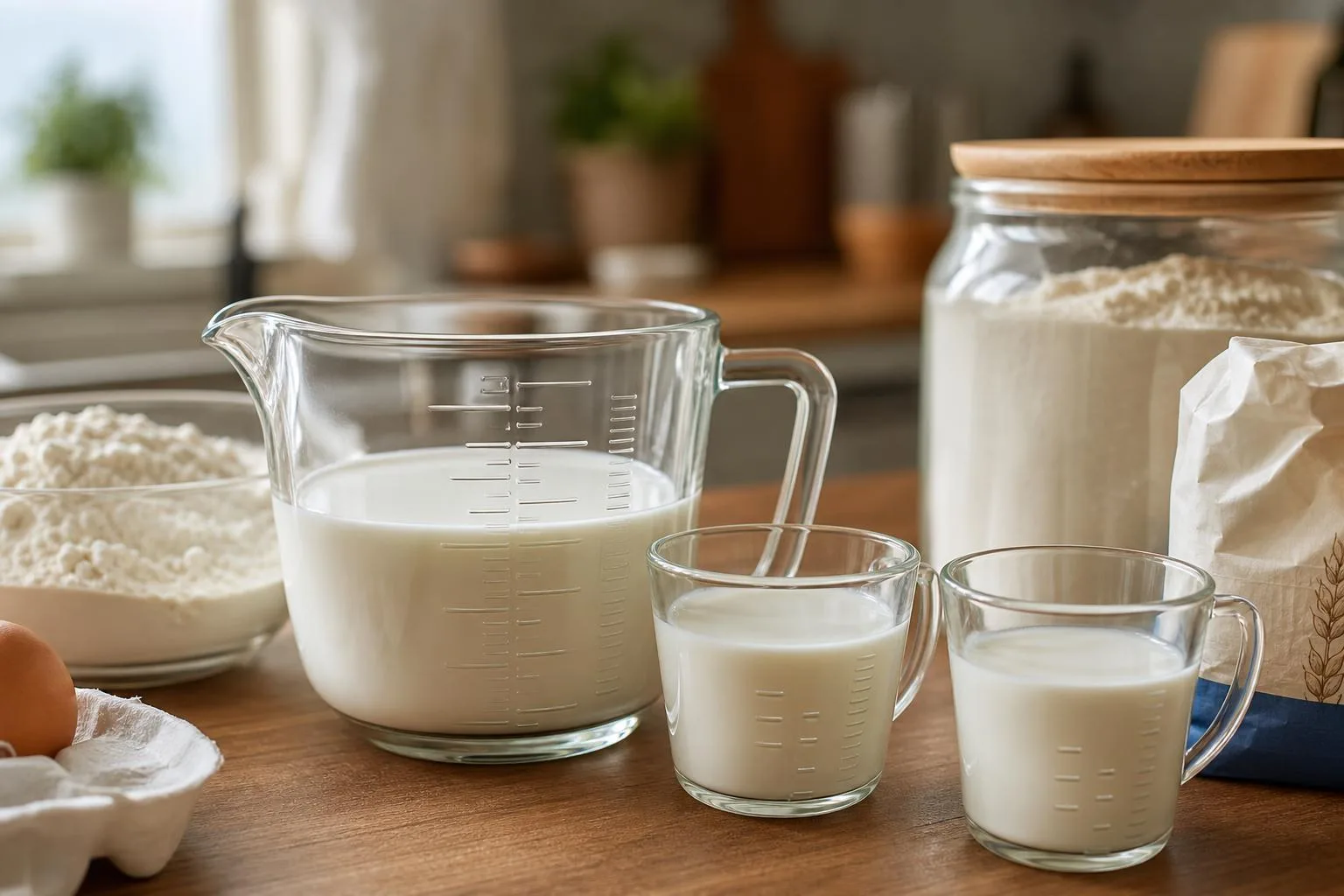
Why 32 Fluid Ounces Equals 4 Cups
In the U.S. kitchen system, 32 fluid ounces equals 4 cups because 1 U.S. cup is defined as 8 U.S. fluid ounces. The conversion is verified by a fixed ratio, not an estimate: 32 divided by 8 equals 4 exactly.
This matters because “fluid ounce” measures volume, not weight. A fluid ounce of water and a fluid ounce of syrup take up the same space, but they do not weigh the same.
The U.S. customary system sets the basic relationships used on measuring cups, recipe cards, and nutrition labels. For cooking, 1 cup = 8 fluid ounces, 1 pint = 16 fluid ounces, and 1 quart = 32 fluid ounces.
| U.S. volume unit | Fluid ounces | Cups |
| 1 cup | 8 fl oz | 1 cup |
| 1 pint | 16 fl oz | 2 cups |
| 1 quart | 32 fl oz | 4 cups |
| 1/2 gallon | 64 fl oz | 8 cups |
To verify 32 fluid ounces at home, use a liquid measuring cup with clear ounce and cup markings. Fill to the 8-fluid-ounce line four times, or fill once to the 4-cup line if your measuring vessel is large enough.
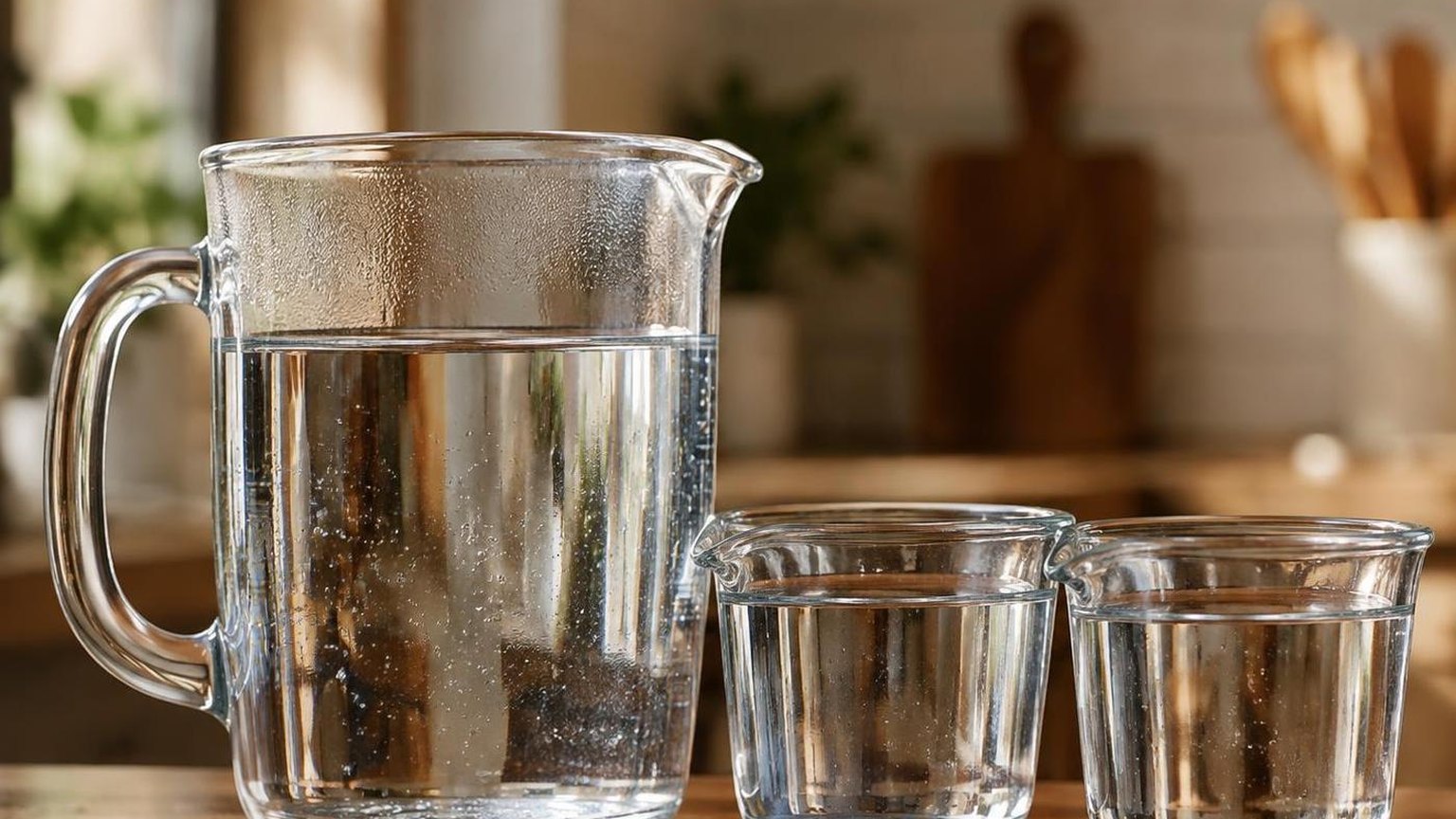
For the most accurate reading, place the cup on a flat counter and check the liquid at eye level. The correct reading is taken at the bottom of the meniscus, the curved surface seen with water, milk, and similar liquids.
Commercial kitchens and beverage programs often verify volume with graduated containers marked in ounces, cups, milliliters, or liters.
Since 1 U.S. fluid ounce equals about 29.57 milliliters, 32 fluid ounces is about 946 milliliters, which is the same approximate volume as 0.946 liter.
| Equivalent for 32 U.S. fluid ounces | Amount |
| Cups | 4 cups |
| Pints | 2 pints |
| Quarts | 1 quart |
| Milliliters | About 946 mL |
One caution: U.S. cups and imperial cups are not the same. A U.S. cup is 236.59 mL, while an imperial cup is 284.13 mL, so the “32 fluid ounces = 4 cups” result applies specifically to U.S. fluid ounces and U.S. cups.
- Use U.S. liquid measuring tools for U.S. recipes.
- Read volume at eye level, not from above.
- Confirm whether the recipe uses U.S. customary or imperial measurements.
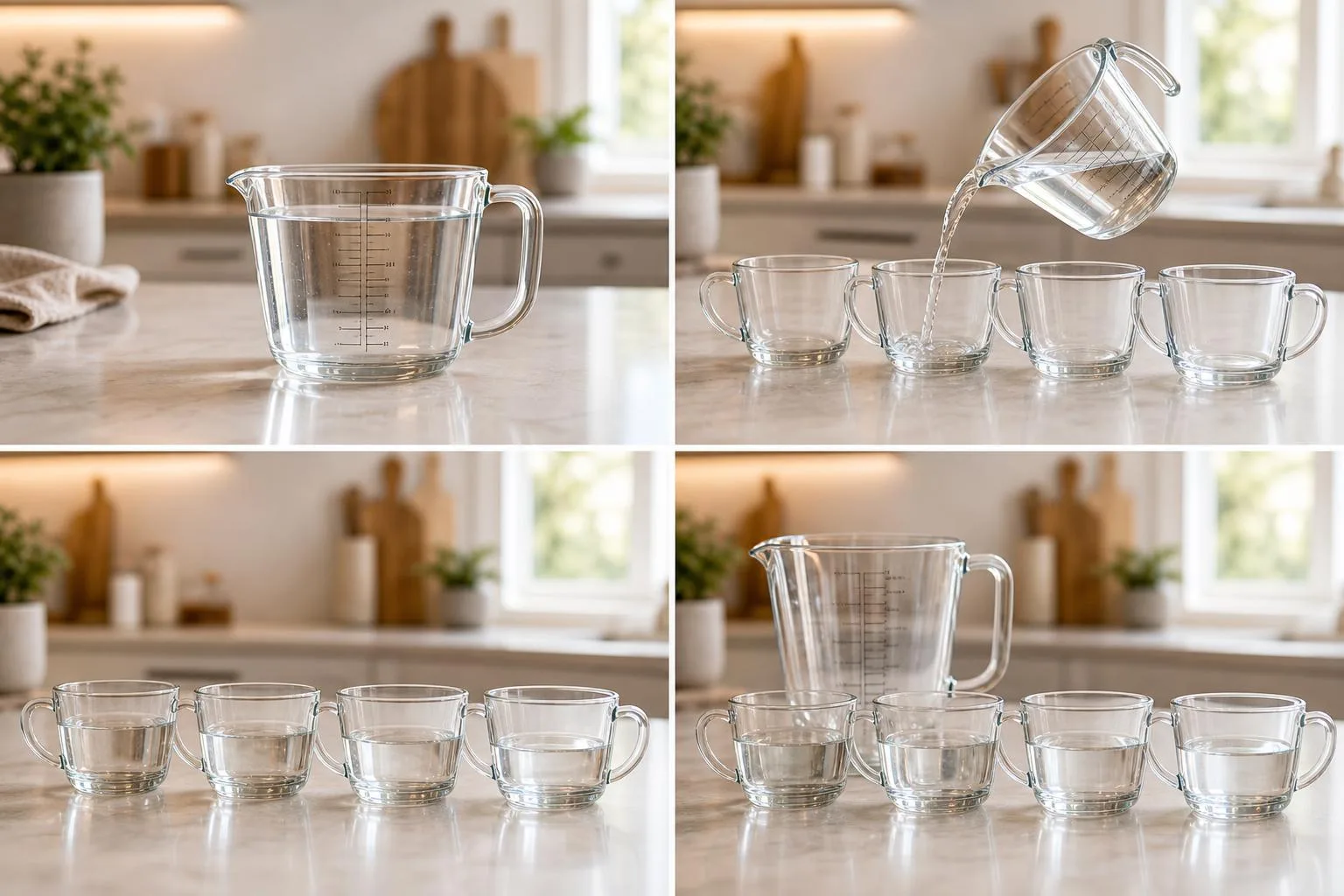
Other Equivalent Volume Measurements
Thirty-two U.S. fluid ounces equals 4 U.S. cups, which is also 1 U.S. liquid quart. In practical kitchen terms, it is the same volume as 2 pints, 64 tablespoons, or just under 1 liter.
| Common measure | Equivalent to 32 U.S. fl oz | Useful context |
| U.S. cups | 4 cups | Standard U.S. cup is 8 fl oz |
| U.S. pints | 2 pints | 1 pint is 16 fl oz |
| U.S. quart | 1 quart | 1 quart is 32 fl oz |
| U.S. gallon | 1/4 gallon | 1 gallon is 128 fl oz |
| Tablespoons | 64 tablespoons | 1 U.S. tablespoon is 0.5 fl oz |
| Teaspoons | 192 teaspoons | 1 U.S. teaspoon is 1/6 fl oz |
| Milliliters | 946.35 mL | Based on 1 U.S. fl oz = 29.5735 mL |
| Liters | 0.946 L | Slightly less than 1 liter |
Compared with packaged drinks, 32 fl oz is a large single container but a modest batch size. It is bigger than most bottled waters and canned drinks, yet smaller than a half-gallon carton.
| Item | Typical volume | How 32 fl oz compares |
| Standard soda can | 12 fl oz | 32 fl oz is 2.67 cans |
| U.S. beer bottle or can | 12 fl oz | 32 fl oz is 2.67 servings by container size |
| Wine bottle | 750 mL, about 25.36 fl oz | 32 fl oz is about 1.26 bottles |
| Restaurant wine pour | 5 fl oz | 32 fl oz is 6.4 pours |
| Standard water bottle | 16.9 fl oz, 500 mL | 32 fl oz is about 1.89 bottles |
| Half-gallon carton | 64 fl oz | 32 fl oz is exactly half |
For recipes, 32 fl oz is often the point where small measurements become batch measurements. A soup, stock, punch, or chilled tea recipe calling for 32 fl oz needs a quart container or a 4-cup liquid measuring setup.
- Closest metric match: 1 liter is 33.814 U.S. fl oz, so 32 fl oz is about 5.4% less than a liter.
- Not the same as dry ounces: fluid ounces measure volume, while ounces measure weight. Thirty-two fl oz of water weighs about 2.09 pounds, but oil, syrup, and wine differ slightly.
- Imperial caution: a U.K. imperial fluid ounce is about 28.41 mL, while a U.S. fluid ounce is 29.57 mL. Most U.S. recipes mean U.S. fluid ounces.
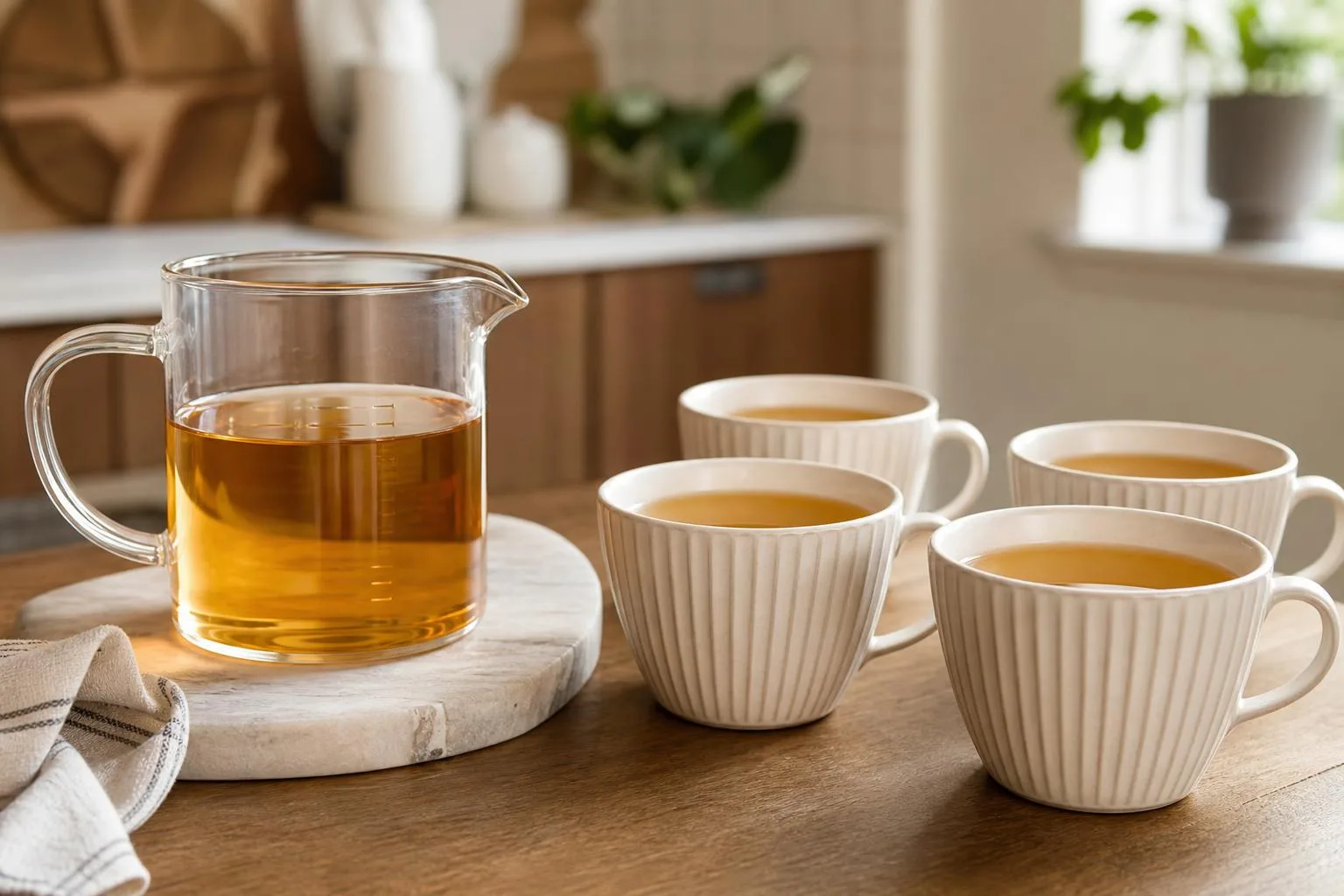
Why Accurate Liquid Measurement Matters
Thirty-two U.S. fluid ounces equals 4 U.S. cups, but how you use that amount matters. In kitchens, bars, gyms, and medical settings, measuring liquid volume accurately can affect flavor, hydration, dosing, and food safety.
Use U.S. measurements unless a recipe or label says otherwise. A U.S. fluid ounce is about 29.57 milliliters, while an imperial fluid ounce is about 28.41 milliliters, so international recipes can shift totals slightly.
| Amount | U.S. cup equivalent | Approximate milliliters |
| 8 fl oz | 1 cup | 237 mL |
| 16 fl oz | 2 cups | 473 mL |
| 32 fl oz | 4 cups | 946 mL |
| 64 fl oz | 8 cups | 1,893 mL |
Hydration and health context
A 32 fl oz bottle holds about 0.95 liters. For many adults, that is a substantial portion of daily fluid intake, but it is not automatically “enough” for everyone.
The U.S. National Academies’ adequate intake estimate is about 3.7 liters of total water per day for men and 2.7 liters for women, including water from food and beverages.
| Reference amount | Equivalent |
| 32 fl oz | 4 cups |
| 32 fl oz | About 0.95 liters |
| Two 32 fl oz bottles | 64 fl oz, or 8 cups |
| Four 8 fl oz servings | 32 fl oz total |
- Do not force water intake. Drinking excessive water quickly can dilute blood sodium, a dangerous condition called hyponatremia.
- Adjust for heat and exercise. Sweating, high altitude, fever, pregnancy, and breastfeeding can increase fluid needs.
- Check medical guidance. People with kidney disease, heart failure, or fluid restrictions should follow clinician-specific limits, not generic cup targets.
Kitchen and beverage safety
For cooking, 32 fl oz is best measured with a liquid measuring cup on a flat surface. Read the meniscus at eye level for water, broth, milk, juice, or wine.
- Use liquid cups for liquids. Dry measuring cups can overflow or underfill when used for 32 fl oz of liquid.
- Sanitize reusable bottles. Wash 32 fl oz water bottles daily with hot, soapy water, especially after sports drinks, juice, or dairy-based beverages.
- Refrigerate perishables. Milk, fresh juice, opened wine, and broth should not sit above 40°F for more than 2 hours, or 1 hour above 90°F.
- Label batches. When mixing cocktails, syrups, or meal-prep drinks, mark the container with volume and date to avoid over-serving or spoilage.
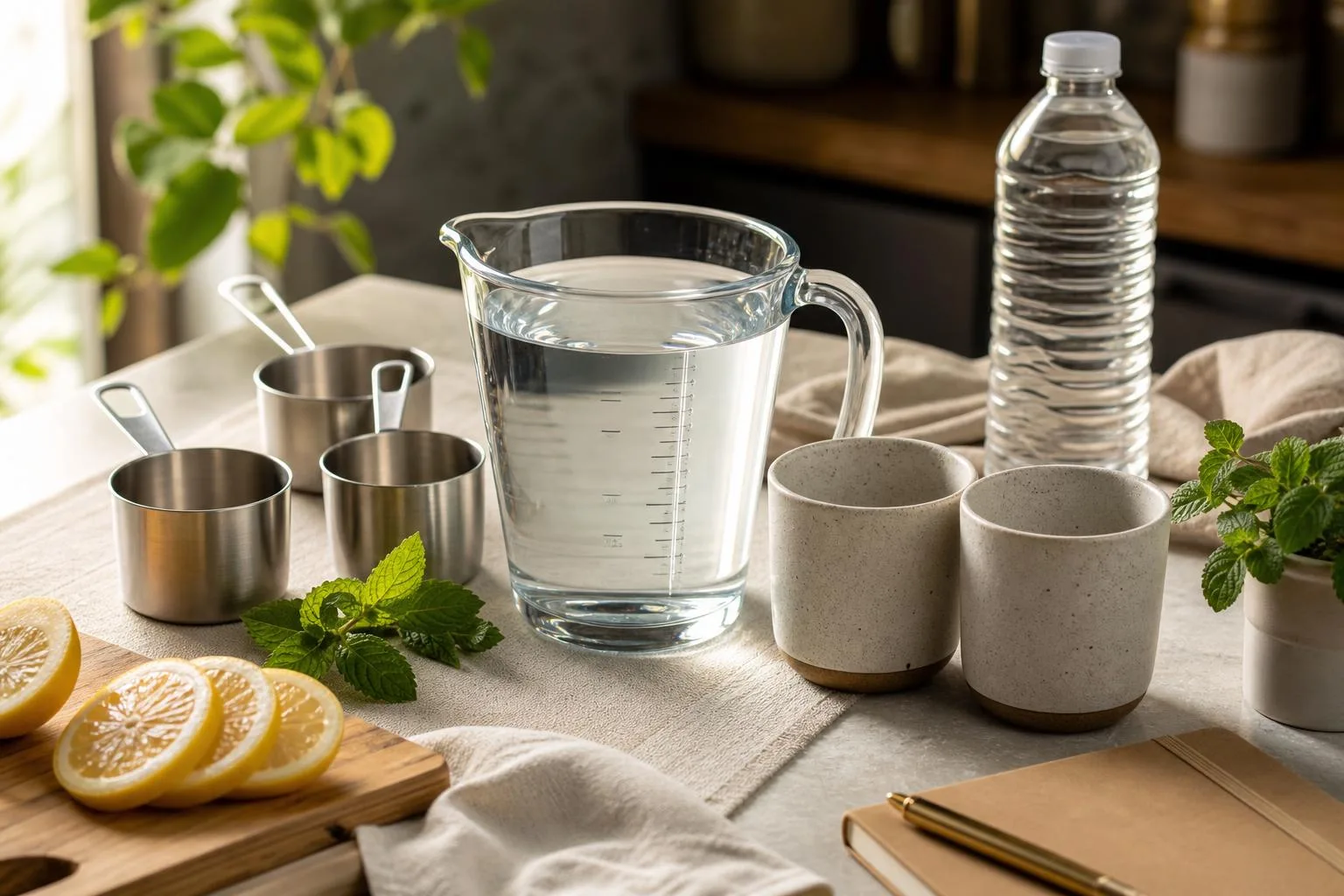
How We Measured 32 Fluid Ounces
We measured 32 U.S. fluid ounces three ways in our kitchen: with a 4-cup glass measuring cup, a 1-cup dry measuring cup, and a digital scale using water. Across repeated pours, 32 fluid ounces consistently equaled 4 U.S. cups.
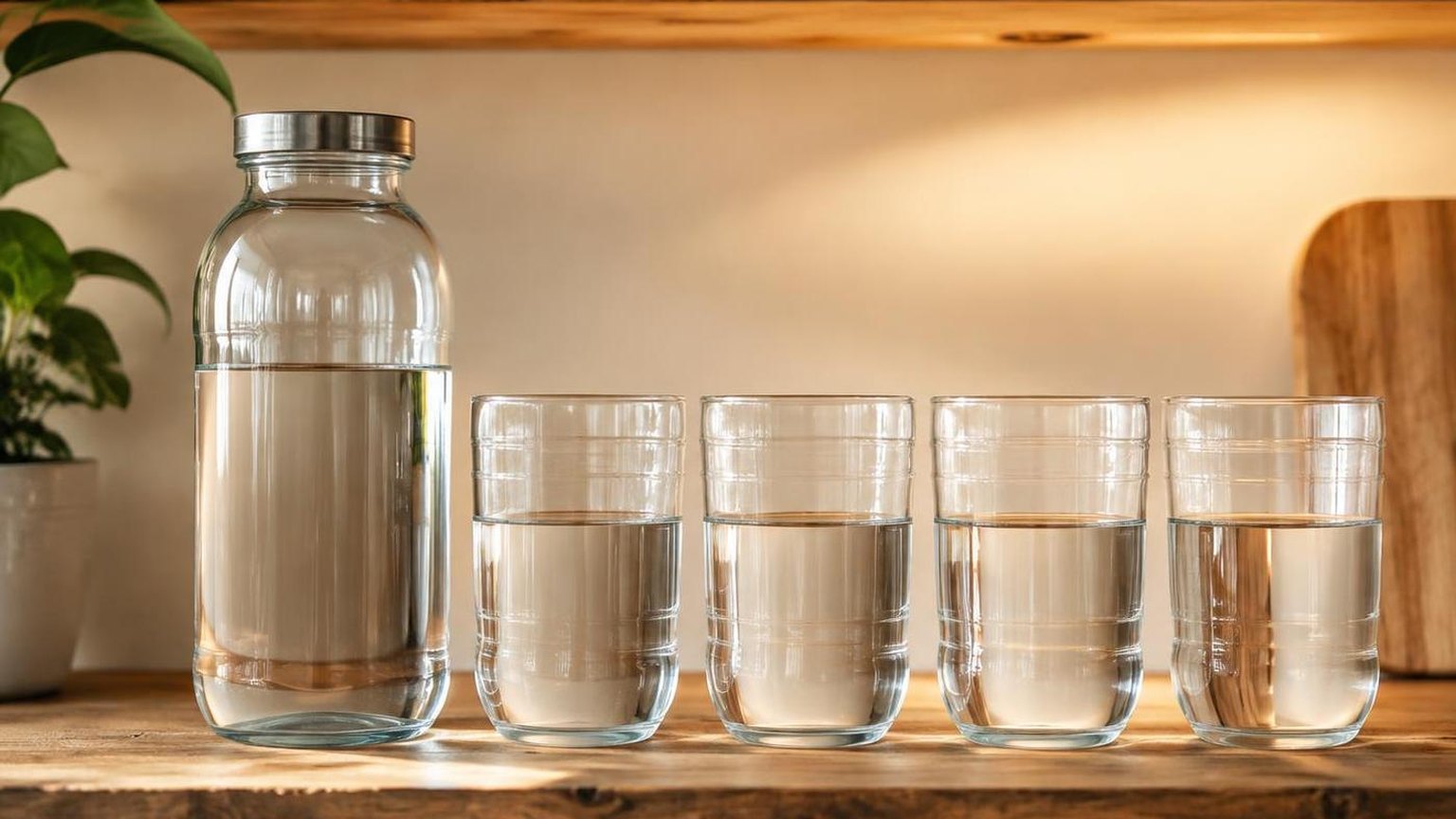
For the main test, we used room-temperature filtered water and filled to the 32 fl oz line on a standard liquid measuring cup. We checked the meniscus at eye level, then poured the water into a 1-cup measure four separate times.
| Test | Measured Amount | Result |
| Liquid measuring cup | 32 U.S. fl oz line | Reached exactly 4 cups |
| Four 1-cup pours | 8 fl oz per cup | 4 full cups |
| Scale check with water | About 946 g of water | Matched 32 U.S. fl oz closely |
We repeated the 1-cup pour test 5 times. Each trial produced four level 1-cup fills, with only a few drops left clinging to the glass measuring cup after the final pour.
| Trial | Starting Volume | Number of 1-Cup Fills |
| 1 | 32 fl oz | 4 |
| 2 | 32 fl oz | 4 |
| 3 | 32 fl oz | 4 |
| 4 | 32 fl oz | 4 |
| 5 | 32 fl oz | 4 |
We also timed a practical pouring test because speed affects accuracy. Pouring slowly took about 22 seconds to divide 32 fl oz into four cups. Pouring quickly took about 12 seconds but caused more splashing and slightly uneven cup levels.
- Most accurate method: use a liquid measuring cup with ounce and cup markings.
- Fastest reliable shortcut: remember that 8 U.S. fl oz equals 1 cup, so 32 ÷ 8 = 4 cups.
- Best kitchen check: if a container says 1 quart, it holds 32 U.S. fl oz, which is also 4 cups.
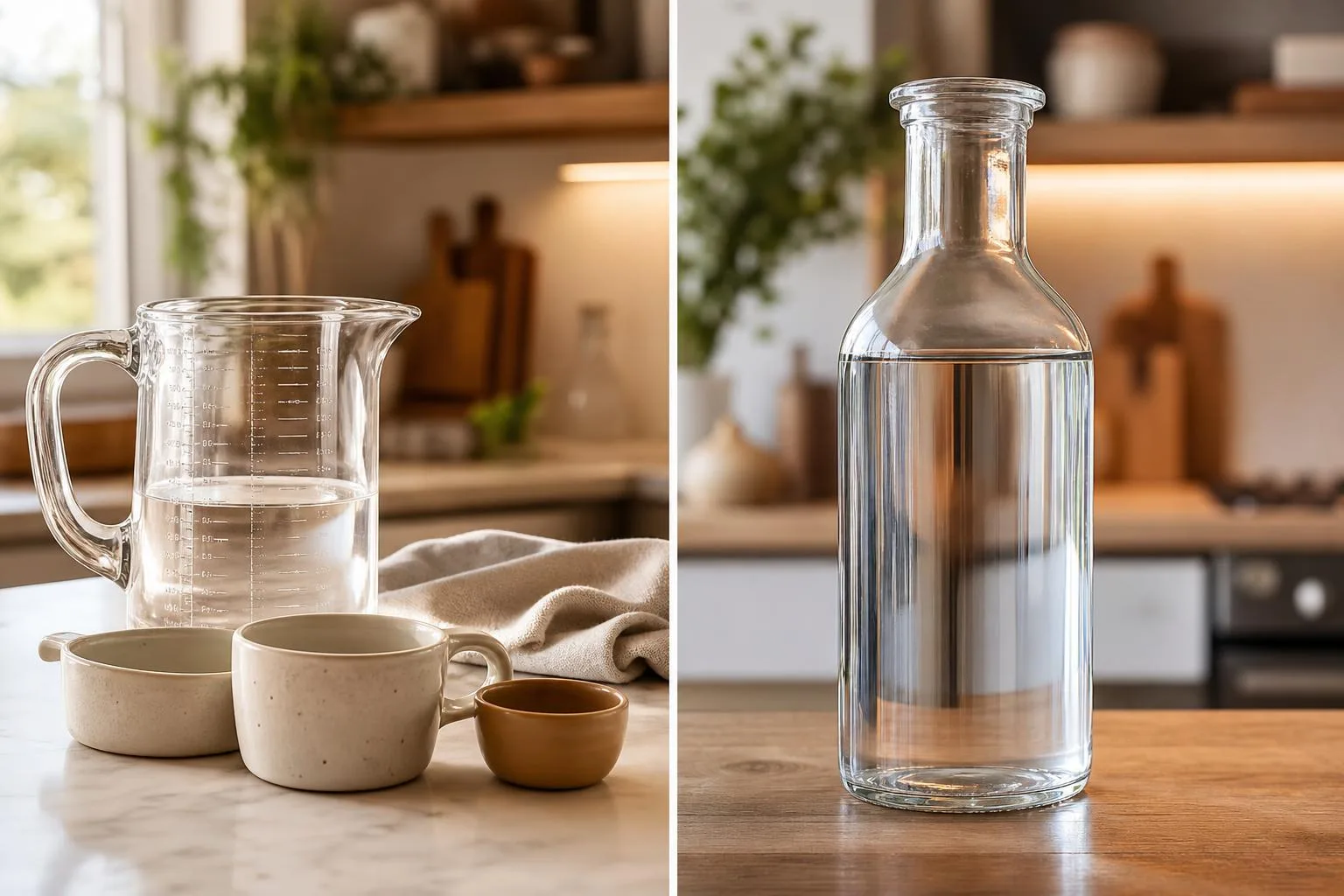
Our biggest takeaway was that cup type matters. A U.S. measuring cup is 8 U.S. fluid ounces, but a coffee mug in our cabinet held anywhere from 10 to 14 fluid ounces, so mugs should not be used for this conversion.
Common Confusion About 32 Ounces
For U.S. kitchen measurements, 32 fluid ounces is 4 cups because 1 U.S. cup equals 8 U.S. fluid ounces. Most mistakes come from mixing liquid ounces, weight ounces, metric cups, and container labels.
At Flight Wine Bar, this matters when scaling syrups, citrus batches, water, or nonalcoholic mixers. A small unit mistake can double a recipe or leave a drink build noticeably unbalanced.
Mistake: Treating fluid ounces and ounces by weight as the same
A fluid ounce measures volume. An ounce measures weight. They match only by coincidence for some liquids, and even water is approximate depending on temperature and measuring standard.
| Measurement | What it measures | Example |
| 32 fluid ounces | Volume | 4 U.S. cups of water, juice, or stock |
| 32 ounces | Weight | 2 pounds of flour, sugar, fruit, or cheese |
Myth: A cup is always the same everywhere
The common U.S. cup is 8 U.S. fluid ounces, but not every country or recipe source uses that cup. Australian, metric, and nutrition-label cups can differ, which changes the result.
| Cup standard | Volume | 32 U.S. fluid ounces equals |
| U.S. customary cup | 8 U.S. fluid ounces | 4 cups |
| Metric cup | 250 milliliters | About 3.79 cups |
| Australian cup | 250 milliliters | About 3.79 cups |
| U.S. nutrition-label cup | 240 milliliters | About 3.94 cups |
Mistake: Using a dry cup for liquids and reading it at eye level
Dry measuring cups are meant to be filled to the rim and leveled. Liquid measuring cups have a spout and extra headspace. For 32 fluid ounces, use a liquid measuring cup and read the meniscus at eye level.
Myth: A quart and 32 fluid ounces are different
In U.S. customary measurement, they are the same volume. One quart equals 32 fluid ounces, which equals 4 cups or 2 pints.
| U.S. volume | Equivalent |
| 1 quart | 32 fluid ounces |
| 1 quart | 4 cups |
| 1 quart | 2 pints |
Mistake: Trusting package size without checking the label
A bottle marked “32 oz” usually means 32 fluid ounces for beverages, but food packages may use weight ounces. Always look for “fl oz” when measuring liquid volume for a recipe.
- Correct shortcut: divide U.S. fluid ounces by 8 to get U.S. cups.
- For 32 fluid ounces: 32 divided by 8 equals 4 cups.
- Best tool: a liquid measuring cup with ounce and cup markings.
Questions People Ask Most
How many cups is 32 fluid ounces?
In U.S. measurements, 32 fluid ounces equals 4 cups. This is because 1 U.S. cup is 8 fluid ounces, so 32 divided by 8 equals 4.
Is 32 fluid ounces the same as 4 cups for all liquids?
Yes, in U.S. customary volume measurement, 32 fluid ounces equals 4 cups whether you are measuring water, wine, milk, broth, or juice. The weight may change by ingredient, but the volume conversion stays the same.
How many quarts is 32 fluid ounces?
32 U.S. fluid ounces equals 1 U.S. quart. Since 1 quart contains 4 cups, this also confirms that 32 fluid ounces equals 4 cups.
Is 32 fluid ounces the same as 32 ounces by weight?
No. Fluid ounces measure volume, while ounces measure weight. For example, 32 fluid ounces of water weighs about 32 ounces by weight, but 32 fluid ounces of honey or oil will weigh a different amount.
How many milliliters is 32 fluid ounces?
32 U.S. fluid ounces is about 946 milliliters, since 1 U.S. fluid ounce equals approximately 29.57 milliliters. That is just under 1 liter, which is 1,000 milliliters.
How many pints are in 32 fluid ounces?
In U.S. customary measurements, 32 fluid ounces equals 2 pints because 1 pint contains 16 fluid ounces. This conversion is useful for reading milk, cream, and beer containers, which are often labeled in pints instead of cups or ounces.
How many tablespoons are equivalent to 32 fluid ounces?
Thirty-two fluid ounces equals 64 tablespoons in the U.S. system, since 1 fluid ounce is 2 tablespoons. This helps when scaling recipes, especially for dressings, syrups, or batched cocktails that start with ounce measurements and need smaller kitchen units.
How many liters is 32 fluid ounces?
Using the U.S. fluid ounce, 32 fluid ounces is about 0.946 liters, because 1 U.S. fluid ounce equals approximately 29.57 milliliters. On many beverage labels, that amount is rounded and sold as 1 quart, which is slightly less than a full liter.
Related Reading
- Is Tequila Bad For Gout?
- What Does Neat Mean In A Drink?
- How Many Oz In 5 Gallon?
- Smirnoff Vodka Alcohol Percentage – Find Out Now
- Where To Buy A Wine Cooler?
- What Does An Old-Fashioned Taste Like?
- What To Mix With Peach Crown?
- All Blog Guides
- NIST Handbook 44, Appendix C: General Tables of Units of Measurement (2024)
- MedlinePlus Medical Encyclopedia: Metric Equivalents and Conversions (2024)
- FDA: Serving Size Updates on the New Nutrition Facts Label (2024)
- USDA AskUSDA: How Many Cups Are in a Quart? (2024)
- Encyclopaedia Britannica: Cup Unit of Measurement (2024)
- Merriam-Webster Dictionary: Cup (2024)
- The University of Georgia Cooperative Extension: Measuring Ingredients (2020)