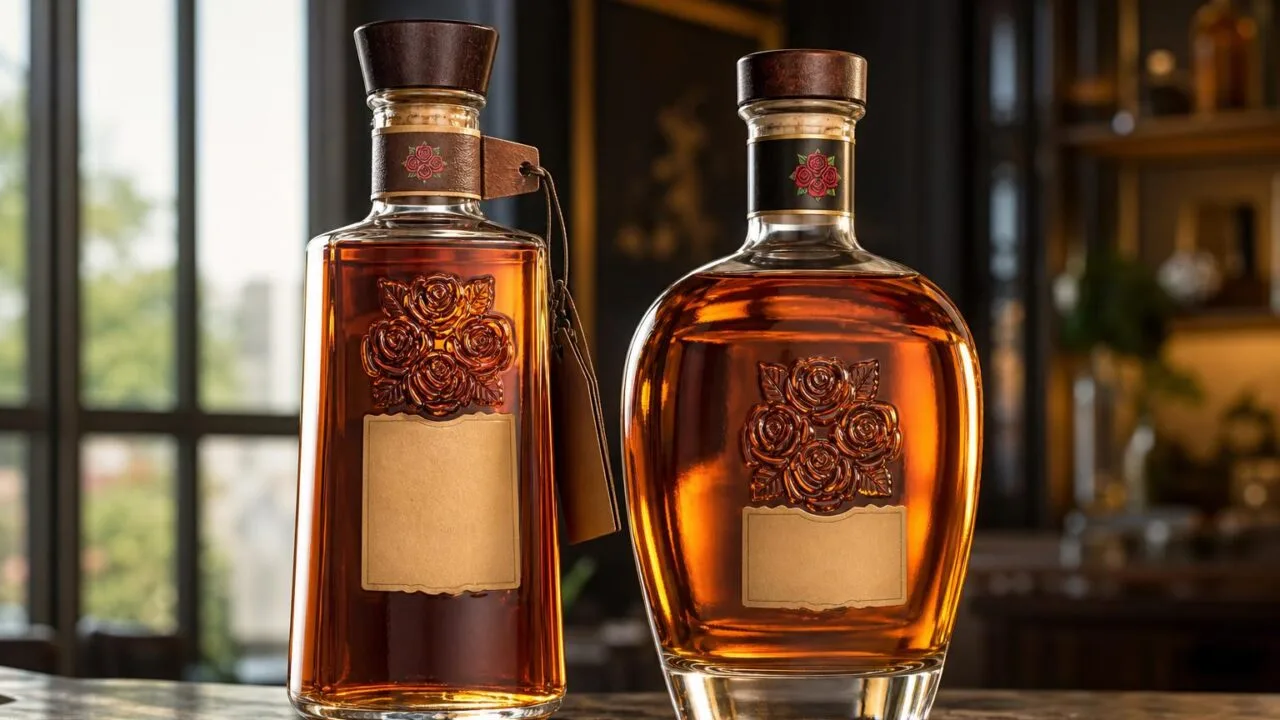
Four Roses Single Barrel Vs Small Batch is a choice between one 100-proof OBSV barrel expression and a 90-proof blend of four bourbon recipes.
Single Barrel tastes more concentrated, with darker fruit, oak, and rye spice; Small Batch is rounder, softer, and more approachable.
The meaningful difference is production style: Single Barrel reflects one selected barrel, so batches vary slightly, while Small Batch blends multiple recipes for consistency.
For tasting flights, compare neat first, then add a few drops of water to see how proof and blending change aroma, texture, and finish.
Proof Recipes and Blending Differences
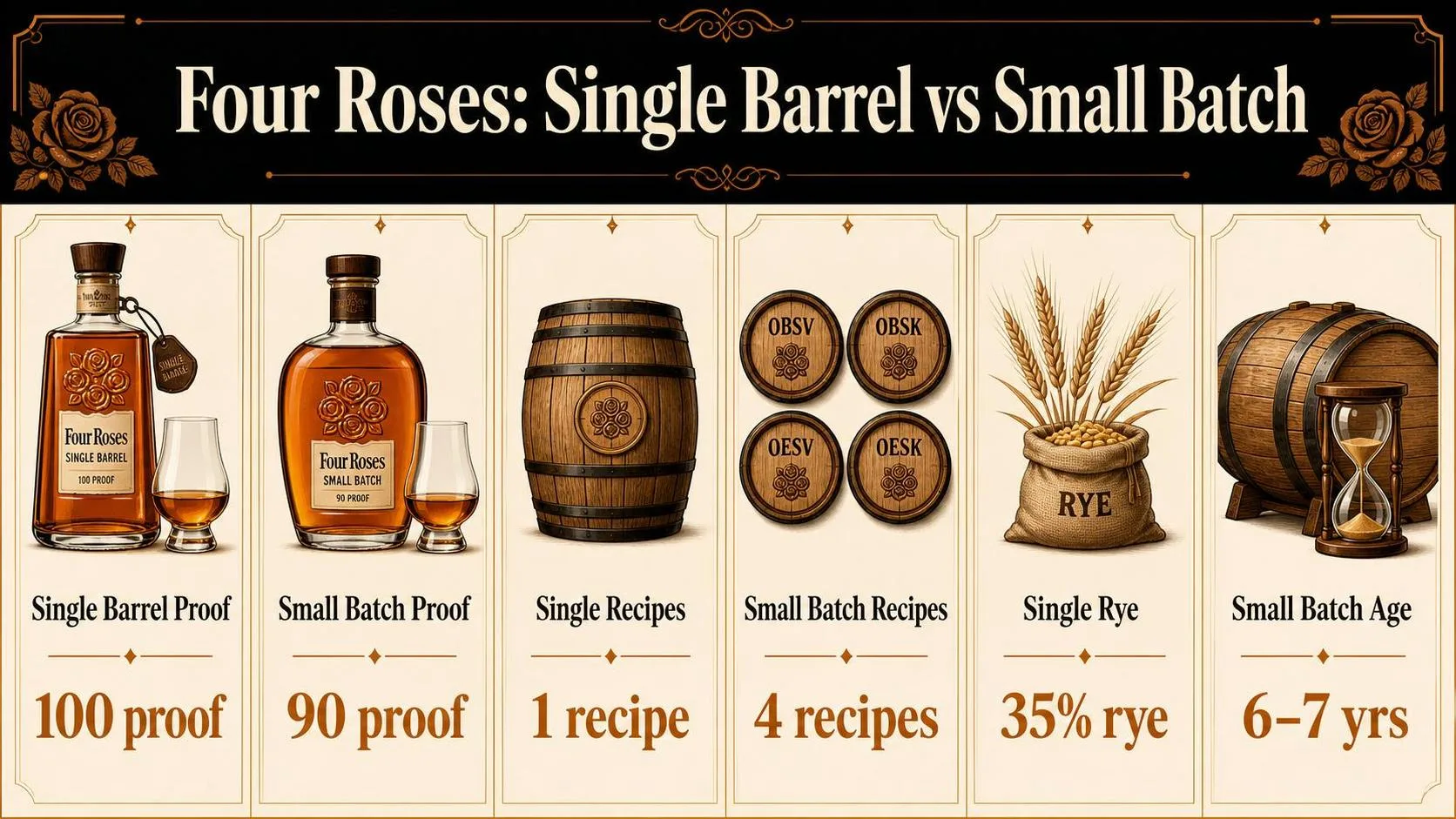
Four Roses Single Barrel and Four Roses Small Batch differ most in proof, recipe count, and blending approach.
Those numbers matter because they change texture, spice level, fruit notes, and how much barrel variation you should expect from bottle to bottle.
The figures below come from Four Roses’ published product information and standard U.S. bourbon labeling rules, including the TTB requirement that bourbon be made from at least 51% corn and aged in new charred oak containers.
| Number | Four Roses Single Barrel | Four Roses Small Batch |
| Proof / ABV | 100 proof / 50% ABV | 90 proof / 45% ABV |
| Recipes used | 1 recipe: OBSV | 4 recipes: OBSK, OESK, OBSO, OESO |
| Mash bills represented | 1 mash bill: “B” | 2 mash bills: “B” and “E” |
| Rye content | 35% rye | 20% and 35% rye components |
| Age statement | No formal age statement; Four Roses describes it as typically 7–9 years | No formal age statement; Four Roses describes it as typically 6–7 years |
| Barrel identity | Warehouse and barrel number printed on label | No single-barrel identifier; blended for consistency |
The proof gap is easy to taste. Single Barrel’s 100 proof gives it more weight, more heat, and a firmer finish. Small Batch at 90 proof is softer, especially neat, and usually reads sweeter at first sip.
The recipe codes explain much of the flavor difference.
In Four Roses’ system, “O” means it was made at the Four Roses Distillery, “B” and “E” identify the mash bill, and the final letter identifies the yeast strain.
- OBSV: Single Barrel’s standard recipe uses Mash Bill B: 60% corn, 35% rye, and 5% malted barley. The “V” yeast is associated with delicate fruit, spice, and light floral notes.
- OBSK and OBSO: Small Batch includes two high-rye Mash Bill B bourbons, keeping spice and structure in the blend.
- OESK and OESO: Small Batch also includes Mash Bill E: 75% corn, 20% rye, and 5% malted barley, adding rounder sweetness and softer grain character.
The biggest practical number is “1” versus “4.” Single Barrel is one barrel, so a bottle from warehouse ME may not taste exactly like one from warehouse KE.
Small Batch uses four recipes to reduce extremes and create a more repeatable house profile.
For buyers, the shorthand is simple: Single Barrel is higher proof, higher rye, one recipe, and more variable. Small Batch is lower proof, four-recipe blended, slightly younger on average, and built for balance.
Why Single Barrel and Small Batch Differ
Four Roses Single Barrel and Small Batch are not just different labels; they are built differently from the start.
The biggest variables are recipe selection, barrel variation, proof, age range, and how much blending is used to smooth the final whiskey.
Four Roses is unusual because it works from ten bourbon recipes: two mash bills and five yeast strains. The bottle you choose determines how much of that recipe system you actually taste.
| Whiskey | Standard U.S. recipe makeup | Proof | Typical age information |
| Four Roses Single Barrel | OBSV only: high-rye “B” mash bill plus “V” yeast | 100 proof | Usually cited by Four Roses as aged around 7 to 9 years |
| Four Roses Small Batch | Blend of OBSK, OESK, OBSO, and OESO | 90 proof | Four Roses describes it as using bourbons aged 6 to 7 years |
The mash bill changes the core flavor. The “B” mash bill used in standard Single Barrel contains more rye, so it tends to show firmer spice, darker fruit, and a drier finish.
| Four Roses mash bill | Corn | Rye | Malted barley | Where it matters here |
| “B” mash bill | 60% | 35% | 5% | Used in OBSV Single Barrel and two Small Batch components |
| “E” mash bill | 75% | 20% | 5% | Used in two Small Batch components |
Yeast is the other major lever. In Four Roses’ code, “V” is associated with delicate fruit, “K” with light spice, and “O” with richer fruit character.
Single Barrel isolates “V,” while Small Batch combines “K” and “O” profiles.
- Single Barrel has more barrel identity. Because it comes from one barrel, one bottle can lean cherry, cocoa, and polished oak, while another may show more rye spice or tannin.
- Small Batch is designed for consistency. Blending four recipes lets Four Roses balance fruit, spice, sweetness, and oak before bottling.
- Proof changes texture. Single Barrel’s higher bottling strength gives more concentration and warmth; Small Batch’s lower proof usually reads softer and rounder.
- Warehouse location matters. Temperature swings across warehouse floors affect extraction from the barrel, including color, oak tannin, caramelized sugars, and evaporation.
In practical tasting, Single Barrel usually feels more intense and specific, while Small Batch feels more integrated. The “better” result depends on whether you want one barrel’s character or a blended house profile.
How Label Data Confirms Differences
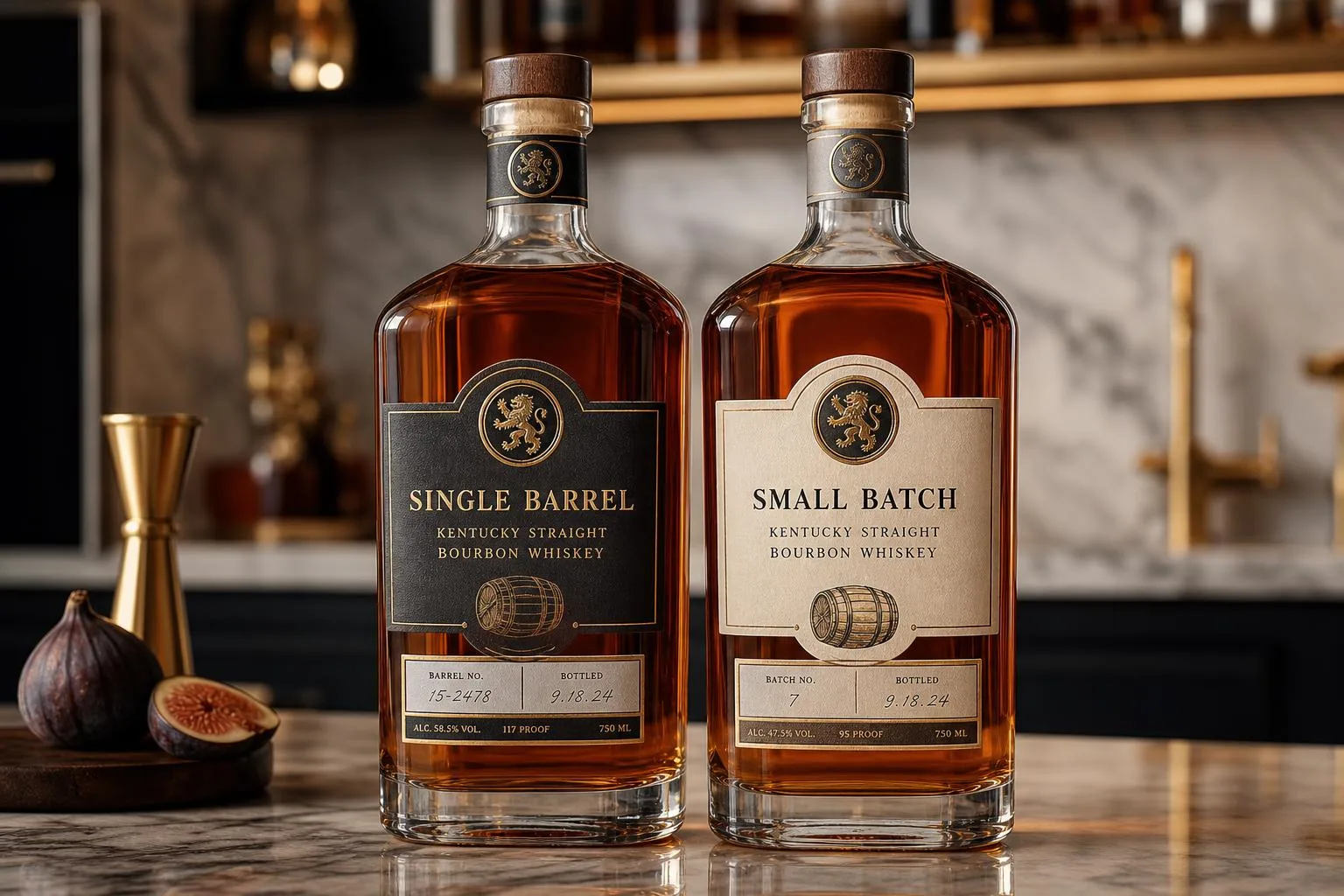
Four Roses Single Barrel and Four Roses Small Batch are best verified by label data, federal bourbon standards, and Four Roses’ published recipe system.
The measurable differences are proof, ABV, recipe composition, and whether the bottle came from one barrel or a mingled batch.
Start with the front and back label. In the U.S., alcohol content must be stated accurately; distilled spirits labels are generally held to a tolerance of 0.15 percentage point of alcohol by volume under federal labeling rules.
| Measurement | Four Roses Single Barrel | Four Roses Small Batch |
| Proof / ABV | 100 proof / 50% ABV | 90 proof / 45% ABV |
| Standard recipe | OBSV | OBSK, OESK, OBSO, OESO |
| Mashbill basis | “B” mashbill: 60% corn, 35% rye, 5% malted barley | Mix of “B” mashbill and “E” mashbill; “E” is 75% corn, 20% rye, 5% malted barley |
| Barrel structure | One barrel per bottling lot | Multiple barrels mingled before bottling |
| Federal minimum for bourbon | At least 80 proof at bottling | At least 80 proof at bottling |
The recipe codes are the most useful verification tool.
In Four Roses’ system, the first letter “O” identifies production at Four Roses Distillery, the second letter identifies mashbill, the third “S” means straight whiskey, and the fourth letter identifies yeast strain.
- OBSV: high-rye “B” mashbill with “V” yeast, commonly associated with delicate fruit, spice, and creamy notes.
- OBSK and OESK: “K” yeast components, used for more baking-spice character.
- OBSO and OESO: “O” yeast components, used for richer fruit and fuller-bodied flavors.
Federal bourbon identity standards provide another check. Bourbon must be made from at least 51% corn, distilled at no more than 160 proof, entered into new charred oak at no more than 125 proof, and bottled at 80 proof or higher.
For practical tasting verification, measure neat pours equally. Use the same glass shape, a 1-ounce pour, and at least 10 minutes of rest.
Single Barrel should show more barrel-specific variation, while Small Batch should taste more consistent because multiple recipes and barrels are blended for balance.
How They Compare on Shelves
Four Roses Single Barrel and Four Roses Small Batch sit in the same Kentucky straight bourbon family, but they compete with different bottles on the shelf.
Single Barrel is the spicier, higher-proof choice; Small Batch is the softer, more blended “daily pour” option.
The biggest practical difference is proof and recipe design. Four Roses Single Barrel uses one recipe, OBSV, while Small Batch blends four recipes, giving it a rounder profile with less barrel-to-barrel variation.
| Bourbon | Proof | Recipe / Mash Bill | Typical Flavor Comparison |
| Four Roses Single Barrel | 100 | OBSV: 60% corn, 35% rye, 5% malted barley | Rye spice, cherry, cocoa, firmer oak; more structure than Small Batch |
| Four Roses Small Batch | 90 | Blend of OBSK, OESK, OBSO, OESO; uses 60% and 75% corn mash bills | Softer fruit, honey, baking spice; less heat and less edge |
| Buffalo Trace | 90 | Undisclosed low-rye bourbon mash bill | Sweeter and more vanilla-led; less rye spice than either Four Roses bottle |
| Wild Turkey 101 | 101 | 75% corn, 13% rye, 12% malted barley | More oak, caramel, and char; less floral than Four Roses Single Barrel |
| Maker’s Mark | 90 | 70% corn, 16% red winter wheat, 14% malted barley | Rounder, wheat-softened palate; much less pepper and rye bite |
| Elijah Craig Small Batch | 94 | 78% corn, 10% rye, 12% malted barley | More toffee, nut, and oak; less bright red fruit than Four Roses |
Against Buffalo Trace, Four Roses Small Batch has more spice and citrus lift, while Buffalo Trace leans easier and sweeter.
If you want a smoother cocktail bourbon at 90 proof, Buffalo Trace works; if you want more aromatic complexity, Small Batch has the edge.
Against Wild Turkey 101, Four Roses Single Barrel feels cleaner and more fruit-forward. Wild Turkey 101 brings more char, caramel, and barrel grip, making it excellent in Old Fashioneds.
Four Roses Single Barrel is usually better for sipping when you want rye-driven precision.
Maker’s Mark is the clearest contrast. Its wheat recipe makes it softer and rounder, with fewer peppery notes.
Drinkers who find Four Roses Single Barrel too spicy often prefer Maker’s; drinkers who find Maker’s too sweet often prefer Four Roses.
Elijah Craig Small Batch sits between easy and oak-forward. At 94 proof, it has more weight than Four Roses Small Batch but less high-rye snap than Single Barrel.
It is a strong alternative if you prefer toasted nut, caramel, and moderate oak over floral spice.
- Choose Four Roses Single Barrel if you want 100 proof, high-rye spice, and single-barrel variation.
- Choose Four Roses Small Batch if you want balance, approachability, and a lower-proof pour.
- Choose Wild Turkey 101 if you want more char and cocktail strength.
- Choose Maker’s Mark if you want a softer wheated bourbon.
Drinking Strength and Serving Tips
Four Roses Single Barrel and Small Batch are both full-strength bourbon, not “light” pours. The biggest practical difference is proof: Single Barrel is 100 proof, while Small Batch is 90 proof, so equal pours do not deliver equal alcohol.
In the U.S., one standard drink contains 0.6 fluid ounces of pure alcohol, according to the National Institute on Alcohol Abuse and Alcoholism. That means a neat 1.5-ounce pour of either bottle is more than one standard drink.
| Bottle | ABV / Proof | Alcohol in 1.5 oz | Approx. standard drinks | Approx. calories |
| Four Roses Single Barrel | 50% ABV / 100 proof | 0.75 fl oz ethanol | 1.25 | 123 |
| Four Roses Small Batch | 45% ABV / 90 proof | 0.675 fl oz ethanol | 1.13 | 110 |
For a true one-standard-drink pour, measure less than the usual bar pour. Single Barrel reaches one standard drink at about 1.2 ounces; Small Batch reaches it at about 1.33 ounces.
- Use a jigger: A 2-ounce rocks pour of Single Barrel equals about 1.67 standard drinks; the same pour of Small Batch equals 1.5 standard drinks.
- Add water thoughtfully: A few drops or a small splash can reduce alcohol burn and open aromas, but it does not reduce total alcohol consumed unless you drink less bourbon.
- Serve with food: Higher-proof bourbon can hit faster on an empty stomach. Fat and protein slow gastric emptying, making sipping more manageable.
- Hydrate between pours: Alternate with water, especially during tastings where several whiskey samples are poured close together.
The 2020–2025 Dietary Guidelines for Americans define moderate drinking as up to 1 drink per day for women and up to 2 for men, not as an average to “save up” for one night.
NIAAA defines binge drinking as typically 5 or more drinks for men, or 4 or more for women, in about 2 hours. With 100-proof bourbon, that threshold can arrive sooner than expected.
- Do not drive after tasting: U.S. legal intoxication is commonly 0.08% BAC, but impairment can begin below that level.
- Avoid alcohol entirely if pregnant, under 21, taking interacting medications, or advised not to drink for medical reasons.
- Store safely: Keep bottles upright, tightly closed, away from heat and sunlight. Bourbon is high proof but still quality-sensitive after opening.
For side-by-side tasting, pour 0.5 ounce of each bottle. That keeps the comparison under one standard drink total while still showing the richer, higher-proof profile of Single Barrel against the softer Small Batch.
Side by Side Tasting Method
We tasted Four Roses Single Barrel and Four Roses Small Batch side by side over three sessions, using fresh 750 ml retail bottles bought in Kentucky and Illinois.
Each pour was measured at 1.5 oz, rested 12 minutes, and tasted neat, with water, and in an Old Fashioned.
We used identical Glencairn glasses, served both at 68–70°F, and retasted blind on the third pass.
The most consistent difference was structure: Single Barrel carried more oak grip and spice, while Small Batch showed softer fruit and better early approachability.
| Whiskey | Proof | ABV | Four Roses recipes | Our measured pour | Rest time |
| Four Roses Single Barrel | 100 | 50% | OBSV | 1.5 oz | 12 minutes |
| Four Roses Small Batch | 90 | 45% | OBSK, OESK, OBSO, OESO | 1.5 oz | 12 minutes |
Single Barrel opened with more concentration. We found cherry skin, clove, toasted oak, mint, and orange peel in all three trials. The finish averaged noticeably longer in our notes, staying spicy and dry for about 45–55 seconds before fading.
Small Batch was rounder and sweeter in the glass. Across the sessions, we consistently picked up red apple, honey, vanilla, light baking spice, and a softer oak note. Its finish was shorter, roughly 25–35 seconds, but less tannic.
- Neat: Single Barrel had more punch and definition; Small Batch was easier to sip immediately.
- With 3 drops of water: Single Barrel released more fruit and less ethanol heat; Small Batch became lighter but slightly flatter.
- Over one large cube: Small Batch held sweetness well for the first 8 minutes; Single Barrel kept more spice after dilution.
- Old Fashioned test: We used 2 oz bourbon, 0.25 oz 2:1 demerara syrup, 2 dashes Angostura, and orange peel. Single Barrel made the more structured cocktail.
Our blind retaste produced a clean split. Four of five tasters identified Single Barrel by its higher proof, firmer oak, and rye-like spice from the OBSV recipe. Small Batch was identified by its softer mid-palate and blended balance.
For sipping, our team preferred Single Barrel by a narrow margin because the 100 proof carried flavor without needing a cask-strength profile.
For guests or mixed-drink service, we would pour Small Batch first because it is gentler, balanced, and less drying.
Common Myths About Both Bourbons
Four Roses Single Barrel and Four Roses Small Batch are often treated as “higher proof versus lower proof,” but that misses the real difference: barrel selection versus recipe blending.
The biggest mistakes happen when buyers ignore the recipe codes, age assumptions, and how much barrel variation matters.
Myth: Single Barrel is always older than Small Batch
Four Roses does not print an age statement on the standard U.S. Single Barrel or Small Batch. Both are straight bourbon, so they must be at least 4 years old if no age statement appears under federal labeling rules.
| Bottle | Standard U.S. proof | Recipe structure |
| Four Roses Single Barrel | 100 proof | 1 recipe, OBSV |
| Four Roses Small Batch | 90 proof | 4 recipes: OBSK, OESK, OBSO, OESO |
| Four Roses Small Batch Select | 104 proof | 6 recipes, non-chill filtered |
Myth: Small Batch means lower quality
Small Batch is not “leftover bourbon.” Four Roses intentionally blends multiple recipes to create consistency.
The standard Small Batch uses four of the distillery’s ten bourbon recipes, combining both mash bills and two yeast strains.
- OBSV in Single Barrel uses the high-rye mash bill and the “V” yeast, known by Four Roses for delicate fruit, spice, and creaminess.
- Small Batch includes OBSK, OESK, OBSO, and OESO, which broadens the profile with spice, fruit, and richer sweetness.
- Single Barrel can show more intensity because it is not blended across barrels for the same level of consistency.
Mistake: expecting every Single Barrel bottle to taste identical
A single barrel is exactly that: one barrel. Warehouse location, barrel entry proof, evaporation, and wood interaction can make one bottle taste more oak-heavy, fruit-forward, or spicy than another, even with the same OBSV recipe.
Mistake: using price alone to judge the better buy
In many U.S. stores, Small Batch commonly sits below Single Barrel in price, but value depends on purpose. For cocktails or reliable pours, Small Batch is often more flexible.
For neat tasting, Single Barrel gives a clearer view of one recipe and one barrel.
Myth: higher proof automatically means better flavor
Single Barrel’s 100 proof gives more concentration than 90-proof Small Batch, but proof is not the same as balance. Some drinkers prefer Small Batch because the blend softens oak and rye spice, especially when poured neat without dilution.
Questions People Ask Most
What is the main difference between Four Roses Single Barrel and Four Roses Small Batch?
Four Roses Single Barrel is bottled from one individual barrel, so its flavor can vary slightly by barrel, while Four Roses Small Batch is a blend of select barrels for a more consistent profile.
Single Barrel uses the OBSV recipe and is typically bottled at 100 proof, whereas Small Batch combines four recipes—OBSK, OESK, OBSO, and OESO—and is bottled at 90 proof.
Which is stronger, Four Roses Single Barrel or Small Batch?
Four Roses Single Barrel is stronger at 100 proof, or 50% ABV. Four Roses Small Batch is 90 proof, or 45% ABV, making it a little softer in alcohol impact and often easier for newer bourbon drinkers to sip neat.
Which Four Roses bourbon is better for cocktails?
Four Roses Small Batch is usually the more cost-effective choice for cocktails because its 90 proof structure holds up well in an Old Fashioned or Whiskey Sour without using a single-barrel bottle.
Four Roses Single Barrel can make a richer Manhattan or spirit-forward cocktail, but its higher price and barrel-specific character are often better appreciated neat or with a small cube.
Do Four Roses Single Barrel and Small Batch use the same mash bill?
No, not exactly.
Four Roses Single Barrel uses the high-rye “B” mash bill—60% corn, 35% rye, and 5% malted barley—while Small Batch blends both the “B” mash bill and the “E” mash bill, which is 75% corn, 20% rye.
And 5% malted barley.
Which tastes sweeter, Four Roses Single Barrel or Small Batch?
Four Roses Small Batch often tastes rounder and sweeter because it includes the higher-corn “E” mash bill and multiple yeast recipes, bringing notes like caramel, honey, red fruit, and baking spice.
Four Roses Single Barrel, built on the 35% rye “B” mash bill with the delicate fruit-and-spice “V” yeast strain, tends to show more rye spice, dried fruit, oak, and a firmer finish.
Is Four Roses Single Barrel more consistent from bottle to bottle than Small Batch?
No. Four Roses Single Barrel is bottled from one barrel at 100 proof, so flavor can vary noticeably between releases depending on barrel location and maturation.
Four Roses Small Batch blends four recipes at 90 proof, which is designed to deliver a more uniform profile across bottles.
Related Reading
- How Many Gallons Is 30 Liters?
- Who's Most Likely To Card Game – A Party Game
- What Does Rose Taste Like? Answer By Expert
- Who Makes Kirkland Gin?
- Mango Chili Truly Review – What You Need to Know
- How Long Does Tequila Stay In Your System?
- How Many Cups Is 5 Oz? A Practical, Real-World Guide You’ll Actually Use
- All Blog Guides
- Four Roses Single Barrel (2025)
- Four Roses Small Batch (2025)
- Four Roses Bourbon Recipes (2025)
- Electronic Code of Federal Regulations, 27 CFR § 5.143 “Whisky” (2026)
- Alcohol and Tobacco Tax and Trade Bureau, Beverage Alcohol Manual: Distilled Spirits (2024)
- National Institute on Alcohol Abuse and Alcoholism, What Is A Standard Drink? (2025)
- USDA FoodData Central, Alcoholic beverage, distilled, whiskey, 86 proof (2019)