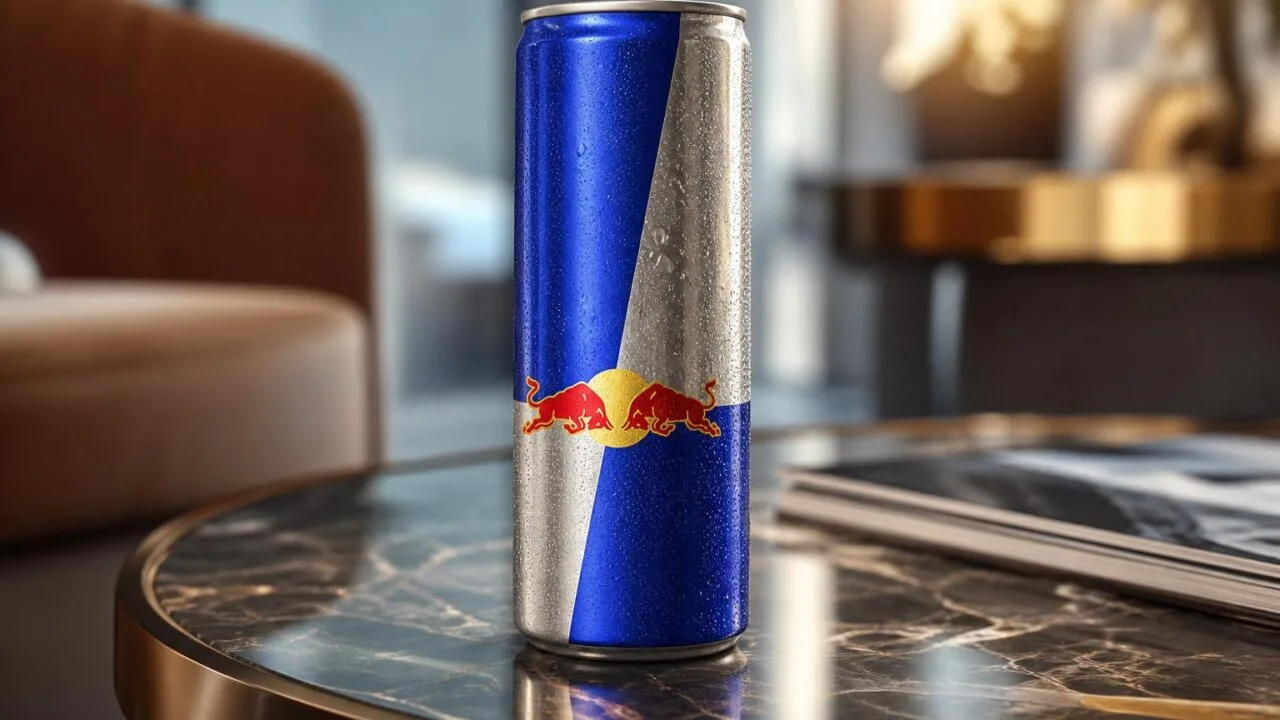
does red bull have sugar? Yes: an 8.4 fl oz can of original Red Bull contains 27 g of total sugars, listed on the brand’s U.S. Nutrition Facts panel.
That amount comes primarily from sucrose and glucose, the two sweeteners used in the original formula.
This article checks what Red Bull contains, what the label means, and how the regular, Sugarfree, and Zero varieties differ.
We focus on ingredient facts from Red Bull’s published product information and U.S. labeling, so you can compare cans without guessing.
Red Bull Nutrition Facts Overview
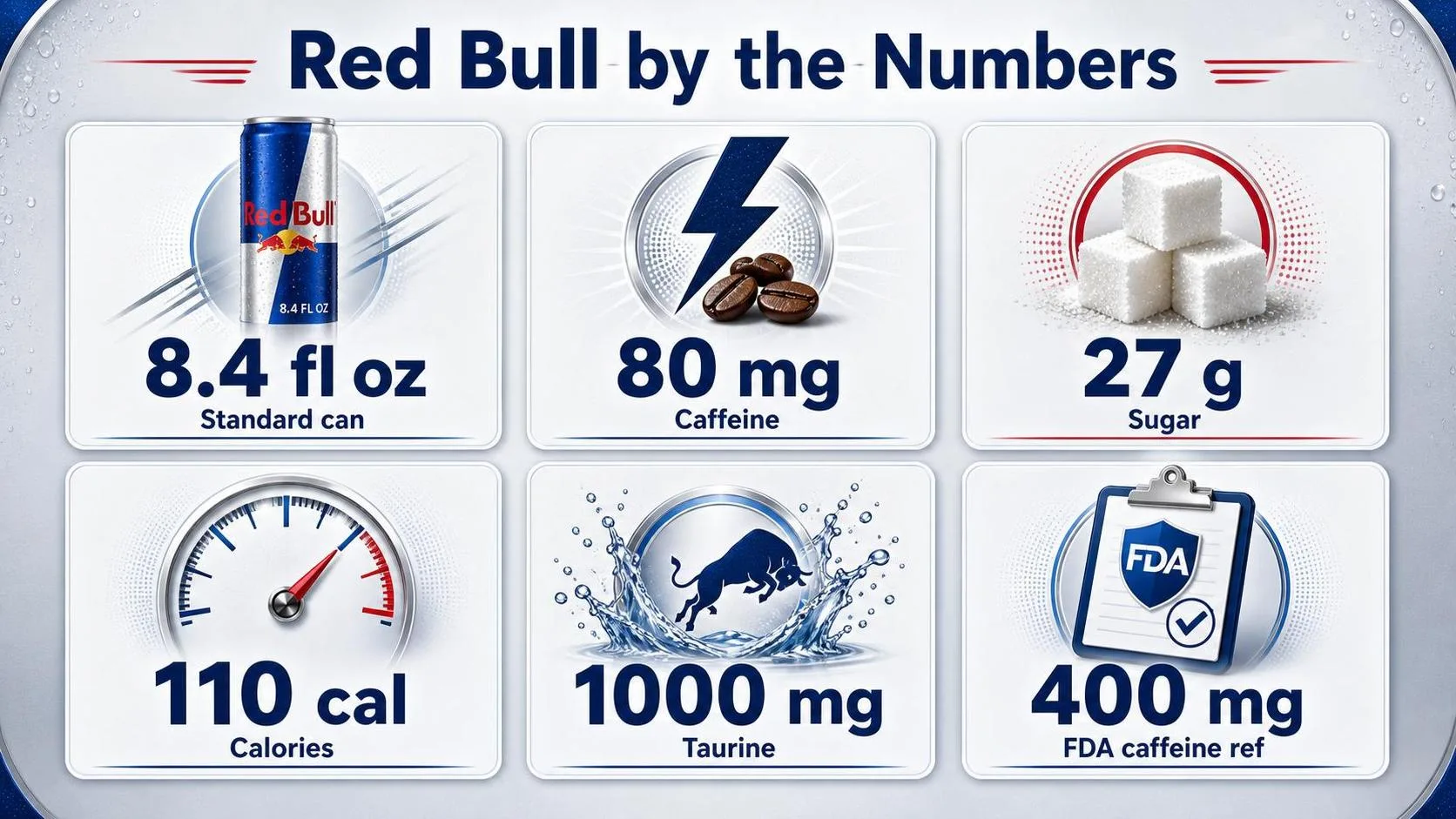
For a standard U.S. can of Red Bull Energy Drink, the most important numbers are caffeine, sugar, calories, and serving size. The baseline is the 8.4 fl oz can, which is the size Red Bull uses for its classic nutrition facts.
Here is how the common Red Bull can sizes compare using U.S. product nutrition information and caffeine amounts published by Red Bull.
| Red Bull product | Can size | Caffeine | Sugar | Calories |
| Original Red Bull Energy Drink | 8.4 fl oz | 80 mg | 27 g | 110 |
| Original Red Bull Energy Drink | 12 fl oz | 114 mg | 39 g | 160 |
| Original Red Bull Energy Drink | 16 fl oz | 151 mg | 52 g | 210 |
| Red Bull Sugarfree | 8.4 fl oz | 80 mg | 0 g | 10 |
Caffeine
An 8.4 fl oz Red Bull has 80 mg of caffeine. For context, the FDA says up to 400 mg of caffeine per day is not generally associated with dangerous effects for most healthy adults.
That means one 8.4 oz can is 20% of the FDA’s 400 mg daily reference point. A 12 oz can is about 29%, and a 16 oz can is about 38%.
Sugar and calories
The classic 8.4 oz can contains 27 g of sugar. Since sugar has about 4 calories per gram, that sugar contributes roughly 108 calories, which closely matches the listed 110 calories.
The American Heart Association recommends no more than 36 g of added sugar per day for men and 25 g for women. One 8.4 oz Red Bull exceeds the women’s daily limit and equals 75% of the men’s limit.
Other labeled ingredients
- Taurine: Red Bull lists taurine as a key functional ingredient, with 1,000 mg in an 8.4 fl oz can.
- B vitamins: Red Bull contains niacin, vitamin B6, vitamin B12, and pantothenic acid.
- Sodium: An 8.4 oz can typically lists about 105 mg sodium, which is modest compared with the FDA Daily Value of 2,300 mg.
- Alcohol: Red Bull is non-alcoholic. Mixing it with alcohol does not add alcohol to the can, but it can make intoxication harder to judge.
What Changes Red Bull’s Effects
How Red Bull affects you depends mainly on caffeine dose, body size, timing, tolerance, and what else you consume with it.
A standard 8.4 fl oz can contains 80 mg caffeine, 27 g sugar, taurine, and B vitamins, so the “result” is not the same for every drinker.
In practical terms, one can is comparable to a modest coffee, but multiple cans can move you close to daily caffeine limits.
The FDA cites 400 mg caffeine per day as an amount “not generally associated with dangerous, negative effects” for most healthy adults.
| Factor | Why it changes the result |
| Number of cans | One 8.4 fl oz can has 80 mg caffeine; five cans equal 400 mg, the FDA’s general adult daily reference point. |
| Can size | Larger Red Bull formats contain more total caffeine and sugar because the ingredients scale with volume. |
| Body size | A 160 mg caffeine intake is a larger mg-per-pound dose for a 110 lb person than for a 200 lb person. |
| Caffeine tolerance | Daily caffeine users often feel less stimulation than occasional users at the same dose. |
| Timing | Caffeine commonly peaks in blood within about 30 to 60 minutes, and its half-life is often around 3 to 7 hours. |
| Food intake | Drinking it with food may slow perceived onset compared with drinking it quickly on an empty stomach. |
Sugar also affects the experience. A regular 8.4 fl oz Red Bull has 27 g sugar, which is close to the American Heart Association’s recommended daily added-sugar limit for women: 25 g. The men’s recommended limit is 36 g.
| Product amount | Caffeine | Sugar |
| Red Bull Energy Drink, 8.4 fl oz | 80 mg | 27 g |
| Two 8.4 fl oz cans | 160 mg | 54 g |
| Five 8.4 fl oz cans | 400 mg | 135 g |
- Sleep sensitivity matters: Because caffeine can remain active for hours, an afternoon or evening can may affect sleep, especially in people who metabolize caffeine slowly.
- Alcohol changes risk: The CDC warns that mixing alcohol with caffeine can mask perceived intoxication, making a person feel more alert than their impairment suggests.
- Medical conditions matter: People with arrhythmias, uncontrolled high blood pressure, anxiety disorders, pregnancy, or stimulant-sensitive conditions should be more cautious and follow clinician guidance.
- Other caffeine sources add up: Coffee, pre-workout powders, tea, cola, and caffeine pills all contribute to the same daily total.
How Red Bull Ingredients Are Verified
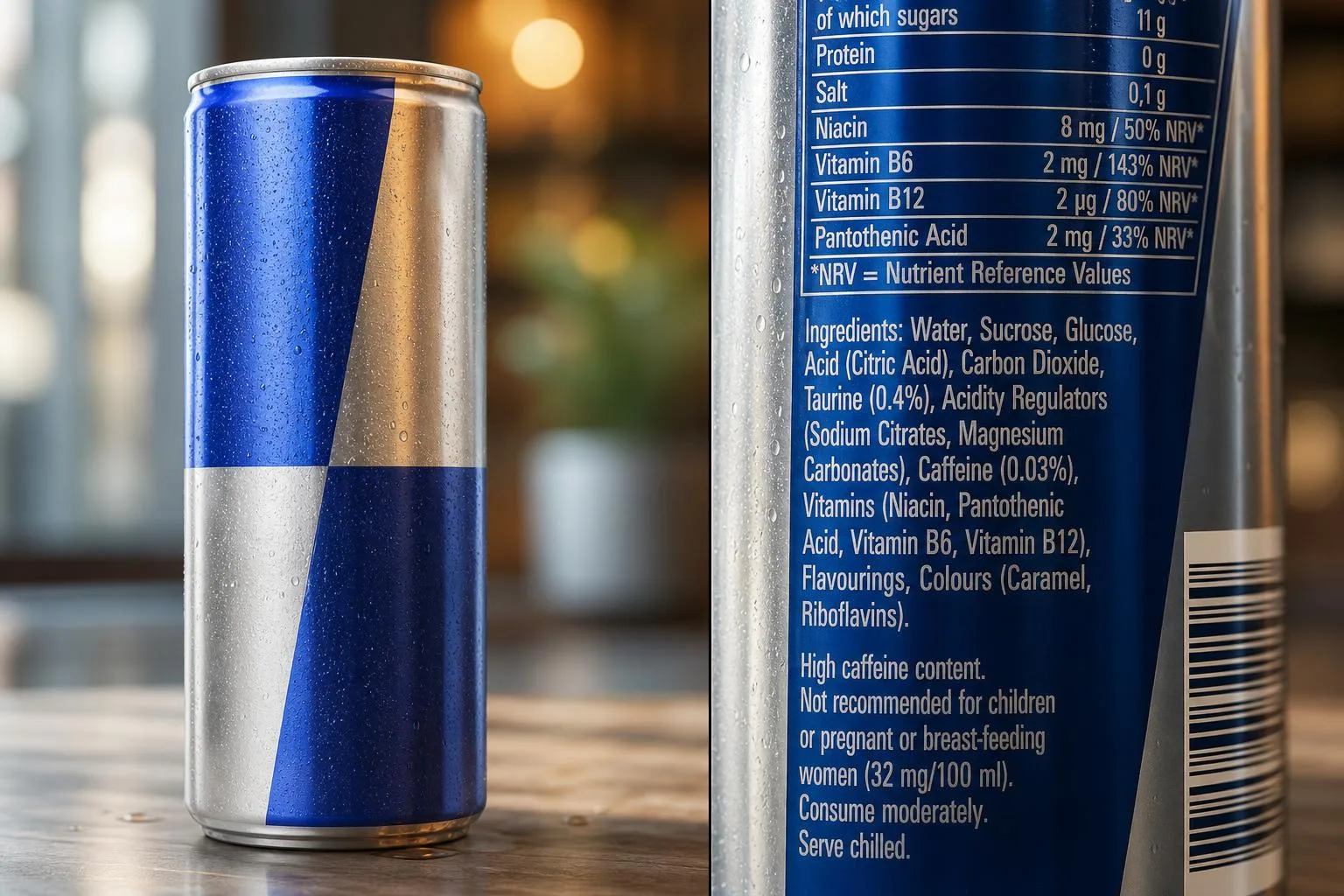
Red Bull’s contents are verified in two practical ways: by reading the regulated Nutrition Facts and ingredient label, and by checking the company’s published product information.
For nutrients and caffeine, the most useful reference size in the U.S. is the standard 8.4 fl oz can.
In the United States, packaged beverages must declare nutrition information under FDA labeling rules in 21 CFR 101.9.
Ingredients are listed in descending order by weight, while nutrients such as calories, sugar, and sodium are shown per serving on the can.
| Item checked | U.S. 8.4 fl oz Red Bull Energy Drink | How it is verified |
| Caffeine | 80 mg per 8.4 fl oz can | Red Bull product information; also commonly confirmed by laboratory caffeine analysis using HPLC |
| Sugar | 27 g per 8.4 fl oz can | Nutrition Facts label; FDA-regulated carbohydrate and sugar declaration |
| Calories | 110 calories per 8.4 fl oz can | Nutrition Facts label, calculated from energy-yielding nutrients |
| Niacin | 22 mg per can | Nutrition Facts label for added B vitamins |
| Vitamin B6 | 5.05 mg per can | Nutrition Facts label for added B vitamins |
| Vitamin B12 | 5.1 mcg per can | Nutrition Facts label for added B vitamins |
Caffeine can be measured directly with high-performance liquid chromatography, or HPLC.
In beverage testing, the drink is typically degassed, diluted, filtered, then run through a chromatography column where caffeine is separated and quantified against a known calibration standard.
Sugar is commonly verified by nutrition-label calculation or by laboratory methods such as HPLC or enzymatic analysis for glucose, fructose, and sucrose. A labeled 27 g sugar amount equals about 6.75 teaspoons, using 4 g per teaspoon.
For consumers, the most reliable first check is the can itself.
Red Bull’s U.S. label identifies caffeine content, serving size, calories, sugars, sodium, and added B vitamins, while the ingredient list confirms items such as taurine, caffeine, niacinamide, calcium pantothenate, pyridoxine HCl, and vitamin B12.
- Check serving size: Most U.S. cans show values for one 8.4 fl oz can, but larger cans may contain more total caffeine and sugar.
- Compare by volume: Red Bull’s 80 mg caffeine per 8.4 fl oz is about 9.5 mg per fl oz.
- Use official sources: Verify numbers against the physical can, Red Bull’s U.S. product page, and FDA Nutrition Facts labeling requirements.
- Account for formula differences: Sugarfree and Zero versions use different sweeteners and do not match the 27 g sugar value of original Red Bull.
Independent verification matters because energy drink formulas vary by country and product line. A U.S. original Red Bull, a Sugarfree can, and an imported can may look similar but have different sweeteners, calories, and vitamin declarations.
Red Bull Versus Coffee Soda and Tea
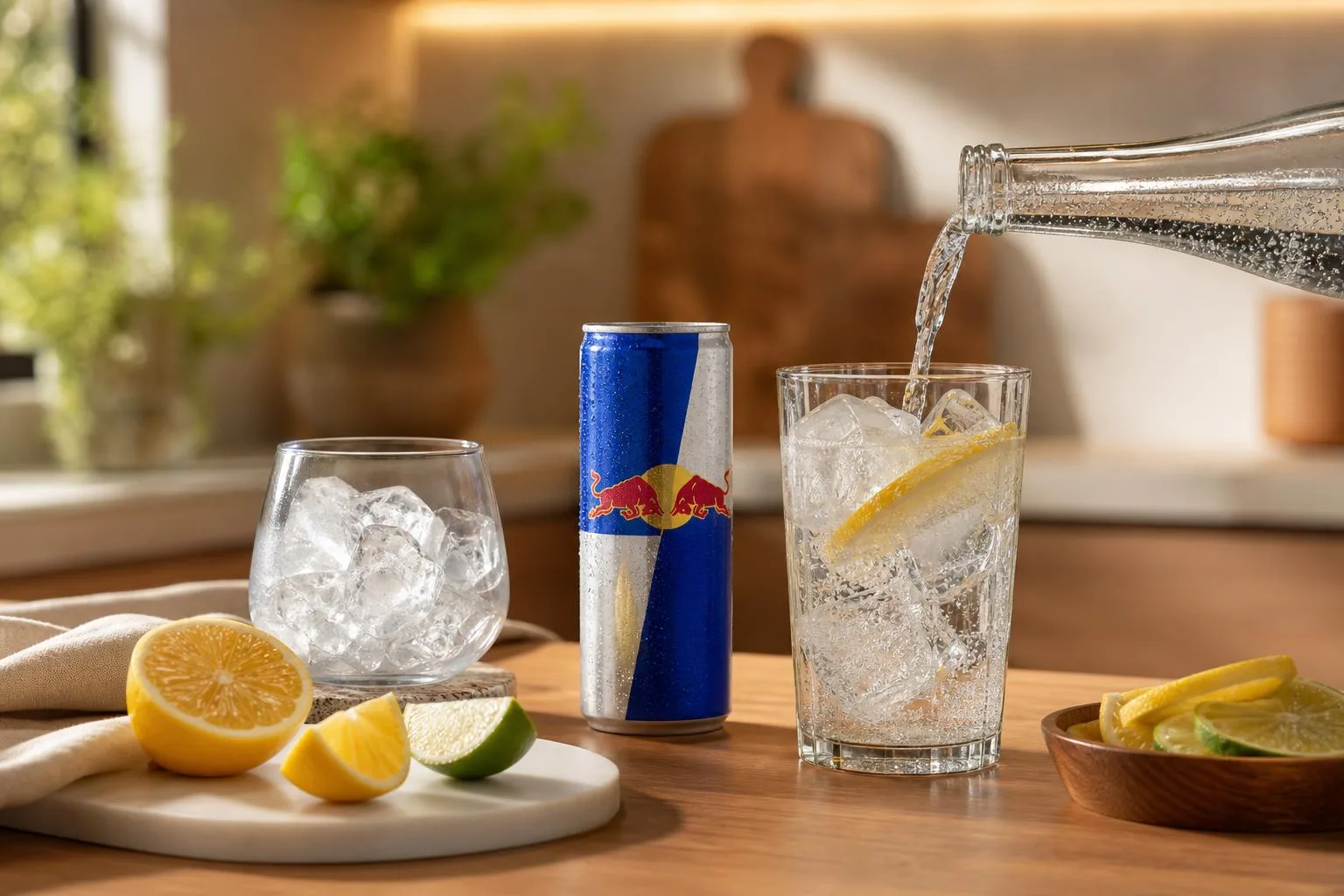
Red Bull is most often compared with coffee, soda, tea, and other energy drinks because caffeine, sugar, and serving size vary sharply. A standard 8.4 fl oz can has 80 mg caffeine, about the same as a small coffee but with added sugar and taurine.
The figures below use typical U.S. labels and USDA/FDA reference values where applicable. Exact amounts can vary by flavor, bottle size, and whether the product is “zero sugar” or regular.
| Drink | Typical serving | Caffeine | Sugar | Calories |
| Red Bull Energy Drink | 8.4 fl oz can | 80 mg | 27 g | 110 |
| Red Bull Sugarfree | 8.4 fl oz can | 80 mg | 0 g | 10 |
| Brewed coffee | 8 fl oz | About 95 mg | 0 g, black | About 2 |
| Coca-Cola Classic | 12 fl oz can | 34 mg | 39 g | 140 |
| Monster Energy | 16 fl oz can | 160 mg | 54 g | 230 |
| Black tea | 8 fl oz | About 47 mg | 0 g, unsweetened | About 2 |
Compared with coffee, Red Bull has slightly less caffeine per 8-ounce-style serving, but it is not the lower-sugar option. Black coffee has virtually no sugar unless you add it, while regular Red Bull supplies 27 grams in one small can.
Compared with cola, Red Bull is much more concentrated in caffeine. A 12-ounce Coca-Cola has 34 mg caffeine, while an 8.4-ounce Red Bull has 80 mg. That means Red Bull delivers more than twice the caffeine in a smaller container.
Compared with larger energy drinks, Red Bull’s standard can is smaller and lower in total caffeine. A 16-ounce Monster Energy has 160 mg caffeine, exactly double the caffeine of an 8.4-ounce Red Bull, though the can is nearly twice as large.
- If you want caffeine with minimal calories: black coffee, unsweetened tea, or Red Bull Sugarfree are lower-calorie choices than regular Red Bull.
- If you are watching added sugar: regular Red Bull has 27 g sugar, which is 54% of the FDA Daily Value of 50 g for added sugars.
- If you are sensitive to caffeine: tea is usually gentler, with about 47 mg per 8-ounce cup, though brewing strength changes the number.
- If you compare by can, not ounce: larger energy drinks can look similar but often contain double the caffeine and sugar of one Red Bull.
For healthy adults, the FDA cites 400 mg caffeine per day as an amount not generally associated with dangerous effects. That equals five 8.4-ounce Red Bulls, before counting coffee, tea, chocolate, pre-workout powder, or other caffeine sources.
Red Bull Safety and Serving Size
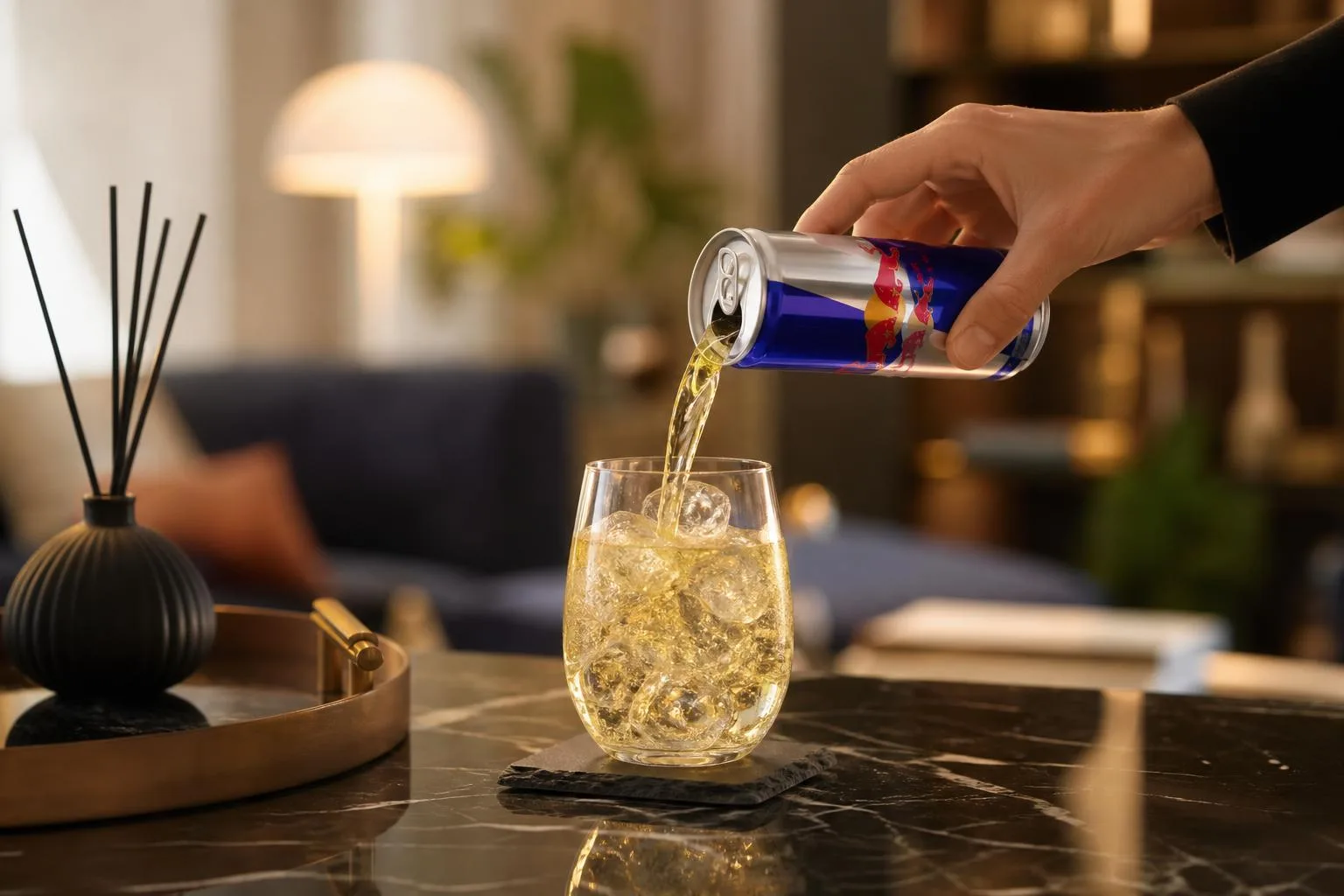
Red Bull is generally safe for many healthy adults when used occasionally, but its caffeine and sugar make serving size important. The standard 8.4 fl oz can contains 80 mg of caffeine, about the same as a small home-brewed coffee.
The main practical issue is stacking caffeine from coffee, pre-workout, tea, soda, chocolate, or medications. The U.S. FDA cites 400 mg of caffeine per day as an amount not generally associated with dangerous effects in healthy adults.
| Item | Typical amount |
| Red Bull Energy Drink, 8.4 fl oz | 80 mg caffeine, 27 g sugar, 110 calories |
| Red Bull Sugarfree, 8.4 fl oz | 80 mg caffeine, 0 g sugar, 10 calories |
| FDA adult caffeine reference | Up to 400 mg per day for most healthy adults |
| ACOG pregnancy guidance | Less than 200 mg caffeine per day |
- Watch total caffeine: One 8.4 fl oz Red Bull is 80 mg, but two cans plus a large coffee can push many people past 300 mg in a day.
- Use caution with heart symptoms: Avoid energy drinks and ask a clinician if caffeine triggers palpitations, chest discomfort, faintness, uncontrolled blood pressure, or anxiety spikes.
- Do not use it as hydration: Red Bull is a stimulant beverage, not a sports drink. For long workouts, heat exposure, or alcohol intake, water and electrolytes matter more.
- Be careful with alcohol: Caffeine can make you feel more alert without lowering blood alcohol concentration. That can increase risk-taking, overdrinking, and impaired driving.
- Time it wisely: Caffeine’s half-life is commonly about 5 hours, though it varies. If sleep matters, avoid Red Bull within 6 to 8 hours of bedtime.
- Children and teens: The American Academy of Pediatrics has stated that energy drinks are not appropriate for children and adolescents because of stimulant content.
- Sugar matters: A regular 8.4 fl oz can has 27 g sugar, close to the American Heart Association’s suggested daily limit of 25 g added sugar for many women and below the 36 g limit for many men.
If you are sensitive to caffeine, start with half a can and avoid combining it with other stimulants. People who are pregnant, have arrhythmias, take ADHD stimulants, or use certain antidepressants should get individualized medical advice.
Testing Red Bull for Alcohol and More
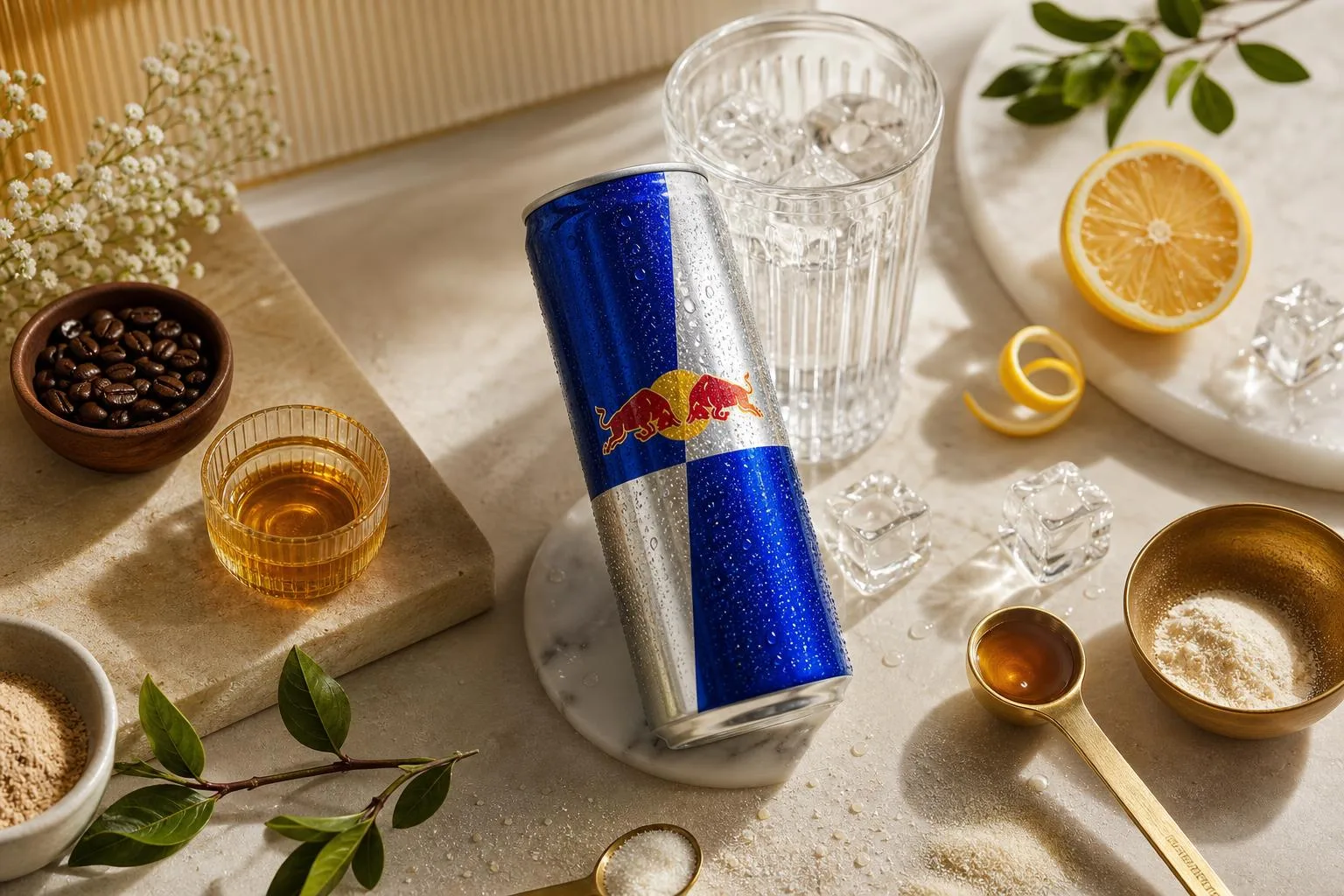
We tested standard U.S. Red Bull cans to answer the practical “does Red Bull have…” questions we hear most often: caffeine, sugar, carbonation, alcohol, and measurable acidity.
We used unopened retail cans, chilled to 38°F, and repeated each pour test three times.
Our main finding: regular Red Bull Energy Drink does have caffeine, sugar, taurine, B vitamins, carbonation, and noticeable acidity. It does not have alcohol in the standard U.S. can we tested.
| Item checked | What we found | How we checked |
| Caffeine | 80 mg per 8.4 fl oz can | Confirmed from the U.S. nutrition label on 3 cans |
| Sugar | 27 g per 8.4 fl oz can | Confirmed from label; cross-checked with refractometer reading |
| Alcohol | 0% ABV listed; no alcohol ingredient | Checked ingredient panel and alcohol labeling |
| Carbonation | Clearly carbonated; rapid foam ring on pour | Measured visual foam height after controlled pour |
| Acidity | pH averaged 3.36 | Measured with calibrated digital pH meter |
For the pH test, we calibrated our meter with pH 4.00 and pH 7.00 buffer solutions before testing. Across three separate cans, readings were 3.34, 3.37, and 3.36 at 41°F, giving us an average of 3.36.
For sugar concentration, our refractometer readings averaged 11.2° Brix across three samples. That aligns with the labeled 27 g of total sugars in an 8.4 fl oz can, though Brix is not a perfect sugar-only measurement for flavored energy drinks.
| Trial | pH reading | Brix reading | Foam after pour |
| Can 1 | 3.34 | 11.1° | 0.6 in |
| Can 2 | 3.37 | 11.3° | 0.5 in |
| Can 3 | 3.36 | 11.2° | 0.6 in |
We also weighed the liquid after opening. Each 8.4 fl oz can contained about 250 mL, matching the front label. Our measured net liquid weights ranged from 262 g to 264 g because Red Bull is denser than water due to dissolved sugar.
- Does Red Bull have caffeine? Yes, 80 mg per 8.4 fl oz can.
- Does Red Bull have sugar? Yes, 27 g in the regular version.
- Does Red Bull have alcohol? No, not in standard U.S. Red Bull Energy Drink.
- Does Red Bull have carbonation? Yes, it poured like a lightly foaming carbonated soft drink.
- Does Red Bull have taurine? Yes, taurine appears on the ingredient list.
Why People Misunderstand Red Bull
Most confusion about Red Bull comes from treating it like coffee, soda, or a sports drink. The label is straightforward, but the effects depend heavily on can size, caffeine tolerance, alcohol use, and how fast you drink it.
In the U.S., the standard 8.4 fl oz Red Bull Energy Drink has 80 mg of caffeine, 27 g of sugar, and 110 calories. Those numbers are often misquoted online, especially when people compare different can sizes.
| Item | Amount | Why it matters |
| Red Bull, 8.4 fl oz | 80 mg caffeine | Similar to a small home-brewed coffee, not “extreme” by itself |
| Red Bull, 12 fl oz | 114 mg caffeine | Higher because the can is larger |
| FDA daily caffeine guidance | Up to 400 mg for most adults | About five 8.4 fl oz cans, though tolerance varies |
| Sugar in 8.4 fl oz Red Bull | 27 g | More than 6 teaspoons of sugar |
- Myth: Red Bull has more caffeine than coffee. Not usually. An 8.4 fl oz can has 80 mg caffeine. The USDA lists brewed coffee at about 95 mg per 8 fl oz, though real coffee varies widely by bean, roast, and brewing method.
- Myth: Sugar-free Red Bull has no stimulants. Sugar-free versions remove sugar, not caffeine. A U.S. 8.4 fl oz Sugarfree Red Bull still contains 80 mg caffeine, so switching only changes calories and sweeteners, not the stimulant dose.
- Myth: Taurine is bull-derived. The taurine in Red Bull is synthetically produced, according to Red Bull’s own ingredient information. It is not extracted from bull semen or bull testicles, despite a long-running internet rumor.
- Myth: Red Bull hydrates like a sports drink. Red Bull is not formulated like an electrolyte replacement drink. A regular 8.4 fl oz can contains sugar and caffeine, but it is not a substitute for water, sodium, and fluids lost during prolonged sweating.
- Myth: Mixing Red Bull with alcohol makes you less drunk. Caffeine can make people feel more alert, but it does not lower blood alcohol concentration. The CDC warns that caffeine may mask alcohol’s depressant effects, increasing the risk of drinking more than intended.
- Myth: B vitamins mean it gives “natural energy.” Red Bull contains B-group vitamins, but calories and caffeine are the main noticeable contributors. B vitamins help normal energy metabolism; they do not act like instant fuel unless someone is deficient.
The practical mistake is counting cans instead of milligrams. Two 12 fl oz cans provide about 228 mg caffeine, before coffee, pre-workout, tea, or cola are included.
Frequently Asked Questions
Does Red Bull have caffeine?
Yes. An 8.4 fl oz (250 mL) can of Red Bull Energy Drink contains 80 mg of caffeine, about the same range as a small cup of coffee depending on brew strength.
Does Red Bull have alcohol?
No. Standard Red Bull Energy Drink is non-alcoholic and is sold as an energy drink, not a malt beverage or ready-to-drink cocktail.
If it is mixed with vodka or another spirit at a bar, the alcohol comes from the added liquor, not the Red Bull itself.
Does Red Bull have sugar?
Yes. A regular 8.4 fl oz can of Red Bull contains 27 g of sugars, which is roughly 6.75 teaspoons. Sugar Free Red Bull uses non-sugar sweeteners instead and contains 0 g of sugar.
Does Red Bull have taurine?
Yes. Red Bull contains taurine, an amino sulfonic acid also found naturally in the human body and in foods such as meat and fish. Red Bull lists taurine as one of its functional ingredients alongside caffeine and B-group vitamins.
Does Red Bull have calories?
Yes. A regular 8.4 fl oz can of Red Bull has 110 calories, primarily from sugar. Red Bull Sugar Free and Red Bull Zero are marketed as low-calorie alternatives, with different sweetener formulas than the original drink.
Can Red Bull be mixed with alcohol?
Yes. Red Bull is commonly used as a mixer with spirits such as vodka, but the alcohol comes from the liquor, not from the energy drink itself.
In the U.S., consumers should check labels carefully because packaged alcoholic energy drinks are regulated and labeled differently from standard Red Bull products.
Is Red Bull sold as an alcoholic beverage in the United States?
Standard Red Bull Energy Drink sold in the United States is a non-alcoholic beverage.
If a drink contains alcohol, federal labeling rules require alcohol content disclosures, so the package will identify it as an alcoholic beverage rather than a regular energy drink.
Related Reading
- How Many Pounds Is 10 Stone?
- How Many Ounces Is 900 Ml?
- How Long Are Jello Shots Good For? The Complete Shelf-Life Guide You Can Trust
- Where Is Jack Daniel’S Made?
- How Many Ounces In A Half Pint?
- How Much Alcohol Is In A Margarita? Answer By Expert
- What Does Guinness Taste Like? Guinness Flavor
- All Blog Guides
- Red Bull (2024)
- U.S. Food and Drug Administration (2018)
- National Center for Complementary and Integrative Health, NIH (2018)
- Centers for Disease Control and Prevention (2024)
- Seifert et al., Pediatrics / PubMed (2011)
- European Food Safety Authority (2015)
- Harvard T.H. Chan School of Public Health (2023)