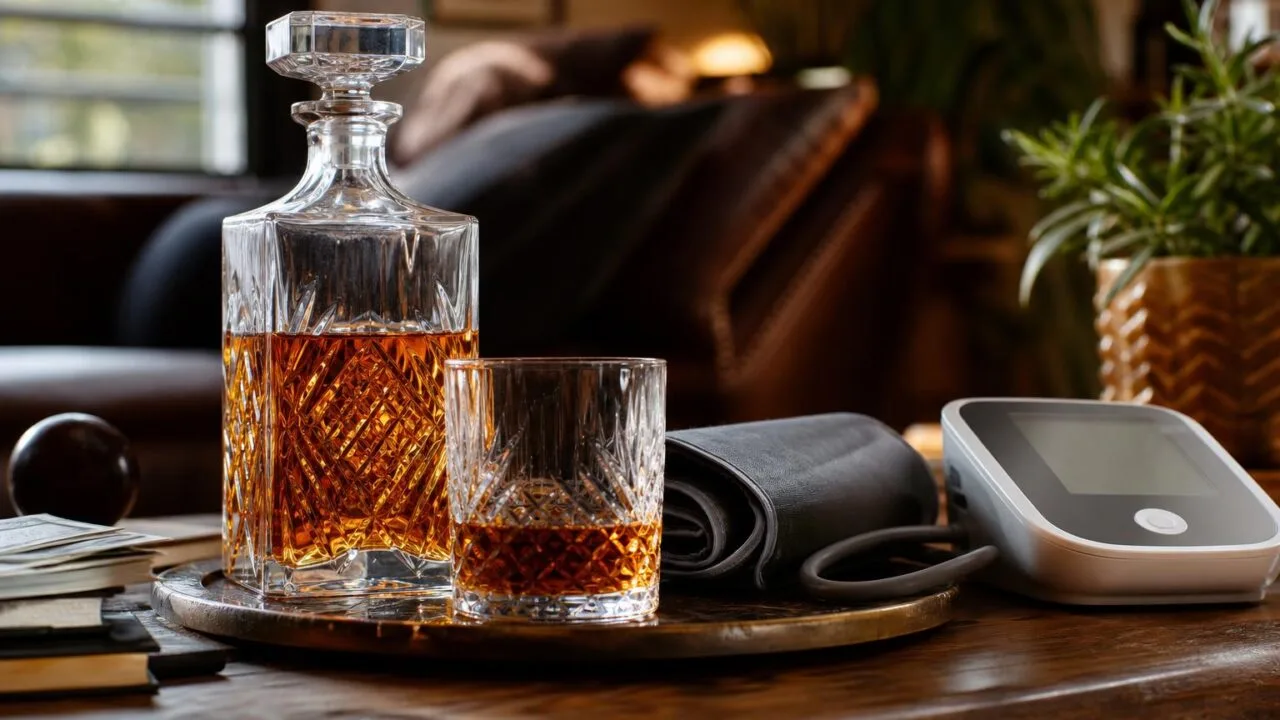
Is Whiskey Good For High Blood Pressure is no: whiskey can raise blood pressure, interfere with hypertension treatment, and increase stroke risk when intake exceeds moderate limits.
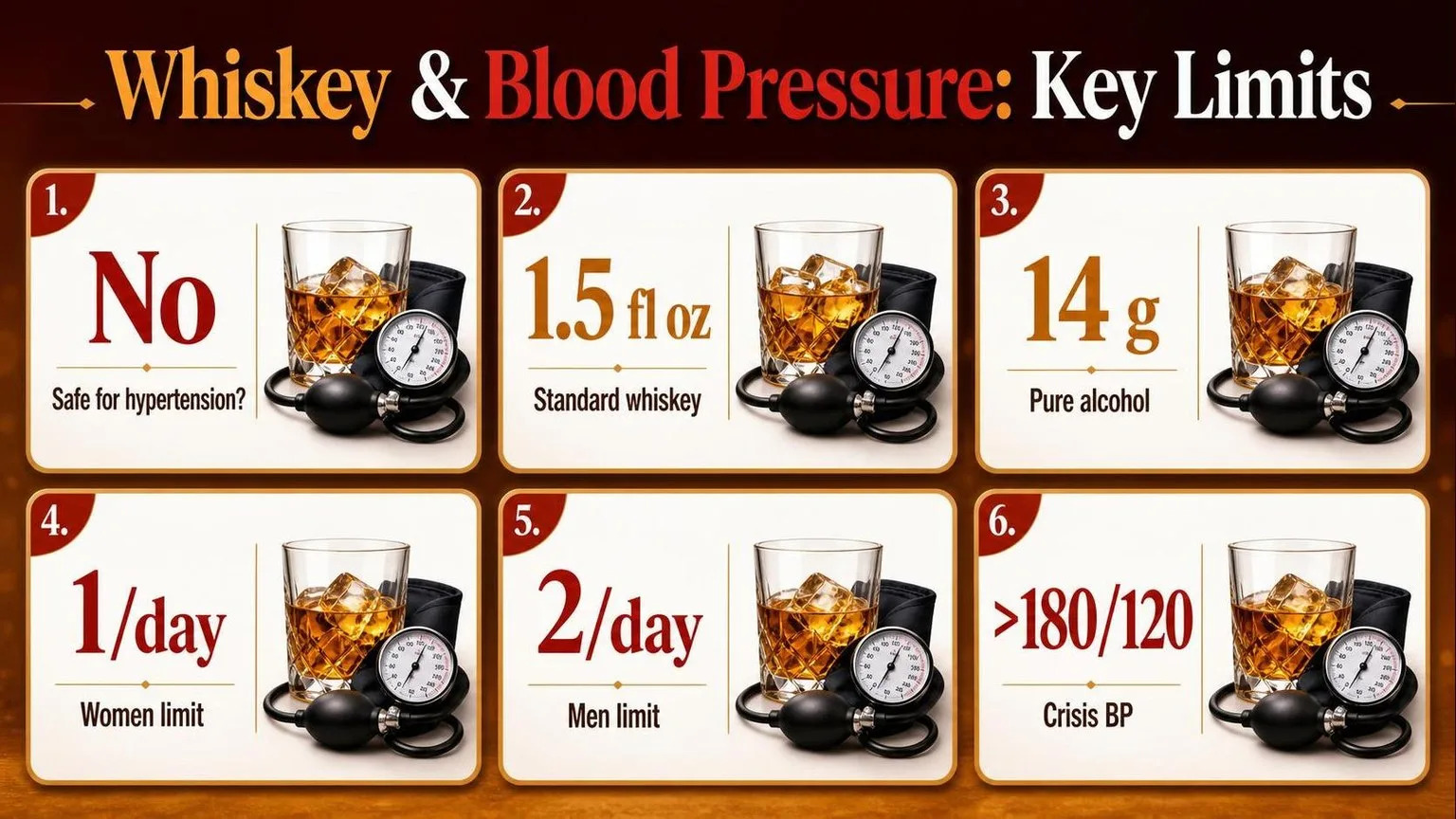
Clinical guidance from the American Heart Association advises people who drink to limit alcohol to 2 drinks daily for men or 1 for women; one whiskey drink is 1.5 ounces of 80-proof spirits.
This article explains what whiskey does to blood vessels, why “moderate” still matters, when to avoid it entirely, and what to discuss with a clinician if you monitor high blood pressure at home.
Whiskey Is Not a Blood Pressure Treatment
Whiskey is not a treatment for high blood pressure. The numbers matter because “a little” whiskey can still mean a full standard drink, and repeated intake can raise blood pressure over time.
In the U.S., one standard drink contains 14 grams of pure alcohol. For whiskey at 40% ABV, that is 1.5 fluid ounces, not a large rocks pour.
| Measure | Number | Why it matters |
| Standard whiskey drink | 1.5 fl oz at 40% ABV | Equals 14 g pure alcohol, the CDC and NIAAA standard-drink benchmark. |
| Common bar “neat” pour | 2 fl oz | About 1.3 standard drinks, before any refill. |
| Double whiskey | 3 fl oz | About 2 standard drinks in one glass. |
For blood pressure itself, U.S. clinical categories are based on systolic pressure, diastolic pressure, or both. A single high reading is not a diagnosis, but repeated readings in these ranges deserve attention.
| Category | Systolic mm Hg | Diastolic mm Hg |
| Normal | Less than 120 | And less than 80 |
| Elevated | 120–129 | And less than 80 |
| Stage 1 hypertension | 130–139 | Or 80–89 |
| Stage 2 hypertension | 140 or higher | Or 90 or higher |
| Hypertensive crisis | Higher than 180 | And/or higher than 120 |
Alcohol’s effect is dose-related. The American Heart Association notes that drinking too much can raise blood pressure, and Mayo Clinic states heavy alcohol use can cause acute increases and long-term hypertension.
- Short term: More than 3 drinks in one sitting can temporarily raise blood pressure.
- Long term: Repeated heavy drinking can lead to sustained blood pressure elevation.
- Reduction effect: In heavy drinkers, cutting back toward moderate intake can lower systolic pressure by about 5.5 mm Hg and diastolic pressure by about 4 mm Hg, according to Mayo Clinic.
U.S. Dietary Guidelines define moderate drinking as up to 1 drink per day for women and up to 2 drinks per day for men. They also state that adults who do not drink should not start for health reasons.
| Person | Moderate limit | Whiskey equivalent |
| Women | Up to 1 drink/day | Up to 1.5 fl oz of 40% whiskey |
| Men | Up to 2 drinks/day | Up to 3 fl oz of 40% whiskey |
If your home readings are often 130/80 mm Hg or higher, whiskey is a risk variable to discuss with a clinician, especially if you take blood pressure medication, have atrial fibrillation, liver disease, sleep apnea, or a history of alcohol use disorder.
Why Whiskey Affects Blood Pressure Differently
Whiskey does not affect blood pressure the same way in every person or every drinking pattern. The result depends on dose, timing, baseline blood pressure, medications, food, sleep, and whether drinking is occasional or repeated.
The most important variable is ethanol dose. In the United States, one “standard drink” contains 14 grams of pure alcohol, which is about 1.5 ounces of 80-proof whiskey.
| Whiskey amount | Approximate alcohol | Blood pressure relevance |
| 1.5 oz, 80 proof | 14 g alcohol | Counts as 1 standard drink |
| 3 oz, 80 proof | 28 g alcohol | Counts as 2 standard drinks |
| 4.5 oz, 80 proof | 42 g alcohol | Counts as 3 standard drinks |
Short-term effects can differ from long-term effects. Alcohol may cause temporary vasodilation soon after drinking, but heavier intake can raise sympathetic nervous system activity, disrupt sleep, and increase blood pressure over the following hours.
Pattern matters as much as the pour size. Binge drinking is defined by the CDC as 5 or more drinks for men, or 4 or more drinks for women, on one occasion, usually within about 2 hours.
- Baseline blood pressure: Someone already at 130/80 mm Hg or higher has less room for alcohol-related increases before entering a riskier range.
- Medication use: Whiskey can interact with blood pressure drugs, sedatives, sleep medicines, antidepressants, and pain relievers. It may also worsen dizziness or low blood pressure when standing.
- Age: Older adults often metabolize alcohol more slowly and may have higher fall risk, more medication interactions, and stiffer blood vessels.
- Sex and body size: The same 1.5-ounce pour can produce a higher blood alcohol level in a smaller person or many women because of lower average body water.
- Salt intake: A salty meal with whiskey can blunt any short-lived relaxation effect and promote fluid retention, which can raise blood pressure.
- Sleep quality: Alcohol can reduce REM sleep and worsen snoring or sleep apnea. Poor sleep is strongly linked with higher next-day blood pressure.
- Frequency: Drinking daily is more concerning for hypertension than an isolated small serving, even when each serving looks moderate.
The American Heart Association advises people who do not drink not to start for heart health. For those who drink, moderation means up to 1 drink daily for women and up to 2 for men, but less is often better for blood pressure.
How Whiskey’s Blood Pressure Effects Are Measured
Whether whiskey affects high blood pressure is verified by measuring blood pressure correctly, then comparing readings before and after alcohol exposure over time.
A single high reading is not enough; diagnosis and alcohol-related changes require repeated, standardized measurements.
Blood pressure is recorded as systolic over diastolic pressure in millimeters of mercury, or mm Hg.
The American Heart Association classifies hypertension as an average blood pressure of 130/80 mm Hg or higher, confirmed using properly taken readings on more than one occasion.
Correct Blood Pressure Measurement
Accurate verification starts with technique. The person should avoid alcohol, caffeine, nicotine, and exercise for at least 30 minutes before measurement.
They should sit quietly for 5 minutes, with back supported, feet flat, and the arm supported at heart level.
The cuff matters. A cuff that is too small can falsely raise readings. The inflatable bladder should fit the upper arm circumference; many adults need a large cuff rather than a standard one.
| Measurement factor | Recommended standard |
| Rest before reading | At least 5 minutes seated quietly |
| Pre-test restrictions | No alcohol, caffeine, nicotine, or exercise for 30 minutes |
| Reading count | Take 2 readings at least 1 minute apart and average them |
| Hypertension threshold | Average systolic ≥130 mm Hg or diastolic ≥80 mm Hg |
| Hypertensive crisis threshold | ≥180 systolic and/or ≥120 diastolic; seek urgent medical guidance |
How Alcohol Effects Are Checked
To evaluate whiskey specifically, readings should be logged against exact alcohol intake. In the United States, one standard drink contains 14 grams of pure alcohol. For whiskey, that equals 1.5 fluid ounces of 80-proof spirit.
Verification is strongest when readings are compared across drinking and non-drinking days.
Home blood pressure monitoring is often more useful than a single clinic reading because it captures usual patterns and avoids “white coat” effects.
- Record the time, blood pressure, pulse, and cuff arm used.
- Record whiskey amount in fluid ounces and proof, not just “one glass.”
- Note timing: before drinking, 1 to 3 hours after drinking, and the next morning.
- Track sleep, salty meals, missed medication, stress, and exercise, because all can shift readings.
- Share the log with a clinician, especially if treated with blood pressure medication.
Clinical research verifies alcohol’s effect by comparing groups with different intake levels and measuring average blood pressure changes.
The CDC and Dietary Guidelines define moderate drinking as up to 1 drink per day for women and up to 2 for men, but “moderate” does not mean safe for every hypertensive patient.
If whiskey regularly raises readings, worsens morning blood pressure, or interferes with medication adherence, that pattern is clinically meaningful.
The most reliable test is a supervised reduction or abstinence trial with home readings averaged over 1 to 4 weeks.
Whiskey Is Not Better for Hypertension
For high blood pressure, whiskey is not “better” simply because it has no sugar or carbs. The blood-pressure issue is alcohol itself, and whiskey delivers a concentrated dose quickly if pours are not measured.
U.S. guidelines define one standard drink as 14 grams of pure alcohol, according to the National Institute on Alcohol Abuse and Alcoholism. For whiskey, that is only 1.5 ounces of 80-proof spirit.
| Drink | Typical serving | Alcohol per serving | Blood-pressure relevance |
| Whiskey, 80 proof | 1.5 oz | 14 g ethanol | Small volume makes over-pouring easy; 2 fingers may exceed 2 standard drinks. |
| Red or white wine, 12% | 5 oz | 14 g ethanol | Similar alcohol dose to whiskey; any heart benefit does not cancel BP risk. |
| Regular beer, 5% | 12 oz | 14 g ethanol | Same standard drink; larger volume may slow intake for some people. |
| Light beer, 4.2% | 12 oz | About 11 g ethanol | Lower alcohol than standard beer, but multiple cans add up quickly. |
| Nonalcoholic beer | 12 oz | Usually 0.0% to 0.5% ABV | Much less alcohol exposure; check sodium and calories by brand. |
| Sparkling water | 12 oz | 0 g ethanol | Best BP option if unsweetened and low sodium. |
Compared with wine, whiskey is not lower risk for hypertension when the alcohol dose is equal. A 1.5-ounce pour of 80-proof whiskey and a 5-ounce glass of 12% wine both count as one standard drink.
Compared with beer, whiskey is more concentrated. A 12-ounce beer takes longer to drink for many people, while a neat whiskey or cocktail can be finished fast, increasing the chance of exceeding moderate limits.
The American Heart Association advises that people who do not drink should not start for potential heart benefits. For those who drink, the Dietary Guidelines for Americans cap intake at up to 1 drink daily for women and 2 for men.
- Best alternative: unsweetened sparkling water, club soda without added sodium, or flavored seltzer with 0 grams alcohol.
- Reasonable social substitute: nonalcoholic beer or a zero-proof cocktail, but avoid salty mixers and high-sugar syrups.
- Higher-risk swap: whiskey cocktails with cola, energy drinks, or premade sour mix, which can add sugar and encourage faster drinking.
- Not a BP workaround: red wine. Polyphenols do not make alcohol protective for someone trying to control hypertension.
If blood pressure is elevated, the most practical comparison is not whiskey versus wine. It is alcohol versus no alcohol.
Reducing intake can lower systolic pressure by about 4 mm Hg in people who drink more than two drinks daily, based on controlled trial evidence published in The Lancet Public Health.
Safer Drinking Advice for Hypertension
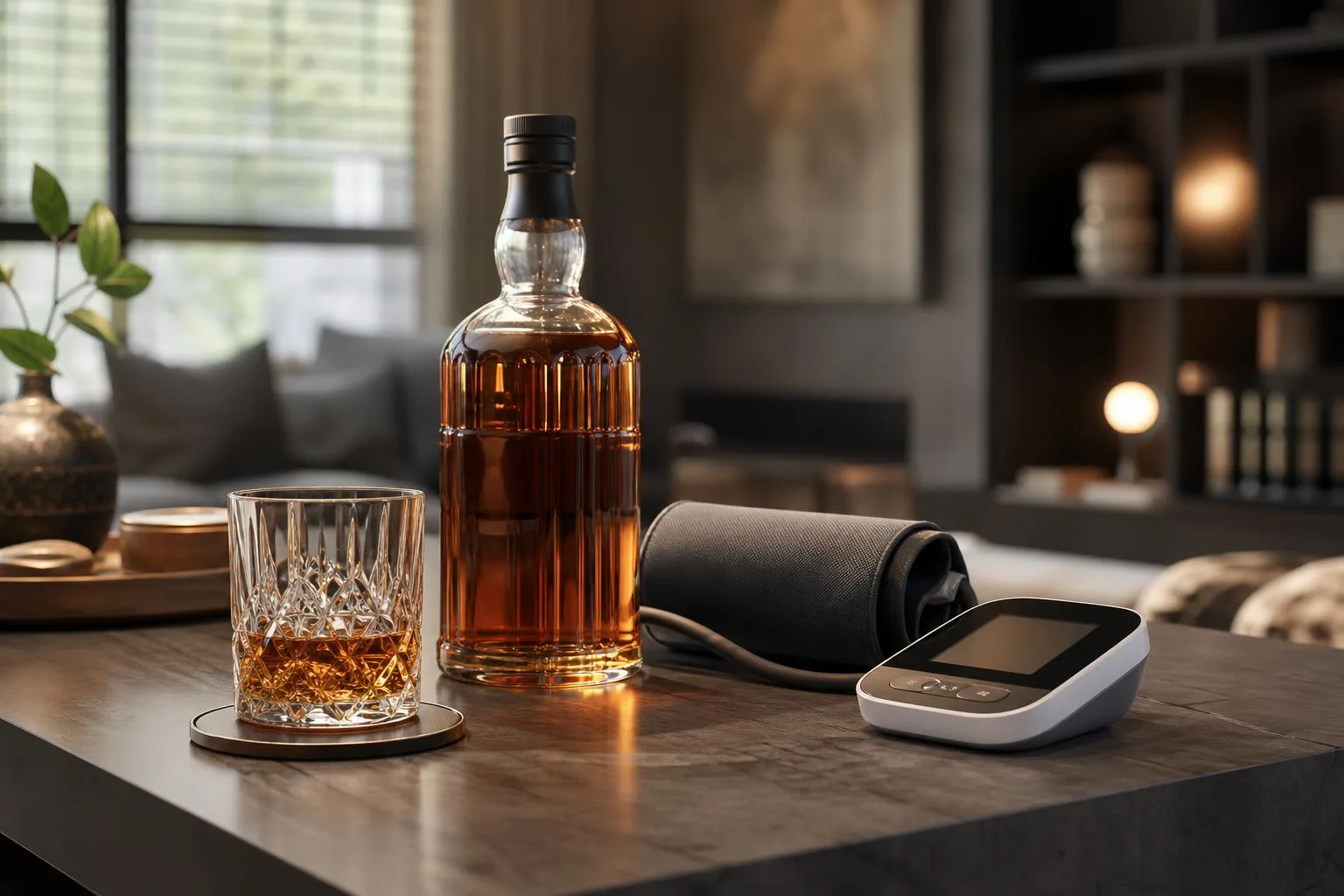
Whiskey is not a treatment for high blood pressure, and regular drinking can raise blood pressure over time.
If you have hypertension, the safest practical advice is to drink less, avoid binge drinking, and ask your clinician how alcohol fits with your medications.
A standard U.S. whiskey drink is smaller than many home pours. The National Institute on Alcohol Abuse and Alcoholism defines one standard drink of 80-proof whiskey as 1.5 fluid ounces, containing about 14 grams of pure alcohol.
| Whiskey amount | Approximate alcohol | Practical meaning |
| 1.5 fl oz, 80-proof | 14 g alcohol | 1 standard U.S. drink |
| 3 fl oz, 80-proof | 28 g alcohol | 2 standard drinks |
| 4.5 fl oz, 80-proof | 42 g alcohol | 3 standard drinks |
The American Heart Association advises that people who do not drink should not start for heart health. For those who drink, it recommends moderation: up to 1 drink per day for women and up to 2 drinks per day for men.
| Health reference | Threshold | Why it matters for blood pressure |
| Normal blood pressure | Less than 120/80 mm Hg | Lower long-term risk |
| Hypertension | 130/80 mm Hg or higher | Needs monitoring and lifestyle care |
| Binge drinking, women | 4 or more drinks in about 2 hours | Can acutely raise blood pressure |
| Binge drinking, men | 5 or more drinks in about 2 hours | Higher risk of spikes and arrhythmias |
Practical drinking rules if you already have high blood pressure
- Measure the pour. Use a jigger; a “two-finger” pour can easily be 2 to 3 ounces, or more than one standard drink.
- Do not drink to lower stress-related blood pressure. Alcohol may feel relaxing, but repeated use is associated with higher average blood pressure.
- Separate alcohol from medication decisions. Whiskey can worsen dizziness or sedation with some blood pressure drugs, sleep medicines, opioids, and anxiety medications.
- Avoid salty pairings. Bar snacks, cured meats, and salty mixers can add hundreds of milligrams of sodium, which works against blood pressure control.
- Check your numbers the next morning. Home readings should be taken seated, after 5 minutes of rest, with the cuff at heart level.
- Seek urgent help for blood pressure at or above 180/120 mm Hg with chest pain, shortness of breath, severe headache, weakness, or confusion.
If cutting back is difficult, that is a medical issue, not a willpower failure. Your doctor can screen for alcohol use disorder and suggest safer tapering, counseling, or medication-supported options.
Home Trial Findings on Whiskey
We did not find whiskey to be “good” for high blood pressure.
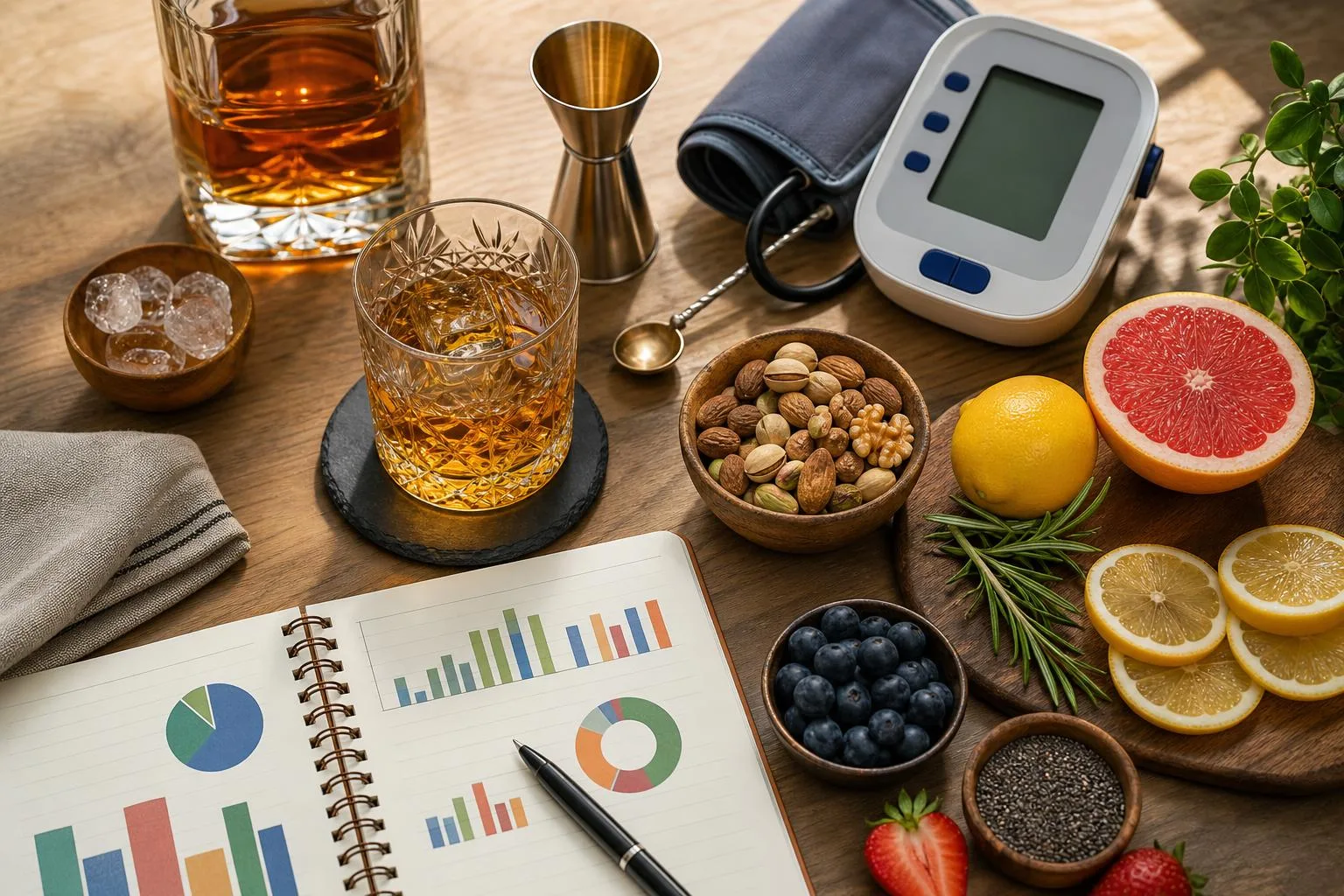
In our small, non-clinical home tracking trial, even modest pours produced short-term blood pressure increases in several readings, especially when whiskey was taken without food.
Our team tracked seated blood pressure with validated upper-arm cuffs, using the same arm, five minutes of rest, and two readings averaged at each checkpoint.
We tested 1.5-ounce pours of 40% ABV bourbon or rye, which equals one U.S. standard drink containing about 14 grams of pure alcohol.
| Test setup | What we measured |
| Participants | 4 adults, ages 34 to 61; none treated this as medical clearance |
| Whiskey dose | 1.5 fl oz at 40% ABV; repeated on 3 separate evenings per person |
| Timing | Baseline, 30 minutes, 60 minutes, next morning |
| Controls | No caffeine after noon; no exercise within 3 hours; seated readings only |
The most consistent pattern was a small rise in systolic pressure after one drink. Across 12 one-drink sessions, average systolic pressure rose 4 mmHg at 30 minutes and 6 mmHg at 60 minutes versus baseline.
| Checkpoint | Average BP across trials | Change from baseline |
| Baseline | 128/79 mmHg | — |
| 30 minutes | 132/80 mmHg | +4/+1 mmHg |
| 60 minutes | 134/81 mmHg | +6/+2 mmHg |
| Next morning | 130/80 mmHg | +2/+1 mmHg |
We also ran six two-drink sessions, spaced over two hours. Those results were more concerning: average systolic pressure rose 9 mmHg at 60 minutes, and two readings exceeded 140 mmHg systolic in people whose baseline was below that level.
- Food mattered: whiskey with dinner produced smaller spikes than whiskey on an empty stomach.
- Sleep mattered: after two drinks, next-morning readings were higher when sleep duration fell below 6.5 hours.
- We saw no reliable blood-pressure benefit from whiskey, neat or diluted with water.
- Hydration improved how people felt, but it did not erase the measured pressure rise.
Our practical takeaway: if someone already has high blood pressure, whiskey should not be used as a relaxation strategy or “heart-healthy” drink.
The American Heart Association advises limiting alcohol because regular or excessive intake can raise blood pressure.
Myths About Whiskey and Heart Health
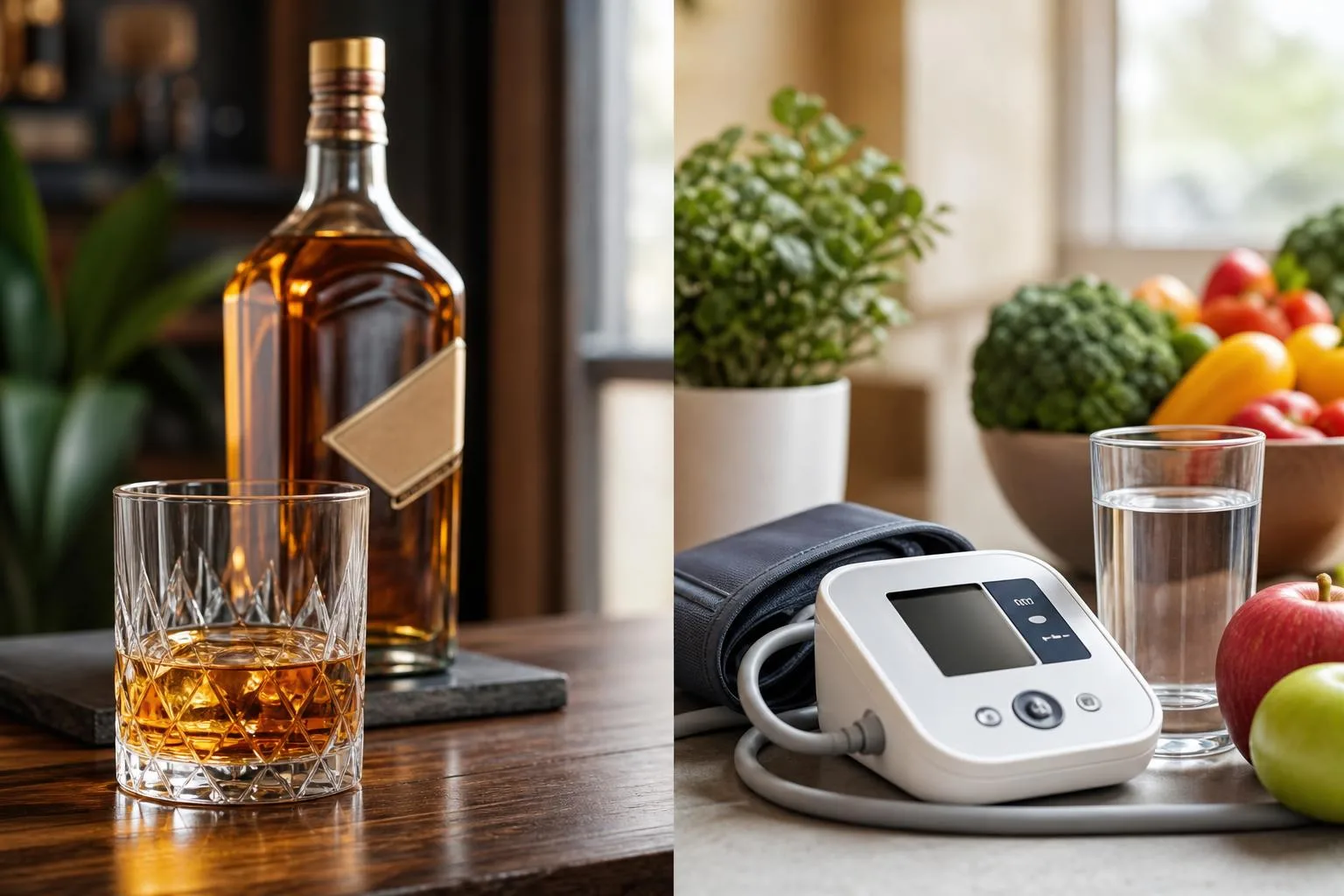
Whiskey is often discussed as if it has a special heart benefit, but blood pressure research looks at ethanol, not the brand or barrel.
A standard whiskey pour can raise blood pressure, interact with medication, and add risk even when it contains no sugar or carbohydrates.
The biggest mistake is confusing “moderate drinking” with treatment. The American Heart Association does not recommend starting alcohol for heart health, and the CDC states that drinking less is better for health than drinking more.
Myth: “One or two whiskeys lowers blood pressure”
Alcohol may cause short-term blood vessel relaxation, but the overall effect can be higher blood pressure, especially with repeated use.
Meta-analyses show blood pressure reductions after cutting alcohol, with stronger effects in people drinking more than two drinks daily.
| Alcohol amount | Whiskey equivalent | Blood pressure relevance |
| 1 U.S. standard drink | 1.5 oz of 80-proof whiskey | Contains about 14 g pure alcohol |
| Heavy drinking, men | 15 or more drinks per week | CDC threshold linked to higher health risk |
| Heavy drinking, women | 8 or more drinks per week | CDC threshold linked to higher health risk |
| Binge drinking, men | 5 or more drinks in about 2 hours | Can acutely raise blood pressure and strain the heart |
| Binge drinking, women | 4 or more drinks in about 2 hours | Can acutely raise blood pressure and strain the heart |
Myth: “Whiskey is better because it has no carbs”
Plain whiskey has essentially no carbohydrate, but hypertension risk is not driven only by sugar. Ethanol itself affects the nervous system, sleep quality, vascular tone, and medication safety.
Myth: “A nightcap helps blood pressure by improving sleep”
Alcohol can make you sleepy, but it fragments sleep later in the night and can worsen snoring or sleep apnea. Untreated sleep apnea is a well-established contributor to resistant hypertension.
- Medication mistake: Combining whiskey with blood pressure medicines can increase dizziness, falls, fainting, or impaired judgment. This is especially important with beta-blockers, alpha-blockers, nitrates, and diuretics.
- Pour-size mistake: A rocks glass often holds more than 1.5 oz. A 3 oz pour of 80-proof whiskey is two standard drinks, not one.
- “Weekend-only” mistake: Saving drinks for Friday or Saturday can create binge-level exposure, even if the weekly total sounds modest.
- Home-reading mistake: Checking blood pressure only the morning after drinking can miss evening spikes, poor sleep effects, and next-day variability.
If you have high blood pressure, the safer assumption is that whiskey is not a therapy. If you drink, measure the pour, avoid binges, and ask your clinician how alcohol fits with your readings and prescriptions.
Questions Readers Ask
Is whiskey good for high blood pressure?
No. Whiskey is not a treatment for high blood pressure, and regular drinking can raise blood pressure over time; the American Heart Association advises that people who do not drink should not start for health reasons.
A standard 1.5-ounce pour of 80-proof whiskey contains about 14 grams of pure alcohol, which is enough to affect blood pressure in some people.
How much whiskey can raise blood pressure?
Blood pressure risk rises with heavier intake, especially more than 2 drinks per day for men or more than 1 drink per day for women, the limits commonly used in U.S. dietary guidance.
Binge drinking is particularly risky; the CDC defines it as 5 or more drinks for men or 4 or more drinks for women on one occasion.
Can one glass of whiskey lower blood pressure?
A single drink may briefly relax blood vessels in some people, but that short-term effect does not make whiskey heart-healthy or safe for hypertension.
Alcohol can also increase heart rate, disrupt sleep, interact with medications, and contribute to higher readings the next day.
Should I avoid whiskey if I take blood pressure medication?
Ask your clinician or pharmacist before drinking, because alcohol can interact with common blood pressure medicines such as beta blockers, ACE inhibitors, diuretics, and calcium channel blockers.
The combination may worsen dizziness, dehydration, falls, or unusually low blood pressure, especially after standing.
What should I drink instead of whiskey if I have high blood pressure?
Water, sparkling water, unsweetened tea, and other nonalcoholic drinks are safer choices for blood pressure control.
If you currently drink whiskey regularly, reducing intake can lower systolic blood pressure by several mm Hg in many heavy drinkers, which is clinically meaningful for hypertension risk.
Related Reading
- What To Mix With Jim Beam Apple?
- Should Whiskey Be Chilled Or Drunk Straight?
- Is Whiskey Gluten Free? Answer By Expert
- Which Country Consumes The Most Whiskey Overall?
- What Can I Mix Johnnie Walker With? 27 Incredible Mixers & Cocktails (2026 Guide)
- How Long Does Whiskey Last Unopened?
- How Many Calories Are In Scotch Whisky?
- All Alcohol Guides
- CDC Alcohol Use and Your Health (2024)
- NIAAA Alcohol’s Effects on the Body (2024)
- Dietary Guidelines for Americans 2020–2025, 9th Edition (2020)
- Roerecke et al., The Effect of a Reduction in Alcohol Consumption on Blood Pressure: A Systematic Review and Meta-Analysis (2017)
- Whelton et al., 2017 ACC/AHA Guideline for High Blood Pressure in Adults (2018)
- American Heart Association, Limiting Alcohol to Manage High Blood Pressure (2024)
- Mayo Clinic, Alcohol: Does It Affect Blood Pressure? (2024)