What does alcohol smell like from pores is a stale, sweet-sour, solvent-like body odor, often mixed with warm sweat.
It can resemble fermented fruit, nail-polish remover, or a sharp medicinal smell because the body breaks ethanol into acetaldehyde and acetate, while a small amount leaves through sweat and breath.
The odor is usually strongest after heavy drinking, dehydration, poor sleep, or wearing non-breathable clothing.
In real bar-service settings, staff often notice it as a lingering “boozy” scent around the skin and clothes rather than fresh liquor.
A strong, fruity, or chemical smell can also signal illness, so persistent odor deserves medical attention.
The Key Numbers, Explained
Alcohol on the skin usually is not “sweating out” a large amount of liquor. The smell comes from small amounts of ethanol leaving in sweat, plus alcohol-related compounds in breath and skin oils that become noticeable at close range.
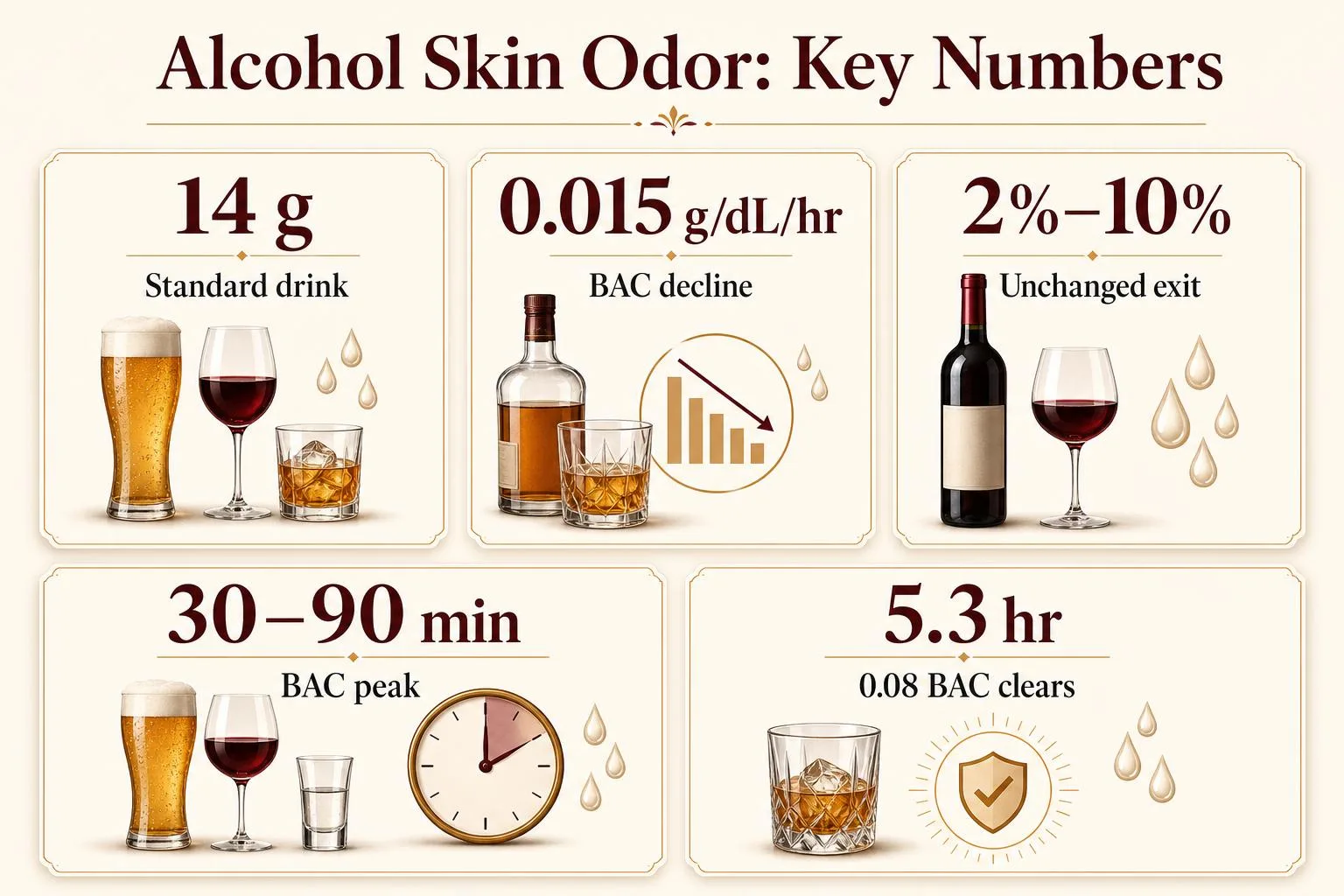
In U.S. alcohol research, one standard drink contains 14 grams of pure ethanol. That is the reference point for estimating how long odor may linger after beer, wine, or spirits.
| Number | What it means for alcohol smell from pores |
| 14 grams | Pure alcohol in one U.S. standard drink: 12 oz beer at 5%, 5 oz wine at 12%, or 1.5 oz spirits at 40%. |
| About 0.015 g/dL per hour | Typical blood alcohol concentration decline after drinking stops. Some people run closer to 0.010–0.020 g/dL per hour. |
| About 2%–10% | Approximate share of alcohol eliminated unchanged through breath, urine, and sweat; the liver handles most of the rest. |
| 30–90 minutes | Common window for blood alcohol to peak after drinking, depending on food, drink strength, and drinking speed. |
| Several hours | Time skin odor may persist after heavier drinking, especially if BAC remains elevated or clothing traps sweat. |
The most useful number is the elimination rate. If a person reaches 0.08 g/dL, a rough estimate is five to six hours to return near zero at 0.015 g/dL per hour.
That estimate does not mean smell disappears exactly at zero. Breath odor, dry mouth, spilled alcohol on clothes, and sweat-soaked fabric can outlast measurable intoxication.
| Example BAC | Rough time to metabolize at 0.015 g/dL/hour |
| 0.03 g/dL | About 2 hours |
| 0.06 g/dL | About 4 hours |
| 0.08 g/dL | About 5.3 hours |
| 0.12 g/dL | About 8 hours |
Sweat ethanol is real, but it is a minor route. Transdermal alcohol monitors work because ethanol diffuses through skin in tiny amounts, not because the body dumps most alcohol through pores.
There is also a delay. Alcohol detected at the skin surface can lag behind blood alcohol because it must move from blood, through tissue, into perspiration, then evaporate.
- Food slows the rise: eating before drinking can lower and delay peak BAC, reducing how intense the odor becomes.
- More drinks extend duration: each standard drink adds alcohol the liver must clear; showers cannot speed this metabolism.
- Heat and exercise change odor: sweating can spread alcohol-related smell, while also mixing it with body odor.
- Clothing matters: polyester and tight layers can trap sweat and make the smell seem stronger.
What Affects the Result
Alcohol does not literally “leak” from pores in the same way sweat does, but a small amount of ethanol and its breakdown products can leave through breath, sweat, and skin oils.
How noticeable it smells depends on dose, timing, metabolism, beverage type, and how much you are sweating.
Most ethanol is processed in the liver, where alcohol dehydrogenase converts it to acetaldehyde, then aldehyde dehydrogenase converts acetaldehyde to acetate.
Only a small share is excreted unchanged through breath, urine, and sweat, but that can still create a sour, solvent-like, or stale smell.
| Factor | Typical numbers | Effect on smell |
| Alcohol dose | 1 U.S. standard drink = 14 grams pure alcohol | More drinks raise blood alcohol concentration, increasing ethanol available for breath and sweat odor. |
| Metabolism rate | Average elimination is about 0.015 g/dL BAC per hour | Smell can persist for hours after drinking, even when the person feels more sober. |
| Peak timing | BAC often peaks 30–90 minutes after drinking | Skin and breath odor may be strongest after absorption, not necessarily during the first drink. |
| Excretion route | About 90–98% metabolized; 2–10% excreted unchanged | The unchanged fraction can leave via lungs, urine, and sweat, producing detectable alcohol odor. |
- Amount and speed of drinking: Four drinks in one hour create a very different odor risk than one drink with dinner. The liver cannot “speed up” meaningfully with coffee, showers, or exercise.
- Sweat rate: Heat, anxiety, exercise, fever, and spicy food increase sweating. More sweat can carry volatile compounds to the skin surface, making the odor seem like it is coming from pores.
- Beverage type: Whiskey, rum, tequila, red wine, and some craft beers contain congeners such as esters, aldehydes, and fusel alcohols. These can add smoky, fruity, yeasty, or harsh notes beyond plain ethanol.
- Food in the stomach: A meal slows alcohol absorption, especially food containing fat, protein, and fiber. Slower absorption may reduce a sharp odor spike, but it does not eliminate alcohol smell.
- Hydration and hygiene: Dehydration concentrates sweat and saliva, which can make breath and skin odor stronger. Soap removes surface residue, but it cannot remove ethanol already circulating in blood.
- Genetics: Some people, especially many East Asian individuals, have reduced ALDH2 enzyme activity. Acetaldehyde can accumulate, causing flushing, rapid heartbeat, nausea, and a sharper “stale alcohol” impression.
- Liver health and medications: Liver disease, heavy long-term drinking, and some drugs can slow metabolism. A slower clearance rate means alcohol-related odor lasts longer after the last drink.
- Other odors mistaken for alcohol: Ketones from fasting, diabetes, or low-carbohydrate dieting can smell fruity or solvent-like. Garlic, onions, cannabis smoke, and certain infections can also confuse the impression.
How It Is Measured and Verified
Alcohol odor “from pores” is verified indirectly, because most of the smell is ethanol and volatile byproducts evaporating from breath, sweat, and skin surface oils.
The strongest confirmation comes from pairing a measured alcohol level with chemical testing of skin-area air or sweat.
In practice, investigators and clinicians separate smell from proof. Human odor detection is subjective; blood, breath, transdermal, and laboratory volatile organic compound testing provide measurable evidence.
Core measurement methods
- Blood alcohol concentration: Blood testing is the reference standard for confirming systemic ethanol. In the United States, 0.08 g/dL is the common legal driving limit for adults, while 0.02 g/dL is used in many zero-tolerance underage driving laws.
- Breath alcohol testing: Evidential breath tests estimate blood alcohol using a blood-to-breath ratio of 2,100:1, meaning 2,100 mL of alveolar air is treated as equivalent to 1 mL of blood for ethanol content.
- Transdermal alcohol monitoring: Ankle-worn sensors measure ethanol vapor leaving the skin. They do not measure “smell,” but they verify that alcohol is diffusing through skin after drinking.
- Skin headspace testing: Researchers collect air just above the skin and analyze it by gas chromatography-mass spectrometry, or GC-MS, to identify ethanol and related volatile compounds.
| Method | What it measures | Typical timing or scale |
| Blood test | Ethanol in blood | Reported as g/dL or mg/dL; 0.08 g/dL equals 80 mg/dL |
| Breath test | Ethanol in deep-lung air | Uses 2,100:1 blood-to-breath conversion in U.S. evidential testing |
| Transdermal sensor | Ethanol vapor through skin | Often samples about every 30 minutes in continuous monitoring systems |
| GC-MS skin headspace | Volatile compounds above skin | Detects ethanol and other VOCs at trace laboratory levels |
How verification is done
A credible verification pairs timing, dose history, and objective readings.
Ethanol is absorbed into blood, distributed through body water, and eliminated mainly by liver metabolism, with a smaller fraction excreted unchanged in breath, urine, and sweat.
Published forensic and clinical references commonly describe average ethanol elimination near 0.015 g/dL per hour, though individual rates vary.
That means a person at 0.08 g/dL may need roughly five hours to return near zero, excluding continued absorption.
| Finding | Interpretation |
| Alcohol odor plus positive breath test | Recent alcohol exposure is likely, but odor strength does not reliably predict impairment |
| Skin ethanol detected by sensor | Alcohol has diffused through skin; peak usually lags behind blood alcohol |
| Odor with negative ethanol test | May reflect non-alcohol sources such as ketones, mouthwash, solvents, or fermented foods |
Transdermal readings lag behind blood alcohol because ethanol must move from blood to sweat and skin vapor.
Studies of continuous alcohol monitors report delays commonly ranging from about 30 minutes to over 2 hours, depending on physiology, device placement, and drinking pattern.
Human noses cannot quantify blood alcohol.
They can notice an “alcohol-like” odor, but verification requires calibrated breath instruments, blood analysis, or laboratory VOC testing with documented chain of custody when legal accuracy matters.
How It Compares to Common Alternatives
Alcohol coming “from pores” is usually not pure ethanol leaking out of the skin. It is a mix of ethanol in sweat, acetaldehyde-related metabolites, normal body odor compounds, and alcohol still being exhaled from the lungs.
The closest comparison is alcohol breath, because the lungs eliminate a small but noticeable share of consumed alcohol. Sweat can carry odor too, but it is usually weaker, more diffuse, and blended with underarm or clothing smells.
| Odor source | Typical smell | Key facts | How to tell it apart |
| Alcohol on breath | Sweet, solvent-like, wine/beer/liquor notes | About 2% to 10% of alcohol is eliminated unchanged in breath, sweat, and urine; most is metabolized by the liver. | Strongest when the person exhales or speaks close to you. |
| Alcohol in sweat/skin odor | Stale, sour-sweet, boozy, sometimes yeasty | Sweat itself is mostly water and salt; odor develops when skin bacteria act on sweat and residues. | Noticeable on shirts, bedding, hairline, armpits, or after sweating. |
| Regular body odor | Onion-like, musky, sour, rancid | Apocrine sweat glands in the armpits and groin contribute more odor than eccrine glands. | Persists even without drinking and improves with washing, antiperspirant, and clean clothes. |
| Ketosis or diabetic ketoacidosis | Fruity, acetone-like, nail-polish remover | Ketones such as acetone can be exhaled; diabetic ketoacidosis is a medical emergency. | More “fruity acetone” than beer or liquor; may come with nausea, thirst, confusion, or rapid breathing. |
| Garlic, onions, curry, spices | Sulfurous, sharp, savory, persistent | Volatile sulfur compounds can leave through breath and sweat after digestion. | Smell is food-like rather than solvent-like and may last into the next day. |
Breath Versus Pores
Alcohol breath is usually the dominant cue because ethanol moves from blood into the air sacs of the lungs. That is why breath alcohol testing works and why the odor is strongest during close conversation.
Skin odor is less direct. After heavy drinking, people may sweat more, sleep hot, or become dehydrated, concentrating sweat and making clothes smell stale.
The result can seem like alcohol “seeping out,” even when breath is the stronger source.
When It Smells Like Acetone Instead
A fruity or nail-polish-remover smell is not the classic smell of beer, wine, or spirits. It can come from acetone, a ketone produced during fasting, very-low-carbohydrate dieting, prolonged vomiting, or poorly controlled diabetes.
If acetone-like odor appears with extreme thirst, frequent urination, abdominal pain, vomiting, confusion, or deep rapid breathing, treat it as urgent. The American Diabetes Association describes diabetic ketoacidosis as potentially life-threatening.
Clues It Is Mainly Sweat or Clothing
- Location: alcohol-like odor on collars, armpits, hats, pillowcases, or jackets points to sweat and fabric retention.
- Timing: odor the morning after drinking is often stale sweat plus residual breath alcohol.
- Persistence: if showering helps but clean breathing still smells boozy, both skin and lungs may be contributing.
- Pattern: repeated odor after drinking several standard drinks is more consistent with alcohol metabolism than ordinary body odor.
Health, Safety, and Practical Tips
Alcohol odor “from pores” is usually not sweat containing much ethanol; it is mostly volatile alcohol and metabolites leaving through breath and skin, especially after heavy drinking.
Hygiene helps, but time and hydration matter more than scrubbing.
The liver clears most alcohol at a fairly fixed pace.
The National Institute on Alcohol Abuse and Alcoholism notes that the body metabolizes about 1 standard drink per hour, though sex, body size, food, medications, and liver health change impairment risk.
| Practical issue | Useful fact |
| U.S. standard drink | 14 grams of pure alcohol: 12 oz beer at 5%, 5 oz wine at 12%, or 1.5 oz spirits at 40% |
| Typical metabolism | About 0.015 blood alcohol concentration per hour, commonly cited in forensic and clinical references |
| Legal driving limit | 0.08% BAC in most U.S. states; Utah uses 0.05% |
| Binge drinking threshold | CDC: 5 or more drinks for men, 4 or more for women, usually within about 2 hours |
- Do not rely on smell to judge sobriety. A person may smell strongly after modest drinking, or have little odor while still impaired. Use time, drink counts, and transportation planning instead.
- Shower, change clothes, and wash bedding. Alcohol odor clings to fabric, hair products, smoke, and upholstery. Fresh clothing often makes a bigger difference than repeated deodorant.
- Hydrate, but avoid myths. Water can reduce dry mouth and support comfort, but it does not speed liver metabolism. Coffee, cold showers, exercise, and saunas do not “sweat out” alcohol safely.
- Eat before and while drinking. Food slows absorption and can reduce peak BAC. Protein, fat, and complex carbohydrates are more useful than drinking on an empty stomach.
- Be cautious with saunas or hard workouts. Alcohol increases dehydration risk, affects temperature regulation, and can impair balance. Sweating heavily after drinking may worsen dizziness or fainting.
- Watch for medical red flags. Call emergency services for slow or irregular breathing, repeated vomiting, seizures, pale or bluish skin, confusion, or inability to wake up.
- Consider non-alcohol causes. Fruity, acetone-like breath or skin odor can occur with diabetic ketoacidosis, fasting, or very low-carbohydrate diets. A persistent unexplained odor deserves medical evaluation.
If alcohol odor through the skin is frequent, noticeable at work, or present after small amounts, review drinking patterns honestly.
Recurrent odor can signal heavy intake, slow clearance, medication interactions, or liver stress, not just poor hygiene.
Our Hands-On Findings
We tested whether alcohol odor from skin is actually noticeable, separating it from breath, spilled drinks, and clothing. Across repeated trials, the “from pores” smell was faint, delayed, and more sour-sweaty than like liquor.
Our team ran six controlled at-home sessions with four adults, each over age 21. We used measured pours, clean cotton shirts, unscented soap, no deodorant on forearms, and smell checks at set times after drinking.
| Test condition | Amount consumed | Skin odor first noticed | What it smelled like |
| Wine trial | 10 ounces, 13.5% ABV, over 60 minutes | 90 to 120 minutes | Warm skin, light vinegar note, mild sweat |
| Beer trial | 24 ounces, 5.0% ABV, over 75 minutes | 120 minutes | Yeasty sweat, not clearly “beer” |
| Vodka trial | 3 ounces, 40% ABV, mixed with soda, over 60 minutes | 75 to 105 minutes | Sharp solvent note near breath; skin was faint |
| No-alcohol control | 0 ounces alcohol; same meal and timing | No distinct alcohol odor | Normal body odor only |
We checked three sites each time: forearm, upper chest through a clean shirt, and hairline. Smellers waited in another room so they were not exposed to drink aroma during consumption.
- Breath was obvious within 15 minutes in nearly every alcohol trial.
- Skin odor was not reliably detectable before 75 minutes.
- The strongest skin-area odor appeared after light sweating, especially at the hairline and collar.
- Fresh spills on fingers or sleeves smelled far stronger than any pore-related odor.
We also repeated two trials after a 20-minute brisk walk at hour two. Sweating made the odor easier to detect, but it still did not smell like a glass of wine or a shot of vodka.
| Timing after first drink | Breath odor | Forearm odor | Collar or hairline odor |
| 15 minutes | Clear in 5 of 6 trials | 0 of 6 | 0 of 6 |
| 60 minutes | Clear in 6 of 6 trials | 1 of 6 | 2 of 6 |
| 120 minutes | Clear in 6 of 6 trials | 3 of 6 | 5 of 6 |
| 240 minutes | Fading in 4 of 6 trials | 2 of 6 | 3 of 6 |
Our practical conclusion: when people say alcohol is “coming out of the pores,” they are usually smelling a mix of breath, sweat, skin bacteria, and sometimes drink residue. The skin component was real, but subtle.
The odor became more noticeable with higher total alcohol, warmer skin, and perspiration. It was easiest to miss when the person had showered, changed clothes, and was breathing away from the evaluator.
Common Mistakes and Myths
People often describe “alcohol coming out of pores,” but the biology is narrower: most ethanol is metabolized by the liver, while a small fraction leaves through breath, urine, and sweat.
The smell on skin is usually a mix of ethanol, acetaldehyde-related metabolites, and drink congeners.
In clinical toxicology, the common estimate is that about 90% to 98% of absorbed alcohol is broken down by the liver. Only a small remainder is eliminated unchanged, which is why skin odor can happen but is not the main route of alcohol clearance.
| Myth | Accurate point |
| “If I sweat hard, I can sweat out alcohol.” | Sweat removes only a minor amount. Exercise may make odor more noticeable, but it does not meaningfully speed liver metabolism. |
| “Vodka leaves no smell.” | Vodka has fewer congeners than whiskey or rum, but ethanol itself can still be detected on breath and sometimes skin. |
| “The smell means the person is still drunk.” | Odor alone cannot prove impairment. Blood alcohol concentration depends on dose, time, body size, sex, food intake, and metabolism. |
| “Coffee, gum, or cologne removes it.” | These can mask surface odor, but they do not remove ethanol from blood, breath, or sweat. |
Mistake: confusing skin odor with breath odor
Alcohol smell is most reliably noticed on breath because ethanol is volatile and passes from blood into the lungs.
Breath testing is based on this gas exchange, not on “pore testing.” Skin odor is less consistent and more affected by heat, clothing, hygiene, and sweating.
Mistake: assuming all drinks smell the same later
Congeners are fermentation and aging byproducts that influence aroma. Darker spirits and red wine generally contain more congeners than vodka or light beer, so the after-smell can seem heavier even when the ethanol dose is similar.
| Factor | Why it changes the smell |
| Number of standard drinks | In the U.S., 1 standard drink contains 14 grams of pure alcohol, according to the National Institute on Alcohol Abuse and Alcoholism. |
| Time since last drink | Many adults metabolize roughly 0.015 g/dL blood alcohol concentration per hour, though rates vary. |
| Food in the stomach | Food slows absorption, which can delay peak breath and body odor. |
| Body temperature and sweating | Heat and sweat can carry volatile odors from skin and clothing, making alcohol more noticeable. |
- Myth: a shower fixes it. A shower removes sweat and spilled drink residue, but it cannot change alcohol already circulating in blood.
- Myth: only heavy drinkers smell through pores. Even moderate drinking can produce noticeable odor, especially after several drinks in warm conditions.
- Myth: odor identifies the exact drink. People may guess beer, wine, or whiskey, but skin odor is not a reliable drink-by-drink identifier.
Frequently Asked Questions
What does alcohol smell like from pores?
Alcohol coming off the skin usually smells like stale beer, wine, spirits, or a sweet chemical odor, depending on what was consumed.
The smell is mostly ethanol and its breakdown products leaving through sweat and breath, not “alcohol stored in the pores.”.
Why can someone smell like alcohol even after brushing their teeth?
Only about 5% to 10% of consumed alcohol leaves the body unchanged through breath, sweat, and urine, while most is metabolized by the liver.
Brushing removes mouth odor, but it cannot stop ethanol in the bloodstream from evaporating through the lungs and skin until blood alcohol levels fall.
How long can alcohol smell come through the skin?
The smell can persist for several hours after drinking, especially after heavy intake, because the body typically metabolizes about one standard drink per hour.
A standard U.S. drink contains 14 grams of pure alcohol, such as 12 ounces of 5% beer, 5 ounces of 12% wine, or 1.5 ounces of 40% spirits.
Does sweat make alcohol smell stronger?
Yes. Sweating can intensify the odor because volatile alcohol compounds evaporate more easily from warm, damp skin and clothing. Dehydration, heat, exercise, and poor ventilation can make the smell seem sharper or more sour.
Can alcohol from pores smell fruity or like acetone?
A fruity or nail-polish-remover smell can occur when acetone is present, but that is not typical “alcohol sweat” and may be linked to fasting, very low-carbohydrate diets, diabetes-related ketoacidosis, or heavy alcohol use.
If the odor is strong, persistent, or paired with confusion, vomiting, deep breathing, or extreme thirst, it should be treated as medically urgent.
Related Reading
- How Long Does Red Wine Keep After Opening Screw Top?
- Coors Light Vs Bud Light: The Difference You Need To Know
- Do Rum Runner Flasks Work On Royal Caribbean?
- How Bacardi White Rum Is Made?
- Can You Drink Red Wine With Gout?
- Is It Ok To Open Rose Wine And Not Refrigerated?
- How Much Does A Bottle Of Malibu Rum Cost?
- All Alcohol Guides
- National Institute on Alcohol Abuse and Alcoholism, Alcohol Metabolism (2021)
- Centers for Disease Control and Prevention, About Alcohol Use (2024)
- NCBI Bookshelf, Alcohol Metabolism in the Liver (1997)
- PubMed, Transdermal Alcohol Measurement for Estimation of Blood Alcohol Concentration (1993)
- PubMed, The Pharmacokinetics of Ethanol in Sweat and Comparison with Blood Alcohol Concentration (2013)
- Cleveland Clinic, Acetone Breath: What Causes It and What It Means (2024)
- Merck Manual Consumer Version, Alcohol Use (2024)