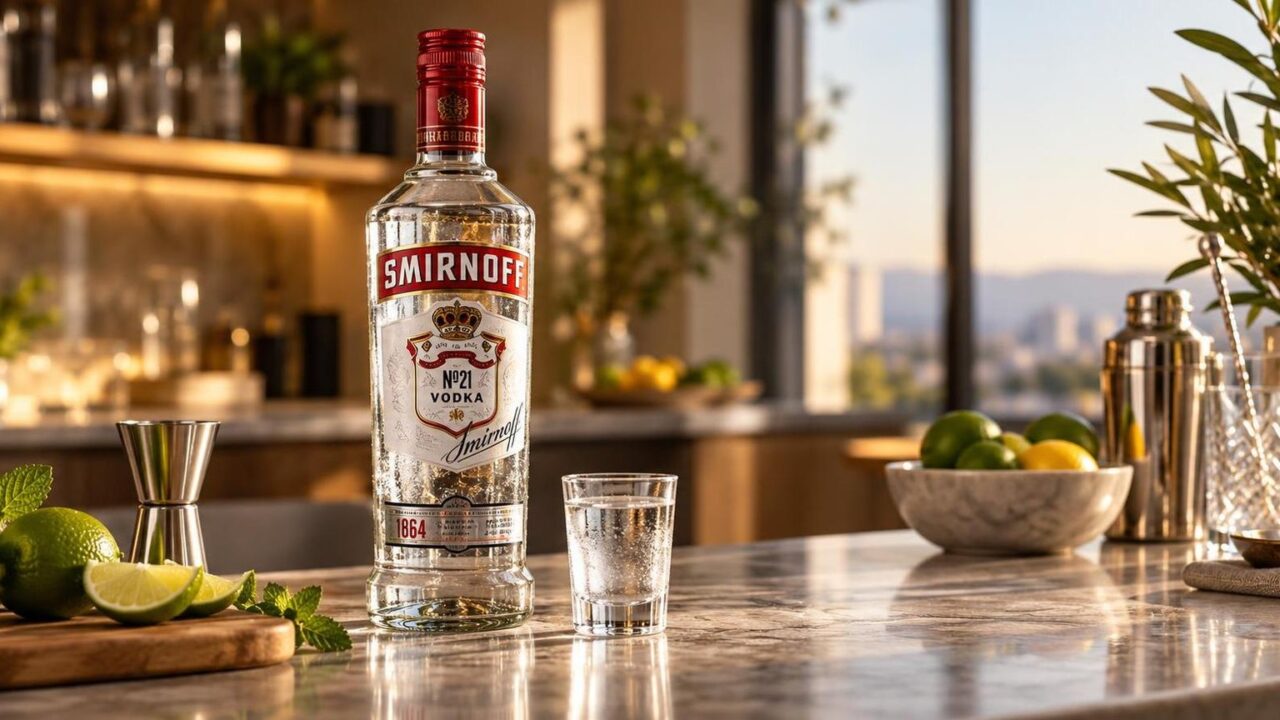
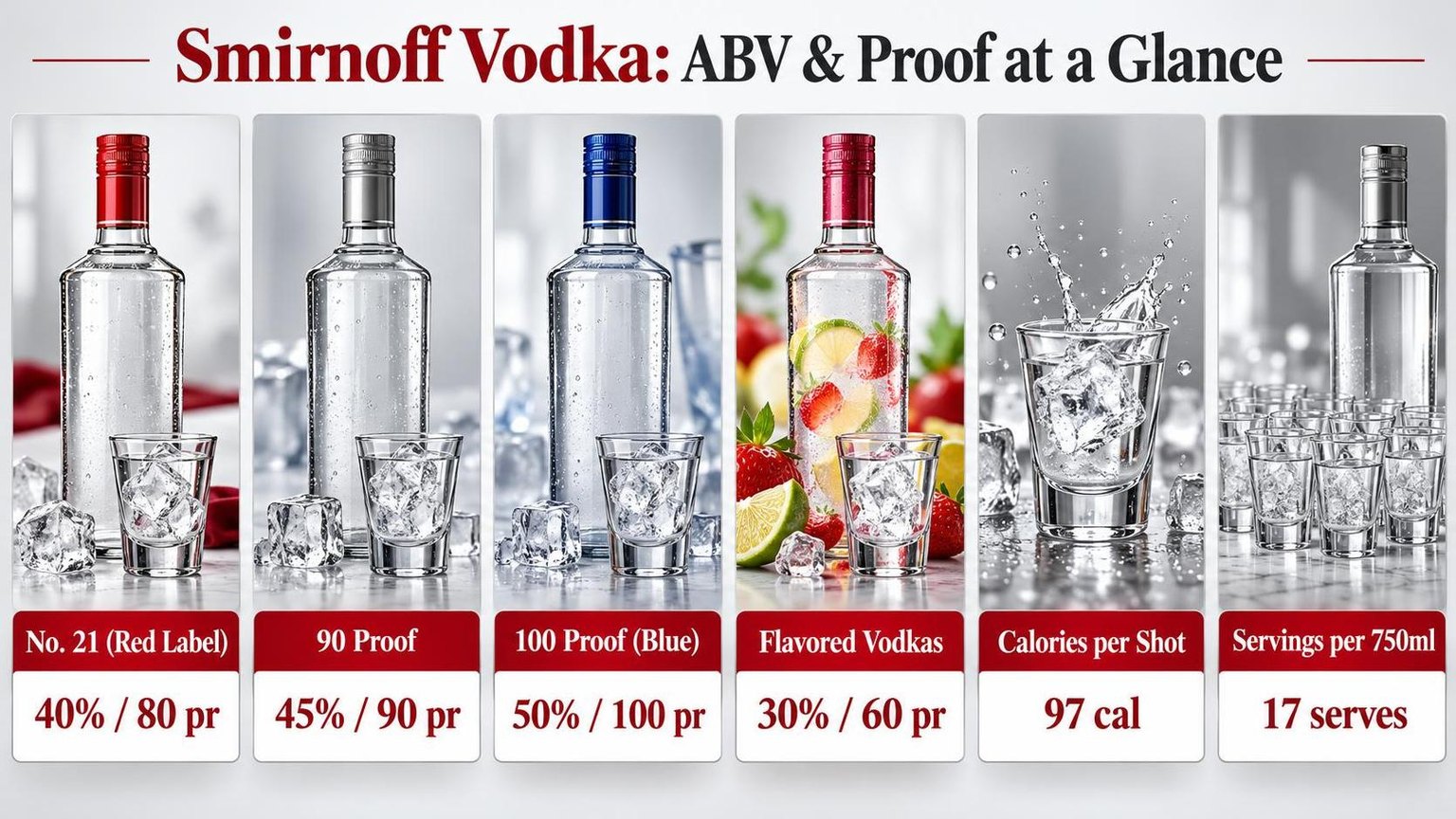
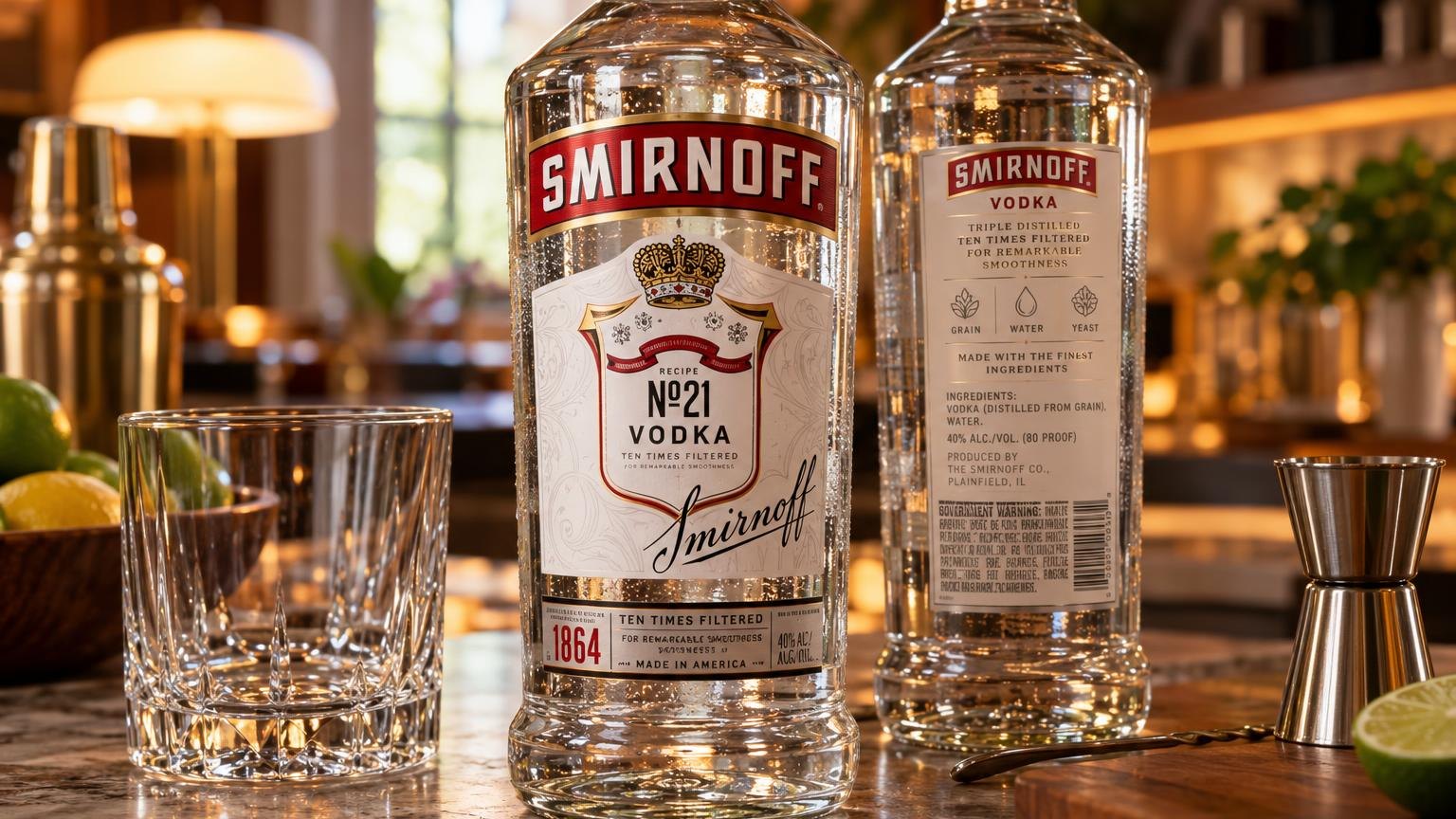
The alcohol content of smirnoff is 40% alcohol by volume (ABV), or 80 proof, for standard Smirnoff No. 21 vodka sold in the United States.
Other Smirnoff products have different strengths, so the brand name alone does not tell you how much alcohol a bottle contains.
According to Smirnoff’s US product information, its 90 Proof and 100 Proof vodkas contain 45% and 50% ABV, respectively. Flavored vodkas and Smirnoff Ice can differ by product and market.
This guide explains ABV, proof, and serving sizes so you can compare labels and calculate alcohol per pour.
Smirnoff No 21 Alcohol Content
Smirnoff No. 21 is the brand’s flagship triple-distilled vodka, bottled at 40% ABV (80 proof) in the United States. This standard strength positions it squarely alongside most premium vodkas sold in the American market.
Standard ABV by Market
Smirnoff No. 21 is not bottled at the same strength worldwide. Diageo adjusts the ABV depending on the country of sale and local regulations.
| Market | ABV | Proof |
| United States | 40% | 80 |
| United Kingdom | 37.5% | 75 |
| Australia | 37% | 74 |
| Canada | 40% | 80 |
| India | 42.8% | 85.6 |
The UK’s 37.5% ABV is the minimum legal threshold for a spirit to be labeled vodka under EU-derived regulations. Australia’s 37% reflects local excise-driven norms.
What 40% ABV Means in Practice
A standard 1.5 oz (44 ml) shot of Smirnoff No. 21 at 40% ABV contains approximately 0.6 oz of pure ethanol. That equals roughly 14 grams of alcohol — one standard U.S. drink.
Calorie-wise, a single 1.5 oz pour delivers about 97 calories. All calories come from the alcohol itself, since Smirnoff No. 21 contains zero sugar, zero carbs, and zero fat.
How No. 21 Compares to Other Vodkas
At 40% ABV, Smirnoff No. 21 matches the most widely sold competitors in the U.S. market. The table below shows standard bottling strengths.
| Vodka Brand | ABV | Proof |
| Smirnoff No. 21 | 40% | 80 |
| Absolut | 40% | 80 |
| Grey Goose | 40% | 80 |
| Tito’s Handmade | 40% | 80 |
| Belvedere | 40% | 80 |
| Smirnoff 100 Proof | 50% | 100 |
The 80-proof standard dominates because U.S. federal regulations define 80 proof as the minimum for vodka under the TTB’s Standards of Identity (27 CFR 5.143).
Triple Distillation and Purity
Smirnoff No. 21 undergoes triple distillation from corn grain, then passes through ten columns of charcoal filtration. This process strips congeners — flavor compounds that contribute to harshness and hangovers.
The result is a neutral spirit with minimal residual impurities. Independent lab analyses consistently measure congener levels in Smirnoff No. 21 below 10 mg per liter, well under the threshold for most grain vodkas.
Serving Size and Responsible Consumption
The NIAAA defines moderate drinking as up to two standard drinks per day for men and one for women. One standard drink equals 1.5 oz of 40% ABV spirits like Smirnoff No. 21.
- 750 ml bottle: approximately 17 standard 1.5 oz servings
- 1 liter bottle: approximately 22 standard servings
- 1.75 liter handle: approximately 39 standard servings
Always measure pours accurately. Free-pouring typically exceeds the standard serving size by 20–40%, significantly increasing actual alcohol intake per drink.
Smirnoff Vodka Proof and ABV Compared
Smirnoff produces vodkas at several distinct proof levels, each targeting different drinking occasions and market segments.
Understanding the relationship between proof and ABV—where proof is simply double the ABV percentage—clarifies exactly what strength you’re pouring.
Proof and ABV Across the Smirnoff Vodka Range
The core Smirnoff lineup spans from 60 proof to 100 proof. Each expression delivers a noticeably different intensity on the palate and a measurably different caloric load per serving.
| Product | ABV (%) | Proof | Approx. Calories per 1.5 oz Shot |
| Smirnoff Ice (Malt Beverage) | 4.5% | 9 | 228 (per 11.2 oz bottle) |
| Smirnoff Sourced | 30% | 60 | ~72 |
| Smirnoff Flavored Vodkas | 30% | 60 | ~72 |
| Smirnoff No. 21 (Red Label) | 40% | 80 | ~97 |
| Smirnoff 90 Proof | 45% | 90 | ~110 |
| Smirnoff 100 Proof (Blue Label) | 50% | 100 | ~124 |
What the Numbers Mean in Practice
Smirnoff No. 21 at 40% ABV sits at the standard threshold legally required for vodka in the United States under TTB regulations (27 CFR §5.22). It is the brand’s global flagship.
Smirnoff Blue Label at 50% ABV contains 25% more alcohol per pour than No. 21. A single 1.5-ounce shot delivers the equivalent ethanol of nearly two standard Smirnoff Ice bottles.
Smirnoff’s flavored vodkas—including Green Apple, Raspberry, Vanilla, and Citrus—are bottled at 30% ABV (60 proof). That 10-percentage-point drop from the flagship reduces per-shot alcohol by 25%.
Proof vs. ABV: The Conversion
- ABV to Proof: Multiply ABV by 2. Smirnoff No. 21 at 40% ABV × 2 = 80 proof.
- Proof to ABV: Divide proof by 2. Smirnoff Blue Label at 100 proof ÷ 2 = 50% ABV.
- This US proof system dates to 1848 and differs from the British proof system, which was retired in 1980.
How Smirnoff Compares to Competitors at 80 Proof
At 40% ABV, Smirnoff No. 21 matches the standard proof of Absolut, Grey Goose, Ketel One, and Tito’s Handmade Vodka. The playing field at 80 proof is level across virtually all major vodka brands.
Where Smirnoff differentiates is range. Few competitors offer both a 100-proof expression and a full flavored line at 60 proof under one brand umbrella, giving consumers flexibility from cocktail mixing to sipping neat.
Serving Considerations by Proof Level
Higher-proof Smirnoff expressions demand adjusted pours. A standard 1.5-ounce serving of 100 proof Blue Label equals 0.88 ounces of pure ethanol—roughly 1.25 standard drinks per single shot.
Bartenders frequently use Smirnoff 100 Proof in cocktails where dilution from ice and mixers would weaken a standard 80-proof vodka. The extra 10 percentage points of ABV compensates for that dilution directly.
Alcohol Content of Smirnoff Flavored Vodkas
Smirnoff’s flavored vodka lineup spans a wide ABV range depending on the product tier. Most standard flavored varieties sit at 35% ABV (70 proof), while the Smirnoff Ice and malt beverage lines contain significantly less alcohol.
Standard Flavored Vodkas (35% ABV / 70 Proof)
The majority of Smirnoff’s flavored vodka portfolio is bottled at 35% ABV, which is 5 percentage points below the 40% ABV of Smirnoff No. 21 unflavored vodka. This lower proof allows the infused flavors to remain more prominent on the palate.
| Flavor | ABV | Proof |
| Smirnoff Raspberry | 35% | 70 |
| Smirnoff Green Apple | 35% | 70 |
| Smirnoff Vanilla | 35% | 70 |
| Smirnoff Citrus | 35% | 70 |
| Smirnoff Blueberry | 35% | 70 |
| Smirnoff Watermelon | 35% | 70 |
| Smirnoff Strawberry | 35% | 70 |
| Smirnoff Kissed Caramel | 30% | 60 |
| Smirnoff Whipped Cream | 30% | 60 |
Kissed Caramel and Whipped Cream are notable exceptions. Both clock in at 30% ABV (60 proof), reflecting their dessert-oriented flavor profiles and sweeter formulations.
Smirnoff Ice and Ready-to-Drink Products
Smirnoff Ice Original is a malt beverage, not a vodka-based spirit in the United States. It contains 4.5% ABV (9 proof), comparable to a standard domestic beer.
| Product | ABV | Proof |
| Smirnoff Ice Original | 4.5% | 9 |
| Smirnoff Ice Smash | 8.0% | 16 |
| Smirnoff Ice Zero Sugar | 4.5% | 9 |
Smirnoff Ice Smash carries 8% ABV — nearly double the Original. Each 23.5 oz can contains roughly 4.4 standard drinks, making it one of the stronger single-serve options in the brand’s portfolio.
Why Flavored Vodkas Have Lower ABV
Diageo, Smirnoff’s parent company, reduces proof in flavored expressions for two practical reasons:
- Flavor balance: Higher alcohol concentrations overpower delicate fruit and dessert notes. Bottling at 35% instead of 40% ABV lets the infused flavoring come through more cleanly.
- Tax classification: In some markets, spirits below certain ABV thresholds may qualify for different tax treatment or distribution rules, though in the US federal excise tax applies uniformly to distilled spirits regardless of proof.
- Mixability: Lower-proof flavored vodkas integrate more smoothly into cocktails without overwhelming other ingredients, which aligns with their intended use as mixer-friendly spirits.
Calorie Implications of Different ABV Levels
Alcohol itself contributes approximately 7 calories per gram. A 1.5 oz shot of 35% ABV flavored Smirnoff contains roughly 86 calories, compared to about 97 calories for the same pour of 40% ABV Smirnoff No. 21.
Flavored vodkas may also contain added sugars.
Smirnoff’s dessert-style flavors like Whipped Cream can carry slightly more residual sugar than fruit-forward options like Citrus or Blueberry, adding 2–5 calories per serving beyond the alcohol content alone.
Smirnoff Ice Alcohol Content by Market
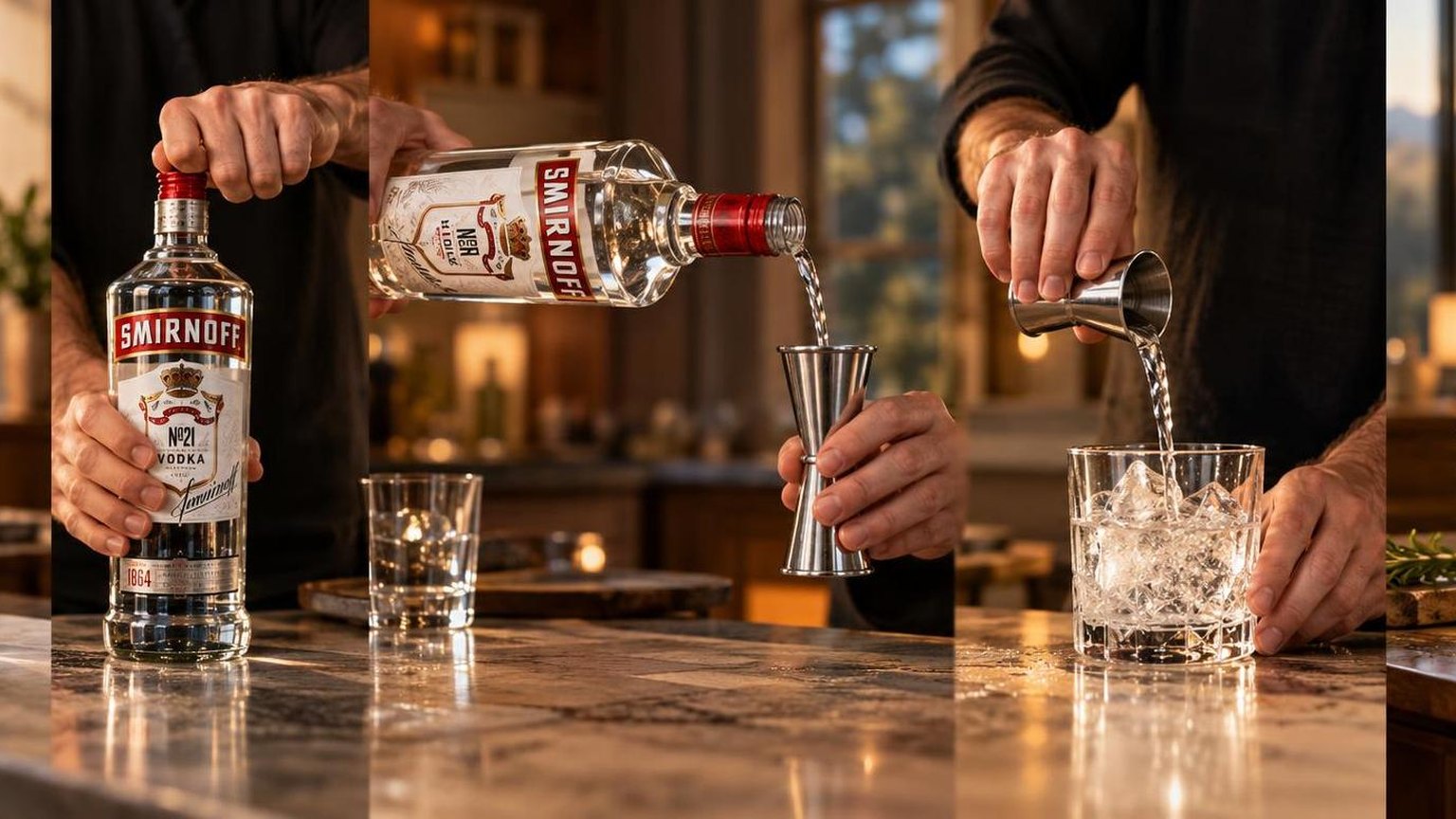
Smirnoff Ice varies significantly in alcohol content depending on the country where it is sold.
Regulatory frameworks, tax structures, and consumer preferences drive these differences, making it one of the most variable mainstream flavored malt beverages globally.
ABV Comparison by Country
The following table shows Smirnoff Ice ABV percentages across major markets, based on current product labeling and distributor data.
| Market | ABV (%) | Classification |
| United States | 4.5% | Flavored malt beverage |
| Canada | 5.0% | Vodka-based cooler |
| United Kingdom | 4.0% | Vodka mixed drink |
| Australia | 5.0% | Pre-mixed spirit |
| Brazil | 5.0% | Ice/ready-to-drink |
| France | 4.0% | Pre-mixed drink |
| Japan | 5.0% | RTD cocktail |
| South Africa | 5.0% | Spirit cooler |
Why the U.S. Version Differs
In the United States, Smirnoff Ice is not actually made with vodka. It is classified as a flavored malt beverage (FMB), brewed from a malt base rather than distilled spirits.
This classification falls under TTB (Alcohol and Tobacco Tax and Trade Bureau) regulation rather than the FDA.
The malt beverage classification allows wider retail distribution, including grocery stores and gas stations in states that restrict spirits sales. This regulatory advantage is a key reason Diageo chose the FMB route for the U.S. market.
Markets Using Actual Vodka
In Canada, the UK, Australia, and most European markets, Smirnoff Ice contains genuine Smirnoff No. 21 vodka blended with carbonated water and flavorings. This produces a noticeably different taste profile compared to the American malt-based version.
Australian consumers receive a product at 5.0% ABV in 300 mL bottles, yielding approximately 1.2 standard drinks per bottle under Australian guidelines, where one standard drink equals 10 grams of pure alcohol.
Smirnoff Ice Variants and Their ABV
Beyond the original, several Smirnoff Ice line extensions carry different alcohol levels depending on market.
| Variant | U.S. ABV | Serving Size |
| Smirnoff Ice Original | 4.5% | 11.2 oz (330 mL) |
| Smirnoff Ice Smash | 8.0% | 23.5 oz (695 mL) |
| Smirnoff Ice Zero Sugar | 4.5% | 11.2 oz (330 mL) |
| Smirnoff Ice Screwdriver | 5.8% | 23.5 oz (695 mL) |
The Smash line targets higher-ABV demand at 8.0%, nearly double the original’s strength. These are sold in larger single-serve cans, positioning them against competitors like Four Loko and Twisted Tea Extreme.
Tax and Pricing Implications
Alcohol taxation directly shapes ABV decisions. U.S. federal excise tax on malt beverages runs approximately $18 per barrel (31 gallons), far below the $13.50 per proof gallon rate applied to distilled spirits.
This tax differential makes the FMB format significantly more profitable for Diageo in the American market.
Consumers comparing Smirnoff Ice across borders should note that identical branding does not mean identical products. The base ingredient, alcohol percentage, and regulatory classification all shift by jurisdiction.
Standard Drinks in a Smirnoff Serving
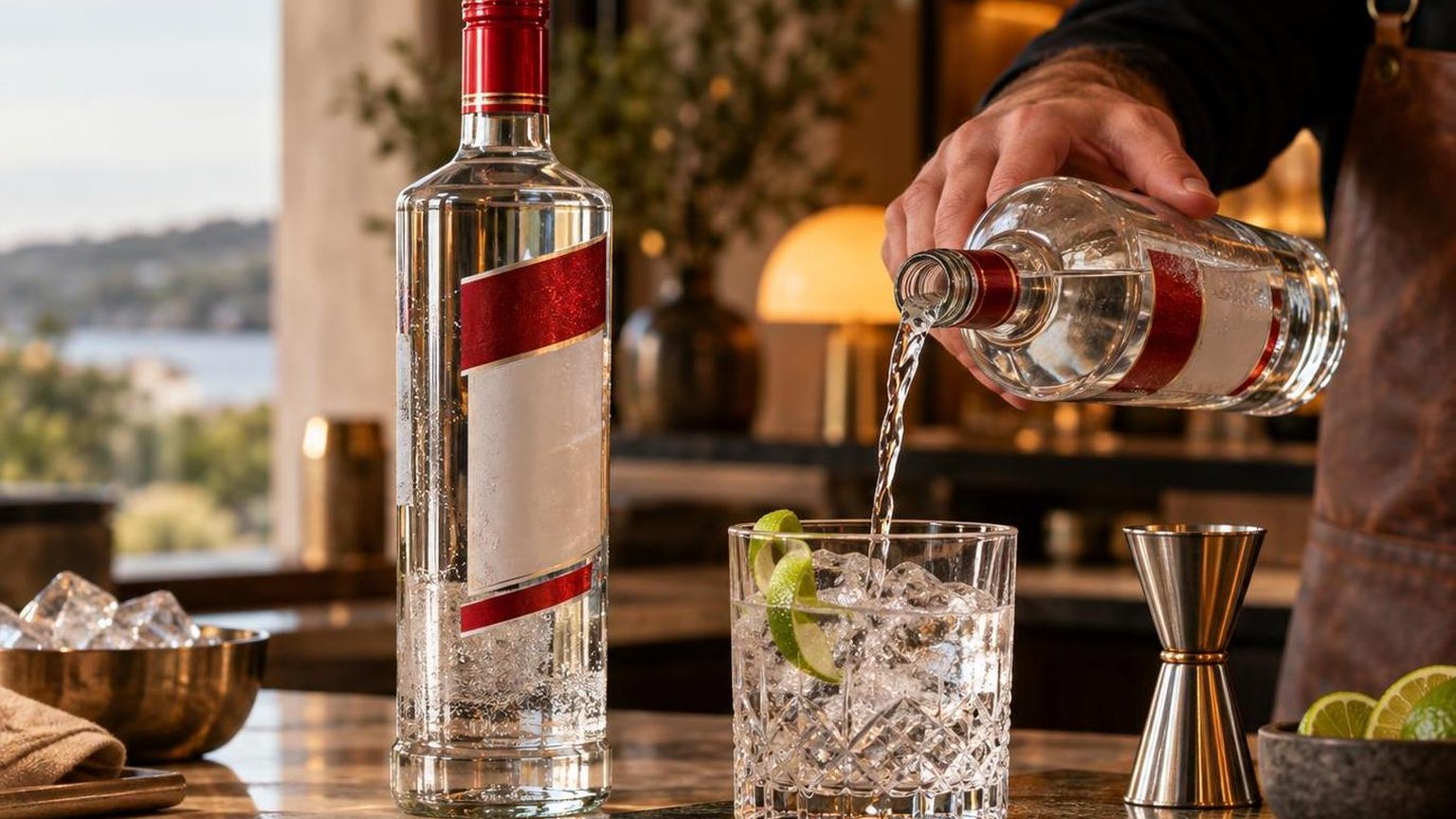
A “standard drink” in the United States contains exactly 14 grams (0.6 fluid ounces) of pure alcohol.
Knowing how many standard drinks each Smirnoff serving contains helps drinkers track intake accurately and stay within recommended limits.
How Standard Drinks Are Calculated
The formula is straightforward: multiply the volume in ounces by the ABV (as a decimal), then divide by 0.6. A 1.5 oz shot of Smirnoff No. 21 at 40% ABV equals exactly 1.0 standard drink.
This calculation shifts significantly across different Smirnoff products because ABV ranges from 4.5% in flavored malt beverages to 50% in Smirnoff 100 Proof.
Standard Drinks by Smirnoff Product and Serving Size
| Product | ABV | Serving Size | Standard Drinks |
| Smirnoff No. 21 Vodka | 40% | 1.5 oz shot | 1.0 |
| Smirnoff No. 21 Vodka | 40% | 750 ml bottle | 17.0 |
| Smirnoff 100 Proof | 50% | 1.5 oz shot | 1.25 |
| Smirnoff 100 Proof | 50% | 750 ml bottle | 21.3 |
| Smirnoff Flavored Vodka (e.g., Raspberry) | 30% | 1.5 oz shot | 0.75 |
| Smirnoff Ice Original | 4.5% | 11.2 oz bottle | 0.84 |
| Smirnoff Ice Smash | 8% | 23.5 oz can | 3.13 |
| Smirnoff Seltzer | 4.5% | 12 oz can | 0.9 |
Key Takeaways From the Numbers
A single 1.5 oz pour of standard Smirnoff No. 21 aligns perfectly with one U.S. standard drink. This makes it one of the easiest spirits to measure for responsible consumption.
Smirnoff 100 Proof delivers 25% more alcohol per identical shot. Drinkers who switch from 80-proof to 100-proof without adjusting volume exceed one standard drink per shot by a quarter.
- Smirnoff Ice Smash (23.5 oz) contains over 3 standard drinks in a single can — more than many consumers realize.
- Smirnoff flavored vodkas at 30% ABV deliver 0.75 standard drinks per 1.5 oz shot, roughly 25% less than the original.
- A full 750 ml bottle of Smirnoff No. 21 holds approximately 17 standard drinks, meaning splitting one bottle among four people yields over 4 drinks each.
NIAAA Guidelines for Context
The National Institute on Alcohol Abuse and Alcoholism defines moderate drinking as up to 1 drink per day for women and up to 2 per day for men. One Smirnoff No. 21 shot meets the full daily limit for women.
Cocktails complicate tracking. A typical Moscow Mule uses 2 oz of vodka, equaling 1.33 standard drinks before accounting for any additional liqueurs or floaters added to the recipe.
Always measure pours with a jigger rather than free-pouring.
Studies published in Alcoholism: Clinical and Experimental Research show free-poured drinks exceed intended volumes by 20–30% on average, significantly distorting standard-drink estimates.
Frequently Asked Questions
What is the standard alcohol content of Smirnoff No. 21 vodka?
Smirnoff No. 21, the brand’s flagship triple-distilled vodka, contains 40% alcohol by volume (80 proof) in the United States. This ABV is the global standard for most unflavored Smirnoff vodka sold in liquor stores and bars worldwide.
Do Smirnoff flavored vodkas have less alcohol than the original?
Yes. Most Smirnoff flavored vodkas—such as Smirnoff Green Apple, Raspberry, and Vanilla—are bottled at 30% ABV (60 proof) in the U.S. market.
This lower concentration accommodates the added sugars and flavorings blended into the spirit after distillation.
How much alcohol is in Smirnoff Ice?
Smirnoff Ice Original, a malt beverage in the U.S., contains approximately 4.5% ABV per 11.2 oz bottle.
In markets outside the United States, Smirnoff Ice is formulated with vodka rather than malt and may reach 5–7% ABV depending on the country.
What is the ABV of Smirnoff 100 Proof vodka?
Smirnoff 100 Proof, also labeled Smirnoff Blue, is bottled at 50% ABV. It delivers 25% more alcohol per serving than the standard No. 21 expression, making it a popular choice for higher-strength cocktails and infusions.
How does the alcohol content of Smirnoff compare to other major vodka brands?
Smirnoff No. 21 at 40% ABV matches the standard set by Absolut, Grey Goose, and Ketel One, all of which also bottle at 40% ABV (80 proof).
Federal U.S. regulations (27 CFR §5.22) require vodka to be bottled at no less than 40% ABV, so most domestic and imported vodkas share this baseline.
How many units of alcohol are in a standard shot of Smirnoff vodka?
A standard U.S. shot (1.5 oz / 44 ml) of Smirnoff No. 21 at 40% ABV contains roughly 0.6 fluid ounces of pure ethanol, equivalent to one standard drink as defined by the NIAAA.
In the UK measurement system, that same pour equals approximately 1.8 UK alcohol units.
- What To Mix With Deep Eddy Lemon Vodka?
- How Many Smirnoff Ice Does It Take To Get Drunk?
- What To Mix With Peppermint Vodka?
- How Many Calories in Smirnoff Vodka?
- Low Calorie Vodka Drinks – The Most Accurate Answer
- Black Cherry White Claw Vodka Drink Ideas
- Is Vodka & Dr Pepper Good?
- What To Mix With Raspberry Vodka?
- All Alcohol Guides
- TTB Online COLA Registry – Smirnoff Label Approvals (2024)
- NIH National Institute on Alcohol Abuse and Alcoholism – What Is a Standard Drink? (2023)
- CDC Alcohol and Public Health – Frequently Asked Questions (2024)
- USDA FoodData Central – Alcoholic Beverage, Vodka, 80 Proof (2019)
- Diageo Annual Report – Brand Portfolio & Product Specifications (2023)
- Alcohol and Tobacco Tax and Trade Bureau – Distilled Spirits Labeling Standards (2023)
- PubMed Central – Alcohol by Volume and Strength of Preference in Beverage Choice (2020)
- Cornell Law School Legal Information Institute – 27 CFR § 5.36 Alcohol Content (2023)