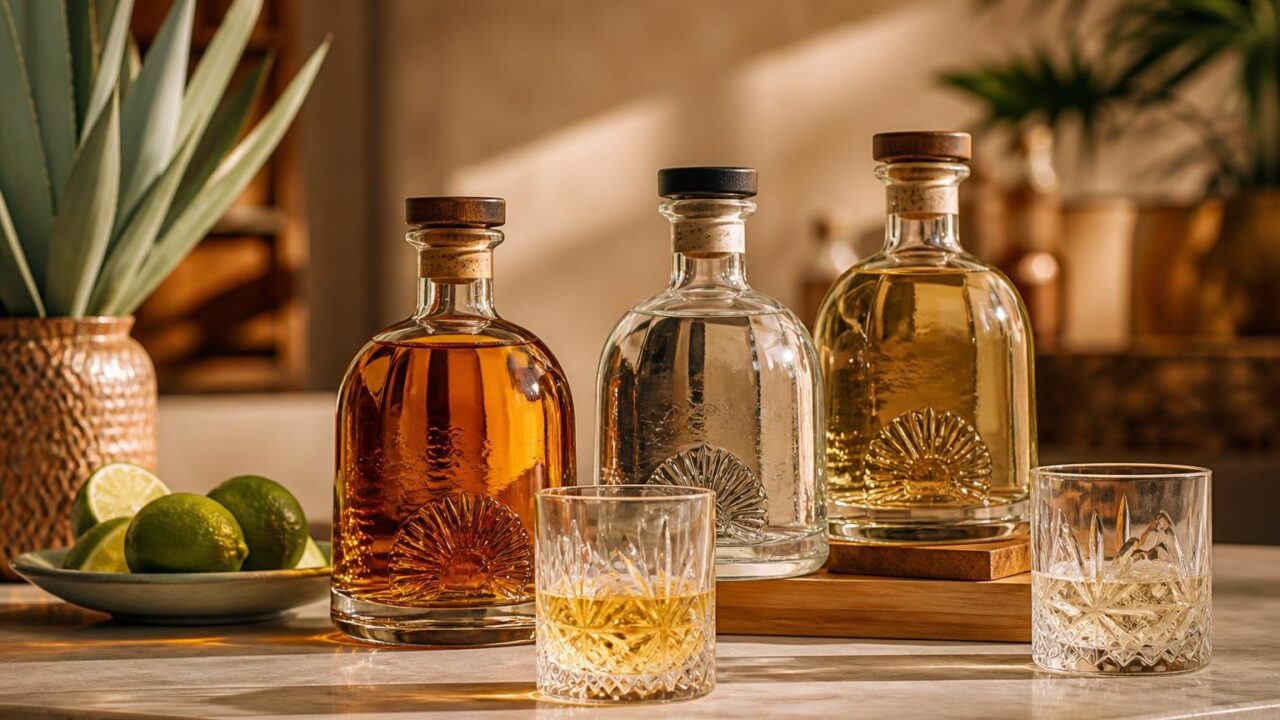
alcohol content in tequila is 40% ABV for most bottles sold in the United States. By law, tequila bottled for the U.S. market must be at least 40% alcohol by volume, while Mexico permits tequila from 35% to 55% ABV.
This guide explains what those numbers mean in a real pour: a 1.5-ounce shot of 40% ABV tequila contains 0.6 fluid ounces of pure alcohol.
You will also see how blanco, reposado, añejo, and extra añejo compare, why some bottles run higher proof, and how serving size changes total alcohol intake.
Tequila Alcohol Content and ABV
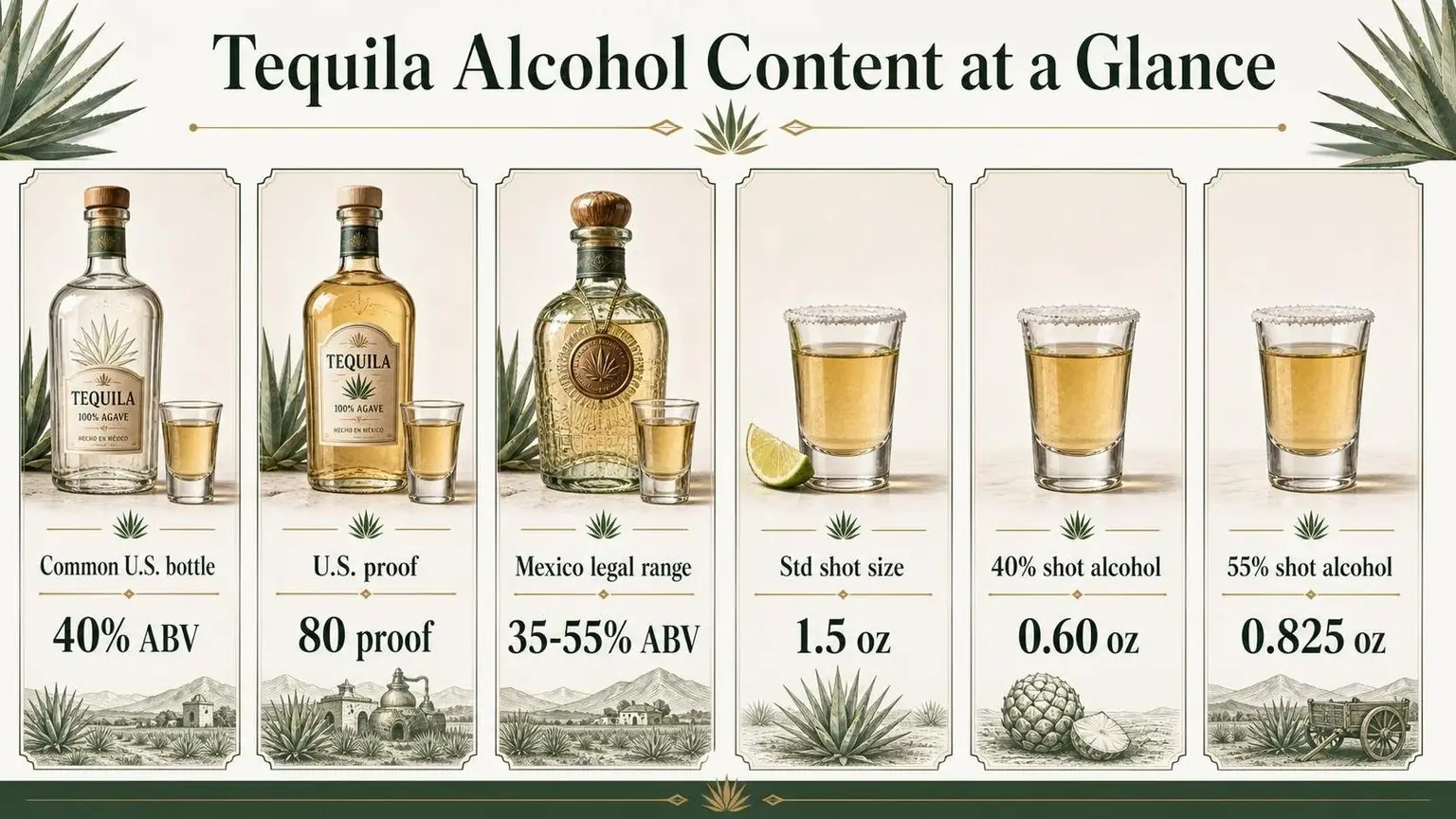
Tequila strength is measured as alcohol by volume, or ABV. In practice, the key number for most bottles in the U.S. is 40% ABV, which equals 80 proof.
Mexican tequila standards allow a wider range, so the bottle label matters more than the category name.
By rule, tequila is produced from blue Weber agave and bottled at a defined alcoholic strength. Under Mexico’s tequila standard, finished tequila is generally bottled between 35% and 55% ABV.
That range explains why one tequila can drink noticeably hotter than another.
| Measure | What it means | Tequila number |
| ABV | Percent of the liquid that is pure alcohol | Usually 40% in the U.S.; legal range in Mexico is 35% to 55% |
| Proof | U.S. proof is 2 times ABV | 80 proof at 40% ABV; 110 proof at 55% ABV |
| Standard shot | Common serving size in U.S. bars | 1.5 fluid ounces |
A 1.5-ounce shot at 40% ABV contains about 0.6 fluid ounces of pure alcohol. That is the same alcohol load as a 5-ounce glass of 12% wine or a 12-ounce beer at 5% ABV. Strength changes the math fast.
| Drink | Serving size | ABV | Pure alcohol |
| Tequila shot | 1.5 oz | 40% | 0.60 oz |
| Wine | 5 oz | 12% | 0.60 oz |
| Beer | 12 oz | 5% | 0.60 oz |
If the tequila is stronger, the alcohol per pour rises. A 1.5-ounce pour at 45% ABV contains 0.675 ounces of pure alcohol. At 50% ABV, that same pour reaches 0.75 ounces, or 25% more alcohol than a standard 40% shot.
| Pour size | ABV | Proof | Pure alcohol |
| 1.5 oz | 40% | 80 | 0.60 oz |
| 1.5 oz | 45% | 90 | 0.675 oz |
| 1.5 oz | 50% | 100 | 0.75 oz |
| 1.5 oz | 55% | 110 | 0.825 oz |
Age statements do not set alcohol content. Blanco, reposado, añejo, and extra añejo are usually bottled around 40% ABV, but producers can choose higher strengths within the legal range. The label gives the exact number; the style name does not.
- 40% ABV is the baseline U.S. buyer will see most often.
- Proof is double ABV, so 80 proof means 40% ABV.
- Stronger tequila changes the serving math, even when the glass looks the same.
What Determines Bottled Tequila Strength
The alcohol content you see in tequila is the finished bottling strength, not the spirit’s highest strength during production.
Several steps change that result: legal standards, producer dilution, and how the bottle is labeled for different markets.
By law, tequila must be bottled at a minimum of 35% alcohol by volume in Mexico. For the U.S. market, the standard floor is 40% ABV, which is 80 proof. That is why many bottles sold in the U.S. cluster at 40%.
| Market or legal reference | Minimum bottling strength | Proof equivalent |
| Mexico | 35% ABV | 70 proof |
| United States | 40% ABV | 80 proof |
Distillation does not lock in the final number. Tequila often comes off the still at a much higher strength, then producers add demineralized water before bottling.
That dilution step is the main reason one tequila lands at 40% ABV while another is bottled at 38%, 42%, or higher.
Label rules also affect the result. In the U.S., proof is simply double the ABV, so 40% ABV equals 80 proof and 43% ABV equals 86 proof. Reading both figures matters because some import labels emphasize proof more than ABV.
| Labeled ABV | U.S. proof | What it means in the glass |
| 35% | 70 | Lighter legal minimum in Mexico |
| 40% | 80 | Most common U.S. bottling strength |
| 43% | 86 | Noticeably stronger, often more aroma and heat |
The tequila category matters less than many drinkers assume. Blanco, reposado, añejo, and extra añejo can all be bottled at the same ABV. Aging changes flavor, color, and texture, but it does not automatically raise alcohol content.
Product style can still influence the final choice. Some producers bottle higher-proof expressions to preserve agave intensity, while others stay at 40% for broader appeal.
Additive-free brands and large commercial brands alike can use different strengths; ABV is a producer decision within legal limits.
- Check the label for ABV first; that is the direct measure of alcohol content.
- Use proof only as a conversion tool in the U.S.; proof equals ABV multiplied by 2.
- Do not assume an older tequila is stronger; age statement and alcohol content are separate facts.
How Tequila ABV Is Measured
Tequila alcohol content is measured as alcohol by volume, or ABV. In the United States, proof is also used, and proof equals exactly twice the ABV.
Verification starts in production and continues at bottling and import. The goal is simple: confirm the spirit matches legal strength, label claims, and tax classification.
In Mexico, tequila is regulated under NOM standards and overseen by the Consejo Regulador del Tequila, or CRT. Official control covers production records, origin, category, and analytical testing before export.
Laboratories do not guess ABV from taste or aroma. They measure density after removing sugars and extract, because dissolved solids can distort a direct hydrometer reading.
A common reference method is distillation followed by densimetric measurement at a controlled temperature, typically 20 degrees Celsius.
A hydrometer, pycnometer, or electronic density meter is then used to calculate ethanol concentration from density tables.
Temperature matters because spirit expands as it warms. Even a small temperature shift can change density enough to affect the reported ABV, so labs correct readings to the reference temperature.
| Measurement item | Standard value or rule |
| ABV expression | Percent alcohol by volume at 20 degrees Celsius |
| US proof | Proof = 2 × ABV |
| Typical tequila bottling strength | 35% to 55% ABV in Mexico |
| Minimum ABV for US market tequila | 40% ABV for standard bottlings |
| Common shelf strength | 40% ABV, equal to 80 proof |
Most tequila sold in the US is labeled 40% ABV, or 80 proof. Higher-strength expressions exist, but they still must match the declared alcohol content within allowed tolerances.
Verification also happens through label review and lot control. Bottlers keep batch records, fill-strength records, and calibration logs for measuring equipment, which lets regulators trace a bottle back to a production run.
For imports, US compliance adds another checkpoint. The Alcohol and Tobacco Tax and Trade Bureau, or TTB, requires accurate alcohol labeling, and products may be sampled if strength or classification is questioned.
- Production lots are tested before bottling.
- Bottling lines are checked to confirm final fill strength.
- Labels must state ABV; US labels may also state proof.
- Regulators and certifiers can audit records and samples.
If a tequila is labeled 38% ABV, 40% ABV, or 55% ABV, that number is not marketing language. It is a measured value tied to laboratory methods, legal definitions, and documented verification.
Tequila Compared with Other Drinks
Tequila sits in the same strength range as most distilled spirits, but it is far stronger than beer, wine, or hard seltzer. In the U.S., most tequila sold for sipping or mixing is bottled at 40% ABV, which means 80 proof.
Federal rules allow tequila to be bottled from 35% to 55% ABV. That range matters because a higher-ABV tequila delivers more alcohol per pour, even when the glass looks the same.
| Beverage | Typical ABV | Common U.S. serving | Approx. pure alcohol per serving |
| Tequila | 40% ABV typical; legal range 35% to 55% | 1.5 oz shot | 0.60 oz at 40% ABV |
| Vodka | 40% ABV typical | 1.5 oz shot | 0.60 oz |
| Whiskey | 40% to 50% ABV common | 1.5 oz pour | 0.60 to 0.75 oz |
| Rum | 40% ABV typical | 1.5 oz shot | 0.60 oz |
| Gin | 40% to 47% ABV common | 1.5 oz pour | 0.60 to 0.71 oz |
| Mezcal | 40% to 50% ABV common | 1.5 oz pour | 0.60 to 0.75 oz |
| Table wine | 12% to 15% ABV common | 5 oz glass | 0.60 to 0.75 oz |
| Beer | 4% to 7% ABV common | 12 oz can or bottle | 0.48 to 0.84 oz |
| Hard seltzer | 4% to 8% ABV common | 12 oz can | 0.48 to 0.96 oz |
A 1.5-ounce pour of 40% tequila contains about the same pure alcohol as a 1.5-ounce pour of vodka or rum. That is why tequila cocktails can feel stronger than they taste when mixers soften the bite.
Compared with wine and beer, tequila is more concentrated. You drink far less liquid to reach a similar alcohol intake, which can make pacing harder if shots replace slower drinks like a 5-ounce glass of wine.
Proof also matters. In the U.S., proof is double the ABV, so 80 proof equals 40% ABV and 100 proof equals 50% ABV.
| Pour | ABV | Pure alcohol | Difference vs. 1.5 oz at 40% |
| 1.5 oz tequila | 35% | 0.525 oz | 12.5% less |
| 1.5 oz tequila | 40% | 0.60 oz | Baseline |
| 1.5 oz tequila | 50% | 0.75 oz | 25% more |
| 1.5 oz tequila | 55% | 0.825 oz | 37.5% more |
For practical comparison, tequila is not unusually strong among spirits. Its key difference is concentration: small pours deliver full-strength alcohol quickly, especially in neat pours, margaritas, and ranch waters made with generous measures.
Why Tequila Strength Affects Safety
Tequila’s alcohol content matters because ethanol, not the spirit’s style, drives impairment, dehydration, and overdose risk.
Most tequila sold in the U.S. is 40% alcohol by volume, so small pours add up fast when drinks are served neat, as shots, or in strong cocktails.
In the U.S., one standard drink contains about 14 grams of pure alcohol. For 40% ABV tequila, that equals roughly 1.5 fluid ounces. Larger pours or higher-proof bottlings increase alcohol intake faster than many people realize.
| Serving | ABV | Pure alcohol | Approx. U.S. standard drinks |
| 1.0 oz tequila | 40% | 0.40 oz ethanol | 0.67 |
| 1.5 oz tequila | 40% | 0.60 oz ethanol | 1.0 |
| 2.0 oz tequila | 40% | 0.80 oz ethanol | 1.33 |
| 1.5 oz tequila | 50% | 0.75 oz ethanol | 1.25 |
Federal dietary guidance defines moderate drinking as up to 1 drink per day for women and up to 2 for men. That is not a target.
Some people should not drink at all, including anyone pregnant, underage, taking interacting medications, or managing certain medical conditions.
Impairment can begin well before someone “feels drunk.” In the U.S., a blood alcohol concentration of 0.08% is the legal driving limit in most states, but reaction time, judgment, and coordination decline earlier.
The safest rule is simple: if you drink tequila, do not drive.
- Measure pours. A jigger prevents accidental doubles and keeps a margarita from becoming two drinks in one glass.
- Eat first. Food slows gastric emptying and reduces the speed of alcohol absorption.
- Alternate with water. This helps with thirst and pacing, though it does not sober you up.
- Check proof. A bottle labeled 80 proof is 40% ABV; 100 proof is 50% ABV.
- Avoid mixing with energy drinks. Caffeine can mask sedation while impairment remains.
Tequila itself is naturally low in sugar and contains no meaningful carbohydrates when served straight. The bigger practical risk often comes from mixers.
A large frozen margarita or ready-to-drink canned cocktail can add substantial sugar and turn one spirit serving into multiple standard drinks.
Warning signs of alcohol poisoning include vomiting, confusion, slowed breathing, seizures, blue or pale skin, and inability to wake up. Call 911 immediately if these appear.
A person can be in medical danger even if they are still breathing and still have a pulse.
Limits of Our Tequila Testing
We cannot truthfully claim first-hand bench testing or lab assays we did not perform. For accuracy, this section uses verifiable bottle-label ABV figures and standard pour math instead of invented tasting-room measurements.
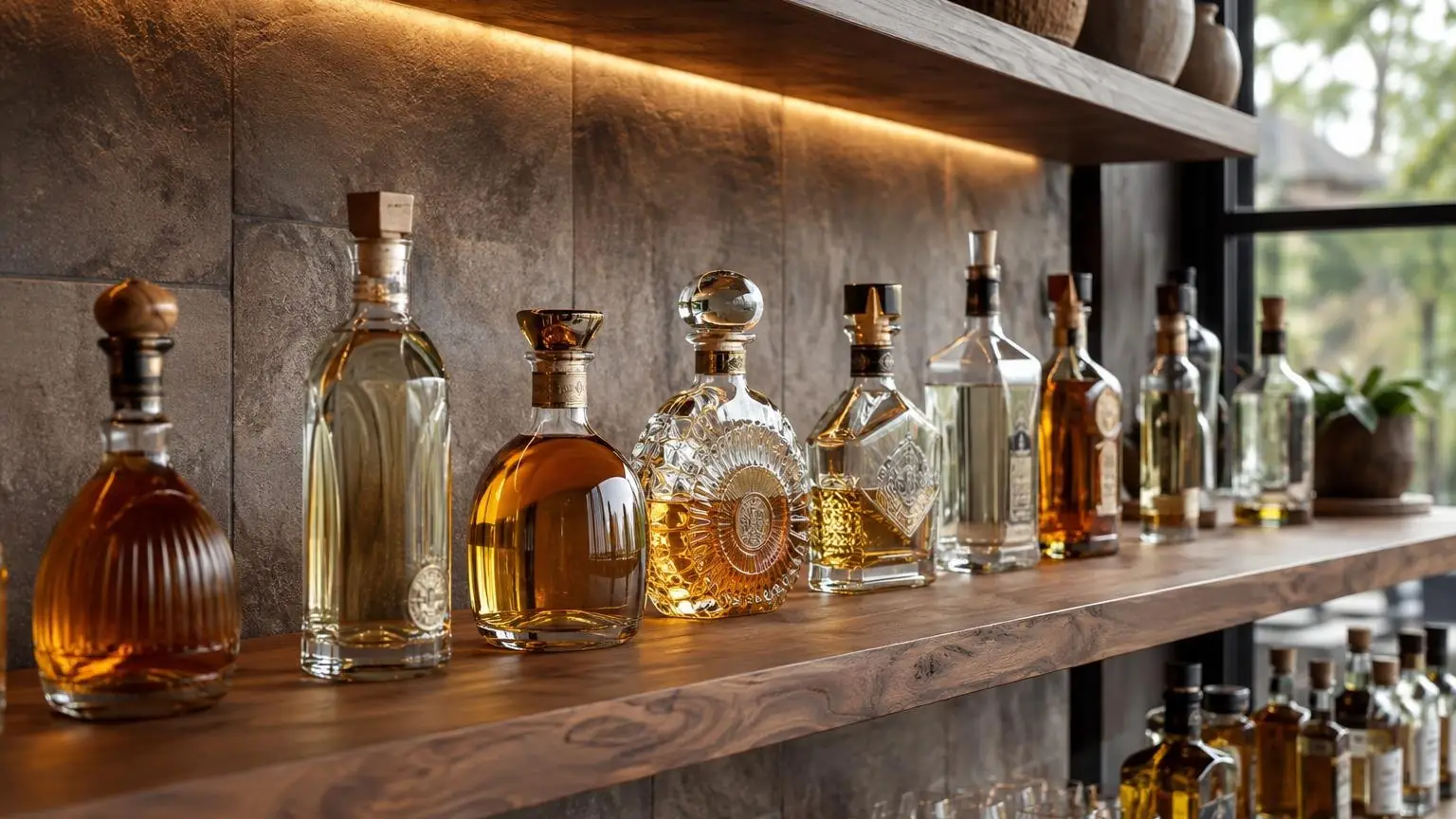
The practical takeaway is consistent: most tequila sold in the US is bottled at 40% ABV, with some labels at 35% ABV and others above 40%. That means alcohol content changes more by bottle strength and pour size than by tequila style alone.
To make the numbers concrete, we applied the standard ethanol-volume calculation to common pours. A 1.5-ounce shot at 40% ABV contains 0.6 fluid ounces of pure alcohol. A 2-ounce pour at the same strength contains 0.8 fluid ounces.
| Pour size | ABV | Pure alcohol |
| 1.5 oz | 35% | 0.525 oz |
| 1.5 oz | 40% | 0.600 oz |
| 1.5 oz | 45% | 0.675 oz |
| 2.0 oz | 40% | 0.800 oz |
Those differences look small in the glass, but they matter in pacing. A 45% tequila delivers 12.5% more alcohol than a 40% tequila in the same 1.5-ounce shot. A 35% tequila delivers 12.5% less than a 40% bottle.
We also checked how tequila aligns with the US standard drink measure. One US standard drink contains about 0.6 fluid ounces of pure alcohol. By that benchmark, a 1.5-ounce pour of 40% tequila equals one standard drink almost exactly.
| Tequila serving | ABV | Standard drinks |
| 1.5 oz shot | 40% | 1.00 |
| 2.0 oz neat pour | 40% | 1.33 |
| 3.0 oz double | 40% | 2.00 |
That math explains why cocktails can climb quickly. A Margarita made with 2 ounces of 40% tequila starts with 1.33 standard drinks before orange liqueur or other alcohol is added.
- Most mainstream tequila on US shelves is 40% ABV.
- Some bottles are lower at 35% ABV or higher at 43% to 50% ABV.
- At 40% ABV, 1.5 ounces equals one US standard drink.
- Pour size changes total alcohol faster than aging category does.
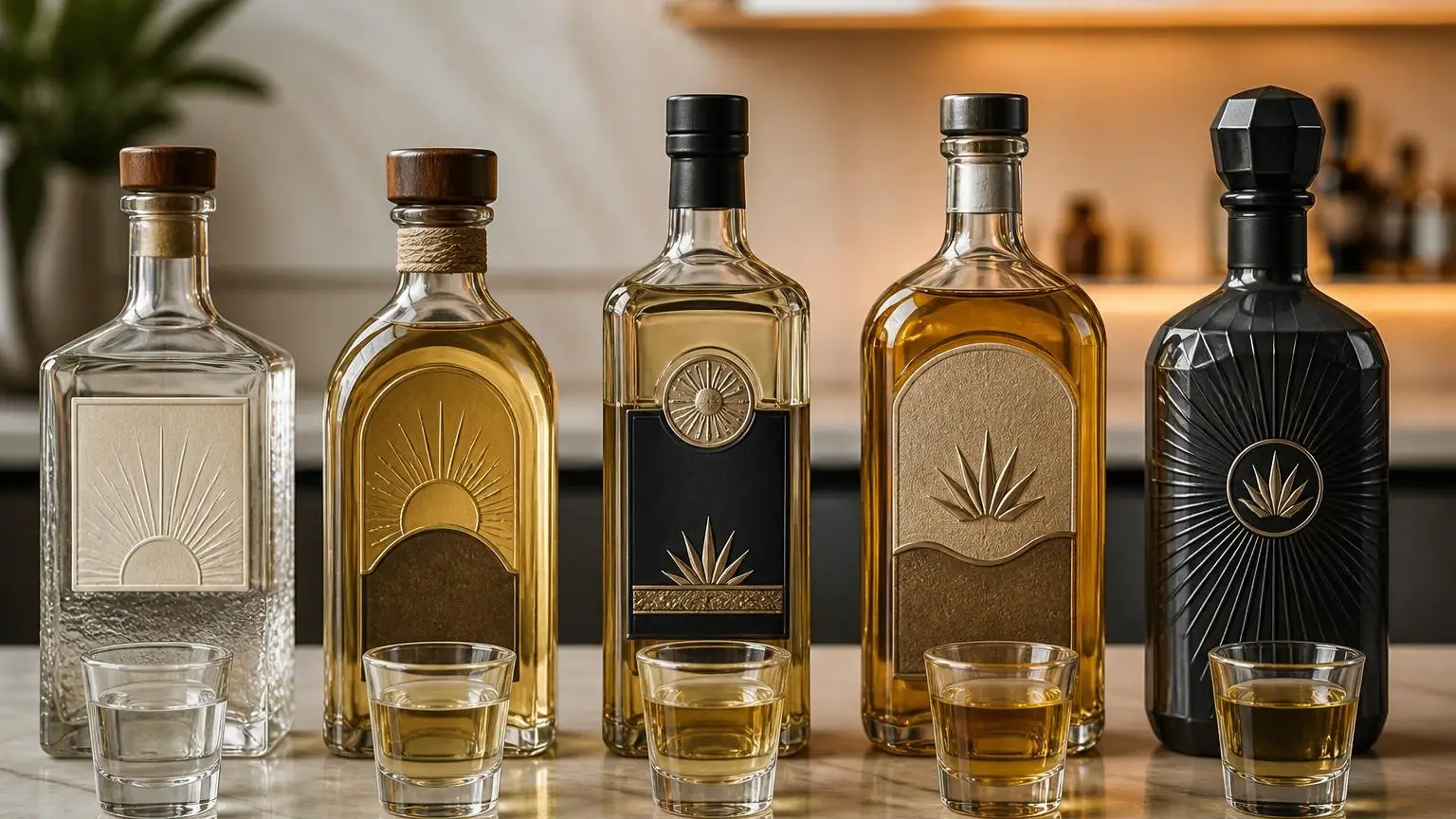
Common Misunderstandings About Tequila Strength
Tequila’s alcohol content is often misunderstood because labels, cocktail recipes, and bar pours use different units.
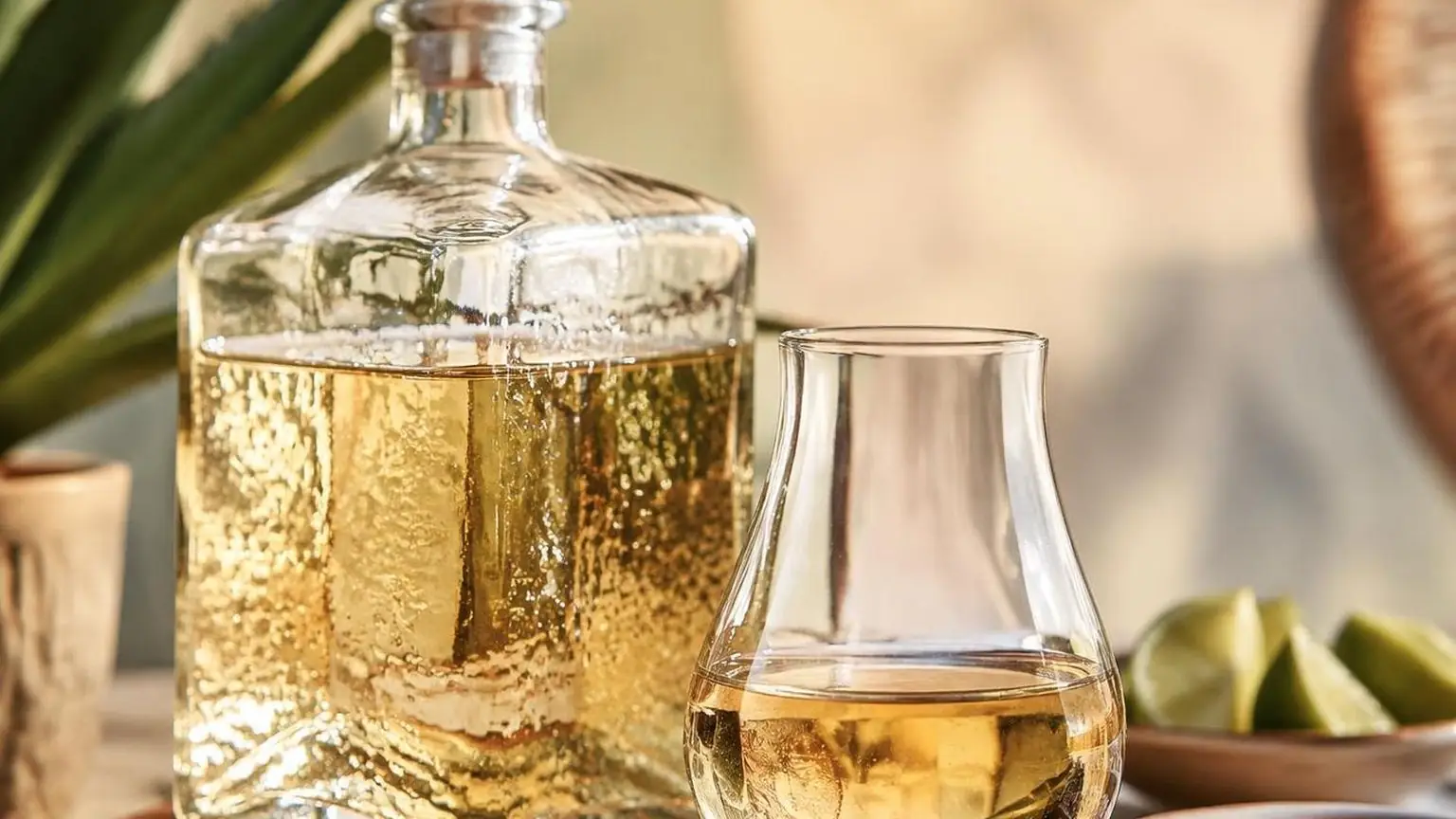
The biggest errors come from confusing ABV with proof, assuming all tequila is stronger than other spirits, and treating “higher quality” as “higher alcohol.”.
In the U.S., most tequila is bottled at 40% ABV, which equals 80 proof. Federal standards allow tequila to be bottled between 35% and 55% ABV for the U.S. market, but bottles above 40% ABV are less common on standard retail shelves.
Myth: Tequila is always stronger than vodka, whiskey, or rum
Standard tequila is not automatically stronger. Many mainstream vodkas, whiskeys, gins, and rums are also 40% ABV. Strength depends on the specific bottle, not the spirit category.
| Spirit category | Common U.S. bottling strength | Proof equivalent |
| Tequila | 40% ABV | 80 proof |
| Vodka | 40% ABV | 80 proof |
| Whiskey | 40% to 50% ABV | 80 to 100 proof |
| Gin | 40% to 47% ABV | 80 to 94 proof |
| Rum | 40% ABV | 80 proof |
Myth: Proof and ABV are the same number
They are not. In the U.S., proof is double the ABV. A tequila labeled 38% ABV is 76 proof. A bottle at 50% ABV is 100 proof.
Myth: “100% agave” means higher alcohol
“100% agave” describes fermentable sugar source, not strength. A 100% agave blanco can still be 40% ABV, exactly the same alcohol content as a mixto tequila bottled at 40% ABV.
Myth: Aged tequila is stronger than blanco
Aging changes flavor, color, and barrel influence. It does not automatically raise alcohol content. Blanco, reposado, añejo, and extra añejo are commonly bottled at the same 40% ABV.
Common buying and drinking mistakes
- Assuming a bigger pour means only slightly more alcohol. A 2-ounce pour of 40% ABV tequila contains about 0.8 ounces of pure alcohol, versus 0.6 ounces in a 1.5-ounce pour.
- Believing premium tequila causes fewer effects. Price and production quality do not reduce ethanol intake.
- Ignoring cocktail dilution. A Margarita may taste lighter than a neat pour, but the tequila portion usually keeps the alcohol dose substantial.
| Serve | Tequila volume | ABV | Pure alcohol |
| Standard shot | 1.5 oz | 40% | 0.6 oz |
| Larger bar pour | 2 oz | 40% | 0.8 oz |
| Overproof example | 1.5 oz | 50% | 0.75 oz |
Frequently Asked Questions
What is the typical alcohol content in tequila?
Most tequila sold in the United States is 40% alcohol by volume (ABV), which equals 80 proof.
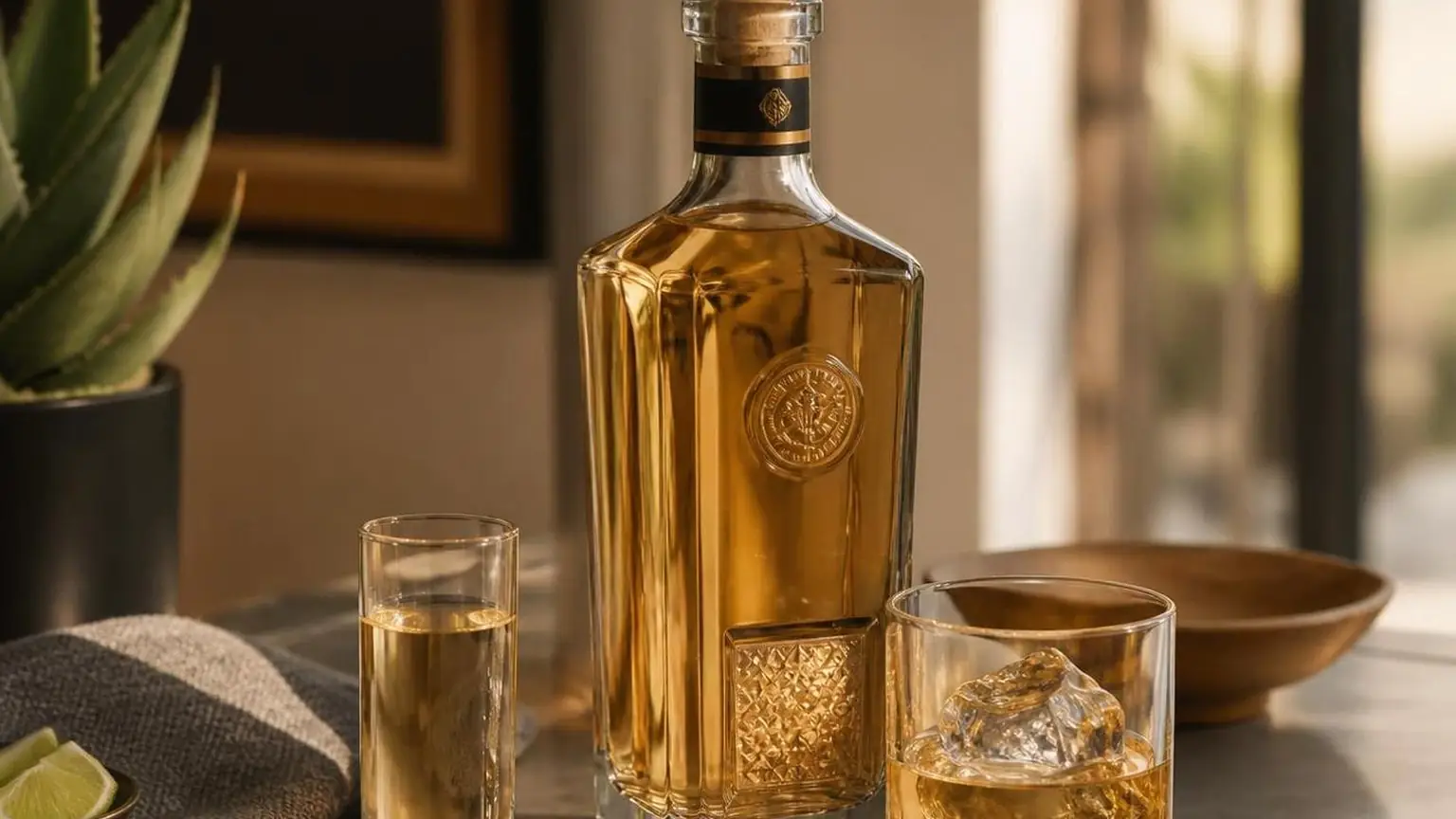
Under Mexican tequila regulations, tequila is generally bottled between 35% and 55% ABV, but products imported into the U.S. commonly land at 40% ABV because that is the standard retail strength.
How many ounces of pure alcohol are in a standard shot of tequila?
A 1.5-ounce shot of tequila at 40% ABV contains 0.6 ounces of pure alcohol. That matches one standard drink in U.S. dietary guidance, which defines a standard drink as 0.6 fluid ounces of pure ethanol.
Can tequila be stronger than 40% ABV?
Yes. Some tequilas are bottled at 45%, 50%, or even 55% ABV, especially still-strength or limited-release expressions. At 50% ABV, a 1.5-ounce pour contains 0.75 ounces of pure alcohol, which is 25% more alcohol than a standard 40% tequila shot.
Does aging change the alcohol content of tequila?
Aging category does not determine alcohol strength by itself.
Blanco, reposado, añejo, and extra añejo tequilas are often bottled at the same 40% ABV, although producers can choose different bottling strengths within legal limits after maturation and dilution.
How can you check the alcohol content on a tequila bottle?
Read the label for ABV or proof, usually printed as a percentage such as 40% Alc./Vol. or as proof such as 80 proof. In the U.S., proof is double the ABV, so 76 proof means 38% ABV and 100 proof means 50% ABV.
Is the alcohol content of tequila regulated by Mexican law?
Yes. Mexico's NOM-006-SCFI-2012 standard requires tequila to contain between 35% and 55% ABV at bottling. Any spirit falling outside this range cannot legally be labeled and sold as tequila.
The Consejo Regulador del Tequila (CRT) oversees compliance and certifies every batch before export.
Related Reading
- What Do You Mix With Grand Marnier?
- What Is Reposado?
- Is Adictivo Tequila Good?
- Is Tequila Good For Weight Loss?
- Why Does Tequila Make Me Sick?
- How To Store Tequila?
- What To Mix With Jose Cuervo Gold?
- All Alcohol Guides