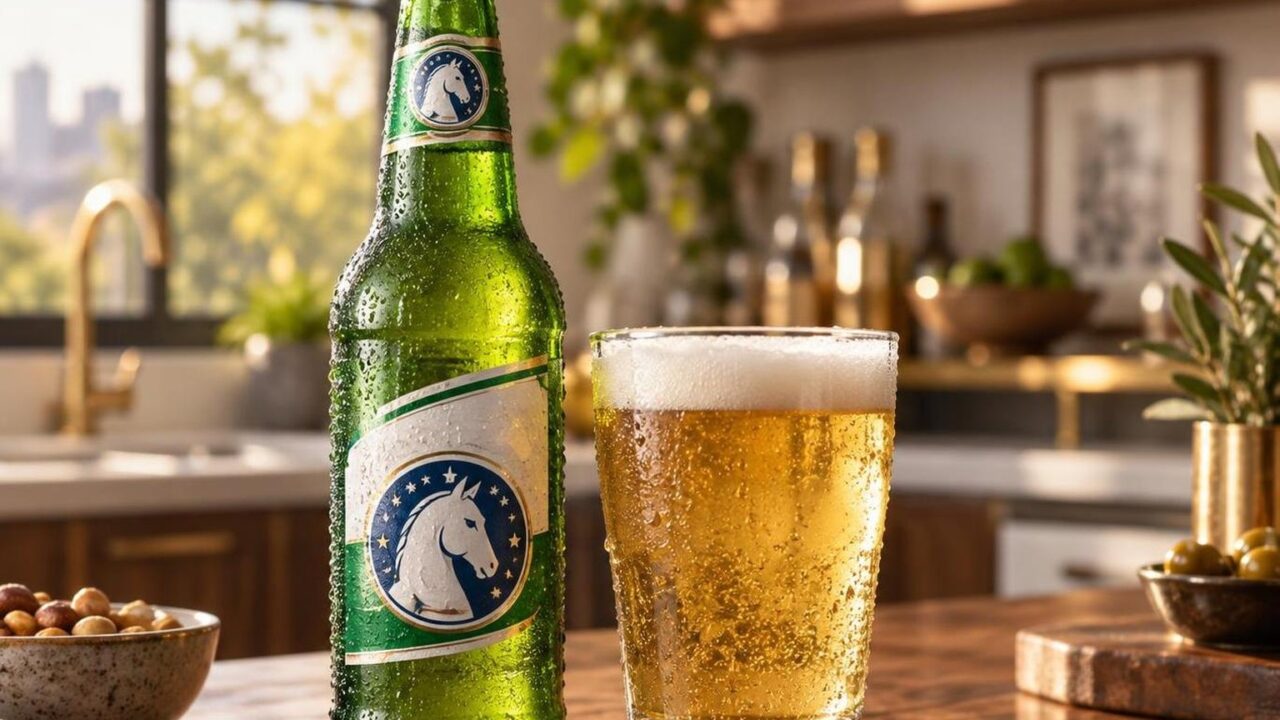
alcohol content of rolling rock beer is 4.4% ABV. That puts a 12-ounce bottle at about 0.53 ounces of pure alcohol, slightly below many standard American lagers that sit near 5.0% ABV.
This guide explains Rolling Rock’s ABV, calories, serving math, and how it compares with Bud Light, Coors Light, Miller Lite, and classic full-strength lagers.
Use it to estimate intake accurately, read labels clearly, and understand what one bottle contributes to responsible drinking limits.
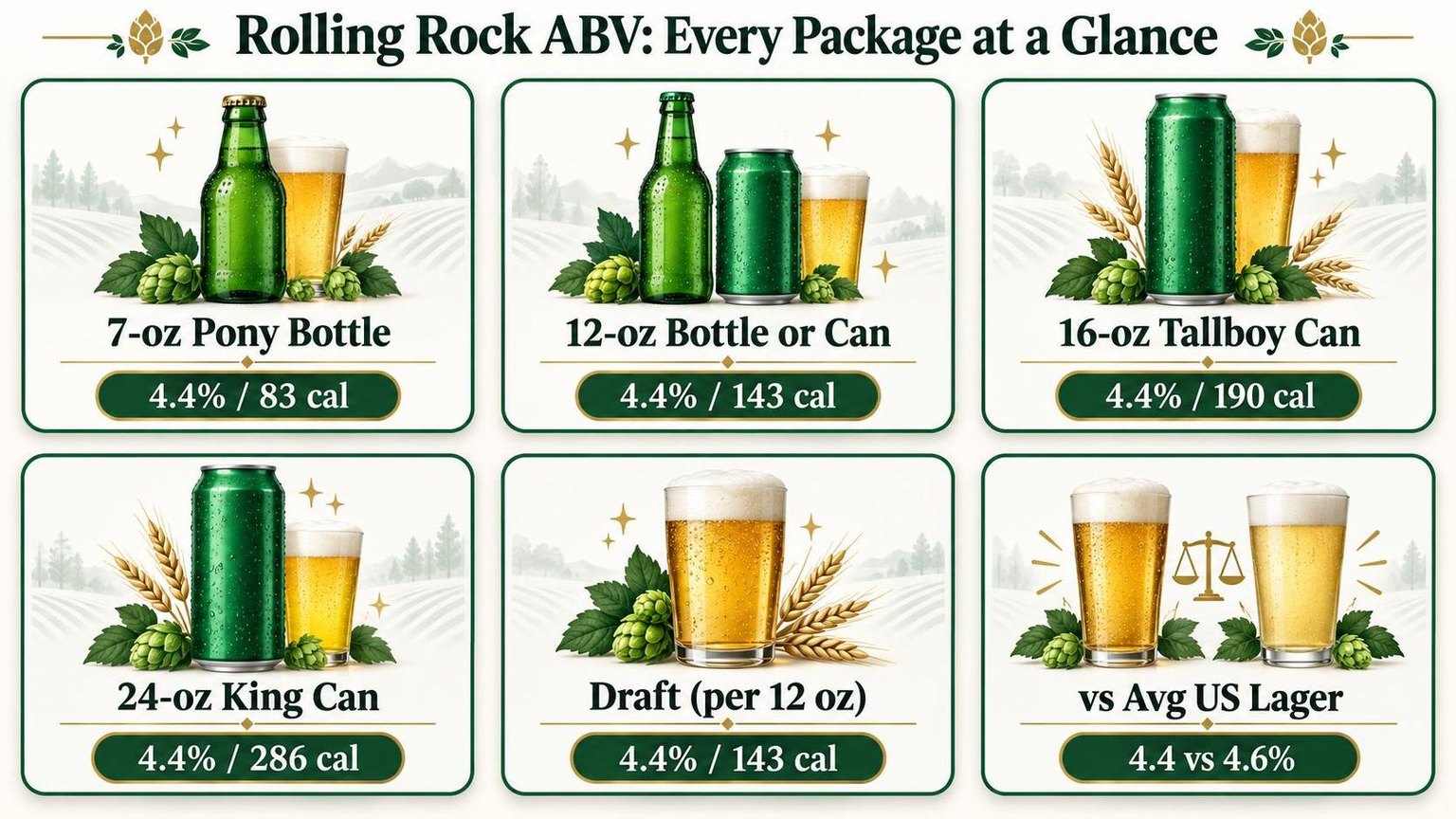
Rolling Rock ABV by package
Rolling Rock’s alcohol content varies slightly depending on the packaging format and serving size.
The flagship Rolling Rock Extra Pale carries a standard 4.4% ABV across most packages, but subtle differences exist between draft, bottle, and can formats worth examining.
Standard ABV across formats
Rolling Rock Extra Pale maintains 4.4% ABV as its listed alcohol content regardless of whether it’s served from a bottle, can, or draft line.
This consistency reflects Anheuser-Busch InBev’s centralized brewing standards since acquiring the brand in 2006.
| Package Format | ABV | Common Sizes | Calories (approx.) |
| Green glass bottle | 4.4% | 7 oz, 12 oz | 83 / 143 |
| Standard can | 4.4% | 12 oz, 16 oz | 143 / 190 |
| Draft (keg) | 4.4% | 1/2 barrel, 1/4 barrel | 143 per 12 oz |
| Rolling Rock Extra Pale (24 oz can) | 4.4% | 24 oz | 286 |
The iconic 7-ounce pony bottle
Rolling Rock’s 7-ounce “pony” bottle remains one of the brand’s most recognizable packages. At 4.4% ABV, each pony bottle delivers roughly 0.31 oz of pure alcohol — about 58% of a standard drink.
This smaller format originated in Latrobe, Pennsylvania, where the beer was brewed from 1939 until production moved to Newark, New Jersey, in 2006. The pony bottle contains approximately 83 calories.
12-ounce bottles and cans
The 12-ounce serving — whether in Rolling Rock’s signature green glass bottle or aluminum can — contains 4.4% ABV. Each 12-ounce unit delivers 143 calories and 9.8 grams of carbohydrates.
Green glass bottles expose beer to UV light, which can cause “skunking” through a photochemical reaction with iso-alpha acids in hops. Cans offer superior light protection, potentially preserving flavor stability better than bottles.
Larger format cans
Rolling Rock is available in 16-ounce tallboy cans and 24-ounce “king” cans. Both maintain the 4.4% ABV. The 16-ounce format contains approximately 190 calories, while the 24-ounce can delivers around 286 calories.
Draft versus packaged differences
Draft Rolling Rock is filtered and pasteurized identically to its packaged counterparts, maintaining the same 4.4% ABV. Kegs are available in half-barrel (15.5 gallons) and quarter-barrel (7.75 gallons) configurations.
Perceived flavor differences between draft and bottled Rolling Rock stem from serving temperature, carbonation levels, and line cleanliness — not alcohol variation.
Draft systems typically serve at 36–38°F, which can subtly affect mouthfeel.
- Half barrel keg: approximately 165 twelve-ounce servings at 4.4% ABV
- Quarter barrel keg: approximately 82 twelve-ounce servings at 4.4% ABV
- Sixth barrel keg: approximately 55 twelve-ounce servings at 4.4% ABV
Across every package, Rolling Rock delivers a uniform 4.4% ABV — placing it slightly below the American lager average of 4.6% and making it a sessionable option among mainstream domestic beers.
Alcohol content in a standard serving
Rolling Rock, brewed by Latrobe Brewing Company (now owned by Anheuser-Busch InBev), contains 4.4% alcohol by volume (ABV).
This places it squarely in the light American lager category, slightly below the 5.0% ABV average for mainstream domestic beers.
A standard 12-oz (355 ml) bottle of Rolling Rock delivers approximately 0.53 oz of pure alcohol. That figure equals roughly one standard drink as defined by the NIAAA.
Rolling Rock ABV compared to similar lagers
Rolling Rock’s 4.4% ABV sits below most mainstream competitors. The following table shows how it stacks up against other popular American lagers.
| Beer | ABV (%) | Calories (12 oz) |
| Rolling Rock Extra Pale | 4.4% | 130 |
| Budweiser | 5.0% | 145 |
| Coors Banquet | 5.0% | 147 |
| Miller High Life | 4.6% | 141 |
| Pabst Blue Ribbon | 4.8% | 144 |
| Yuengling Traditional Lager | 4.5% | 141 |
| Bud Light | 4.2% | 110 |
| Natural Light | 4.2% | 95 |
Rolling Rock’s ABV is only 0.2 percentage points above light beers like Bud Light yet carries 20 more calories per serving.
Alcohol by serving size
Rolling Rock is commonly sold in 7-oz “pony” bottles, standard 12-oz bottles, and 16-oz tallboy cans. Pure alcohol content scales proportionally with volume.
| Serving size | Volume (ml) | Pure alcohol (oz) | Standard drinks |
| 7-oz pony bottle | 207 | 0.31 | ~0.52 |
| 12-oz bottle/can | 355 | 0.53 | ~1.0 |
| 16-oz tallboy | 473 | 0.70 | ~1.3 |
| 24-oz can | 710 | 1.06 | ~2.0 |
The iconic 7-oz pony bottle — a Rolling Rock trademark since 1939 — delivers roughly half a standard drink per bottle.
What 4.4% ABV means in practice
At 4.4% ABV, Rolling Rock is classified as a session-strength beer. Most brewing authorities define session beers as those at or below 5.0% ABV.
A 160-lb person consuming two 12-oz Rolling Rocks in one hour would reach an estimated blood alcohol concentration (BAC) of approximately 0.03–0.04%, well below the 0.08% legal driving limit in all 50 U.S. states.
Rolling Rock does not produce a “light” branded variant. Its 4.4% ABV and 130-calorie profile already position it closer to light beer territory than full-strength lager territory.
- ABV: 4.4% — verified on Anheuser-Busch product labeling
- IBU (bitterness): Approximately 10–15, contributing to its notably mild, clean finish
- Original gravity: Estimated at 1.040–1.042, consistent with adjunct lager recipes
- Alcohol by weight (ABW): Approximately 3.5%, a metric still used in some U.S. state regulations
Understanding the distinction between ABV and ABW matters in states like Utah, where beer sold in grocery stores was historically capped at 3.2% ABW (equivalent to roughly 4.0% ABV). Rolling Rock at 3.5% ABW exceeded that old threshold.
Rolling Rock compared with light beers
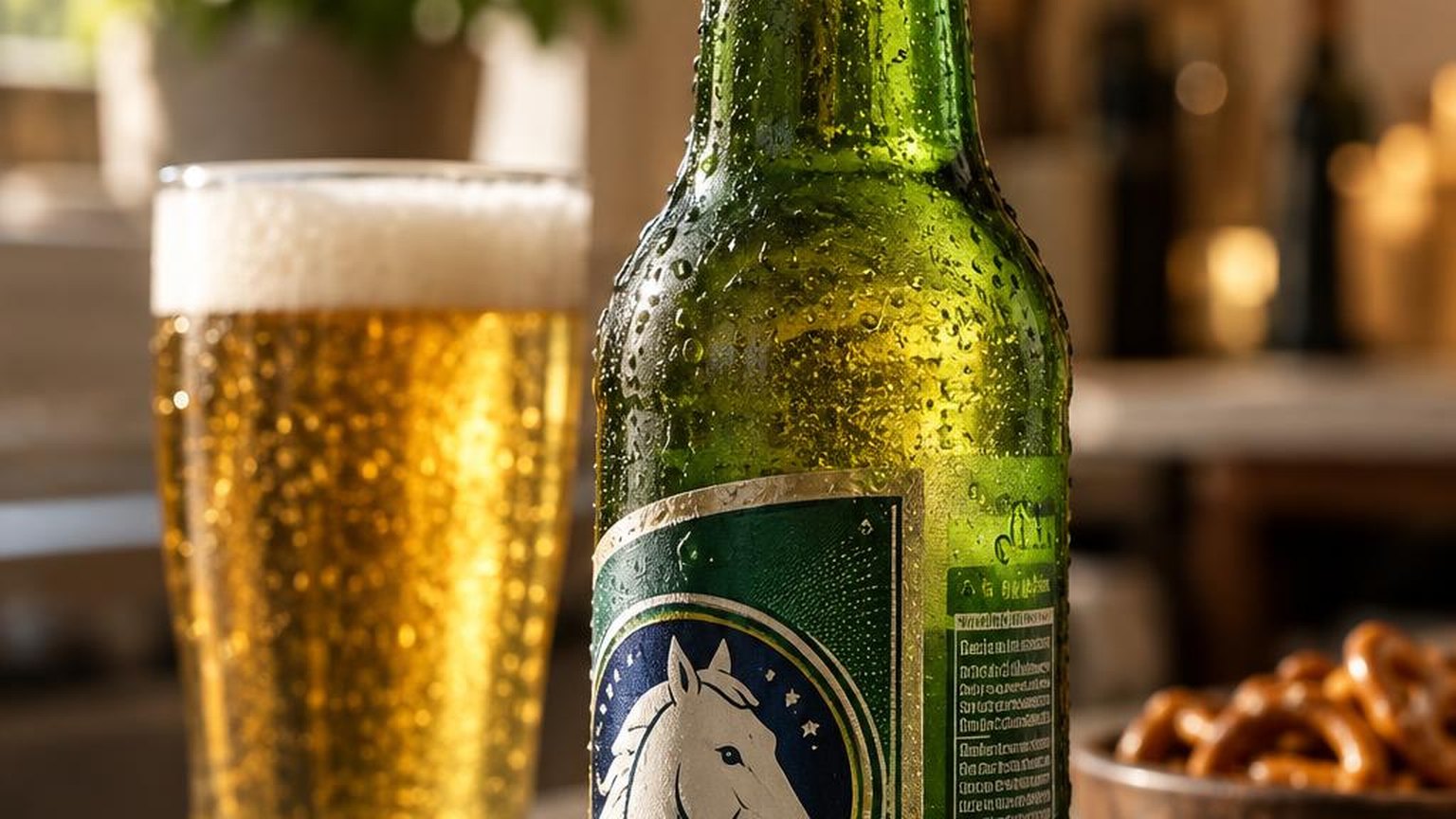
Rolling Rock Extra Pale Ale sits at 4.4% ABV, placing it between full-strength domestics and the light beer category. Its 130 calories per 12 oz serving exceeds most light beers but falls below standard lagers like Budweiser at 145 calories.
Light beers in the U.S. typically range from 3.2% to 4.2% ABV. Rolling Rock’s 4.4% ABV technically disqualifies it from the light category, though the margin separating it from top-end light beers is narrow.
ABV, calorie, and carbohydrate comparison
| Beer | ABV (%) | Calories (12 oz) | Carbs (g) |
| Rolling Rock Extra Pale Ale | 4.4 | 130 | 9.8 |
| Bud Light | 4.2 | 110 | 6.6 |
| Coors Light | 4.2 | 102 | 5.0 |
| Miller Lite | 4.2 | 96 | 3.2 |
| Michelob Ultra | 4.2 | 95 | 2.6 |
| Natural Light | 4.2 | 95 | 3.2 |
| Busch Light | 4.1 | 95 | 3.2 |
| Keystone Light | 4.1 | 104 | 5.1 |
| Corona Light | 3.7 | 99 | 5.0 |
| Miller 64 | 2.8 | 64 | 2.4 |
Rolling Rock carries 34 more calories than Miller Lite and 35 more than Michelob Ultra per serving. That gap accumulates quickly over multiple drinks during a session.
Why the numbers matter
At 9.8 grams of carbohydrates, Rolling Rock contains nearly four times the carbs found in Michelob Ultra’s 2.6 grams. Drinkers managing carbohydrate intake should note this significant difference.
The 0.2% ABV advantage Rolling Rock holds over most light beers translates to roughly 5% more ethanol per bottle. Over a six-pack, that equals approximately one additional third of a standard drink.
Key distinctions between Rolling Rock and light beers
- Brewing process: Light beers use enzymes or extended mashing to convert more starches into fermentable sugars, reducing residual carbohydrates and calories while maintaining comparable ABV.
- Body and mouthfeel: Rolling Rock’s higher carbohydrate content gives it a slightly fuller body compared to the thinner profile typical of Coors Light or Michelob Ultra.
- Flavor trade-off: The extra 30–35 calories in Rolling Rock contribute to a more pronounced malt character that ultra-light options sacrifice for calorie reduction.
- Price positioning: Rolling Rock often retails at $15–$18 per 18-pack, competitive with light beer pricing despite offering a non-light formulation.
Rolling Rock occupies an unusual middle ground. It delivers close to light-beer alcohol levels with calorie and carb counts closer to full-strength lagers, making it a poor substitute for dedicated low-calorie options.
Drinkers specifically seeking reduced-calorie alternatives should choose established light beers. Those prioritizing flavor over calorie savings may find Rolling Rock’s modest 4.4% ABV a reasonable session-strength option.
Calories and carbs alongside alcohol
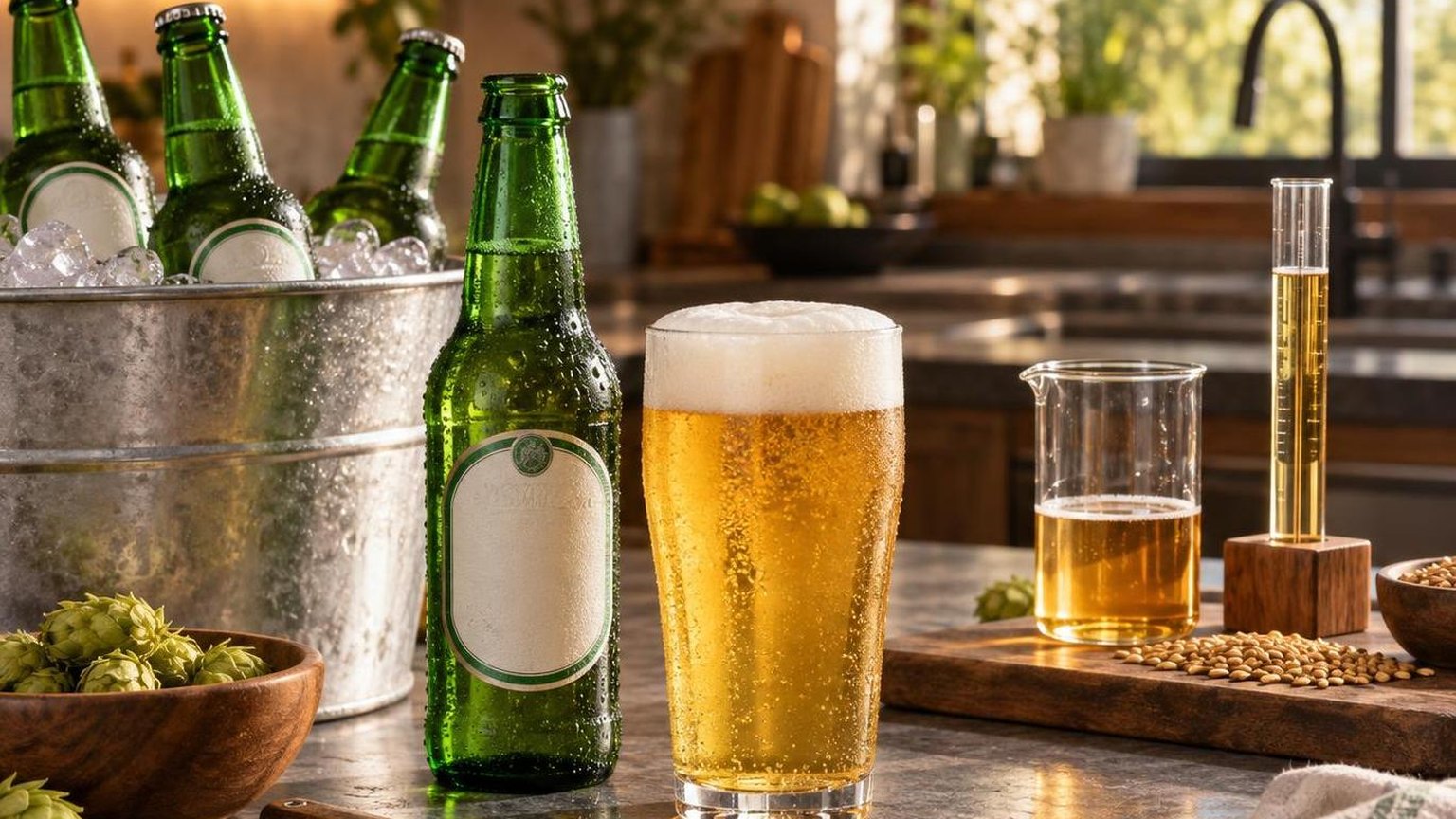
Rolling Rock’s 4.4% ABV places it in the light-to-standard American lager category, and its calorie and carb profile follows suit. A standard 12 oz bottle delivers approximately 130 calories and 10 grams of carbohydrates.
These numbers sit between ultra-light beers and craft lagers. Understanding where Rolling Rock falls helps drinkers make informed choices.
Rolling Rock vs. comparable American lagers
The following table compares Rolling Rock’s nutritional profile against popular beers in the same price and style range per 12 oz serving.
| Beer | ABV (%) | Calories | Carbs (g) |
| Rolling Rock Extra Pale | 4.4 | 130 | 10.0 |
| Budweiser | 5.0 | 145 | 10.6 |
| Coors Banquet | 5.0 | 147 | 11.7 |
| Pabst Blue Ribbon | 4.8 | 144 | 12.8 |
| Miller High Life | 4.6 | 141 | 13.1 |
| Yuengling Traditional Lager | 4.5 | 141 | 12.0 |
| Bud Light | 4.2 | 110 | 6.6 |
| Miller Lite | 4.2 | 96 | 3.2 |
Rolling Rock undercuts most full-strength domestics by 10–17 calories per bottle. Its carbohydrate count of 10 g is notably lower than Miller High Life’s 13.1 g.
Why the numbers are linked
Alcohol itself contributes 7 calories per gram—nearly double the 4 calories per gram from carbohydrates. In any beer, alcohol accounts for the majority of total calories.
At 4.4% ABV, a 12 oz Rolling Rock contains roughly 12.4 grams of pure ethanol. That ethanol alone supplies about 87 calories, meaning alcohol drives approximately 67% of the beer’s total energy.
The remaining ~43 calories come from residual carbohydrates and trace proteins left after fermentation. Rolling Rock’s clean, dry finish reflects efficient attenuation by the yeast.
Practical implications for moderate drinkers
- Calorie budgeting: Three Rolling Rocks total 390 calories—roughly equivalent to a McDonald’s McDouble (400 calories).
- Carb-conscious choices: At 10 g of carbs, Rolling Rock delivers fewer carbohydrates per bottle than Pabst Blue Ribbon or Coors Banquet, though dedicated light beers like Miller Lite (3.2 g) win that comparison decisively.
- Standard drinks: One 12 oz Rolling Rock at 4.4% ABV equals approximately 0.88 standard U.S. drinks (one standard drink = 14 g pure alcohol). This means five Rolling Rocks cross the four-standard-drink threshold.
- Session pacing: The slightly sub-standard alcohol content provides a modest buffer compared to 5.0% ABV beers, reducing total intake by roughly 12% per bottle at the same drinking pace.
Rolling Rock occupies a practical middle ground: fewer calories and carbs than most mainstream American lagers, with only marginally less alcohol.
For drinkers tracking intake, it offers a measurable advantage over heavier domestic options without requiring the flavor trade-offs of ultra-light beers.
How strong Rolling Rock tastes
Rolling Rock’s 4.4% ABV places it squarely in the light-bodied American lager category. That modest alcohol level directly shapes its flavor profile—clean, crisp, and notably mild compared to craft alternatives.
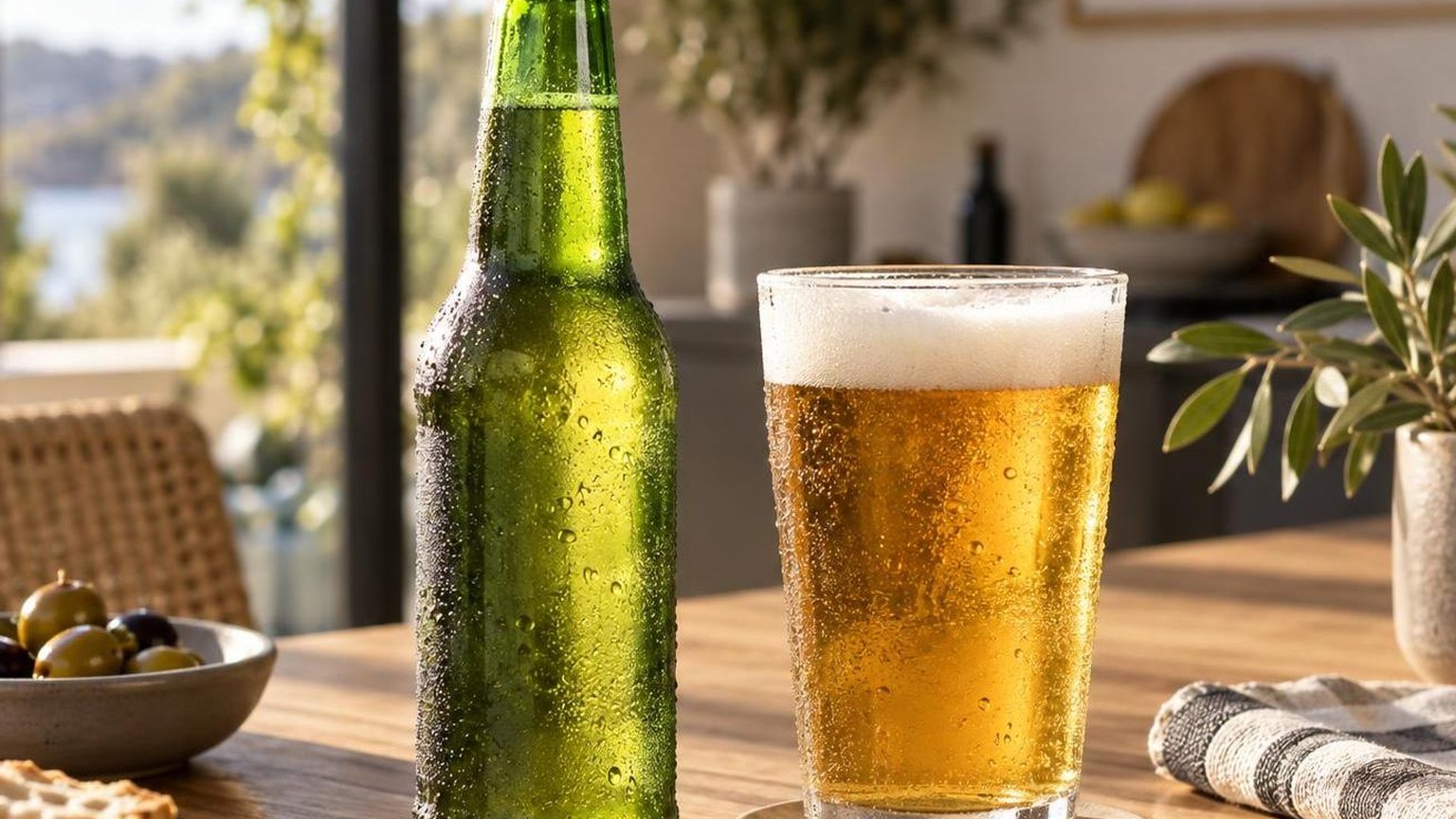
The beer pours a pale straw-gold with a thin white head. Its aroma carries faint grain and a subtle sweetness without hop-forward intensity.
Perceived strength on the palate
At 4.4% ABV, Rolling Rock delivers virtually no alcohol warmth. Drinkers perceive it as refreshing rather than boozy, which is intentional for the American adjunct lager style.
The malt bill uses rice as an adjunct grain, thinning the body and reducing residual sweetness. This creates a dry, light finish that masks even its moderate alcohol content.
Bitterness registers at approximately 10–15 IBU (International Bitterness Units). For context, a typical American IPA ranges from 40–70 IBU, making Rolling Rock roughly four to five times less bitter.
How Rolling Rock compares to similar lagers
Rolling Rock’s perceived strength aligns closely with other mainstream American lagers. The table below shows ABV, estimated IBU, and calorie counts for direct competitors.
| Beer | ABV | Estimated IBU | Calories (12 oz) |
| Rolling Rock Extra Pale | 4.4% | 10–15 | 130 |
| Budweiser | 5.0% | 12 | 145 |
| Coors Banquet | 5.0% | 11 | 147 |
| Pabst Blue Ribbon | 4.8% | 10 | 144 |
| Miller High Life | 4.6% | 7 | 141 |
| Yuengling Traditional Lager | 4.5% | 16 | 141 |
Rolling Rock sits at the lower end of this group in ABV, calories, and bitterness. Only Miller High Life comes close in lightness of body.
Flavor characteristics driven by alcohol level
- Body: Thin to medium-thin. The 4.4% ABV and rice adjunct produce a watery mouthfeel that appeals to sessionable drinking.
- Sweetness: Minimal. Lower alcohol correlates with fewer residual sugars after fermentation, keeping the finish dry and clean.
- Carbonation: Moderately high. Elevated CO₂ compensates for the light body, adding texture and a crisp bite.
- Hop presence: Barely perceptible. The low IBU count means herbal or floral hop notes stay in the background.
- Aftertaste: Short and clean. No lingering bitterness, malt sweetness, or alcohol heat remains after each sip.
Rolling Rock’s 130 calories per 12-ounce serving reflect its restrained alcohol content. Fewer fermentable sugars mean less alcohol and fewer total calories.
For drinkers seeking a beer that tastes light without crossing into the “light beer” label, Rolling Rock occupies a specific niche.
Its 4.4% ABV produces a flavor experience defined more by what it omits than what it asserts—no harsh bitterness, no alcohol burn, no heavy malt backbone.
Questions People Ask Most
What is the alcohol content of Rolling Rock beer?
Rolling Rock Extra Pale has an alcohol by volume (ABV) of 4.4%. This places it slightly below the average American lager, which typically ranges from 4.5% to 5.0% ABV.
The relatively moderate alcohol level contributes to its reputation as a light, sessionable beer.
How does Rolling Rock’s ABV compare to other popular American lagers?
At 4.4% ABV, Rolling Rock sits below Budweiser (5.0%), Coors Banquet (5.0%), and Miller High Life (4.6%). It is closer in strength to Pabst Blue Ribbon at 4.8% ABV but still noticeably lighter.
Among mainstream domestic lagers, Rolling Rock is one of the lower-alcohol options that is not marketed as a “light” beer.
How many calories does Rolling Rock have per serving?
A standard 12 oz bottle of Rolling Rock contains approximately 130 calories and 9.8 grams of carbohydrates. The calorie count is directly linked to its 4.4% ABV, since alcohol contributes roughly 7 calories per gram.
This makes it a mid-range option calorically among non-light domestic beers.
Does Rolling Rock make a light version with lower alcohol?
Yes, Rolling Rock Green Light is a reduced-calorie variant with an ABV of 3.7% and only 83 calories per 12 oz serving.
It was introduced to compete in the light beer segment dominated by brands like Bud Light (4.2% ABV) and Miller Lite (4.2% ABV). The lower alcohol content results from a brewing process that produces less residual sugar and fermentable extract.
Has Rolling Rock’s alcohol content changed since Anheuser-Busch acquired the brand?
Anheuser-Busch InBev purchased Rolling Rock from InBev (which had acquired it from Latrobe Brewing) in 2006 and moved production from Latrobe, Pennsylvania, to Newark, New Jersey.
The official ABV has remained at 4.4% through the ownership transition.
However, some long-time drinkers have reported perceived differences in taste and body, which they attribute to changes in water source and brewing equipment rather than alcohol percentage.
How many Rolling Rocks would it take to reach the legal blood alcohol limit?
For a 160-pound male drinking on an empty stomach, approximately 3 to 4 Rolling Rocks consumed within one hour would bring blood alcohol concentration (BAC) near the 0.08% legal limit in all 50 US states.
Individual factors such as body weight, sex, metabolism, and food intake significantly alter this estimate. Each 12 oz Rolling Rock at 4.4% ABV delivers roughly 0.52 oz of pure ethanol.
What style of beer is Rolling Rock and how does that style influence its alcohol level?
Rolling Rock is classified as an American adjunct lager, a style that uses rice or corn alongside barley malt to create a lighter body and flavor.
Adjunct lagers typically fall between 4.0% and 5.0% ABV because the adjuncts produce a highly fermentable but lower-gravity wort.
Rolling Rock’s 4.4% ABV fits squarely within this range, reflecting the style’s emphasis on drinkability over intensity.
Is Rolling Rock’s 4.4% ABV listed on the bottle or packaging?
Federal labeling regulations enforced by the Alcohol and Tobacco Tax and Trade Bureau (TTB) do not require ABV to appear on beer labels, though most major brewers now include it voluntarily.
Rolling Rock displays its 4.4% ABV on its packaging and on the Anheuser-Busch product website.
The iconic green bottle also features the mysterious “33” on its back label, which refers to the number of words in the original quality pledge — not the alcohol content.
Related Reading
- How Many Gallons In A Half Barrel Keg? The Complete, Real-World Guide From Someone Who’s Actually Used One
- What Alcohol Mixes With Ginger Ale?
- Crowler Vs Growler – What Is The Difference Between Them?
- Does IBC Root Beer Have Caffeine? The Most Accurate Answer
- Budweiser Zero Vs Heineken 0.0: Which is Best?
- Is A&W Root Beer Caffeine Free? The Most Accurate Answer
- All Alcohol Guides
- TTBOnline COLA Registry – Anheuser-Busch Label Approval (2023)
- USDA FoodData Central – Beer, regular, all (2024)
- National Institute on Alcohol Abuse and Alcoholism – What Is a Standard Drink? (2023)
- CDC Alcohol and Public Health – Frequently Asked Questions (2024)
- BeerAdvocate – Rolling Rock Extra Pale (2024)
- Untappd – Rolling Rock Extra Pale (2024)
- RateBeer – Rolling Rock (2024)
- CalorieKing – Rolling Rock Beer (2024)
- Cornell University – Alcohol Content of Selected Beverages (2023)
- Anheuser-Busch Official Product Page – Rolling Rock (2024)