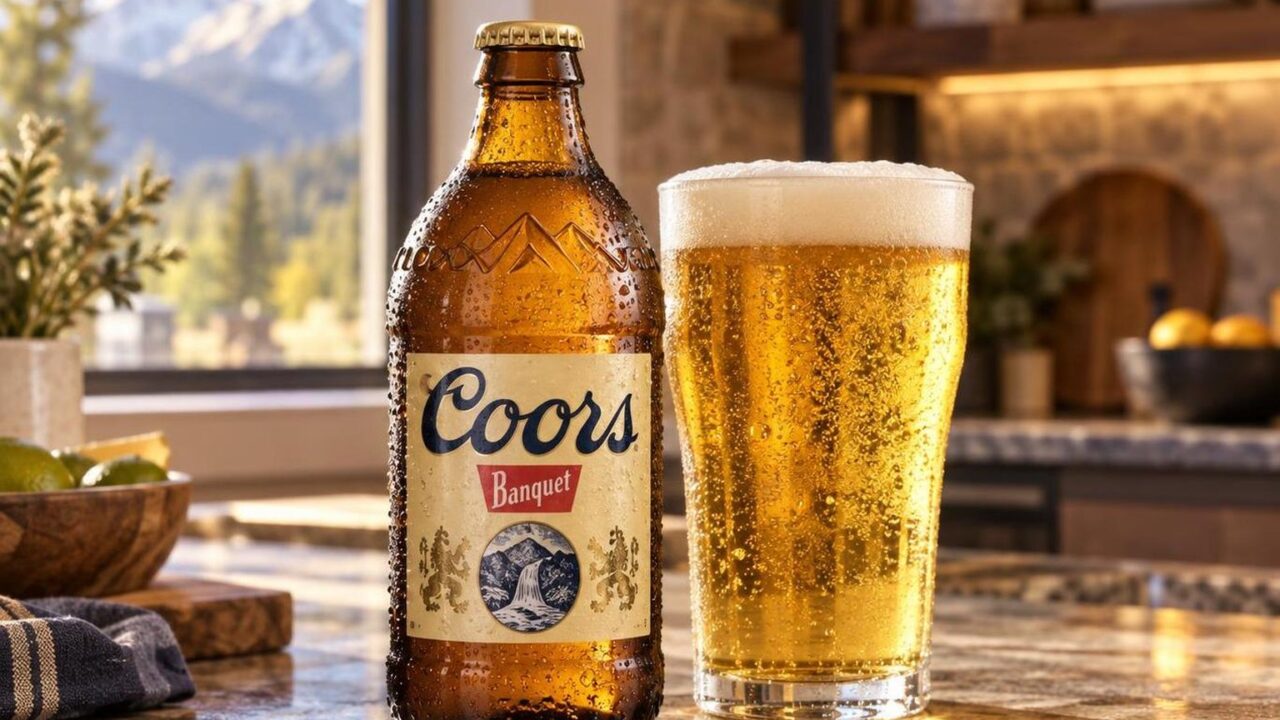
alcohol content of coors banquet beer is 5.0% ABV.
That means a 12-ounce bottle or can contains about 0.6 fluid ounces of pure alcohol, matching the U.S. “standard drink” definition used by the National Institute on Alcohol Abuse and Alcoholism.
Coors Banquet is a full-strength American lager, not a light beer, so its alcohol level sits above Coors Light at 4.2% ABV.
This guide explains how its ABV compares with common beers, how many calories typically come with that strength, and what the number means for responsible serving and drinking.
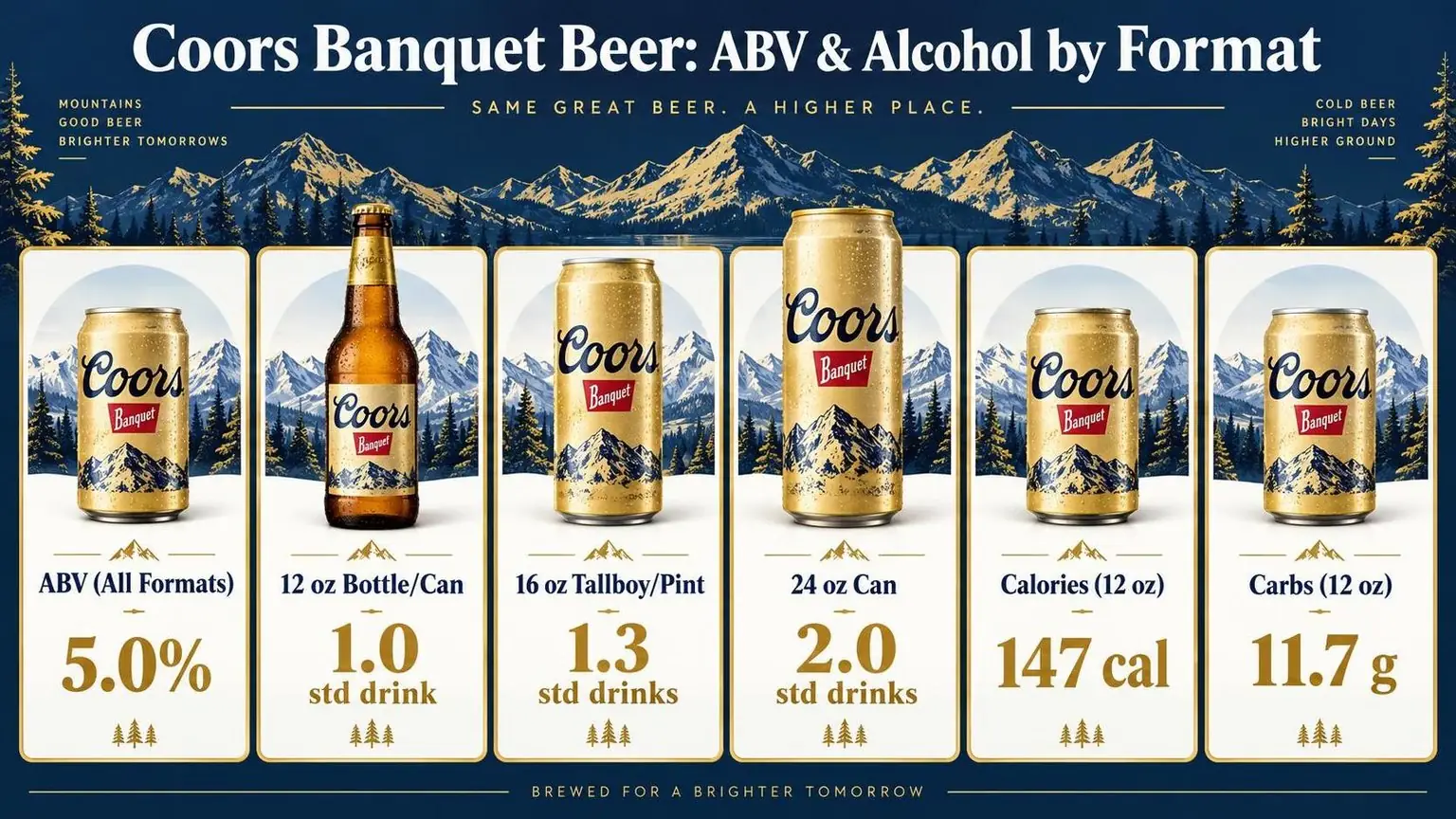
Coors Banquet ABV and Serving Sizes
Coors Banquet carries an alcohol by volume (ABV) of 5.0%, placing it squarely in the standard American lager category. This ABV has remained consistent since the Coors Brewing Company standardized the recipe for wide distribution decades ago.
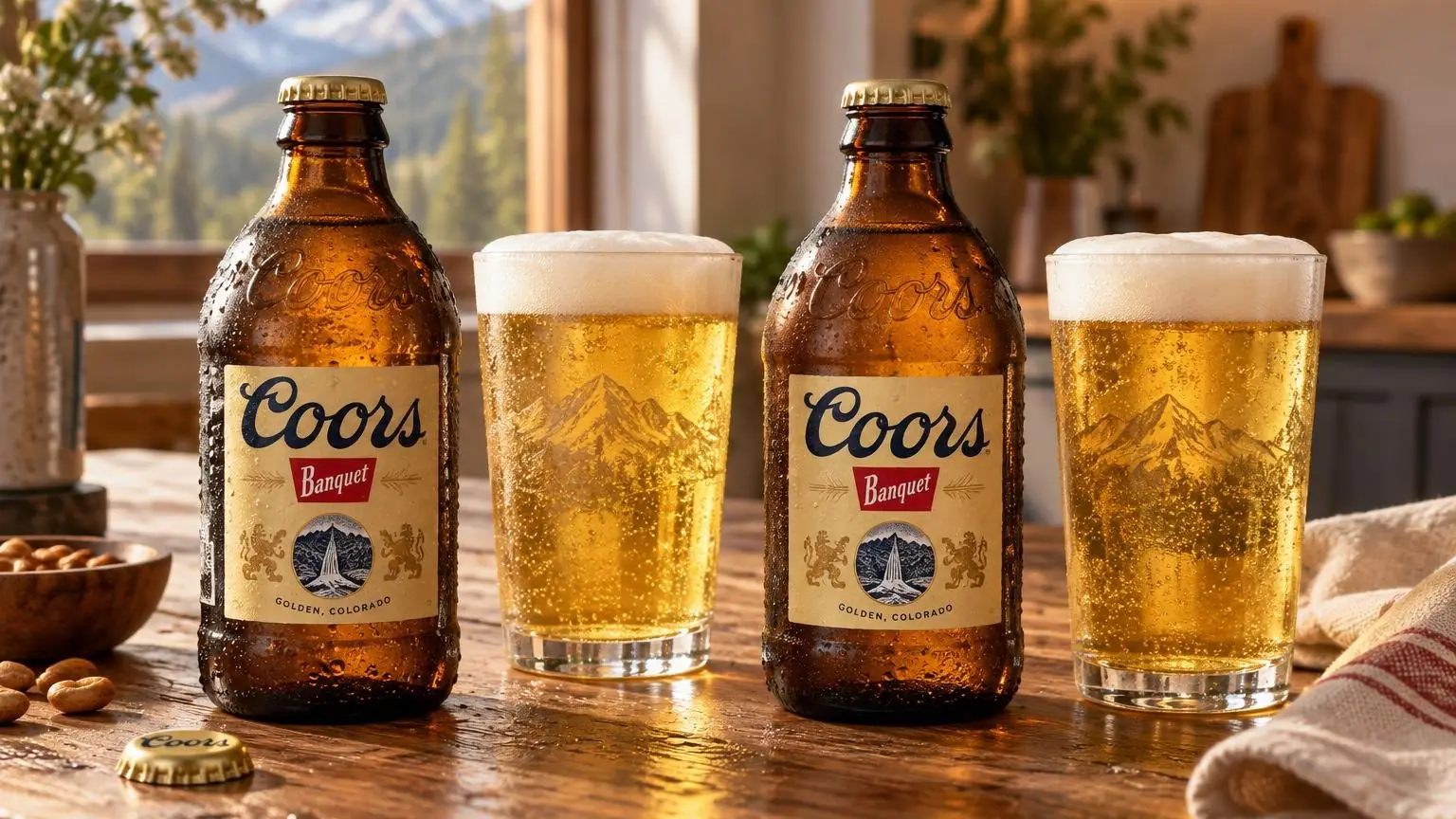
How 5.0% ABV Compares to Other Coors Varieties
The Coors portfolio spans a range of alcohol levels. Coors Banquet sits in the middle, stronger than Coors Light but below certain specialty releases.
| Beer | ABV | Calories (12 oz) |
| Coors Light | 4.2% | 102 |
| Coors Banquet | 5.0% | 147 |
| Coors Original (Draft) | 5.0% | 149 |
| Keystone Light (Coors family) | 4.1% | 104 |
| Blue Moon Belgian White (Molson Coors) | 5.4% | 170 |
Standard Alcohol Content by Serving Size
Coors Banquet is available in multiple package formats. The actual alcohol delivered per container changes substantially as the volume increases.
| Serving Size | Fluid Ounces | Alcohol (fl oz) | Standard Drinks (approx.) |
| Bottle | 12 oz | 0.60 | 1.0 |
| Tallboy Can | 16 oz | 0.80 | 1.3 |
| Large Can | 24 oz | 1.20 | 2.0 |
| Pint (draft) | 16 oz | 0.80 | 1.3 |
| Stubby Bottle | 7 oz | 0.35 | 0.6 |
The NIAAA defines one U.S. standard drink as 0.6 fluid ounces of pure alcohol. A single 12-oz Coors Banquet equals exactly one standard drink by that measure.
Calorie and Carbohydrate Breakdown
At 147 calories per 12-oz serving, Coors Banquet is moderately caloric for a domestic lager. It contains approximately 11.7 grams of carbohydrates, 1.3 grams of protein, and zero grams of fat.
These macros reflect the adjunct-lager brewing process Coors uses, incorporating both barley malt and corn adjuncts. The corn contributes fermentable sugars that lighten the body without significantly altering final ABV.
Factors That Affect Perceived Strength
- Serving temperature: Coors Banquet is traditionally served cold (38–42°F), which suppresses alcohol perception on the palate.
- Carbonation level: Moderate carbonation accelerates alcohol absorption slightly compared to flat beverages.
- Drinking pace: The clean, easy-drinking profile encourages faster consumption, increasing effective intake per hour.
- Altitude note: Brewed at the Golden, Colorado facility at 5,675 feet elevation, though altitude affects the drinker’s tolerance—not the beer’s ABV.
Coors Banquet’s 5.0% ABV delivers a predictable, moderate alcohol load. Drinkers tracking intake should count each 12-oz bottle as one full standard drink and adjust for larger formats accordingly.
Alcohol in Cans Bottles and Draft
Coors Banquet maintains a consistent 5.0% ABV across cans, bottles, and draft pours in the United States. Unlike some craft breweries that vary ABV by format, Molson Coors holds this figure steady regardless of packaging or serving method.
ABV by Package Format
The 5.0% ABV applies uniformly across every Coors Banquet container sold domestically. Here is the full breakdown by format:
| Format | ABV | Calories (approx.) | Fluid Ounces |
| 12 oz can | 5.0% | 149 | 12 |
| 16 oz tallboy can | 5.0% | 199 | 16 |
| 24 oz can | 5.0% | 298 | 24 |
| 12 oz longneck bottle | 5.0% | 149 | 12 |
| 32 oz crowler | 5.0% | 397 | 32 |
| Draft (pint, 16 oz) | 5.0% | 199 | 16 |
Calorie counts scale linearly with volume because the recipe and fermentation profile remain identical across packaging lines.
Standard Drinks per Container
One U.S. standard drink equals 14 grams of pure alcohol. A 12 oz serving of Coors Banquet at 5.0% ABV equals exactly one standard drink. Larger formats contain proportionally more.
| Container | Standard Drinks |
| 12 oz can or bottle | 1.0 |
| 16 oz tallboy or draft pint | 1.3 |
| 24 oz can | 2.0 |
| 32 oz crowler | 2.7 |
This matters for responsible consumption tracking. A single 24 oz can delivers two full standard drinks, not one.
Does Draft Pour Differently?
Draft Coors Banquet uses the same 5.0% ABV beer. Kegs are filled from the same production batch as cans and bottles at the Golden, Colorado brewery. No reformulation occurs for draft lines.
Perceived differences in draft strength typically stem from serving temperature, carbonation levels, or pour size. A standard U.S. pint glass holds 16 oz, delivering 1.3 standard drinks per pour.
State-Level Exceptions
Until 2019, Utah capped grocery and convenience store beer at 3.2% ABW (approximately 4.0% ABV). Coors produced a separate 3.2% ABW version for that market.
Utah raised its limit to 5.0% ABV in November 2019, eliminating the need for a lower-strength variant.
Colorado faced a similar restriction until 2019 when full-strength beer became available in grocery stores. Kansas followed in April 2019. Today, Coors Banquet sells at 5.0% ABV in all 50 states without variation.
- All domestic Coors Banquet packaging holds 5.0% ABV
- Calorie content scales directly with serving size
- Draft uses the identical recipe as packaged formats
- No reduced-ABV state variants remain in production as of 2019
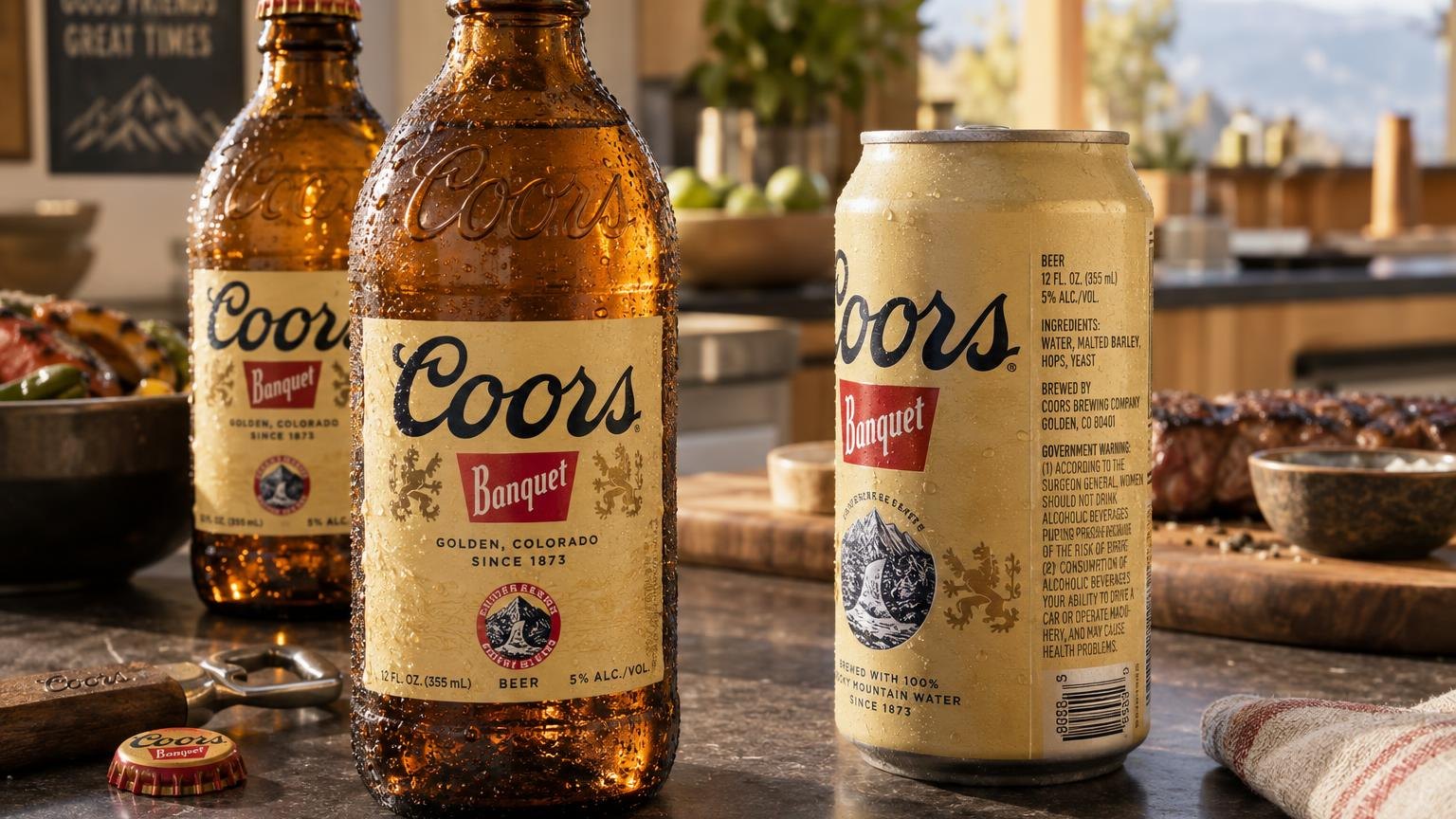
Coors Banquet Versus Coors Light
Coors Banquet and Coors Light share the same Golden, Colorado heritage but differ significantly in alcohol strength, calorie count, and body. Understanding these differences helps drinkers choose the right beer for the occasion.
ABV and Nutritional Comparison
The core distinction starts with alcohol by volume. Coors Banquet contains 5.0% ABV, while Coors Light sits at 4.2% ABV—a 0.8 percentage-point gap that affects flavor intensity and caloric load.
| Attribute | Coors Banquet (12 oz) | Coors Light (12 oz) |
| ABV | 5.0% | 4.2% |
| Calories | 149 | 102 |
| Carbohydrates | 11.7 g | 5.0 g |
| Protein | 1.1 g | 0.7 g |
| Fat | 0 g | 0 g |
| Year Introduced | 1873 | 1978 |
| Style | American Lager | Light Lager |
Coors Banquet delivers 46% more calories per serving than Coors Light. That gap comes primarily from higher carbohydrate content—more than double—and the additional alcohol itself.
Brewing and Ingredient Differences
Both beers use Rocky Mountain water and Moravian barley. Coors Banquet follows Adolph Coors’s original 1873 recipe, using a higher proportion of two-row barley malt for a fuller grain character.
Coors Light uses a lighter malt bill with added corn syrup during fermentation. The corn syrup ferments out completely but contributes to a thinner, crisper body with fewer residual sugars.
Flavor Profile
Coors Banquet has a toasted malt sweetness, mild hop bitterness around 10–15 IBU, and a slightly honeyed finish. The mouthfeel is medium-bodied compared to craft lagers but fuller than any light beer.
Coors Light emphasizes clean, neutral drinkability. Its bitterness is lower—roughly 10 IBU—and the finish is dry with minimal malt presence. It was specifically engineered for maximum refreshment.
When to Choose Each
- Choose Coors Banquet when you want more flavor, a slightly stronger buzz per bottle, and a beer that pairs with grilled meats or hearty pub food.
- Choose Coors Light for extended social sessions, hot-weather drinking, or calorie-conscious consumption where staying under 110 calories per serving matters.
- Standard drinks per serving: Coors Banquet equals roughly 0.83 standard drinks; Coors Light equals approximately 0.70—a meaningful difference across multiple beers.
Market Position
Coors Light ranked as the fourth best-selling beer in the United States in 2023, moving over 16 million barrels annually. Coors Banquet is a smaller-volume brand but has experienced double-digit sales growth since 2022.
The “Banquet” nickname originated from its popularity at miners’ banquets in the Colorado Rockies during the late 1800s.
That heritage-driven branding now fuels a resurgence among younger drinkers seeking authenticity over light-beer marketing.
Calories Carbs and Alcohol by Volume
Coors Banquet is a full-strength American lager, not a light beer. Molson Coors lists it at 5% alcohol by volume, with 147 calories and 11.7 grams of carbohydrates per standard serving.
Nutrition and alcohol per serving
| Serving size | Calories | Carbohydrates | Alcohol by volume |
| 12 US fluid ounces | 147 calories | 11.7 grams | 5% ABV |
| 16 US fluid ounces | Approximately 196 calories | Approximately 15.6 grams | 5% ABV |
| 24 US fluid ounces | Approximately 294 calories | Approximately 23.4 grams | 5% ABV |
The larger-serving figures are proportional estimates based on Molson Coors’ published standard-serving values. ABV does not increase with package size, but the total amount of ethanol, calories, and carbohydrates consumed does.
How much alcohol is in Coors Banquet?
A standard serving contains about 0.6 fluid ounces of pure ethanol. That amount matches the US definition of one standard alcoholic drink used by the National Institute on Alcohol Abuse and Alcoholism.
| Coors Banquet amount | Approximate pure alcohol | US standard drinks |
| 12 fluid ounces | 0.6 fluid ounces | 1 |
| 16 fluid ounces | 0.8 fluid ounces | 1.33 |
| 24 fluid ounces | 1.2 fluid ounces | 2 |
Container size therefore matters when tracking intake. One large can may represent more than one standard drink even though the label still shows the same alcohol-by-volume percentage.
Where the calories come from
Beer calories come primarily from ethanol and residual carbohydrate.
Alcohol supplies about seven calories per gram, while carbohydrate supplies about four calories per gram; these values explain why a full-strength lager can remain calorie-dense without tasting sweet.
| Energy-bearing component | Approximate energy per gram |
| Alcohol | 7 calories |
| Carbohydrate | 4 calories |
| Protein | 4 calories |
| Fat | 9 calories |
The carbohydrate figure is not the beer’s complete calorie source. Multiplying carbohydrates alone by their energy value accounts for only part of the listed total because ethanol contributes substantial energy.
Practical tracking points
- Use the package volume, not the can count alone, when estimating calories and standard drinks.
- Draft pours can exceed the standard serving used for published nutrition information.
- ABV measures ethanol as a percentage of total liquid volume; it does not indicate calories directly.
- Nutrition values may vary slightly because brewing ingredients and analytical rounding create normal batch-level differences.
For diet or alcohol tracking, record both serving volume and number of servings. The manufacturer’s standard-serving figures provide the most reliable baseline for Coors Banquet sold in the United States.
How Many Coors Banquets to Drive
Coors Banquet contains 5.0% ABV, making each 12 oz serving deliver approximately 0.6 oz of pure alcohol. Understanding how this translates to blood alcohol concentration (BAC) determines when driving becomes illegal—and dangerous.
The legal BAC limit across all 50 U.S. states is 0.08%. Utah stands alone at 0.05%, the strictest threshold in the country.
Estimated BAC After Coors Banquet (12 oz, 5.0% ABV)
BAC depends on body weight, biological sex, food intake, and metabolism rate. The Widmark formula provides standard estimates for one-hour drinking periods.
| Beers Consumed | 160 lb Male | 140 lb Female | 200 lb Male |
| 1 | 0.025% | 0.035% | 0.020% |
| 2 | 0.050% | 0.070% | 0.040% |
| 3 | 0.075% | 0.105% | 0.060% |
| 4 | 0.100% | 0.140% | 0.080% |
| 5 | 0.125% | 0.175% | 0.100% |
These estimates assume consumption within one hour on an empty stomach, with no metabolic elimination factored in. The body metabolizes alcohol at roughly 0.015% BAC per hour.
General Thresholds by Body Weight
For most adults, the number of Coors Banquets that pushes BAC to or above 0.08% within one hour breaks down as follows:
| Body Weight | Male (Approx. Limit) | Female (Approx. Limit) |
| 120 lbs | 2 beers | 1–2 beers |
| 140 lbs | 2–3 beers | 2 beers |
| 160 lbs | 3 beers | 2 beers |
| 180 lbs | 3–4 beers | 2–3 beers |
| 200 lbs | 4 beers | 3 beers |
| 220 lbs | 4–5 beers | 3 beers |
Women typically reach higher BAC levels than men at the same weight due to differences in body water percentage and alcohol dehydrogenase enzyme activity.
Factors That Accelerate Impairment
- Empty stomach: Food slows alcohol absorption by up to 50%, according to the National Institute on Alcohol Abuse and Alcoholism (NIAAA).
- Fatigue: Sleep deprivation amplifies cognitive impairment from alcohol.
- Medications: Antihistamines, antidepressants, and pain relievers can multiply alcohol’s sedative effects.
- Carbonation: Beer’s carbonation may speed gastric emptying, accelerating absorption slightly.
- Altitude: Coors Banquet is brewed in Golden, Colorado at 5,675 feet—drinkers at high altitude may feel effects faster due to lower oxygen levels.
Critical Safety Note
Impairment begins well before reaching 0.08% BAC. The NHTSA reports that crash risk increases measurably at just 0.02% BAC—roughly one Coors Banquet for a smaller adult.
These calculations are estimates, not guarantees of legal sobriety. Individual metabolism varies significantly. The only BAC guaranteed to be safe for driving is 0.00%.
If you have consumed any Coors Banquet and need to drive, use a personal breathalyzer, wait at least one hour per standard drink consumed, or arrange alternative transportation.
Common Questions
What is the alcohol content of Coors Banquet beer?
Coors Banquet contains 5.0% alcohol by volume (ABV). This places it squarely in the standard American lager category, matching competitors like Budweiser and Miller High Life at the same 5.0% ABV level.
How many calories does Coors Banquet have compared to other beers at the same ABV?
A 12 oz serving of Coors Banquet contains approximately 147 calories and 11.7 grams of carbohydrates. This is slightly higher than Coors Light (102 calories, 4.2% ABV) but comparable to other full-strength American lagers in the 5.0% range.
Is Coors Banquet stronger than Coors Light?
Yes. Coors Banquet has 5.0% ABV while Coors Light has 4.2% ABV, making Banquet roughly 19% stronger in alcohol content per serving. The difference translates to about 0.1 additional standard drinks per 12 oz bottle.
How many Coors Banquet beers equal one standard drink?
One 12 oz Coors Banquet at 5.0% ABV equals exactly one standard drink as defined by the NIAAA (0.6 oz of pure alcohol). A standard 12 oz serving contains 0.6 fluid ounces of pure ethanol, matching the benchmark precisely.
Does the alcohol content of Coors Banquet change in 3.2% beer states?
Historically, states like Utah, Colorado, and Minnesota required grocery and convenience stores to sell only 3.2% ABW (about 4.0% ABV) beer. Coors produced a lower-strength version for these markets.
Most of these states have since reformed their laws—Utah moved to 5.0% ABV in 2019, and Colorado followed in 2019 as well—so full-strength Coors Banquet is now widely available.
Does Coors Banquet have the same ABV on draft as in bottles and cans?
Yes, Coors Banquet maintains 5.0% ABV across all packaging formats including 12 oz bottles, 12 oz cans, 16 oz tallboys, and draft kegs sold in the United States. The recipe and fermentation process are standardized regardless of the serving vessel.
Why is Coors Banquet called a “banquet beer” and does that affect its alcohol level?
The name dates to the 1800s when Adolph Coors brewed the beer in Golden, Colorado, and it was served at local miners’ banquets and celebrations.
The name reflects heritage, not a distinct brewing specification—its 5.0% ABV is a standard strength chosen for broad drinkability rather than any banquet-specific formulation.
How does Coors Banquet’s 5.0% ABV compare to craft lagers and imports?
Coors Banquet’s 5.0% ABV sits below many craft lagers, which commonly range from 4.8% to 5.5% ABV, and well below Mexican imports like Modelo Especial (4.4%) or above lighter imports like Corona Extra (4.6%).
German-style pilsners from craft breweries frequently reach 5.2–5.5%, making Coors Banquet moderate by comparison.
Further Reading
- 11 Essential Facts About How Many Cans Of Beer In A Keg (2026 Complete Draft System & Serving Guide)
- What Time Can I Buy Beer In Tn?
- How Much Is A Keg Of Beer?
- What is Draft Beer? All Information Easiest To Understand
- Rainier Beer: A Taste Of The Pacific Northwest
- How To Chug Beer? A Real-World, No-Nonsense Guide for Beginners and Party Veterans
- 12 Critical Facts About The Legal Drinking Age In Georgia
- 11 Essential Facts About How Many Glasses Of Beer In A Keg (2026 Full Draft System & Event Planner Guide)
- All Alcohol Guides
- USDA FoodData Central (2024)
- National Institute on Alcohol Abuse and Alcoholism – What Is a Standard Drink? (2024)
- CDC – Alcohol and Public Health FAQs (2024)
- Molson Coors Beverage Company – Coors Banquet Product Page (2024)
- Alcohol and Tobacco Tax and Trade Bureau – Beer Statistics (2024)
- University of Notre Dame – McDonald Center for Student Well-Being, Standard Drink Chart (2024)
- National Institutes of Health – Rethinking Drinking (2024)
- CalorieKing – Coors Banquet Beer Nutrition (2024)