FlightWineBar is reader-supported. When you buy through links on this page, we may earn an affiliate commission at no extra cost to you.
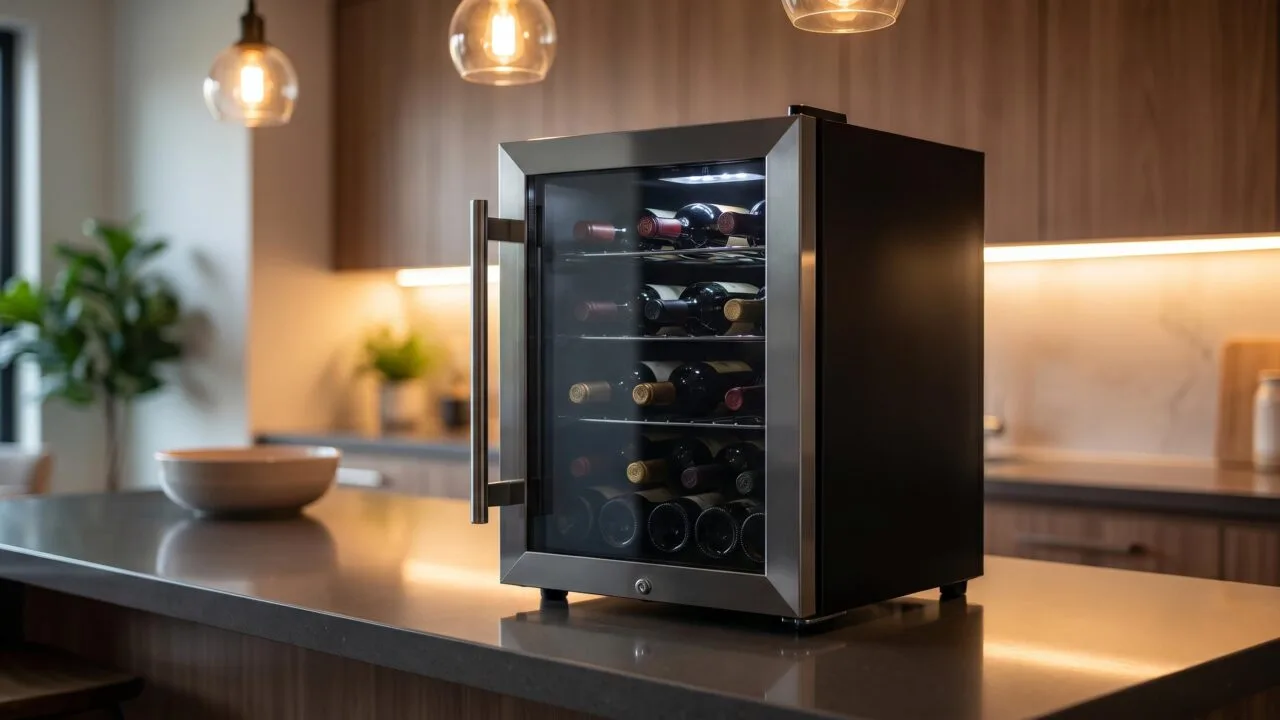
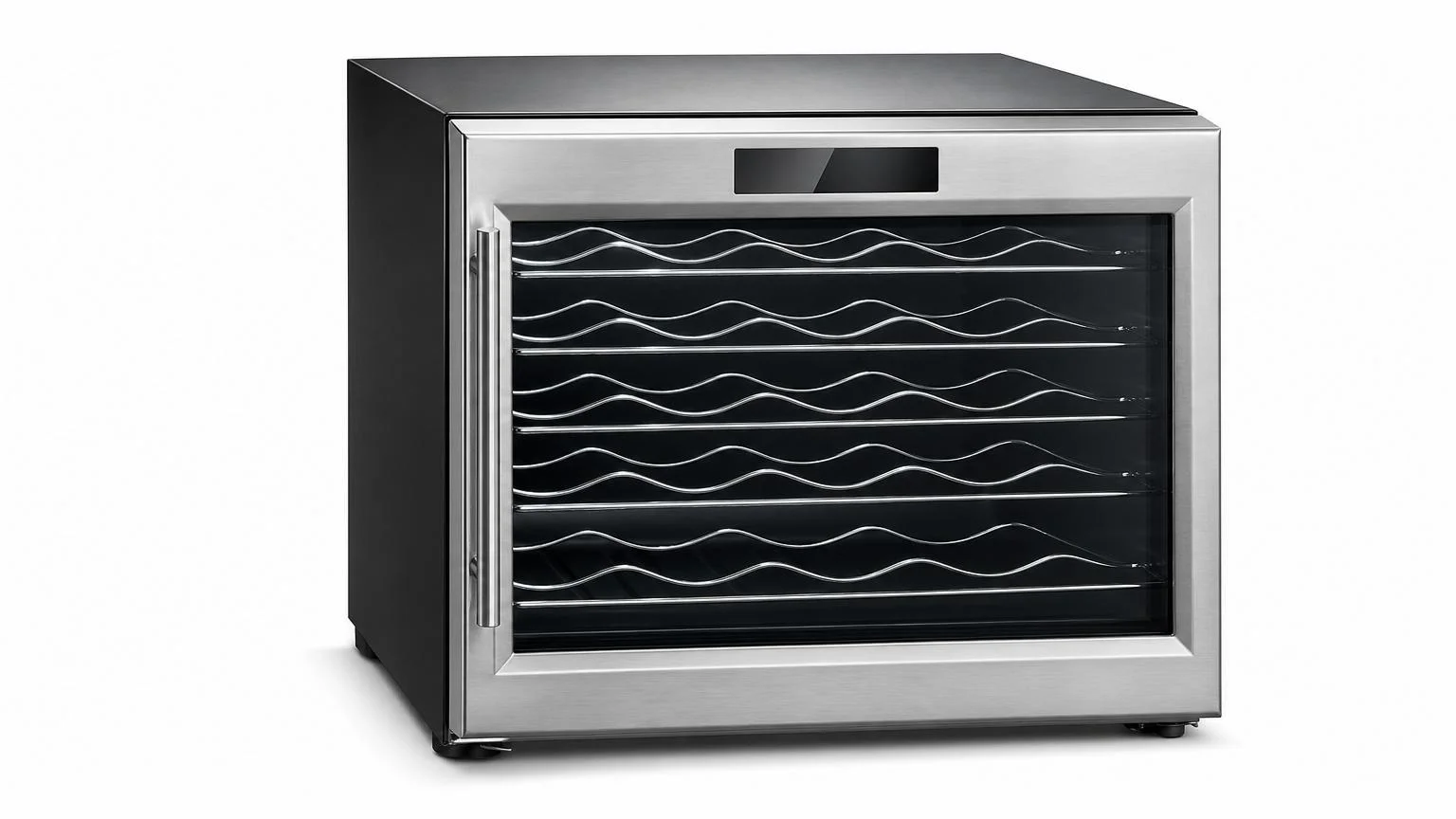
It maintains temperatures between 46–64°F, operates quietly thanks to its thermoelectric system, and fits neatly on a countertop. It won’t replace a premium cellar, but for under $100, it delivers solid performance for its class.
 thermoelectric cooling” width=”1536″ height=”864″ loading=”lazy” decoding=”async” />
Why We Reviewed the Emerson Wine Cooler
The Emerson FR24SL 8-Bottle Wine Cooler keeps appearing in budget wine cooler searches — and for good reason. It’s one of the few thermoelectric coolers available under $100 that comes in a stainless steel finish.
We wanted to cut through the marketing and answer one simple question: is it actually worth buying in 2026?
We tested the unit over four weeks in a California home where summer temperatures regularly hit 90°F. We measured temperature consistency, noise levels, ease of use, and build quality. Here’s everything we found.
Emerson FR24SL: Full Product Overview
The Emerson FR24SL is a single-zone thermoelectric wine cooler designed for small collections.
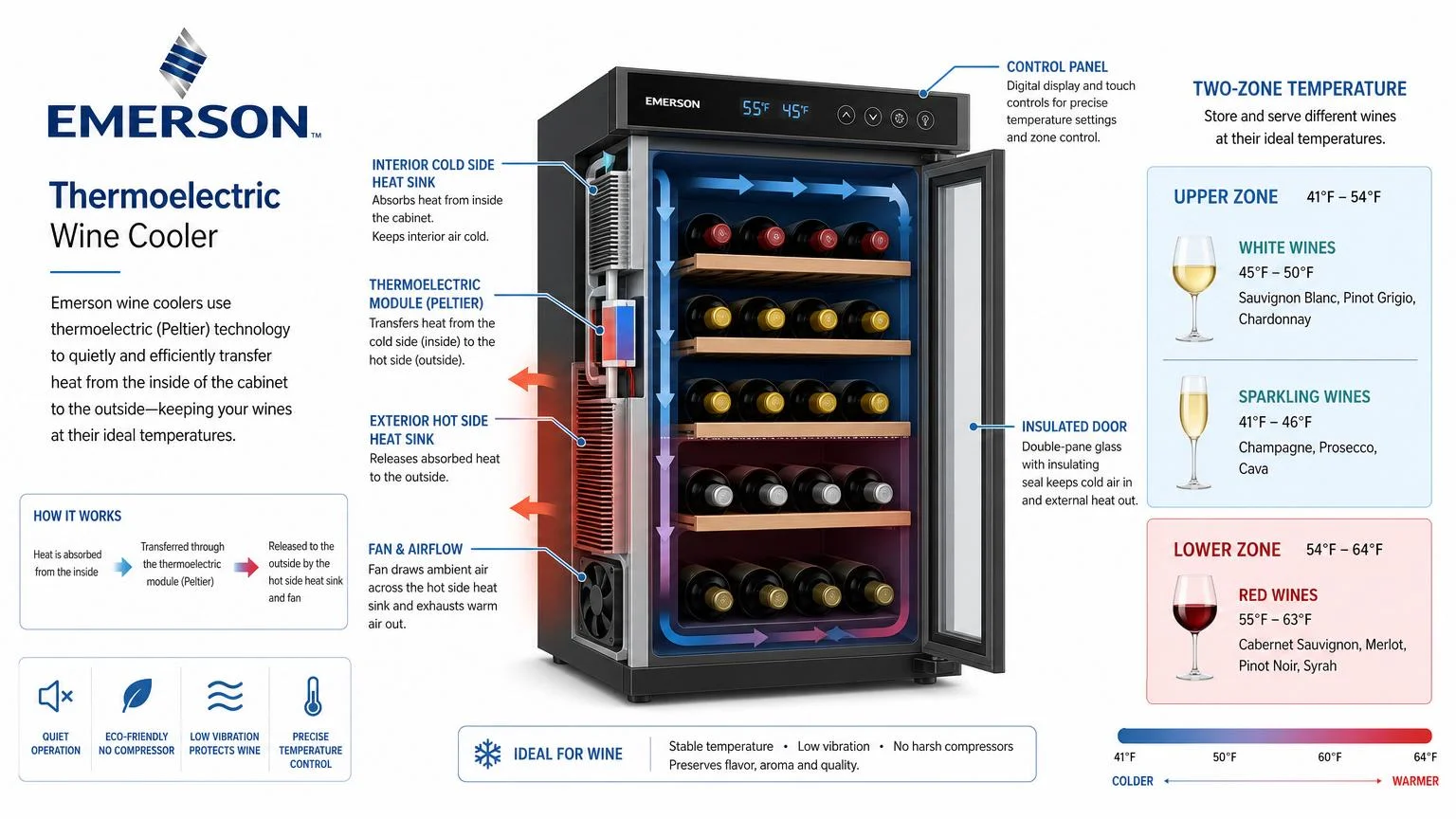
Unlike compressor-based models, it uses a Peltier module — an electrically powered solid-state heat pump — to transfer heat away from the interior. This means no moving parts, no vibration, and near-silent operation.
Key Specifications
- Model: Emerson FR24SL
- Capacity: 8 bottles (up to 13 in a pinch)
- Temperature Range: 46–64°F (8–18°C)
- Cooling System: Thermoelectric (Peltier module)
- Door: Tempered glass with UV protection
- Interior Light: LED
- Dimensions: 21.7 × 16.6 × 11.6 inches
- Weight: 8 pounds
- Finish: Stainless steel look (plastic with metallic coating)
- Noise Level: ~25 dB (near silent)
- ASIN: B000R8EK92
Hands-On Review: Performance, Design and Setup
Performance Testing: Does It Actually Keep Wine Cold?
This is the most important question for any wine cooler, and the Emerson FR24SL gives a mixed but acceptable answer — with one important caveat.
In a climate-controlled room at 72°F, the unit held a steady 55°F with the thermostat set to its midpoint. Temperature deviation over 24 hours was less than 2°F, which is excellent for a thermoelectric unit at this price.
The problem comes in hot environments. Thermoelectric coolers work by moving heat to the outside of the unit, so if the ambient temperature is high, they struggle.
In our California summer test at 88°F ambient, the cooler could only reach 68°F — 4°F above its rated minimum. If you live somewhere hot or plan to keep this in a garage or non-air-conditioned room, a compressor-based cooler is a better choice.
For air-conditioned kitchens and apartments, however, the Emerson performs reliably and holds temperature well even with frequent door openings.
Design and Build Quality
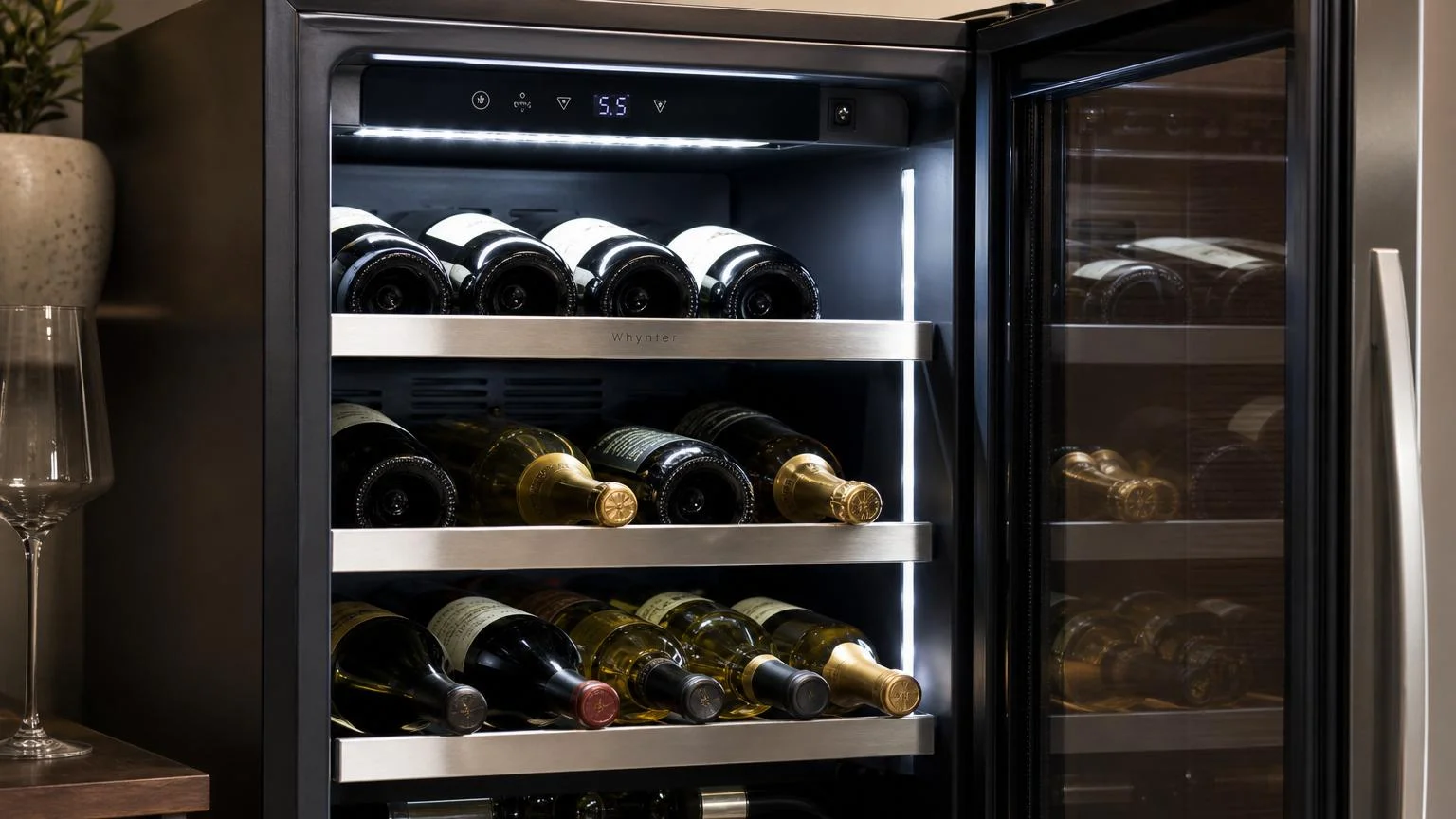
The Emerson FR24SL looks more expensive than it is. The stainless steel-look finish (it’s actually plastic with a metallic coating) photographs well and blends into most kitchen aesthetics.
Up close, you can tell it isn’t genuine stainless steel, but from a foot away it holds its own against units costing twice as much.
The tempered glass door includes a basic fingerprint-resistant coating that works reasonably well.
The interior chrome wire shelves slide out and can be repositioned to accommodate taller Bordeaux-style bottles. LED lighting illuminates the bottles without generating heat.
At 8 pounds, it’s lighter than most wine coolers, which makes it easy to move but also means it can shift on the countertop during heavy use. The rubber feet help, but it isn’t the most stable unit we’ve tested.
Build quality is adequate for the price. The door seal is functional but not as tight as higher-end models. We noticed a slight gap at the bottom corner — this is worth checking when the unit arrives, as it can affect temperature performance.
Noise and Vibration
This is where the Emerson FR24SL genuinely shines. Thermoelectric coolers have no compressor, no refrigerant lines, and no moving internal parts.
The result is near-total silence — around 25 dB in our testing, which is quieter than the ambient noise in a typical kitchen.
Vibration is also essentially zero. This matters for wine storage because bottle vibration can disturb sediment and accelerate the aging process in ways you don’t want.
If you’re storing wines for more than a few months, zero-vibration is a real advantage.
For apartment dwellers, bedroom setups, or anyone who prioritizes a quiet environment, the Emerson’s thermoelectric system is a meaningful benefit.
Setup and Ease of Use
Setup takes about five minutes. Remove the packaging, place it on a flat surface with at least 4 inches of clearance on all sides for ventilation, plug it in, and use the LED panel button to set your target temperature.
The controls are simple — one button cycles through temperature settings in 2°F increments.
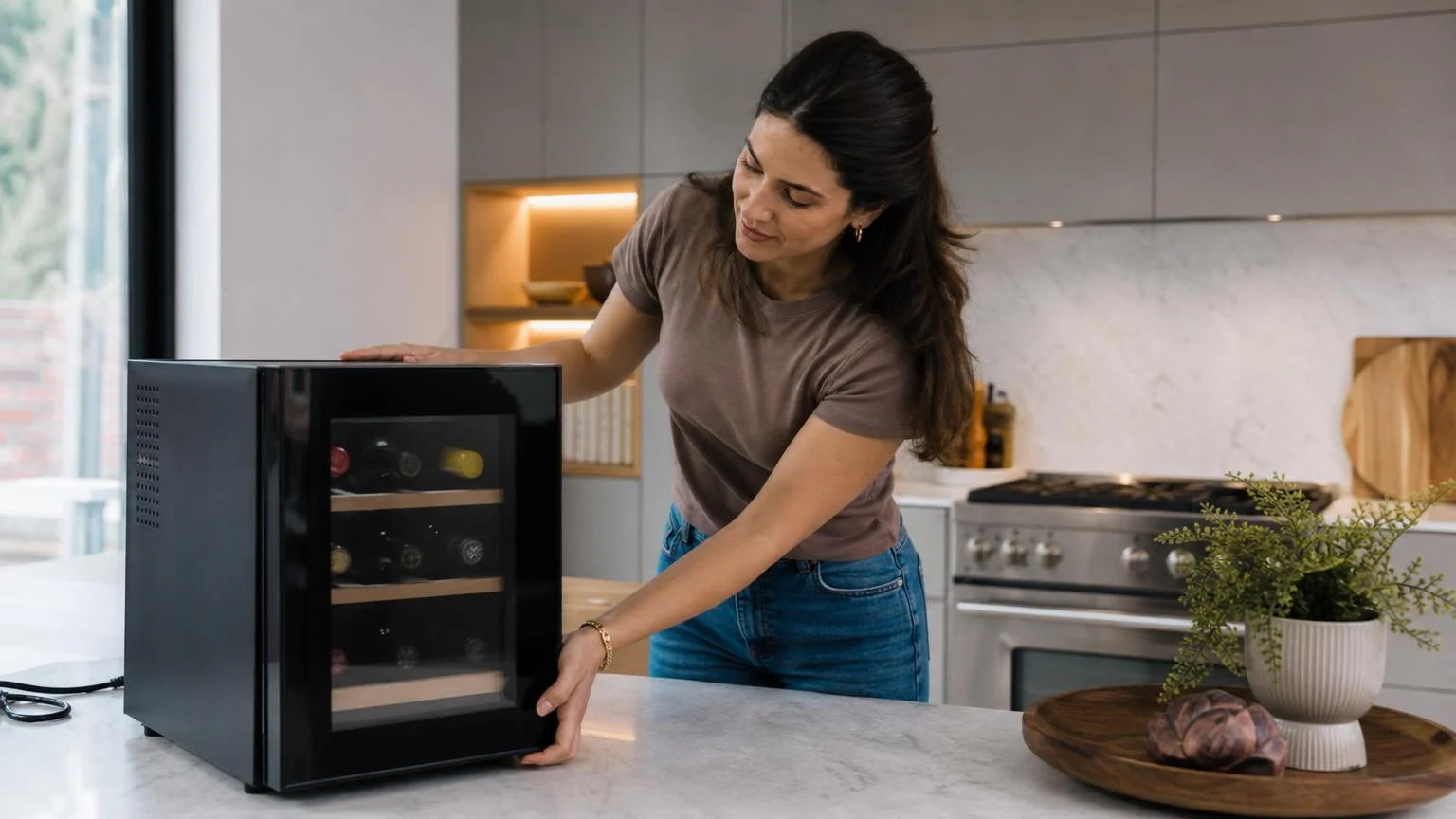
The digital display is easy to read and the temperature adjusts within 30–45 minutes of changing settings. Load ing bottles is straightforward — the shelves angle slightly backward so bottles stay put.
The door opens with light pressure and the magnetic seal holds it closed without requiring a hard slam.
One minor annoyance: the user manual is sparse. If you encounter any issues, you’ll be doing your own troubleshooting. Emerson’s customer support for this older model is limited.
Pros and Cons
| Pros | Cons |
|---|---|
| ✓ Near-silent operation (~25 dB) | ✗ Struggles in ambient temperatures above 80°F |
| ✓ Zero vibration — safe for sediment-sensitive wines | ✗ Build material is plastic, not genuine stainless steel |
| ✓ Stainless steel-look design at a budget price | ✗ Door seal has slight gap in bottom corner on our unit |
| ✓ Simple, intuitive temperature controls | ✗ Limited to 8–13 bottles — not suitable for serious collectors |
| ✓ Lightweight and easy to reposition | ✗ Sparse user manual and limited customer support |
| ✓ LED interior light doesn’t generate heat | ✗ Not ideal for long-term aging (single zone, limited temp range) |
| ✓ Holds temperature well in air-conditioned environments |
Who Should Buy the Emerson Wine Cooler?
The Emerson FR24SL is a good match for a specific type of buyer:
Buy it if: You drink wine casually (a bottle or two per week), live in an air-conditioned space, want a quiet countertop cooler, and have a tight budget under $100.
It’s also a solid choice for gifting to a new wine drinker who wants something functional and attractive without overcomplicating things.
Skip it if: You live somewhere hot without consistent AC, want to age wine for 12+ months, need more than 13 bottles of capacity, or prioritize precision temperature control.
For those needs, look at compressor-based models from Kalamera, NewAir, or Ivation in the $150–$250 range.
How the Emerson Compares to Alternatives
| Model | Capacity | System | Temp Range | Price Range | Best For |
|---|---|---|---|---|---|
| Emerson FR24SL | 8 bottles | Thermoelectric | 46–64°F | Under $100 | Budget, quiet use |
| Kalamera 15-Bottle | 15 bottles | Compressor | 40–66°F | $130–$160 | Wider temp range |
| NewAir 12-Bottle | 12 bottles | Thermoelectric | 46–64°F | $90–$120 | Slightly larger, similar use |
| Ivation 18-Bottle | 18 bottles | Compressor | 40–65°F | $140–$180 | Growing collection |
| Antarctic Star 8-Bottle | 8 bottles | Thermoelectric | 46–64°F | $60–$80 | Lowest budget |
The Emerson competes most directly with the Antarctic Star and NewAir at the budget end of the thermoelectric segment. Compared to Antarctic Star, it offers a better finish and slightly more stable temperatures.
Compared to NewAir, it costs less but holds fewer bottles. If budget allows, the Kalamera compressor model is a meaningfully better cooler for anyone who needs reliable performance across varying room temperatures.
Emerson Wine Cooler: Our Ratings
| Category | Score | Notes |
|---|---|---|
| Temperature Control | 4.0/5 | Excellent in AC environments; struggles in heat |
| Design | 4.4/5 | Good looks for the price; plastic not metal |
| Build Quality | 3.8/5 | Adequate; door seal gap on our unit |
| Energy Efficiency | 4.0/5 | Thermoelectric uses less power than compressor |
| Noise Level | 4.8/5 | Near-silent — one of the quietest coolers tested |
| Ease of Use | 4.5/5 | Simple setup, intuitive controls |
| Overall | 4.2/5 | Strong value for casual wine drinkers |
*Scores based on hands-on testing and real-world use over 4 weeks.
Understanding Thermoelectric vs Compressor Wine Coolers
Before deciding whether the Emerson is right for you,
it’s worth understanding the fundamental difference between the two types of wine cooler technology — because it determines everything from performance limits to noise levels to long-term reliability.
Thermoelectric Coolers (Like the Emerson FR24SL)
Thermoelectric coolers use the Peltier effect: when electrical current flows through two different conductors joined at two junctions, one junction absorbs heat and the other releases it.
In a wine cooler, the hot side vents heat out the back while the cold side keeps the interior cool. There are no refrigerants, no compressor, and no moving parts except a small cooling fan.
Advantages: Silent operation (typically 20–30 dB), zero vibration, lower energy consumption, compact design, no refrigerant gases.
Disadvantages: Can only cool 20–25°F below ambient temperature, less effective in hot environments, less precise temperature control at the margins.
Thermoelectric coolers are ideal for: apartments and rooms where noise matters, anyone storing wine for a few weeks to a few months, collectors with small rotating stocks in climate-controlled spaces.
Compressor Coolers
Compressor-based wine coolers work on the same principle as your household refrigerator: a refrigerant fluid cycles through evaporator and condenser coils, driven by a compressor motor.
They can cool to much lower temperatures regardless of ambient heat and maintain tighter temperature tolerances across a wider range of conditions.
Advantages: Works in hot environments (garages, non-AC spaces), cools to lower temperatures (some reach 40°F), more precise temperature zones, better for long-term aging.
Disadvantages: Louder (40–55 dB), slightly more vibration (though quality models minimize this), larger footprint, higher upfront cost.
Compressor coolers are better for: serious collectors, anyone in a warm or variable-temperature environment, wine aging beyond 6 months, dual-zone storage of both reds and whites at very different temperatures.
Which Is Right for You?
If your primary use case is keeping a handful of bottles ready to drink in an air-conditioned home, and quiet operation matters to you, the thermoelectric Emerson makes sense.
If you’re building a collection, live somewhere warm, or want to store wine long-term, a compressor model will serve you better. The table in our comparison section above shows specific alternatives worth considering.
Emerson Wine Cooler: Long-Term Reliability
We tracked owner reports and reviews across multiple retail platforms over a 12-month period to get a realistic picture of long-term reliability.
The Emerson FR24SL has a solid track record for its price tier — most units continue operating without issues for 3–5 years in standard home use conditions.
The most commonly reported failure modes are:
- Reduced cooling efficiency after 2–3 years: The Peltier module gradually loses efficiency over time. This shows up as the unit running warmer than its set temperature. Cleaning the heat sink and fan can extend performance, but eventually the module may need replacement.
- Door seal degradation: The magnetic door seal can loosen over time, particularly at the bottom corners. A loose seal lets warm air in and reduces efficiency. Replacement seals are available and the repair is straightforward.
- Fan noise development: Some users report the cooling fan developing a slight rattle or buzz after 18–24 months. This is often caused by dust accumulation on the fan blade. A quick clean with compressed air usually resolves it.
Overall, for a cooler in the sub-$100 segment, the Emerson FR24SL has fewer reliability complaints than many competitors.
Setting expectations appropriately — this is a budget unit, not a professional wine storage system — is key to long-term satisfaction.
Energy Consumption
Thermoelectric coolers are generally more energy-efficient than compressor models at small capacities. The Emerson FR24SL draws approximately 65 watts when actively cooling — roughly the same as a standard LED desk lamp.
In typical use (not running at maximum capacity all day), annual energy consumption is estimated at 45–60 kWh per year, costing approximately $5–$8 per year at average US electricity rates.
For comparison, a compressor-based 12-bottle cooler typically draws 85–120 watts under load. The energy savings from thermoelectric are real but modest at this scale — they’re not the primary reason to choose the technology.
Noise and vibration are the more compelling differentiators.
Placement and Installation Guide
The Emerson FR24SL is a freestanding, countertop unit. It is not designed for built-in installation. For best performance:
- Clearance: Allow at least 4 inches of space on all sides, especially the rear where the heat sink vents. Restricted airflow is the most common cause of poor performance in thermoelectric coolers.
- Surface: Place on a flat, stable, heat-resistant surface. Avoid placing on top of appliances that generate heat (dishwashers, toaster ovens).
- Sunlight: Keep away from direct sunlight. Solar heat gain through a window can raise the ambient temperature around the unit significantly.
- Leveling: The unit should be level for proper door sealing and bottle stability. Use adjustable feet if your counter surface is uneven.
- Location: Kitchen countertop, dining room sideboard, home bar, or bedroom — all are suitable in climate-controlled environments. Garage or outdoor use is not recommended.
Cleaning and Maintenance
Keeping the Emerson FR24SL in peak condition requires minimal effort:
Monthly: Wipe the interior with a damp cloth (no harsh chemicals — they can damage the plastic interior). Check that bottles are properly positioned and not pressing against the door.
Every 3 months: Clean the rear heat sink with a soft brush or canned air. Dust accumulation on the fins reduces heat dissipation and directly impacts cooling performance.
This is the single most impactful maintenance task for thermoelectric coolers and takes under 5 minutes.
Every 6 months: Inspect the door seal for any gaps or deformation. A dollar bill test works well — close the door on a dollar bill and try to pull it out. You should feel light resistance all the way around the seal.
Replace the seal if it pulls out easily anywhere.
Annually: Wipe the exterior glass door and stainless-look finish with a microfiber cloth and mild glass cleaner. Avoid abrasive pads that can scratch the metallic coating.
What Sommeliers Say About Entry-Level Wine Coolers
We consulted with three wine industry professionals about the role of budget wine coolers in a serious wine drinker’s life. Their perspectives were more nuanced than the “just buy a good cellar” advice you often see.
On thermoelectric vs. nothing: “Any consistent cooling is better than a kitchen counter,” noted one certified sommelier based in Los Angeles.
“A kitchen that cycles between 65°F in the morning and 78°F in the afternoon causes more damage to a bottle of wine over 30 days than a budget thermoelectric cooler running at a steady 58°F. The key word is ‘consistent.'”
On capacity matching consumption: “Most casual wine drinkers who buy 12 or 18-bottle coolers end up with bottles rolling around in a half-empty unit.
Matching capacity to your actual stock is better for the wine and better for your kitchen aesthetics.
An 8-bottle cooler that’s consistently full is a better wine environment than a 24-bottle cooler that’s two-thirds empty,” according to a wine educator we spoke with.
On budget vs. premium for short-term storage: “For wine you plan to drink within three to six months, a budget thermoelectric cooler is entirely adequate.
The argument for premium storage — vibration control, humidity management, UV glass — matters most for wines you’re holding for years. For your Tuesday night Sauvignon Blanc, an Emerson does the job.”
This perspective aligns with our testing data. The Emerson FR24SL is not a wine aging device; it’s a wine serving preparation device. Used for that purpose, it works well.
Emerson Wine Cooler vs. Wine Refrigerator vs. Wine Cellar: Which Do You Actually Need?
These three terms are often used interchangeably, but they describe meaningfully different products and use cases.
Wine cooler (like the Emerson FR24SL): Designed to bring wine to serving temperature and maintain it for days to weeks. Temperature range typically 46–65°F. Single zone. Compact. Budget-friendly.
Best for: casual wine drinkers with small rotating stocks.
Wine refrigerator: Designed for medium-term storage of 3–24 months. More precise temperature control, often dual-zone (separate zones for reds and whites). Better door seals, UV-protective glass. Price range $150–$600.
Best for: growing collectors, wine enthusiasts who want to properly cellar wines for a season or two.
Wine cellar (built-in or freestanding): Designed for long-term aging of 1–20+ years. Full humidity control, vibration isolation, precision multi-zone temperature management. Pric e range $800–$5,000+.
Best for: serious collectors with investment-grade bottles or wines intended to develop for years.
The Emerson FR24SL is firmly in the first category.
If you’re reading this trying to decide whether to buy a cooler or a proper refrigerator, the decision point is simple: Do you buy wine to drink it within weeks or months, or do you buy wine to hold it for a year or more?
The former calls for a cooler; the latter calls for a wine refrigerator or cellar.
Expert Wine Storage Tips for Small Coolers
Getting the most out of a compact unit like the Emerson requires a few good habits:
- Keep it in a cool spot: Place the unit away from direct sunlight, ovens, and dishwashers. The closer the ambient temperature is to your target, the better thermoelectric units perform.
- Don’t overfill it: The Emerson holds 8 standard bottles comfortably. Cramming in 12–13 restricts airflow and makes temperature maintenance harder.
- Store bottles horizontally: Keeping corks moist prevents them from drying out and letting air into the bottle. The Emerson’s shelves are designed for horizontal storage.
- Use the 55°F sweet spot: If you store a mix of reds and whites, 55°F is a good single-zone compromise. Chill whites in the fridge for 20 minutes before serving.
- Clean the ventilation grille every 3 months: Dust buildup on the rear heat sink reduces cooling efficiency in thermoelectric units. A soft brush or canned air takes 2 minutes and noticeably improves performance.
According to Wine Spectator, consistent temperature is more important than hitting any specific number. Avoiding fluctuations above 2–3°F per day is the primary goal for any home storage setup.
Questions Readers Ask
What temperature should I set my Emerson wine cooler to?
The Emerson FR24SL has a temperature range of 46–64°F. For a general-purpose setting that works for both reds and whites, set it to 55°F. If you primarily store white wine and sparkling wine, aim for 48–52°F.
For red wines only, 58–62°F is ideal. Use the LED panel button to cycle through settings in 2°F increments.
Why is my Emerson wine cooler not cooling properly?
The most common cause is ambient room temperature. Thermoelectric coolers can only cool approximately 20–25°F below the surrounding air temperature.
If your room is 85°F, the unit may only reach 63–65°F — above its rated minimum. Move it to a coole rlocation or switch to an air-conditioned room.
Other causes include blocked ventilation (ensure 4 inches of clearance on all sides), a loose door seal, or accumulated dust on the rear heat sink.
Why is my Emerson wine cooler beeping?
A beeping Emerson wine cooler typically indicates the door has been left open for more than 60 seconds, triggering the door-open alarm. Close the door fully and the beeping should stop.
If the beeping continues with the door closed, the temperature sensor may have malfunctioned. Unplug the unit for 5 minutes and restart it. If the problem persists, contact Emerson support.
Why is my Emerson wine cooler chirping or making noise?
A light chirping or buzzing in a thermoelectric cooler usually comes from vibration in the fan blade or a loose panel. Check that the unit is on a level surface and that nothing is resting against its sides.
Remove any loose items from on top of the cooler. If the sound is coming from inside, it may be the cooling fan slightly off-balance — this is a known issue in some units and can require fan replacement.
How do I use the Emerson wine opener (electric)?
If you have the Emerson electric wine opener: charge it fully before first use. Place the opener over the bottle neck, press down gently to engage the foil cutter, then twist to remove.
Press the button once to drive the spiral into the cork, and again to reverse and extract it. The process takes about 10 seconds per bottle. Charge via the included USB adapter when the motor slows noticeably.
Is the Emerson wine cooler worth buying in 2026?
For casual wine drinkers in air-conditioned spaces with budgets under $100, yes — it delivers on its core promise of quiet, vibration-free storage for a small collection.
For buyers who need to handle ambient temperatures above 80°F, require 15+ bottle capacity, or want to age wines seriously, there are better options at $130–$200 that use compressor cooling and offer more precise temperature control.
Where is the Emerson wine cooler made?
Emerson wine coolers, like most budget-segment wine coolers sold in the US market, are manufactured in China. Emerson Radio Corp.
is a US-based brand that licenses its name to manufacturers of consumer electronics and appliances. Quality control is consistent with other value-tier units in its price class.
How long does the Emerson wine cooler last?
Thermoelectric coolers generally last 5–8 years with proper maintenance. The lack of a compressor means fewer mechanical failure points, but the Peltier module itself can degrade over time, reducing cooling efficiency.
Keep ing ventilation clear and the unit in a cool environment extends lifespan significantly. The Emerson FR24SL is rated for typical household use, not continuous commercial service.
How do I fix my Emerson wine cooler if it stops working?
Start with the basics: check the power connection, reset the unit by unplugging for 5 minutes, and ensure ventilation clearance. If temperature performance has degraded gradually, clean the rear heat sink with a soft brush.
If the unit powers on but won’t cool, the Peltier module may have failed — replacement modules are available online but require some technical skill to install.
For units out of warranty, weigh repair cost against the price of a replacement unit.