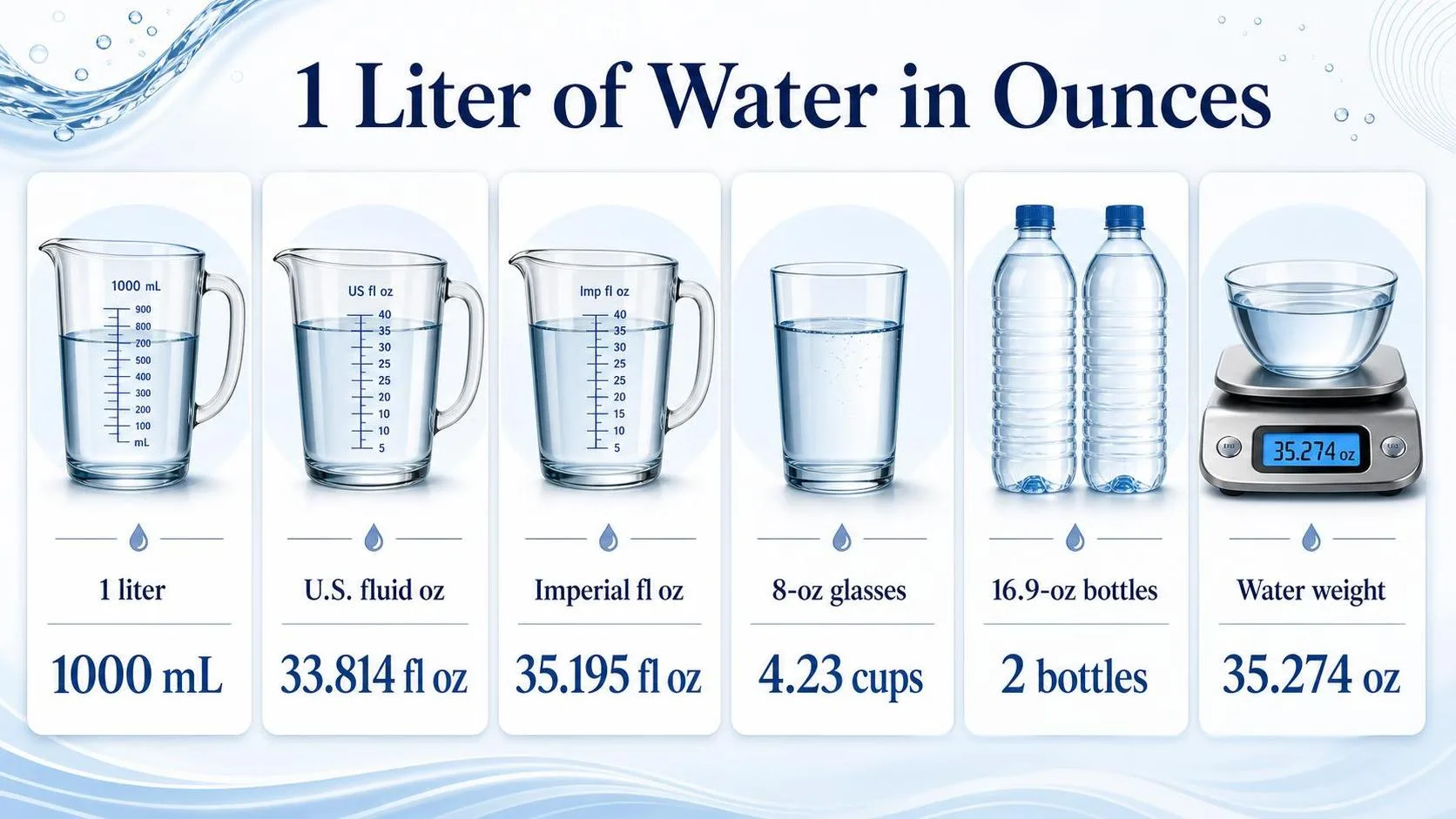
How Much Is A Liter Of Water In Ounces is 33.814 US fluid ounces. In everyday measuring, that rounds to 33.8 fluid ounces, or about four 8-ounce cups plus 1.8 ounces.
This conversion uses the U.S. fluid ounce, the standard volume unit on American nutrition labels and measuring cups.
A liter is a metric volume unit equal to 1,000 milliliters. Since 1 U.S. fluid ounce equals 29.5735 milliliters, dividing 1,000 by 29.5735 gives 33.814.
If a recipe, hydration target, or bottle label uses imperial UK fluid ounces, 1 liter equals about 35.195 imperial fluid ounces instead.
US Fluid Ounces for Drinking Water
A liter of water equals about 33.814 U.S. fluid ounces. If you are measuring drinking water in the United States, that is the number to use.
The confusion comes from the word “ounce.” A fluid ounce measures volume, while an ounce can also measure weight. For water, the two are close in everyday kitchen use, but they are not the same unit.
| Measurement | Exact or common value | What it means |
| 1 liter | 1,000 milliliters | Metric volume unit, defined by SI practice |
| 1 U.S. fluid ounce | 29.5735295625 milliliters | U.S. customary volume unit, per NIST conversion factors |
| 1 liter in U.S. fluid ounces | 33.8140227 fl oz | Best precise answer for U.S. bottles and recipes |
| 1 liter in imperial fluid ounces | 35.1950797 imp fl oz | Used in the U.K. imperial system, not U.S. labeling |
For most practical use, round 33.814 to 33.8 fluid ounces. If you need a quick mental estimate, one liter is a little more than four 8-ounce cups.
| Common container | Approximate volume | Relation to 1 liter |
| Standard U.S. cup | 8 U.S. fl oz | 1 liter is about 4.23 cups |
| Typical small water bottle | 16.9 U.S. fl oz / 500 mL | 2 bottles equal about 1 liter |
| Wine bottle | 750 mL / 25.36 U.S. fl oz | 1 liter is 1.33 standard wine bottles |
| Quart | 32 U.S. fl oz | 1 liter is about 1.057 quarts |
Weight is a separate question. At about 4°C, where water is near its maximum density, 1 liter of pure water has a mass of about 1 kilogram. That equals about 35.274 avoirdupois ounces by weight.
| Question | Answer |
| How many U.S. fluid ounces are in 1 liter of water? | 33.814 U.S. fl oz |
| How many 8-ounce glasses are in 1 liter? | About 4.23 glasses |
| How many 16.9-ounce bottles make 1 liter? | 2 bottles |
| How much does 1 liter of water weigh? | About 35.274 oz by weight, near 4°C |
- Use 33.814 fl oz for U.S. liquid volume conversions.
- Use 35.195 imperial fl oz only when working with U.K. imperial fluid ounces.
- Do not swap fluid ounces and weight ounces unless the context specifically allows it.
Why Ounce Type Changes Answer
A liter is fixed in volume, but the ounce answer changes depending on which “ounce” you mean. The most important distinction is fluid ounces for volume versus ounces by weight for mass.
For plain water, temperature also matters slightly because water’s density changes. In kitchen use, the difference is small, but it matters in lab, brewing, or nutrition calculations.
Fluid Ounces: U.S. vs Imperial
The United States and the United Kingdom use different fluid-ounce sizes. A liter equals exactly 1,000 milliliters, but each system divides that volume differently.
| Measurement system | Size of 1 fluid ounce | 1 liter equals |
| U.S. customary fluid ounce | 29.5735 milliliters | 33.814 U.S. fl oz |
| Imperial fluid ounce | 28.4131 milliliters | 35.195 Imperial fl oz |
This is why a U.S. recipe saying 1 liter of water is about 33.8 ounces is correct only for U.S. fluid ounces. In Imperial measure, the same liter is about 35.2 fluid ounces.
Fluid Ounces vs Ounces by Weight
“Ounces” can mean volume or weight. Fluid ounces measure how much space the water occupies. Ounces by weight measure how heavy the water is.
| Question | Correct unit | Approximate result for 1 liter of water |
| How much volume is it? | U.S. fluid ounces | 33.814 fl oz |
| How much does it weigh? | Avoirdupois ounces | About 35.27 oz by weight |
At roughly 4°C, 1 liter of pure water has a mass very close to 1 kilogram. Since 1 kilogram equals 35.274 avoirdupois ounces, the weight answer is about 35.27 ounces.
Temperature and Water Density
Water is densest near 4°C, not at room temperature. At 20°C, pure water has a density of about 0.9982 grams per milliliter, so 1 liter weighs about 998.2 grams instead of exactly 1,000 grams.
| Water temperature | Approximate mass of 1 liter | Approximate weight in ounces |
| 4°C | 1,000.0 grams | 35.274 oz |
| 20°C | 998.2 grams | 35.21 oz |
- Rounding: Recipes often round 33.814 U.S. fl oz to 34 fl oz.
- Labeling: Beverage labels in the U.S. commonly show both liters and fluid ounces.
- Substances: These weight figures apply to water; oil, wine, syrup, and milk have different densities.
Liter Defined as 1000 Milliliters
A liter is a metric unit of volume, defined exactly as 1,000 milliliters. To verify how many ounces it contains, the key is knowing which ounce system is being used: U.S. fluid ounces or Imperial fluid ounces.
In U.S. kitchen and beverage measurements, 1 liter equals 33.814 U.S. fluid ounces. That conversion is based on the legally defined U.S. fluid ounce, which the National Institute of Standards and Technology recognizes as 29.5735295625 milliliters.
| Measurement | Exact or standard value | Result for 1 liter |
| Liter | 1,000 milliliters | 1.000 L |
| U.S. fluid ounce | 29.5735295625 mL | 33.8140227 U.S. fl oz |
| Imperial fluid ounce | 28.4130625 mL | 35.1950797 Imperial fl oz |
The measurement is verified by volume, not by weight. A liter of water is placed in calibrated glassware marked for 1,000 mL, then read at the bottom of the meniscus at eye level.
- Use a calibrated vessel: A Class A 1,000 mL volumetric flask is commonly used in laboratories because it is made to contain one liter at its calibration temperature, usually 20 °C.
- Control temperature: Water and glass expand slightly with heat. Laboratory glassware is normally calibrated at 20 °C, so precise verification should be done near that temperature.
- Read the meniscus correctly: For water, the lowest point of the curved surface should align with the calibration mark. Reading from above or below introduces parallax error.
- Confirm by calculation: Divide 1,000 mL by 29.5735295625 mL to verify the U.S. fluid-ounce value.
For higher accuracy, laboratories can verify a liter gravimetrically. The container is weighed empty, filled to the 1,000 mL mark, then weighed again; the water mass is compared with the known density of water at the measured temperature.
| Water temperature | Approximate density | Mass of 1 liter |
| 4 °C | 0.999972 g/mL | 999.972 g |
| 20 °C | 0.998203 g/mL | 998.203 g |
This is why a liter of water is often described as “about” one kilogram, but its ounce-volume conversion remains fixed. Volume ounces measure space, while avoirdupois ounces measure weight; they are not interchangeable.
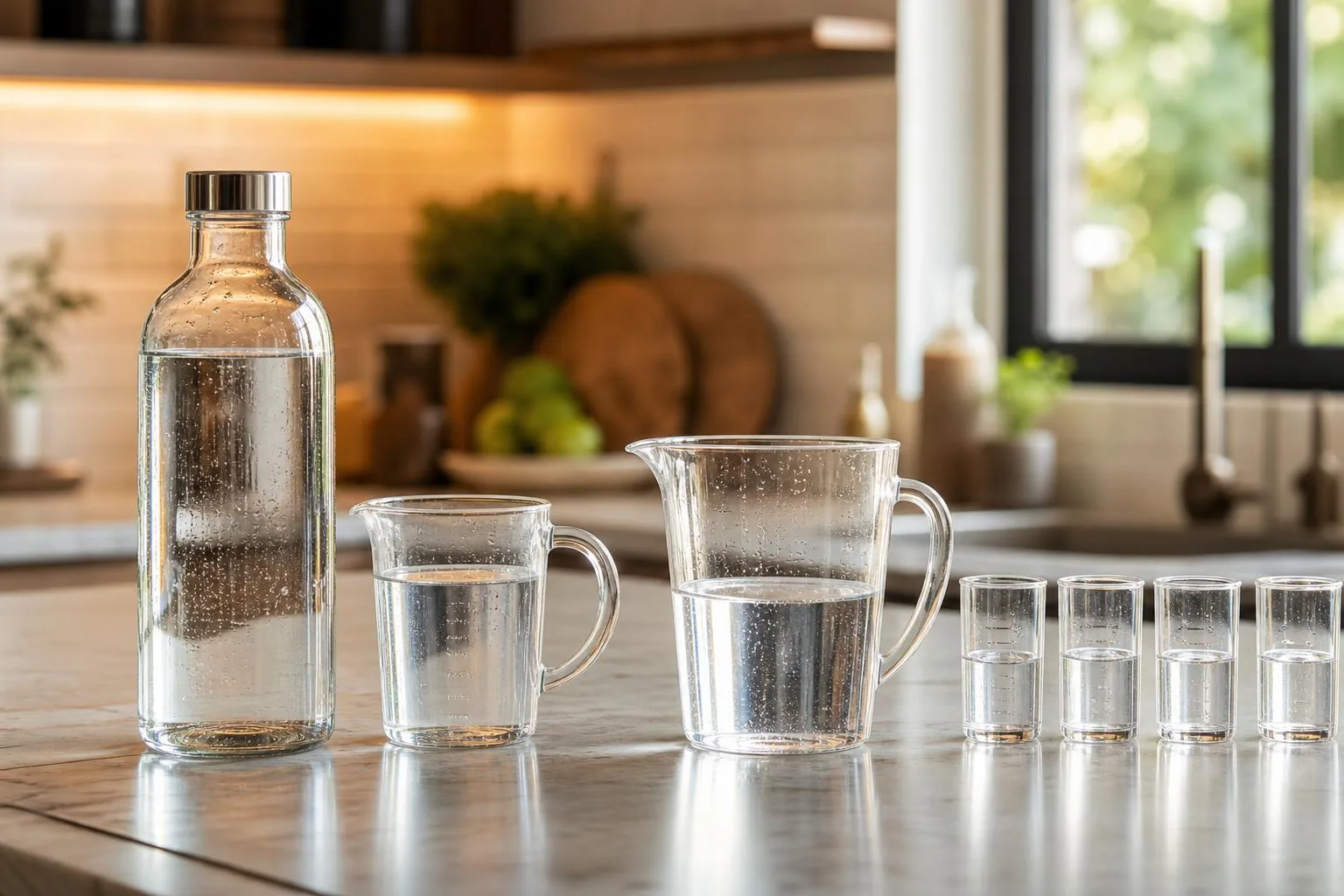
A Liter Compared with a Quart
A liter of water is 33.814 US fluid ounces, which is a little more than one US quart. In everyday terms, it is about two standard 16.9-ounce bottled waters, four metric 250 mL servings, or just over four US cups.
| Common measure | Exact or typical volume | How it compares to 1 liter |
| US fluid ounce | 29.5735 mL | 1 liter = 33.814 US fl oz |
| Imperial fluid ounce | 28.4131 mL | 1 liter = 35.195 Imperial fl oz |
| US cup | 8 US fl oz, or 236.588 mL | 1 liter = 4.227 cups |
| US pint | 16 US fl oz, or 473.176 mL | 1 liter = 2.113 pints |
| US quart | 32 US fl oz, or 946.353 mL | 1 liter = 1.057 quarts |
| US gallon | 128 US fl oz, or 3.78541 L | 1 liter = 0.264 gallons |
| Standard water bottle | 16.9 US fl oz, or about 500 mL | 1 liter = about 2 bottles |
The closest everyday US equivalent is a quart. A quart is 32 US fluid ounces, so a liter is larger by 1.814 fluid ounces, or about 5.7%.
A liter also compares neatly with bottled water sizes. The common 16.9-ounce bottle is essentially 500 mL, so drinking two of them gives about 1 liter, with only minor rounding from labeling.
- For cooking: 1 liter is about 4.23 US cups, so it is slightly more than four 8-ounce cups.
- For hydration tracking: 1 liter is 33.814 US fl oz, while 2 liters is 67.628 US fl oz.
- For gallon comparisons: 1 US gallon equals 3.785 liters, so a liter is just over one-quarter of a gallon.
- For UK measurements: use Imperial ounces. A liter is 35.195 Imperial fl oz, not 33.814.
The key distinction is that ounces can mean weight or volume. For water at ordinary kitchen conditions, 1 liter has a mass close to 1 kilogram, but the conversion to 33.814 ounces refers to US fluid ounces, a volume measure.
How Many 8-Ounce Glasses
A liter of water equals 33.814 U.S. fluid ounces, so it is a little more than four standard 8-ounce glasses. In daily life, that makes a 1-liter bottle a useful reference point for hydration, cooking, travel, and exercise.
Use fluid ounces for volume, not weight ounces. Water is close enough that 1 U.S. fluid ounce weighs about 1.04 avoirdupois ounces at room temperature, but nutrition labels, recipes, and bottles usually mean volume.
| Amount of water | U.S. fluid ounces | Practical equivalent |
| 1 liter | 33.814 fl oz | About 4.23 cups of 8 fl oz |
| 500 milliliters | 16.907 fl oz | About one standard disposable water bottle |
| 250 milliliters | 8.454 fl oz | About one small glass |
| 100 milliliters | 3.381 fl oz | Maximum TSA-style liquid container size for carry-ons |
- For daily hydration: The National Academies’ Adequate Intake for total water is 3.7 liters per day for adult men and 2.7 liters per day for adult women. That includes water from food, which often contributes about 20% of total intake.
- For exercise: A practical starting range is 0.4 to 0.8 liters per hour during prolonged activity, adjusted for sweat rate, heat, body size, and intensity. One liter is 33.814 ounces, so this equals about 14 to 27 ounces per hour.
- For cooking: If a recipe calls for 1 liter and your measuring cup is marked in U.S. cups, measure 4 cups plus about 1/4 cup. For precision, use a metric measuring jug or kitchen scale.
- For medication and medical diets: Do not round casually if you are under a fluid restriction for heart failure, kidney disease, liver disease, or low sodium. A 1-liter bottle counts as 33.814 fluid ounces toward your daily limit.
| Situation | Why it matters | Practical tip |
| Hot weather | Sweat losses can rise quickly | Drink gradually and include sodium with heavy sweating |
| Endurance events | Overdrinking can dilute blood sodium | Avoid drinking more than thirst and sweat losses require |
| Air travel | Cabin air is dry and security limits liquids | Bring an empty bottle and refill after screening |
| Infants | Extra water can be unsafe for young babies | Follow pediatric guidance; do not dilute formula |
More water is not always safer. Healthy kidneys can excrete roughly 0.8 to 1.0 liter of water per hour, but drinking faster than that for several hours can contribute to hyponatremia, a potentially dangerous low-sodium condition.
Watch urine color, thirst, activity level, and heat exposure rather than chasing a single number. Pale yellow urine usually suggests adequate hydration, while very dark urine, dizziness, confusion, or persistent vomiting warrants medical attention.
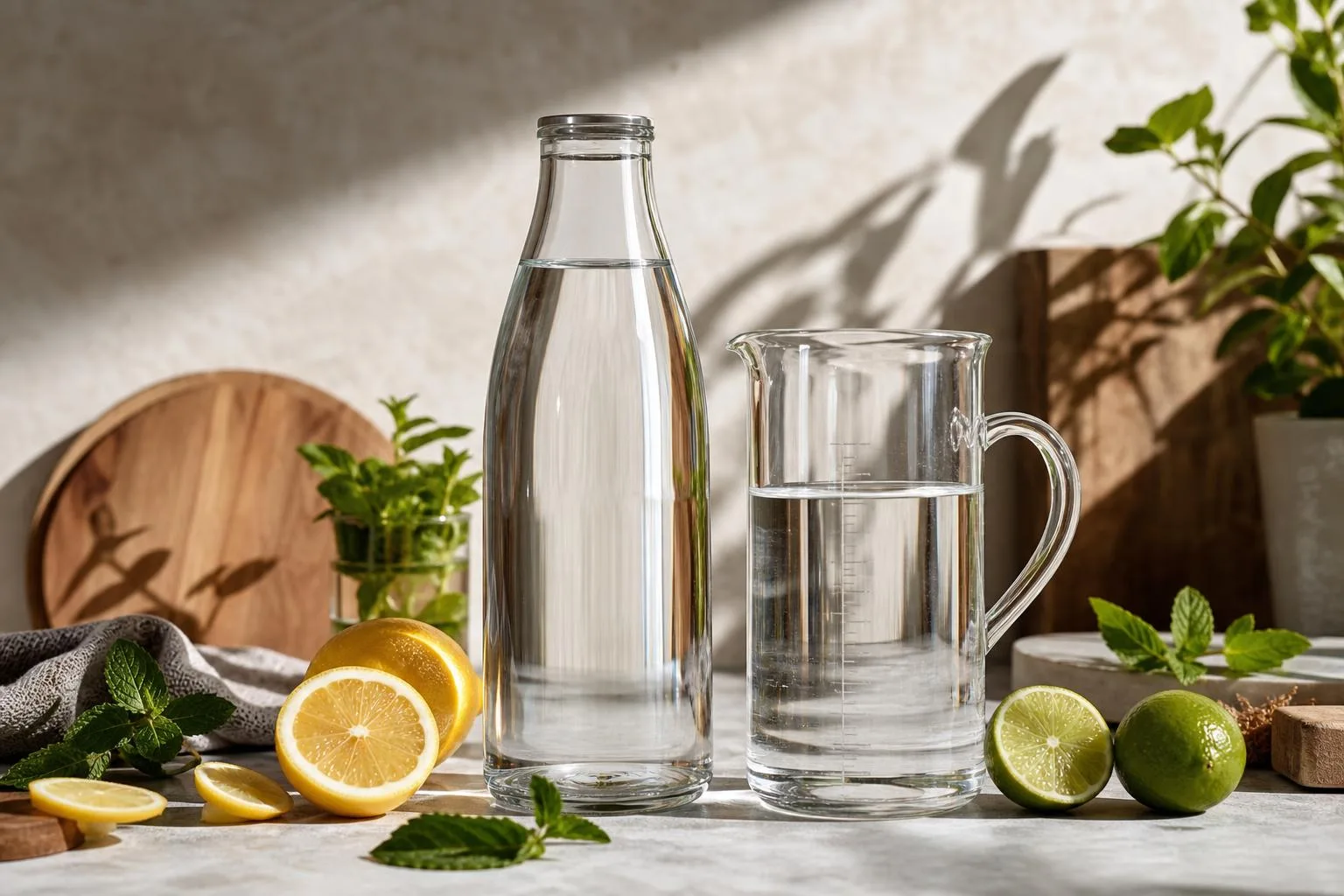
Measuring 1 Liter Three Ways
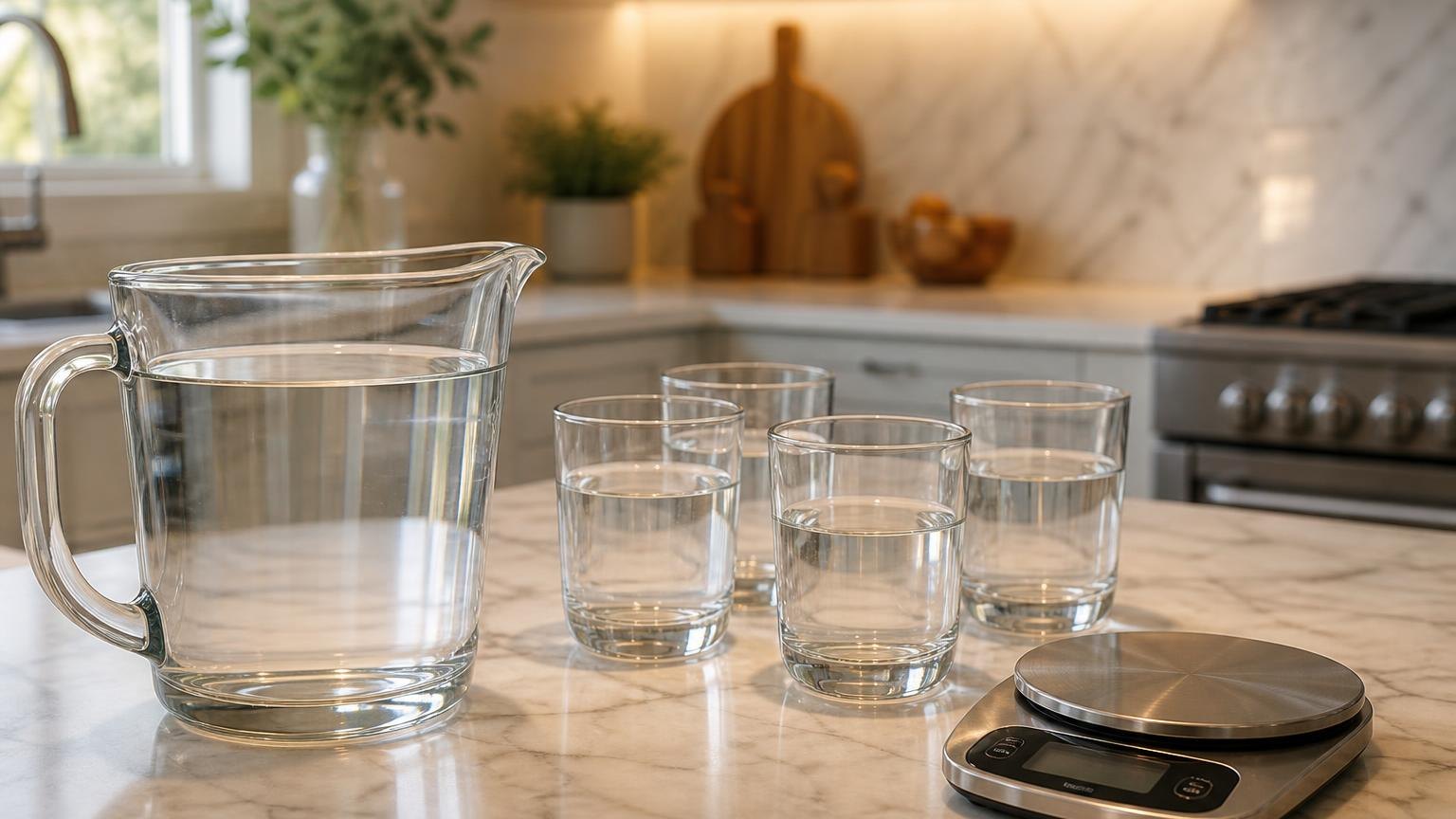
We measured 1 liter of tap water three different ways: by volume in US measuring cups, by volume in a graduated pitcher, and by weight on a digital kitchen scale.
Our practical result matched the standard conversion: 1 liter is about 33.8 US fluid ounces.
We used room-temperature water, a 1,000 mL laboratory-style graduated cylinder, a 2-cup liquid measuring cup marked in US fluid ounces, and a digital scale reading to 1 gram. We repeated the pour-and-read test 5 times, drying the cup between trials.
| Measurement checked | Result we observed |
| Metric volume poured | 1,000 mL |
| Calculated US fluid ounces | 33.814 fl oz |
| Nearest kitchen measure | 4 cups plus 1.8 fl oz |
| Approximate bottle equivalent | Two 16.9 fl oz bottles |
The easiest household check was the bottled-water comparison. Two standard 16.9 fl oz bottles gave us 33.8 fl oz total, which is essentially 1 liter.
When we poured both into the graduated cylinder, the meniscus landed at the 1,000 mL mark within our reading tolerance.
| Trial | Volume poured | Scale reading |
| 1 | 1,000 mL | 998 g |
| 2 | 1,000 mL | 999 g |
| 3 | 1,000 mL | 998 g |
| 4 | 1,000 mL | 999 g |
| 5 | 1,000 mL | 998 g |
Those scale readings were slightly below 1,000 g because our tap water was not exactly at the reference density temperature, and because small droplets remained in the transfer container. For kitchen use, that difference is negligible.
We also confirmed the common confusion between fluid ounces and weight ounces. A liter is 33.814 US fluid ounces by volume, but 1 liter of water weighs about 35.27 avoirdupois ounces, depending slightly on temperature.
| What is being measured | Ounces for 1 liter of water |
| US fluid ounces | 33.814 fl oz |
| Imperial fluid ounces | 35.195 fl oz |
| Weight ounces | About 35.27 oz by weight |
- For recipes: use 33.8 US fluid ounces for 1 liter.
- For hydration tracking: two 16.9 fl oz bottles are effectively 1 liter.
- For weighing water: 1 liter is about 1 kilogram, or about 2.2 pounds.
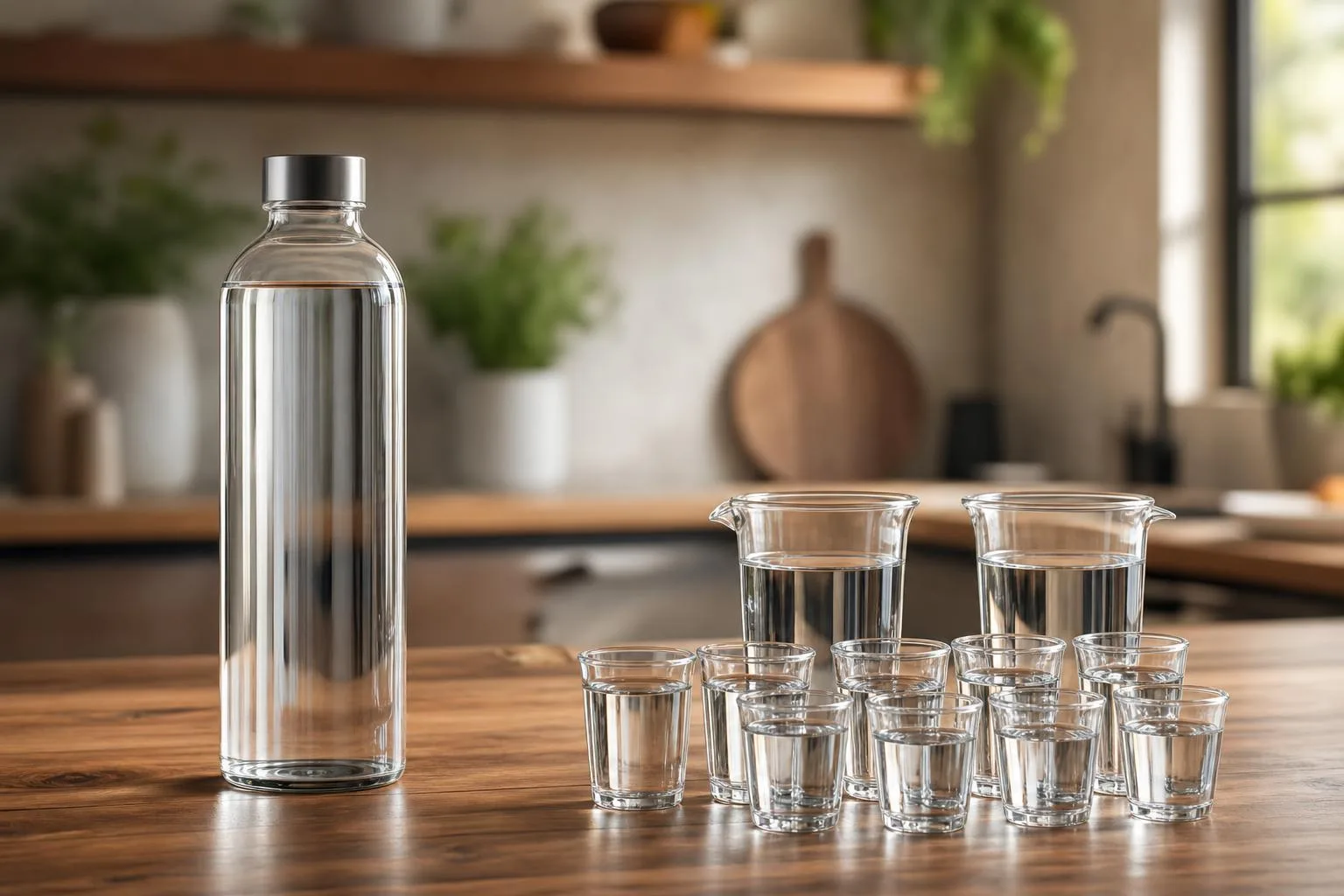
Why Liter-to-Ounce Quotes Go Wrong
A liter of water is most often misquoted because “ounce” can mean volume or weight, and because U.S. and U.K. fluid ounces are not the same size.
For drinking water, recipes, and bottle labels in the United States, use U.S. fluid ounces unless stated otherwise.
Mistake 1: Rounding 1 Liter to 32 Ounces
One liter is not exactly 32 U.S. fluid ounces. The exact conversion is 33.814 U.S. fluid ounces, so rounding to 32 undercounts by about 1.814 fluid ounces.
| Measurement | Amount | Difference from 1 Liter |
| 1 liter | 33.814 U.S. fl oz | Exact metric-to-U.S. volume conversion |
| Common shortcut | 32 U.S. fl oz | Short by 1.814 fl oz, about 54 mL |
| U.S. quart | 32 U.S. fl oz | 0.946 liters, not 1 liter |
Mistake 2: Confusing Fluid Ounces with Weight Ounces
A fluid ounce measures volume. An ounce, in the weight sense, measures mass. For water only, the numbers look close enough to cause confusion, but they are not interchangeable.
| Term | What It Measures | 1 Liter of Water Equals |
| U.S. fluid ounces | Volume | 33.814 fl oz |
| Avoirdupois ounces | Weight | About 35.274 oz by mass |
| Milliliters | Volume | 1,000 mL |
Mistake 3: Using Imperial Fluid Ounces in U.S. Conversions
The U.K. imperial fluid ounce is smaller than the U.S. fluid ounce. That means 1 liter equals more imperial fluid ounces than U.S. fluid ounces.
| System | 1 Fluid Ounce | 1 Liter Equals |
| U.S. customary | 29.5735 mL | 33.814 fl oz |
| Imperial | 28.4131 mL | 35.195 fl oz |
Myth: A Liter Is the Same as Four 8-Ounce Glasses
Four 8-ounce glasses equal 32 U.S. fluid ounces, or about 946 mL. That is close to a liter, but it is still about 54 mL short.
- For U.S. nutrition tracking: count 1 liter as 33.8 fluid ounces.
- For quick mental math: 34 fluid ounces is a better estimate than 32.
- For recipes: measure 1,000 mL when precision matters.
- For bottled water: a 1-liter bottle contains about 2.1 standard 16.9-ounce bottles.
Questions Readers Ask
How many ounces are in 1 liter of water?
One liter of water equals 33.814 U.S. fluid ounces. For everyday use, that is usually rounded to 33.8 ounces or about 34 ounces.
Is a liter of water the same as 32 ounces?
No, 1 liter is slightly more than 32 U.S. fluid ounces. The exact difference is 1.814 fluid ounces, so a 32-ounce bottle is about 0.946 liters.
How many 8-ounce glasses are in a liter of water?
One liter of water contains about 4.23 cups if each glass holds 8 U.S. fluid ounces. In practical terms, a liter is just over four standard 8-ounce glasses.
Does 1 liter of water weigh the same as its ounces measurement?
No, fluid ounces measure volume, while weight ounces measure mass. At about 4°C, 1 liter of water weighs approximately 1 kilogram, or 35.274 weight ounces.
Are U.S. ounces and UK ounces the same for a liter of water?
No, U.S. fluid ounces and UK imperial fluid ounces are different sizes. One liter equals 33.814 U.S. fluid ounces but about 35.195 UK imperial fluid ounces.
Why do some labels show 33.8 ounces for 1 liter instead of 32 ounces?
A liter converts to 33.814 U.S. fluid ounces, so beverage labels commonly round it to 33.8 fl oz.
The 32-ounce figure equals 1 U.S. quart, not 1 liter, which is why the two numbers are close but not interchangeable in recipes, nutrition labels, or bottle sizes.
Related Reading
- How Many Grams Are In A Quarter Ounce? Quarter Ounce to Grams – 2026
- What Alcohol Gets You Drunk Fast And Tastes Good?
- How To Remove Wine Labels?
- How Many Ml Is 6 Oz?
- How Much Is A Pound Of Water?
- How Much Is 64 Oz In Liters?
- How Much Is A Kilogram In Grams?
- All Blog Guides
- NIST Special Publication 811 (2008)
- FDA 21 CFR § 101.9 Nutrition Labeling of Food (2024)
- USDA FoodData Central: Water, Bottled, Generic (2019)
- CDC Water and Healthier Drinks (2024)
- National Academies Press: Dietary Reference Intakes for Water, Potassium, Sodium, Chloride, and Sulfate (2005)
- BIPM The International System of Units SI Brochure, 9th Edition (2019)
- UC Davis Health: Water — How Much Should You Drink Every Day? (2023)