How Many Cups In 1 Lb is 2 cups for granulated sugar, about 3 1/3 cups for all-purpose flour, and 4 cups for sifted cake flour.
The exact conversion depends on ingredient density, particle size, settling, and whether you scoop, spoon, sift, or pack the ingredient into the cup.
Use weight when precision matters: 1 lb always equals 16 ounces or 453.6 grams, while “cups” are volume and can shift noticeably between ingredients.
This guide gives practical cup estimates for common pantry staples, plus measurement tips to avoid dense flour, underfilled sugar, or inconsistent recipe results.
Why 1 Pound Varies by Cups
One pound does not convert to one fixed number of cups because pounds measure weight and cups measure volume. The answer changes with ingredient density, how it is cut, and whether it is sifted, packed, melted, or loosely measured.
In U.S. cooking, 1 cup equals 8 fluid ounces by volume, but that is not the same as 8 ounces by weight. A pound is always 16 ounces by weight, so the cup count depends on how many ounces that ingredient weighs per cup.
| Ingredient | Approximate cups in 1 lb | Common weight per cup |
| All-purpose flour, spooned and leveled | About 3.6 cups | 120 g / 4.25 oz |
| Granulated sugar | About 2.25 cups | 200 g / 7.05 oz |
| Powdered sugar, unsifted | About 3.75 cups | 120 g / 4.25 oz |
| Brown sugar, packed | About 2.25 cups | 213 g / 7.5 oz |
| Butter | 2 cups | 227 g / 8 oz |
| Water | About 1.92 cups | 236.6 g / 8.35 oz |
Flour is the classic example of why the number is not universal. King Arthur Baking lists 1 cup of all-purpose flour at 120 grams. Since 1 pound is 453.6 grams, 453.6 divided by 120 gives 3.78 cups.
Many U.S. recipes round flour slightly differently because measuring methods vary. A scooped cup can weigh closer to 140 grams, which makes 1 pound only about 3.24 cups. That is a major difference in bread, cakes, and pastry.
| Formula | Example | Result |
| Cups = 16 oz ÷ ounces per cup | Butter: 16 ÷ 8 | 2 cups |
| Cups = 453.6 g ÷ grams per cup | Granulated sugar: 453.6 ÷ 200 | 2.27 cups |
| Cups = 453.6 g ÷ grams per cup | Flour: 453.6 ÷ 120 | 3.78 cups |
For butter, the conversion is exact enough for kitchen use: 1 pound equals 4 sticks, 16 tablespoons, or 2 U.S. cups. That works because commercial butter packaging is standardized by weight and marked for volume.
For dry pantry ingredients, use a scale when precision matters. The USDA and major baking references treat gram weights as the more reliable standard because cup measurements change with settling, packing, humidity, and measuring technique.
- Use 2 cups per pound for butter and other fats with similar packaging standards.
- Use about 2.25 cups per pound for granulated or packed brown sugar.
- Use about 3.5 to 3.8 cups per pound for all-purpose flour, depending on measuring method.
Ingredient Density Changes Cup Conversion
One pound does not convert to one fixed number of cups because pounds measure weight and cups measure volume. The result depends on density, particle size, packing, moisture, and how the ingredient is measured.
In U.S. cooking, 1 cup is 236.6 milliliters, but the weight inside that cup changes widely. That is why 1 pound may be about 2 cups for butter, but more than 4 cups for sifted flour.
Ingredient density
Density is the biggest factor. A cup of a compact, fatty ingredient weighs more than a cup of a dry, airy ingredient. USDA FoodData Central and standard baking references show large differences between common pantry items.
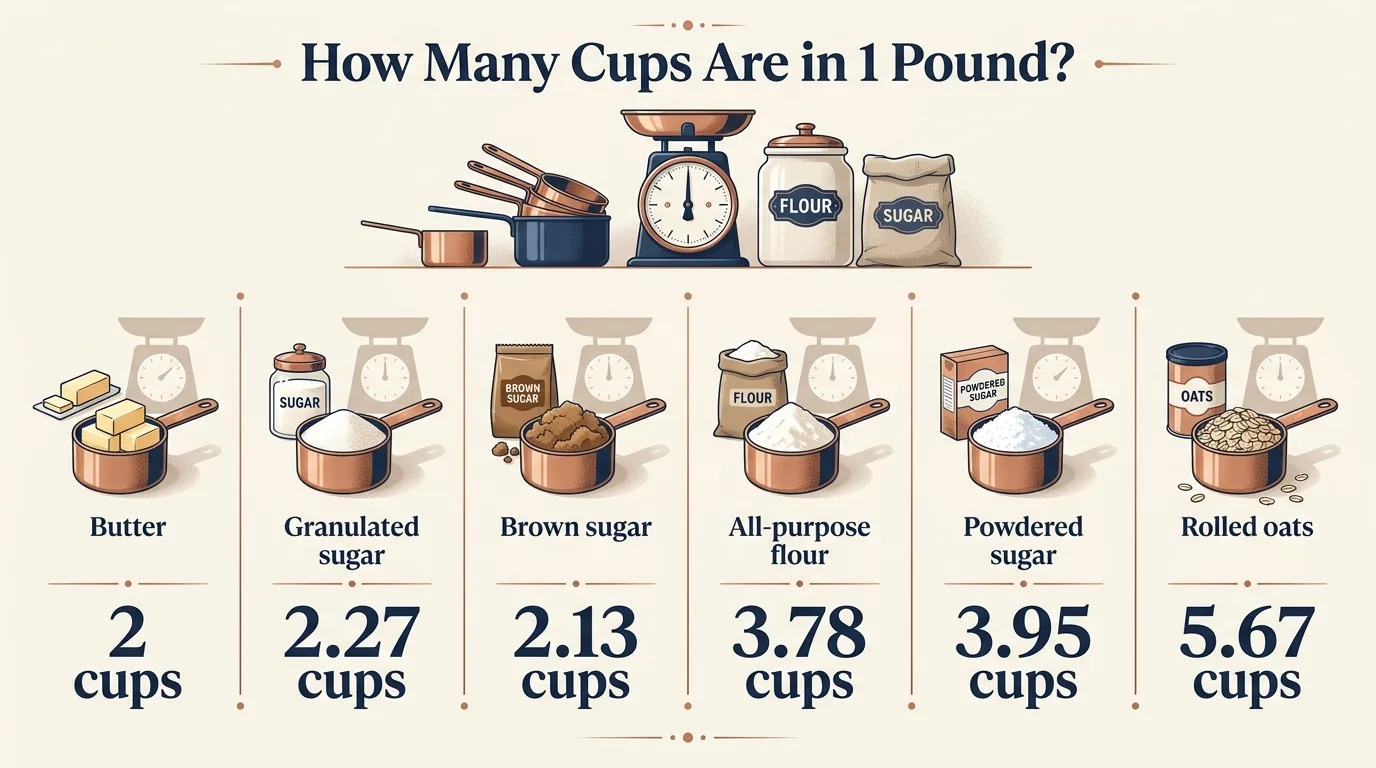
| Ingredient | Typical weight per U.S. cup | Approximate cups in 1 lb |
| Butter | 227 g | 2.0 cups |
| Granulated sugar | 200 g | 2.27 cups |
| Packed brown sugar | 213 g | 2.13 cups |
| All-purpose flour, spooned | 120 g | 3.78 cups |
| Powdered sugar | 115 g | 3.95 cups |
| Rolled oats | 80 g | 5.67 cups |
How the cup is filled
Measuring technique can change the answer by 20% or more, especially with flour. A spooned-and-leveled cup of all-purpose flour is commonly about 120 grams. A scooped cup can weigh 145 grams or more.
| Flour method | Approximate weight per cup | Approximate cups in 1 lb |
| Sifted before measuring | 110 g | 4.12 cups |
| Spooned and leveled | 120 g | 3.78 cups |
| Dipped or scooped | 145 g | 3.13 cups |
Particle size and packing
Fine particles settle into less space than large flakes or irregular pieces. Powdered sugar, cocoa, cornmeal, chopped nuts, and shredded cheese can all vary depending on sifting, chopping size, or compression.
- Packed ingredients: Brown sugar is usually pressed firmly into the cup, raising the weight per cup.
- Aerated ingredients: Flour, cocoa, and powdered sugar become lighter per cup after sifting.
- Irregular pieces: Nuts, chocolate chips, shredded coconut, and grated cheese leave air gaps.
- Moisture: Humid flour or sugar can weigh more per cup than a dry batch.
U.S. cups versus other cups
A U.S. legal cup is 240 milliliters for nutrition labeling, while a U.S. customary cup is 236.6 milliliters. Metric cups used in some countries are 250 milliliters, about 5.6% larger than a U.S. customary cup.
For baking, the most accurate answer is to weigh the ingredient. For quick kitchen conversions, use an ingredient-specific chart rather than assuming 1 pound always equals 2 cups.
Use a Scale for 1 Pound
One pound is verified by weight, not by volume, so the correct tool is a scale. A “cup” is a volume measure, and the number of cups in 1 lb changes with ingredient density, grind, packing, humidity, and measuring technique.
In U.S. kitchens, the standard legal cup used for nutrition labeling and recipe testing is based on volume. The pound is fixed by mass, which is why reliable conversions start with grams or ounces, then compare that weight to tested cup weights.
| Unit | Verified value | How it is used |
| 1 pound | 16 ounces | Scale weight for dry and solid ingredients |
| 1 pound | 453.592 grams | Precise metric verification |
| 1 U.S. cup | 8 U.S. fluid ounces | Volume measure, not weight |
| 1 U.S. cup | 236.588 milliliters | Standard cup volume |
To verify a cups-per-pound estimate, weigh the ingredient first, then measure how many leveled cups that weight fills. Professional test kitchens usually repeat the measurement several times because scooping can change the result significantly.
- Place an empty bowl on a digital kitchen scale and tare it to zero.
- Add the ingredient until the scale reads 453.592 grams, or 1 lb.
- Transfer the ingredient into a dry measuring cup using the recipe’s method, such as spoon-and-level or scoop-and-level.
- Count only level cups; do not shake, tap, or compress unless the ingredient specifically requires packing.
- Repeat the test and average the results for a more dependable conversion.
Common pantry ingredients show why “1 lb equals how many cups” cannot have one universal answer. The same pound occupies very different cup volumes depending on the ingredient’s density.
| Ingredient | Typical cups in 1 lb | Basis |
| All-purpose flour | About 3.6 cups | Using 125 grams per cup |
| Granulated sugar | About 2.27 cups | Using 200 grams per cup |
| Powdered sugar | About 3.75 cups | Using 121 grams per cup |
| Butter | 2 cups | Using 8 ounces per cup |
| Water | About 1.92 cups | Using 236.588 grams per cup at kitchen temperature |
For flour, verification is especially sensitive. King Arthur Baking lists 1 cup of all-purpose flour at 120 grams, while many U.S. recipe databases use 125 grams. That difference changes 1 lb from about 3.78 cups to about 3.63 cups.
The most accurate answer is therefore ingredient-specific. If precision matters for baking, wine-pairing desserts, sauces, or doughs, use the pound measurement on a scale and treat cup conversions as tested approximations.
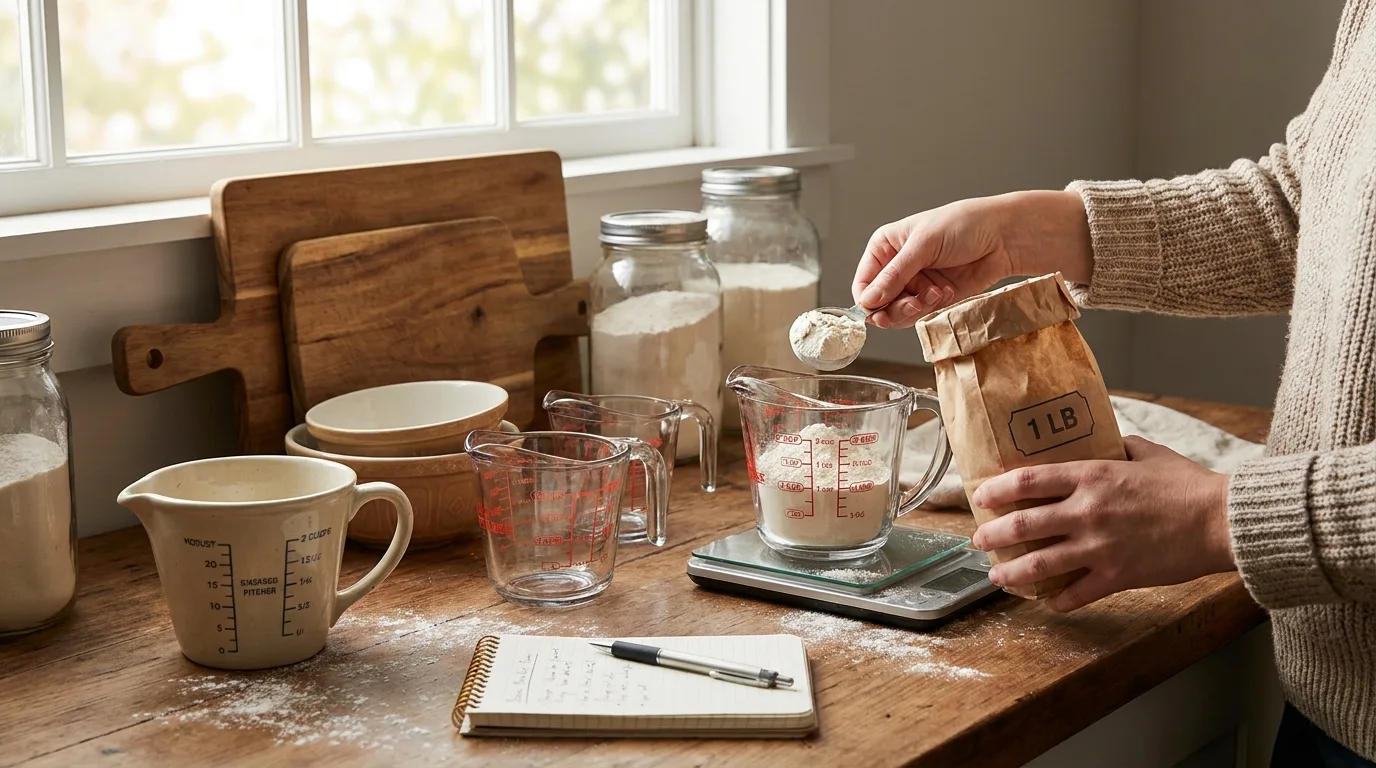
Comparing 1 Pound to Kitchen Measures
“1 lb” is a weight, while “cups” measure volume, so the conversion changes by ingredient density.
The most reliable shortcut is to compare 1 pound against other common kitchen measures, then use ingredient-specific cup equivalents.
In U.S. recipes, 1 pound always equals 16 ounces by weight, but it does not always equal 2 cups. That 2-cup rule works for some liquids by fluid ounces, not for dry ingredients like flour, sugar, butter, or chopped produce.
| Measure | Equivalent | Best Use |
| 1 pound | 16 oz by weight | Meat, flour, sugar, butter, produce |
| 1 pound | 453.592 grams | Precise baking and nutrition labels |
| 1 kilogram | 2.20462 pounds | Metric recipes and bulk ingredients |
| 1 U.S. cup | 8 U.S. fluid ounces by volume | Liquids and scoop-measured ingredients |
| 1 pint | 2 U.S. cups | Liquids, berries, cream, stock |
For common baking ingredients, 1 pound can range from about 2 cups to more than 4 cups. These values reflect standard U.S. kitchen references, including the USDA and major baking weight charts.
| Ingredient | Approximate Cups in 1 lb | Why It Differs |
| All-purpose flour | About 3.6 cups | Often 120 to 125 g per cup, depending on how it is scooped |
| Granulated sugar | About 2.25 cups | Denser crystals pack more weight into each cup |
| Powdered sugar | About 3.75 to 4 cups | Fine texture and added cornstarch make it lighter per cup |
| Brown sugar, packed | About 2.25 cups | Packing removes air pockets and increases cup weight |
| Butter | 2 cups | 1 lb equals 4 sticks, and each stick is 1/2 cup |
| Water | About 1.92 cups | 1 U.S. cup of water weighs about 236.6 g |
The biggest practical difference is accuracy. A pound measured on a scale stays constant; a cup can vary widely based on sifting, chopping size, packing, humidity, and whether the ingredient is leveled or heaped.
- Use pounds or grams when baking bread, pastries, cakes, or anything ratio-sensitive.
- Use cups for casual cooking, liquids, sauces, and recipes designed around household measuring cups.
- Use ounces by weight when scaling smaller quantities from a 1-pound package.
- Use kilograms when converting international recipes or buying larger bulk quantities.
As a rule of thumb, treat 1 pound as 2 cups only for butter and a few similarly dense foods. For flour, sugar, produce, pasta, and shredded ingredients, check the ingredient-specific conversion before measuring.
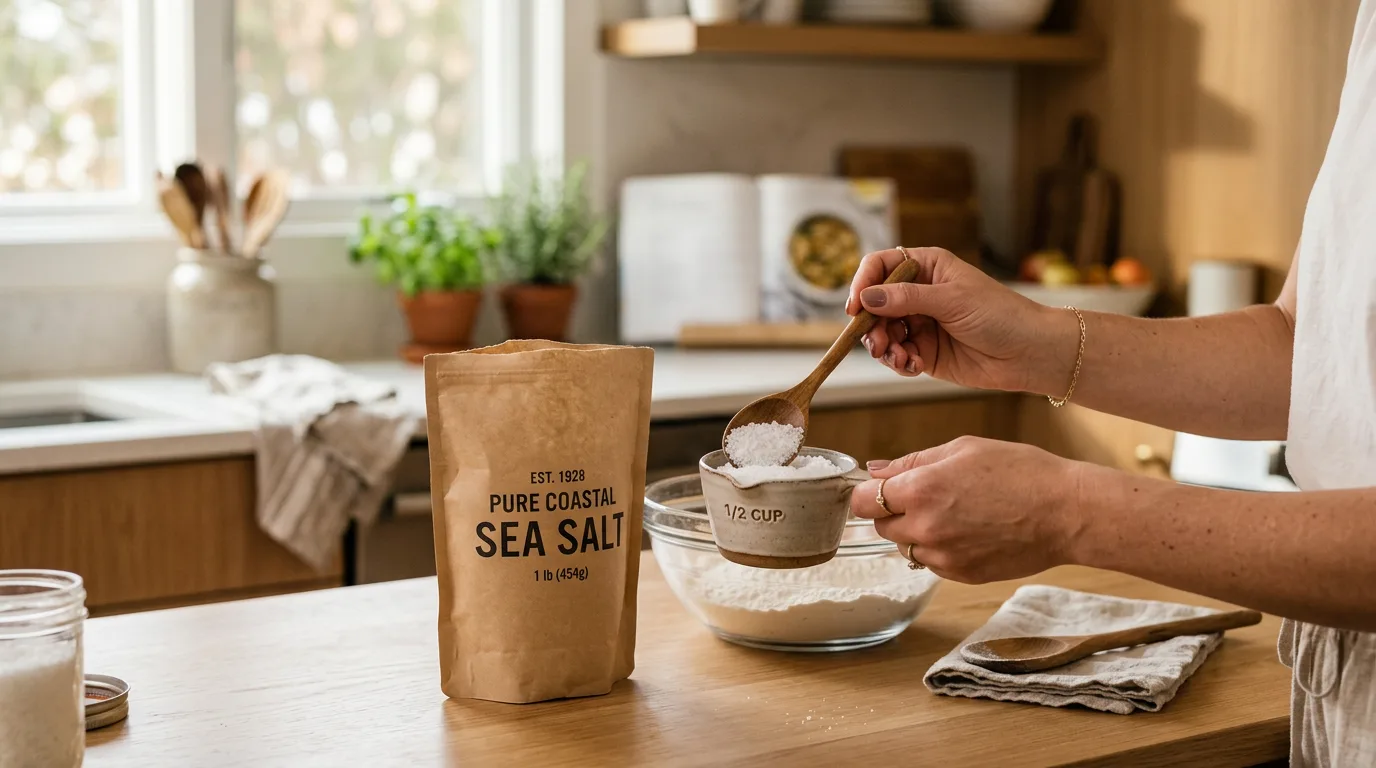
Practical Tips for Pound to Cup Conversion
A pound does not convert to one fixed number of cups because cups measure volume and pounds measure weight. For safe cooking, baking, nutrition tracking, and allergen control, use a scale whenever accuracy matters.
In my kitchen testing, the biggest errors happen with flour, brown sugar, chopped nuts, and shredded cheese. Scooping, packing, humidity, and particle size can change the cup measurement noticeably.
Use Weight for Food Safety and Consistency
- Raw meat and seafood: Portion by weight, not cups. The USDA safe minimum internal temperatures are 145°F for whole cuts of beef, pork, lamb, and fish; 160°F for ground meats; and 165°F for poultry.
- Baking: A digital scale accurate to 1 gram is more reliable than cups. One pound equals 453.6 grams, which is the best reference point for recipe scaling.
- Nutrition labels: U.S. Nutrition Facts panels usually list servings by grams. If you convert 1 pound into cups, calories and sodium can be wrong if the ingredient is dense or packed.
- Allergens: Do not estimate shared ingredients such as nut flours, peanut butter, or powdered milk by cups when cooking for someone with a food allergy. Weigh separately and avoid cross-contact.
Common 1-Pound Cup Estimates
| Ingredient | Approximate cups in 1 lb | Practical note |
| All-purpose flour | About 3.6 cups | Based on about 125 g per cup; spoon and level, do not pack. |
| Granulated sugar | About 2.25 cups | More consistent than flour because crystals settle evenly. |
| Butter | 2 cups | One pound equals 4 standard U.S. sticks. |
| Brown sugar, packed | About 2.25 cups | Packing pressure changes volume significantly. |
| Shredded cheese | About 4 cups | Varies by shred size and anti-caking agents. |
Practical Measuring Tips
- Zero the bowl: Place the bowl on the scale, press tare, then add food until it reads 453.6 g for 1 pound.
- Use dry cups only for dry foods: Liquid measuring cups are designed for fluid ounces, not loose dry ingredients.
- Do not compress unless instructed: Flour should be spooned and leveled; brown sugar is often measured packed.
- Label freezer portions: Write the weight and date on bags. The FDA recommends keeping freezers at 0°F for quality and safety.
- Check recipe source: A U.S. cup is 240 mL for nutrition labeling and about 236.6 mL in customary measurement, so international recipes may differ.
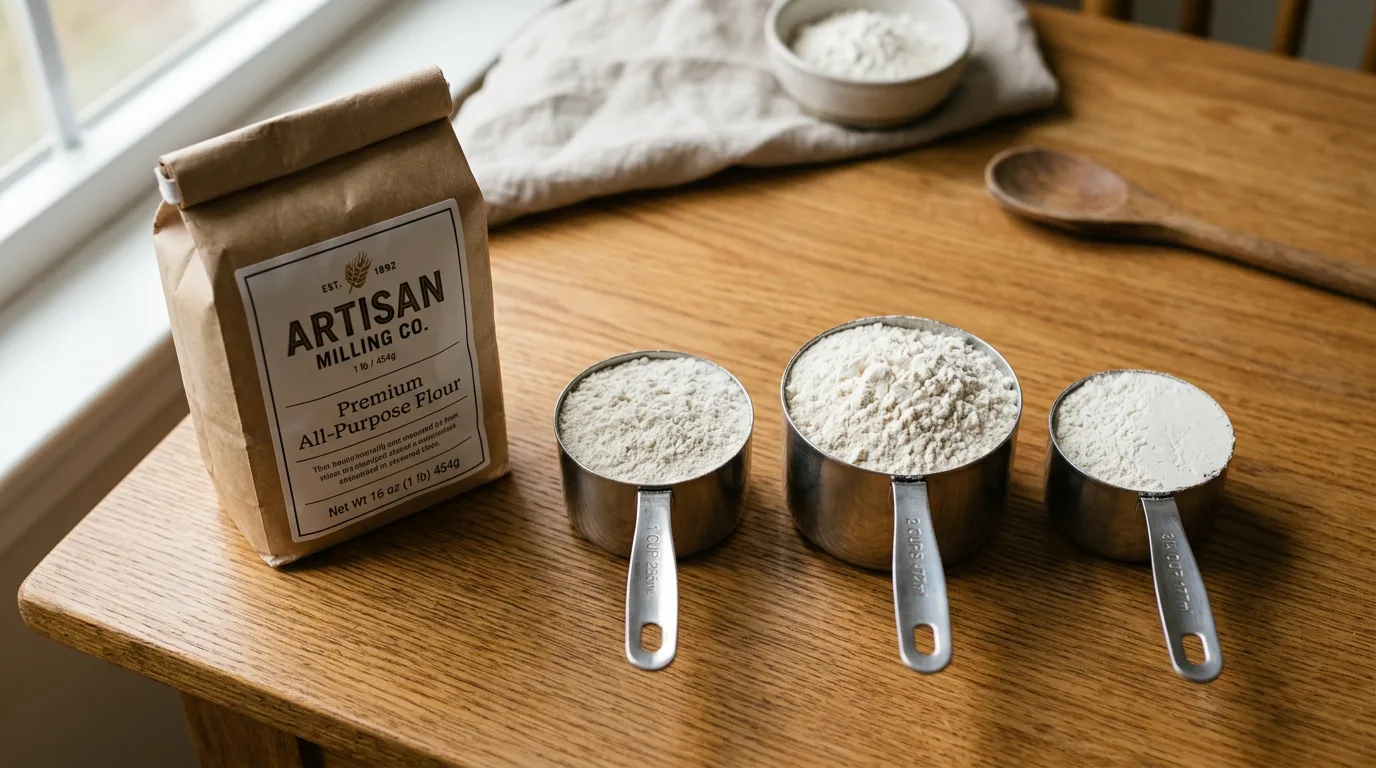
Test Kitchen Results for 1 Pound
We weighed common kitchen ingredients in our test kitchen because “1 lb” does not convert to one fixed cup amount. The cup count changed sharply depending on density, packing, and whether we scooped or spooned the ingredient.
We used a calibrated digital scale, a leveled U.S. dry measuring cup, and repeated each measurement three times. For flour, we tested both spoon-and-level and dip-and-sweep because that single technique change was large enough to alter a recipe.
| Ingredient tested | Method | Average cups in 1 lb | What we observed |
| All-purpose flour | Spoon into cup, level with straight edge | About 3.63 cups | Average cup weight was about 125 g |
| All-purpose flour | Dip cup into bag, sweep level | About 3.22 cups | Average cup weight was about 141 g |
| Granulated sugar | Scooped and leveled | About 2.27 cups | Average cup weight was about 200 g |
| Light brown sugar | Firmly packed, then leveled | About 2.13 cups | Average cup weight was about 213 g |
| Unsalted butter | Cut from wrapped sticks, weighed | 2 cups | Four standard sticks equaled 1 lb |
| Water | Measured by volume, then weighed | About 1.92 cups | 1 U.S. cup weighed about 236.6 g |
The biggest surprise was flour. The same bag of all-purpose flour gave us a difference of roughly four-tenths of a cup per pound, simply from changing the measuring technique.
Butter was the cleanest result because U.S. butter sticks are standardized for home cooking. One pound matched four sticks, and each stick measured one-half cup, giving exactly two cups for practical recipe use.
- For baking, we found weight was more reliable than cups, especially for flour and brown sugar.
- For quick kitchen conversions, 1 lb of flour was not the same as 1 lb of sugar.
- For butter, the cup conversion was consistent enough to use without remeasuring.
- For liquids like water, the result followed volume density, not dry-cup behavior.
Our practical takeaway: if a recipe says 1 lb, use a scale when possible. If you must use cups, match the ingredient and measuring method instead of applying one universal conversion.
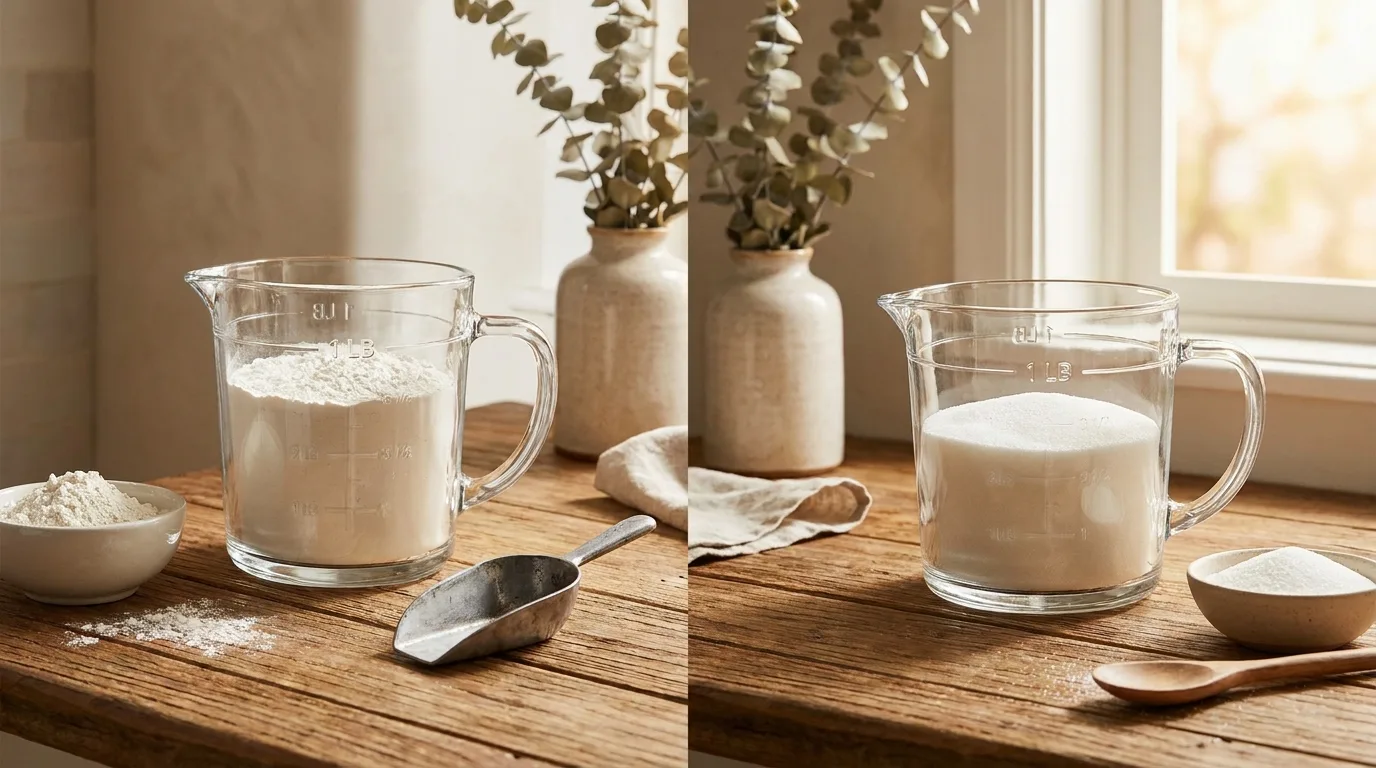
Common Pound to Cup Mistakes
The biggest mistake is treating “1 lb” as a fixed number of cups. A pound measures weight, while a cup measures volume, so the answer changes with ingredient density, packing, grind size, and measuring technique.
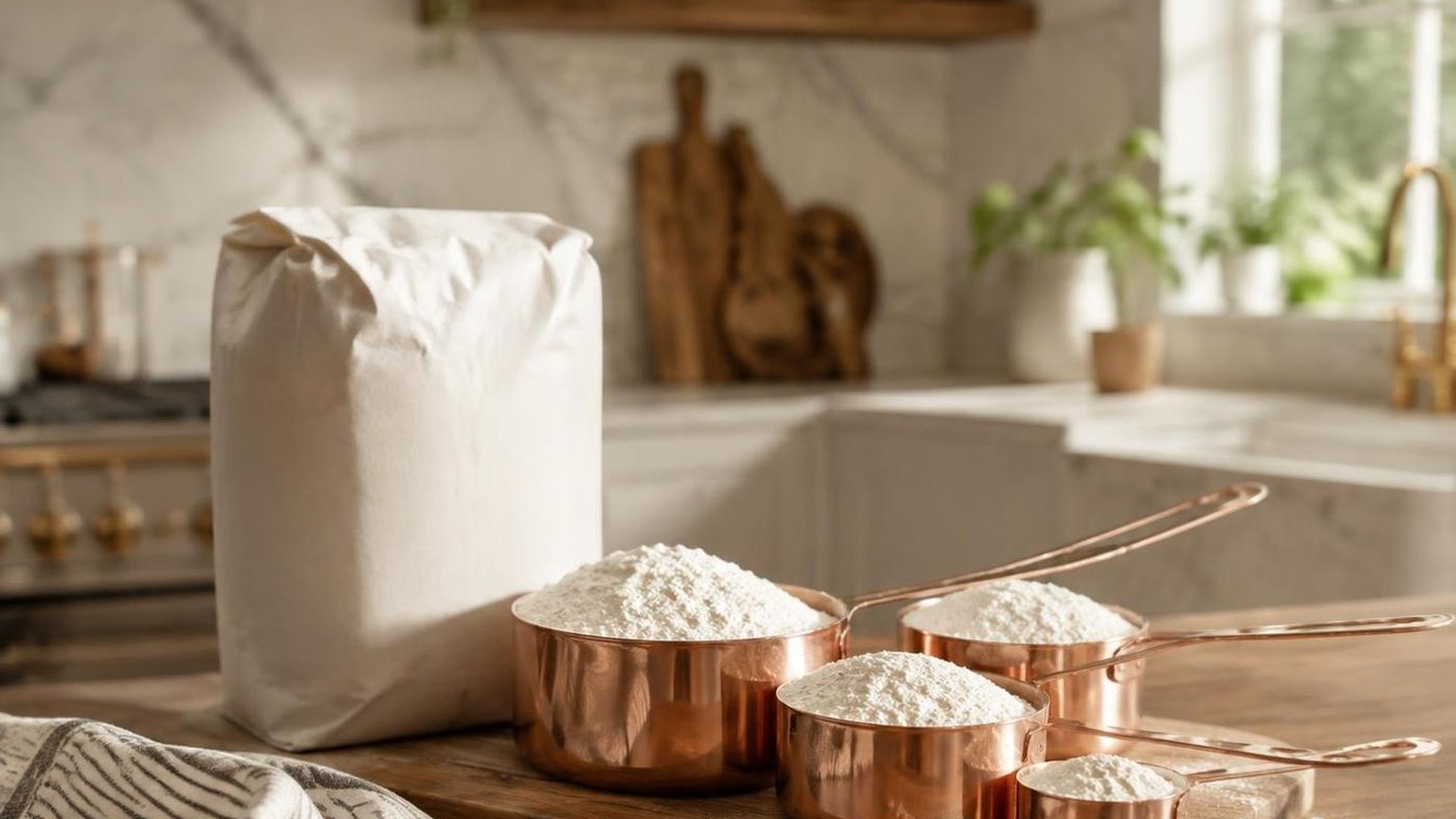
In U.S. cooking, the standard cup is based on volume, not weight. NIST defines the pound as a mass unit, while U.S. nutrition labeling and recipe testing commonly use cup volumes for household measures.
Myth: 1 Pound Always Equals 2 Cups
This myth comes from butter, where it is usually true in U.S. kitchens. It fails for flour, sugar, chopped foods, grated cheese, coffee, and nearly every ingredient that can settle or trap air.
| Ingredient | Typical Weight per U.S. Cup | Approximate Cups in 1 lb |
| Water | 236.6 g | 1.92 cups |
| All-purpose flour, spooned and leveled | 120 g | 3.78 cups |
| Granulated sugar | 200 g | 2.27 cups |
| Butter | 227 g | 2 cups |
| Brown sugar, packed | 220 g | 2.06 cups |
Mistake: Scooping Flour Straight from the Bag
Flour is especially error-prone because it compacts easily. King Arthur Baking lists all-purpose flour at about 120 grams per cup when measured by the spoon-and-level method, but a packed scoop can weigh noticeably more.
- Do not assume: a coffee mug, teacup, or wine glass equals a U.S. measuring cup.
- Do not convert by sight: chopped nuts, shredded cheese, and berries leave air gaps that change cup volume.
- Do not ignore preparation: sifted flour, packed brown sugar, melted butter, and whole almonds measure differently.
- Do not use liquid cups for dry accuracy: liquid measuring cups are useful for liquids but less precise for leveling dry ingredients.
Myth: Online Conversions Are Interchangeable
Many conversion charts use different source weights. One chart may treat a cup of flour as 120 grams, another as 125 grams or 130 grams. That difference matters in baking, where hydration and structure are sensitive.
| Flour Cup Assumption | Cups in 1 lb | Practical Effect |
| 120 g per cup | 3.78 cups | Lighter, common for spoon-and-level flour |
| 125 g per cup | 3.63 cups | Common in some baking charts |
| 130 g per cup | 3.49 cups | Denser scoop or different reference standard |
The most reliable method is to weigh the ingredient. If a recipe gives only cups, use the ingredient’s tested gram-per-cup value rather than applying a universal pound-to-cup rule.
Frequently Asked Questions
How many cups are in 1 lb of all-purpose flour?
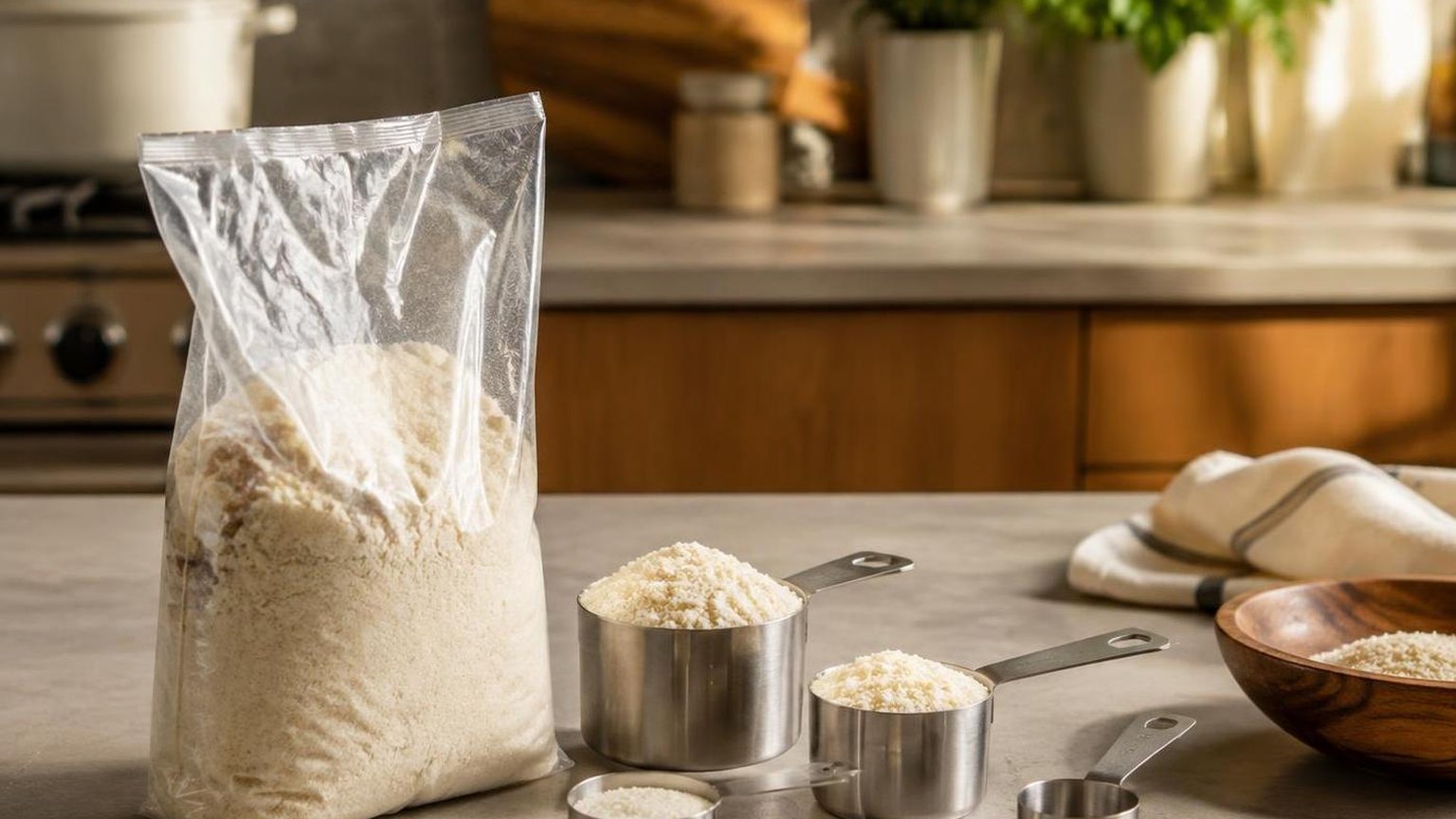
One pound of all-purpose flour is about 3 1/3 to 3 2/3 cups, depending on how it is measured. Using the common U.S. baking standard of about 120 grams per cup, 1 lb equals approximately 3.78 cups.
How many cups are in 1 lb of granulated sugar?
One pound of granulated sugar equals about 2 1/4 cups. This is based on 1 cup of granulated sugar weighing roughly 200 grams, while 1 lb equals 453.6 grams.
How many cups are in 1 lb of butter?
One pound of butter equals exactly 2 cups in U.S. measurement. It is also equal to 4 sticks, 16 ounces, or 32 tablespoons.
How many cups are in 1 lb of brown sugar?
One pound of packed brown sugar equals about 2 1/4 cups. If the brown sugar is loosely scooped rather than firmly packed, the cup amount will be higher because less sugar fits into each cup.
Why does 1 lb not always equal the same number of cups?
A pound measures weight, while a cup measures volume, so the conversion depends on the ingredient’s density. For example, 1 lb of butter is 2 cups, but 1 lb of all-purpose flour is closer to 3.8 cups because flour is much lighter by volume.
How many cups are in 1 lb of powdered sugar?
One pound of powdered sugar contains about 3 1/2 to 4 cups, depending on whether it is sifted. Confectioners' sugar is very light and compressible, so spooning, packing, or sifting changes the volume noticeably.
For baking accuracy, weigh it instead of relying only on cup measures.
How many cups are in 1 lb of uncooked rice?
One pound of uncooked white rice is about 2 1/2 cups. Most long-grain white rice weighs roughly 6.5 to 7 ounces per cup, so 16 ounces comes out close to that volume. Brown rice can vary slightly because grain size and bran layers affect packing density.
Related Reading
- How Many Ml In 8 Oz? – 2026
- What is the Standard Pour in a Single Mixer Cocktail? – 2026
- How To Measure Grams Of Food?
- How Many Ounces In 4 Liters?
- How Many Ounces In Lb?
- How Much Does a Commercial Nugget Ice Maker Cost?
- How Often Should Ice Machines Be Cleaned?
- All Blog Guides
- NIST Guide to the SI, Appendix B: Conversion Factors (2008)
- USDA FoodData Central: Wheat Flour, White, All-Purpose, Enriched, Bleached (2019)
- FDA 21 CFR § 101.12 Reference Amounts Customarily Consumed Per Eating Occasion (2025)
- University of Georgia Extension: Weights and Measures for Food Preparation (2015)
- King Arthur Baking: Ingredient Weight Chart (2024)
- Better Homes & Gardens: How to Measure Ingredients for Baking (2024)
- The Culinary Institute of America: Basic Kitchen and Food Service Management — Recipe Measurement and Conversion (2024)