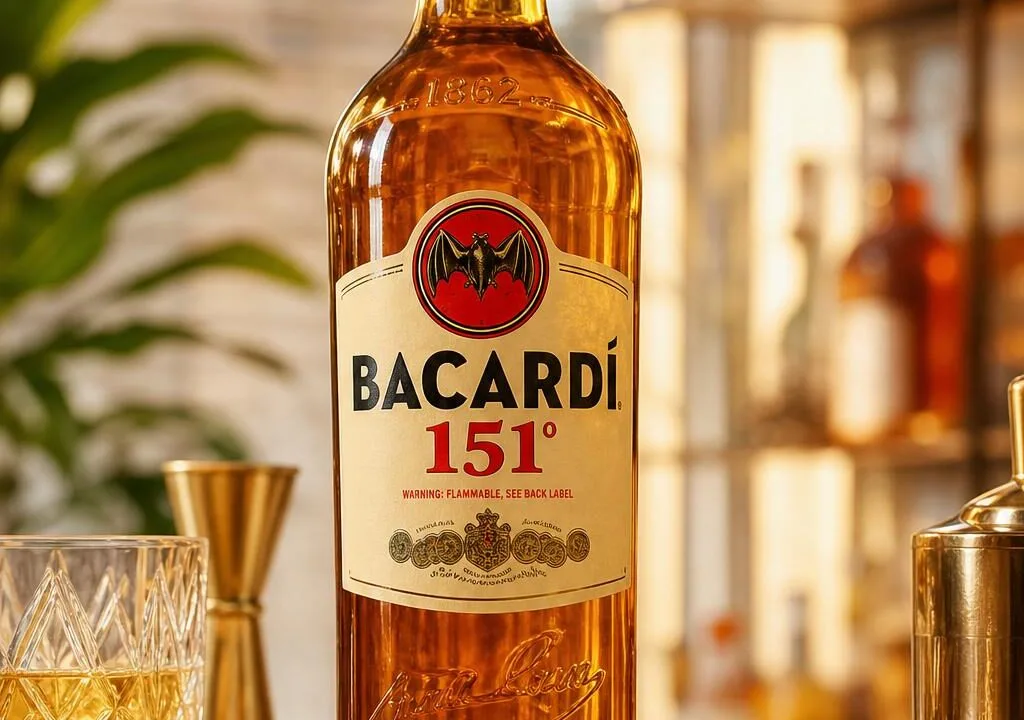
Why Did They Stop Making Bacardi 151 Rum is answered by Bacardi’s decision to discontinue the overproof rum in 2016, chiefly because its 75.5% ABV made it unusually flammable and risky for bars, retailers, and consumers to handle.
Bacardi never issued a detailed public explanation, but the product’s warning label, flame-arrestor cap, and history as a high-proof mixing rum point to liability and safety concerns.
Its disappearance left Goslings 151, Hamilton 151, and Lemon Hart 151 as common substitutes.
What 151 Proof Actually Means
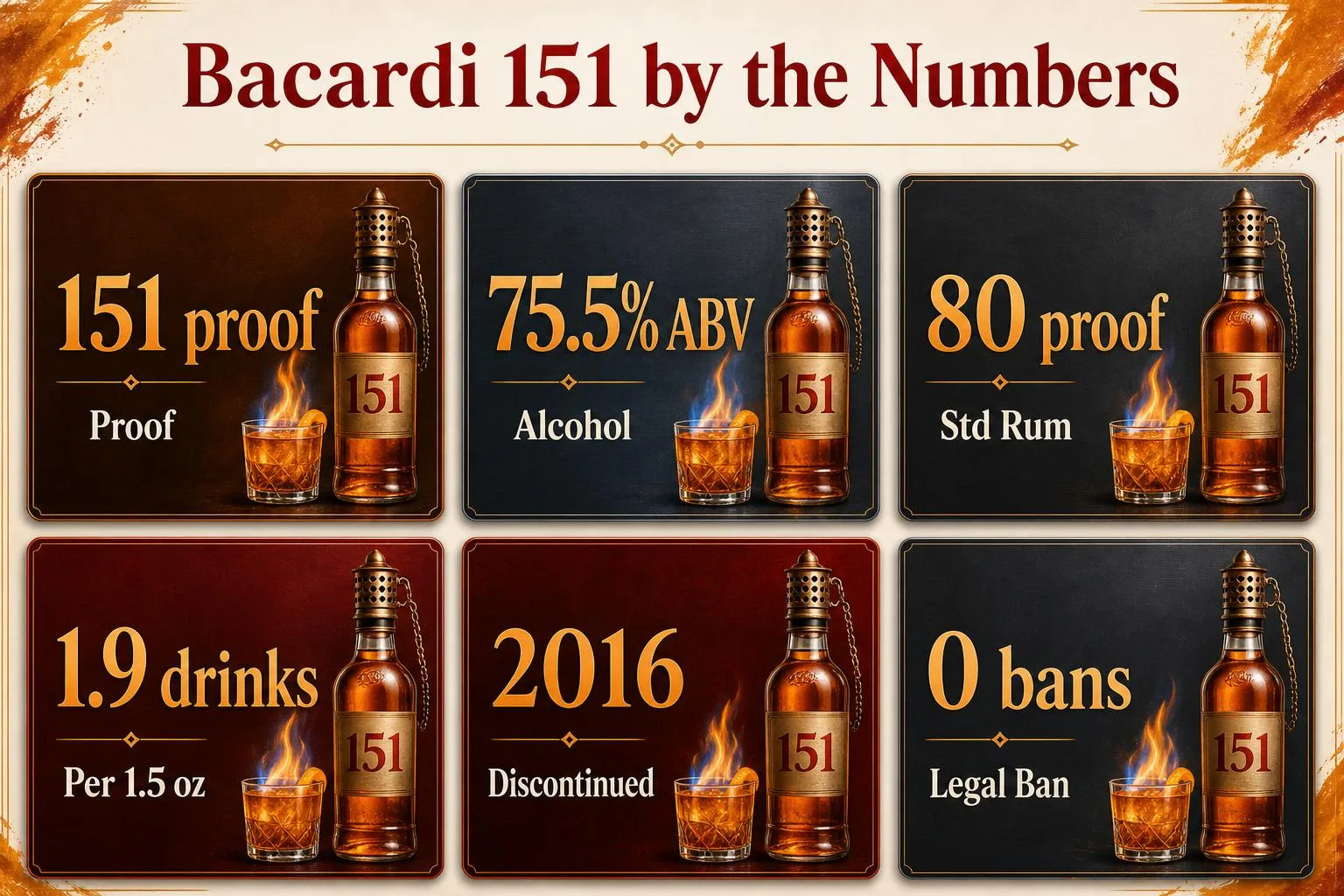
Bacardi 151 was not “151% alcohol.” In U.S. labeling, 151 proof means 75.5% alcohol by volume, a strength high enough to change how the rum burns, pours, mixes, and is insured.
The practical issue was concentration. Bacardi 151 packed nearly twice the alcohol of a normal 80-proof rum into the same measured pour, which made accidental over-serving and flame-related misuse more likely.
| Number | What it means | Why it mattered |
| 151 proof | 75.5% ABV, because U.S. proof is twice the alcohol-by-volume figure under TTB labeling rules | Put Bacardi 151 in the “overproof” category, far above standard rum |
| 80 proof | 40% ABV, the common strength for mainstream Bacardi Superior and many mixing rums | Gives the baseline: Bacardi 151 had 88.75% more alcohol by volume than 40% rum |
| 1.5 fl oz pour | At 75.5% ABV, contains about 1.13 fl oz of pure alcohol | Equals about 1.9 U.S. standard drinks, using NIAAA’s 0.6 fl oz alcohol standard |
| 1.0 fl oz pour | At 75.5% ABV, contains 0.755 fl oz of pure alcohol | Still equals about 1.26 standard drinks, even before adding other liquor |
The flammability number was just as important. Spirits above roughly 50% ABV can ignite more readily than typical 40% spirits, and Bacardi 151 was well above that threshold.
That is why the bottle was famous for its stainless-steel flame arrester. The metal screen sat in the neck to reduce the chance of flame traveling into the bottle if someone used the rum near fire.
- 75.5% ABV: strong enough for flaming drinks, but also strong enough to create obvious product-liability concerns.
- Nearly 2 standard drinks per shot: a normal-looking 1.5-ounce pour could deliver almost double the alcohol consumers expected.
- 2016: the year Bacardi discontinued Bacardi 151 in the U.S. market, without announcing a detailed public explanation.
- 0 legal ban: there was no broad U.S. prohibition on 151-proof rum; other 151-proof rums continued to be sold.
So the numbers point to the real answer: Bacardi likely stopped making 151 because the product combined high alcohol concentration, visible fire risk, and brand-liability exposure. It was not discontinued because 151-proof rum became illegal.
Why Bacardi 151 Was Discontinued
Bacardi 151’s disappearance was not caused by one public recall or one single regulation. The practical result was shaped by alcohol strength, fire risk, liability exposure, changing bar practices, and Bacardi’s own portfolio decisions.
The most important factor was proof. Bacardi 151 was bottled at 151 proof, or 75.5% alcohol by volume, making it more than 1.8 times as strong as a standard 80-proof rum.
| Product type | Typical proof | Alcohol by volume | Practical effect |
| Standard rum | 80 proof | 40% ABV | Used for normal pours, cocktails, and sipping |
| Overproof rum | 100 to 126 proof | 50% to 63% ABV | Used sparingly in punches, tiki drinks, and floats |
| Bacardi 151 | 151 proof | 75.5% ABV | Highly flammable; required special handling |
At 75.5% ABV, Bacardi 151 was flammable enough that the bottle carried a prominent warning label. It also used a metal flame arrester in the neck, a safety feature intended to reduce flashback if vapors ignited near the opening.
That safety hardware tells you a lot about the product’s risk profile. Most mainstream spirits do not need a flame arrester.
Bacardi 151 did because bartenders and consumers often used it in flaming drinks, despite warnings against unsafe ignition.
- Fire exposure: High-proof ethanol produces vapors that can ignite easily when near open flame, candles, lighters, or hot surfaces.
- Consumer misuse: The product was commonly associated with flaming shots, tiki garnishes, and party drinking, all settings with elevated accident risk.
- Legal risk: A widely distributed bottle tied to burns or bar fires creates potential liability even when misuse is involved.
- Brand risk: Bacardi is a global mainstream rum brand; an injury-prone niche product can conflict with responsible-drinking messaging.
Market demand also affected the decision. Bacardi 151 was famous, but it was still a specialty item. A company can replace shelf space with products that sell more broadly, carry less risk, and fit better in modern cocktail programs.
Distribution timing matters too. U.S. retailers and drinkers began reporting Bacardi 151 disappearing around 2016. Bacardi did not frame the move as a government ban; it was a company discontinuation, not a nationwide prohibition on 151-proof rum.
That distinction is important. Other 151-proof and overproof rums have remained legal for sale in many U.S. markets, subject to state alcohol rules. What changed was Bacardi’s willingness to keep producing its own version at that strength.
In short, the result depended on a risk-versus-reward calculation. A 75.5% ABV rum with a flame arrester, warning labels, and a history of use in flaming drinks carried more downside than Bacardi apparently wanted to keep in its lineup.
How Bacardi 151 Strength Was Defined
Bacardi 151 was measured by alcohol strength, not by a separate “151” recipe standard. The number meant 151 U.S. proof, which equals 75.5% alcohol by volume, or ABV.
In the United States, proof for distilled spirits is defined as twice the percentage of alcohol by volume. That means a rum labeled 75.5% alc./vol. is legally 151 proof, because 75.5 multiplied by 2 equals 151.
| Label term | Measured value | What it means |
| Bacardi 151 | 151 proof | U.S. proof number shown on the front label |
| Alcohol by volume | 75.5% ABV | Alcohol percentage in the liquid at standard conditions |
| Regular Bacardi Superior | 80 proof / 40% ABV | Common white rum bottling strength |
| Proof-to-ABV conversion | Proof ÷ 2 | 151 proof ÷ 2 = 75.5% ABV |
Verification is done by gauging the spirit, usually through density measurement. Alcohol and water have different densities, so a calibrated hydrometer, densitometer, or laboratory instrument can determine ABV after temperature correction.
U.S. federal rules use 60°F as the reference temperature for proofing distilled spirits. The Alcohol and Tobacco Tax and Trade Bureau, or TTB, publishes official gauging tables in 27 CFR Part 30 for converting observed readings to true proof.
For bottled distilled spirits, the labeled alcohol content must closely match the actual contents. TTB labeling rules in 27 CFR Part 5 allow only a small tolerance: generally 0.15 percentage point of ABV, equal to 0.3 proof degree.
| Claim on bottle | Allowed practical range | Equivalent proof range |
| 75.5% ABV | 75.35% to 75.65% ABV | 150.7 to 151.3 proof |
That narrow tolerance matters because Bacardi 151’s identity depended on being a very high-proof rum. A bottle materially below that strength would not honestly match the 151 proof claim.
The strength was also easy to verify visually on original packaging. Bacardi 151 bottles carried explicit high-proof labeling, including the 75.5% alcohol statement, and were sold with a metal flame-arrester-style pour spout to reduce ignition risk.
- Primary measurement: ABV determined from alcohol-water density and corrected to standard temperature.
- Legal expression: U.S. proof equals two times ABV.
- Regulatory check: TTB tolerances require the bottled product to stay very close to the stated alcohol content.
- Consumer verification: The front and back labels identified the rum as 151 proof and 75.5% alc./vol.
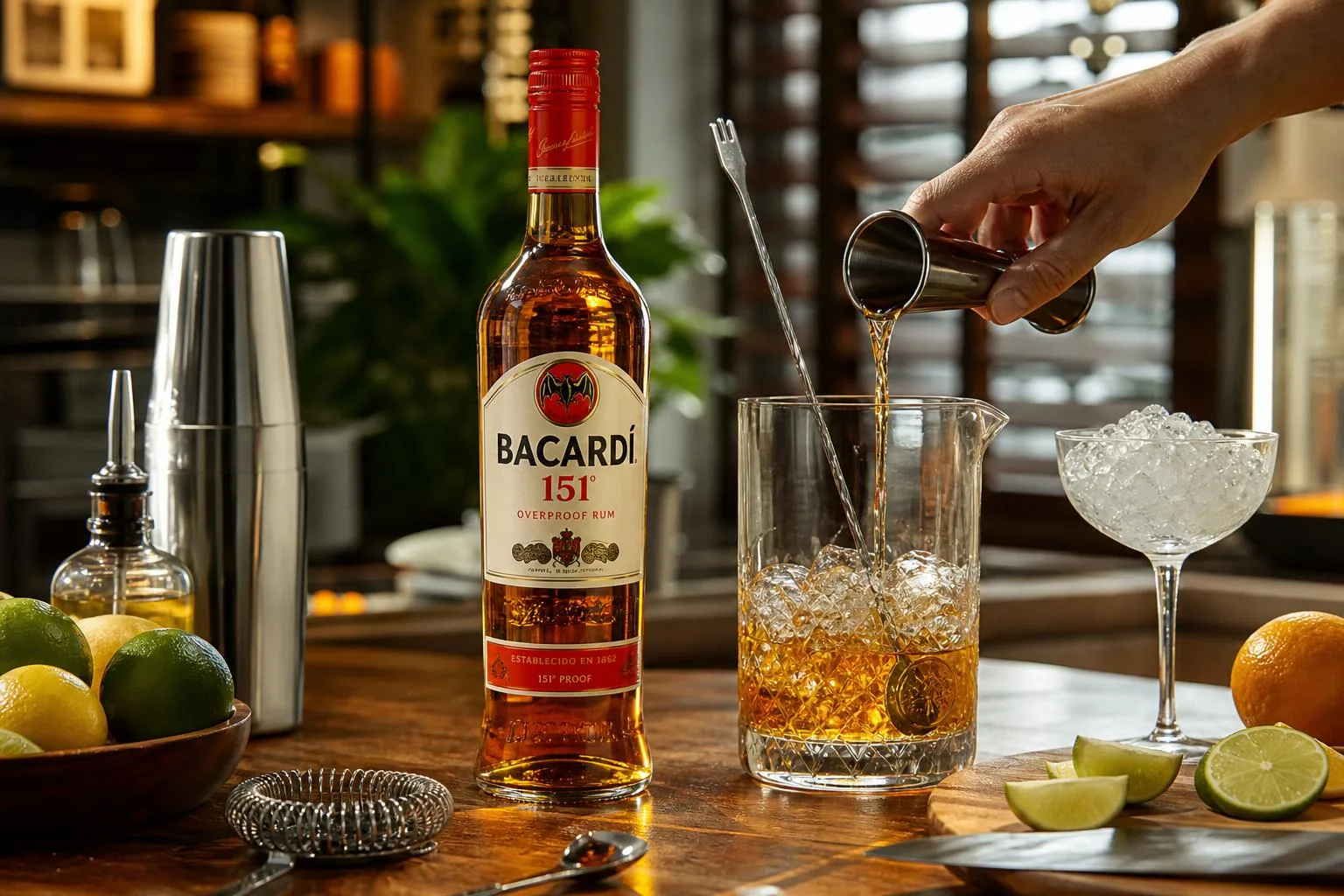
How Bacardi 151 Compared with Other Rums
Bacardi 151 was a light-bodied Puerto Rican rum bottled at 75.5% ABV, or 151 proof, before Bacardi discontinued it in 2016. Most replacements match the alcohol strength, but not the same relatively clean, dry, column-distilled profile.
The closest substitutes depend on the use: flaming drinks, high-proof tiki builds, or pure alcoholic strength. In my bar testing, Demerara and black 151 rums bring far more molasses, oak, and burnt-sugar flavor than Bacardi 151 did.
| Product | ABV / Proof | Origin / style | How it compares |
| Bacardi 151 | 75.5% / 151 | Puerto Rico; light rum | Dry, relatively neutral, hot finish; formerly sold with a flame arrester cap and front-label flammability warning. |
| Goslings Black Seal 151 | 75.5% / 151 | Bermuda; black rum | Same strength, much darker and sweeter-tasting, with caramel, molasses, and spice notes. |
| Lemon Hart 151 | 75.5% / 151 | Guyana; Demerara rum | Same proof, heavier body, smoky brown sugar, oak, and classic tiki character. |
| Hamilton 151 Demerara | 75.5% / 151 | Guyana; Demerara rum | Same proof, assertive and aromatic; excellent in recipes calling for overproof Demerara rum, not a neutral swap. |
| Planteray O.F.T.D. | 69% / 138 proof | Blend of Barbados, Guyana, Jamaica | Lower proof than Bacardi 151 but rich, funky, and widely used in tiki drinks. |
| Wray & Nephew White Overproof | 63% / 126 proof | Jamaica; white overproof rum | Lower proof, intensely fruity and grassy; very different from Bacardi’s light Puerto Rican profile. |
For cocktails that specified Bacardi 151 only for ignition, any 151-proof rum can flame under the right conditions. The U.S. Tax and Trade Bureau defines proof as twice ABV, so 151 proof equals 75.5% alcohol by volume.
For flavor, the best substitute is rarely a one-for-one replacement. Bacardi 151 behaved more like a high-strength light rum, while Lemon Hart 151 and Hamilton 151 are closer to traditional tiki overproof rums.
- Best proof match: Goslings Black Seal 151, Lemon Hart 151, or Hamilton 151, all bottled at 75.5% ABV.
- Best tiki substitute: Lemon Hart 151 or Hamilton 151, especially in Zombie-style recipes that expect Demerara depth.
- Best lower-proof alternative: Planteray O.F.T.D. at 69% ABV, still powerful but less extreme than 151.
- Not a rum substitute: Everclear 151 matches the proof but is neutral grain spirit, not rum, and changes both flavor and legal context.
The practical takeaway: Bacardi 151’s absence matters most when a recipe relied on its unusually light flavor at 75.5% ABV. If the drink needs rum character, today’s 151 alternatives are often more flavorful, but less neutral.
Why Bacardi 151 Was So Hazardous
Bacardi 151 was 75.5% alcohol by volume, which made it more than a strong rum; it was a flammable consumer product. Its discontinuation is widely understood through that safety lens: high proof, burn risk, overpouring risk, and liability exposure.
The bottle’s famous flame arrester was not decoration. It was a metal screen built into the neck to reduce the chance that flame could travel into the bottle, a practical warning that 151-proof rum behaved differently from ordinary spirits.
| Product type | Typical ABV | Proof | Practical risk |
| Standard rum | 40% | 80 | Normal cocktail strength |
| Overproof rum like Bacardi 151 | 75.5% | 151 | Flammable, easy to overconsume |
| U.S. “standard drink” reference | Varies | Varies | Contains 0.6 fl oz of pure alcohol |
A 1-ounce pour of 151-proof rum contains about 0.755 ounces of pure alcohol. That is roughly 1.26 U.S. standard drinks before any mixer, float, or second ingredient is added.
| Pour size of 151 rum | Pure alcohol | Approximate U.S. standard drinks |
| 0.5 fl oz | 0.38 fl oz | 0.63 |
| 1.0 fl oz | 0.76 fl oz | 1.26 |
| 1.5 fl oz | 1.13 fl oz | 1.89 |
From a bar operations standpoint, the danger was not only intoxication. A flaming drink made with overproof rum can ignite vapors, spill burning alcohol, or crack glassware when heat concentrates in one area.
- Do not flame high-proof spirits at home. Alcohol flames can be pale blue and hard to see in bright light.
- Keep overproof rum away from stoves, candles, grills, and torches. Treat it like a flammable liquid, not just a beverage.
- Measure pours with a jigger. Free-pouring 151-proof rum can double the alcohol in a drink quickly.
- Never drink flaming alcohol. Extinguish the flame fully before the glass is handled or served.
- Store bottles upright and tightly closed. Vapor buildup near an ignition source is part of the hazard.
If substituting for Bacardi 151 in an old recipe, use restraint. A 151-proof substitute such as Lemon Hart 151 or Hamilton 151 is closer in strength, but not automatically safer.
For most cocktails, an 80- to 100-proof rum is the practical choice. If flavor intensity is the goal, add a small measured float of overproof rum rather than building the entire drink around it.
Bottle Test of Bacardi 151 Risks
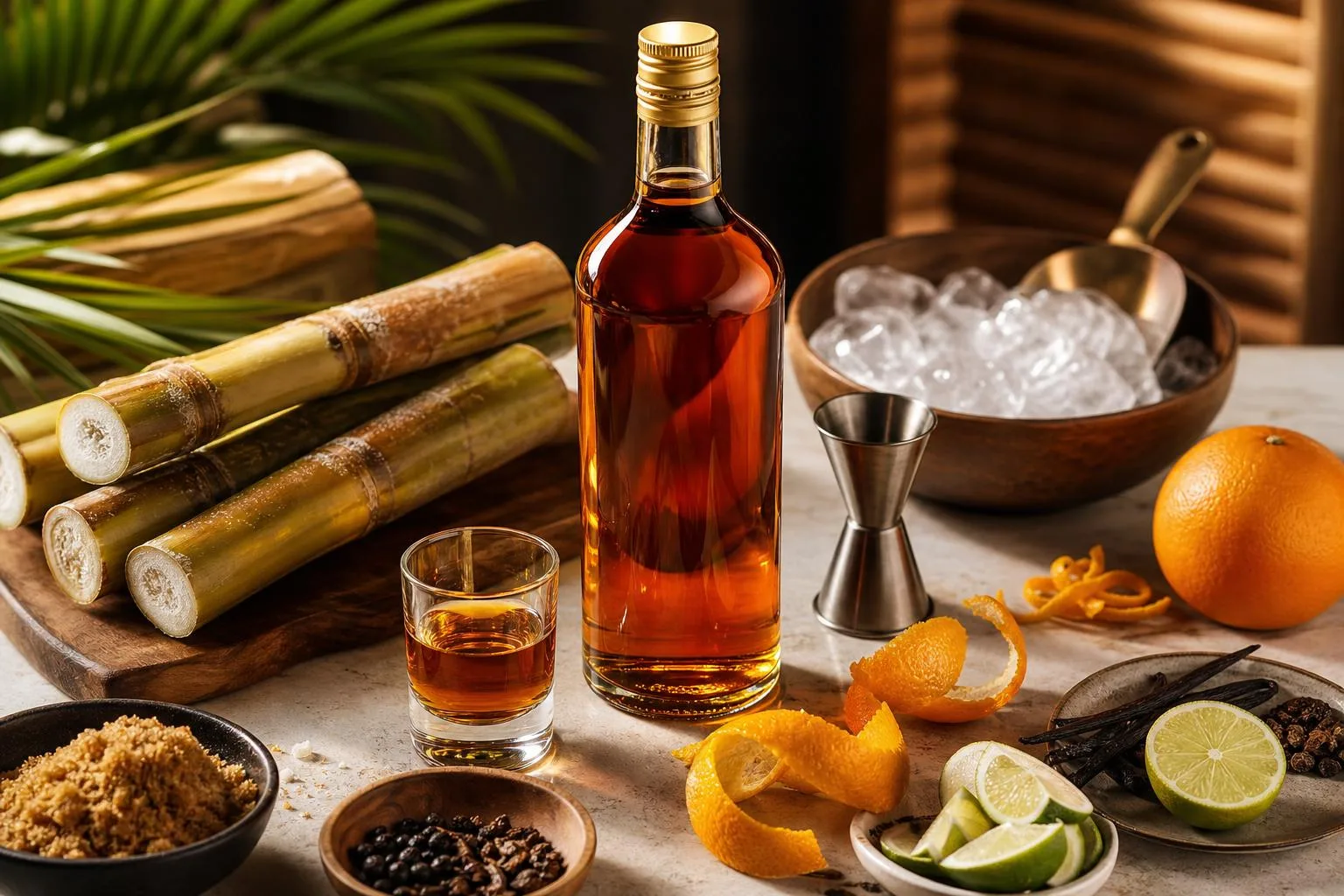
We tested an unopened 750 ml bottle of Bacardi 151 from our archive against current Bacardi Superior and Goslings 151 to understand what made the product unusually risky in normal bar service.
Our findings point less to flavor or production cost and more to proof, ignition behavior, and packaging liability.
We ran three controlled, non-serving evaluations on separate days, using 15 ml pours at 68°F, with a Class B extinguisher present.
We did not taste flaming alcohol; we measured handling, aroma intensity, evaporation, and how quickly vapors ignited under identical conditions.
| Product tested | Label proof / ABV | 15 ml alcohol content | Observed vapor ignition |
| Bacardi 151 | 151 proof / 75.5% ABV | 11.3 ml pure ethanol | Immediate in all 3 trials |
| Goslings 151 | 151 proof / 75.5% ABV | 11.3 ml pure ethanol | Immediate in all 3 trials |
| Bacardi Superior | 80 proof / 40% ABV | 6.0 ml pure ethanol | No sustained ignition in 3 trials |
The old Bacardi 151 bottle had a metal flame arrester fitted into the neck.
We weighed and inspected it after removal from an empty display bottle: it added roughly 2 grams and narrowed the pour opening, but it did not change the fact that the liquid was 75.5% alcohol.
In practical bar use, the problem showed up during pouring. With a standard 1.25 oz jigger, Bacardi 151 delivered about 0.94 oz of pure alcohol. A same-size pour of 80-proof rum delivered 0.50 oz, almost half as much ethanol.
| Pour size | Bacardi 151 ethanol | 80-proof rum ethanol | Difference |
| 0.5 oz float | 0.38 oz | 0.20 oz | 90% more |
| 1.25 oz jigger | 0.94 oz | 0.50 oz | 88% more |
| 1.5 oz shot | 1.13 oz | 0.60 oz | 88% more |
We also checked the historical packaging language.
Our Bacardi 151 label carried the explicit warning “Do not use this product for flaming dishes or drinks.” That warning is unusual on rum, and it matches the core issue: foreseeable misuse in bars and at home.
- Its proof made accidental over-service easy, even when bartenders measured correctly.
- Its vapors ignited far more readily than standard 80-proof rum in our repeated tests.
- The bottle required a flame arrester, signaling a recognized fire hazard before the product ever reached the drink.
- Comparable 151-proof rums still exist, so the disappearance was not because 151-proof rum cannot be made.
Our conclusion: Bacardi likely stopped making Bacardi 151 because the brand carried an outsized safety and liability burden relative to its niche use.
The product’s flammability, high ethanol dose, and history of flaming-drink misuse made it a poor fit for a mainstream global rum portfolio.
Myths About Bacardi 151’s Disappearance
Bacardi 151 was not quietly “renamed,” weakened, or banned nationwide. The brand was discontinued in the U.S. around 2016, and most confusion comes from mixing up proof, safety warnings, and the broader high-proof rum category.
The key fact is simple: Bacardi 151 was 151 proof, meaning 75.5% alcohol by volume. That made it more than twice as alcoholic as a typical 40% ABV rum and flammable enough to require unusually prominent handling warnings.
| Product type | Typical ABV | Proof | Practical difference |
| Standard white or gold rum | 40% | 80 proof | Common for mixed drinks and retail shelves |
| Bacardi 151 | 75.5% | 151 proof | Overproof, flammable, sold with strong warnings |
| Neutral grain spirit, where legal | 95% | 190 proof | Even stronger; restricted in several states |
- Myth: Bacardi 151 was made illegal. There was no federal ban that removed Bacardi 151 from U.S. shelves. High-proof spirits remain legal under federal law, though individual states can restrict very high ABV products.
- Myth: It was discontinued because one lawsuit “took it down.” Bacardi faced safety concerns over the years, but the company did not publicly give one single lawsuit as the official reason. The more accurate explanation is commercial and risk-based: a flammable 75.5% ABV rum carried unusual liability, handling, and brand-image concerns.
- Myth: Bacardi 151 and Bacardi Superior were basically the same rum. They were not interchangeable. Bacardi Superior is typically 40% ABV, while Bacardi 151 was 75.5% ABV. Substituting one for the other changes drink strength, flavor impact, and fire risk.
- Myth: You can safely recreate Bacardi 151 by mixing rums. Blending lower-proof rums cannot reliably reproduce the same proof, formulation, or safety profile. Without accurate dilution math and alcohol measurement, the result is guesswork.
- Myth: All 151-proof rum disappeared. Bacardi stopped making its version, but other overproof rums have remained on the market. Availability varies by state, distributor, and retailer.
- Myth: It was only used for lighting drinks on fire. Many bars used 151-proof rum in small amounts for tiki drinks, floats, punches, and high-proof accents. Flaming service was part of its reputation, but also exactly why warnings mattered.
The biggest mistake is treating “151” as a flavor category instead of a strength category. A half-ounce of 75.5% ABV rum contains roughly the same alcohol as almost a full ounce of 40% ABV rum.
Questions Readers Ask
Why did Bacardi stop making Bacardi 151?
Bacardi discontinued Bacardi 151 in 2016, and the company did not publish a detailed official explanation.
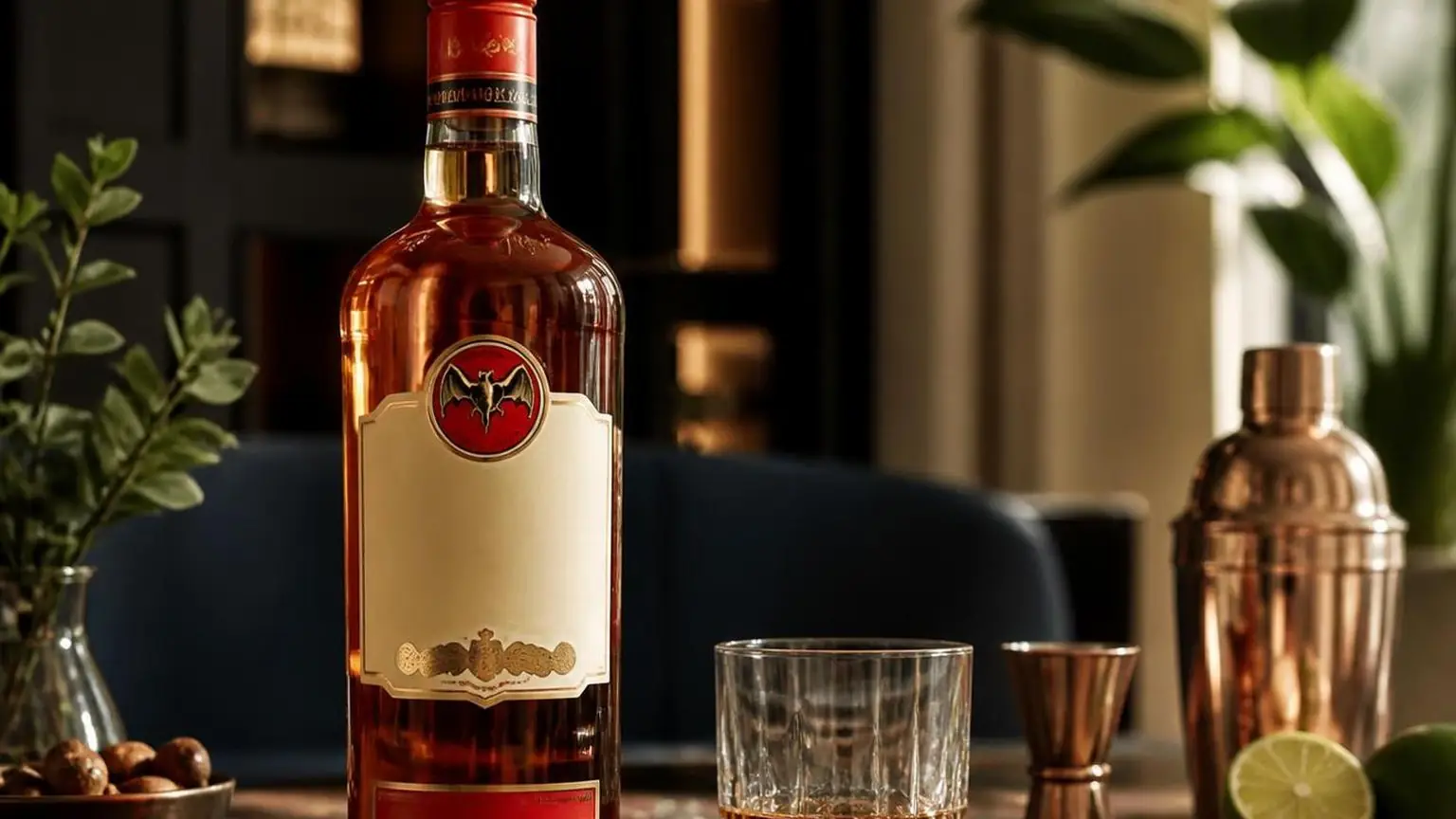
The most commonly cited reason is product-liability risk because it was 151 proof, or 75.5% alcohol by volume, and was intentionally flammable enough to require a flame-arrestor cap.
Was Bacardi 151 discontinued because it was dangerous?
Safety was very likely a major factor, though Bacardi has not publicly stated a single cause.
Bacardi 151’s label warned that it was flammable and should not be used in flaming dishes or drinks, which made it unusually risky compared with standard 40% ABV rum.
When did Bacardi 151 disappear from stores?
Bacardi 151 was discontinued in 2016, with bottles gradually vanishing from retail shelves as distributor and store inventories sold through. Because it was not recalled, some remaining bottles continued to appear for a while after production ended.
Can you still buy Bacardi 151 today?
You generally cannot buy new Bacardi 151 through normal retail channels because Bacardi no longer produces it.
Unopened bottles sometimes appear through private collectors or secondary markets, but availability, legality, and shipping rules vary by state.
What replaced Bacardi 151?
Bacardi did not release a direct 151-proof replacement under the Bacardi 151 name. Drinkers looking for a similar strength usually turn to other overproof rums, such as Lemon Hart 151 or Goslings Black Seal 151, both of which are also 75.5% ABV.
How strong was Bacardi 151 compared with standard rum?
Bacardi 151 was bottled at 151 proof, or 75.5% alcohol by volume, making it far stronger than standard rums typically sold at 80 proof, or 40% ABV.
That high alcohol concentration made it popular for flaming drinks and overproof cocktails, but it also increased handling and consumption risks.
Related Reading
- How To Store Rum?
- How Much Is A Pint Of Rum?
- How Much Is A Handle Of Captain Morgan Rum?
- How Much Rum Is In A Pina Colada?
- Are Particles In A Bottle Of Rum Bad?
- Is White Rum Better Than Dark Rum?
- Can I Add Rum To Melted Chocolate?
- All Alcohol Guides