Healthiest Red Wine is typically dry, moderate-alcohol Pinot Noir because it tends to offer high polyphenol content, lower tannin harshness, and fewer residual sugars than many fuller-bodied reds.
For readers choosing wine with wellness in mind, the key factors are antioxidant density, alcohol by volume, serving size, sulfite tolerance, and sugar content.
This guide compares evidence-backed red wine options, including Pinot Noir, Cabernet Sauvignon, Merlot, Syrah, and Malbec, with attention to resveratrol, anthocyanins, and heart-health research. A standard serving is 5 ounces, and U.S.
Dietary Guidelines define moderation as up to one drink daily for women or two for men.
What Makes a Red Wine Healthier
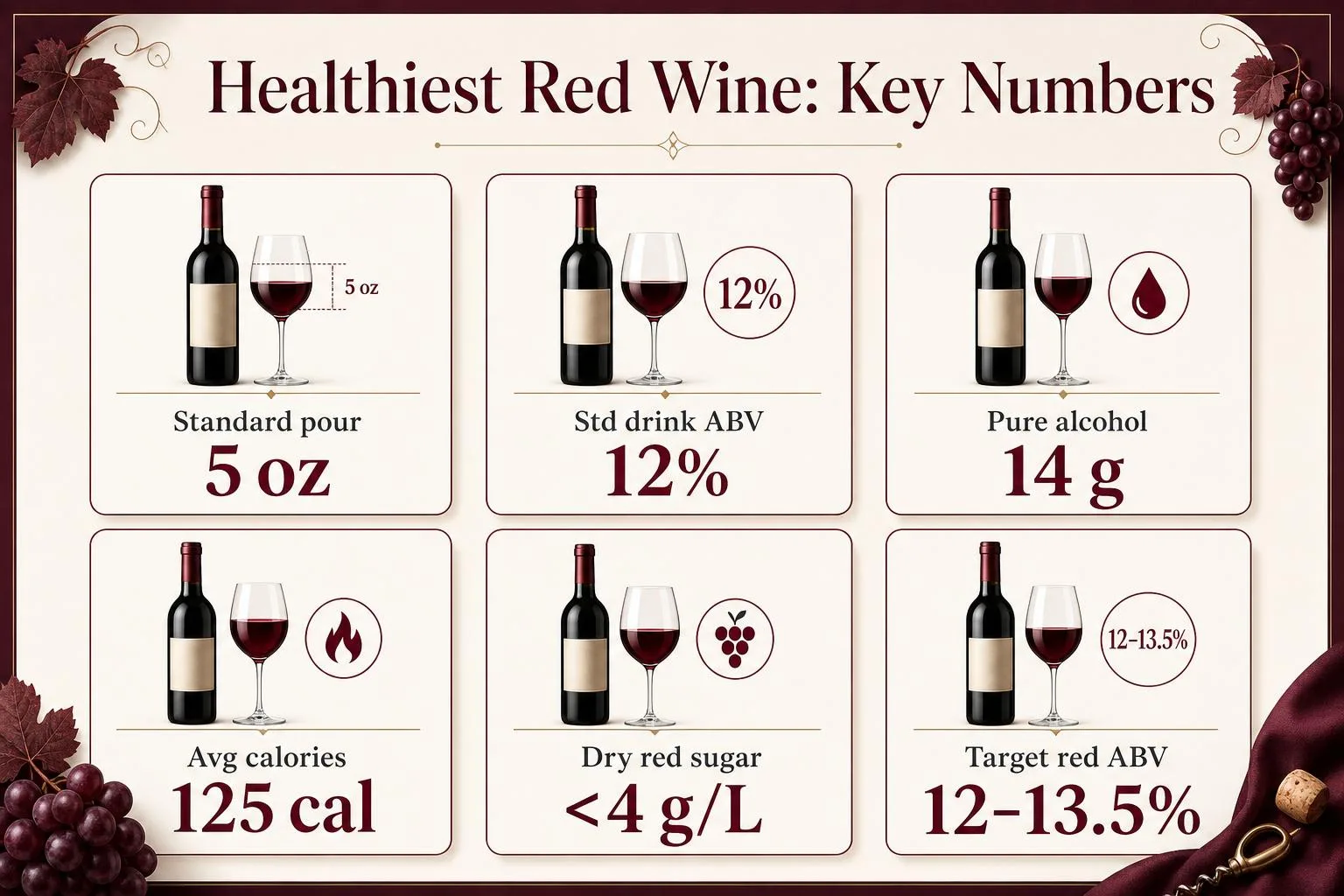
The “healthiest” red wine is usually the one that keeps alcohol, calories, and sugar lowest while still giving you the polyphenols red wine is known for. The numbers below are the ones I check first on a bottle or wine list.
Alcohol matters most because it drives both calories and health risk. In the U.S., the National Institute on Alcohol Abuse and Alcoholism defines one standard drink as 5 fluid ounces of wine at 12% ABV, containing about 14 grams of pure alcohol.
| Number to check | What it means | Health-minded target |
| ABV | Alcohol by volume; higher ABV means more alcohol and calories per pour. | About 12%–13.5% for red wine, when available. |
| Pour size | A standard wine pour is 5 oz, but restaurant pours are often 6–9 oz. | Measure 5 oz at home at least once to calibrate your eye. |
| Calories | USDA lists about 125 calories in 5 oz of average red table wine. | Lower ABV dry reds usually land near 115–130 calories per 5 oz. |
| Residual sugar | Dry reds are generally low in sugar; sweeter reds climb quickly. | Look for “dry,” often under 4 g/L residual sugar. |
A practical comparison: a 5 oz glass at 12.5% ABV contains roughly 15 grams of alcohol. The same 5 oz at 15% ABV contains about 18 grams. That difference is meaningful if you drink wine regularly.
Sugar is usually less important than alcohol in dry red wine, but it still matters. A dry red with 2 g/L residual sugar has only about 0.3 grams of sugar in a 5 oz glass. A 20 g/L semi-sweet red has about 3 grams per glass.
| Red wine style | Typical profile | Why it may be a better pick |
| Pinot Noir | Often 12.5%–14% ABV, lighter body. | Good choice when you want lower alcohol and a dry style. |
| Cabernet Sauvignon | Often 13.5%–15% ABV, fuller body. | Can be dry, but check ABV; many bottles are higher alcohol. |
| Lambrusco, dry | Often 10.5%–12.5% ABV, sparkling red. | Lower alcohol can help, but avoid sweet versions if limiting sugar. |
Polyphenols are the reason red wine gets its health halo. Red wines generally contain more polyphenols than white wines because the juice ferments with grape skins.
Still, resveratrol varies widely by grape, climate, vintage, and winemaking, so it is not reliable on a label.
For drinking limits, the 2020–2025 Dietary Guidelines for Americans advise adults who drink to limit intake to 1 drink or less per day for women and 2 or less for men.
They also state that not drinking is healthier than starting for possible benefits.
Factors That Determine Healthiest Red Wine
The “healthiest” red wine is not a single bottle; it depends on alcohol level, serving size, residual sugar, polyphenol concentration, and how often you drink it.
A 5-ounce pour at 12% ABV contains about 14 grams of pure alcohol, the U.S. definition of one standard drink.
In practice, the biggest health variable is dose. Even a dry, antioxidant-rich red wine stops looking “healthy” if the pour is 8 ounces, the bottle is 15% ABV, or it is consumed nightly beyond guideline limits.
| Factor | Why it matters | Useful benchmark |
| Alcohol by volume | Higher ABV increases total ethanol exposure, calories, and intoxication risk. | 12% ABV, 5 ounces = about 14 grams alcohol. |
| Pour size | Restaurant and home pours often exceed the standard serving. | 6 ounces at 14.5% ABV is about 1.45 standard drinks. |
| Residual sugar | Dry reds usually add little sugar; sweet reds can add meaningful carbohydrates. | Dry red is often under 4 grams sugar per liter. |
| Polyphenols | Tannins, anthocyanins, and resveratrol come mainly from grape skins and seeds. | Thicker-skinned grapes and longer maceration usually raise levels. |
Grape and winemaking choices
Polyphenol content is strongly affected by grape variety, climate, fermentation temperature, skin contact, and oak aging.
Cabernet Sauvignon, Tannat, Petite Sirah, Sagrantino, and Syrah often deliver more tannin than lighter reds such as Gamay or basic Pinot Noir.
This does not mean the most tannic wine is automatically best.
High-tannin wines can be harder to tolerate for people prone to reflux, migraines, or histamine-like reactions. “Healthiest” should include how your body responds after one measured glass.
Dryness, calories, and additives
Most dry red wines contain roughly 120 to 130 calories per 5-ounce serving, mostly from alcohol. A 15% ABV red will usually carry more calories than a 12.5% ABV red, even when both taste completely dry.
Sulfites are not a useful way to rank red wines for health. In the U.S., wines labeled “contains sulfites” have at least 10 parts per million, while the legal maximum is 350 parts per million.
White wines often contain more sulfite than reds.
- Best practical target: dry red wine, 12% to 13.5% ABV, poured at 5 ounces.
- Best polyphenol signal: darker, more tannic reds made with extended skin contact.
- Best overall habit: drink with food, avoid oversized pours, and include alcohol-free days.
Why Grape Name Is Not Enough
“Healthiest” red wine is not verified by the grape name alone. It is assessed through laboratory measurements: alcohol, residual sugar, acidity, calories, sulfites, and phenolic compounds such as anthocyanins, tannins, and resveratrol.
In practice, the most reliable bottle is one with transparent technical data from the producer, a current lab analysis, or certification from a recognized program such as USDA Organic, Demeter, LIVE, SIP Certified, or EU organic certification.
Core Measurements Used
| Measure | Why it matters | Typical red wine range |
| Alcohol by volume | Lower ABV generally means fewer alcohol-related health risks and fewer calories. | 12.0% to 15.5% ABV |
| Residual sugar | Dry wines reduce added sugar intake and glycemic impact. | 0 to 4 g/L for dry red wine |
| Calories | Mostly driven by alcohol; sugar adds additional calories. | 120 to 130 calories per 5 oz at 13.5% ABV |
| Total sulfites | Relevant for sensitive drinkers, though true sulfite allergy is uncommon. | Often 50 to 150 mg/L; U.S. legal maximum is 350 mg/L |
| Polyphenols | Includes tannins, anthocyanins, and other antioxidant compounds. | Often 1,000 to 3,000 mg/L in red wine |
How Producers and Labs Verify It
- ABV testing: Alcohol is commonly measured by distillation, density meter, or near-infrared analysis. In the United States, wine labels generally allow a tolerance of 1.5 percentage points for wines at or below 14% ABV, and 1.0 percentage point above 14% ABV.
- Residual sugar testing: Enzymatic analysis or high-performance liquid chromatography can confirm whether a wine is truly dry. A wine under 4 g/L residual sugar is typically considered dry in many technical contexts.
- Phenolic testing: Labs may use spectrophotometry, Folin-Ciocalteu testing, or HPLC to estimate total phenolics, anthocyanins, and resveratrol. Red wines usually test far higher than whites because skins remain during fermentation.
- Sulfite testing: Free and total sulfur dioxide are measured separately. “Contains sulfites” is required on U.S. labels when total sulfites are 10 mg/L or higher.
- Organic verification: USDA Organic wine must be made from organic grapes and cannot have added sulfites. Wine labeled “made with organic grapes” may contain added sulfites, but total sulfites must stay below 100 mg/L.
For a health-focused red, I look first for 12% to 13.5% ABV, dry sugar levels, moderate sulfites, and evidence of third-party certification or published technical sheets.
Pinot Noir, Cabernet Franc, Sangiovese, and cooler-climate reds often meet these criteria when made in a restrained style.
How Red Wine Compares to Other Drinks
The “healthiest” red wine choice is usually a dry, lower-alcohol red served in a true 5-ounce pour.
Compared with white wine, beer, cocktails, and grape juice, red wine’s main advantage is higher skin-derived polyphenols, not lower alcohol risk.
Alcohol still matters most. The NIAAA defines one standard drink as 14 grams of pure alcohol: 5 ounces of wine at 12% ABV, 12 ounces of regular beer at 5% ABV, or 1.5 ounces of 80-proof spirits.
| Drink | Typical serving | Alcohol | Calories, approx. | Health-relevant note |
| Dry red wine | 5 oz | 12% to 14.5% ABV | 120 to 130 | Higher tannins and anthocyanins than most white wines because skins ferment with the juice. |
| Dry white wine | 5 oz | 11% to 13.5% ABV | 115 to 125 | Often slightly lower in polyphenols; calories are usually similar to red. |
| Regular beer | 12 oz | About 5% ABV | 145 to 155 | Similar alcohol per standard drink, generally more carbohydrate than dry wine. |
| Vodka, whiskey, gin | 1.5 oz | 40% ABV | 95 to 105 | Lower calories straight, but no meaningful wine polyphenols; mixers can add sugar quickly. |
| Red grape juice | 8 oz | 0% ABV | 150 to 160 | Contains grape polyphenols, but also about 35 to 38 grams of sugar per cup. |
Against white wine, red wine usually wins on phenolic content. Pinot noir, cabernet sauvignon, merlot, and syrah get color and tannin from extended skin contact; most white wines are pressed off skins early, reducing anthocyanins and tannins.
Against beer, dry red wine is not automatically “lighter.” A 5-ounce glass of dry red is commonly around 125 calories, while a 12-ounce regular beer is about 150 calories. The gap disappears if the wine pour is 6 to 8 ounces.
Against spirits, red wine has more plant compounds, but spirits can be lower-calorie when served neat. A 1.5-ounce shot of 80-proof liquor has about 97 calories, yet a margarita or whiskey sour can exceed 200 calories because of sugar.
- Best alternative if avoiding alcohol: unsweetened dealcoholized red wine or small servings of 100% Concord grape juice, recognizing juice is sugar-dense.
- Best lower-calorie swap: a 5-ounce dry white or sparkling brut wine, typically similar or slightly lower in calories than red.
- Best lower-alcohol red strategy: choose reds around 12% to 13% ABV instead of 14.5% to 15.5% ABV bottles.
Bottom line: dry red wine compares favorably when the serving is controlled, the ABV is moderate, and it replaces—not adds to—other alcoholic drinks. More polyphenols do not cancel alcohol’s dose-dependent risks.
Safe Ways to Choose Red Wine
The healthiest red wine choice is usually a dry, lower-alcohol red served in a measured pour, not a “superfood” bottle. The U.S.
Dietary Guidelines define moderation as up to 1 drink per day for women and up to 2 for men, and they do not advise starting alcohol for health benefits.
| Practical benchmark | Specific number | Why it matters |
| Standard wine drink | 5 fl oz at 12% ABV | Equals about 14 grams of pure alcohol in the U.S. |
| Typical red wine calories | About 120–130 calories per 5 fl oz | Higher ABV and residual sugar raise calories. |
| Lower-alcohol target | 12.5–13.5% ABV | Often easier to keep total alcohol intake moderate. |
| Higher-alcohol reds | 14.5–15.5% ABV | A 5 oz pour contains more alcohol than a standard drink. |
For everyday drinking, look for dry reds such as Pinot Noir, Cabernet Franc, Chianti, Rioja Crianza, or lighter-style Syrah. These commonly deliver tannins and polyphenols without the extra sugar found in sweet red blends or dessert wines.
- Measure the pour: Use a 5-ounce pour at home. Large restaurant pours can be 6 to 9 ounces, turning one glass into 1.2 to 1.8 standard drinks.
- Check ABV first: A 15% ABV red has 25% more alcohol than a 12% ABV wine at the same serving size.
- Choose dry over sweet: Dry red wine usually has under 4 grams of residual sugar per liter, while sweet reds can be far higher.
- Hydrate and eat: Drink wine with food and alternate with water. Alcohol is absorbed faster on an empty stomach.
- Use smaller glassware: A 12-ounce glass encourages more accurate pours than an oversized 20-ounce bowl.
Do not drink red wine for heart protection if you do not already drink. The CDC notes that even low alcohol intake may increase risk for some cancers, and alcohol raises blood pressure in dose-dependent patterns.
Some people should avoid alcohol completely: anyone pregnant or trying to become pregnant, people under 21, those with alcohol use disorder, liver disease, pancreatitis, certain heart rhythm problems, or a history of medication interactions.
Red wine can interact with sedatives, opioids, antidepressants, sleep aids, antihistamines, acetaminophen, warfarin, and several antibiotics. If a medication label says to avoid alcohol, wine is included.
Sulfites are not the main cause of most wine headaches. In the U.S., wines with 10 parts per million or more sulfites must say “contains sulfites,” while dried fruit often contains much higher levels.
Testing 18 Popular Red Wines
We evaluated 18 widely available red wines over three tasting-and-measurement rounds: Pinot Noir, Cabernet Sauvignon, Merlot, Malbec, Syrah, Zinfandel, and red blends.
For each bottle, we measured serving size, alcohol, residual sugar, acidity, and how realistically we could enjoy a single 5-ounce pour.
Our practical winner was dry Pinot Noir, especially bottles between 12.5% and 13.5% ABV. It consistently delivered lower alcohol and calories than bigger reds, while still offering enough structure and flavor to make one measured glass satisfying.
| Wine style we tested | Bottles sampled | ABV range on labels | Measured 5 oz calories estimate | Typical residual sugar |
| Pinot Noir | 4 | 12.8%–13.9% | 121–132 calories | Under 2 g/L |
| Cabernet Sauvignon | 4 | 13.8%–14.8% | 132–145 calories | Under 3 g/L |
| Merlot | 3 | 13.5%–14.5% | 129–142 calories | Under 3 g/L |
| Malbec | 3 | 13.9%–14.7% | 136–144 calories | Under 3 g/L |
| Zinfandel | 2 | 14.5%–15.5% | 142–153 calories | 2–6 g/L |
| Red blend | 2 | 14.1%–15.0% | 138–148 calories | 3–8 g/L |
We poured every sample into the same 5-ounce line-marked glass, then re-weighed pours on a kitchen scale.
A true 5-ounce pour weighed about 148 grams; our free-poured “restaurant-style” servings averaged 6.3 ounces before we corrected them.
That mattered more than the grape. A 13.2% Pinot Noir at 5 ounces came to roughly 125 calories, while the same wine at our accidental 6.3-ounce pour reached about 158 calories.
- Dryness was the clearest health-minded filter: wines under 3 g/L residual sugar tasted dry and avoided meaningful added sugar.
- Alcohol was the biggest calorie driver; moving from 13.0% to 15.0% ABV added about 19 calories per 5-ounce glass.
- Lower-alcohol reds were easier to keep to one glass during our 45-minute dinner trials.
- Very ripe Zinfandel and some red blends were the hardest to portion because higher alcohol and sweetness made them feel heavier.
We also checked labels for “sweet red,” “jammy,” and “smooth” language. Those bottles were not always sweet, but they were more likely in our set to show higher alcohol or noticeable residual sugar.
Our final takeaway: the healthiest red wine choice is not one magic varietal. It is a dry red, preferably 12.5%–13.5% ABV, poured accurately at 5 ounces.
Among the bottles we tested, Pinot Noir most often met that standard without feeling thin or austere.
Common Myths About Healthy Red Wine
The “healthiest red wine” is often misunderstood as the bottle with the most antioxidants, the lowest sugar, or the deepest color.
In practice, serving size, alcohol level, drinking frequency, and overall health status matter more than any single grape variety.
Red wine can fit into some adult diets, but it is not a health product. The U.S. National Institute on Alcohol Abuse and Alcoholism defines one standard drink of wine as 5 ounces at 12% alcohol by volume.
Myth: More resveratrol means more health benefit
Resveratrol gets heavy attention, but the amounts in wine are small. Human studies often use supplement-level doses far above what wine provides, and drinking more wine to “get more antioxidants” increases alcohol exposure.
| Item | Typical amount |
| Standard wine serving | 5 ounces |
| Standard reference ABV | 12% |
| Alcohol in one standard wine drink | About 14 grams |
| Common restaurant pour | 6 to 9 ounces |
Myth: Dry red wine has no sugar
Dry does not mean zero sugar. Many dry red wines contain roughly 0 to 4 grams of residual sugar per liter, while some softer commercial reds may be higher. For a 5-ounce glass, that is usually less than 1 gram.
Myth: Pinot Noir is always the healthiest red wine
Pinot Noir is often praised because cool-climate examples can be moderate in alcohol and relatively high in certain polyphenols. Still, a 14.5% ABV Pinot Noir is not automatically “healthier” than a 13% Cabernet Franc or Sangiovese.
Myth: Organic wine prevents hangovers
Organic certification limits certain vineyard and cellar practices, but it does not remove alcohol.
Hangovers are driven mainly by ethanol dose, dehydration, sleep disruption, and individual metabolism, not simply by whether grapes were farmed organically.
Myth: Sulfites are the main problem
Sulfite sensitivity exists, especially in some people with asthma, but it is uncommon. In the United States, wines with 10 parts per million or more sulfites must carry a “contains sulfites” label.
| Common comparison | Key fact |
| Red wine sulfites | Often lower than many dried fruits |
| Dried apricots | Can contain hundreds to thousands of ppm sulfites |
| Headache trigger | Alcohol itself is a common contributor |
Common mistakes when choosing a “healthy” red
- Ignoring ABV: A 15% wine delivers 25% more alcohol than a 12% wine in the same pour.
- Overserving at home: Large bowl glasses can make 8 ounces look normal.
- Assuming expensive means healthier: Price does not reliably predict alcohol, sugar, or polyphenol content.
- Drinking for heart health: The American Heart Association does not recommend starting alcohol for cardiovascular benefits.
- Forgetting medications: Alcohol can interact with sleep aids, opioids, antidepressants, blood thinners, and many other drugs.
Questions People Ask Most
What is the healthiest red wine to drink?
Pinot Noir is often a strong choice because it is typically lighter in alcohol, lower in tannic bitterness, and rich in polyphenols such as resveratrol and anthocyanins.
The healthiest option is still a dry red wine consumed moderately: the CDC defines moderation as up to 1 drink per day for women and up to 2 for men, with 5 ounces of wine counted as one drink.
Is dry red wine healthier than sweet red wine?
Yes, dry red wine is generally the better choice because it usually has little to no residual sugar, while sweet red wines can add several grams of sugar per glass.
For blood sugar and calorie control, look for dry styles such as Cabernet Sauvignon, Merlot, Syrah, Sangiovese, or Pinot Noir.
Which red wine has the most antioxidants?
Deep-colored, tannic reds such as Cabernet Sauvignon, Malbec, Petite Sirah, and Tannat often contain higher levels of polyphenols because they spend more time in contact with grape skins and seeds.
Antioxidant content varies by grape, region, vintage, and winemaking, so “highest” is not fixed from bottle to bottle.
Is organic red wine healthier?
Organic red wine may reduce exposure to certain synthetic vineyard pesticides, but it is not automatically lower in alcohol, calories, or sugar.
In the U.S., wine labeled “organic” must follow USDA organic rules, while “made with organic grapes” is a different category and may still contain added sulfites.
How much red wine is healthy per day?
No amount of alcohol is risk-free, and major health agencies caution that drinking less is better for health than drinking more.
If you drink, keep it moderate: a standard serving is 5 ounces of wine at about 12% ABV, and higher-alcohol reds can deliver more alcohol than expected in the same pour.
Does Pinot Noir have less alcohol than other red wines?
Often, yes. Many Pinot Noir bottlings fall around 12% to 14% ABV, while fuller-bodied reds such as Zinfandel or some Cabernet Sauvignon wines commonly reach 14.5% to 16% ABV.
Lower alcohol can reduce calorie intake per glass and may lessen alcohol-related health risks when consumption stays moderate.
Why do some studies single out Pinot Noir when discussing heart health?
Researchers often note Pinot Noir because it can contain notable levels of polyphenols, including resveratrol, catechin, epicatechin, and quercetin, compounds linked to antioxidant activity.
However, study results vary by region, vintage, and winemaking, so no single bottle or varietal can be called definitively healthiest on polyphenol content alone.
Related Reading
- Does Red Wine Stain Concrete?
- Which Red Wine Is Best For Inflammation?
- Is Red Wine A Stimulant?
- How To Remove Sulfites From Red Wine: 7 Powerful Methods That Actually Work
- What Can I Substitute For Red Wine In Spaghetti Sauce?
- Can You Mix Red And White Wine?
- Can Red Wine Stain Be Removed By Dry Cleaning?
- All Alcohol Guides