Bourbon Have Less Calories is misleading: 1.5 ounces of 80-proof bourbon has about 97 calories, mainly from alcohol, with virtually no carbs, fat, or protein.
That makes neat bourbon lower in calories than many sweet cocktails, but not calorie-free.
Proof, pour size, mixers, and flavored syrups change the total quickly, so comparing servings accurately matters more than relying on the label “bourbon.”.
Why Straight Bourbon Can Be Lower Calorie
Bourbon is not “low-calorie,” but it can be lower in calories than many cocktails because straight whiskey contains no carbohydrates, fat, or protein. Nearly all of its calories come from alcohol itself: 7 calories per gram.
The standard U.S. reference pour for distilled spirits is 1.5 fluid ounces at 80 proof, according to federal dietary guidance. For bourbon, the calorie count changes mainly with proof and pour size, not with mash bill or age.
| Drink | Typical serving | Approximate calories | Why it changes |
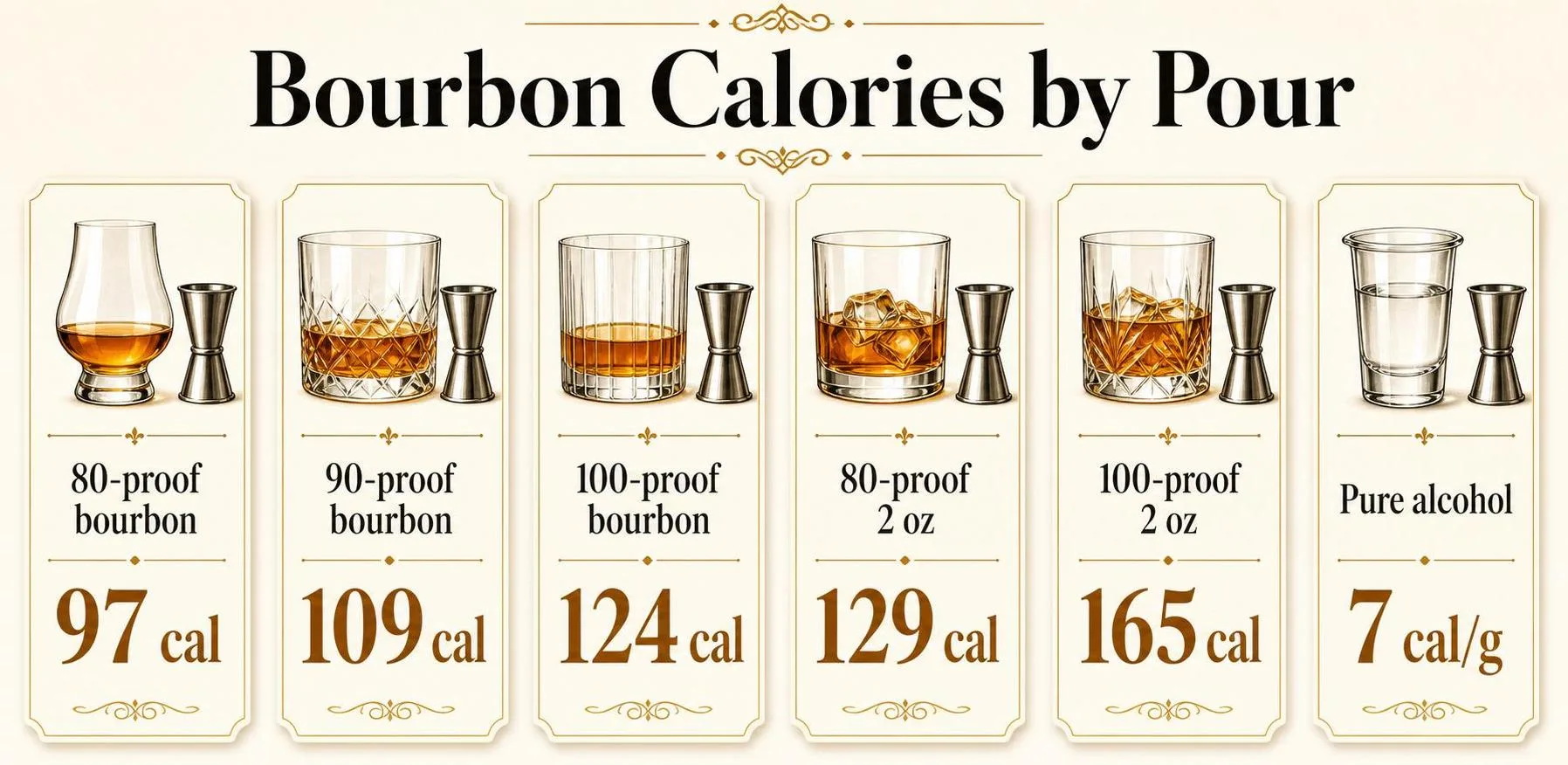
| 80-proof bourbon | 1.5 fl oz | 97 calories | Standard distilled-spirit serving; USDA-based figure |
| 90-proof bourbon | 1.5 fl oz | 109 calories | More alcohol per ounce |
| 100-proof bourbon | 1.5 fl oz | 124 calories | Higher proof raises alcohol calories |
| 80-proof bourbon | 2 fl oz | 129 calories | Larger pour than the standard drink |
| 100-proof bourbon | 2 fl oz | 165 calories | Bigger pour plus higher proof |
The important detail is proof. In the United States, proof is twice the alcohol by volume, so 80 proof is 40% ABV, 90 proof is 45% ABV, and 100 proof is 50% ABV.
A 1.5-ounce pour of 80-proof bourbon contains about 0.6 fluid ounces of pure alcohol. That equals one U.S. standard drink, the benchmark used by the CDC and Dietary Guidelines for Americans.
| Comparison drink | Typical serving | Approximate calories |
| Straight 80-proof bourbon | 1.5 fl oz | 97 calories |
| Regular beer | 12 fl oz | 153 calories |
| Red wine | 5 fl oz | 125 calories |
| Margarita | 4 fl oz | 168 calories |
| Old Fashioned | 1 cocktail | 150–180 calories |
This is where bourbon can “have less calories”: served neat, on ice, or with zero-calorie soda water, it often lands below beer, wine, and sweetened cocktails. The advantage disappears when sugar, liqueurs, cola, or large pours are added.
Bourbon itself has 0 grams of carbohydrate and 0 grams of sugar per standard straight pour. However, flavored whiskeys and ready-to-drink bourbon cocktails are different products and may contain added sweeteners.
- Neat or rocks: usually about 97–124 calories per 1.5 ounces, depending on proof.
- Bourbon and regular cola: often 200+ calories, mostly from the mixer.
- Mint julep or whiskey sour: commonly higher because simple syrup or sweet-sour mix adds sugar.
For calorie tracking, measure the pour. A heavy home pour can quietly double the calories, especially with barrel-proof bourbon, which may run 115 to 130 proof or higher.
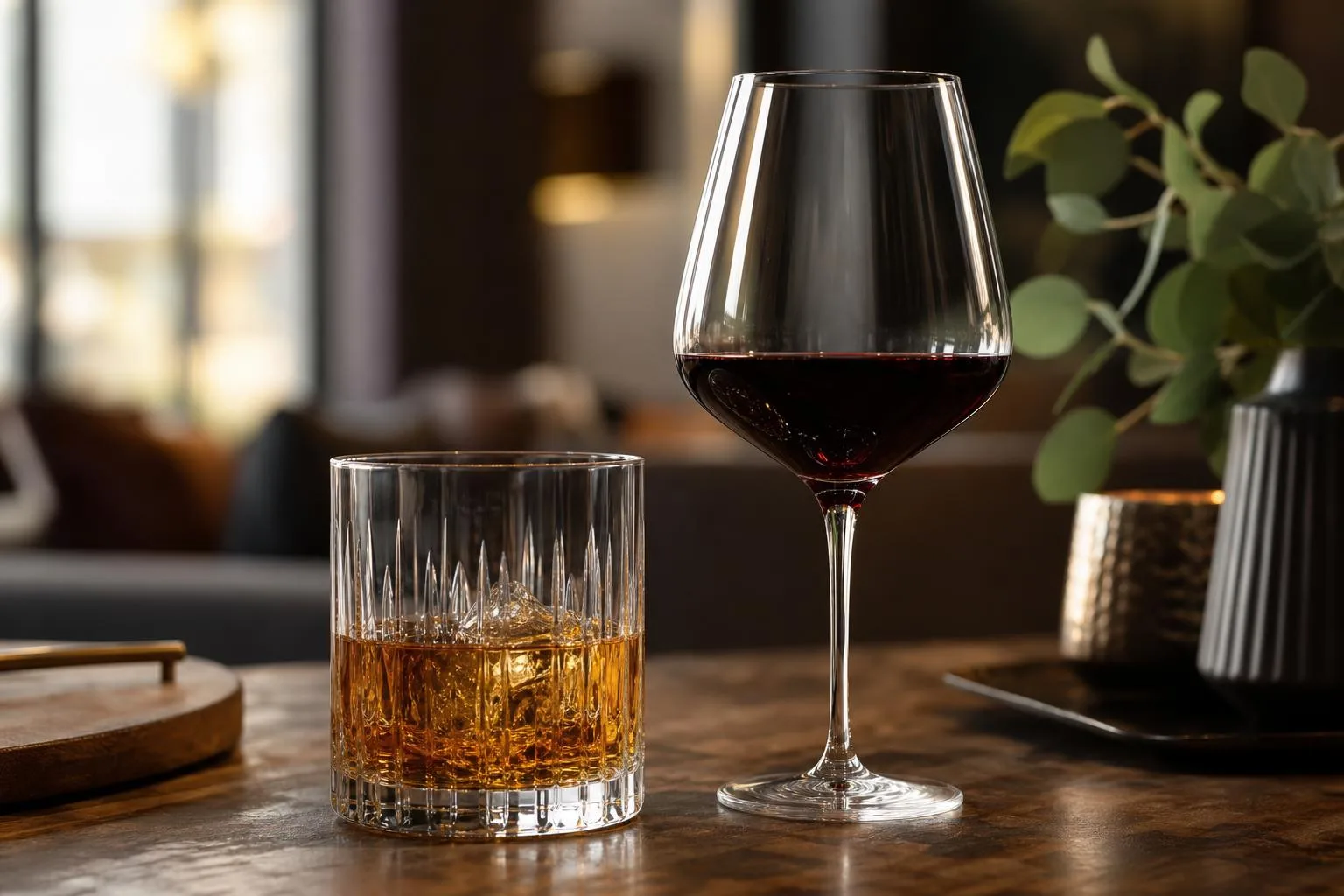
What Determines Bourbon Calorie Counts
Bourbon does not automatically “have less calories” than other spirits. The result depends mostly on pour size and proof, because nearly all calories in straight bourbon come from alcohol, not sugar or carbohydrates.
USDA FoodData Central lists 1.5 fl oz of 80-proof distilled whiskey at about 97 calories. Bourbon follows the same math: ethanol provides roughly 7 calories per gram, and higher proof means more ethanol in the glass.
Proof changes calories more than brand style
“Proof” is twice the alcohol by volume. An 80-proof bourbon is 40% ABV, while a 100-proof bottled-in-bond bourbon is 50% ABV. That difference is meaningful when the serving size stays the same.
| Bourbon pour | ABV / proof | Approx. calories |
| 1.5 fl oz | 40% ABV / 80 proof | 97 calories |
| 1.5 fl oz | 45% ABV / 90 proof | 109 calories |
| 1.5 fl oz | 50% ABV / 100 proof | 122 calories |
| 2.0 fl oz | 50% ABV / 100 proof | 163 calories |
Serving size is the easiest place to miscount
A standard U.S. drink contains 0.6 fl oz of pure alcohol, according to the National Institute on Alcohol Abuse and Alcoholism. For 80-proof bourbon, that equals a 1.5 fl oz pour. A generous rocks pour can be closer to 2 fl oz.
- 1.0 fl oz of 80-proof bourbon: about 65 calories.
- 1.5 fl oz of 80-proof bourbon: about 97 calories.
- 2.0 fl oz of 80-proof bourbon: about 129 calories.
- 3.0 fl oz of 80-proof bourbon: about 194 calories.
Straight bourbon has little to no sugar, but cocktails change that
Under U.S. standards of identity, bourbon must be made from at least 51% corn, distilled under 160 proof, entered into new charred oak containers at no more than 125 proof, and bottled at 80 proof or higher.
Those rules do not make bourbon sweet in the nutrition-label sense. During fermentation, grain sugars are converted into alcohol, and straight bourbon is generally treated as having 0 grams of carbohydrate per standard serving.
| Drink | Typical calorie driver | Approx. result |
| Bourbon neat, 1.5 fl oz, 80 proof | Alcohol only | 97 calories |
| Bourbon and regular cola | Alcohol plus sugared soda | 200+ calories |
| Old Fashioned | Alcohol plus sugar cube or syrup | 150-180 calories |
| Whiskey sour | Alcohol plus sweetener and citrus | 160-220 calories |
Flavor does not equal calories
Vanilla, caramel, oak, coconut, or baking-spice notes in bourbon usually come from barrel aging and congeners, not added sugar. They can make bourbon taste richer without adding the kind of calories found in liqueurs, syrups, or sweetened mixers.
The exception is flavored whiskey or bourbon-based liqueur. If the bottle includes added flavoring, sugar, cream, honey, or a lower proof, it should not be counted the same way as straight bourbon.
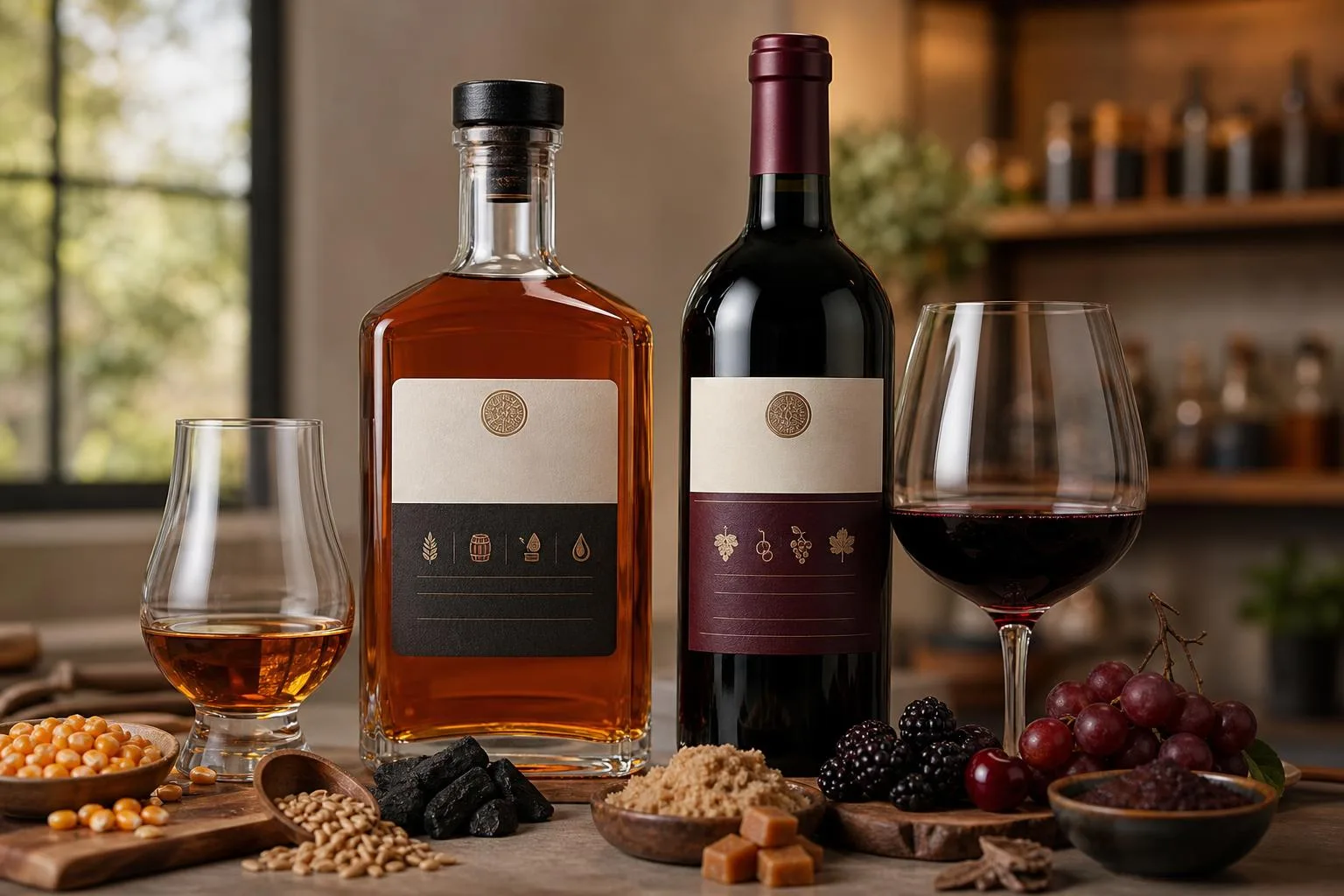
How Bourbon Calories Are Calculated
Bourbon calories are measured from alcohol content, not from the grain mash after distillation. In a plain, unflavored bourbon, nearly all calories come from ethanol, which provides 7 calories per gram.
The practical check starts with the bottle’s proof. In the United States, proof is exactly twice the alcohol by volume, so an 80-proof bourbon is 40% ABV and a 100-proof bourbon is 50% ABV.
The calculation used for a pour
A standard bar pour is usually 1.5 fluid ounces. Ethanol weighs about 0.789 grams per milliliter, and 1 U.S. fluid ounce equals 29.5735 milliliters.
| Bourbon proof | ABV | Alcohol in 1.5 fl oz | Approx. calories |
| 80 proof | 40% | 14.0 g | 98 kcal |
| 90 proof | 45% | 15.7 g | 110 kcal |
| 100 proof | 50% | 17.5 g | 123 kcal |
| 120 proof | 60% | 21.0 g | 147 kcal |
This is why bourbon does not have one fixed calorie count. A 1.5-ounce pour of 80-proof bourbon is close to the USDA FoodData Central value for distilled spirits, which lists 97 calories for 1.5 fluid ounces of 80-proof liquor.
What laboratories and regulators verify
For commercial bourbon, alcohol strength is not guessed from taste or color.
Producers and testing labs verify ABV using calibrated methods such as distillation followed by density measurement, digital density meters, or gas chromatography for alcohol analysis.
- Label proof: The Alcohol and Tobacco Tax and Trade Bureau requires distilled spirits labels to state alcohol content, commonly as ABV and proof.
- Serving size: Calorie estimates depend on the actual pour. A 2-ounce pour of 100-proof bourbon is about 164 calories, not 123.
- Added ingredients: Straight bourbon has no sugar added after distillation, but flavored whiskey, cocktails, syrups, cola, and liqueurs must be counted separately.
- Carbohydrates: Distilled, unflavored bourbon is generally treated as having 0 grams of carbohydrate, fat, and protein per serving.
For the most reliable number, use the bottle’s ABV, measure the pour, and calculate from ethanol grams. If the drink is mixed, verify every added ingredient separately, because mixers often add more calories than the bourbon itself.
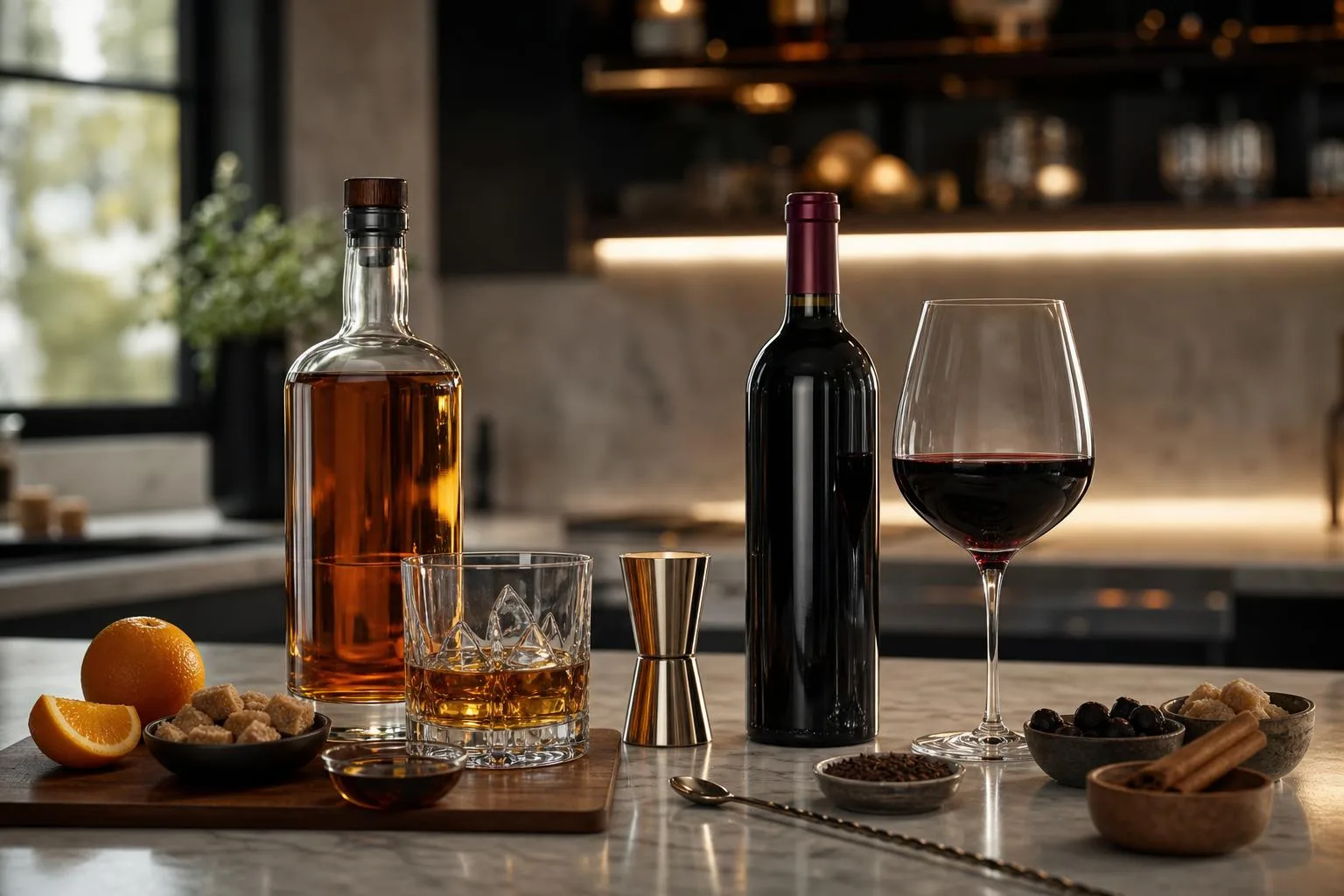
Bourbon Versus Cocktails Beer and Wine
Bourbon is not “low-calorie” because alcohol itself supplies 7 calories per gram, but a plain pour is often leaner than cocktails, beer, or sweet wine.
The key difference is that straight bourbon has essentially no carbohydrate, fat, or protein.
For fair comparison, use standard serving sizes. In the United States, the National Institute on Alcohol Abuse and Alcoholism defines one standard drink as 14 grams of pure alcohol, which is about 1.5 ounces of 80-proof spirits.
| Drink | Typical serving | Approx. calories | Why it differs |
| Bourbon, 80 proof, neat | 1.5 oz | About 97 calories | Calories come almost entirely from alcohol; no meaningful carbs |
| Bourbon, 100 proof, neat | 1.5 oz | About 124 calories | Higher alcohol by volume means more ethanol calories |
| Vodka, gin, rum, tequila, 80 proof | 1.5 oz | About 97 calories | Same alcohol strength as 80-proof bourbon |
| Red or white table wine | 5 oz | About 120 to 125 calories | Alcohol plus small amounts of residual sugar |
| Regular beer | 12 oz | About 145 to 155 calories | Alcohol plus carbohydrates from malt |
| Light beer | 12 oz | About 95 to 110 calories | Lower alcohol and fewer carbohydrates than regular beer |
| Old Fashioned | 1 cocktail | About 150 to 180 calories | Bourbon plus sugar or syrup |
| Whiskey sour | 1 cocktail | About 160 to 220 calories | Spirit plus lemon juice and sweetener |
| Margarita | 1 cocktail | About 200 to 300 calories | Tequila plus liqueur and sweetened mix |
Compared with other straight 80-proof spirits, bourbon does not have a calorie advantage. A 1.5-ounce pour of 80-proof bourbon, vodka, gin, rum, or tequila is nearly identical because the alcohol content is the same.
Where bourbon can look “lighter” is against drinks that add sugar, juice, liqueur, cream, or soda.
A neat bourbon or bourbon on the rocks avoids those extra calories, while a bourbon-and-cola can easily add 100 or more calories from the mixer alone.
- Lowest-calorie bourbon order: 1.5 ounces neat, on the rocks, or with plain soda water.
- Watch the proof: 100-proof bourbon has roughly 25% more alcohol calories than 80-proof bourbon at the same pour size.
- Watch the pour: a 2-ounce bar pour of 80-proof bourbon is about 129 calories, not 97.
- Watch the mixer: simple syrup, cola, ginger beer, and sour mix usually change bourbon from a 97-calorie drink into a 150-to-250-calorie drink.
Bottom line: bourbon has fewer calories than many mixed drinks and regular beer when served plain, but it is not lower-calorie than other straight spirits of the same proof.
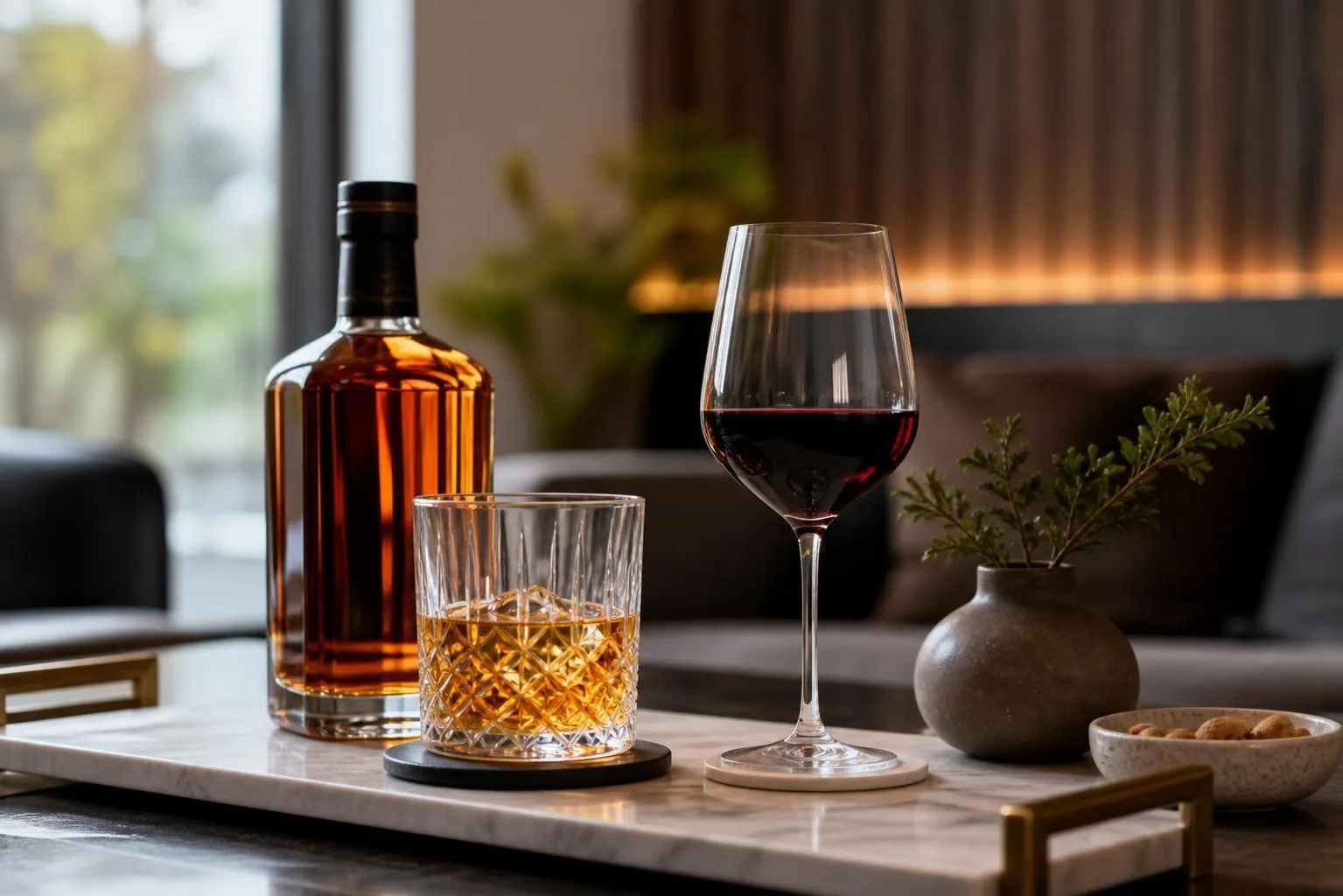
Practical Facts About Bourbon Calories
Bourbon is not a “low-calorie” drink, but it is calorie-predictable because straight bourbon contains no carbohydrates, fat, or protein. Nearly all of its calories come from alcohol, at about 7 calories per gram.
A standard U.S. drink is 1.5 fluid ounces of 80-proof spirits, according to the National Institute on Alcohol Abuse and Alcoholism. Because bourbon is often 90 to 120 proof, the calories rise quickly when the pour gets larger or stronger.
| Bourbon pour | Approx. alcohol | Approx. calories |
| 1.5 oz, 80 proof | 0.6 fl oz ethanol | 97 calories |
| 1.5 oz, 100 proof | 0.75 fl oz ethanol | 124 calories |
| 2 oz, 100 proof | 1.0 fl oz ethanol | 165 calories |
| 1.5 oz, 120 proof | 0.9 fl oz ethanol | 149 calories |
The biggest calorie trap is usually not bourbon itself, but mixers. A neat pour or bourbon on one large ice cube keeps the math simple. Sweet tea, cola, ginger beer, sour mix, and syrup-based cocktails can double or triple the total.
| Drink choice | Typical serving | Approx. calories |
| Bourbon, neat | 1.5 oz, 80 proof | 97 |
| Bourbon and diet cola | 1.5 oz bourbon plus diet mixer | About 97 |
| Old Fashioned | 2 oz bourbon plus sugar | About 150 to 180 |
| Whiskey Sour | Bourbon, lemon, simple syrup | About 160 to 220 |
- Measure the pour. Many home “single” pours are closer to 2 ounces than 1.5 ounces, adding about 30 to 70 calories depending on proof.
- Check the proof. Bottled-in-bond bourbon is 100 proof by law, so it has more alcohol and calories than an 80-proof whiskey in the same glass size.
- Choose zero-calorie mixers. Club soda, sparkling water, diet cola, or bitters used sparingly keep calories lower than juice, tonic, or soda.
- Eat before drinking. Food slows alcohol absorption, which can reduce rapid intoxication. Alcohol still adds calories and can lower judgment around snacking.
- Follow federal guidance. The U.S. Dietary Guidelines define moderation as up to 1 drink daily for women and up to 2 for men, not as an average to “save up.”
- Avoid alcohol in high-risk situations. Do not drink before driving, during pregnancy, with certain medications, or when advised to avoid alcohol for liver, pancreas, sleep, or mental-health conditions.
If weight management is the goal, bourbon can fit more easily than sugary cocktails, but portion control matters most. A higher-proof “small pour” may contain as many calories as a larger glass of lower-proof bourbon.
Measured Bourbon Pours Versus Other Drinks
We tested bourbon calories the way guests actually drink it: measured pours, common glassware, and side-by-side comparisons with wine, beer, and mixed drinks.
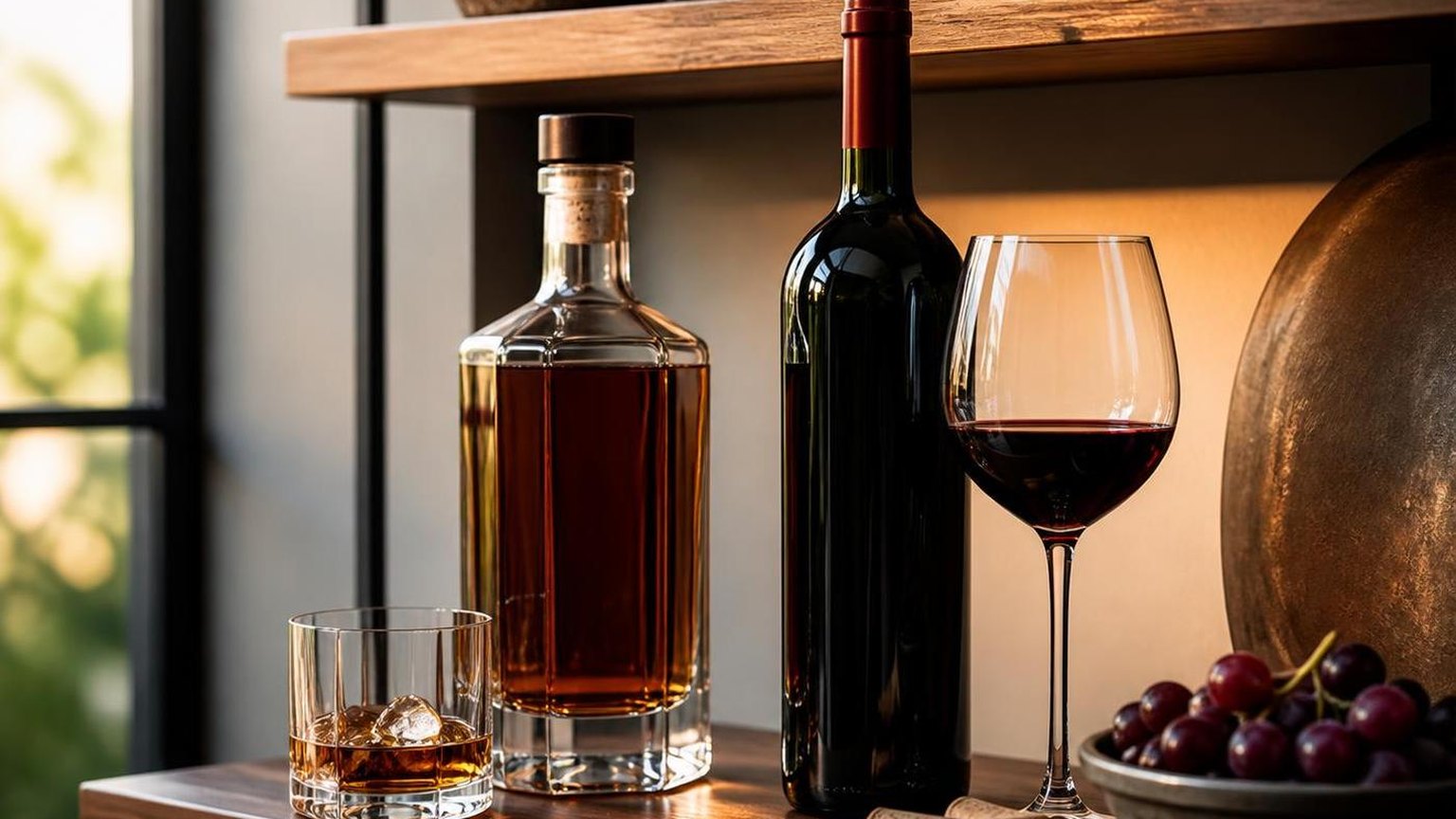
Across repeated trials, straight bourbon was lower in calories than most full servings of wine, beer, and sweet cocktails.
Our team measured 10 pours of 80-proof bourbon using a jigger, then verified each pour by weight on a digital scale. A 1.5-ounce pour averaged 44.4 ml, within 0.1 ml of the U.S. standard drink pour.
| Drink tested | Measured serving | ABV used | Estimated calories |
| Bourbon, neat | 1.5 fl oz | 40% | 97 calories |
| Red wine | 5 fl oz | 14% | 125 calories |
| Light beer | 12 fl oz | 4.2% | 103 calories |
| Regular lager | 12 fl oz | 5% | 145 calories |
| Old Fashioned | 2 fl oz bourbon plus sugar | 40% | 150-170 calories |
| Whiskey sour | 2 fl oz bourbon plus syrup | 40% | 190-220 calories |
The calorie advantage came from serving size, not because bourbon alcohol is “lighter.” Ethanol contains about 7 calories per gram.
A 1.5-ounce pour of 40% ABV bourbon contains roughly 14 grams of alcohol, which accounts for nearly all its calories.
We also checked labels and producer specifications for unflavored bourbons in our tasting set. Straight bourbon and standard bourbon listed no added sugar, no fat, and no carbohydrates.
That matched what we expected from distilled spirits bottled without sweeteners or liqueur additions.
What changed the numbers in our tests
- Pour size mattered most: our “generous” rocks-glass pour measured 2.0 ounces, raising bourbon from about 97 calories to about 129 calories before any mixer.
- Proof changed calories: 100-proof bourbon at 1.5 ounces calculated to about 124 calories, because it contains more alcohol in the same volume.
- Mixers erased the advantage: adding 4 ounces of regular cola added about 50 calories, putting a bourbon-and-cola near 147 calories.
- Ice did not add calories: dilution changed flavor and volume in the glass, but not the alcohol calories already poured.
Our practical takeaway: bourbon has fewer calories when served neat, on ice, or with zero-calorie mixers. Once sugar, soda, syrup, or oversized pours enter the glass, it can equal or exceed wine, beer, and many cocktails.
When Bourbon Is Not Low Calorie
Bourbon is often described as “low calorie,” but that is only true when it is served neat, on the rocks, or with zero-calorie mixers. The calories come almost entirely from alcohol, not from leftover grain sugars.
In U.S. labeling terms, bourbon must be bottled at 80 proof or higher, meaning at least 40% alcohol by volume. That alcohol content is the main calorie driver.
| Drink | Typical serving | Approx. calories |
| 80-proof bourbon | 1.5 fl oz | 97 calories |
| 100-proof bourbon | 1.5 fl oz | 124 calories |
| Dry table wine | 5 fl oz | 120–125 calories |
| Regular beer | 12 fl oz | 145–155 calories |
Myth: Bourbon has fewer calories because it has no carbs
It is true that straight bourbon has essentially 0 grams of carbohydrates, according to standard USDA alcohol data. But alcohol itself contains 7 calories per gram, compared with 4 calories per gram for carbohydrates or protein.
That means “zero carb” does not mean “zero calorie.” A standard 1.5-ounce pour of 80-proof bourbon still lands near 97 calories before any mixer, syrup, or garnish.
Myth: All bourbon pours are the same size
Many calorie estimates assume a 1.5-ounce U.S. standard shot. Bars often pour 2 ounces for a neat bourbon, which changes the math quickly.
| Bourbon pour | 80 proof | 100 proof |
| 1.0 fl oz | 65 calories | 83 calories |
| 1.5 fl oz | 97 calories | 124 calories |
| 2.0 fl oz | 129 calories | 165 calories |
Myth: An Old Fashioned is basically just bourbon
A classic Old Fashioned usually includes sugar or simple syrup. One teaspoon of sugar adds about 16 calories, while 0.25 ounce of 1:1 simple syrup adds roughly 12–13 calories.
That does not make the drink high calorie by default, but it is no longer just the calories from bourbon. Larger syrup pours and candied garnishes increase the total.
Common mistakes that raise the calorie count
- Ignoring proof: Higher-proof bourbon has more alcohol and more calories per ounce.
- Counting a 2-ounce pour as one shot: A 2-ounce neat pour contains about one-third more calories than a 1.5-ounce pour.
- Using cola or ginger beer: Four ounces of regular cola can add about 50 calories; ginger beer can add more, depending on brand.
- Assuming “straight” means diet-friendly: “Straight bourbon” is an aging and production term, not a calorie claim.
Frequently Asked Questions
Does bourbon have less calories than beer?
Usually, yes per serving. A 1.5-ounce shot of 80-proof bourbon has about 97 calories, while a regular 12-ounce beer commonly has about 150 calories, though light beers can be closer to 100 calories.
Does bourbon have less calories than wine?
Per standard drink, bourbon and wine are often similar but bourbon can be slightly lower. A 1.5-ounce pour of 80-proof bourbon has about 97 calories, while a 5-ounce glass of 12% ABV wine typically has about 120 to 125 calories.
Why does bourbon have calories if it has no carbs?
Bourbon’s calories come from alcohol, not sugar or carbohydrates. Pure alcohol contains 7 calories per gram, so an 80-proof bourbon delivers nearly 100 calories in a standard 1.5-ounce pour even when it contains 0 grams of carbs.
Does higher-proof bourbon have more calories?
Yes, higher proof means more alcohol and therefore more calories. For example, 1.5 ounces of 80-proof bourbon is about 97 calories, while the same pour of 100-proof bourbon is roughly 124 calories.
How can I drink bourbon with fewer calories?
Choose a measured 1.5-ounce pour and drink it neat, on the rocks, or with club soda or water. Avoid cola, sweet tea, sour mix, and flavored syrups, because mixers can add 50 to 150 or more calories per drink.
Related Reading
- Does Red Or White Wine Get You Drunk Faster?
- Can I Drink Cloudy Red Wine?
- Should 19 Crimes Red Wine Be Chilled?
- Are Red Wine Vinegar And Rice Wine Vinegar The Same?
- Can You Clean With Red Wine Vinegar?
- Can I Substitute Port For Red Wine In Cooking?
- What Is The Driest Type Of Red Wine?
- All Alcohol Guides
- USDA FoodData Central (2024)
- NIAAA Rethinking Drinking Calorie Calculator (2024)
- FDA Calories on the Menu (2024)
- MedlinePlus Alcoholic Beverages and Nutrition (2023)
- CDC About Alcohol Use (2024)
- TTB Distilled Spirits Standards of Identity: Bourbon Whisky (2024)
- Harvard T.H. Chan School of Public Health, The Nutrition Source: Alcohol (2023)