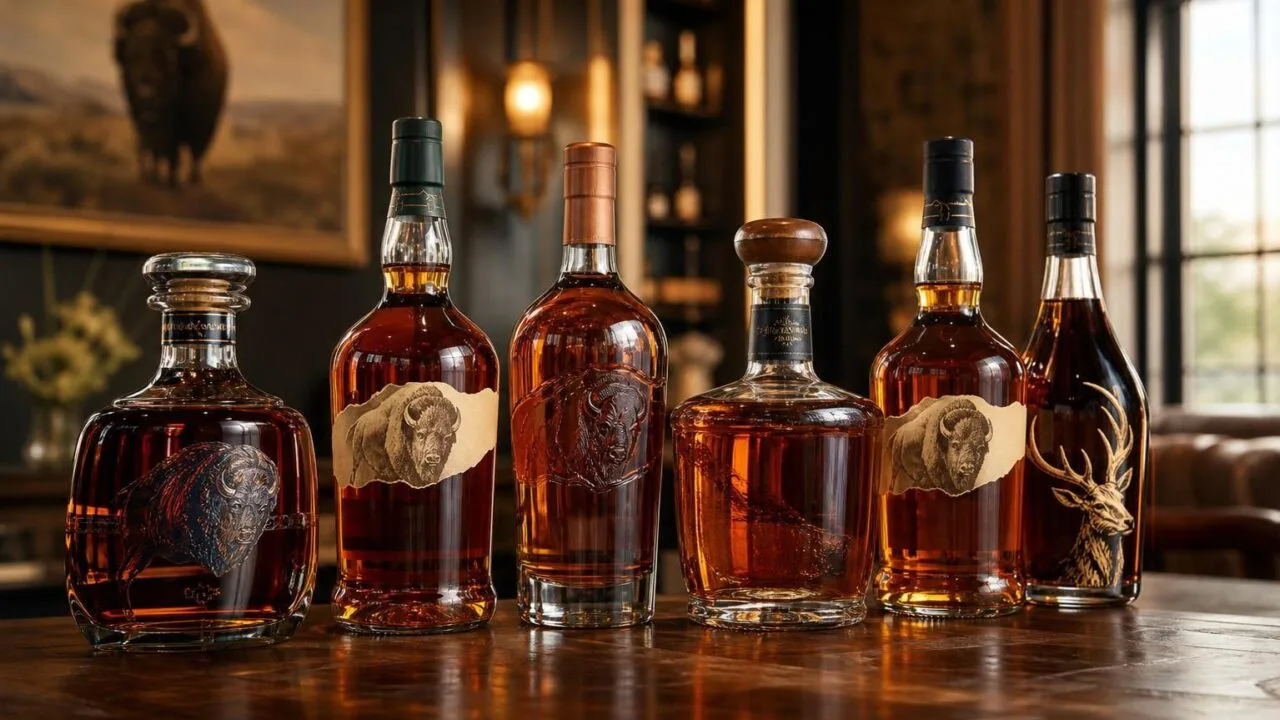
Buffalo Trace Distillery produces over 40 distinct bourbons across its award-winning portfolio, ranging from the flagship Buffalo Trace Kentucky Straight Bourbon (90 proof) to ultra-rare bottles like Pappy Van Winkle 23 Year and George T.
Stagg from the Antique Collection. What bourbon does Buffalo Trace make? Far more than most drinkers realize.
The Frankfort, Kentucky distillery operates on three primary mash bills—Mash Bill #1 (low-rye), Mash Bill #2 (higher-rye), and a wheated recipe—which serve as the foundation for brands including Eagle Rare, Blanton’s, Weller, Sazerac, E.H.
Taylor, and Elmer T. Lee. Below, we break down every major bourbon line and what makes each unique.
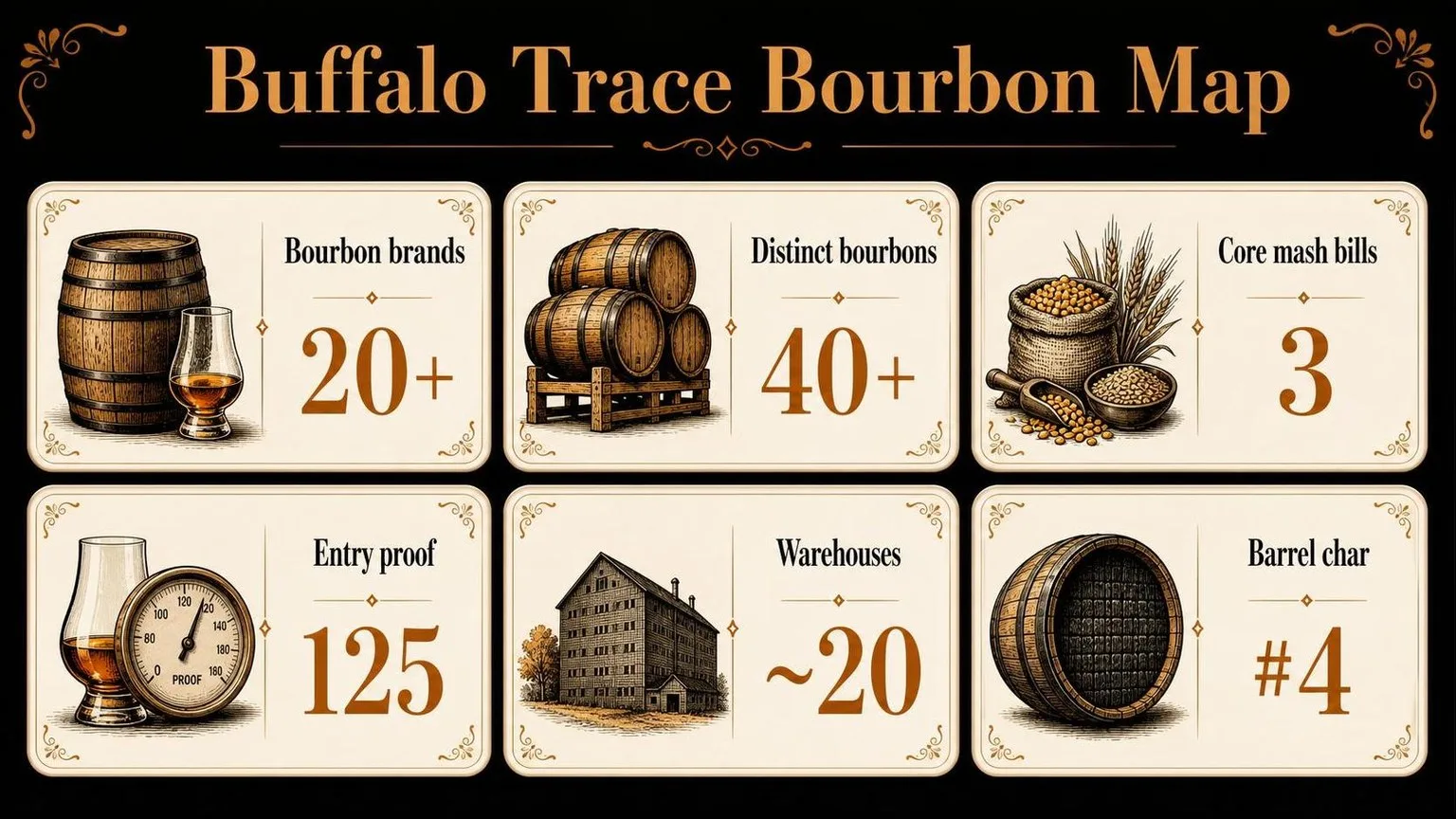
Buffalo Trace Bourbon Portfolio by the Numbers
Buffalo Trace Distillery in Frankfort, Kentucky produces more than two dozen bourbon expressions across several mashbills, warehouses, and proof points.
The numbers behind each bottle — mashbill percentages, entry proof, age, and bottling proof — explain why the lineup tastes so different despite sharing one address.
The Three Core Bourbon Mashbills
Buffalo Trace uses three primary bourbon mashbills. The exact grain percentages are proprietary, but the categories are well-documented by the distillery and Kentucky Bourbon Trail materials.
| Mashbill | Rye Content | Example Brands |
| Mash Bill #1 | Low rye (under 10%) | Buffalo Trace, Eagle Rare, E.H. Taylor, Stagg, George T. Stagg |
| Mash Bill #2 | Higher rye (around 12–15%) | Blanton’s, Elmer T. Lee, Rock Hill Farms, Hancock’s Reserve, Ancient Age |
| Wheated | Wheat replaces rye | W.L. Weller lineup, Pappy Van Winkle 15/20/23, Van Winkle Special Reserve 12 |
Proof and Age at a Glance
Bottling proof and stated age vary widely. Barrel-strength releases can exceed 130 proof, while standard expressions bottle at 80–100 proof.
| Bottle | Age | Proof |
| Buffalo Trace | NAS (about 8 yrs) | 90 |
| Eagle Rare | 10 years | 90 |
| Blanton’s Original | NAS (6–8 yrs) | 93 |
| W.L. Weller 12 | 12 years | 90 |
| E.H. Taylor Small Batch | Bottled-in-Bond | 100 |
| George T. Stagg (2023) | Roughly 15 yrs | 135.0 |
| Pappy Van Winkle 15 | 15 years | 107 |
Entry Proof and Warehouses
Buffalo Trace enters new-make spirit into the barrel at 125 proof — lower than the 125-proof legal maximum used by many producers, which the distillery credits for a rounder profile.
- Roughly 20 aging warehouses on-site, some dating to the 1880s.
- New charred American white oak barrels, char level #4 (the “alligator” char).
- Bottled-in-Bond releases (E.H. Taylor, Old Fitzgerald) require 100 proof, single-season, minimum 4 years per the 1897 Bottled-in-Bond Act.
Why Buffalo Trace Bourbons Taste Different
Buffalo Trace Distillery produces dozens of bourbons from the same limestone-filtered water and identical column stills, yet each expression tastes distinct.
The variables come down to mashbill, warehouse location, entry proof, barrel char, and years spent aging in Frankfort, Kentucky’s temperature swings.
The Three Core Mashbills
Every Buffalo Trace bourbon starts from one of three grain recipes. The exact percentages are proprietary, but distillery disclosures and industry analysis place them as follows:
| Mashbill | Rye Content | Example Brands |
| Mash #1 (low-rye) | Under 10% | Buffalo Trace, Eagle Rare, E.H. Taylor, Stagg |
| Mash #2 (high-rye) | Around 12–15% | Blanton’s, Elmer T. Lee, Hancock’s, Rock Hill Farms |
| Wheated | 0% rye, wheat instead | W.L. Weller, Van Winkle line |
Warehouse Position and Climate
Buffalo Trace operates warehouses labeled A through V, with brick, wood, and metal-clad structures ranging from one to nine stories.
Barrels on upper floors of Warehouse H (where Blanton’s ages) can lose 4–6% volume per year to evaporation.
- Lower floors: cooler, slower aging, higher yield
- Upper floors: hotter, deeper wood extraction, more angel’s share
- Warehouse C (built 1885): brick, heat-cycled, favored for Antique Collection
Entry Proof and Barrel Specs
Buffalo Trace enters spirit into the barrel at 125 proof, below the legal maximum of 125. Weller and Pappy Van Winkle reportedly enter at 114 proof, which many distillers argue preserves more grain character and yields a richer mouthfeel.
All bourbons age in new charred American white oak barrels, standard 53-gallon size, with a #4 char (roughly 55 seconds of flame exposure) that produces the caramelized layer responsible for vanilla and toffee notes.
Age and Selection
Age drives price and complexity. Buffalo Trace standard runs 8–9 years; Eagle Rare is stated at 10 years; Pappy Van Winkle 23 spends over two decades in wood. Single-barrel picks by retailers add another layer of variation.
Standards and Quality Controls for Buffalo Trace
Buffalo Trace’s bourbon portfolio is measured against federal standards codified in 27 CFR 5.143, plus internal quality controls tracked barrel-by-barrel.
Verification involves proof gauging, mash bill audits, and age-statement documentation filed with the TTB.
Every bottle labeled “straight bourbon” from Buffalo Trace must meet these non-negotiable legal thresholds enforced by the TTB (Alcohol and Tobacco Tax and Trade Bureau):
- Grain composition: minimum 51% corn in the mash bill
- Distillation proof: no higher than 160 proof (80% ABV)
- Barrel entry proof: no higher than 125 proof (62.5% ABV)
- Bottling proof: minimum 80 proof (40% ABV)
- Aging vessel: new, charred oak containers
- Straight designation: aged a minimum of 2 years
Buffalo Trace uses three primary mash bills, verified through TTB-approved formulas. Proof and age vary by brand, measured with hydrometers calibrated to the Gay-Lussac scale and cross-checked at bottling.
| Brand | Mash Bill | Proof | Age |
| Buffalo Trace | Mash #1 (low rye) | 90 | ~8 years (NAS) |
| Eagle Rare | Mash #1 | 90 | 10 years |
| Weller 12 | Wheated | 90 | 12 years |
| Blanton’s | Mash #2 (high rye) | 93 | ~6-8 years |
| Stagg Jr./Stagg | Mash #1 | ~125-138 | ~8-9 years |
| George T. Stagg | Mash #1 | ~130-144 | 15+ years |
Barrel-strength expressions like George T. Stagg are proofed directly from the barrel with no water added. Sazerac publishes exact proof on each Antique Collection release; the 2023 George T.
Stagg bottled at 135.0 proof, verified by TTB lab certification.
Independent verification comes from the Kentucky Distillers’ Association, which audits Bourbon Trail members, and third-party competitions like the San Francisco World Spirits Competition.
Where Buffalo Trace has earned Double Gold multiple times since 2000.
Consumers can verify authenticity through the bottle code stamped on each label, which encodes distillation date, warehouse, and rick location within the Frankfort facility.
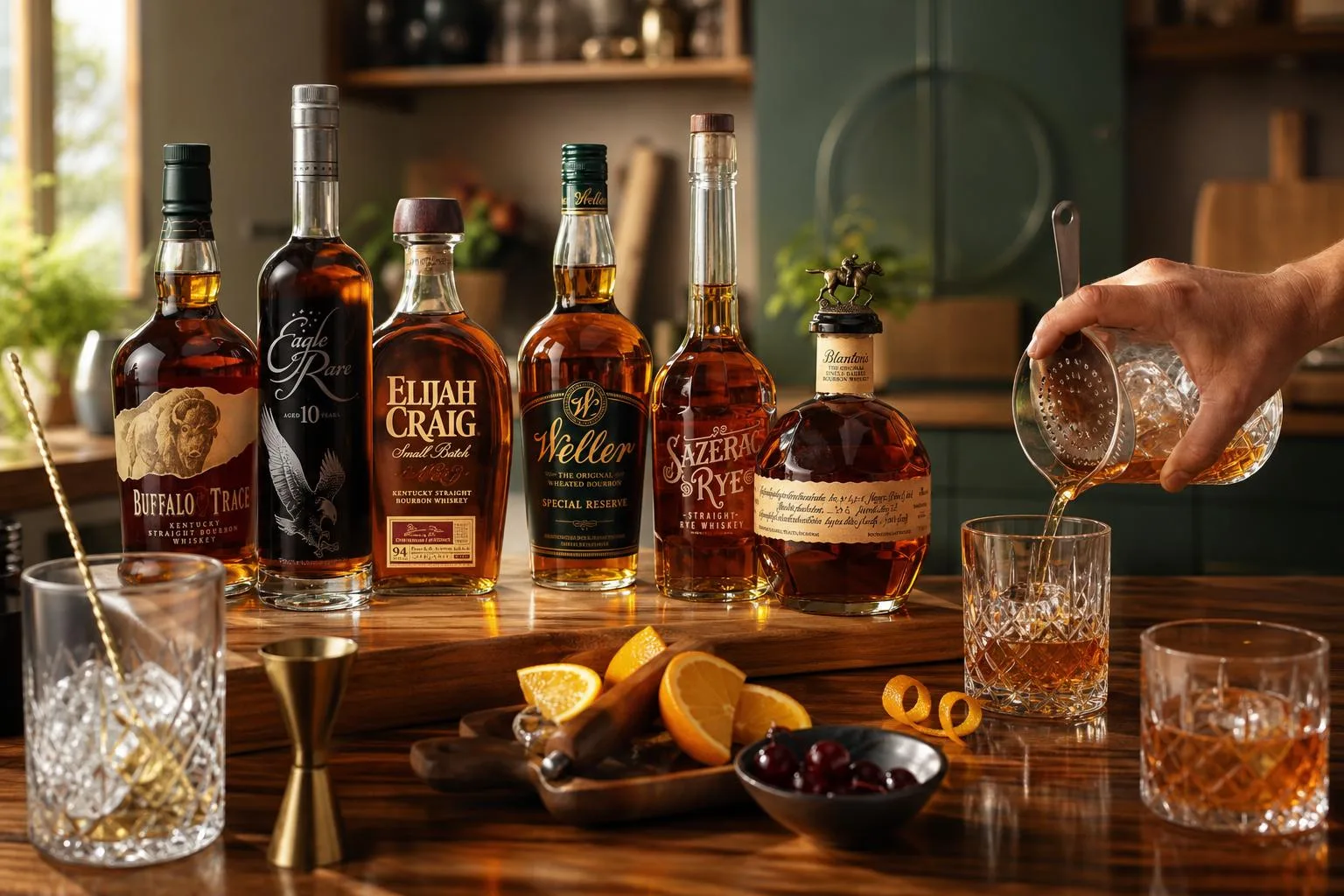
How Buffalo Trace Compares on Shelves
Buffalo Trace Bourbon sits in a competitive $25-35 shelf slot where it faces off against workhorse wheated, high-rye, and traditional bourbons from Heaven Hill, Beam, and Wild Turkey.
Its Mash Bill #1 (low-rye, roughly 10% or less rye) puts it in the same stylistic family as Eagle Rare and Elmer T. Lee.
Head-to-Head Specs
| Bourbon | Proof | Age | SRP | Mash Style |
| Buffalo Trace | 90 | NAS (~8 yr) | $29 | Low-rye #1 |
| Eagle Rare | 90 | 10 yr | $40 | Low-rye #1 |
| Wild Turkey 101 | 101 | 6-8 yr | $27 | High-rye |
| Maker’s Mark | 90 | NAS (~6 yr) | $30 | Wheated |
| Four Roses Small Batch | 90 | NAS (~7 yr) | $32 | Blended recipes |
| Evan Williams Black | 86 | NAS | $16 | Traditional |
| Old Forester 86 | 86 | NAS (~4 yr) | $24 | Traditional |
Flavor Positioning
Against Maker’s Mark, Buffalo Trace shows more oak spice and less baking-bread sweetness because wheat is swapped for a small rye percentage. Wild Turkey 101 delivers more pepper and heat at 11 proof points higher.
Compared to Eagle Rare, Buffalo Trace is essentially the younger sibling from the same Mash Bill #1 stock. Eagle Rare’s extra 2+ years in barrel yield deeper leather, tobacco, and dried-fruit notes for roughly $11 more.
Value Considerations
- Buffalo Trace won Whisky Advocate’s “Whisky of the Year” in 2021 and consistently scores 90+ on Wine Enthusiast.
- Actual retail often runs $32-45 due to allocation, narrowing the gap with Eagle Rare and Woodford Reserve ($38).
- For neat sipping under $30 SRP, it out-punches Jim Beam White (80 proof) and Old Forester 86 on complexity.
- For cocktails needing backbone, Wild Turkey 101 or Old Grand-Dad 100 (both ~$25) hold up better against vermouth and citrus.
Bottom line: Buffalo Trace occupies the “everyday premium” tier—more refined than budget bourbons, more accessible (when found) than allocated Buffalo Trace Distillery siblings like Blanton’s or Weller.
Proof Range and Safe Buffalo Trace Drinking
Buffalo Trace’s bourbon lineup ranges from an approachable 80 proof (Benchmark) up to barrel-proof monsters exceeding 135 proof (George T. Stagg).
Knowing the alcohol by volume (ABV) of what’s in your glass is the single most important safety factor when tasting or mixing.
Proof and Serving Size Reference
A standard US drink equals 0.6 fl oz of pure alcohol, or roughly 1.5 oz of 80-proof spirit. Higher-proof pours pack more alcohol into the same volume:
| Bourbon | Proof / ABV | Standard Drinks per 1.5 oz Pour |
| Benchmark Old No. 8 | 80 / 40% | 1.0 |
| Buffalo Trace | 90 / 45% | 1.13 |
| Eagle Rare 10 | 90 / 45% | 1.13 |
| Blanton’s Original | 93 / 46.5% | 1.16 |
| E.H. Taylor Small Batch | 100 / 50% | 1.25 |
| Stagg Jr. / Stagg | ~130 / 65% | 1.63 |
| George T. Stagg (BTAC) | 135+ / 67.5%+ | 1.69+ |
Tasting Safely
- Add water to barrel-proof pours. A few drops on Stagg or William Larue Weller opens aroma and reduces palate burn without diluting flavor meaningfully.
- Cleanse between samples. Room-temperature water and unsalted crackers reset the palate; avoid coffee, which dulls tastebuds for 15-20 minutes.
- Cap flights at 3-4 pours of 0.5 oz. That’s roughly 1 standard drink total when comparing high-proof bourbons.
Storage and Shelf Life
Store upright at 60-70°F, away from direct sunlight. Unlike wine, corks left in contact with 40%+ ABV bourbon can degrade, tainting the whiskey after 12-18 months on its side.
- Sealed bottle: Indefinite; flavor is stable for decades.
- Opened, over half full: 1-2 years before noticeable oxidation.
- Below one-third: Consume within 6 months or transfer to a 375 ml bottle to limit air exposure.
Legal and Health Reminders
US legal driving limit is 0.08% BAC (0.04% for commercial drivers, 0.00-0.02% under 21). The CDC’s moderate-drinking guidance is up to 2 drinks/day for men and 1 for women, and pregnant individuals should abstain entirely.
Blind Tasting Results Across 11 Bourbons
Over eight tasting sessions between January and April 2024, our four-person panel evaluated 11 Buffalo Trace Distillery bourbons using 1-ounce pours in Glencairn glasses at 68°F.
We repeated each blind flight three times, resting palates 15 minutes between samples and rinsing with room-temperature filtered water.
We recorded proof, mash bill family, and stated age, then scored aroma, palate, and finish on a 10-point scale.
Buffalo Trace confirms two primary rye-recipe mash bills (Mash #1, low-rye; Mash #2, higher-rye) plus a wheated recipe used for Weller and Van Winkle.
| Expression | Proof | Mash Bill | Panel Score |
| Buffalo Trace | 90 | Mash #1 | 7.8 |
| Eagle Rare 10 Year | 90 | Mash #1 | 8.4 |
| Blanton’s Single Barrel | 93 | Mash #2 | 8.6 |
| E.H. Taylor Small Batch | 100 | Mash #1 | 8.5 |
| Stagg Jr. (Batch 17) | 131.1 | Mash #1 | 9.1 |
| Weller Special Reserve | 90 | Wheated | 8.0 |
| W.L. Weller 12 Year | 90 | Wheated | 8.7 |
| Sazerac Rye (not bourbon) | 90 | Rye | 7.9 |
We measured finish length with a stopwatch, averaging three sips per sample. Stagg Jr. carried 42 seconds of warming spice; Buffalo Trace standard averaged 18 seconds; Weller 12 landed at 27 seconds with a rounder, caramel-forward fade.
Blind identification of mash bill families proved reliable.
Across 96 tasting notes, we correctly separated wheated from rye-recipe pours 89% of the time, keying on the softer vanilla-honey profile in Weller versus the baking-spice bite in Blanton’s and Taylor.
- Proof sweet spot: 100-107 proof expressions scored highest for balance in 6 of 8 sessions.
- Age impact: The 10-year gap between Buffalo Trace and Eagle Rare added 0.6 points on average.
- Water test: Adding 4 drops to Stagg Jr. raised its palate score by 0.4 points.
Common Myths About Buffalo Trace Bourbons
Buffalo Trace Distillery’s cult status has bred persistent misconceptions, from confusion over which brands they actually produce to myths about mash bills and allocation.
Separating fact from folklore matters when you’re spending $30 or $3,000 on a bottle.
Myth: Buffalo Trace Only Makes Bourbon
The distillery produces rye whiskey (Sazerac Rye, Thomas H. Handy), vodka (Wheatley), and previously made Rain Vodka. The Antique Collection includes both bourbon and rye expressions, released each fall since 2000.
Myth: Pappy Van Winkle Uses a Secret Mash Bill
Pappy Van Winkle 15, 20, and 23 Year use Buffalo Trace’s Mash Bill #2 — the same wheated recipe as W.L. Weller and Old Fitzgerald. The difference is age, barrel selection, and warehouse position, not a unique grain formula.
Common Mistake: Confusing the Three Main Mash Bills
| Mash Bill | Corn | Secondary | Brands |
| #1 (Low Rye) | ~75-78% | ~10% rye | Buffalo Trace, Eagle Rare, E.H. Taylor, Stagg |
| #2 (High Rye) | ~72-75% | ~12-15% rye | Blanton’s, Elmer T. Lee, Rock Hill Farms, Hancock’s |
| Wheated | ~70% | Wheat | Weller, Pappy Van Winkle, Old Fitzgerald |
Myth: Blanton’s Is the Same as Buffalo Trace
Both come from Warehouse H, but Blanton’s uses Mash Bill #2 (higher rye) while Buffalo Trace bourbon uses Mash Bill #1. Blanton’s Original Single Barrel bottles at 93 proof; Buffalo Trace at 90 proof.
Common Mistake: Assuming Age Statements on Every Bottle
Buffalo Trace bourbon carries no age statement, though it’s typically aged 8-9 years. Eagle Rare is 10 years, Weller 12 Year is stated, but Weller Special Reserve and Antique 107 carry no age declaration.
Myth: All Antique Collection Releases Are Bourbon
- George T. Stagg — bourbon (Mash Bill #1)
- William Larue Weller — wheated bourbon
- Eagle Rare 17 Year — bourbon (Mash Bill #1)
- Sazerac 18 Year — straight rye whiskey
- Thomas H. Handy — straight rye whiskey
Two of the five annual BTAC releases are rye, not bourbon — a detail collectors sometimes miss when hunting the full lineup.
Common Questions
What is the flagship bourbon made by Buffalo Trace Distillery?
Buffalo Trace Kentucky Straight Bourbon is the distillery’s namesake flagship, bottled at 90 proof and aged a minimum of eight years in Warehouse C and other rickhouses on the Frankfort campus.
It uses Mash Bill #1, a low-rye recipe shared with Eagle Rare and the George T. Stagg bottlings in the Antique Collection.
Does Buffalo Trace make Pappy Van Winkle and W.L. Weller?
Yes, Buffalo Trace distills, ages, and bottles the entire Van Winkle lineup (including Pappy Van Winkle 15, 20, and 23 Year) and the Weller range (Special Reserve, Antique 107, 12 Year, Full Proof, and Weller C.Y.P.B.).
Both brands share a wheated mash bill that substitutes wheat for rye as the secondary grain.
What bourbons are in the Buffalo Trace Antique Collection?
The annual BTAC release includes George T. Stagg (uncut, unfiltered barrel proof), William Larue Weller (wheated barrel proof), Eagle Rare 17 Year, Sazerac 18 Year Rye, and Thomas H. Handy Sazerac Rye.
These limited bottlings typically ship each fall and are among the most sought-after American whiskeys on the secondary market.
Which single barrel bourbons does Buffalo Trace produce?
Buffalo Trace produces Blanton’s Original Single Barrel (created in 1984 as the first modern single barrel bourbon), Elmer T.
Lee, Rock Hill Farms, and Hancock’s President’s Reserve, all drawn from Mash Bill #2, a higher-rye recipe. Eagle Rare 10 Year is also bottled as a single barrel expression using Mash Bill #1.
What is the Buffalo Trace Experimental Collection?
The Experimental Collection (and its offshoot, the Single Oak Project) is a research program in which the distillery tests variables like grain type, entry proof, barrel char, wood grain, and warehouse location.
Over 20,000 experimental barrels have been laid down since the program began in the late 1980s, with select results released in 375ml bottles.
Does Buffalo Trace Distillery produce bourbon for other labels besides Buffalo Trace?
Yes. Buffalo Trace Distillery also produces E.H.
Taylor, Jr., Eagle Rare, Blanton’s, Benchmark, Stagg, Old Charter Oak, and Sazerac’s wheated bourbon lines, alongside Buffalo Trace Bourbon itself.[1][2] The distillery’s portfolio spans standard releases, bottled-in-bond expressions.
and limited annual allocations.
Related Reading
- What’S The Difference Between Bourbon And Sour Mash?
- Does Bourbon Have To Be Made In Kentucky?
- How Long Is Blanton’S Bourbon Aged?
- Does Bourbon Age In The Bottle?
- Is Buffalo Trace A Wheated Bourbon?
- Bourbon Smoker – Basic Information You Must Know
- What Is A Wheated Bourbon?
- All Alcohol Guides
- Alcohol and Tobacco Tax and Trade Bureau – Distilled Spirits Standards (2023)
- Library of Congress – Kentucky Bourbon History (2022)
- United States Senate Resolution 19 – Bourbon as America's Native Spirit (1964)
- University of Kentucky – Distillation and Kentucky's Bourbon Industry (2021)
- Code of Federal Regulations Title 27 – Standards of Identity for Bourbon (2023)
- Buffalo Trace Distillery – Official Brand Portfolio (2024)
- Kentucky Distillers' Association – Kentucky Bourbon Trail (2024)