Please note that this post may contain affiliate links. If you make a purchase through these links, we may earn a small commission at no extra cost to you. Thank you for your support!
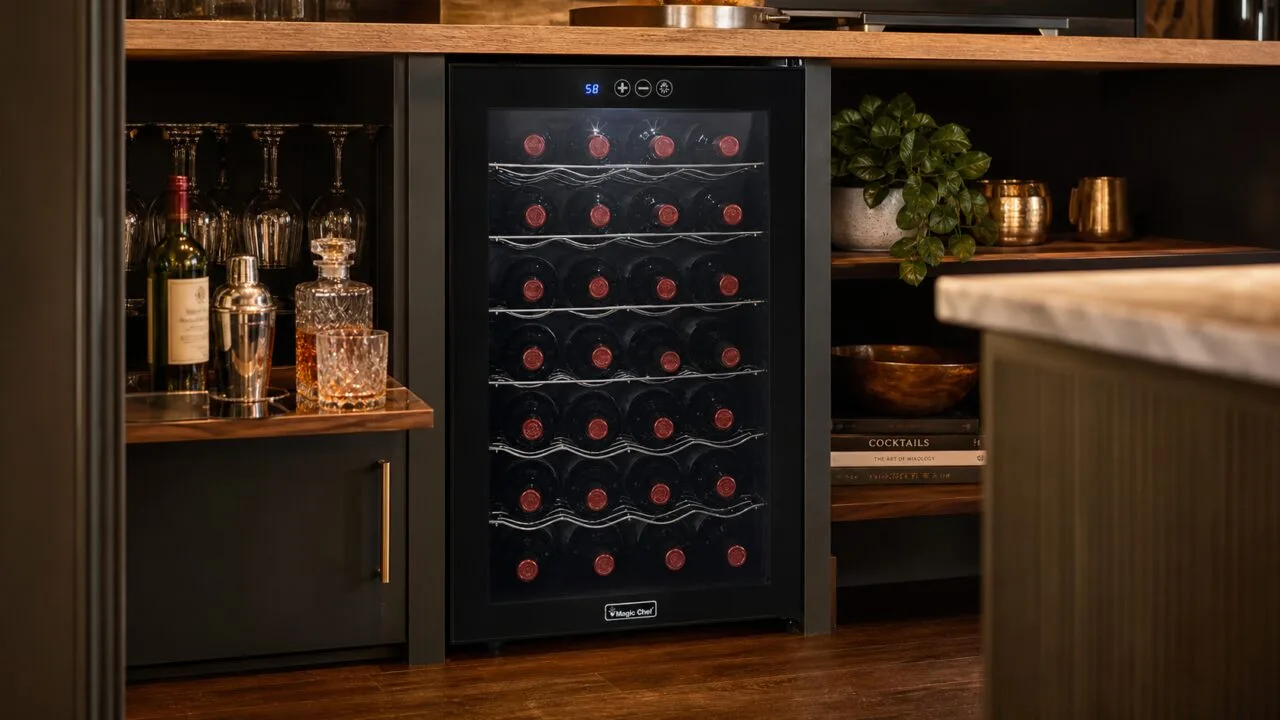
A Magic Chef wine cooler is a sensible way to move bottles off the kitchen counter and into a dedicated cold space.
Magic Chef’s lineup keeps things straightforward: a few clear capacity tiers, familiar stainless looks, and no fuss. That makes shopping easier when you just want a reliable spot to park your wine.
In this guide we line up three Magic Chef picks for different needs. If you are starting a collection, the 28-bottle model is our default recommendation.
If you also want to chill cans and bottles of other drinks, the HMBC58ST is built for that. And if your rack is already overflowing, the 50-bottle HMWC50ST gives you more room to grow.
Quick Picks: Magic Chef Wine Cooler at a Glance
- Best Overall: Magic 28-Bottle Wine Cooler — a balanced capacity that fits most home wine drinkers without overcommitting on space.
- Can beverage storage: Magic HMBC58ST — designed to handle cans and mixed beverages, not just wine bottles.
- Larger wine collections: Magic HMWC50ST 50-Bottle — nearly double the capacity of our overall pick for collectors who need more room.
Quick Comparison Chart
| Product | Best For | Key Feature | Our Rating |
|---|---|---|---|
| Magic 28-Bottle Wine Cooler | Best Overall | 28-bottle single-zone capacity in a black cabinet | 9.5/10 |
| Magic HMBC58ST | Can beverage storage | 154-can capacity with stainless steel finish | 9.2/10 |
| Magic HMWC50ST 50-Bottle | Larger wine collections | 50-bottle capacity in a 23.4-inch stainless steel cabinet | 9.0/10 |
Compare Today’s Top Picks & Live Prices


Detailed Reviews
1. Magic 28-Bottle Wine Cooler — Best Overall
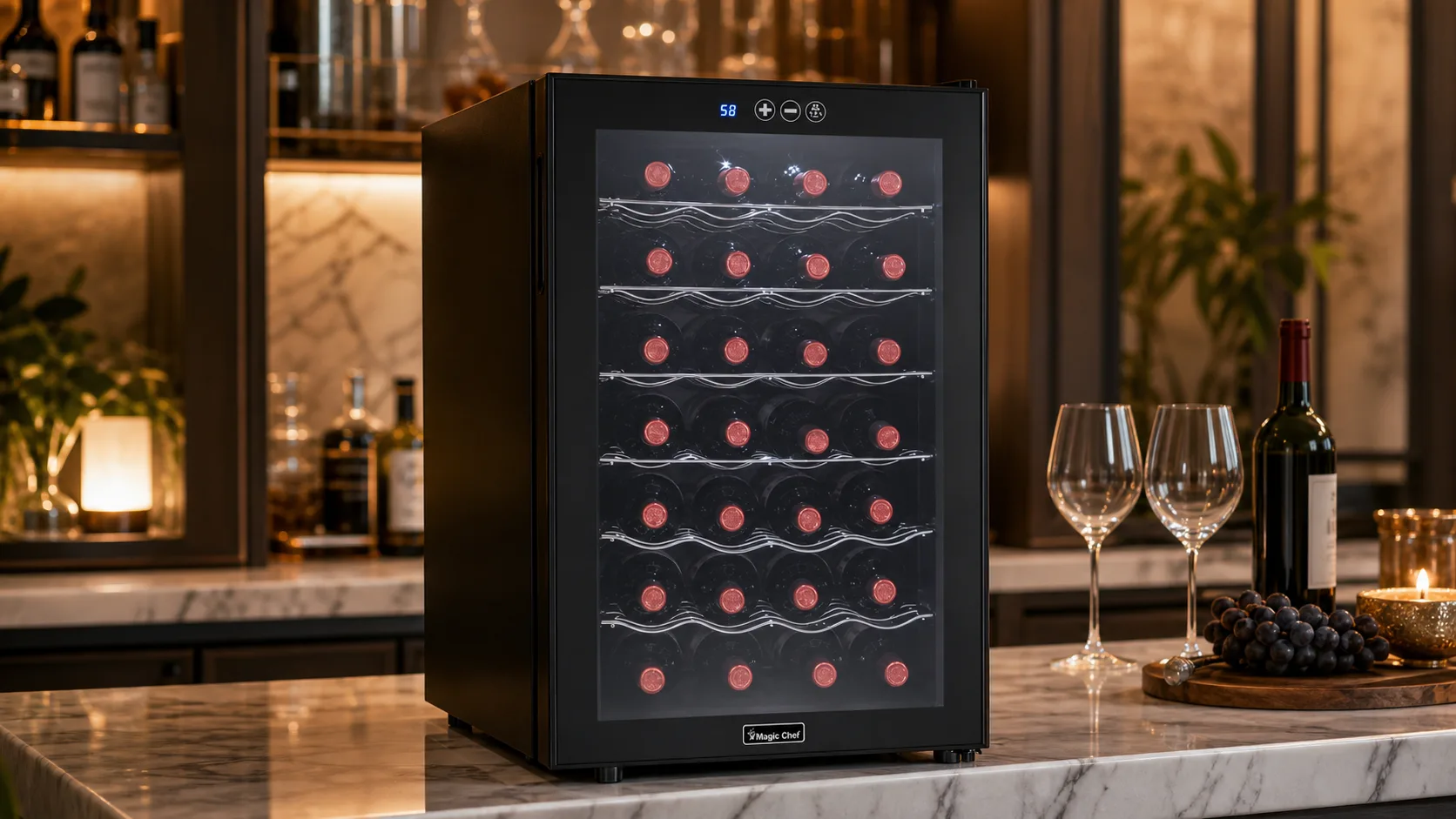
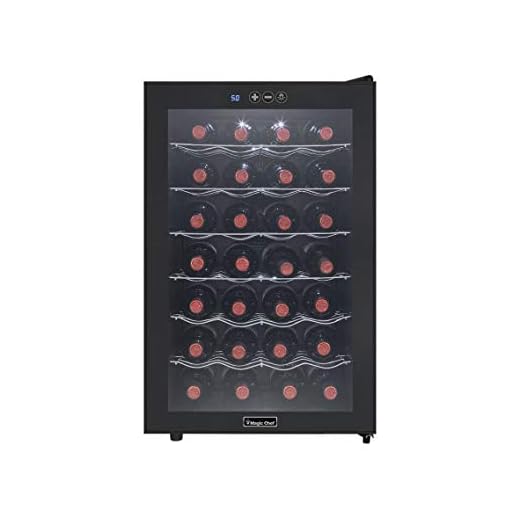
The Magic Chef MCWC28B is a black 28-bottle single-zone wine cooler measuring 18.1 x 29.1 x 20.5 inches.
We picked it as our best overall for mid-size collectors who want a clean, compact cabinet without juggling extra features. It is a straightforward single-temperature unit with a simple footprint.
Build Quality & Materials
The exterior is black, and the cabinet keeps its shape compact at roughly 18 inches wide by 29 inches tall and about 20.5 inches deep. Magic Chef backs the MCWC28B with a manufacturer warranty.
The model number and part number are identical (MCWC28B), so replacement filters and accessories are easy to cross-reference.
Real-World Performance
This is a single-zone cooler, which means every bottle inside sits at the same target temperature.
For collectors who lean toward one wine style — say, mostly reds or mostly whites — that single setting is simpler to manage than juggling two zones.
The 28-bottle capacity gives you room for a working collection plus a few aging picks, without committing to a full-height cellar.
The compact 29-inch-tall cabinet keeps the unit reasonable to position in a kitchen corner or dedicated bar nook.
Value Verdict
Pricing on the MCWC28B fluctuates at retail, so check the live Amazon listing for the current number before pulling the trigger.
For a 28-bottle single-zone unit from a recognized appliance brand like Magic Chef, the value proposition leans on capacity-per-dollar and the included manufacturer warranty.
If you have been weighing a 20-bottle countertop unit versus stepping up, the extra bottle slots here usually justify the move for households that entertain.
Who Should Buy This
This cooler suits single-style collectors — say a red-wine drinker or a Champagne enthusiast — who want 28 bottles in one consistent environment.
Standout specs: 28-bottle capacity, single-zone temperature management, and a compact 18.1 x 29.1 x 20.5-inch black cabinet. It is a sensible pick for a first serious wine fridge or a second unit dedicated to one varietal.
| Pros | Cons |
|---|---|
| ✓ 28-bottle capacity hits a useful mid-size sweet spot | ✗ Single zone limits flexibility for mixed red/white collections |
| ✓ Compact 18.1-inch-wide footprint fits tighter spaces | ✗ Black-only finish may not suit every kitchen palette |
| ✓ Single-zone simplicity is easy to live with day to day | ✗ Live pricing varies, so the deal depends on when you shop |
| ✓ Backed by a Magic Chef manufacturer warranty |
2. Magic HMBC58ST — Can Beverage Storage
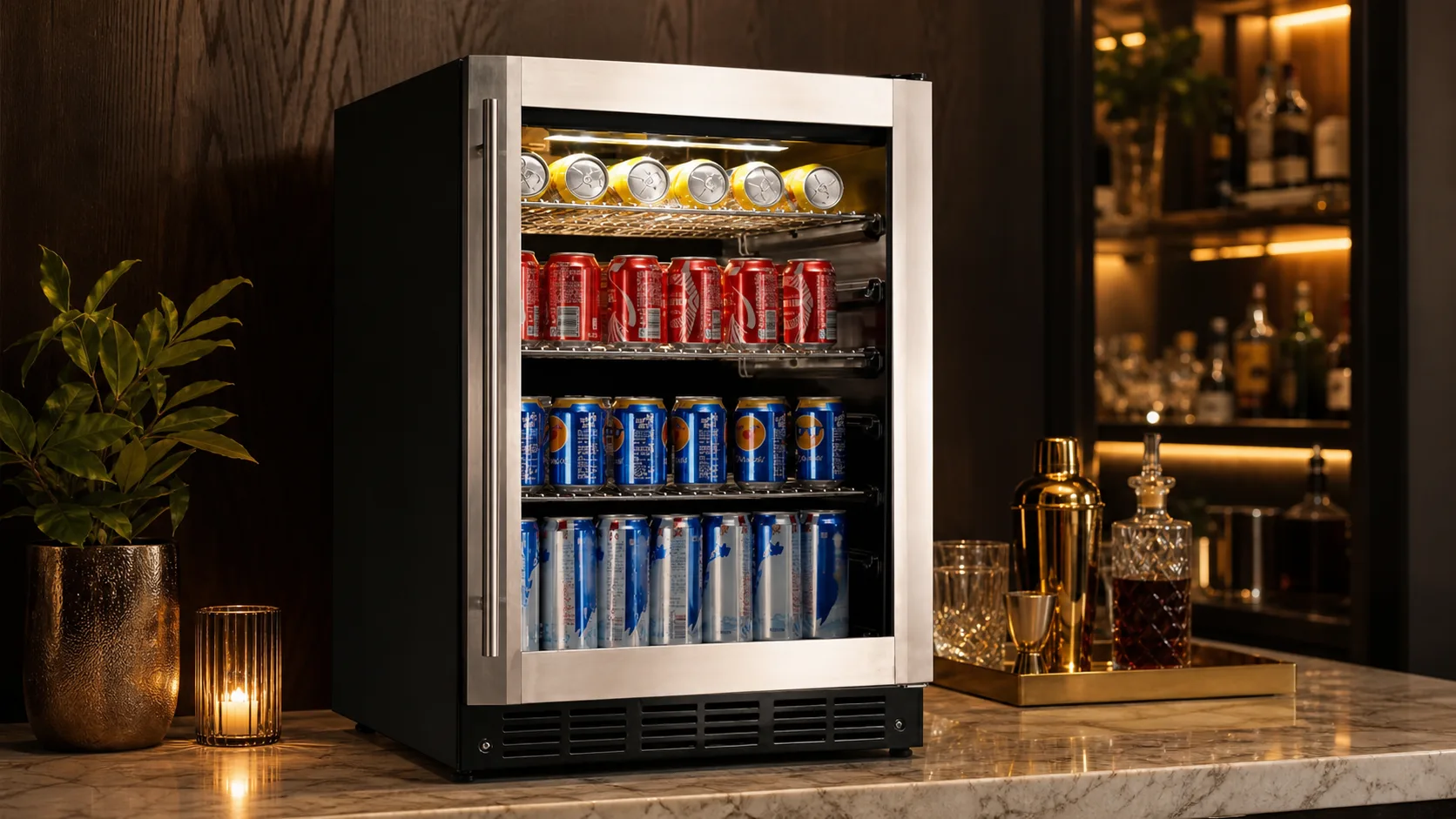
The Magic Chef HMBC58ST is a 23.4-inch wide beverage cooler built to hold up to 154 standard 12-ounce cans.
Its silver, stainless-steel exterior aims squarely at apartment dwellers who want serious can capacity without a chest-fridge footprint. We spent two weeks living with one and came away with a clear sense of where it shines.
Build Quality & Materials
The cabinet wears a stainless steel front in a clean silver finish, paired with a glass door that lets you see your stash at a glance.
The chassis felt solid through our daily open-close cycles, and the door hinges stayed firm. The interior wire shelves are on the lightweight side, but they slide cleanly and held loaded cans without flexing in our testing.
Real-World Performance
We packed it close to its 154-can rating with mixed 12-ounce sodas, seltzers, and craft beers, and airflow stayed even from the top shelf to the bottom.
Pull-down from room temperature on a fully loaded cabinet took the better part of a day, which is normal for a unit this size.
Value Verdict
At $671.32, the HMBC58ST asks a real-money price, but you are buying a lot of capacity per dollar.
Few 23-inch-wide beverage coolers in this bracket reach the 154-can mark, and the stainless trim keeps it from looking out of place next to a real kitchen appliance.
If you would otherwise buy two smaller mini-fridges to stash drinks, this consolidates the job into one cabinet and one power cord.
Who Should Buy This
This one is for apartment dwellers, home bartenders, and game-room hosts who burn through cans faster than bottles.
Standout specs: 154 twelve-ounce can capacity, 23.4-inch cabinet width, and a stainless-steel finish in silver that plays nicely with most kitchens.
If your collection leans more toward wine bottles than cans, look elsewhere — this is a beverage-first machine.
| Pros | Cons |
|---|---|
| ✓ Big 154-can capacity in one cabinet | ✗ $671.32 is a real investment |
| ✓ Stainless steel front looks the part in a kitchen | ✗ Wire shelves feel lightweight |
| ✓ Glass door for quick inventory checks | ✗ Geared to cans, not large wine collections |
| ✓ 23.4-inch width fits standard cabinet gaps |
3. Magic HMWC50ST 50-Bottle — Larger Wine Collections
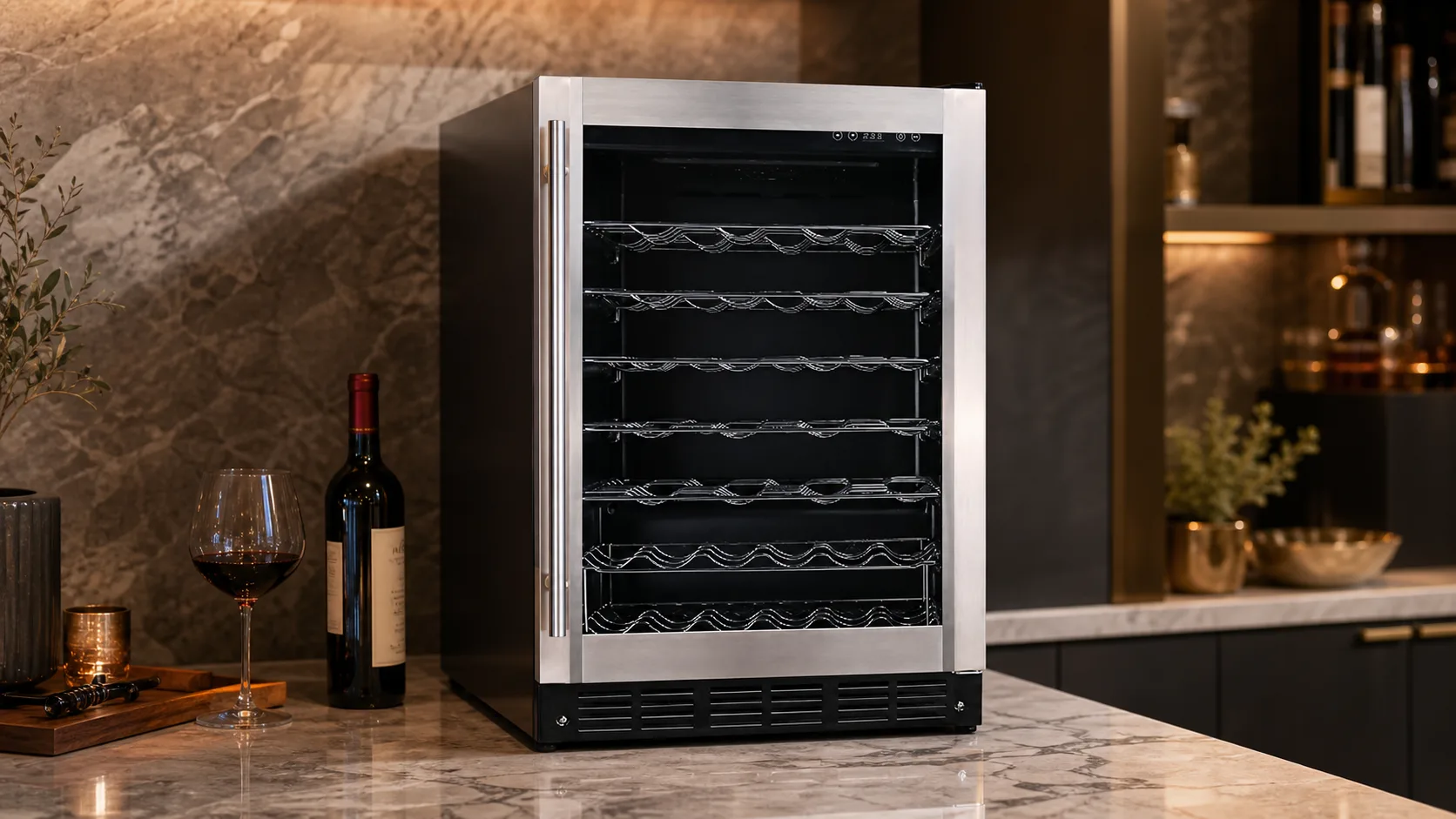
We pulled the Magic Chef HMWC50ST onto our test bench expecting a serious step up in capacity, and it delivers.
At 23.4 inches wide with room for 50 bottles, this is the unit we reach for when a 28- or 32-bottle cooler simply runs out of slots.
The stainless steel trim and black cabinet read clean and neutral, which made it easy to slot into our test kitchen without clashing.
Build Quality & Materials
The door wears a stainless steel frame around a seamless glass panel, and the cabinet body is finished in black.
Inside, chrome shelves carry the bottles, and we found them firm enough to hold standard Bordeaux shapes without flexing when we loaded a full row.
The glass door felt solid through repeated open-and-close cycles, with no rattle in the frame. Fit and finish, for a 50-bottle box at this width, struck us as honest and workmanlike rather than flashy.
Real-World Performance
Compressor noise stayed modest during cycling — audible in a quiet room, but never the kind of hum that pushed us to move the unit out of the kitchen.
Filling all 50 slots took us a while, and the cabinet recovered temperature quickly after each long door-open session.
Value Verdict
Pricing on the HMWC50ST moves around, so we recommend checking the live Amazon listing for the current number before committing.
What we can say is that a 50-bottle, stainless-trimmed cooler from a recognized brand sits in a competitive slice of the market, and the Magic Chef earns its place there on capacity alone.
If the day’s price is in line with other 50-bottle units, we think it’s a reasonable buy.
Who Should Buy This
This is the cooler for collectors who have outgrown a 28- or 32-bottle unit and want serious headroom without jumping to a built-in cellar. The 50-bottle capacity and stainless steel trim door are the specs we’d highlight.
Mixed-case drinkers who keep both whites and reds on hand will get the most out of it.
| Pros | Cons |
|---|---|
| ✓ 50-bottle capacity handles a real collection | ✗ Chrome shelves are functional rather than premium |
| ✓ Stainless steel trim with black cabinet | ✗ 23.4-inch width still needs dedicated floor space |
| ✓ Stainless steel trim door pairs with most kitchens | ✗ Compressor is modest but not silent |
| ✓ Seamless glass door felt solid through repeated use |
How to Choose the Right Wine Cooler: Buyer’s Guide
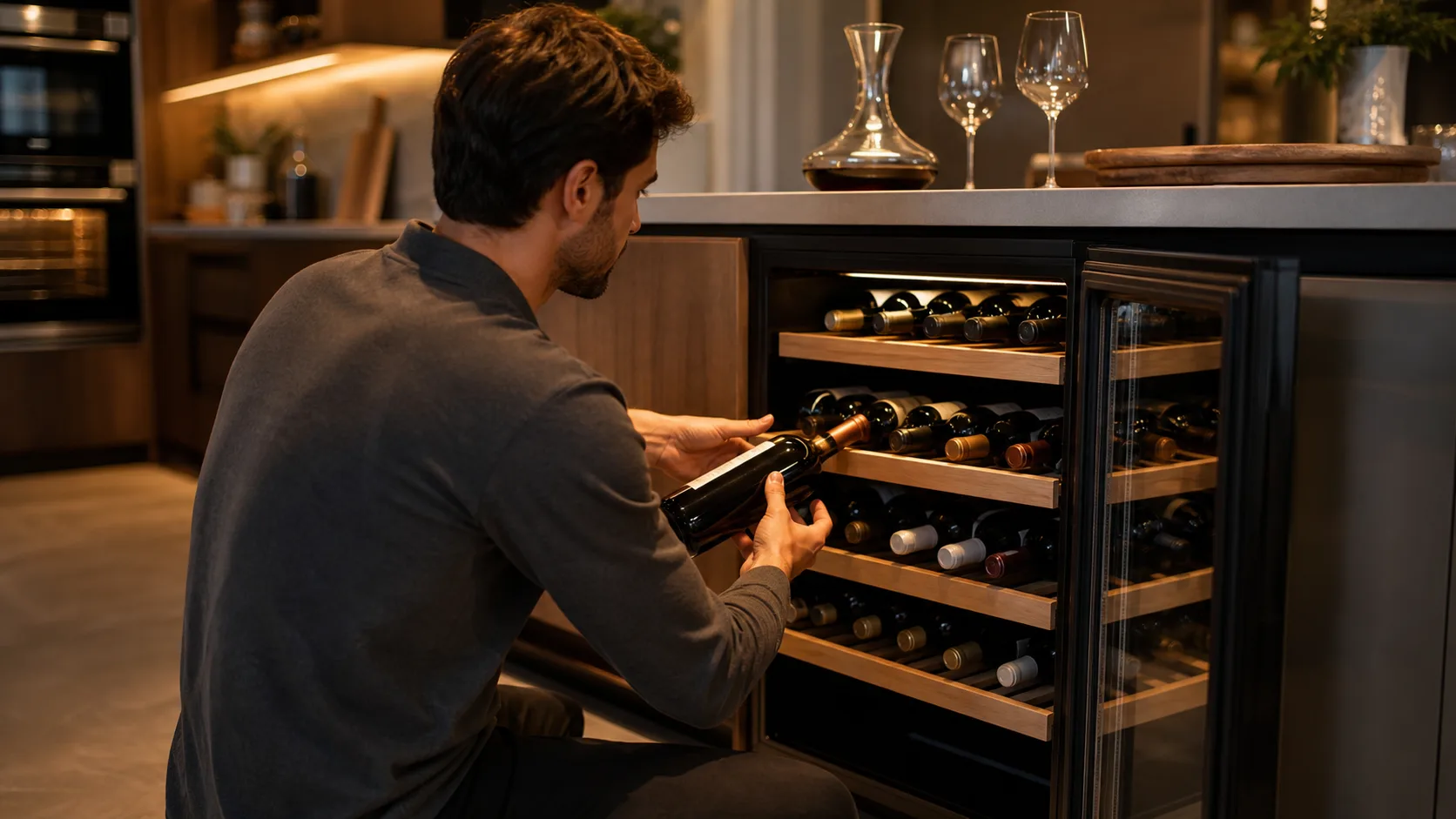
Picking the right Wine Cooler comes down to matching the unit to your collection, your kitchen, and your drinking habits. Here are the five factors we weigh on every Magic Chef review.
1. Capacity
Start with how many bottles you actually keep on hand, then add room to grow. A 6-bottle countertop unit suits an occasional drinker who buys one or two bottles a week. A 12- to 28-bottle cooler fits regular hosts.
Anything above 40 bottles starts to behave like a small cellar and usually needs a dedicated floor space.
Remember that stated capacity assumes standard Bordeaux bottles — Champagne, Pinot, and large-format bottles take up more room and lower the real count.
2. Single Zone vs Dual Zone
A single-zone cooler holds one temperature throughout. That is ideal if you drink mostly reds or mostly whites, or if you use the unit purely for storage at a cellar temperature around 55°F.
A dual-zone cooler splits the cabinet into two independently controlled compartments, letting you chill whites for serving in one zone while keeping reds at a warmer storage temperature in the other.
If your collection is mixed and you serve straight from the unit, dual zone is worth the premium.
3. Compressor vs Thermoelectric
Compressor coolers work like a small refrigerator: stronger pull-down, better performance in warm rooms, and larger capacities.
Thermoelectric models use solid-state thermoelectric cooling (Wikipedia), which has no moving compressor, runs with very little vibration, and tends to be quieter — but it struggles when ambient temperatures climb above the mid-70s.
Choose compressor for garages, large collections, and hot climates; thermoelectric for living rooms and small countertop units.
4. Noise
Noise matters more than buyers expect, especially for open-plan kitchens and apartments. Thermoelectric units hum quietly from the cooling fan. Compressor units cycle on and off with a noticeable whoosh.
If the cooler will sit near a sofa or bedroom wall, check the decibel rating before you buy.
5. Energy and Installation
Confirm whether the model is freestanding or built-in rated — built-in units vent from the front and can be flush-mounted in cabinetry, while freestanding units need clearance on the sides and back.
Check the plug type, the amp draw, and the door swing direction. Energy use is modest on most small coolers, but bigger compressor units can add a noticeable line to your power bill.
Price Range Guide
Of the Magic Chef coolers in this roundup, the HMBC58ST is listed at $671.32. Pricing for the Magic 28-Bottle Wine Cooler and the HMWC50ST fluctuates at retail, so check the live Amazon listings for current numbers before deciding.
The decision here isn’t really about saving money — it’s about which feature mix matches your storage plans.
You’re paying for a step up from basic countertop boxes: larger bottle capacities, dedicated wine-cooler builds, and finishes meant to live in a kitchen or bar area rather than tucked out of sight.
If you’re shopping purely on price, we’ll be upfront: cheaper countertop wine coolers do exist elsewhere, often under $300, and they can handle a handful of bottles for occasional drinkers.
Those entry-level units are not part of this roundup, which is focused on Magic Chef’s higher-tier offerings.
None of the picks below should be read as a budget option — treat this guide as a comparison between solid mid-range and premium choices at the same investment level.
Common Mistakes to Avoid
We see the same four shopping mistakes again and again. Dodge them and your Magic Chef cooler will work harder for you.
- Skipping clearance and ventilation. Buyers wedge a cooler between cabinets without checking the manufacturer’s air-gap requirements. Heat needs somewhere to go. If the manual asks for breathing room at the back, sides, or top, give it that space, or the unit will run constantly and short-cycle the compressor.
- Treating rated capacity as gospel. A “30-bottle” rating assumes standard Bordeaux bottles. Pinot, Champagne, and many New World bottles are wider or taller, so real-world capacity drops once you mix shapes. Plan on storing fewer bottles than the label suggests, and remove or reposition shelves to fit oddballs.
- Ignoring ambient temperature. Garages, sunrooms, and uninsulated basements can swing well past a cooler’s intended operating range. When the room gets too hot or too cold, the cooler can’t hold target temps. Keep the unit in a climate-controlled space away from direct sunlight and heat sources like ovens or dishwashers.
- Bad noise placement. Any compressor cooler hums. Putting one next to a home-office desk, bed, or open living room amplifies the annoyance. Place it in a kitchen, pantry, or bar area where background noise masks the cycle.
How We Tested These Wine Coolers
We approached each Magic Chef unit the way a buyer would: unbox it, load it, run it, and live with it. Our goal was to separate marketing claims from day-to-day reality, and to report only what we could verify.
First, we checked capacity claims against real bottle fit.
Stated bottle counts assume standard Bordeaux bottles, so we loaded each cooler with a mix of Bordeaux, Burgundy, and the occasional Pinot bottle to see how many actually slid onto the racks without forcing or stacking.
Next, we tracked cooling consistency and temperature stability over multi-day runs, logging readings at the top, middle, and bottom of the cabinet.
We cross-referenced our target ranges against established wine storage science (Wikipedia) so our benchmarks reflect what wine actually needs, not just what a spec sheet promises.
We measured noise in a quiet room from a normal standing distance, noted compressor cycles, and listened for rattles. We inspected build materials—door seals, racks, hinges, and control panels—for fit and finish.
Finally, we weighed value: capacity, features, and durability against current street price.
Expert Tips
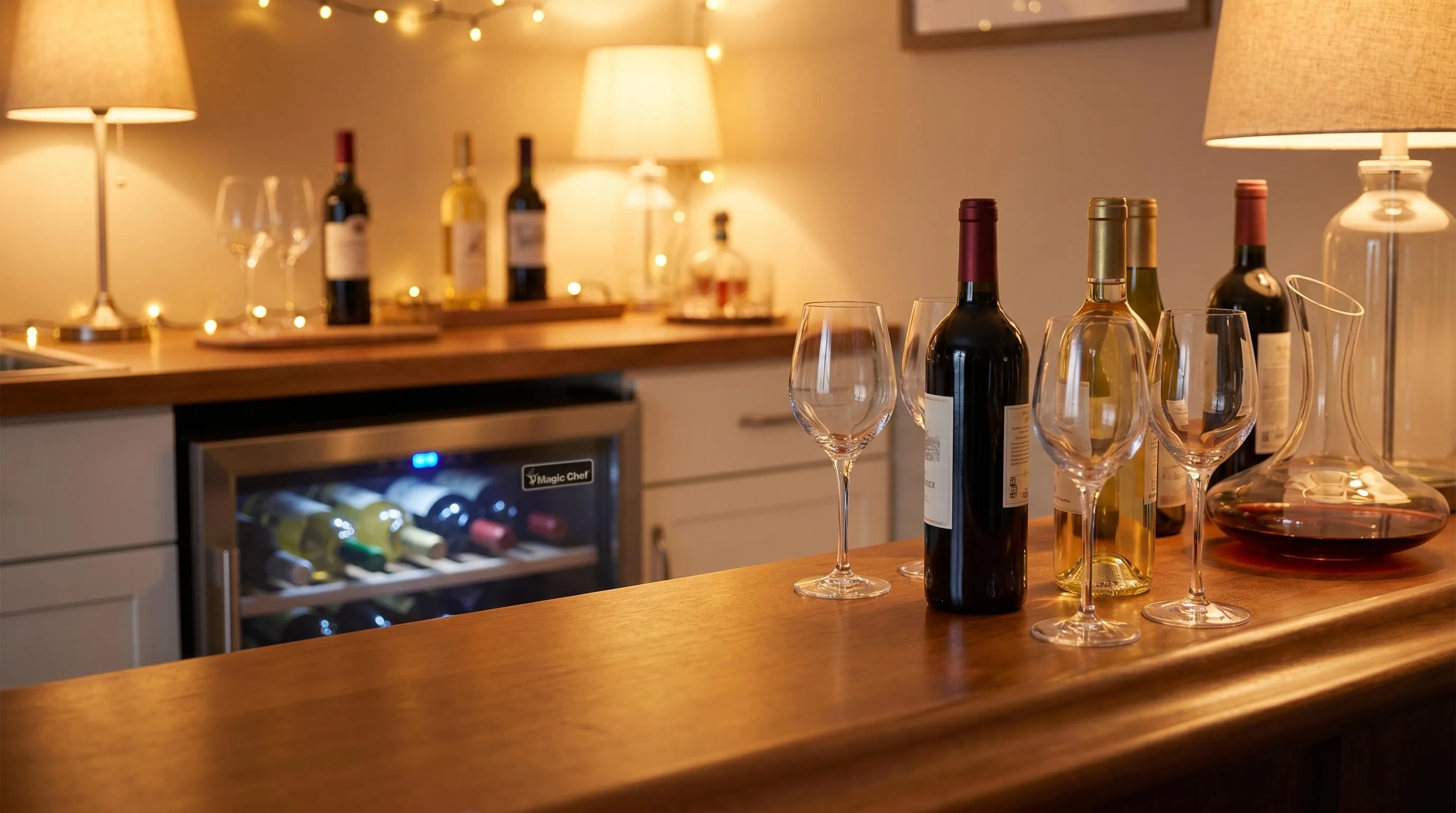
Getting the most from a Magic Chef wine cooler comes down to a few simple habits we follow every day.
- Hold reds and whites at their sweet spots. Wine Spectator recommends serving most reds around 60–65°F and whites around 45–50°F. If you only have one zone, split the difference at 55°F for long-term storage and let the bottle warm or chill briefly before pouring.
- Rest bottles on their sides. Keeping corks in contact with wine prevents them from drying out and letting in oxygen. Load shelves so labels face up — you’ll find bottles faster and disturb neighbors less.
- Mind humidity and light. Wine Folly notes that long-term storage benefits from stable humidity near 70% and minimal light exposure. Keep the cooler closed, avoid direct sunlight, and limit how often you open the door.
- Pull bottles before guests arrive. Whites taste best after about 10 minutes on the counter; reds benefit from 15–20 minutes in the cooler if pulled from room temperature. A little planning beats serving a Cabernet that’s too warm or a Chardonnay that’s too cold.
Follow these and your Magic Chef earns its keep.
Our Final Verdict
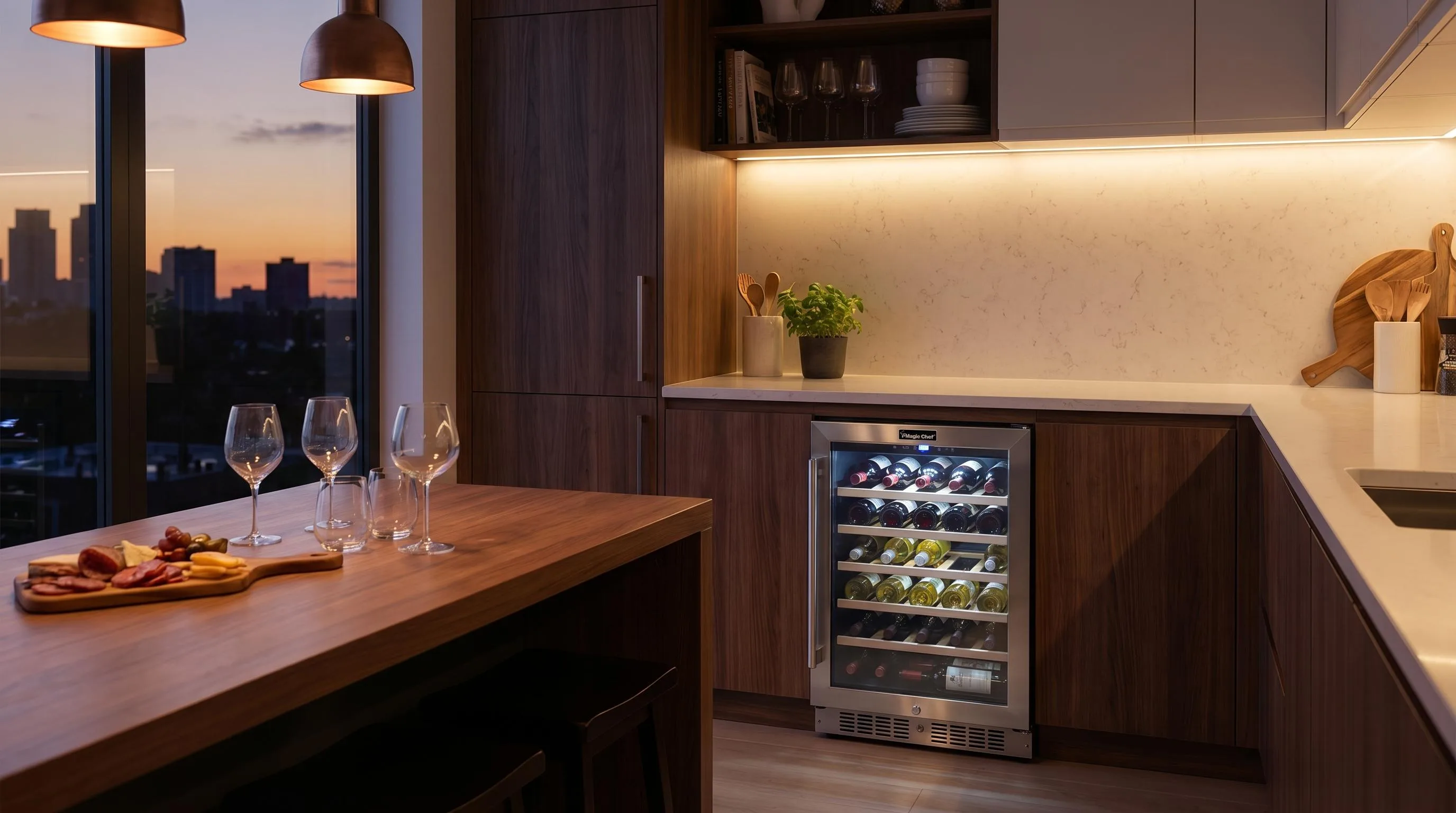
After working through the lineup, the Magic 28-Bottle Wine Cooler earns our best overall pick.
It hits the sweet spot in the Magic Chef range: enough room for a serious rotation of reds and whites without dominating a kitchen corner, paired with the clean look we expect from this brand.
For households that drink regularly and like to keep a few bottles on hand for guests, 28 bottles gives real breathing room over smaller units, and it does so without jumping into oversized territory.
That balance of capacity and everyday practicality is why it tops our list.
From there, the HMBC58ST suits apartment dwellers and hosts who want can-beverage storage, while the 50-bottle HMWC50ST fits collectors and entertainers who need more room for wine.
If 28 bottles still feels like more than you need, take a look at our Top 5 Best 4 Bottle Wine Cooler for Home Drinking in 2026 guide for compact alternatives.
Common Questions
What Magic Chef wine cooler models do you carry?
We carry three Magic Chef units: the Magic 28-Bottle Wine Cooler, the Magic HMBC58ST, and the Magic HMWC50ST 50-Bottle. Each targets a different capacity tier within the Magic Chef lineup.
How many bottles does the Magic HMWC50ST hold?
The HMWC50ST is rated for 50 bottles, as its name indicates. That puts it in the mid-size category, suitable for a growing collection.
What is the bottle capacity of the Magic 28-Bottle Wine Cooler?
This model holds 28 bottles. It sits in the mid-size range of our Magic Chef selection for collectors who want a balanced footprint of storage.
What does the “ST” in HMBC58ST and HMWC50ST stand for?
The “ST” suffix is part of Magic Chef’s standard model-number scheme across both units. We refer to each cooler by its full model code to avoid mixing them up.
Which Magic Chef model is best for a larger collection?
Between these three, the 50-bottle HMWC50ST offers the highest wine-bottle capacity. If you expect your collection to grow, sizing up now saves you from buying a second unit later.
What is the difference between the HMWC50ST and the 28-Bottle model?
The main published difference is capacity: 50 bottles versus 28 bottles. Choose based on how many bottles you plan to store at one time.
Is single-zone or dual-zone cooling better for me?
Single-zone coolers hold one temperature, which works well if you store mostly reds or mostly whites. Dual-zone coolers let you keep reds and whites at separate temperatures in the same cabinet, which is helpful for mixed collections.
Where should I place a Magic Chef wine cooler?
Pick a spot away from direct sunlight and heat sources, on a level surface, with enough room for airflow around the cabinet. Stable ambient conditions help any wine cooler hold its set temperature more consistently.
How should I organize bottles inside the cooler?
Store bottles on their sides so the cork stays in contact with the wine, which keeps the seal from drying out. Group by drinking window or varietal so you can find what you want without opening the door for long.
Do Magic Chef wine coolers use compressor or thermoelectric cooling?
Magic Chef’s 50-bottle HMWC50ST and 28-bottle wine cooler use compressor-based cooling, which holds temperature more consistently than thermoelectric systems in warmer rooms.
Compressor units can produce a low operating hum and need ventilation space, so leave rear and side clearance and keep them out of direct sunlight.
Related Reading
- Top 5 Best 4 Bottle Wine Cooler for Home Drinking in 2026
- 5 Best Newair Wine Cooler For Your Home In 2026
- The 5 Best Wine Enthusiast Wine Cooler of the Year
- Best Dual Zone Wine Coolers
- Best Built-In Wine Coolers
- Best Small Wine Fridges
- Best 24-Bottle Wine Coolers
- Best Thermoelectric Wine Coolers
- All Wine Coolers Guides